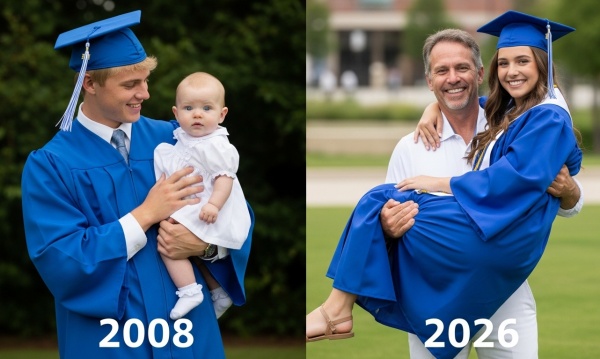
“My Dad Raised Me Alone After My Birth Mother Left Me in His Bike Basket at 3 Months Old – Then She Showed Up at My Graduation with a Shocking Secret”
My dad was just seventeen years old when he found me abandoned in his bike basket outside his house—a tiny three-month-old baby with a note that said, “She’s yours. I can’t do this.” He skipped college, worked two jobs, and raised me alone for eighteen years.
He burned grilled cheese sandwiches, learned to braid my hair from YouTube tutorials, and made sure I never felt unwanted. But on my graduation day, a woman stood up in the crowd and said something that shattered everything I thought I knew about the man who raised me. What she revealed that day changed our lives forever—and forced me to make an impossible choice.
PART 1: The Photo That Tells Our Story
The most important photograph in our house hangs above the fireplace in our living room in Denver, Colorado, and it’s been there for eighteen years. The glass frame has a small crack running through the bottom corner—a souvenir from when I accidentally kicked a soccer ball into it during a particularly aggressive game of indoor football when I was eight years old.
My dad looked at the broken glass, sighed, and said something I’ll never forget: “Well, I survived raising you this long. I can survive a broken frame.” He never bothered to fix it. He said the crack was a reminder that life doesn’t have to be perfect to be beautiful.
In the photograph, a terrified seventeen-year-old boy stands on a football field wearing a graduation cap that sits slightly crooked on his head. His arms are trembling as he holds a tiny infant wrapped in a pale blue blanket. The baby—me—is sleeping peacefully, completely unaware of the chaos that had brought us to that moment.
My dad looks absolutely petrified, like he’s holding the most fragile thing in the world and he’s convinced that even breathing might cause me to shatter into a thousand pieces. His eyes are wide with a mixture of terror and wonder, and his jaw is clenched so tightly you could bounce a quarter off it.
I used to tease him about that photograph all the time. “Dad,” I’d say, pointing at his expression, “you look like you’re about to pass out. Your face is literally the color of milk. If I had sneezed even once, you would’ve dropped me out of pure panic.”
He’d laugh and shake his head, and then he’d do that little shrug he does whenever he’s trying to avoid getting emotional. “I would never have dropped you,” he’d say quietly. “I was just nervous. I thought I was going to break you somehow. But apparently, I did okay.” He did more than okay. He did everything.
PART 2: The Night Everything Changed
My dad was seventeen years old on the night that changed his entire life. He’d been working a late shift at Mario’s Pizza Parlor on Colfax Avenue, delivering pepperoni and sausage pizzas to houses across the Denver metro area. His feet were aching, his shoulders were sore from carrying the heavy insulated delivery bags, and all he wanted to do was collapse into bed.
When he pulled up to the small house on Maple Street where he was living with his uncle—a man who barely acknowledged his existence except to complain about his grades or the dishes he’d left in the sink—he noticed something odd.
His old mountain bike, the one with the rusty chain and the slightly bent front wheel, was leaning against the fence. That wasn’t unusual. What was unusual was the bundle of blankets tucked into the basket on the front of the bike. At first, my dad thought someone had dumped trash there—old clothes, maybe, or garbage that had blown into the yard.
He was too tired to investigate. But then the bundle moved. It shifted slightly, and my dad’s heart jumped into his throat. He walked over slowly, his mind racing through possibilities, and carefully pulled back the edge of the blanket.
Underneath was a baby girl, approximately three months old, with red cheeks and an angry expression on her tiny face. She was crying—not the soft whimper of a tired infant, but the full-throated wail of a baby who was furious at the world. Tucked into the folds of the blanket was a note written on the back of a pizza receipt.
It said simply: “She’s yours. I can’t do this.” That was all. No name, no explanation, no contact information. Just those eight words that would redirect the entire trajectory of my dad’s life.
My dad said later that he didn’t know who to call first. His mother had died when he was twelve—a car accident on I-25 that he still didn’t like to talk about. His father had abandoned the family years before that, leaving my dad’s mother to raise him alone until she couldn’t anymore. After her death, he’d been shuffled to his uncle’s house, a man who viewed him as an obligation rather than a family member.
He was seventeen years old, working part-time at a pizza place for minimum wage, living in a house where he wasn’t wanted, with no one to turn to and no idea what to do. Then I started crying. I cried and cried, my tiny fists flailing in the air, my face turning an alarming shade of red. My dad stood there for a moment, completely frozen, and then something shifted inside him. He picked me up carefully, terrified that he might do something wrong, and he held me against his chest. And he never put me down again.
PART 3: The Boy Who Became a Father
The next morning was my dad’s high school graduation. Most seventeen-year-old boys would have panicked. Most would have called the police, reported an abandoned baby, and let the system handle it. Most would have turned me over to social services and said, “This isn’t my responsibility. This isn’t my problem.” But my dad wasn’t most people.
He wrapped me tighter in the blanket, pulled on his graduation cap and gown over his work clothes, and walked into that graduation ceremony carrying both of us. That’s when the photograph was taken—a moment frozen in time that would define the rest of our lives together.
My dad skipped college. He had been accepted to the University of Colorado with a partial scholarship, but he deferred his admission, then deferred it again, and eventually let it expire. Instead, he worked construction during the day—starting at 5 AM, doing backbreaking labor in the Colorado heat and cold—and delivered pizzas at night to earn extra money. He slept in fragments, catching a few hours here and there, always with one ear open in case I cried.
He learned how to braid my hair by watching terrible YouTube tutorials when I started kindergarten, after I came home crying because another girl had asked why my ponytail looked like “a broken broom.” He burned approximately nine hundred grilled cheese sandwiches during my childhood—I kept count—and he never once complained about the burnt edges or the slightly rubbery texture.
He attended every school play, every soccer game, every parent-teacher conference. He helped me with my homework, even when he didn’t understand the material himself. He taught me how to ride a bike, how to throw a baseball, how to stand up for myself when kids were mean. He worked double shifts so he could afford to send me to summer camp.
He saved money for years so he could buy me a used car when I turned sixteen. He did all of this while working construction and delivering pizzas, while living paycheck to paycheck, while never once making me feel like I was a burden or a mistake. Somehow, despite all of it, he made sure I never felt like the kid whose mother had disappeared. He made me feel chosen. He made me feel loved.
PART 4: The Graduation Day Revelation
My own graduation day finally arrived eighteen years after that photograph was taken. I didn’t bring a boyfriend. I didn’t bring my best friend. I brought my dad. We walked together across the same football field where that old photograph had been taken all those years ago. My dad was trying very hard not to cry—I could tell because his jaw was doing that tight, flexing thing he does when he’s trying to hold his emotions together.
I elbowed him lightly and said, “You promised you wouldn’t do that.” He sniffed and said, “I’m not crying. It’s allergies.” I laughed and said, “There is no pollen on a football field.” He replied, “Emotional pollen,” and for just a second, everything felt exactly like it was supposed to. Then everything went wrong.
The ceremony had just started when a woman stood up from the crowd. At first, I didn’t think anything of it. Parents were shifting in their seats, waving at their kids, taking pictures—normal graduation chaos. But she didn’t sit back down. She walked straight toward us, and something about the way her gaze moved over my face made the hair on the back of my neck stand up.
It was like she was seeing something she’d been searching for a very long time. She stopped a few feet away from us, and I could see her hands trembling. “My God,” she whispered, her voice shaking. She stared at my face like she was trying to memorize every feature, every line, every detail. Then she said something that made the entire field go quiet.
“Before you celebrate today,” she said loudly, her voice carrying across the football field, “there’s something you need to know about the man you call ‘father.'” I glanced at my dad. He was looking at the woman in absolute terror, his face going pale. “Dad?” I nudged him, but he didn’t respond. The woman pointed directly at him. “That man is not your father. He stole you from me.” Gasps rippled through the crowd like a wave.
Parents leaned toward each other, whispering. Teachers exchanged confused looks. I glanced from her face to his, trying to understand if this was some kind of joke. It felt impossible, like someone had just told me the sky was brown or that water was dry. The woman took another step closer. “He stole you from me,” she repeated.
My dad seemed to snap out of his shock then. He shook his head firmly. “That’s not true, Liza, and you know it. At least not all of it.” “What?” I said, my voice barely audible. The whispers grew louder around us. Parents leaned toward each other, their phones coming out to record. Teachers exchanged increasingly confused looks.
I wrapped my fingers around my dad’s wrist, my heart pounding so hard I thought it might burst out of my chest. “Dad, what is she talking about? Who is she?” He looked down at me, his lips parting, but before he could speak, the woman cut in. “I’m your mother, and this man has lied to you your entire life!”
PART 5: The Truth and the Choice
My brain felt like it was trying to run in ten different directions at once. My mother was there at my graduation, and everyone was watching us. She grabbed my hand, her fingers cold and desperate. “You belong with me.” Instinctively, I pulled back. My dad put his arm out in front of me, creating a barrier between my mother and me.
“You’re not taking her anywhere,” he said firmly. “You don’t get to decide that,” she snapped. “Will someone tell me what’s going on?” I demanded. “Dad, please!” He looked at me then and hung his head. “I never stole you from her, but she is right about one thing. I’m not your biological father.”
My world tilted. “What? You… lied to me?” My dad swallowed hard. “Liza left you with me. Her boyfriend didn’t want the baby, and she was struggling. She asked me to watch you for one night so she could meet him and talk things over.” He paused, his voice breaking slightly. “She never came back. He disappeared that night too.
I always assumed they ran off together.” “I tried to come back!” Liza cried out, tears streaming down her face. “I did! But by the time I got away from him, you’d already filed for custody. The system said I’d abandoned you. They said I was an unfit mother. I spent years trying to find you!”
Then a voice rose from somewhere in the stands. “I remember them.” Everyone turned. One of the older teachers from the school was walking down the steps toward us. “You graduated here eighteen years ago with a baby in your arms,” she said, gesturing to my dad. Then she nodded at the woman. “And you, Liza, lived next door to him.
You dropped out of school before graduation. You disappeared that summer. Along with your boyfriend.” The murmuring in the stands grew louder as people began to piece together the story. And just like that, the shape of the narrative shifted. It wasn’t a simple story of theft and lies. It was a story of abandonment, survival, and love.
I turned back to my dad. “Why didn’t you tell me?” I asked, my voice small. My dad swallowed hard. “Because I was seventeen. I didn’t know what I was doing, and I didn’t know how anyone could walk away from a baby. And I thought if you believed at least one parent chose to keep you, it might hurt less.” A broken sob escaped me.
I wrapped my arms around my midsection. “And later?” I whispered. “Why didn’t you tell me when I was older?” “After a while, I didn’t know how to tell you something that might make you feel unwanted,” he said quietly. He looked back at me then, and I could see the pain in his eyes. “In my heart, you were mine the moment I carried you through that graduation.”
“Stop this! You’re making me look bad on purpose,” Liza reached for me again, a wild look in her eyes. “But nothing can change the fact that she doesn’t belong to you.” I ducked behind my dad. “Stop this, Liza! You’re scaring her. Why are you even here?” my dad asked. Liza’s eyes widened. For a moment, she looked fearful. Then she turned to face the crowd, her voice rising.
“Help me, please. Don’t let him keep my child from me any longer.” My child. Not my name, not “daughter,” just a claim. Everyone was talking at once now, but nobody moved forward. Liza stood there a moment longer before she finally seemed to realize that nobody was going to help her take me away from my dad.
“But I’m her mother,” she said in a small, broken voice. I stepped sideways and took my dad’s hand firmly. “You gave birth to me, Liza,” I said clearly. “But he’s the one who stayed. He’s the one who loved me and looked after me. He’s the one who braided my hair and burned grilled cheese sandwiches and worked two jobs so I could go to summer camp.
He’s the one who showed up for every single moment of my life. That makes him my father.” Applause broke out in the crowd, starting slowly and then building into a roar. My mother’s face went pale, and that’s when she revealed the true reason she’d come for me that day. “You don’t understand!” Tears streamed down her face. “I’m dying. I have leukemia. The doctors say my best chance is a bone marrow match. You’re the only family I have left.”
The applause stopped instantly. Whispers spread through the stands again. Some people looked angry. One woman muttered loudly enough that I could hear her: “She has no right to ask that.” My mother sank to her knees right there on the grass, in front of everyone, in the middle of my graduation.
“Please,” she begged. “I know I don’t deserve it, but I’m begging you to save my life.” I looked at my dad. He didn’t answer for me. He never did. He just placed a hand on my shoulder. “You don’t owe her anything. But no matter what you decide, I’ll support you.”
Even then, standing in the ruins of the secret he’d carried for eighteen years, he was still making space for me to choose. I realized something important then: everything important I’d learned about life came from him, anyway. I never needed him to tell me what to do because he’d been showing me how to live a good life every single day.
I turned back to my mother. “I’ll get tested,” I said quietly. The crowd murmured again. Liza put her hands over her face. I squeezed my dad’s hand hard. “Not because you’re my mother, but because he raised me to do the right thing, even when it’s hard.” My dad wiped his eyes. He didn’t even try to pretend he wasn’t crying that time.
The principal stepped forward onto the field. “I think, after everything we just witnessed, there’s only one person who should walk this graduate across the stage.” The crowd erupted in applause. I slipped my arm through my dad’s. As we started toward the stage, I leaned closer to him. “You know you’re stuck with me forever, right?” He laughed softly, tears still streaming down his face. “Best decision I ever made.”
