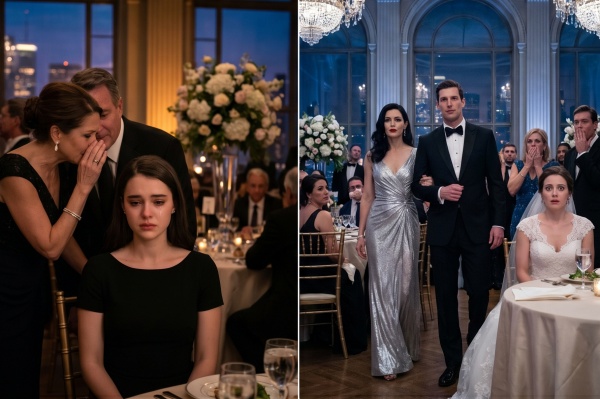
My Fiancé Married My Best Friend on Our Wedding Day—Then I Walked In With the Man His Family Feared
Three months before my wedding, I found my fiancé’s cufflinks beside my best friend’s bed. Instead of apologizing, he married her on the exact day that was supposed to be mine, while everyone laughed at me like I was the punchline. But they didn’t know my name had been used on documents I never signed.
Part 1 — The Wedding That Was Supposed to Be Mine
Three months before my wedding, I found my fiancé’s cufflinks in my best friend’s apartment. Not on her dresser, not tucked in some innocent corner where he could have forgotten them after a group dinner, but beside her bed on a little brass tray where she kept earrings and perfume samples. I stood there holding them in my palm while Chelsea talked from the kitchen about oat milk and bridesmaid shoes. My name was engraved on the inside of one cufflink because I had given them to Preston for our engagement party.
At first, my mind tried to protect me. Maybe he had lent them to her boyfriend, maybe Chelsea had found them in my car, or maybe there was some reasonable explanation that did not involve the two people I trusted most turning my life into a private joke. Then Chelsea walked back into the bedroom, saw my hand, and went completely still. That was the moment I knew.
My name is Madison Hale, though everyone in Charleston called me Maddie. I was thirty-one, a corporate event planner, and the kind of woman people described as “steady” when they really meant useful. I remembered birthdays, handled emergencies, booked venues, smoothed family arguments, and made other people’s chaos look beautiful under soft lighting. Preston Whitmore loved that about me until he decided it made me boring.
Preston came from one of those old Southern families with a name on hospital wings, college plaques, and real estate signs across South Carolina. The Whitmores were not as rich as they pretended to be, but they were rich enough to make pretending look convincing. Preston’s mother, Lillian, wore pearls to breakfast and could insult you so politely it took ten minutes to feel the bruise. When Preston proposed, people acted like I had won something.
A Whitmore man, a family diamond, a church wedding downtown, a honeymoon in Napa, and a house in Mount Pleasant with double porches and gas lanterns by the front door. My own mother cried when I showed her the ring. My father, who ran a small hardware store outside Greenville, shook Preston’s hand and told him to take care of me. Preston promised he would, and for nearly two years, I believed him.
Chelsea Reynolds was supposed to be my maid of honor. She had been my best friend since sophomore year at the University of South Carolina, back when we survived bad dorm coffee, unpaid internships, and heartbreaks that felt enormous until real life showed us bigger ones. She knew my family, my fears, my passwords, and every private detail of my relationship with Preston. She also knew exactly how much it would destroy me.
When I asked her why Preston’s cufflinks were beside her bed, Chelsea started crying before she answered. That used to be her power. She could cry in a way that made people rush to comfort her before asking what she had done. “Maddie,” she whispered, “I never meant for this to happen.”
That sentence should be illegal. I drove straight to Preston’s office afterward, still holding the cufflinks in my fist. He worked for Whitmore Development, the family real estate company, in a glass building near King Street. His assistant looked startled when I walked past her desk, but I did not stop.
Preston was on a call when I entered. He looked annoyed first, then alarmed, and that order mattered. He ended the call and stood, asking what I was doing there. I placed the cufflinks on his desk, and for a long moment, he stared at them like they were evidence in a trial.
Then he sighed. Not cried, not apologized, just sighed. “Chelsea told you?” he asked. I almost laughed from the shock of it and said, “No, Preston. Your cufflinks did.”
He rubbed his forehead and said, “This is not how I wanted you to find out.” The room became very quiet. Beyond the glass wall, people moved through the office carrying coffee, folders, and the harmless routines of a normal Thursday. Inside, my future was being dismantled by a man in a monogrammed shirt.
“How long?” I asked. He looked away, so I asked again. “How long, Preston?” Finally, he said, “Six months.”
Six months meant he had kissed me at Christmas with her lipstick probably still in his memory. It meant she had helped me choose wedding flowers while sleeping with the groom. It meant every brunch, every fitting, every smiling photo had been a performance with me cast as the fool. I told him he needed to call off the wedding.
He blinked. “Let’s not make any rash decisions.” I stared at him because rash was not the word I would have chosen for six months of betrayal. He said weddings were complicated, families were involved, and deposits had been paid. When I repeated, “Deposits are paid,” his face tightened because even he heard how ugly it sounded.
But that was exactly what he meant. He wanted time, not to repair us, but to control the story. By the following week, Charleston society had learned a version where Preston and I had “grown apart,” Chelsea had “unexpectedly become a source of comfort,” and I was “struggling emotionally.” I discovered that betrayal rarely travels alone; it brings public relations.
Lillian Whitmore called me two days after I returned the ring. She did not ask if I was okay. She asked whether I intended to “make a scene.” Her voice carried the chilly elegance of a woman who believed embarrassment was a greater sin than infidelity.
“Maddie,” she said, “you are a lovely girl. But Preston and Chelsea make sense in a way you and Preston never quite did.” I sat on my apartment floor surrounded by unopened wedding gifts and listened to my almost-mother-in-law explain why my replacement was more suitable. “You mean she comes from money,” I said. After a pause, Lillian replied, “I mean she understands our world.”
I looked at the crystal serving bowl on the floor, a gift from one of Preston’s cousins, still wrapped in silver paper. “Your world seems very crowded for a place with so little room for decency,” I said. She hung up without another word. The wedding was canceled, but not the venue.
Two months later, I learned why. Preston and Chelsea were getting married on the same date, at the same church, with nearly the same guest list. The invitations went out in cream envelopes with gold lettering, as if my heartbreak had simply been edited and reprinted. Someone sent me a photo of one with the message, “Can you believe this?”
I could, and that was the problem. On the Saturday that was supposed to be mine, I stayed in my apartment and turned off my phone. I wore sweatpants, ate cereal from the box, and refused to look at the weather because I knew I had chosen that season for the light. At 4:00 p.m., while Preston and Chelsea were probably standing at the altar, my neighbor knocked gently and left banana bread outside my door.
I cried harder over that bread than I had over the ring. By Monday, the photos were everywhere. Chelsea wore the dress silhouette I had once shown her, Preston smiled beneath the church arch where I was supposed to stand, and Lillian held Chelsea’s hand like she had gained the daughter she always deserved. In the comments, people wrote things like, “Everything happens for a reason,” and “So happy they found their true match.”
Then came the video. It was from the reception at the Whitmore family estate on Sullivan’s Island, where someone had recorded Preston’s best man giving a toast. He joked that Preston had “upgraded before the warranty expired,” and the room burst into laughter. I watched it once, and only once.
Something inside me went cold, not because I wanted Preston back, but because I finally understood the size of their disrespect. They had not just betrayed me. They had turned my humiliation into entertainment. That night, I received an email from an address I did not recognize.
The subject line read: You may want to know what they’re hiding. The message contained only one sentence: If you want the truth about Whitmore Development, meet me at the Battery tomorrow at 7:00 a.m. It was signed Alexander Mercer. I knew the name, because everyone in the Whitmore family feared it.
Part 2 — The Man They Warned Me About
Alexander Mercer was not dangerous in the way gossip made him sound. He did not raise his voice, threaten people, or arrive with bodyguards and dark sunglasses like some villain from a cheap movie. He was dangerous because he remembered everything, documented everything, and had enough money to make powerful families answer questions they preferred to bury. That was why the Whitmores hated him.
I met him the next morning near the seawall at the Battery, where the harbor was silver under the early sun and tourists had not yet crowded the sidewalks. He stood beneath a live oak in a charcoal coat, tall, composed, and painfully still. He looked like a man who had learned long ago that silence made other people reveal themselves. “Madison Hale?” he asked.
“Maddie,” I said automatically. He asked whether I preferred Maddie, and I realized no one had asked me that in a long time. Most people simply used whatever version of me felt convenient. “Madison,” I said. “Today, I prefer Madison.”
Alexander nodded once. “Then Madison.” He was forty-two, a private equity investor and attorney who had built Mercer Strategic Holdings out of Atlanta. More importantly, he had been quietly buying distressed real estate debt across the Southeast, including several loans tied to Whitmore Development. In Charleston, people called him ruthless because he did not confuse charm with repayment.
The Whitmores called him a predator. Alexander called himself a creditor. As we walked along the water, he told me his family and the Whitmores had history. Preston’s father had bought Alexander’s mother’s house out from under her after his father died—legally, perhaps, but not ethically.
I said I was sorry, but Alexander only nodded. “Thank you,” he said. “But I did not ask you here for sympathy.” When I asked why he had asked me here, he removed a folded paper from inside his coat. “Because your name appears in a file it should not appear in,” he said.
The paper was a vendor agreement for my canceled wedding, connected to a hospitality subsidiary of Whitmore Development. My signature was at the bottom, but I had never signed it. At first, I thought I was misunderstanding because I had signed plenty of wedding contracts. Flowers, catering, tents, lighting, music, transportation—I could tell the difference between a service charge and a gratuity in my sleep.
But this agreement was different. It made me personally responsible for nearly $86,000 in nonrefundable event expenses routed through a Whitmore-owned company. My hands began to shake as I stared at the signature. “This is not mine,” I said.
“I know,” Alexander replied. When I asked why they would do this, he explained that the wedding had not disappeared; it had become Preston and Chelsea’s wedding. Some deposits had been transferred, some invoices had been rewritten, and some obligations appeared to have been left attached to me. In other words, someone intended to leave me exposed if the vendors pushed collection.
The humiliation turned into something sharper. Forgery was not gossip, and fraud was not society drama. Suddenly, the laughter in that reception video sounded different. Not just cruel, but careless.
I asked how he got the document. He said, “Lawfully,” through a debt review connected to Whitmore Development’s restructuring. His attorneys had found irregularities, and my document had stood out. When I asked why he was telling me, he looked out over the harbor and said, “Because you are not collateral damage to me.”
I did not know what to do with that sentence. For months, everyone around Preston had treated me like an inconvenience to be managed, a woman whose pain was embarrassing because it interrupted the celebration. Even my silence had been used against me. Now this stranger, this man the Whitmores whispered about like a storm on the horizon, was telling me I mattered enough to be warned.
Alexander advised me to hire independent counsel immediately. He gave me the name of a Charleston attorney named Denise Caldwell, a former assistant U.S. attorney who handled civil fraud and business disputes. He made it clear he was not my lawyer and could not advise me personally. That mattered to him.
“I do not want you relying on me blindly,” he said. “That is how people like the Whitmores survive. They teach women to trust the nearest confident man.” I almost smiled and told him he was a confident man. “Yes,” he replied. “Which is why you should verify everything I say.”
So I did. By the end of the week, Denise had confirmed enough to make my stomach twist. My name had been used on documents connected to event expenses, emails suggested Preston’s office knew about the transfers, and Chelsea’s mother had negotiated upgrades after my wedding was canceled. Several invoices still referenced the original Hale-Whitmore account.
Denise’s advice was clear. “We start with preservation letters,” she said. “No public accusations, no Facebook posts, no dramatic comments under wedding photos.” We would document, demand records, and file if necessary. That was when I learned the difference between revenge and legal strategy.
Revenge wants a scene. Legal strategy wants evidence. Still, Charleston noticed when Denise Caldwell’s letters arrived. Preston called me within an hour, which was the first time he had called since marrying my best friend.
I let it go to voicemail. “Maddie,” he said, voice tight, “I don’t know what you think you’re doing, but involving lawyers is unnecessary.” He said that if there were billing issues, we could discuss them like adults. The man who married my maid of honor on my wedding date wanted to discuss maturity.
Chelsea texted next. “Why are you trying to ruin our happiness?” I looked at the message for a long time. Then I replied with the only sentence Denise had approved: “Please direct all communication to my attorney.”
Chelsea sent seven more messages. I did not answer. Two weeks later, I saw Alexander again, this time in Denise’s office. He came with his legal team because the forged document intersected with Whitmore Development’s debt problems.
The conference room smelled like coffee, paper, and old wood polish. I sat across from the man Preston’s family feared and realized he had not come to save me. He had come to tell the truth in a room where truth had consequences. That was better.
During the meeting, Alexander’s attorney explained that Whitmore Development had been overleveraged for years. The family had used reputation to secure extensions, refinancing, and favorable vendor treatment. Their social image mattered because without it, lenders and partners might look too closely at the numbers. My wedding, apparently, had become part of that image.
A grand event, a respected local family alliance, a show of stability. Then Preston switched brides, and the machinery kept moving. I felt sick as the pieces settled into place. When I asked why Chelsea would agree to this, Denise said sometimes people convince themselves that if they get the happy ending, the details do not matter.
Alexander looked at me then. “Details always matter.” Outside the office, he offered to walk me to my car. I almost said no because I did not want to become another woman standing beside a powerful man in someone else’s story. But I was tired, and the parking garage was dim, and his presence felt calm rather than possessive.
At my car, Alexander warned me that they would try to make me look bitter. I told him they already had. He said they would try harder. When I asked what people would say about him, a faint smile crossed his face.
“They have already said everything,” he said. “It did not help them pay their debts.” For the first time in months, I laughed. It surprised both of us. And for once, the sound did not feel like betrayal of my own pain.
Part 3 — The Party They Thought I Would Avoid
Charleston society survives on invitations. Who receives them, who declines, who is seated near the host, and who is quietly left off the list can carry more meaning than any newspaper headline. So when the Whitmore Foundation announced its annual Harbor Lights Gala six weeks after Preston and Chelsea’s wedding, everyone waited to see whether I would attend. I had planned that gala for three years.
I knew the donor tables, the caterer, the auction items, the floral budget, and which board member pretended to be gluten-free only when seated beside his wife. My fingerprints were all over the event, though my name had been removed from the program after the engagement collapsed. Chelsea was now listed as “special events chair.” That was almost funny, but not quite.
Denise advised me not to attend unless I could remain calm. My mother begged me not to go because she feared I would be hurt again. My father said he would drive down from Greenville and stand beside me if I wanted, though he owned exactly one suit and hated valet parking with religious intensity. I told them I needed to go.
Not to scream. Not to confront. Not to steal attention from the charity. I needed to walk into a room where they had turned me into a joke and prove to myself that I still had legs. Two days before the gala, Alexander called.
He said he had received an invitation. I nearly dropped my coffee because I could not imagine why the Whitmore Foundation would invite him. “Because they need money,” he said simply. The foundation’s charity work was real, but like many family foundations, it also functioned as a stage where wealthy people demonstrated virtue under chandeliers.
If Mercer Strategic Holdings appeared as a sponsor, it signaled that the Whitmores were still financially welcome among serious players. I asked if he was going. He said he was considering it, partly to observe and partly because he assumed I might attend. Then he asked if he could accompany me.
I knew what people would say. They would think I brought him to scare the Whitmores. When I said that out loud, Alexander asked, “Did you?” I smiled and admitted, “Maybe a little.”
“Then let’s not lie to ourselves,” he said. On the night of the gala, I wore a navy satin dress I had bought on sale and altered myself. No white, no red, no dramatic revenge gown with a slit up to my hip like a movie scene. Just clean lines, small pearl earrings, and my grandmother’s bracelet.
Alexander arrived in a black car at exactly 6:30 p.m. He wore a tuxedo like he had been born bored by formalwear. When he stepped out and saw me, he did not whistle or stare too long or say something rehearsed. He simply said, “Madison, you look like yourself.”
It was the best compliment anyone had given me in months. The gala was held at the Hibernian Hall downtown, with gas lamps outside and magnolia arrangements framing the entrance. As we walked in, conversation shifted before it stopped. That is how Southern rooms reveal shock: not with silence at first, but with a small adjustment in volume, like someone lowering the temperature.
Then people saw Alexander, and the silence became real. Across the room, Preston turned from a donor conversation and froze. Chelsea stood beside him in a champagne-colored dress, one hand on his arm, smiling at something she had not heard. When she followed his gaze and saw me, her smile cracked.
Then she saw Alexander. Her face went pale. Lillian Whitmore noticed last, near the auction table, speaking with a state senator and holding a glass of white wine. Her eyes moved from my face to Alexander’s, then down to where my hand rested lightly on his arm.
For the first time since I had known her, Lillian looked unsure. Not frightened exactly, but interrupted. Alexander leaned slightly toward me and told me to breathe. I realized I had been holding it.
We crossed the room slowly, not because we were performing, but because formal events require slow movement unless you are fleeing a fire. People greeted Alexander carefully. Men who had mocked him in private shook his hand with both of theirs. Women who had pretended not to see me suddenly smiled like we had always been close.
Preston reached us near the bar. “Maddie,” he said. “Madison,” I corrected. His jaw tightened before he repeated it properly.
Chelsea gave a fragile laugh. “You came.” I told her I was invited. Her eyes flicked to Alexander and she asked, “Together?” Alexander answered before I could: “Yes.”
Preston’s smile sharpened. “Interesting company.” I smiled back and said, “Isn’t it?” For a moment, his old power tried to return. The look, the tone, the private assumption that I would soften because conflict made me uncomfortable.
But something had changed. I was not standing there to be chosen. I had chosen where to stand. Then Lillian approached with the kind of smile that could cut ribbon.
“Mr. Mercer,” she said. “How unexpected.” Alexander replied that the foundation had sent a very gracious invitation. Lillian said they welcomed all supporters of the arts. Alexander nodded and said, “I have always believed institutions reveal themselves most clearly through what they ask others to fund.”
Her smile faltered. I nearly choked on my sparkling water. Chelsea looked between us, irritated that she could not understand the language of people who read contracts before signing them. Preston understood enough, and his eyes hardened.
“Can we speak privately?” Preston asked me. “No,” I said. One word, no explanation, no apology. It landed harder than any speech I could have given.
Preston leaned closer and said this was not the place. I looked around the room at the donors, the orchids, the string quartet, and the silent people pretending not to listen. Then I said, “You married my best friend on my wedding date and let your best man make me a punchline at your reception. You don’t get to decide where dignity belongs.”
Chelsea inhaled sharply. Lillian whispered my name as if warning me back into obedience. I turned to her and asked, “Yes?” She had nothing to say.
That was when Denise Caldwell entered the room. She did not come to make a scene. She came as a ticketed guest, in a black dress, carrying a small clutch and the expression of a woman who had never feared a committee. But Preston saw her, and the color drained from his face.
Alexander noticed too. “Your attorney has excellent timing,” he said. “She bills accordingly,” I replied. By the end of the night, the Whitmores knew the private joke was over. They just did not know how public the consequences would become.
Part 4 — The Truth Costs More Than a Wedding
The lawsuit was filed on a Monday morning. Denise filed claims related to forged signatures, improper billing, and civil fraud against the appropriate parties and business entities. She was careful, precise, and absolutely allergic to exaggeration. The complaint did not call Preston a monster or Chelsea a thief; it simply laid out documents, dates, invoices, and signatures that were not mine.
That made it worse for them. Emotion can be dismissed, but paper is harder to charm. By noon, the local business press had picked it up. By dinner, half of Charleston had read enough to stop using the word bitter around me.
By midnight, Chelsea had deleted most of her wedding photos. Preston called again, and this time I answered only because Denise was sitting beside me and had approved the recording notification required under the circumstances. “You’re destroying my family,” Preston said. I replied, “No. I’m asking why your family used my name.”
He said I knew how these things happened. I told him I knew exactly how signatures happened, and mine did not happen there. His voice lowered as he warned that if this went forward, Chelsea would be dragged into it. Even then, he made her the delicate one.
“You should have thought of Chelsea before letting her enjoy a wedding billed partly under my name,” I said. He insisted she did not know. I said, “Then she can say that under oath.” That ended the call.
The next few months were not glamorous. People imagine legal vindication as a dramatic courtroom scene, but most of it is emails, deadlines, document productions, and bills that make your stomach hurt. Denise worked efficiently, but justice still costs money before it pays anything back. Alexander did not pay my legal fees because I would not let him.
He did, however, provide documents through proper channels when subpoenaed and cooperated with his own counsel in the related debt review. His company’s investigation into Whitmore Development widened. Vendor manipulation, questionable transfers, and inflated valuations began to surface like rot beneath fresh paint. The Whitmore reputation cracked slowly, then all at once.
A regional bank declined to extend a major loan. A hotel redevelopment deal in Savannah collapsed. Two board members resigned from the foundation, citing “personal reasons,” which in Southern business language means the smoke had reached the curtains. Lillian stopped attending luncheons, Chelsea stopped posting, and Preston started looking tired in photographs.
One afternoon, while leaving Denise’s office, I found Chelsea waiting near the parking lot. She wore sunglasses even though the sky was cloudy. For a second, I saw the girl I had known at nineteen, the one who cried over statistics homework and once drove two hours to bring me soup after a breakup. Then I remembered she had worn my almost-wedding day like a borrowed dress.
“We need to talk,” she said. I told her we did not. When she called me Maddie, I corrected her. “Madison,” she said, flinching as if the name itself had become a locked door.
I stopped beside my car but kept my distance. Chelsea said she did not know about the signatures. Maybe that was true, and maybe it was not. The worst thing about betrayal is that it destroys your ability to receive truth cleanly.
“But you knew about Preston,” I said. Tears filled her eyes as she said she loved him. I reminded her that she loved him while helping me plan my wedding. She said she was confused, and I told her confusion was forgetting where you parked, not sleeping with your best friend’s fiancé for six months.
She began crying harder. A year earlier, I would have hugged her automatically. That day, I let her cry. She whispered that she thought if Preston picked her, it meant something.
“It did,” I said. “It meant he was willing to betray someone who trusted him.” Her face crumpled, and I did not enjoy it the way I thought I would. For months, I had imagined this conversation as a victory. But standing there, watching her finally understand the prize she had won, I felt only tired.
I asked if she knew they were laughing at me. She asked if I meant the toast. I said yes. She claimed she did not know he was going to say that, but when I asked why she laughed, she looked down.
That was answer enough. I told her I hoped she told the truth when asked, not for me, but for herself. Then I got into my car and left her standing there. It was the first time I walked away from Chelsea without looking back.
The settlement discussions began in early summer. Whitmore Development wanted confidentiality. Denise wanted accountability, correction of records, payment of damages, and written acknowledgment that I had not authorized the disputed agreements. Alexander’s team wanted separate concessions tied to debt restructuring and governance oversight.
The Whitmores wanted everyone to stop looking. No one did. During mediation, Preston finally sat across from me in a conference room without music, flowers, or applause. He looked thinner, his tie too tight, while Chelsea sat beside him pale and silent.
Lillian sat at the end of the table like a queen forced to attend traffic court. The mediator, a retired judge, spoke gently about resolution, expense, and uncertainty. Then Denise laid out the documents one by one. Signature comparisons, email chains, invoice transfers, and internal notes referencing “keeping Maddie attached until final reconciliation.”
The phrase made my skin crawl. Preston stared at the table. Chelsea covered her mouth. Lillian said the matter was being interpreted unfairly.
The retired judge looked at her over his glasses. “Mrs. Whitmore, I spent thirty-two years on the bench. This is being interpreted generously.” I nearly loved him for that. By the end of the day, we had the framework of a settlement.
I would receive compensation, written correction to vendors and credit agencies, reimbursement of legal costs, and a formal acknowledgment that my signature had been used without authorization. The agreement would not require me to praise anyone, lie for anyone, or pretend the matter was a misunderstanding. Separate from my case, Whitmore Development entered a restructuring process under strict oversight. Alexander’s company did not destroy them; it simply stopped letting them pretend.
When we left the building, reporters waited across the street. Denise told me I did not have to speak. Alexander, who had attended part of the day for the related business matter, stood a few feet away, careful not to crowd me. A reporter called out, “Ms. Hale, do you feel vindicated?”
I thought about the canceled wedding, the laughter, the forged documents, Chelsea crying in a parking lot, and Preston saying we could discuss things like adults only after lawyers arrived. Then I said, “I feel free to move forward.” It was the only headline I could live with. And for the first time in a long time, I meant it.
Part 5 — Walking Back In for Myself
A year after Preston married Chelsea, I attended another wedding. This one was in Savannah, under oak trees dripping with Spanish moss, for a college friend who had loved me before I became a scandal and continued loving me after. There were no society photographers, no political donors, and no one measuring worth by last names. Just music, shrimp and grits, wildflowers, and people who cried when vows were spoken because they still believed promises mattered.
Alexander came with me. By then, people had started calling him my boyfriend, which made us both uncomfortable for different reasons. I did not want anyone thinking I had traded one powerful man for another. He did not want people assuming I needed rescuing.
The truth was quieter. We had become friends first. He sent articles about contract law and terrible jokes about hotel coffee. I sent him photos of Charleston sunsets and once, accidentally, a grocery list that included ice cream, duct tape, and “emotional support crackers.”
He replied that any properly drafted life plan should include all three. He never pushed, and that was how I began to trust him. At the Savannah wedding, he held my hand during the first dance, not as a declaration to the room, but as a question asked gently. I answered by lacing my fingers through his.
Somewhere between the music and the warm Georgia night, I realized I was not afraid of being seen with him. I was afraid of being seen happy. Happiness after humiliation can feel like tempting fate. Later that evening, we walked along the riverfront, where tourists carried plastic cups and riverboats glowed against the dark water.
Alexander bought pralines from a little shop because I said my father loved them. He listened when I talked about rebuilding my business. When I worried aloud that clients would always remember me as the woman from the Whitmore scandal, he stopped walking. “Madison,” he said, “people may remember what happened to you. That does not mean they get to define who you became.”
I looked at him under the streetlights and asked if he practiced saying things like that. “No,” he said. “But I invoice hourly if you want more.” I laughed so hard a couple nearby turned to stare. That laugh felt like proof that something in me had survived.
By fall, my event planning company had more clients than before. Some hired me because they admired my work, and some, I suspected, hired me because they enjoyed the quiet scandal of it. I accepted both kinds of checks and delivered excellent results. My father said that was the most American form of healing he had ever heard of.
Preston and Chelsea lasted fourteen months. I did not celebrate when I heard. Their marriage ended quietly, with a legal separation first and then a divorce filing in Charleston County. Chelsea moved to Charlotte to work for a nonprofit, while Preston left Whitmore Development after the restructuring and took a job with a firm in Texas.
Lillian sold the Sullivan’s Island estate, which surprised everyone. The buyer, through a trust, donated part of the grounds for coastal preservation and converted the main house into a private retreat for nonprofit leadership programs. I only learned later that Alexander had been involved in structuring the deal. He did not tell me because, as he put it, “not every closed door needs a dramatic speech.”
Still, one door remained. The Harbor Lights Gala returned the following spring under new leadership. The Whitmore name was smaller on the invitation. The foundation had reorganized, improved its governance, and added independent board members who did not share a last name.
Denise was invited as an honoree for her pro bono work. So was I. Not as Preston’s former fiancée, not as the woman from the lawsuit, but as the event designer who had helped rebuild the gala after its ugliest year. For a long time, I stared at the invitation on my desk.
Then I called Alexander. “I’m going,” I said. He said he had assumed I would. When I asked if he would come with me, he paused before answering.
“Are you asking because they fear me,” he asked, “or because you want me there?” I smiled. “Both can be true.” He said yes, they could. That night, I walked back into Hibernian Hall beside the man his family had feared.
But everything was different. The first time, I had needed his presence like armor. The second time, I wore my own. I chose a green dress, not because it meant anything, but because I liked the way it moved when I walked.
People turned when we entered. Of course they did, because Charleston does not waste a second chance to witness a story continue. But no one laughed. Lillian was there, older somehow, standing near the entrance with a glass of water instead of wine.
She saw me, then Alexander, and for a moment I thought she might turn away. Instead, she walked toward us. “Madison,” she said. I answered, “Lillian.”
Her eyes flicked down, perhaps searching for weakness, perhaps only memory. “You look well,” she said. I told her I was. She nodded slowly and said, “I hope that is true.”
The conversation could have ended there, but she surprised me again. “What happened was handled badly,” she said. Alexander went very still beside me. I looked at Lillian and repeated, “Handled badly?”
Her mouth tightened. Pride fought with age, and age appeared to be winning. “Done badly,” she corrected. “Done wrongly.” It was not a perfect apology, but perfect apologies mostly exist in movies. I said, “Thank you.”
Across the room, I saw my reflection in one of the tall windows. For a second, I remembered the woman I had been the first time I walked in there with Alexander: hurt, furious, polished together by sheer will. I wanted to reach through the glass and tell her she would not always feel like a wound people were staring at. Then Alexander touched my hand lightly.
“Ready?” he asked. “For what?” I replied. “Whatever comes next,” he said. I looked around the room and realized life, infuriating and generous, had kept going.
The string quartet was playing. Donors were bidding on art. Young volunteers carried trays of crab cakes through conversations about coastal schools and after-school programs. So much had changed, and yet I was still standing.
Halfway through dinner, Denise gave a speech about accountability and community trust. She did not mention my case, and she did not need to. Everyone in the room understood that reputations were not rebuilt by hiding the truth, but by surviving its arrival. At dessert, my father texted me a photo of himself eating the pralines Alexander had sent him.
“Tell that fancy lawyer-investor I approve,” he wrote. I showed Alexander the message. He read it, then looked genuinely nervous for the first time since I had known him. “That sounds serious,” he said.
“It is,” I told him. “My father does not approve lightly.” Alexander asked if he should be afraid. I said, “Terrified.” He smiled, not his public smile, but a real one, quick and warm, gone almost before I could memorize it.
After the gala, we stepped outside into the humid Charleston night. The gas lamps glowed against the old brick, and carriages passed slowly on the street. For once, the city did not feel like a courtroom or a stage. It felt like home again.
“I used to think walking back in with you was the moment they lost,” I said. Alexander looked at me and asked, “And now?” I watched the city lights shimmer against the street and answered honestly. “Now I think walking back in at all was the point.”
He nodded. “That sounds right.” I took a breath and said, “Preston didn’t break my life. He exposed the parts of it that were built around being chosen by people who did not value me.” Alexander did not rush to answer.
That was one of the things I loved about him, though I had not said the word yet. He gave silence room to become honest. Finally, he asked, “And what are you building now?” I looked through the tall windows at the people moving under chandeliers, at Denise laughing with my mother, at donors writing checks for children they would never meet, and at the place where I once thought my humiliation would live forever.
“My own name,” I said. Alexander held out his hand. I took it. A year earlier, everyone had laughed when my ex-fiancé married my best friend on the day that was supposed to belong to me.
They thought the story ended with me humiliated, replaced, and erased from the life I had helped plan. They thought I would disappear because disappearing would make their cruelty easier to celebrate. Instead, I came back. Not to beg, not to scream, not to steal a man or win a room.
I came back with truth, counsel, evidence, and the quiet understanding that dignity does not need applause to be real. And yes, I walked in beside the man his family feared. But I stayed because I was no longer afraid of them.
