Doctors Declared Her Dead at 7:54 PM—But When They Placed Her Newborn Twins on Her Chest, She Opened Her Eyes…
Part 1: The Final Moments
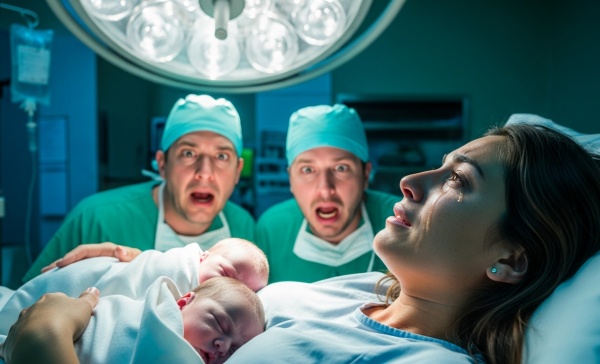
She was declared dead at 7:54 PM. The monitor had already released that long, blood-curdling beep, and the doctor had already announced the time aloud to be recorded in the file. But 11 minutes later, when a nurse defied all logic and placed her two newborn sons on her chest, one on each side, Elena Rogers’ fingers moved. They clung to a small white blanket, and she opened her eyes as if she had returned from a place far too deep and far too distant.
I’m Elena’s sister, and I’m writing this because the world needs to know what happened that night at Mercy General Hospital in Austin, Texas. What the medical community calls “impossible” and what our family calls a miracle. This is the story of how my sister died and came back to life for her sons—a story that still gives me chills every time I think about it.
It started as what should have been a routine twin delivery. Elena was 38 weeks pregnant with identical twin boys, and everything had been going smoothly throughout her pregnancy. She’d had all her checkups, taken her prenatal vitamins religiously, and even kept up with her prenatal yoga classes until week 36. Her doctor, Dr. Patricia Morrison, had assured us that Elena was the picture of health.
That Tuesday evening in March felt like any other spring day in Austin. The temperature was a comfortable 72 degrees, and the bluebonnets were just starting to bloom along the highways. Elena had texted me at 4:30 PM saying she was having contractions about 10 minutes apart. “It’s time,” she wrote, followed by two baby emojis. I was at work at the advertising agency downtown, and I immediately grabbed my keys and headed to the hospital.
By the time I arrived at 5:15 PM, Elena was already in the delivery room. Her husband, Marcus, was holding her hand, and she was breathing through contractions that were now coming every five minutes. She looked tired but excited, her face flushed with anticipation. “I can’t wait to meet them,” she told me, squeezing my hand. Those would be the last coherent words she’d speak for hours.
The delivery started normally enough. Dr. Morrison was calm and confident, the nursing staff was attentive, and Elena was handling the pain like a champion. She’d opted for an epidural, which was administered at 6:00 PM when she was 6 centimeters dilated. Everything was going according to plan, or so we thought.
Part 2: When Everything Went Wrong
At 7:12 PM, Elena was fully dilated and ready to push. The first baby, whom they’d already decided to name Oliver, was in position. Dr. Morrison gave Elena the go-ahead to push with the next contraction. I watched my sister summon every ounce of strength she had, her face turning red with effort.
But then something changed. The monitors started beeping erratically. Elena’s blood pressure, which had been stable at 120/80, suddenly spiked to 180/120. Her heart rate jumped from 85 beats per minute to 145. Dr. Morrison’s calm demeanor shifted instantly to focused concern. “We need to get these babies out now,” she said, her voice sharp and urgent.
What happened next was like watching a nightmare unfold in slow motion. Elena pushed with everything she had, and Oliver was born at 7:18 PM, weighing 5 pounds, 11 ounces. He came out crying, a healthy pink color, perfect in every way. But Elena didn’t get to hold him. The nurses whisked him away to be cleaned and checked while Dr. Morrison focused on delivering the second baby.
That’s when things went from urgent to catastrophic. Elena started seizing. Her whole body convulsed violently on the delivery table, and foam appeared at the corners of her mouth. Marcus screamed her name, but she couldn’t hear him. The medical team sprang into action with a precision that was both impressive and terrifying to witness.
“Eclampsia!” Dr. Morrison shouted. “Get me magnesium sulfate, now!” Nurses rushed around, hooking up new IV lines, adjusting monitors, calling for additional help. The second baby, Sebastian, was still inside, and his heart rate was dropping dangerously low. It had gone from a healthy 140 beats per minute to 90, then 70, then 50.
Dr. Morrison made a split-second decision. “We’re doing an emergency C-section. I need an OR team here in 60 seconds.” But there wasn’t time to move Elena to an operating room. They had to do it right there in the delivery room. I was ushered out into the hallway along with Marcus, both of us in shock, unable to process what was happening.
Through the small window in the door, I could see at least a dozen medical professionals working on my sister. Someone was cutting through her abdomen while someone else was managing her airway because she’d stopped breathing on her own. They’d intubated her, and a respiratory therapist was manually pumping air into her lungs with a bag valve mask.
At 7:31 PM, they pulled Sebastian out. He wasn’t crying. He was blue and limp, and my heart stopped. A neonatal team immediately began working on him, doing chest compressions on his tiny body. Marcus was sobbing beside me, and I was frozen, unable to cry, unable to speak, unable to do anything but watch through that window.
Part 3: The Longest 23 Minutes
Sebastian’s cry finally pierced the air at 7:34 PM—three minutes that felt like three hours. He weighed 5 pounds, 8 ounces, slightly smaller than his brother but fighting just as hard. They rushed both babies to the NICU for observation, but at least they were alive. At least they were breathing.
But Elena wasn’t. Despite the medical team’s best efforts, her condition continued to deteriorate. Her blood pressure had dropped to dangerous levels—60/40, then 50/30. They were pumping her full of medications, doing chest compressions, shocking her heart with the defibrillator. I could hear the charges building—200 joules, then 300, then 360.
Dr. Morrison was shouting orders: “Push another round of epinephrine! Someone check her pupils! How long has she been down?” A nurse responded, “Seven minutes of CPR, doctor. No pulse, no respiratory effort.” The words hit me like physical blows. My sister was dying right in front of me, and there was nothing I could do.
Marcus had collapsed against the wall, sliding down until he was sitting on the floor, his head in his hands. “She can’t die,” he kept repeating. “The boys need her. I need her. She can’t die.” I wanted to comfort him, but I had no comfort to give. I was watching my best friend, my only sister, slip away.
At 7:47 PM, I heard Dr. Morrison say the words that would haunt me: “She’s not responding. We’ve been at this for 13 minutes.” In medical terms, that’s an eternity. Brain damage typically begins after just four to six minutes without oxygen. Even if they brought her back, there was a very real possibility that Elena wouldn’t be Elena anymore.
But they kept trying. They tried for seven more minutes, long past the point where most doctors would have called it. Dr. Morrison later told me she couldn’t stop because she kept thinking about those two babies in the NICU who needed their mother. She kept thinking about Marcus. She kept thinking about the fact that Elena was only 32 years old and had been perfectly healthy just an hour ago.
At 7:54 PM, the monitor released that sound—the long, continuous beep that everyone recognizes from medical dramas but hopes never to hear in real life. It’s the sound of a heart that has stopped beating, of a life that has ended. Dr. Morrison looked at the clock on the wall and said, in a voice heavy with defeat, “Time of death, 7:54 PM.”
The room fell silent except for that terrible beeping. Someone turned off the monitor, and the silence that followed was somehow worse. Nurses began the grim task of cleaning up, removing IV lines, turning off machines. Dr. Morrison pulled off her gloves and walked toward the door where Marcus and I were standing. Her face was drawn, and I could see tears in her eyes.
“I’m so sorry,” she said when she reached us. “We did everything we could. She had a massive cerebral hemorrhage caused by the eclampsia. There was nothing more we could have done.” Marcus let out a sound I’d never heard before—a wail of pure anguish that came from somewhere deep in his soul. I held him while he sobbed, my own tears finally coming.
Part 4: The Impossible Decision
Dr. Morrison gave us a moment, then said gently, “I know this is incredibly difficult, but we need to know about organ donation. And… the babies are stable in the NICU. Would you like to see them?” Marcus couldn’t speak, so I nodded for both of us. But then something occurred to me—something that would change everything.
“Wait,” I said, my voice hoarse. “Can we… can we bring the babies to her first? Before…” I couldn’t finish the sentence. Before they take her away. Before she becomes a body instead of my sister. Before this becomes real and permanent and final.
Dr. Morrison looked surprised, then thoughtful. “That’s… that’s actually not standard procedure, but I don’t see why not. It might give you some closure. Let me check with the NICU team.” She disappeared down the hallway, and Marcus and I stood there in that horrible limbo between life and death, between hope and despair.
Ten minutes later, a NICU nurse named Sarah Chen appeared with a double bassinet. Inside were Oliver and Sebastian, each wrapped in white hospital blankets with blue and pink stripes, wearing tiny knit caps. They were so small, so perfect, so completely unaware that their mother was gone. Oliver was awake, his dark eyes—Elena’s eyes—staring up at nothing in particular. Sebastian was sleeping, his little chest rising and falling with each breath.
“We can take them in for a few minutes,” Sarah said softly. “It’s important for the family to have this time.” She was young, maybe 26 or 27, with kind eyes that had clearly seen too much sadness in her career. She wheeled the bassinet into the delivery room where Elena’s body lay on the table, now covered with a white sheet up to her shoulders.
Marcus and I followed, neither of us sure what we were supposed to do or feel. Sarah carefully picked up Oliver, then Sebastian, and looked at us. “Would you like to hold them near her?” she asked. Marcus shook his head, unable to move, so I stepped forward. Sarah placed Oliver in my left arm and Sebastian in my right, and I carried my nephews to meet their mother for the first and last time.
But then Sarah did something that wasn’t in any medical textbook or hospital protocol. Maybe it was instinct, or maybe it was something else—something she couldn’t explain even later when asked. She took the babies from me and gently placed them directly on Elena’s chest, one on each side, skin to skin. “Sometimes,” she said quietly, “the body knows things we don’t understand.”
Part 5: The Miracle at 8:05 PM
For a moment, nothing happened. The babies lay there on their mother’s chest, Oliver making small mewing sounds, Sebastian still sleeping peacefully. Marcus had moved closer, his hand on Elena’s arm, tears streaming down his face. I was standing at the foot of the bed, watching, waiting for… I don’t know what.
Then, at exactly 8:05 PM—11 minutes after she’d been declared dead—I saw it. Elena’s right index finger moved. Just a tiny twitch, barely perceptible, but I saw it. “Marcus,” I whispered, afraid to speak louder, afraid I was imagining it. “Marcus, look at her hand.”
He looked down just as her fingers moved again, this time more deliberately. They curled around the edge of the white blanket covering Sebastian. Then her left hand moved, reaching for Oliver. Sarah gasped and immediately hit the call button. “I need a doctor in here now!” she shouted, her professional composure cracking. “The patient is moving!”
Dr. Morrison burst through the door, followed by two other doctors and three nurses. “That’s impossible,” she said, but she was already moving toward Elena, checking for a pulse. Her eyes went wide. “I’ve got a pulse. Weak and thready, but it’s there. Get her back on the monitors! Someone get me a crash cart! Move!”
The room exploded into controlled chaos again, but this time it was different. This time there was hope. They reconnected Elena to the heart monitor, and we could all see it—the blip, blip, blip of a heartbeat that shouldn’t exist. Her blood pressure was 70/50, dangerously low but present. She was breathing on her own, shallow breaths but breaths nonetheless.
Elena’s eyes fluttered open. They were unfocused at first, glazed and confused, but they were open. She looked down at the two babies on her chest, and her arms—which had been limp and lifeless minutes ago—wrapped around them protectively. “My babies,” she whispered, her voice barely audible. “My boys.”
Marcus was sobbing again, but this time with joy. “Elena! Oh my God, Elena!” He was touching her face, her hair, her arms, as if he needed to confirm she was real. Dr. Morrison was staring at the monitors in disbelief, shaking her head. “This isn’t possible,” she kept saying. “This simply isn’t possible.”
But it was happening. Right in front of all of us, Elena Rogers was coming back to life. Her heart rate strengthened—60 beats per minute, then 70, then 80. Her blood pressure climbed to 90/60, then 100/70. Color returned to her face, replacing the gray pallor of death with the pink flush of life. She was looking at her babies, really looking at them, tears streaming down her face.
“I heard them,” she said, her voice getting stronger. “I was somewhere else, somewhere dark and cold, and I heard them crying. I heard them, and I knew I had to come back.” She looked up at Marcus, then at me. “I couldn’t leave them. I couldn’t leave you. So I came back.”
The medical team worked quickly to stabilize her. They ran tests—CT scans, MRIs, blood work, everything they could think of. The results were baffling. The cerebral hemorrhage that had killed her was still there, visible on the scans, but it had somehow stopped bleeding. Her brain function was normal. Her vital signs were normalizing by the minute. By all medical logic, she should have been dead, or at the very least, severely brain damaged.
Dr. Morrison called in specialists from across the hospital. Neurologists, cardiologists, intensivists—they all examined Elena and her charts. They all came to the same conclusion: they had no medical explanation for what had happened. One neurologist, Dr. James Patterson, who’d been practicing for 35 years, told us he’d never seen anything like it in his entire career.
“I’ve read about cases like this in medical journals,” he said, “but I never thought I’d witness one. We call it ‘Lazarus syndrome’—spontaneous return of circulation after failed resuscitation. But those cases usually happen within minutes, and the patients rarely have full neurological recovery. Your wife,” he said to Marcus, “was dead for 11 minutes. By all accounts, she should not be alive, and she certainly shouldn’t be neurologically intact. This is… this is extraordinary.”
Elena spent the next week in the ICU under close observation. The hemorrhage in her brain slowly resolved on its own, something the doctors said was “highly unusual but not unheard of.” Her recovery was remarkably fast. Within three days, she was sitting up, talking normally, and asking to see her babies every hour. Within five days, she was walking around her room. Within a week, she was discharged with a clean bill of health.
The twins, Oliver and Sebastian, were also thriving. They’d spent four days in the NICU for observation but had no complications from their traumatic birth. When Elena was finally able to hold them properly, to nurse them and care for them, she cried tears of gratitude. “I fought so hard to come back to them,” she told me. “I was in this dark place, and I could hear them crying, and I just kept thinking, ‘I have to get back to my babies.’ I don’t know how I did it, but I did.”
Sarah Chen, the NICU nurse who had placed the babies on Elena’s chest, became something of a local hero. The hospital administration initially questioned her decision to deviate from protocol, but once Elena’s story got out, they changed their tune. Sarah said she couldn’t explain why she’d done it—it was just a feeling, an instinct that told her it was the right thing to do.
“I’ve been a NICU nurse for five years,” Sarah told me later, “and I’ve learned to trust my instincts. Something told me those babies needed to be with their mother, even if she was gone. I’ve heard stories about skin-to-skin contact doing miraculous things—helping premature babies stabilize, helping mothers produce milk, strengthening the bond between parent and child. I just thought… maybe it could help somehow. I never imagined this would happen.”
The story spread quickly. Local news picked it up first, then regional, then national. Within two weeks, Elena’s story was being covered by major networks. Medical journals requested permission to document her case. Researchers wanted to study her, to understand what had happened. But Elena just wanted to go home with her family and live her life.
Part 6: Life After the Miracle
Three months have passed since that night at Mercy General Hospital. Elena is completely healthy, with no lingering effects from her brush with death. The boys are growing like weeds—Oliver is now 12 pounds, 4 ounces, and Sebastian is 11 pounds, 9 ounces. They’re hitting all their developmental milestones, smiling, cooing, and generally being the most beautiful babies I’ve ever seen (but I’m biased).
Elena says she doesn’t remember much about being “dead.” She remembers the darkness, the cold, and hearing her babies cry. She remembers making a conscious decision to fight her way back. “It wasn’t my time,” she says simply. “My boys needed me, and I wasn’t going to let death take me away from them.”
Marcus has barely let Elena out of his sight since that night. He took three months of paternity leave from his job as a software engineer, and he’s been the most devoted husband and father I’ve ever seen. “I lost her once,” he told me. “I’m never taking a single moment with her for granted again.”
As for me, I’m still processing what I witnessed. I’m a logical person—I work in advertising, I deal in facts and figures and market research. But what I saw that night defies logic. I watched my sister die, and I watched her come back to life. I don’t know if it was a miracle, a medical anomaly, or the sheer force of a mother’s love, but I know what I saw.
Dr. Morrison has stayed in touch with Elena, checking on her regularly even though she’s no longer her patient. “In 20 years of practicing obstetrics,” she told us, “I’ve delivered thousands of babies and seen countless complications. But I’ve never seen anything like this. Elena’s case has reminded me why I went into medicine in the first place—because sometimes, despite everything we know about science and the human body, miracles happen.”
The hospital has since changed its protocols. Now, when a mother passes away during or shortly after childbirth, if the family requests it and the babies are stable, they allow skin-to-skin contact between the infant and the deceased mother. They call it “Elena’s Protocol.” It’s a small change, but it acknowledges that there are things about the human body, about the bond between mother and child, that we don’t fully understand.
Elena has started a blog about her experience, and she’s been contacted by dozens of families who’ve lost loved ones during childbirth. She offers them comfort, hope, and understanding. “I don’t know why I was given a second chance,” she writes, “but I’m going to make the most of it. Every day with my boys, with my husband, with my family—it’s a gift. I died and came back, and I’ll never forget how precious life is.”
People often ask Elena if she’s religious, if she believes God brought her back. She says she’s not sure. “I was raised Catholic, but I wasn’t particularly devout,” she explains. “What happened to me has made me think a lot about faith, about what happens after we die, about whether there’s something bigger than us at work in the universe. I don’t have answers, but I have questions now that I never had before.”
What I know for certain is this: on March 15th, at 7:54 PM, my sister Elena Rogers was declared dead. At 8:05 PM, when her newborn sons were placed on her chest, she came back to life. The doctors call it Lazarus syndrome. The media calls it a miracle. Elena calls it love—the love of a mother who refused to leave her children behind.
I call it the most extraordinary thing I’ve ever witnessed. And every time I hold Oliver and Sebastian, every time I see them smile at their mother, I’m reminded that there are forces in this world more powerful than death itself. Sometimes, love really does conquer all—even the final frontier.
Elena’s story has changed how I view life, death, and everything in between. It’s taught me that we don’t have all the answers, that medicine and science, as advanced as they are, can’t explain everything. It’s taught me that the bond between a mother and her children is stronger than we can possibly imagine. And it’s taught me to never, ever give up hope, even when all seems lost.
Today, Elena is planning the boys’ first birthday party. She’s already bought matching outfits—little suits with bow ties. She’s ordered a cake from the best bakery in Austin, designed a guest list, and decorated their house with blue and silver balloons. She’s doing all the normal things that mothers do, living the life she fought so hard to come back to.
And sometimes, when I watch her with Oliver and Sebastian, I see her pause and hold them a little tighter, kiss them a little longer. I know she’s remembering that night, remembering the darkness, remembering the choice she made to come back. And I know she’s grateful for every single moment she has with them—moments that, by all rights, she should never have had.
This is Elena’s story. It’s a story of death and rebirth, of medical mystery and maternal love, of the thin line between this world and whatever lies beyond. It’s a story that challenges everything we think we know about life and death. And it’s a story that reminds us that sometimes, just sometimes, the impossible becomes possible.
If you’re reading this and you’re going through something difficult, if you’re facing odds that seem insurmountable, remember Elena. Remember that she was declared dead and came back to life because she heard her babies crying and refused to leave them. Remember that love—real, fierce, unconditional love—has power we can’t begin to understand.
Elena Rogers died at 7:54 PM on March 15th. But at 8:05 PM, when her sons were placed on her chest, she opened her eyes and came home. And that, more than anything else, is what miracles look like.
