Part 1: The Woman Who Mistook Evidence for a Weapon
The photo arrived at 2:17 p.m. on a Tuesday in late August, and the first thing I noticed was not the dress, not the man, not even the garden I had walked through a hundred times in the years I had been a Whitmore wife. The first thing I noticed was the timestamp on my phone screen, because I had been watching the clock all morning the way you do when you are waiting for news that might go either way.
A nurse named Grace was threading a fresh line of saline into the IV taped to the back of my left hand. She had warm eyes and the practiced calm of someone who had seen every variety of human crisis and decided to be kind about all of them.
The hospital room smelled of antiseptic and the faint sweetness of the carnations Priya had brought the day before, now drooping in a plastic cup on the windowsill. Outside, Manhattan was doing what Manhattan always does in late summer — blazing and indifferent, all glass and exhaust and the particular yellow of cabs cutting through crosswalks while the rest of the world had its emergencies in private.
My phone buzzed against the rolling tray beside my bed. The tray held a cup of ice chips, a stack of discharge papers I had not yet signed, and a manila folder my attorney Marcus Hale had set down ten minutes earlier before stepping into the hallway to take a call.
I knew the number before the screen finished lighting up. I had never saved it, but certain numbers embed themselves in your nervous system the way certain smells do — you recognize them before your brain has finished deciding whether to.
Grace glanced at my monitor. My pulse had climbed four points. She didn’t say anything, just smoothed the tape on my hand and moved quietly to the door.
I opened the message.
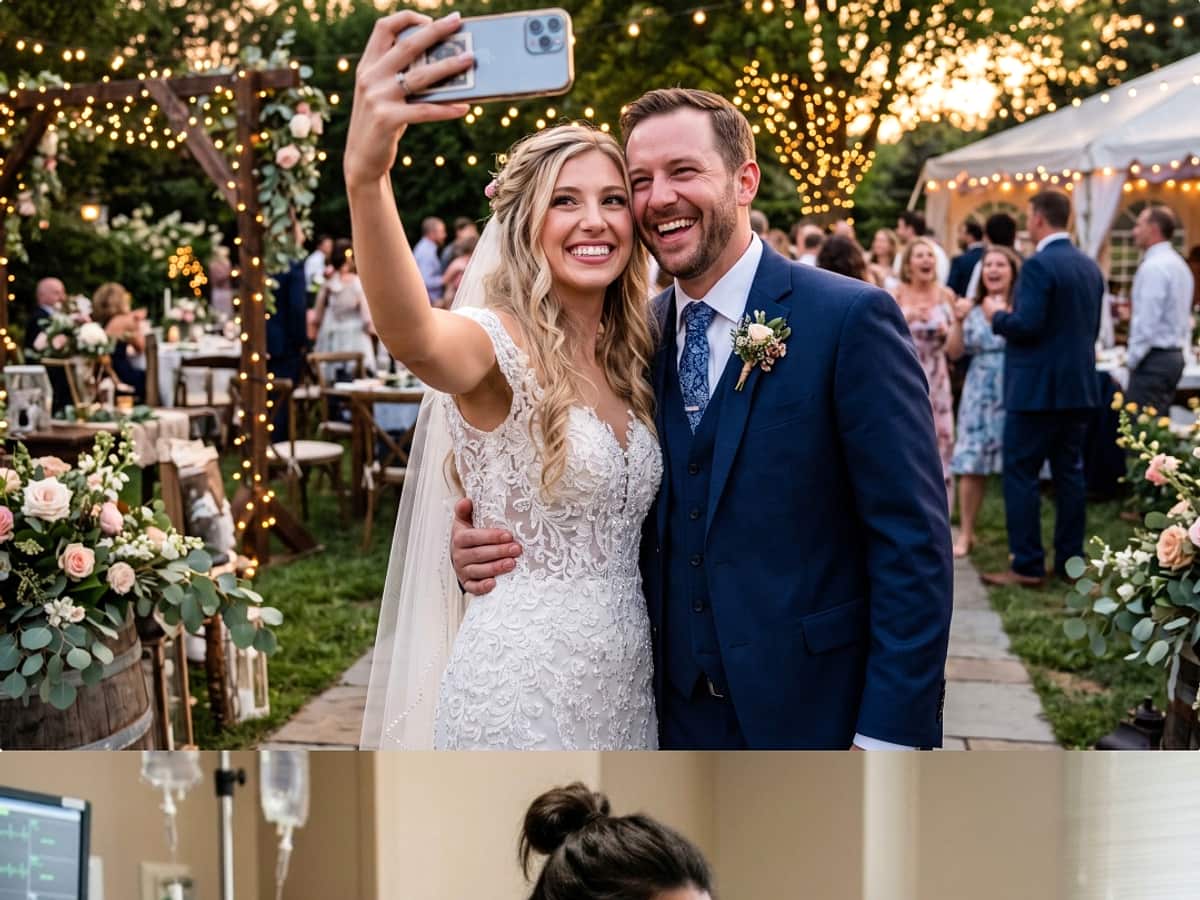
She was standing in the garden at the Southampton estate, the one that technically belonged to the Whitmore family trust and practically belonged to my mother-in-law Elaine, who had spent thirty years perfecting its hydrangeas and its gravel paths and its imported French fountain as though beauty were a form of argument. Late-August light fell across everything in that particular gold that photographers chase and the rest of us only notice when we are already somewhere else in our minds.
Vanessa Cole was wearing my engagement gown.
Ivory silk, cut on the bias, with a low back and a hem that pooled slightly on the left side because the seamstress on Madison Avenue had told me that was the romantic choice. My mother had paid for it — my mother, who was alive then and healthy enough to cry at the fitting and tell me I looked like something out of a painting she had loved since college. She died the following spring, and I had packed the gown into a cedar-lined box in the back of the closet on the Upper West Side because I could not look at it without hearing her voice.
Vanessa’s red hair was curled over one shoulder. Her left hand rested on Daniel’s chest with the easy familiarity of someone who had stopped performing and started inhabiting.
Daniel’s hand was at her waist. He was not looking at the camera.
He was looking at her with the expression I had spent seven years trying to earn and eventually stopped asking about.
Below the photo, one sentence: Some women are born to belong here.
I read it twice. Then a third time, not because the meaning was unclear but because the smallness of it surprised me.
After everything — the months of suspicion, the discovered receipts, the charity events where Daniel stood six inches farther from me than he used to, the night I found a $300 dinner charge at a restaurant he had told me was closed for renovation — after all of that, this was what she chose. One sentence.
A costume. A garden.
She thought I would shatter. She thought the dress would do it, that I would see my mother’s money and my own history draped over her body and come apart at every seam I had been holding together since January.
Marcus came back through the door at exactly the wrong moment for Vanessa and exactly the right moment for me. He was sixty-one years old, silver-haired, and had the particular stillness of a man who had spent four decades in rooms where money and grief arrived together.
He had handled my father’s estate. He had handled the prenuptial agreement Daniel’s family had insisted on, which I had signed without reading as carefully as I should have, because I was twenty-eight and in love and certain that the document was a formality rather than a forecast.
I turned the phone toward him without a word.
He looked at the screen. Then at me.
Then at the screen again. A muscle moved near his jaw.
“Is that your gown?” he asked.
“Yes.”
“And that is Daniel.”
“Yes.”
“And the garden — the estate security system covers that section?”
I looked past him toward the window, where a helicopter was crossing the East River like a slow black thought. My hand had drifted to my stomach, a habit I had developed in the weeks since the pregnancy had become complicated, since the doctors had started using words like monitoring and precautionary and we want to be careful here in the tone that means they are already worried.
“Daniel had the system upgraded after the attempted break-in last October,” I said. “He was very particular about coverage. He said he wanted every angle.”
Marcus set the phone down on the tray. He did not smile — Marcus was not a man who smiled when the other side handed him a gift — but something in his face reorganized itself into a kind of focused quiet, the way a room changes when someone closes the windows before a storm.
“Then we’re going to preserve everything,” he said. “Don’t respond to this.
Don’t forward it. Don’t post it anywhere.”
“I wasn’t going to.”
“I know,” he said. “I’m saying it anyway.”
He picked up the manila folder, tucked the phone inside a small evidence sleeve he produced from his jacket pocket with the calm of someone who had come prepared for exactly this, and walked back to the door. He paused with his hand on the frame. “Emily,” he said, “she just handed us the garden.”
I didn’t answer. I was already thinking about the cameras.
Part 2: The Architecture of a Careful Man
I met Daniel Whitmore at a fundraiser for a children’s literacy organization, held in a room at the Metropolitan Museum where the ceiling was painted with figures who looked like they had seen every human drama and found it mildly tedious. He was thirty-six, which in the circles his family moved in meant he was young enough to still be considered a prospect and old enough to have learned which fork to use without looking. He had the kind of face that photographed well in black and white — strong jaw, easy smile, the particular confidence of someone who had never had to wonder whether they belonged in a room.
I was twenty-nine. I worked in arts administration, which in Manhattan meant I was perpetually underpaid and perpetually surrounded by beautiful things that belonged to other people.
I wore a dress I had bought on sale and spent forty minutes convincing myself looked intentional. Priya, my closest friend since graduate school, had dragged me to the event and then immediately disappeared with a curator she had been trying to talk to for months, leaving me with a glass of wine and the mild social anxiety of someone who attends these things for work reasons rather than social ones.
Daniel found me standing in front of a painting I genuinely liked, which he later told me was what had drawn him over — that I was looking at it rather than at the room. It was a flattering observation and probably true, and I have spent a great deal of time since then wondering how much of what followed was genuine and how much was a man who had learned to say the right things at the right moment because his family had sent him to schools where that was the curriculum.
We were married eighteen months later in a ceremony at the Southampton estate that Elaine had orchestrated with the precision of a military campaign. My mother wore pale blue and cried during the vows. Daniel’s father, a man named Park Whitmore who communicated primarily through silence and the occasional approving nod, shook my hand at the reception and said, “You’ll do well here,” which I understood was the warmest thing he knew how to say.
For the first three years, I believed it. I believed in the apartment on the Upper West Side with its high ceilings and its view of the park.
I believed in the dinners with board members and the weekends in Southampton and the way Daniel introduced me at events — my wife Emily — with a particular emphasis on the possessive that I had mistaken for pride. I believed in the nursery we had started planning when I became pregnant, the one with the felt cloud mobile and the yellow walls and the name we had not yet chosen but had started circling.
I stopped believing somewhere around month four of the pregnancy, when I found a receipt in Daniel’s coat pocket for a dinner at a restaurant on Park Avenue — $300 for two, on a Wednesday night when he had told me he was at a board meeting that had run until ten. I put the receipt back.
I told myself there was an explanation. I told myself the explanation would arrive if I waited quietly enough.
What arrived instead was a charge on the shared account for $39 at a boutique I didn’t recognize, then $12.99 for a streaming service neither of us had signed up for, then a series of emails I found by accident when I was looking for a contract in the shared family office account — emails that were not accidentally left open but carelessly, because Daniel had always believed that his wife was too polite to look.
He was right about the politeness. He was wrong about the limits of it.
By the time I collapsed in our kitchen at eleven-thirty on a Saturday night and woke up in a hospital bed with Grace adjusting my IV and Marcus sitting in the visitor chair with his briefcase already open, I had been quietly gathering information for six weeks. Not for revenge — I want to be precise about that. I gathered it because I had a child coming into the world and I needed to understand what world that was going to be.
Elaine had called the hospital the morning after I was admitted. She was gracious in the way she was always gracious — measured, warm at the surface, careful underneath.
She asked about the baby. She asked about my comfort.
She did not ask about Daniel, which told me she already knew more than she was saying. Elaine Whitmore had been married to Park for forty years.
She understood the architecture of a careful man better than anyone.
What I did not know then — what I would not learn until the security footage arrived — was that Elaine had made a phone call of her own the night before Vanessa’s photo was sent. She had called the estate manager. She had asked him to pull the archive from the outdoor cameras going back thirty days.
She had not told Daniel she was doing it.
That was the detail that changed everything, and I would not understand it until Marcus came back through my hospital room door the following morning carrying a laptop in a black case and the particular expression of a man who has just seen something he cannot unsee.
Part 3: Thirty Days of Footage and One Afternoon in Particular
The rain came overnight and was still going when Marcus arrived at 10:42 a.m. He was carrying two cups of coffee from the place on the corner that charged $18,600 worth of attitude for a medium dark roast — I know that number because it appeared later in the financial audit, a standing monthly charge on the household account that Daniel had been expensing as a client entertainment cost for fourteen months. At the time I just noticed he was carrying coffee he knew I couldn’t drink, which meant he needed something to do with his hands.
Behind him was a woman I had not met before, introduced as Elaine’s personal attorney, a compact woman named Margaret Chen who wore no jewelry and carried a tablet in a leather sleeve and had the eyes of someone who had been in rooms like this before and found them clarifying rather than distressing.
Marcus set the laptop on the rolling tray. Margaret stood near the window. Grace came in, checked my monitor, and left without being asked.
“The estate manager pulled thirty days of outdoor footage,” Marcus said. “Elaine authorized it. She did not inform Daniel.”
I looked at Margaret. “Did she know what she’d find?”
Margaret considered the question with the care of someone who understood that the answer was also a legal statement. “She suspected,” she said finally. “She wanted to know before she decided anything.”
Marcus opened the laptop.
I will not describe everything that was on those recordings, partly because some of it is still part of an ongoing legal matter and partly because the specific details belong to a chapter of my life I have chosen to close rather than annotate. What I will say is this: the cameras were thorough.
Daniel had insisted on overlapping coverage, no blind spots, motion-activated archiving with a timestamp on every frame. He had designed a security system that was, in the end, a perfect witness.
Vanessa Cole had visited the Southampton estate on four separate occasions in the past thirty days. Twice when I was in the city.
Once when I was at a prenatal appointment. Once — and this was the one that made Margaret set down her tablet and look at the ceiling for a moment — on the afternoon of August 14th, which was the day Daniel had told me he was driving out alone to check on some storm damage to the boathouse.
The footage from August 14th showed no storm damage inspection. It showed Daniel and Vanessa in the garden from 12:40 p.m.
to 1:05 p.m., which was when they moved inside. It showed Vanessa arriving with a garment bag.
It showed her leaving without one.
The ivory gown had been in the cedar box in our closet on the Upper West Side. I had checked, after I found the emails.
It was still there. I had not thought to check again after I was admitted to the hospital, because I had not imagined that even Daniel would do something so specific, so deliberate, so architecturally cruel as to take a dead woman’s gift and hand it to the woman who was replacing her daughter.
But the footage showed exactly that. At 12:43 p.m., Daniel carried the garment bag from the car to the garden.
At 12:51 p.m., Vanessa was wearing the gown. At 1:05 p.m., they went inside.
The photo Vanessa had sent me — timestamped, geotagged, sent from her personal phone to mine at 2:17 p.m. — had been taken in that same garden on that same afternoon. The estate camera had captured the moment from a different angle, thirty seconds before she pressed send.
I sat with that for a long time. The rain moved across the window in sheets. Somewhere down the hall, a television was playing a game show, the kind with cheerful music and a host who laughed at everything.
“She sent it from her own phone,” I said.
“Yes,” Marcus said.
“She wanted me to know it was her.”
“She wanted you to feel it,” Margaret said quietly. “There’s a difference.”
There was. Vanessa had wanted me to feel the photo land, to feel the specific weight of it — the garden, the gown, the man, the message.
She had not considered that feeling something and being destroyed by it are not the same thing. She had not considered that a woman who has spent six weeks quietly gathering information while pretending to be too polite to look is not a woman who shatters.
She had also not considered the cameras, which was Daniel’s mistake, not hers, but which she had now made her own by pressing send.
Margaret opened her tablet. “There’s something else,” she said.
She turned the screen toward me. It was a screenshot of a social media profile — Vanessa’s, set to public.
Posted at 8:12 p.m. the previous evening, after I had already shown Marcus the photo, after Marcus had already made his calls to the right people: a photo of the garden at sunset, the fountain lit from below, the hydrangeas in full bloom.
The caption read: Home is where you’re chosen.
She had posted it publicly. With the estate visible. With the fountain Daniel’s mother had imported from France clearly identifiable to anyone who had ever attended a Whitmore event or read the society pages.
Elaine had seen it at 8:12 p.m. Margaret had received a call from Elaine at 8:14 p.m.
I thought about Elaine then — this woman I had never fully understood, who had always been warm at the surface and careful underneath, who had shaken my hand at my own wedding reception and said nothing more personal than welcome to the family — and I understood for the first time that she had her own reasons for making that call to the estate manager. Her own accounting to do. Her own version of enough.
“What did Elaine say?” I asked.
Margaret looked at me steadily. “She said she would like to meet with you when you’re discharged. She said to tell you she is sorry it took her this long to see clearly.”
The game show down the hall went to a commercial. The rain kept going. I closed my eyes for a moment and thought about my mother, not as she looked near the end but as she had been at my engagement dinner, laughing at something Daniel’s uncle had said, her hand on my arm, her voice carrying the particular warmth of a woman who believed her daughter had found something real.
I hoped she couldn’t see the footage from wherever she was. Then I hoped she could.
Part 4: The Offer and What It Revealed
I was discharged on a Friday morning under instructions so specific they felt like a legal document: rest, monitor symptoms, keep all appointments, reduce stress. The nurse who delivered this last instruction said it with a straight face, which I respected. Reducing stress while your husband’s mistress is posting photos of your dead mother’s dress to social media and your attorney is preserving security footage for a divorce proceeding is the kind of medical advice that exists in a category of its own.
Priya drove me home. She did not talk much, which was one of the things I loved most about her — she understood that sometimes the kindest thing a person can do is simply take up space beside you without filling it with words. She had brought food from the place on Amsterdam Avenue I had been craving for weeks, and she sat with me at the kitchen table while I ate and looked out at the park and tried to remember what ordinary felt like.
Daniel was not at the apartment. He had sent a text at 11:31 a.m.
— I know the time because I saved it, the way you save things that will matter later — that read: Heard you’re being discharged today. Let me know if you need anything.
Mom wants to talk. Not I want to talk. Not I’m coming home. Mom wants to talk, as though Elaine were the message and he were merely the delivery system.
I did not respond.
The call from Daniel’s family attorney came at 12:40 p.m. His name was Hargrove, and he had the voice of a man who had spent thirty years making uncomfortable things sound like reasonable proposals.
He said Daniel wanted to discuss a settlement framework. He said the family was prepared to be generous.
He used the word generous three times in four minutes, which told me the number they had in mind was not generous at all but was one they had decided sounded like it was.
I let him finish. Then I said, “Please send anything formal to Marcus Hale. He’s handling my interests.”
There was a pause. “Of course,” Hargrove said. “Though I should mention — and I say this as someone who has known the Whitmore family for many years — that these matters tend to go more smoothly when they stay private.”
“I agree,” I said. “I’ve been very private.”
Another pause, longer this time. “Mrs. Whitmore—”
“I’ll let Marcus know to expect your call,” I said, and ended it.
Priya looked at me from across the table. “How do you feel?”
“Like I just declined a settlement offer I haven’t seen yet.”
“Is that good?”
“It means they’re worried,” I said. “Worried people offer settlements.”
What Hargrove did not know — what Daniel apparently had not yet told him — was that Margaret Chen had already filed a preservation order for the estate security footage on behalf of Elaine’s interests in the family trust. The footage was no longer simply evidence in a divorce proceeding. It was evidence in a trust dispute, because Elaine had spent the previous forty-eight hours reviewing thirty days of recordings and discovering that several items from the estate — including, but not limited to, a piece of jewelry that had belonged to Daniel’s grandmother and was specifically enumerated in the trust documents as non-transferable — had been removed from the property during Vanessa’s visits.
The ivory gown was not in the trust. It was mine, purchased by my mother, belonging to no document except the memory of a fitting room on Madison Avenue and a woman crying into a handkerchief.
But the jewelry was different. The jewelry had paperwork.
And paperwork, as Daniel had always said, was how his family handled everything.
Marcus came by that afternoon with a summary of where things stood. He sat across from me at the kitchen table in the same chair Priya had occupied and laid out the landscape with the calm precision of someone reading a map he had drawn himself.
The footage. The jewelry.
The emails from the shared office account. The financial audit, which had turned up the $18,600 in charges over fourteen months that Daniel had been running through the household account under categories that did not survive scrutiny.
The $300 dinner. The $39 boutique charge.
The $12.99 streaming service, which was minor but which Marcus included because he said small lies were load-bearing walls — remove one and you understood the whole structure.
“He’s going to come back with a number,” Marcus said.
“He already did. Through Hargrove.”
“What did you say?”
“I referred him to you.”
Marcus allowed himself a small, precise smile. “Good. Because the number I’m going to give him is going to be different from whatever Hargrove suggested.”
“Different how?”
“Different in the way that accounts for the trust items, the financial irregularities, the medical costs, and the fact that your child is going to need a great deal of stability in the first several years of her life.”
I looked at him. “You said her.</“
He blinked. “I apologize. I shouldn’t have—”
“No,” I said. “It’s all right.
I’ve known for a while.” I looked down at my hands, at the place where the IV tape had left a small bruise on the back of my left hand.
“I just hadn’t said it out loud to anyone except the doctor.”
Marcus nodded once, slowly, the way he nodded when something mattered and he wanted to acknowledge it without making it larger than it needed to be. “Then we’re going to make sure she has what she needs,” he said.
That evening, Elaine called. Not through Hargrove, not through Margaret, not through Daniel.
She called my cell phone directly, which she had never done in seven years of marriage. Her voice was steady but careful, the way a person sounds when they have rehearsed what they want to say and are still not entirely sure it will come out right.
“I owe you an apology,” she said. “I saw things I chose not to see.
I told myself it was none of my business. I was wrong about that.”
I didn’t say anything for a moment. Outside, the park was going gold in the late afternoon light, the way it does in early September when summer is finally admitting it’s over.
“Thank you,” I said. “That means something.”
“I want you to know,” she said, “that whatever happens with Daniel, you are not losing this family. That child is a Whitmore. And so, as far as I’m concerned, are you.”
It was the most direct thing Elaine had ever said to me. It arrived seven years too late and exactly on time, which is how the most important things tend to arrive.
After we hung up, I sat in the quiet of the kitchen for a long time. Then I went to the nursery and stood in the doorway, looking at the yellow walls and the mobile of felt clouds and little stars that turned slowly in the draft from the window.
I had painted those walls myself, on a Saturday in June when Daniel had said he would help and then gotten a call he said he couldn’t ignore. I had put on old clothes and opened the cans and done it alone, and I had been angry about it at the time, and now I was glad, because those walls were mine in a way that nothing Daniel had touched could be.
I reached up and set the mobile spinning.
Part 5: The Garden in October, and After
My daughter was born six weeks early on a rainy Thursday in October, in the same hospital where I had received Vanessa’s photo, in a room two floors above the one where Grace had adjusted my IV line and Marcus had looked at a screen and said we’re going to preserve everything. She arrived furious and small and entirely herself, screaming with the conviction of someone who had already heard enough from the adults in her vicinity and had opinions about it. The nurses laughed.
I cried, which was the first time I had cried since the shower in July, and it felt completely different from all the crying that had come before — not grief, not humiliation, not the particular exhaustion of holding yourself together in elevators and charity luncheons. Just relief.
Just the specific, overwhelming relief of something real arriving in the middle of everything that had been false.
Priya was in the waiting room. Elaine was in the waiting room.
Marcus was in the waiting room, which was not strictly necessary but which I found I was glad about. Daniel was not there, which was his choice and which I had stopped having feelings about somewhere around the time the financial audit was complete.
I named her after my mother. I had decided that in the hospital in August, lying in the dark after Marcus left and Grace turned the lights low and the city went on outside the window doing its relentless city things. I had decided it quietly, the way you decide things that don’t need to be announced, that just need to be true.
The divorce was finalized four months later. I will not walk through every detail of it, partly because some of it is sealed and partly because the details are less interesting than people expect.
There was no dramatic courtroom scene. There was no moment where Daniel broke down and admitted everything in front of a judge.
What there was, was paperwork — the kind of paperwork that accounts for fourteen months of financial irregularities, the removal of trust items from a family estate, a security footage archive that documented thirty days of visits, and a medical record that established the direct relationship between a period of sustained deception and a premature birth.
Hargrove had come back with a number. Marcus had come back with a different one.
After two weeks of negotiation, Daniel’s family had agreed to Marcus’s number, which was the number that accounted for everything. The $18,600 in household charges.
The medical costs. The trust items, which were handled separately through Margaret and Elaine and a process I was not directly part of but which I understood had been thorough.
A settlement that would allow me to stay in the apartment until my daughter started school, and after that, to buy something of my own.
Vanessa Cole did not appear in any of the legal proceedings. She was a private citizen who had been involved with a married man, which is a moral failure but not a legal one, and Marcus had advised me early on that making her a central figure in the divorce would cost more than it returned. I had agreed, not because I had forgiven her — forgiveness is a long project and I was not finished with it — but because I had understood, somewhere between the hospital and the nursery and the phone call from Elaine, that my energy was not a renewable resource and I needed to spend it on the right things.
I heard, through Priya, who heard through someone at a gallery opening, that Vanessa and Daniel had stopped seeing each other by December. I did not find this satisfying in the way I might have expected. I found it mostly irrelevant, which I think is what moving on actually feels like from the inside — not triumph, just the quiet discovery that something which once occupied the whole center of your attention has drifted to the edge.
In the spring, when my daughter was five months old and had developed the habit of grabbing my hair with both hands and laughing at her own strength, Elaine invited me to Southampton for a weekend. I almost said no. Then I thought about the garden — the hydrangeas and the gravel paths and the fountain and the cameras that had, in the end, told the truth about everything — and I thought about my mother, who had cried at a fitting on Madison Avenue and paid for a dress that became, against all reasonable expectation, a piece of evidence rather than a memory.
I went.
Elaine met me at the door with the baby’s name on her lips and her arms already open, and we walked through the garden in the late-April light, the hydrangeas just beginning to bud, the fountain doing its quiet work in the corner. My daughter was in a carrier against my chest, her head tucked under my chin, her small fist wrapped around my finger with the grip of someone who had decided I was worth holding onto.
We did not talk about Daniel. We did not talk about Vanessa or the footage or the settlement or the dress. We talked about the garden, and about my mother, and about what it felt like to be standing in a place that had once made me feel like a guest and now felt, strangely, like something I had earned.
The cedar box is still in the back of the closet on the Upper West Side. I have not opened it.
I don’t know yet whether I will keep the gown or give it away or do something else entirely with it. What I know is that it belongs to me — not to a marriage, not to a man, not to a woman who thought wearing it would make her belong somewhere.
It belonged to my mother’s hands and her tears and the afternoon she spent watching me stand in front of a mirror on Madison Avenue, and that is a thing that cannot be taken by anyone who was not in that room.
My daughter grabbed my finger tighter. The fountain ran. The hydrangeas moved in the April wind.
I stayed in the garden until the light changed.
Names and identifying details in this story have been changed. This is a dramatized account shared for entertainment and reflection, and any resemblance to real people is coincidental.
