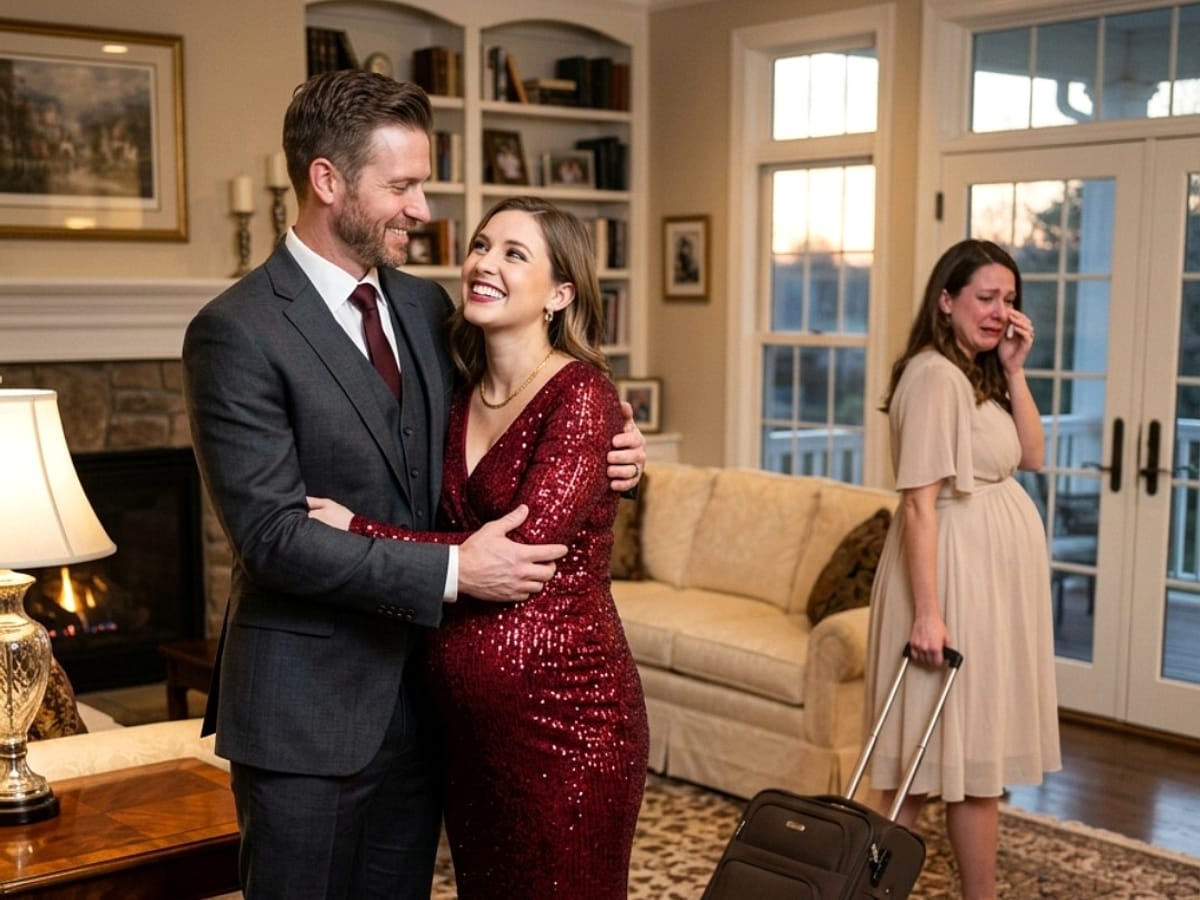
Part 1: The Brooch That Wasn’t His to Give
The conference room on the thirty-fourth floor of a Midtown Manhattan law firm had floor-to-ceiling windows, gray leather chairs, and the particular kind of silence that costs money to maintain. I had been in rooms like this before — rooms where fortunes changed hands and people smiled while destroying each other. I had just never expected to be the one being destroyed.
I arrived eleven minutes early. That was always my way.
Grant used to call it a character flaw, said punctuality was for people who had nothing better to do. I called it self-respect.
Either way, I was sitting beneath a framed photograph of the Brooklyn Bridge when the elevator doors opened and my husband of nine years walked out with another woman beside him.
Her name was Savannah Bell. I knew that already.
I had known it for six weeks, ever since I found a sonogram tucked into the inner pocket of Grant’s weekend bag — the kind of small, domestic discovery that rewrites everything you thought you understood about your own life. She was twenty-seven years old, visibly pregnant, and wearing a pale green maternity dress that draped softly over a belly that looked to be about seven months along.
And pinned above her left collarbone, catching the afternoon light like a small, quiet accusation, was my grandmother’s pearl brooch.
I had to breathe through my nose for a moment. Not because I was going to cry — I had finished crying weeks ago, alone in the bathroom of our Greenwich estate with the shower running so the housekeeper wouldn’t hear. I breathed because I needed to stay very, very still inside myself, the way you do when something irreversible is happening and you know that how you carry yourself in the next sixty seconds will matter for years.
The brooch was not worth much in the way that Grant measured worth. It wasn’t a Cartier piece or a Bulgari heirloom.
It was a small oval of freshwater pearls set in brushed silver, the kind of thing a jeweler in 1958 Boston would have made for a young woman on a courthouse budget. My grandmother had worn it the day she married my grandfather.
My mother had worn it the afternoon she was sworn in as an American citizen, standing in a federal building in Hartford with tears running down her face and her hand over her heart. I had worn it the night Grant got down on one knee in a restaurant in the West Village and asked me to spend my life with him.
Savannah touched it with two fingers as she approached, a gesture so casual it felt like a slap.
“Eleanor,” she said. Her voice was warm and careful, the voice of someone who had practiced this moment. “It’s good to finally meet you properly.”
I looked past her to Grant. He was wearing a navy suit, silver at his temples, jaw set in the expression I had come to recognize as his armor — the face he wore when he was about to do something he knew was wrong but had already decided to do anyway.
“Why is she wearing that?” I asked him.
He exhaled through his nose. “Let’s not make this harder than it needs to be.”
“That brooch belonged to my grandmother.”
“Eleanor.” His voice dropped into the register he used for subordinates. “We’re here to be adults.”
Savannah’s hand moved to her belly. It was a practiced gesture, I realized — the kind of movement designed to remind everyone in the room of what she represented and what I supposedly did not.
I had watched women do it at baby showers for years, that unconscious cradling, and I had always found it beautiful. On her, in that moment, it felt like a weapon.
Grant’s attorney, Mr. Holloway, appeared from a side door and ushered us all into the conference room.
The walnut table was long enough to seat twelve. A single folder sat at the chair across from Grant, my name printed on the cover in clean black type: ELEANOR WHITMORE — DISSOLUTION AGREEMENT.
They sat on one side. I sat on the other.
Holloway cleared his throat. “The terms are, I think you’ll find, exceptionally generous.”
Grant folded his hands on the table. He had always had beautiful hands — steady, unhurried, the hands of a man who had never once doubted his own authority.
“I want you to be taken care of, Eleanor. That’s all this is.”
I opened the folder without responding.
The number was on the second page, printed in a font slightly larger than the surrounding text, as if even the document understood it was the point of the whole exercise.
$50,000,000.
Fifty million dollars.
I read the conditions beneath it. Vacate the Greenwich property within thirty days.
Sign a nondisclosure agreement covering the affair, the divorce proceedings, and any details related to Savannah Bell or her pregnancy. Waive all future claims against Whitmore Capital, its subsidiaries, and the offshore trust structures Grant had spent the better part of a decade building.
In exchange: fifty million dollars wired to an account of my choosing, a car, and what the document called “a dignified transition.”
Grant watched my face the way he always watched people when he expected a reaction. He had a talent for reading rooms, for knowing exactly when someone was about to break. It was what made him good at his job and terrible as a husband.
“Savannah is due soon,” he said. “Twins.
A boy and a girl. They deserve a stable home.”
I turned a page.
“You and I both know,” he continued, his voice dropping into something almost gentle, “that this marriage stopped being what either of us needed a long time ago. You deserve a fresh start.
Somewhere new. Somewhere you can build something for yourself.”
I looked up. “And what about nine years?”
He paused. “What about them?”
“Nine years of my life. Six rounds of IVF.
Two miscarriages I buried without telling anyone because you said grief made you uncomfortable at dinner parties. Nine years of being the wife of Grant Whitmore, which is a full-time occupation with no salary and apparently no severance beyond whatever you’ve decided my silence is worth.”
I kept my voice level. “Is that what fifty million covers?”
Savannah looked at the table.
Grant’s jaw tightened. “I’m trying to be fair.”
“You’re trying to be efficient,” I said. “There’s a difference.”
Holloway shifted in his chair. “Mrs. Whitmore, I’d strongly recommend taking a few days to review with your own counsel before—”
I reached into my bag and set a slim folder on the table.
Grant’s eyes dropped to it. “What is that?”
“My attorney reviewed the preliminary draft last week,” I said. “I’ve had time to think.”
The silence in the room changed texture entirely.
Savannah sat up straighter. Grant stared at the folder as if it had appeared from nowhere. And I held his gaze and said, very quietly, “Where do I sign?”
He had prepared for a fight. He had prepared for tears, for threats, for months of litigation and headlines and mutual friends forced to choose sides. He had not prepared for this — for me, calm and ready, pen already in hand.
He had not prepared for what I was not telling him.
Part 2: The Woman Who Flew West
I signed every page in that conference room, shook Holloway’s hand, did not look at Savannah again, and walked out into a Manhattan afternoon that smelled like rain and exhaust and the particular freedom of having nothing left to lose. My car was waiting. I told the driver to take me to JFK.
I had already packed two weeks earlier.
Marisol Vega met me outside baggage claim at SFO just after sunrise, wearing leggings and an oversized sweatshirt with the hood pushed back, holding a coffee in each hand and looking at me with the expression she had been perfecting since we were roommates at Georgetown — the one that said I know everything and I’m not going to say I told you so, but only because I love you.
She handed me a coffee. I took it. Neither of us spoke for a moment.
“He brought her to the meeting,” I said finally.
“I know. Daniel called me.” Daniel was her husband, a family law attorney who had been quietly advising me for the past month.
“She was wearing my grandmother’s brooch.”
Marisol closed her eyes briefly. “Eleanor.”
“I didn’t say anything. I just signed.”
She looked at me carefully. “And the other thing?”
I had told Marisol two weeks earlier, standing in her kitchen in Pacific Heights at midnight, shaking so hard she had made me sit down and put both hands around a mug of chamomile tea before I could get the words out. I had taken three pregnancy tests in the bathroom of her guest room first, just to be certain.
Then a fourth. Then I had called my OB in New York, who had confirmed it the following morning with bloodwork.
Ten weeks. Naturally conceived, against every statistical probability my reproductive endocrinologist had ever quoted me. After six failed IVF cycles and two losses and years of being told that my odds were “not impossible, but significantly reduced,” my body had simply decided, on its own timeline, that it was ready.
The cruelest and most perfect timing imaginable.
“The other thing is fine,” I said. “Twelve weeks now. I have an appointment Thursday.”
Marisol squeezed my arm. “Come on. I made breakfast.”
I moved into her guest room and spent the first week doing very little. I slept.
I ate the food Marisol left outside my door when she sensed I needed quiet. I walked along the waterfront in the mornings when the fog was still thick and the city felt muffled and forgiving.
I let myself feel the full weight of everything — the grief of the marriage, the strange relief of being out of it, the terror and wonder of what was growing inside me.
I thought about telling Grant.
I thought about it for a long time, lying in the dark of Marisol’s guest room listening to the foghorns in the bay. He was the father.
That was a biological fact that no amount of anger could change. But I kept returning to the image of him across that walnut table, Savannah at his side, and the words he had said with such deliberate calm: Fifty million dollars is generous compensation for a wife who couldn’t bear me children.
He had said it like a verdict. Like a thing he had been thinking for years and had finally been given permission to speak aloud.
I decided my son — I knew by then it was a boy, had known somehow since the morning I sat on Marisol’s bathroom floor with three positive tests in my hand — I decided my son would enter the world on my terms. Not as a bargaining chip.
Not as a plot twist in Grant’s narrative. Not as proof of anything to anyone.
He would be mine first. The rest could wait.
Daniel helped me establish residency in California and set up a new legal structure around the $50 million, which had cleared into a new account within ten days of signing. He was careful and thorough and never once made me feel like a charity case, which I appreciated more than I could say. Marisol found me a rental house in a quiet neighborhood in Marin — a craftsman bungalow with a lemon tree in the backyard and a porch that faced west, toward the water.
I painted the nursery myself. Pale yellow, with white trim. Marisol helped, and we listened to old Fleetwood Mac albums and drank sparkling water and talked about everything except Grant Whitmore.
In January, I got a call from a number I didn’t recognize. When I answered, a woman’s voice said, “Mrs.
Whitmore? My name is Rebecca Cho.
I’m a journalist with the San Francisco Chronicle. I’m working on a story about Whitmore Capital, and I was hoping you might be willing to speak with me.”
I said I wasn’t ready to make any public statements.
She said she understood, and left her number.
I wrote it down.
In February, I got a second call. This one was from a blocked number, and the voice on the other end was female and young and frightened. She said her name was Caitlin, and that she had worked as a junior analyst at Whitmore Capital until eight months ago, when she had been quietly let go after raising concerns about certain fund accounting practices with her direct supervisor.
She had been trying to find someone who would listen.
I listened for forty-five minutes. Then I called Daniel. Then I called Rebecca Cho back.
I did not violate my NDA. The NDA covered the affair, the divorce, and Savannah Bell’s pregnancy. It said nothing about securities fraud.
By the time the Chronicle’s legal team had reviewed everything Caitlin had documented, it was late March. I was thirty-four weeks pregnant, moving slowly around my little house in Marin, and the lemon tree in the backyard was just beginning to bloom.
The story was scheduled to publish in April.
And then my water broke.
Part 3: The Morning Everything Arrived at Once
My son was born on April 18th at 4:12 in the morning, during a spring storm that rolled in off the Pacific sometime around midnight and turned the streets of Marin into rivers of reflected light. I had been awake since ten, timing contractions on my phone while rain hammered the windows and the lemon tree in the backyard bent sideways in the wind.
Marisol drove me to the hospital. She held my hand through the parts that were hard and talked me through the parts that were harder, and at 4:12 a.m., in a delivery room that smelled like antiseptic and something floral from the diffuser Marisol had smuggled in, my son arrived in the world with a sound like a declaration.
They placed him on my chest. He was warm and furious and perfect, with dark hair plastered flat against his head and his hands already curled into small, determined fists.
“Hi,” I whispered. “I’ve been waiting for you.”
Marisol was crying. The nurse was pretending not to. I was somewhere beyond crying, in a place that didn’t have a name yet.
I named him Noah. I had decided that months ago, lying in the dark of the Marin house listening to the bay. Noah, because it meant rest, and because after everything, rest felt like the right thing to give him.
Noah Daniel — the middle name for Daniel, who had been steadier than anyone had a right to expect.
Marisol handed me my phone around six in the morning, after Noah had been weighed and measured and declared magnificently healthy, after I had eaten a bowl of hospital oatmeal that tasted like the best thing I had ever consumed in my life. “You’re going to want to see this,” she said.
The Chronicle story had gone live at midnight.
The headline read: WHITMORE CAPITAL UNDER SEC SCRUTINY AS FORMER EMPLOYEES ALLEGE SYSTEMATIC FUND MISREPORTING. The byline was Rebecca Cho. The story was thorough, careful, and devastating — fourteen months of documentation, four named sources, and a paper trail that Caitlin had preserved on an encrypted drive she had kept in a safety deposit box in Oakland.
By six-thirty, it had been picked up by the Wall Street Journal. By seven, Bloomberg.
By eight, the story had a second dimension: a gossip column in New York had run a piece noting that Savannah Bell, Grant Whitmore’s pregnant companion, had been quietly hospitalized two days earlier after her OB raised concerns about the twins’ development. The column was vague on details, as gossip columns tend to be when lawyers are involved.
But the implication was clear enough.
Something was wrong with the pregnancy.
I set the phone face-down on the blanket and looked at Noah, who had fallen asleep against my shoulder with his mouth slightly open and his fist pressed against my collarbone.
“None of that is your story,” I told him. “You don’t have to carry any of it.”
He slept through the whole morning, unbothered, as the world three thousand miles away began to come apart.
I learned the details later, in pieces, from Daniel and from news alerts I read in the quiet hours of the night when Noah was feeding and the house was dark and still. Savannah’s twins had been delivered by emergency C-section at thirty-one weeks.
Both boys survived — I want to be clear about that, because whatever I felt about Savannah Bell, I never wished harm on children. But in the chaos of the delivery and the NICU admission, a routine paternity confirmation had been processed as part of the hospital’s standard documentation for high-risk multiple births.
The results came back two days after the birth.
Grant Whitmore was not the father of either child.
The man listed on the original birth certificate application — a name I didn’t recognize, a name that turned out to belong to a hedge fund manager Grant had considered a close friend for eleven years — was.
I sat with that information for a long time before I felt anything about it. Then I felt something I hadn’t expected: not satisfaction, not vindication, but a deep and exhausted sadness for the shape that people’s lives could take when they built them on things that weren’t true.
Grant had traded his marriage for a future that didn’t exist.
And somewhere in a San Francisco hospital, my son was learning to breathe.
Part 4: The Fall of Grant Whitmore
The first time I saw Grant after Noah’s birth, it was a Tuesday in late June, in a conference room in a building on Market Street in San Francisco — nothing like the Midtown room where our marriage had ended. This room had modest furniture, a view of the street below, and the particular atmosphere of a meeting that nobody in it wanted to be having.
Grant looked like a man who had aged five years in three months. The silver at his temples had spread.
There were lines around his eyes that hadn’t been there in September, and he was wearing a suit that fit him slightly wrong, as if he had lost weight and hadn’t bothered to have it adjusted. He looked, for the first time in the nine years I had known him, like someone who was not entirely certain of the outcome.
He had found out about Noah six weeks earlier, through a source I never identified — someone in Marin, perhaps, or a mutual acquaintance who had seen Marisol posting careful, face-obscured photographs of a baby on her private social media. Grant had called Daniel first, then me.
I had let the call go to voicemail. Then I had called Daniel, and we had agreed on the terms under which this meeting would happen.
I came with Daniel. Grant came with two attorneys, neither of whom was Holloway — Holloway, I had heard, had quietly stepped back from Whitmore Capital matters in the weeks following the Chronicle story, citing a scheduling conflict that fooled no one.
Grant looked at me across the table for a long moment before he spoke.
“You have a son,” he said. It wasn’t quite a question.
“I have a son,” I agreed.
“He’s mine.”
“Biologically, yes.”
His jaw worked. “You should have told me.”
I had thought about how to answer this question for weeks. I had rehearsed versions of it in the car, in the shower, during the long nights when Noah was awake and I was walking him in slow circles around the living room. In the end, I decided the truest answer was the simplest one.
“You told me, in front of your attorney and the woman you were replacing me with, that fifty million dollars was generous compensation for a wife who couldn’t bear you children,” I said. “I was ten weeks pregnant when you said that. I made a decision about what kind of environment I wanted my son to grow up in, and I stand by it.”
The room was very quiet.
One of Grant’s attorneys cleared his throat and began to say something about parental rights and legal obligations. Daniel cut him off, not rudely but with the calm precision of someone who had been preparing for this conversation for months.
The NDA I had signed covered the affair and the divorce. It did not cover a child who had not existed, legally or in Grant’s knowledge, at the time of signing.
Noah’s existence was a separate matter entirely, and Daniel had structured our position accordingly.
What followed was not a single meeting but a series of them, spread across July and into August, conducted through attorneys and mediators in rooms that grew progressively less tense as the parameters became clearer. Grant wanted access to Noah.
I was not opposed to that in principle — I had never wanted to make my son a weapon, and I had no interest in raising him to be a stranger to his father. What I wanted was a framework that put Noah’s stability first and Grant’s convenience second, and that did not require me to be in the same room as Grant Whitmore more than necessary.
We got there, eventually.
The SEC investigation moved on its own timeline, separate from everything personal. Caitlin’s documentation had been thorough enough that the agency’s preliminary findings were issued in August, and trading in Whitmore Capital’s main fund was suspended pending a full audit.
Grant’s attorneys were managing that separately, and I made a point of not following it closely. It was not my fight.
I had not gone to Rebecca Cho to destroy Grant — I had gone because Caitlin deserved to be heard, and because the people whose retirement savings were in those funds deserved to know the truth.
What happened to Grant as a result of that truth was between him and the consequences he had built.
Savannah Bell had moved back to Atlanta by June. I knew this because Marisol told me, and I knew Marisol knew because she had a network of information sources that I had long since stopped questioning.
The twins were healthy. Their father — the hedge fund manager, whose name I eventually learned was Preston — had apparently been informed of the paternity results and was, by all accounts, handling it with the particular grace of a man who had been caught doing something he couldn’t explain.
Grant had not spoken publicly about any of it. His publicist had issued a single statement in May saying that he was focused on his family and his business and had no further comment.
I read that statement once and then deleted the alert from my phone.
My pearl brooch came back to me in a padded envelope with a New York postmark and no return address, sometime in early July. It arrived on a Wednesday morning, and I sat on the porch with Noah asleep in the carrier on my chest and held it in my palm for a long time.
The pearls were undamaged. The silver clasp still worked.
I pinned it to the strap of the carrier, just above Noah’s sleeping head, and went back inside.
Part 5: The Life He Couldn’t Buy Back
Noah turned one on a clear April morning, the sky the particular shade of blue that only happens in Northern California in spring, when the rains have stopped and everything is still green and the light has that quality of having been washed clean. We held the party in the backyard, under the lemon tree that had grown considerably since I moved in, its branches heavy with fruit that Marisol had been threatening to turn into a tart for months.
There were no society photographers. No imported floral installations or gold balloon arches or catered stations with uniformed staff.
There were neighbors from the street, a few of whom had become genuinely good friends over the past year. There was Daniel and his wife, Rosa, who had brought a homemade cake decorated with a single candle and a lopsided fondant lemon that Noah immediately tried to eat.
There was Marisol, who had appointed herself official photographer and was documenting everything with the intensity of someone who understood that ordinary days are the ones worth keeping.
Noah sat in the grass in a small linen outfit and regarded his cake with the focused suspicion of someone encountering frosting for the first time. Then he put both hands directly into it and looked up at me with an expression of pure, uncomplicated delight.
I laughed until I had to sit down.
Grant had seen Noah four times by then, in supervised visits arranged through our parenting coordinator — a calm, practical woman named Dr. Osei who had been doing this work for twenty years and had seen every variation of complicated family structure imaginable.
The visits had gone, by all accounts, adequately. Grant was not a natural with infants; he held Noah with the careful stiffness of someone handling something valuable and fragile, which I supposed was a kind of progress.
Noah, for his part, treated Grant the way he treated most new people — with cautious interest, followed by a determination to grab whatever the person was wearing and see if it came off.
I did not attend the visits. That was the arrangement, and it suited both of us.
I had started working again in January, consulting for a nonprofit that focused on financial literacy programs for women going through divorce — work that had found me, in a way, through a connection Marisol had made at a fundraiser the previous fall. It was not the career I had paused when I married Grant, which had been in arts administration, but it turned out I had more useful knowledge than I had realized, and the work felt like something that mattered in a way that attending charity galas on Grant’s arm never quite had.
The SEC investigation had resulted in a formal enforcement action in March. I read the press release once, noted that the penalties were substantial and the fund restructuring mandatory, and then closed the browser and went to make Noah’s lunch.
It was not my victory to claim. It belonged to Caitlin, who had kept that encrypted drive in a safety deposit box for fourteen months because she believed that what she had documented was wrong and that someone, eventually, would listen.
She had found a new position at a different firm by then, one with a compliance culture she described, in a brief email she sent me in February, as “aggressively boring, which is exactly what I needed.”
I wrote back and told her I was glad.
Savannah Bell, I heard through the reliable channel of Marisol’s information network, had settled into a quieter life in Atlanta with her twins and their actual father, who had apparently decided that the situation, while complicated, was one he wanted to be present for. I had no feelings about this beyond a mild, distant hope that the boys were healthy and that the adults around them would manage to behave like adults.
Children don’t choose the circumstances they’re born into. Noah hadn’t.
The twins hadn’t. That was the one thing Savannah and I had in common, and it was enough to wish her well from a very great distance.
At Noah’s party, after the cake and the candle and the song, after the neighbors had drifted home and Daniel and Rosa had loaded their car and driven away with Rosa calling out the window that she’d bring the leftover tart on Tuesday, Marisol and I sat on the porch steps with glasses of cold sparkling water while Noah slept inside, exhausted and frosting-stained and entirely at peace with the world.
The lemon tree threw long shadows across the yard. The light was going gold.
“Do you think about it much?” Marisol asked.
She didn’t specify what it was. She didn’t need to.
I thought about the conference room. The walnut table.
The folder with my name on it. The number printed in slightly larger type, as if size could convey sincerity.
The brooch on Savannah’s dress. Grant’s voice saying the quiet part out loud, his face arranged in the expression of a man being reasonable.
“Sometimes,” I said. “Less than I used to.”
“Good.”
“I think about my grandmother more. She got married in a courthouse in Boston in 1958 with forty dollars in her pocket and a pearl brooch and a man who showed up.
She built an entire life out of that.” I turned the brooch over in my fingers — I had taken to wearing it on a chain now, close to my collarbone.
“I think she’d find all of this very dramatic.”
Marisol laughed. “She’d find it extremely dramatic and she’d want every detail.”
“She would,” I agreed.
From inside the house came a small sound — not a cry, just a murmur, the sound of a baby shifting in sleep and resettling. We both went still for a moment, listening.
The sound didn’t develop into anything. Noah slept on.
I had thought, in the months after the divorce, that the hardest part would be the loneliness. And it was hard, in the way that any radical restructuring of a life is hard — the silence of a house that used to have another person in it, the recalibration of every routine, the strange grief of mourning a marriage that had been unhappy for years but was still, somehow, a loss.
But the loneliness had not lasted the way I feared it would. It had been replaced, gradually and then all at once, by something I didn’t have a precise word for — a kind of spaciousness, maybe.
Room to be exactly who I was without performing a version of myself calibrated to Grant’s preferences. Room to be tired without it being a problem.
Room to be happy without it being a surprise.
Room for Noah, who had arrived like an answer to a question I had stopped asking.
Grant had offered me fifty million dollars to disappear quietly. He had meant it as a ceiling — the maximum value he was willing to assign to nine years of my life, to my grief, to my presence in his world. He had slid that folder across the table with the confidence of a man who believed that everything had a price and that he had correctly calculated mine.
What he had not calculated was that I would take the money and build something with it that had nothing to do with him. That I would move to a city where the fog came in off the water every morning and burned off by noon, and plant myself there, and grow. That I would raise his son in a house with a lemon tree and neighbors who brought food when the baby was sick and a best friend who showed up at baggage claim with two coffees and no judgment.
That the life he thought he was buying me out of would turn out to be the life I actually wanted.
Noah woke up just before sunset, and I brought him out onto the porch and held him while the light went pink over the water in the distance. He grabbed my necklace chain with both hands and tugged, the way he always did, and I unclipped it and let him hold the brooch, watching him turn it over in his small fingers with that expression of total concentration that babies have when they’re examining something new.
“That belonged to your great-great-grandmother,” I told him. “She was a very practical woman who did not have much patience for nonsense.”
He looked up at me with Grant’s gray eyes and my mother’s stubborn chin and a face that was entirely, unmistakably his own.
Then he put the brooch in his mouth.
“Fair enough,” I said, and took it back, and held him until the stars came out.
Names and identifying details in this story have been changed. This is a dramatized account shared for entertainment and reflection, and any resemblance to real people is coincidental.
