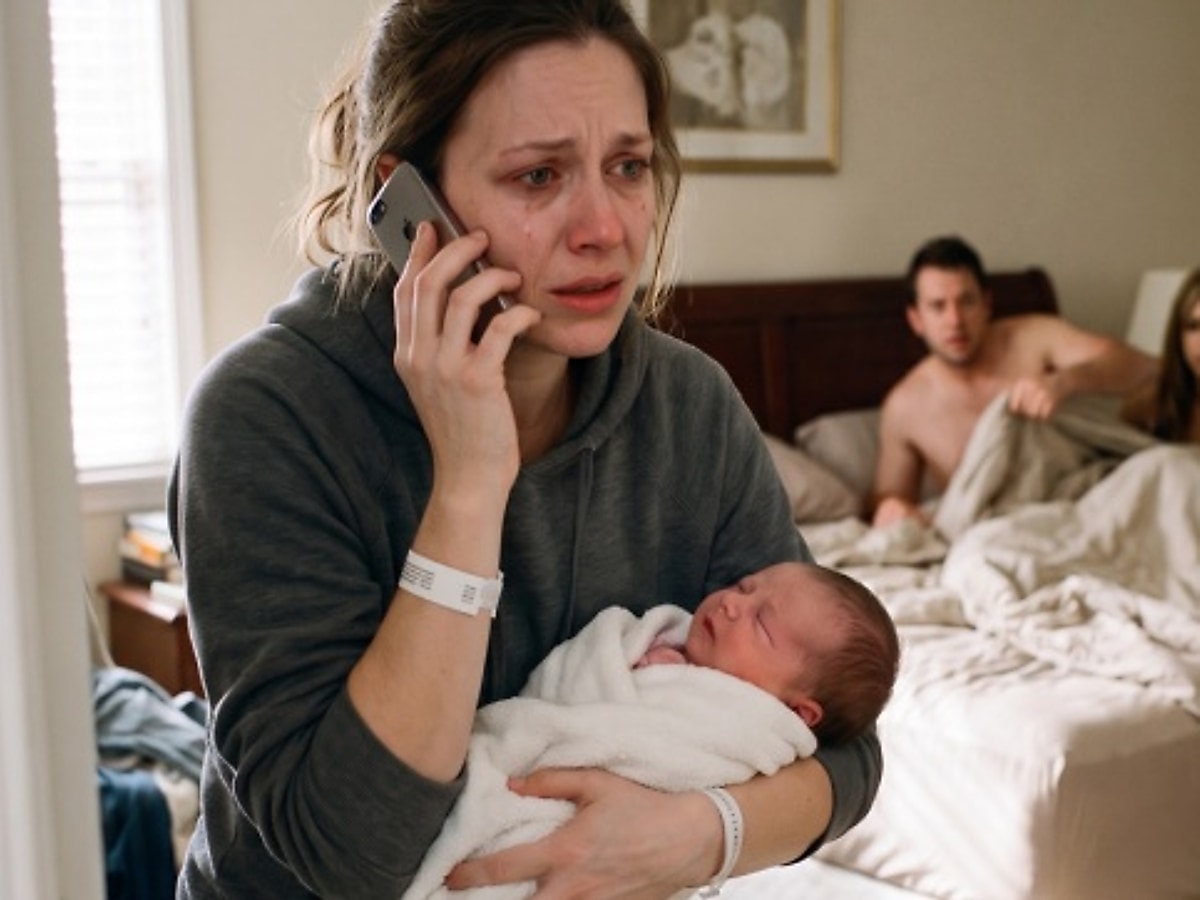
Part 1: The Blanket I Almost Forgot
When I look back on that day, the part I remember most clearly is the blanket.
Not the raised voices, not the stranger sitting where I slept, not my husband’s expression when he turned and saw me standing there with our daughter against my chest.
Just the blanket.
Soft pink with a white satin trim, tiny daisies stitched along one edge. My mother had found it in a small shop in Charleston, South Carolina, three months before I was due, insisting every baby needed one blanket built to survive spit up, sleepless nights, and eventually become something you keep forever.
I had tucked it carefully into my hospital bag.
I thought I was bringing my daughter home to a family that wanted her.
My name is Claire Whitmore. I was thirty-one, and I had just given birth to my first child, a daughter named Lily Grace Whitmore.
She arrived weighing 6 pounds, 11 ounces at Northside Hospital in Atlanta, after twenty-one hours of labor that ended in an emergency C-section, leaving me stitched, shaking, and hopelessly in love in a way nothing had prepared me for.
The instant the nurse laid her near my cheek, every worry from the pregnancy dissolved.
Her fists were curled tight under her chin.
Her cry came out small but furious, as though she already had opinions about the lighting in the room.
I whispered something to her, and just like that, my whole world split into two categories: everything before Lily, and everything after.
My husband, Daniel Whitmore, technically stood in that delivery room.
Physically present, at least.
He held my hand loosely while his attention kept drifting toward the monitors, checking his phone every so often. When the doctor said we needed to move fast because Lily’s heart rate was dropping, Daniel went white and asked if he could step out to call his mother.
The nurse told him this wasn’t the moment.
I nearly laughed despite the fear pressing on my chest.
That was exactly who Daniel was.
Always finding the exit during the hardest part.
We had been married four years and together for six. He came from a well established Atlanta family, the kind that called itself “comfortable” while owning rental properties, a house on Lake Oconee, and a construction company plastered with their last name on every truck.
Whitmore Development Group.
His father, Robert Whitmore, had built that company thirty years earlier. Daniel worked as vice president of operations, though everyone quietly understood his mother, Margaret Whitmore, ran the place like her personal throne with Daniel positioned as heir.
We met at a charity event in Buckhead, where he charmed the room in that smooth, practiced Southern way.
He held doors open.
He remembered people’s names.
He was the type who called older women “ma’am” and made waitstaff feel seen, which impressed me even though I usually distrusted men who wore watches worth more than my rent.
I worked as a senior accountant at a healthcare management firm back then, independent and skeptical, not easily swept up. But something about Daniel made me feel chosen in a way that felt like safety.
Looking back, that might have been his one real talent.
He knew exactly how to make being picked feel permanent.
His mother never warmed to me, not really.
Margaret preferred her cruelty dressed up as compliments.
At our engagement dinner, she told everyone how “practical” I was, as though that were a polite way of saying plain. At my bridal shower, she thanked me for not being “one of those glamorous types.” When I mentioned continuing my career after the wedding, she smiled thinly and said some women needed that kind of structure.
Daniel always waved it off.
“That’s just Mom being old fashioned,” he’d say.
Old fashioned became our family’s polite word for disrespect.
When I finally got pregnant, after nearly a year of trying, Margaret transformed overnight.
For about ten minutes I actually believed she had come around.
She sent prenatal vitamins.
She picked out nursery pieces.
She invited me to lunch at The Swan Coach House and asked genuine sounding questions about my checkups.
Then, around fourteen weeks, she asked whether we planned to learn the baby’s sex.
I told her only if the baby cooperated.
She smiled and mentioned that Robert, and Daniel of course, were hoping for a grandson.
I told her we just wanted a healthy child.
She said “obviously,” in that tone people use when they think you’ve completely missed her point.
At twenty weeks the ultrasound tech announced it was a girl.
I cried from joy.
Daniel smiled, though smaller than I expected.
Margaret didn’t smile at all when we shared the news.
She just repeated the word girl, then said “how sweet” and nothing else.
After that, the gifts slowed to nothing.
Her suggestions for the nursery stopped completely.
At a family dinner, I overheard her telling Daniel’s aunt they could always “try again,” as if my daughter were some rough draft that hadn’t earned final approval yet.
That night I told Daniel his mother’s attitude bothered me deeply.
He sighed and told me not to start.
I asked if he agreed with her.
He looked away and said that wasn’t fair.
That was the moment I understood he wasn’t failing to defend me by accident. Somewhere inside, part of him agreed, even if he never said it out loud.
Still, I told myself Lily’s birth would fix things, the way babies sometimes soften even the hardest people. I pictured Margaret melting the second she saw that tiny face, forgetting every ridiculous thing she’d said about sons and legacies.
The hospital stay crushed that fantasy fast.
After the C-section I was groggy, sore, and struggling to get Lily to latch properly. My incision burned with every movement while nurses cycled through with blood pressure checks, medication, and lactation help I was too exhausted to fully absorb.
Daniel stayed the first night.
The second night he said he needed to go home to shower, promising he’d come back early.
He didn’t.
He showed up the next afternoon with coffee only for himself, claiming he wasn’t sure I was allowed any. He snapped a picture holding Lily for the family group chat, stayed maybe an hour, then said his mother needed help with something back at the house.
I should have caught it.
The distance in his eyes.
The way he rushed through every question I asked about whether things at home were ready.
But I had just come through major surgery. I was learning how to feed a newborn while bleeding, swollen, and running on almost no sleep. There wasn’t room left in me for suspicion.
On discharge day, Daniel was supposed to arrive at 11 a.m.
At 10:48 he texted that he was running late and that his mother would drive us home if needed.
I stared at that message.
My daughter was two days old.
I had a fresh surgical incision across my stomach, and my husband was “running late.”
A nurse wheeled me down while Lily slept, wrapped in that pink blanket, in her car seat.
Margaret showed up instead, wearing cream slacks and pearl earrings, looking like a woman performing charity under duress.
“Well,” she said, glancing at Lily. “She’s tiny.”
I told her she was perfect.
Margaret’s smile carried no warmth as she repeated “of course.”
The drive home was silent, every bump sending pain through my abdomen while I kept one hand pressed to my stitches and one eye on Lily’s chest rising and falling. Margaret navigated Atlanta traffic like every red light was a personal insult aimed at her.
“Daniel had something urgent,” she said eventually.
I asked what kind.
“Business,” she answered.
I looked out the window and asked if that business happened to fall on the day his daughter came home.
Her knuckles went white on the wheel as she told me men carried pressure differently and I’d understand once I calmed down.
Calmed down.
I had been a mother for exactly forty eight hours, and already the request was for me to be quieter.
When we reached our house in Brookhaven, I noticed Daniel’s truck already parked outside.
Margaret noticed me noticing.
“Must have made it back after all,” she said too quickly.
Our house was the two story brick colonial with white columns I had decorated a nursery in almost entirely alone, folding tiny onesies, sorting diapers by size, hanging a framed sign above the crib promising Lily she was loved beyond measure.
I believed every word of that sign when I hung it.
Margaret carried my bag inside while I struggled with the car seat, my body feeling split down the middle from the effort.
The house felt strangely empty.
No flowers.
No sign, no smell of dinner waiting, no father rushing to greet us.
I unbuckled Lily and lifted her against my chest, still bundled in pink, and called out for Daniel.
Nothing.
Margaret stood frozen near the staircase.
Then I heard it.
A woman’s laugh, drifting down from upstairs.
From our bedroom.
I looked at Margaret’s face and saw absolutely no surprise there.
My pulse started slamming as I began climbing the stairs, each step burning, each one screaming at me to stop, each one carrying me closer to whatever waited behind that door.
When I reached the top, the door sat open just enough.
Enough to hear Daniel’s voice.
Enough to hear a woman say his mother had promised to keep me downstairs.
Enough to shatter my entire life before I even touched the handle.
Part 2: What I Found Upstairs
I pushed the door open with my shoulder since both arms were full of Lily.
For a second, no one in that room moved.
Daniel stood beside the bed, shirt unbuttoned, hair a mess, all the color draining from his face.
A woman sat on the mattress wearing one of his dress shirts, legs crossed, lipstick smeared, looking at me with more irritation than guilt, as though I’d interrupted something that was somehow mine to apologize for.
Her name was Vanessa Cole.
I recognized her instantly.
She worked in marketing at Whitmore Development Group and had come to our house twice for company get togethers, once bringing wine and complimenting my kitchen. She was thirty five, divorced, polished, and exactly the kind of confident that Margaret pretended to dislike while secretly admiring.
Daniel took one step toward me.
I looked past him at the bed.
Our comforter, the pillows I’d arranged before leaving for the hospital, the framed wedding photo still sitting on the nightstand, our newborn breathing softly against my chest.
Something in me separated, mind from body.
My incision throbbed and my knees wobbled, but I stayed upright.
Vanessa stood and started buttoning the shirt back up.
“This isn’t what it looks like,” she said.
I asked her what it looked like then.
She opened her mouth, then shut it.
Good.
Some excuses just fall apart the second you say them out loud.
Daniel ran a hand through his hair and told me I wasn’t supposed to be home yet.
Not an apology.
Not a question about whether I was okay.
Not a single word for the baby.
I told him I’d been discharged from the hospital with his daughter.
He finally glanced at Lily, as though remembering she existed.
His face shifted.
“Is she alright?” he asked.
I almost laughed at how late that question arrived.
I told him she was two days old and already better than anyone in that room deserved.
Vanessa grabbed her pants from the chair by the window, the same chair where I’d sat at midnight during my pregnancy counting kicks and dreaming about who this baby would become.
She mumbled that maybe she should leave.
Daniel called after her.
That single moment froze something solid inside me.
He said her name with actual concern, actual tenderness, urgency I hadn’t heard directed at me in months.
Vanessa slipped past us into the hallway, staying as far from Lily as physically possible, which honestly was the smartest move she made all day.
Margaret appeared at the top of the stairs, not surprised, only annoyed.
She told Vanessa to wait downstairs.
I asked her downstairs, like this was a business meeting.
She lifted her chin and said we needed to discuss things as a family.
A family.
My fingers tightened around Lily’s blanket.
Daniel stepped closer and told me to sit down since I’d just had surgery.
I backed away and told him not to pretend to care about my body now.
He said that wasn’t fair.
I asked when exactly today he’d planned to start being fair.
Margaret stepped fully into the room and told us both to stop before we upset the baby.
I looked down at Lily, still sleeping peacefully, unaware her first day home had already become evidence in something ugly.
I said she seemed calmer than any adult in this room who had actually betrayed her.
Margaret’s eyes narrowed as she called Lily “not a weapon.”
I told her Lily was a baby, something this family seemed to have completely forgotten.
Daniel finally buttoned his shirt all the way and said he’d messed up.
I let those words hang in the air.
Messed up is what you say when you forget the milk, or miss a highway exit, or crack a phone screen.
Not when your wife comes home from childbirth to find you with another woman in the bed you shared.
I asked how long this had been going on.
He looked away.
Margaret answered before he could, saying that wasn’t productive right now.
I told her she knew.
She didn’t deny it.
I said she knew, and still she picked me up from the hospital and drove me straight to this.
Margaret’s mouth curved into something that wasn’t quite a smile as she claimed she’d been trying to avoid an unpleasant scene.
I laughed once, which hurt my stitches, and asked if bringing me home to exactly this counted as avoiding one.
She said I shouldn’t have come upstairs when I should’ve been resting.
I just stared at her, stunned by the sheer nerve of that sentence.
From the hallway, Vanessa’s voice floated in, saying she was sorry, that she really hadn’t thought Daniel still loved me.
Daniel closed his eyes.
Margaret snapped at her to be quiet.
Still loved me.
Those words sank in slowly.
This wasn’t one careless afternoon.
This had history, a timeline, promises maybe, plans possibly.
I asked Daniel again how long, and this time he answered.
Six months, he whispered.
Six months put us right at three months pregnant, back when I was eating crackers before I could even stand up, terrified to tell people too early because I’d miscarried once before conceiving Lily. I’d been sending him ultrasound photos while he was apparently building a second life on the side.
I asked if he’d been with her the night I was admitted.
Silence answered for him.
I asked if he’d been with her the night I called scared before my C-section.
His face crumpled as he finally said yes.
The room went perfectly still.
I looked down at Lily’s tiny face, half hidden under pink fabric, and thought about how she’d been fighting her way into the world while her father was somewhere else entirely.
Margaret sighed like all of this was becoming tiresome, telling me I needed to start thinking practically.
I told her I was thinking extremely practically.
She said no, I was emotional, that I’d just had a difficult birth and wasn’t in a position for dramatic decisions.
I told her my husband had his mistress in my bed the same day I was discharged from major surgery.
She said screaming wouldn’t change that.
I told her I wasn’t screaming.
That seemed to bother her more than anything.
Daniel sat on the edge of the bed, then stood again quickly, as if realizing too late what that gesture looked like.
He said he’d wanted to tell me.
I asked when.
He said he didn’t know.
I asked if it would’ve been before or after I healed, before or after Vanessa moved in.
His eyes flicked toward his mother for half a second.
There it was.
Small.
Fast.
But undeniable.
I turned to Margaret and asked if she’d planned this.
She folded her arms and said Daniel needed stability.
I nearly choked on the word.
She added that Vanessa understood his world in a way I never had.
I asked what that was supposed to mean.
She said I was a good accountant, but always somehow different from them.
Different meaning not old money.
Not their social circle.
Not willing to treat her like royalty.
Not willing to let the family name swallow everything I was.
I asked her what she thought about Lily.
Margaret looked at the bundle in my arms and said she was a girl.
The way she said it emptied all the air out of the room.
Not granddaughter.
Not baby.
Just girl, wrapped in satin like a disappointment.
Daniel looked uncomfortable but didn’t correct her, and that silence told me everything I needed.
Margaret went on, saying I had no right to act like I controlled anything in this family since I’d only given birth to a daughter.
For a second I couldn’t breathe.
Not because I believed her.
Because I finally saw the entire shape of what I was facing.
This wasn’t just an affair.
This was a whole system built around a mother who valued women only for producing sons, protecting the family image, and staying quiet, a husband too weak to stand up to her and too selfish to be honest with me, a mistress downstairs already imagining she could step into my life, and a daughter, two days old, already being written off for the wrong chromosome.
My whole body shook, not from fear but from clarity.
I asked Daniel directly if he agreed with his mother.
He hesitated a beat too long, then said that wasn’t the point right now.
I told him it was exactly the point.
I shifted Lily carefully and reached into my hoodie pocket with my free hand.
Margaret’s eyes sharpened as she asked who I was calling.
I unlocked my phone and told her my attorney.
Daniel looked startled, calling it ridiculous.
I looked straight at him and said no, I was calling the woman who had drafted the postnuptial agreement his own mother had insisted I sign.
Margaret’s expression changed instantly.
For the first time since I’d walked into that room, she looked genuinely afraid.
Part 3: The Paper Margaret Wished She’d Never Written
Three years earlier, Margaret had tried to shield the family fortune from me, though of course she never framed it that bluntly.
She’d invited me to a private club in Buckhead, speaking gently over iced tea about clarity and legacy and modern families while Daniel stared into his menu like it held escape instructions.
She’d said Whitmore Development was a family company, with assets and trust structures everyone simply wanted protected.
I’d asked protected from what.
She’d smiled and said misunderstanding.
Daniel had covered my hand and called it just paperwork, something lots of families do.
I’d told him we were already married.
He’d said it was a postnup, not a prenup, as if I hadn’t already guessed that.
I was an accountant, not decoration.
The first draft insulted me. It shielded his business interests, family holdings, and inheritance while giving me next to nothing beyond what state law already covered, plus vague language about confidentiality and misconduct that could’ve been used to silence me if he ever behaved badly.
Margaret assumed embarrassment would keep me from pushing back.
She assumed wrong.
I hired my own attorney, a woman named Marianne Holt, silver haired, sharp eyed, with a calm voice that made powerful people nervous without her ever raising it.
Marianne read that draft once and said they clearly thought I was sweet.
I asked if that was bad.
She said it was, when people confuse sweet with stupid.
Over six weeks she rebuilt the entire agreement, and if Margaret wanted protection, she was going to get it aimed both directions.
The final version separated premarital and business assets clearly, but also protected my own savings, retirement, home equity, spousal support under certain conditions, and included a misconduct clause tied to adultery, concealment, and reputational harm.
Most critically, Marianne insisted on language covering pregnancy and postpartum abandonment specifically.
I thought that was overkill at the time.
She didn’t.
She told me she’d seen too much, that if a spouse committed serious misconduct during pregnancy, childbirth, or the immediate postpartum window, and that misconduct created financial or housing instability, there needed to be consequences built in.
Margaret’s attorney hated it.
Margaret hated it more.
Daniel called me paranoid.
I asked him why it bothered him if he’d never do something like that to me while I was in the hospital having our child.
He had no answer.
The clause stayed exactly as written.
And now, standing in our bedroom with fresh stitches and my newborn against my chest, I watched Margaret remember every word of it.
Her lips parted, then pressed shut.
Daniel asked what clause.
I almost laughed, because of course he’d signed it without truly reading it, the way men like him often mistake paperwork for decoration until it eventually cuts them.
I called Marianne, and she picked up on the third ring.
I told her everything in a rush, the hospital, Vanessa, Margaret’s knowledge, the six months, Margaret’s comment about my having no right to speak because I’d had a daughter.
Silence, then her steady question about whether I was physically safe.
I said yes, glancing at Daniel, at Margaret, at the open door.
She asked if the baby was safe.
I said she was right in my arms.
Marianne told me not to argue further, not to sign anything, to gather what I safely could and call someone I trusted nearby.
I mentioned my friend Rachel, ten minutes away.
She told me to call Rachel next, then said she’d send a short message confirming I was represented, and after that to go somewhere safe to recover, since leaving for medical safety after childbirth was never abandonment.
Margaret snapped at me to hang up.
Marianne heard her clearly and asked if that was Margaret.
I confirmed it and put the call on speaker.
Marianne’s voice filled the room, cool and precise, introducing herself as my counsel and advising that I not engage further with Daniel, Margaret, or Vanessa that night given my postpartum recovery.
Margaret called it a family matter.
Marianne corrected her, calling it now a legal matter involving marital misconduct, medical vulnerability, potential housing instability, and a newborn.
Daniel stepped in, insisting nobody meant to hurt me.
Marianne replied that having his affair partner in the marital bed the day his wife returned from the hospital with his newborn wasn’t going to age well for him.
Vanessa reappeared in the hallway, dressed now, purse in hand, announcing she was leaving.
Marianne called that an excellent idea.
Vanessa left without another word.
Margaret glared at the phone as though she could intimidate cell service itself.
Marianne instructed me to gather the diaper bag, medications, discharge papers, identification, and financial documents for the next forty eight hours, and to call 911 if anyone physically blocked me.
Daniel asked if she was serious about that.
I told him I’d just had abdominal surgery, his mistress had been in my bed, and his mother had helped hide it, so yes, I was completely serious.
I ended the call and dialed Rachel Monroe, my closest friend from work, a tax manager with three kids and a minivan that had seen more emergency pickups than most ambulances.
She answered cheerfully, asking about my new mom life.
I asked if she could come get Lily and me.
Her tone shifted instantly as she asked what happened.
I told her I’d explain when she arrived, and she said she was already leaving.
Then I called my mother in Charleston.
She answered warmly, asking if I was home yet.
I told her yes, but that I couldn’t stay there.
I explained everything, the affair, Vanessa, Margaret’s knowledge, our safety.
My mother inhaled sharply, then her voice turned to steel as she said she was booking a flight, not asking permission.
That was the moment I nearly broke completely.
Not upstairs.
Not seeing Vanessa.
Not hearing Margaret insult my daughter.
But hearing my mother believe me instantly, without a single question.
Margaret tried one more angle, warning that if I left with the baby, Daniel could claim something.
I told her to finish that sentence very carefully.
She didn’t.
Daniel sat on the bed with his head in his hands, saying he didn’t want this.
I told him he’d wanted everything until it finally came with a price.
He looked up crying, saying he loved me.
I almost felt sorry for him.
Almost.
I told him no, he loved having a wife who made him look respectable.
His face fell apart as I walked toward the nursery to start packing.
The nursery smelled like fresh paint and the lavender sachets Margaret had once mocked as pointless.
I placed Lily gently in the bassinet and began gathering everything, every movement pulling at my incision, my body sore, leaking, trembling with exhaustion and adrenaline at once.
Diapers, wipes, swaddles, formula, bottles, my medication, discharge papers, my wallet, my laptop.
The pink blanket stayed wrapped around Lily the entire time.
Daniel stood in the doorway, asking me not to take her.
I told him she wasn’t furniture.
He said he was her father.
I told him then he should act like one and stop making this harder.
Rachel arrived twelve minutes later, footsteps pounding up the stairs, taking one look at my face before turning to Daniel and telling him to step back while she helped me down since I’d just had surgery.
He actually listened.
Together we made our way down slowly.
Margaret stood rigid in the foyer, calling this all a mistake.
I stopped in front of her and told her the real mistake was almost teaching my daughter to accept disrespect before she was even three days old.
She asked what that meant.
I looked down at Lily and said self respect, then walked out the door.
Part 4: A House Without Their Name On It
The first night at Rachel’s blurred together through pain medication, whispered calls, and Lily’s tiny cries.
Rachel gave me her guest room with a bassinet set up beside the bed while Mark made soup and disappeared with their kids to give me some quiet.
She told me my only job that night was healing and feeding the baby, that everyone else could face their own consequences.
I laughed, then cried, then laughed again, which hurt worse than either alone.
Postpartum feelings don’t behave like weather.
They behave like a slow motion storm with a newborn strapped to it.
Lily woke every couple of hours, feeding was rough, my milk came in painfully by the second night, and I cycled through exhaustion, humiliation, and rage without warning.
But we were safe.
Marianne moved fast, filing first for temporary protective orders through Fulton County Superior Court rather than jumping straight to divorce.
She explained Georgia courts don’t exist to punish cruelty on its own, but the postnuptial agreement, Daniel’s conduct, my medical vulnerability, and Lily’s stability all mattered legally.
She requested temporary exclusive use of the house, temporary support, asset preservation, and a structured parenting plan suited to a newborn, along with formal notice about the misconduct clause tied to the agreement.
That was when regret started creeping in on their side.
Not the emotional kind.
The financial kind.
The clause didn’t hand me the company, despite what Margaret would later imply to anyone who’d listen, but it did trigger real support obligations, accelerated property rights, and exposure to attorney fees given how Daniel’s timing had caused instability.
Marianne had written it airtight.
Margaret’s own lawyer had signed off on it years earlier.
Daniel had put his name on it without reading closely enough.
Daniel texted constantly that first day, admitting he’d made a terrible mistake, begging to see Lily, promising to end things with Vanessa, blaming his mother’s comment, insisting he never meant for me to get hurt.
That last line made me furious.
As if my pain were some accidental side effect of him bringing another woman into our bed while I lay in a hospital gown learning to keep our daughter alive.
I responded once, through language Marianne approved, confirming Lily was safe and healthy, that I was recovering from surgery, and that parenting arrangements would go through counsel for now.
He replied that I couldn’t keep his daughter from him.
Marianne answered directly, clarifying I wasn’t denying him access, only recovering from surgery following his own admitted misconduct, and that he shouldn’t show up at Rachel’s home uninvited.
He didn’t.
Margaret tried something worse instead.
She started managing the narrative, and within three days I was getting texts from Daniel’s cousins asking if it was true I’d “taken the baby” because Daniel wanted out.
Rachel, folding burp cloths beside me, said flatly that we weren’t letting that become the story.
Marianne agreed, sending a cease and desist letter over false statements affecting my reputation and legal standing, reminding Daniel’s side that the confidentiality clause cut both directions.
That letter landed hard.
The family group chat went silent.
Margaret called my mother next, which turned out to be a mistake.
My mother, Evelyn Parker, arrived in Atlanta forty hours after my first call, carrying a suitcase, a casserole, and the quiet fury of a woman who never raised her daughters to beg for basic respect.
When Margaret called, my mother put her on speaker so I could hear every word.
Margaret suggested the two of them “calm things down.”
My mother told her plainly that her daughter had come home from major surgery with a newborn to find her son committing adultery in her own bed.
Margaret called that harsh.
My mother called it accurate.
Margaret said there were complexities.
My mother said her granddaughter wasn’t one of them.
Then Margaret made the mistake of blaming my reaction on hormones.
Rachel, standing nearby, whispered that Margaret was finished.
My mother’s voice dropped low and calm as she warned Margaret never to reduce her daughter’s pain or granddaughter’s worth to hormones again, or she’d learn exactly how calm fury could look.
Margaret hung up.
I loved my mother fiercely in that moment.
One week after Lily’s birth, Daniel had his first supervised visit at Marianne’s office, arranged in a neutral room used for high conflict custody transitions since I was still healing and tensions ran too hot for private handoffs.
He showed up with red eyes and a gift bag containing a stuffed lamb and a small gold bracelet engraved with Lily’s initials.
I accepted the lamb.
Not the bracelet.
Lily slept through most of it while Daniel held her carefully, crying the moment she opened her eyes, whispering that she looked like me.
I said nothing.
Eventually he told me he’d ended things with Vanessa.
I told him that wasn’t something I owed him credit for.
He said he knew.
I asked if he really did.
He said he was starting to.
That felt honest.
Maybe.
The temporary hearing happened when Lily was three weeks old.
I wore a loose black dress since nothing else sat right over my incision, my mother beside me while Rachel watched Lily in the hallway between feedings.
Daniel sat with his lawyer.
Margaret sat behind him wrapped in pearls and quiet martyrdom.
Marianne laid out the entire timeline calmly, from the hospital discharge through Daniel’s absence, Margaret’s arrival, Vanessa in our bed, the six month confession, Margaret’s comment about daughters, my medical condition, and the postnuptial agreement itself.
Daniel’s attorney tried softening it, calling it emotional, saying Daniel wanted involvement, calling Margaret’s comment unfortunate but taken out of context.
The judge asked, over her glasses, what context could improve telling a postpartum mother she had no right to speak because she’d had a daughter.
Nobody had an answer for that.
The judge granted me temporary exclusive use of the house given Lily’s need for stability and my recovery, ordered Daniel to keep covering household expenses and temporary support, and set a gradual, structured parenting schedule that specifically excluded Margaret unless both parents agreed otherwise.
Margaret’s face went white at that last part.
Excluded unless both parents agreed.
Those words probably stung worse than any dollar figure could have.
Outside the courtroom, Daniel approached with my mother stepping beside me protectively.
He apologized for his mother.
I told him that was the smallest debt he owed an apology for.
He then apologized specifically, for Vanessa, for the affair, for abandoning me at the hospital, for failing to protect either me or Lily, for letting his mother call our daughter less.
That last part almost reached something in me.
Almost.
I thanked him for naming it clearly, though I didn’t feed whatever hope flickered across his face.
Then Margaret appeared, stiffly saying she shouldn’t have said what she said, calling Lily innocent in all this.
I told her Lily wasn’t innocent despite being a girl, she was simply valuable as a human being.
Margaret’s face colored as she started to protest, and I told her yes, she had meant exactly what she said.
She looked away first.
That was the beginning of real regret settling into that family, not because I’d screamed or exposed them publicly, but because I’d simply stopped protecting their image for them.
Part 5: The Lesson in the Cedar Chest
I moved back into the house when Lily was four weeks old, not for the memories but because it was her home, and leaving it behind would have only made Daniel’s betrayal more comfortable for him.
First thing I did was replace the mattress, using marital funds and sending both attorneys the receipt without asking permission.
Second, I boxed up our wedding photo, not thrown away, just out of sight, since clean sheets mattered more to me that week than symbolic gestures.
My mother stayed six weeks, Rachel visited constantly, and slowly the house started feeling like mine in ways it never had while I was married.
I moved Lily’s bassinet beside my bed, painted the powder room a dark green Daniel always called too moody, and tucked Margaret’s silver framed family portrait into a closet.
I let people bring me meals and accepted every offer of help I would once have refused out of pride.
Lily taught me early that needing help was never weakness.
Daniel’s visits were clumsy at first, too many gifts and not enough diapers, tears that exhausted me faster than they moved me. I set firm boundaries, reminding him he was there for Lily, not for us.
Eventually he learned, changing diapers, washing bottles, discovering that newborns don’t care about company names or male heirs, only warmth and clean clothes and steady arms.
Vanessa resigned from Whitmore Development Group within a month, officially for personal reasons, unofficially because Margaret decided she’d become more liability than asset once her texts entered the picture.
She emailed me once, apologizing, claiming Daniel told her our marriage was already over emotionally.
I forwarded it straight to Marianne without replying.
I had a newborn and stitches, not spare energy for anyone else’s conscience.
The divorce dragged on fourteen months, tangled with property, business interests, the postnuptial agreement, and custody. There were valuations, disclosures, mediation, parenting plans, and enough legal bills to make me question every decision except Lily.
The agreement held, not every clause exactly as written since courts adjust and lawyers argue for a living, but enough to change everything meaningfully. I received a real settlement tied to assets, equity, support, and the misconduct provisions Daniel had signed years before, while he kept his business interests but not without cost.
Margaret’s attempt to shield her son’s inheritance had accidentally armored the very woman he betrayed.
There’s something almost funny in that, though it cost plenty to get there.
We settled on shared legal custody with Daniel’s time increasing gradually as Lily grew and he proved himself capable and consistent, while Margaret was left out of any decision making authority entirely, something I refused to negotiate.
Daniel tried once, reminding me she was still Lily’s grandmother.
I told him she could see Lily once she learned to treat her as a granddaughter, not a failed grandson.
He didn’t push further, whether from growth or exhaustion I couldn’t say, but it worked either way.
Margaret first saw Lily again at a supervised family lunch in Sandy Springs when Lily was six months old, sitting stiffly across the table while Daniel held her in a yellow dress, gnawing on a strawberry shaped teething toy.
Margaret stared for a long moment before Lily smiled at her, the way babies forgive people who haven’t earned it yet.
Something in Margaret’s face cracked as she whispered that Lily had Daniel’s eyes.
I told her Lily had her own eyes.
Margaret nodded slowly and admitted she’d been wrong about daughters.
I told her yes, she had been.
It wasn’t a full apology or any kind of healing, just one honest brick placed into a wall that had been crooked for generations.
I didn’t forgive her that day, and I didn’t need to, since forgiveness was never meant to be a performance for anyone else’s comfort. I simply let her stay at the table, and for Lily’s sake, that was enough for the moment.
Daniel changed more than I expected, going to therapy, standing up to his mother’s voice in his own decisions, moving into a townhouse near Decatur, and learning the unglamorous work of real parenting, restocking diapers before running out, knowing the pediatrician by name, wiping spit up off his shoulder before video calls.
By Lily’s first birthday, held in Rachel’s backyard decorated with daisies in honor of that old pink blanket, Daniel arrived early to help set up chairs while Margaret brought a small gift and, for once, no commentary.
At one point, watching Lily smear cake through her own hair, Daniel told me she was perfect.
I agreed.
He said he hated missing the beginning.
I told him he hadn’t missed it, he’d damaged it.
He closed his eyes and admitted I was right, and for once he didn’t ask me to soften that truth just so he could feel better hearing it.
Lily is three now, wild, funny, stubborn, deeply suspicious of peas, obsessed with sidewalk chalk and rain boots, and firmly convinced that Duke, our neighbor’s golden retriever, is “a very good gentleman.”
She has Daniel’s eyes, my chin, and absolutely no idea her arrival once shook an entire family’s arrogance loose from its foundation.
Good.
Kids deserve time to grow before they learn everything the adults around them survived.
I still keep that pink blanket, folded now in a cedar chest at the foot of my bed, softened from years of washing, the satin edge worn smooth from small fingers. Lily sometimes pulls it out to drape over her dolls, calling it her “baby me blanket,” with no idea I once carried her out of that house wrapped inside it.
Someday I’ll tell her the real story, not the bedroom details too heavy for a child, but the lesson underneath all of it.
I’ll tell her that on the day she came home, some people forgot exactly how much she was worth.
I’ll tell her that her mother never did.
I’ll tell her being born a daughter never made her less wanted, less powerful, or less capable of shifting the direction of an entire family’s future.
I’ll tell her that the moment someone says you have no right to speak is usually the exact moment your voice matters most.
People still ask what I said on that call that made an entire family regret underestimating me.
They expect something dramatic, a threat, a secret, some devastating line.
The truth is far simpler.
I called my attorney.
That was the whole trick.
I chose documentation over collapse, strategy over screaming, protection over performance, and reminded a powerful family they’d underestimated
Disclaimer: Names and identifying details have been changed. This story is dramatized for entertainment purposes.
