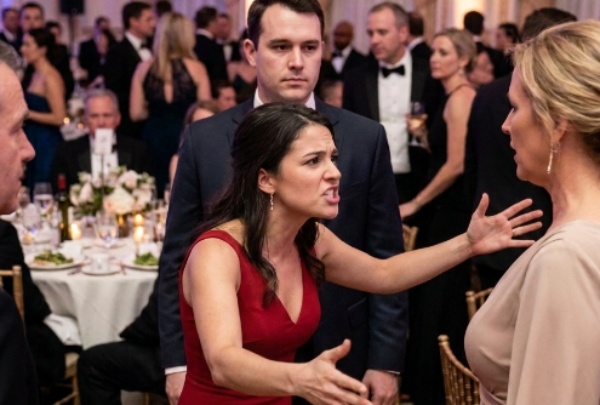
My husband brought his lover to my family’s charity gala and introduced her as a public relations consultant. By the end of the night, she had slapped me in front of donors, board members, and nearly every person he had spent years trying to impress. He begged me not to “make a scene,” but the scene had already happened. And this time, I wasn’t…
Part 1: The Woman in the Silver Dress
My husband brought his lover to my family’s charity gala and introduced her as a public relations consultant.
That was the sentence I kept repeating in my head while standing beneath three crystal chandeliers in the ballroom of the Fairmont Hotel in downtown Chicago. Around me, men in tuxedos lifted glasses of champagne, women in evening gowns admired the floral arrangements, and waiters moved between tables with silver trays of bacon-wrapped scallops.
Everyone thought it was going to be a beautiful night.
For months, I had helped plan that gala. I had chosen the cream table linens, approved the jazz quartet, argued with the florist over the exact shade of white roses, and personally called half the donors to make sure they felt appreciated. The event was for the Whitmore Children’s Literacy Fund, the charity my late parents had started thirty-one years ago with one used bookmobile and a church basement full of donated paperbacks.
My parents believed every child deserved a book with their name written inside the front cover. Not borrowed. Not discarded. Theirs.
When they died within two years of each other, I inherited the charity, the old family brownstone in Lincoln Park, and the responsibility of keeping their work alive. My husband, Daniel, inherited nothing from them except the social shine that came from standing beside me.
And Daniel loved shine.
He loved being photographed with donors. He loved shaking hands with aldermen, school principals, and local business owners. He loved being called “a visionary partner” in newspaper blurbs, even though he had never once sat on the floor of a public school library helping second graders sound out words.
That was my work.
Daniel’s work was being admired for supporting it.
For seventeen years, I let him have that role. I told myself every marriage had compromises. I told myself if people needed to believe Daniel was the charming face of our charity, that was harmless as long as the children still got books.
I had become very good at turning humiliation into practicality.
The gala that night was our biggest fundraiser of the year. Three hundred guests. A silent auction. A live auction. Corporate sponsors. A pledge goal of $750,000 to expand our after-school reading programs into two more Chicago neighborhoods.
I should have been thinking about donor cards and auction paddles.
Instead, I was staring at my husband’s hand on the lower back of a woman I had never met.
She was younger than me by at least fifteen years, maybe more. Early thirties, polished blonde hair, silver dress, red lipstick, diamond earrings too expensive for someone introduced as a consultant. She laughed with her head tilted toward Daniel like he had invented humor.
I knew that laugh.
Not from her.
From myself, years ago.
Before I learned that charm can be a room with no windows.
Daniel saw me watching and smiled in that careful public way of his, the smile that said, behave. Then he guided the woman toward me through the crowd as if he were presenting a new board member instead of walking my humiliation across the ballroom floor.
“Marianne,” he said smoothly, “I want you to meet Vanessa Cole. She’s helping us with public relations for the donor campaign.”
Vanessa extended her hand.
“It’s such an honor,” she said.
Her voice was sweet, warm, practiced. She looked directly into my eyes with the confidence of someone who believed I did not know, or worse, someone who knew I knew and wanted to see what I would do about it.
I shook her hand.
Her fingers were cold.
“Public relations,” I repeated.
Daniel’s smile tightened by one millimeter. No one else would have noticed. I noticed everything about Daniel by then.
“Yes,” he said. “Vanessa has wonderful ideas about expanding our reach.”
“I’m sure she does.”
Vanessa’s smile flickered.
Behind her, Senator Harold Klein was speaking to our board chair, Elaine Mercer. Near the bar, my cousin Ruth was arguing with a caterer about gluten-free desserts. At table twelve, a retired school superintendent was already crying over the video montage we had not even played yet.
The entire room was full of people my husband had spent years trying to impress.
And he had brought his lover into it.
I had suspected there was another woman for six months. Maybe longer, if I was honest. Daniel had started guarding his phone like classified evidence. He bought new cologne, began “working late” on Wednesdays, and suddenly cared about boutique hotels in Milwaukee and Indianapolis.
When I asked questions, he smiled sadly.
“Marianne, you’re exhausted,” he would say. “You always imagine betrayal when you’re stressed.”
That was one of his favorite tricks. He never said I was crazy. He was too refined for that. He simply said I was tired, anxious, emotional, overwhelmed, sensitive, grieving, hormonal, distracted, or anything else that made my instincts sound like symptoms.
So I stopped asking.
But I did not stop noticing.
A lipstick stain on a shirt collar he claimed was from “a donor who hugged too aggressively.” A restaurant receipt for two from a French place in River North on a night he said he ate alone at his office. A text message that flashed across his Apple Watch while he was carving Thanksgiving turkey.
Miss you already.
The sender’s name was saved as V.C. Consulting.
Now V.C. Consulting stood in front of me wearing a silver dress and my husband’s private smile.
“Marianne has been the soul of this charity for years,” Daniel told Vanessa.
The soul.
That was how men like Daniel complimented women in public. They turned our labor into poetry so no one had to pay attention to the work.
Vanessa touched his arm lightly.
“You must be so proud of her,” she said.
I almost laughed.
Daniel said, “Always.”
There are moments when a person’s life splits quietly. Not with shouting. Not with breaking glass. Just one clean inner crack that tells you the old version of yourself cannot continue.
Mine happened then.
Standing between my husband and his mistress, beneath flowers I had chosen and lights I had paid for, I realized I was not heartbroken.
I was finished.
A donor approached before I could speak. Then another. Daniel used the interruption to guide Vanessa away, his hand still hovering near her back, not quite touching this time. He knew I had seen too much.
He also knew I had protected him before.
That was his mistake.
At 7:15 p.m., the gala officially began.
At 7:40, the children’s choir from West Garfield Park sang “This Little Light of Mine,” and half the room reached for tissues.
At 8:05, we served dinner.
At 8:50, Daniel gave a speech about service, family, and the power of community. He thanked the sponsors. He thanked the board. He thanked my late parents with a catch in his voice so convincing even I might have believed it once.
Then he looked at me.
“And most of all,” he said into the microphone, “I want to thank my wife, Marianne, whose grace has taught me what true generosity means.”
The room applauded.
I sat perfectly still.
Vanessa stood near the back wall, watching me over the rim of her wineglass.
By the end of the night, that same woman would slap me in front of donors, board members, and nearly every person Daniel had spent years trying to impress.
But before that happened, Daniel still believed he was in control.
Part 2: The Performance
The first time Daniel lied to my face, we were twenty-nine years old.
We had been married for eight months. I found a credit card charge for a weekend resort in Lake Geneva, Wisconsin, while he was supposedly at a financial conference in Dallas. When I asked him about it, he looked wounded.
“Marianne,” he said, “do you really think that little of me?”
That question worked because I loved him.
I apologized.
Years later, I understood that some people train you to mistake your own reasonable questions for cruelty. They look hurt instead of guilty. They ask why you don’t trust them instead of explaining why they should be trusted.
Daniel became an expert at that.
In public, he was flawless. He remembered people’s names, sent handwritten condolences, brought coffee to staff meetings, and hugged widows with respectful timing. At charity events, he could make a retired banker write a $25,000 check while believing it had been entirely their idea.
At home, he was different.
Not monstrous. That would have been easier to explain.
He was cold in ways that left no bruises. He corrected my stories at dinner parties. He sighed when I spoke too long. He made jokes about my “little projects,” even though my little projects raised enough money to put twenty thousand books into children’s hands every year.
If I complained, he called me defensive.
If I cried, he called me fragile.
If I became quiet, he said I was punishing him.
I learned to choose silence because silence was cheaper.
By the time I was forty-eight, I had become a woman everyone admired and no one really saw. I wore navy dresses, sensible heels, pearl earrings, and expressions appropriate to the occasion. I wrote thank-you notes. I managed staff. I balanced budgets. I smiled next to Daniel in photographs.
And I kept records.
That habit began after my father died.
The charity became more complicated then. There were grants, corporate donors, restricted funds, operating budgets, audit requirements, and donor-advised gifts. Daniel said he wanted to “help professionalize the organization,” which meant he inserted himself into financial conversations and began speaking over me in board meetings.
At first, I was grateful.
Then I was uneasy.
Then I was careful.
Daniel had a talent for making money move through fog. Consulting fees. Event expenses. Reimbursement requests. Vendor recommendations. He never stole in obvious ways. He was too smart for that. He created gray areas and stood inside them smiling.
So I saved everything.
Emails. Receipts. Invoices. Board minutes. Hotel charges. Screenshots of texts. Copies of signed contracts. I told myself it was responsible governance. That was true.
It was also self-defense.
On the night of the gala, all of that sat in a locked folder on my laptop and a second copy with our attorney, Nina Patel. Nina had been my parents’ lawyer before she became mine, a woman with sharp suits, calm eyes, and the ability to say devastating things in a very pleasant voice.
Two weeks before the gala, I had sat in Nina’s office overlooking Michigan Avenue and said, “I think Daniel is having an affair.”
Nina took off her glasses.
“Do you think, or do you know?”
“I know enough.”
“Is the affair connected to the charity?”
“I think so.”
That was when Nina stopped looking like a family friend and started looking like a lawyer.
“Then we separate the personal from the organizational,” she said. “You do not confront him publicly. You do not post anything online. You do not threaten him. You protect the charity first, and yourself second.”
“What about my dignity?”
Nina’s expression softened.
“Marianne, protecting yourself is protecting your dignity.”
I remembered that sentence while watching Vanessa circulate through my gala as if she belonged there.
She was good. I would give her that. She listened with flattering attention, laughed at the right volume, touched people lightly on the arm, and used phrases like “brand visibility” and “community storytelling.” She told donors the charity needed “a more modern emotional footprint,” which sounded meaningful if you didn’t think about it for more than five seconds.
Daniel watched her proudly.
Not romantically at first. Professionally. Possessively. As if he had discovered a younger version of charisma and brought it to show off.
But he forgot I had spent seventeen years studying him.
I saw the way his eyes followed her. I saw the private nod he gave when she moved toward certain donors. I saw her lean close to whisper something that made him briefly close his eyes.
Elaine Mercer saw it too.
Elaine was our board chair, seventy-one, elegant, widowed, and sharper than most knives in most kitchens. She had donated the first $100,000 gift my parents ever received and considered the charity her third child.
She came to stand beside me during the silent auction.
“Who is the woman in silver?” she asked.
“A public relations consultant, apparently.”
Elaine glanced at me. “Apparently?”
I kept my eyes on Daniel. “Daniel brought her.”
Elaine was quiet for a moment.
Then she said, “Do I need to know something tonight?”
That was why I loved Elaine. She never asked questions out of curiosity when action might be required.
“Not yet,” I said.
“Are you sure?”
“No.”
She turned her champagne glass slowly by the stem. “That is not comforting.”
“I know.”
At 9:30, the live auction began.
A weekend in Napa went for $18,000. A private dinner with a Michelin-starred chef went for $31,000. Courtside Bulls tickets went for $12,500, mostly because two law firm partners refused to let each other win.
Money loosened the room.
By 10:10, people were warm with wine and generosity. The pledge cards came out. The video played. Children on-screen talked about reading their first chapter books, about wanting to become teachers, doctors, artists, engineers. One little boy named Mateo said books made him feel “like the world had more rooms.”
That line broke the room open.
Within fifteen minutes, we passed our goal.
$812,000.
I should have felt joy.
I did feel joy.
Then I looked across the ballroom and saw Daniel leading Vanessa toward the service hallway.
Not the lobby. Not the restroom corridor. The service hallway behind the ballroom, where staff carried trays and donors never went.
I followed them.
I did not plan to. My body simply moved before my caution could catch up.
The hallway was narrow and brightly lit, the opposite of the ballroom’s warm gold glow. The carpet gave way to gray utility flooring. The sound of music became muffled behind the walls.
Daniel and Vanessa stood near a stack of folded banquet chairs.
He had his hand on her waist.
She was crying.
That surprised me.
“I can’t keep doing this,” she said.
Daniel spoke softly. “Not here.”
“You said after tonight.”
“I said we would talk after tonight.”
“No, Daniel. You said after tonight you would tell her.”
I stood very still.
Tell me what?
Vanessa wiped under her eye carefully, trying not to ruin her makeup. “I have been patient. I have smiled at your wife. I have listened to you talk about timing and optics and the board and your reputation. I’m done being hidden.”
Daniel’s face changed.
Not into guilt.
Into irritation.
“Lower your voice,” he said.
That was when I stepped forward.
“You should listen to her,” I said. “The walls are thin.”
They both turned.
For one second, nobody breathed.
Then Daniel did what Daniel always did.
He performed.
“Marianne,” he said, with perfect wounded surprise. “This isn’t what it looks like.”
It was almost impressive, really. The man could stand in a burning kitchen holding a match and accuse the smoke of being misunderstood.
Vanessa stared at me, her face pale beneath expensive foundation.
“I think it is exactly what it looks like,” I said.
Daniel took a step toward me. “We are not doing this here.”
“No,” I said. “You did this here.”
His jaw tightened.
Vanessa looked between us. “He told me you knew.”
I laughed once. Not loudly. Not kindly.
“Of course he did.”
Her face crumpled with anger and embarrassment. “He said your marriage was over.”
“That must have been convenient for both of you.”
Her eyes hardened.
Daniel raised a hand. “Enough.”
I looked at him. “No, Daniel. Not enough. Not anymore.”
For the first time that night, he looked afraid.
Not because he loved me.
Because there were witnesses nearby.
A waiter appeared at the end of the hall carrying a tray of empty coffee cups. He saw us, froze, and reversed direction with the wisdom of a man paid hourly and unwilling to die for other people’s drama.
“Marianne,” Daniel said, lowering his voice, “go back to the ballroom.”
“Is that an instruction?”
“It is a request.”
“No. A request leaves room for refusal.”
Vanessa stepped forward. “You don’t have to humiliate him.”
I turned to her slowly.
That sentence was the match.
Not because she defended him. I expected that. But because she said it as if humiliation was something I was creating, not something they had dragged into my parents’ charity gala wearing perfume and lies.
“Vanessa,” I said, “he introduced his mistress as a public relations consultant at a fundraiser built by my dead parents. If humiliation is present tonight, I did not invite it.”
Her face flushed.
Daniel snapped, “That’s enough.”
The ballroom doors opened then, and laughter spilled into the hallway. Two donors stepped out, followed by Elaine Mercer. Elaine saw us, saw Daniel’s face, saw Vanessa’s tears, and understood enough to move closer.
“Is there a problem?” Elaine asked.
Daniel immediately softened his expression.
“Nothing we can’t handle,” he said.
Elaine looked at me.
I said nothing.
That silence frightened Daniel more than any shouting would have.
He knew I was a woman who filled silence to make others comfortable. I explained, softened, translated, excused, and repaired. But that night, I let silence stand there in its full height.
Vanessa looked at Elaine, then at me, then at Daniel.
“You told me you were leaving her,” she said.
Elaine’s eyebrows rose.
Daniel whispered, “Vanessa.”
But it was too late.
The scene had already happened.
Part 3: The Slap
People always say everything happens fast in shocking moments.
That is not how I remember it.
I remember the slap slowly.
I remember Vanessa’s hand rising. I remember the silver bracelet sliding down her wrist. I remember Daniel reaching too late, not to protect me, but to stop the spectacle. I remember the sound, sharp and flat, echoing against the service hallway walls.
Then I remember my cheek burning.
For three seconds, nobody moved.
Vanessa looked as shocked as I was, as if her hand had made the decision without informing the rest of her. Daniel stared at me with horror, but not the kind a husband should feel when his wife has just been struck.
His horror was social.
He was watching donors gather behind Elaine.
Board members. Sponsors. Staff. A city councilman. The retired superintendent. My cousin Ruth, still holding a gluten-free cupcake like evidence.
Nearly every person Daniel had spent years trying to impress stood there and saw the truth arranged in human form: his wife with a red mark on her cheek, his mistress in a silver dress, and him between us, begging the wrong person for mercy.
“Marianne,” he said, “please don’t make a scene.”
That was when something in the hallway changed.
Not outside me.
Inside me.
For years, Daniel had used that phrase like a leash.
Don’t make a scene when he corrected me in front of friends. Don’t make a scene when he disappeared during my mother’s final hospital stay and claimed a client emergency. Don’t make a scene when he flirted with younger women at donor dinners. Don’t make a scene when he moved charity money through vendors I did not trust.
The scene had always been happening.
I had merely been trained not to point at it.
I touched my cheek gently.
Then I looked at him.
“The scene,” I said, “is that your lover just assaulted me at my family’s charity gala.”
Someone gasped.
Vanessa began crying harder. “I’m sorry. I didn’t mean—”
“Do not speak to me right now,” I said.
My voice was calm.
That calmness scared people more than screaming would have.
Elaine stepped beside me. “Marianne, do you want hotel security?”
Daniel turned to her. “Elaine, that’s unnecessary.”
Elaine did not look at him.
“Marianne?” she repeated.
I looked at Vanessa.
She looked young suddenly. Not innocent. Young. A woman who had believed a married man’s version of reality and discovered in public that she was not special enough to be spared from his lies.
But young did not mean harmless.
And pain did not excuse striking another person.
“Yes,” I said. “Please call security.”
Daniel’s face went white.
“Marianne, think carefully.”
“I am.”
“You don’t want this attached to the charity.”
I almost smiled.
Even then, he thought the charity was a shield for him to crouch behind.
“No,” I said. “I don’t want you attached to the charity.”
The hallway went silent.
Elaine’s mouth tightened, but her eyes flashed with approval.
Daniel lowered his voice so only I could hear. “You will regret this.”
I turned slightly toward him.
“Say that louder,” I said.
He glanced at the donors.
Of course he did not.
Security arrived within four minutes. Two men in dark suits and earpieces, polite but serious. The hotel event manager came with them, a woman named Patrice who looked like she had handled everything from drunk groomsmen to senators behaving badly.
“What happened?” Patrice asked.
“I was struck in the face by Ms. Cole,” I said. “I would like the incident documented.”
Vanessa sobbed. “It was an accident.”
Ruth said, “Honey, I watched you pull your arm back.”
I had never loved my cousin more.
Daniel looked like he wanted the floor to swallow Ruth first and him second.
Patrice asked whether I wanted police called.
The question hung in the hallway.
Everyone waited for me to protect the room.
To say no, no, it’s fine. To minimize. To preserve the donors’ comfort, Daniel’s reputation, Vanessa’s future, the charity’s dignity, everyone and everything except my own face.
I thought of my mother then.
Not as she was at the end, frail and furious at her failing lungs, but as she was when I was a child. She used to stand in front of rooms full of businessmen who thought a woman asking for library funding was cute, and she would make them write checks before dessert.
My mother did not confuse grace with surrender.
“Yes,” I said. “Call the police.”
Daniel closed his eyes.
Vanessa whispered, “Oh my God.”
The police did not arrive with sirens. This was downtown Chicago on a Saturday night, and a slap at a charity gala was not exactly a bank robbery. Two officers came through the service entrance twenty minutes later while Elaine moved the donors back into the ballroom and instructed the jazz quartet to keep playing.
That was Elaine’s genius.
She could preserve an institution while allowing truth to breathe.
I gave a statement. So did Vanessa. So did Ruth, Elaine, and the waiter who had tried very hard not to be involved but had seen enough. The officers explained that I could choose whether to pursue a complaint. They documented the visible redness on my cheek and advised me of my options.
I said I wanted the report filed.
Vanessa did not get dragged away in handcuffs. Real life is usually less cinematic than people want. But she was escorted out of the hotel, shaking, mascara streaked down her face, silver dress catching the light with every step.
Daniel tried to follow her.
Elaine stepped in front of him.
“Do not,” she said.
He stared at her. “Excuse me?”
“If you leave this room with that woman tonight,” Elaine said quietly, “do not bother returning to any board meeting connected to this foundation.”
Daniel looked at me, expecting me to soften it.
I did not.
He stayed.
That was the cruelest part, maybe.
Not that he had brought her.
Not that she had slapped me.
That he stayed because the board mattered more to him than either of us.
At 11:42 p.m., I returned to the ballroom.
The crowd tried not to stare and failed. Some people looked sympathetic. Some looked hungry for gossip. Some looked ashamed, though they had done nothing wrong except witness what polite society prefers to pretend does not happen among people with engraved invitations.
I walked to the podium.
Daniel caught my arm before I reached it.
“Marianne,” he whispered, “please.”
I looked down at his hand.
He let go.
“I am not going to ruin the charity,” I said. “That is your fear because that is what you would do.”
He looked as if I had slapped him back.
But I did not need my hands for what came next.
I stepped to the microphone.
The ballroom quieted.
I could see every face. Donors, staff, board members, volunteers, sponsors, friends, acquaintances, people who loved me, people who barely knew me, people who had admired Daniel for years because I had allowed them to.
I took one breath.
“Good evening,” I said. “I apologize for the interruption some of you witnessed tonight. Since this event supports children and families, I will not allow private misconduct to take attention away from the work my parents started and all of you continue to make possible.”
Daniel stood frozen near the side of the stage.
I continued.
“Thanks to your generosity, we have raised more than $812,000 tonight. That means thousands of children in Chicago will receive books, reading support, and after-school programming this year. That is the story that deserves to leave this ballroom.”
A few people applauded softly.
Then more.
Then the whole room.
I did not look at Daniel.
“And tomorrow,” I said, “the board will receive information regarding leadership changes necessary to protect the integrity of this organization.”
The applause stopped.
Daniel’s face turned gray.
I smiled, not because I was happy, but because I was free.
“Thank you for standing with the children we serve,” I said. “Please get home safely.”
Then I left the stage.
Daniel followed me into the lobby.
“What did you do?” he demanded.
I kept walking.
“What did you send them?”
I turned near the coat check.
“The truth.”
His nostrils flared. “You have no idea what you’re destroying.”
I looked at the man I had married.
Handsome. Polished. Terrified.
“No, Daniel,” I said. “I know exactly what I’m saving.”
Part 4: The Morning After
By 8:00 the next morning, my phone had eighty-three unread messages.
By 9:30, it had one hundred and twelve.
By 10:00, Nina Patel was sitting at my kitchen table with coffee, a yellow legal pad, and the expression of a woman who had expected disaster but appreciated punctuality.
My cheek had faded from bright red to a dull tenderness. I had slept three hours, maybe four. The house felt strange without Daniel in it, though he had not officially moved out. His absence had weight, like a piano removed from a room.
Nina reviewed the police report number, the board packet, and the emergency meeting schedule.
“You handled yourself well,” she said.
“I wanted to throw a water glass at his head.”
“But you didn’t.”
“I considered it.”
“Considering is free.”
That made me laugh for the first time since the slap.
Elaine arrived at 10:15 with a paper bag of bagels and the fury of an Old Testament prophet wearing Chanel. Ruth arrived ten minutes later with cream cheese, gossip, and three printed screenshots from social media.
“People are posting,” Ruth said.
“Of course they are,” Nina replied.
A guest had uploaded a vague Facebook post about “unexpected drama at a Chicago charity gala.” Someone else had written, “When the PR consultant turns out to be more than PR.” No names yet, but enough hints for half the city’s nonprofit circles to start texting.
Nina pointed at me.
“You do not respond.”
“I know.”
“You do not clarify.”
“I know.”
“You do not like comments, share posts, or write something poetic about betrayal.”
Ruth looked disappointed.
I said, “I know.”
Nina had already drafted a short public statement for the charity.
The Whitmore Children’s Literacy Fund remains focused on its mission to expand access to books and reading support for children across Chicago. Following an incident at last night’s annual gala, the board is reviewing internal leadership matters. We are grateful to our donors, volunteers, and community partners for their continued support.
No names. No accusations. No gossip.
Clean. Legal. Boring.
Boring, I was learning, could be powerful.
The emergency board meeting happened at noon over Zoom, though Elaine came to my house so we could sit side by side. Daniel joined from his office, wearing a suit and the expression of a man prepared to charm his way through a house fire.
He began before Elaine even finished calling the meeting to order.
“I want to apologize for the unfortunate personal matter that became visible last night,” he said. “I deeply regret that Marianne chose to address it publicly during a donor event.”
Ruth, who was listening from the kitchen despite not being on the board, whispered, “Oh, I’ll kill him.”
Nina held up one finger without looking away from the screen.
Elaine said, “Daniel, you will have an opportunity to speak after the materials are reviewed.”
His smile faltered.
“What materials?”
I clicked share screen.
For a moment, I felt the old fear. The trained reflex to protect him. The memory of every time I had swallowed truth to keep dinner pleasant, donors comfortable, staff undistracted, relatives uninvolved.
Then I saw my own reflection in the laptop screen.
My cheek still faintly marked.
My shoulders straight.
I opened the first folder.
Vendor contracts.
Consulting invoices.
Travel reimbursements.
Payments made to V.C. Consulting over eighteen months totaling $96,400.
Board members began shifting in their little Zoom squares.
Daniel leaned forward. “Those were approved expenses.”
“Some were,” Nina said. “Some appear to lack proper documentation. Several overlap with hotel bookings and travel dates unrelated to charity business.”
“That’s absurd.”
I opened the second folder.
Hotel receipts.
Flights.
Restaurant charges.
Calendar entries.
Emails showing Daniel had recommended Vanessa’s firm without disclosing their personal relationship.
Elaine’s voice was cold. “Daniel, did you have a romantic or sexual relationship with Ms. Cole while recommending payments to her consulting business?”
Daniel looked at me.
Even then, he searched my face for rescue.
I gave him none.
“That is a private matter,” he said.
“No,” Elaine replied. “It became a governance matter when foundation funds were involved.”
There it was.
The sentence that separated scandal from accountability.
For years, Daniel had counted on people being too embarrassed to use direct language. Affair. Conflict of interest. Undisclosed relationship. Misuse of funds. Assault. Police report.
Polite people soften words.
But law, when used correctly, sharpens them.
The board voted to place Daniel on immediate administrative leave from any charity role pending an independent review. His access to charity accounts, email, donor systems, and internal documents was suspended by 2:00 p.m. By 3:30, the foundation’s outside accounting firm had been contacted. By 4:15, Daniel had called me eleven times.
I did not answer.
At 5:02, he came home.
Not quietly.
The front door opened hard enough to hit the wall. I was in the dining room with Nina, Elaine, and Ruth, sorting physical copies of documents into banker’s boxes. Daniel stopped when he saw them.
“You invited an audience,” he said.
Nina looked up. “Your wife invited counsel and witnesses.”
His mouth tightened.
Elaine stood. “I’m leaving now. Marianne, call me if you need anything.”
Ruth crossed her arms. “I’m staying.”
“No,” Nina said. “You’re leaving too.”
Ruth protested, but Nina gave her a look that could freeze Lake Michigan.
Five minutes later, only Daniel, Nina, and I remained.
Daniel turned to me.
“How long have you been planning this?”
I looked at him across the dining room table my parents had bought when I was twelve.
“I didn’t plan your choices.”
“You collected documents.”
“Yes.”
“You spied on me.”
“I reviewed charity records and household finances.”
“You wanted to destroy me.”
“No,” I said. “For a long time, I wanted to believe you.”
That landed.
He looked away first.
Then, because remorse was too honest a place for him to stay, he turned cruel.
“You think these people care about you?” he asked. “They care about the charity. They care about money. Without me, half those donors won’t return your calls.”
Nina wrote something on her legal pad.
I almost thanked him for speaking in front of my attorney.
“Maybe,” I said. “But the children we serve deserve money raised honestly.”
He laughed. “You sound like your mother.”
That should have hurt.
Instead, it steadied me.
“Good.”
His eyes narrowed. “You’ll regret making me your enemy.”
Nina finally spoke.
“Mr. Hale, I’m going to advise you to stop threatening my client.”
“I’m not threatening her.”
“You are. Poorly.”
A strange thing happened then.
Daniel looked small.
Not harmless. Not powerless. But small in the way stage sets look small when the lights come up and you can see the plywood.
For years, I had mistaken his control for strength.
It was not strength.
It was fear, outsourced.
Nina slid a document across the table.
“This is a notice requesting that you temporarily vacate the residence while marital and organizational matters are reviewed. You are not required to sign it right now, but I strongly suggest you consult your own attorney before removing documents, devices, or property from this home.”
Daniel looked at the paper, then at me.
“You’re kicking me out.”
“I’m asking you to leave.”
“This is my house too.”
“Yes,” I said. “And we will handle that legally.”
He studied me, waiting for my voice to break.
It did not.
At 7:20 p.m., Daniel packed two suitcases.
At 7:44, he walked out.
At 7:46, I locked the door.
Then I sat on the staircase and cried until my ribs hurt.
Not because I wanted him back.
Because ending a lie still hurts when you built a life around it.
Part 5: The Truth Stays
The independent review took four months.
The divorce took fourteen.
The gossip took about three weeks to become boring, which was both insulting and comforting.
At first, people called constantly. Some with real concern. Some with curiosity wearing concern’s coat. A few wanted details so badly they practically drooled through the phone.
I learned to say one sentence.
“I’m focusing on my family, my health, and the charity.”
Then I stopped talking.
Silence is different when you choose it.
Daniel hired an attorney who sent aggressive letters full of phrases like reputational harm and emotional distress. Nina responded with documents, dates, and calm language. The letters became less aggressive after that.
Vanessa disappeared from Chicago nonprofit circles almost immediately.
I did not pursue a civil case against her. I did file the police report, and I did cooperate when contacted. Eventually, through her attorney, she sent a formal written apology that used the word “assault” once and the word “unacceptable” twice.
I read it at my kitchen table.
Then I put it in a folder and made tea.
People expected me to hate her loudly, but I found that I could not give her that much of my life. Vanessa had harmed me. She had also been lied to by the same man who lied to me, though that did not excuse what she did.
Accountability did not require obsession.
That became one of the lessons I kept.
Daniel resigned from the charity before the review concluded, claiming he wanted to avoid distracting from the mission. The review found undisclosed conflicts of interest, improper reimbursements, and governance violations. It did not find enough to turn the entire matter into the kind of criminal scandal people whispered about, but it found enough.
Enough for repayment.
Enough for resignation.
Enough for the board to restructure financial controls.
Enough for every donor to understand that the charming man with perfect speeches had not been the hero of the story.
The charity survived.
More than that, it grew.
That shocked Daniel most of all.
He had spent years telling me donors loved him. Maybe some did. But most loved the children. Most loved the mission. Most loved the memory of my parents driving through Chicago winters in a rattling bookmobile with boxes of paperbacks and a thermos of coffee between them.
Six months after the gala, we opened two new reading rooms.
One on the South Side.
One in Humboldt Park.
At the ribbon-cutting, a little girl named Alina chose a copy of Charlotte’s Web and asked if she had to give it back.
“No,” I told her. “It’s yours.”
She hugged the book to her chest like I had handed her a passport.
That was the moment I knew Daniel had not destroyed the thing my parents built.
He had only revealed that he was never its foundation.
My personal life took longer to rebuild.
The house felt too quiet at first. I kept expecting Daniel’s keys in the bowl by the door, his voice from the den, his criticism disguised as a question. Are you wearing that? Did you mean to send that email? Don’t you think you’re overreacting?
The ghosts of control stay after the controller leaves.
So I changed small things.
I painted the dining room blue because Daniel had always insisted neutral colors helped resale value. I replaced the heavy curtains in the bedroom with linen ones that let in morning light. I donated the tuxedo he left in the hall closet after Nina confirmed I could.
Ruth helped me clear out the garage.
Elaine made me join her for Saturday breakfast once a month and pretended it was about board business.
My therapist, Dr. Levin, taught me that betrayal is not only the act itself. It is the years you spend questioning your own judgment afterward.
“Your instincts were working,” she told me. “You were trained not to trust them.”
That sentence stayed with me.
The first time I went to a gala after everything happened, I almost turned around in the parking lot.
It was not even my event. It was for a hospital foundation in Evanston, and I was only a guest. Still, when I saw the women in gowns and the men in dark suits, my cheek seemed to remember the slap before my mind did.
I sat in my car gripping the steering wheel.
Then I looked at myself in the rearview mirror.
“You are not the scene,” I said out loud.
It sounded silly.
It worked anyway.
I went inside.
People were kind. Some too kind, which is its own kind of discomfort. But nobody slapped me, nobody asked for details, and nobody collapsed because I arrived without Daniel.
Life, I discovered, continues without the people who once convinced you they were holding it together.
A year after the gala, the Whitmore Children’s Literacy Fund held its annual fundraiser again.
Same hotel.
Same ballroom.
Different woman at the microphone.
Me.
I wore a deep green dress, my mother’s earrings, and no wedding ring. The chandeliers were still dramatic. The flowers were still expensive. The donors still drank too much white wine and became generous after dessert.
But the air felt different.
Cleaner.
Elaine sat at the front table. Ruth waved from the back like she was at a baseball game. Nina attended as a guest and still somehow looked like she was billing someone.
When I stepped onto the stage, the room stood.
A standing ovation is a strange thing when you know how much of survival happens on bathroom floors, in lawyer’s offices, and in the silent seconds before you decide not to answer the phone. Applause makes strength look glamorous. It is not.
Strength is often paperwork.
Strength is a locked door.
Strength is saying, “Please call security,” when everyone expects you to smooth things over.
I waited until the room quieted.
“Last year,” I said, “this organization faced a difficult moment.”
A ripple moved through the ballroom.
I continued.
“We learned that integrity cannot be something we print in a program booklet. It has to be something we practice when it costs us comfort.”
Elaine nodded once.
I looked out over the donors.
“My parents started this work because they believed children deserve access to stories. Stories help us understand who we are, where we come from, and what kind of future we can imagine. But adults need honest stories too.”
The room was completely still.
“For a long time, I told a story that protected someone else. I called silence grace. I called endurance loyalty. I called fear privacy.”
My voice did not shake.
“I do not do that anymore.”
No one applauded yet.
They were listening too hard.
“This foundation is here because truth did not destroy it. Truth protected it. And every child who receives a book because of your generosity tonight is part of a better story than the one we refused to keep telling.”
Then the room stood again.
This time, I let myself feel it.
Not as praise.
As witness.
After the event, we raised $1.1 million.
The next morning, Daniel sent me an email.
No subject line.
Marianne,
I heard last night went well. Despite everything, I’m glad the charity is succeeding. I know you probably won’t believe this, but I’m sorry for the pain I caused. I hope someday you can remember there were good years too.
Daniel
I read it twice.
There had been good years.
That was the cruel part.
Bad marriages are rarely bad every minute. If they were, more people would leave sooner. There had been road trips, Christmas mornings, hospital waiting rooms where he held my hand, dinners where he made me laugh until I cried.
But good moments do not erase a pattern.
A candle does not excuse a house fire.
I did not reply.
Instead, I went to the new reading room in Humboldt Park. It smelled like carpet cleaner, crayons, and construction dust. Volunteers were still arranging books by age group, and a boy in a red hoodie was sitting cross-legged in the corner reading Dog Man with total concentration.
I sat at a small table and wrote my parents’ names on a dedication plaque.
Then I wrote mine beneath theirs.
Not Daniel’s.
Mine.
That evening, I walked home through Lincoln Park with my coat buttoned against the cold. The city was loud around me: traffic, dogs barking, someone laughing outside a bar, the distant rumble of the train. Chicago did not care that I had survived something. That comforted me.
At home, I placed my keys in the bowl by the door.
Only my keys.
The house was quiet, but no longer empty.
On the mantel, I kept one photograph from the old days. Not of Daniel. Not of galas or ribbon-cuttings or staged smiles.
It was a picture of my parents standing beside their first bookmobile, both of them windblown and grinning, my mother holding a cardboard box full of children’s books, my father giving a thumbs-up like a man who believed hope could fit inside a van.
For years, I thought protecting their legacy meant protecting the image of my marriage.
I was wrong.
Protecting their legacy meant protecting the truth.
My husband brought his lover to my family’s charity gala and introduced her as a public relations consultant. By the end of the night, she had slapped me in front of donors, board members, and nearly every person he had spent years trying to impress. He begged me not to make a scene, but the scene had already happened.
And this time, I did not clean it up for him.
I did not smile for the room.
I did not swallow the truth so others could digest their dessert comfortably.
I called security.
I filed the report.
I opened the folders.
I let the board see what I had seen for years.
And when people asked me later how I found the courage to do all that, I told them the truth.
Courage did not arrive like lightning.
It arrived like a receipt.
One small proof at a time.
One lie documented.
One boundary spoken.
One locked door.
One night when I finally understood that protecting a man from the consequences of his own choices was not love.
It was captivity.
And I was done living inside it.
