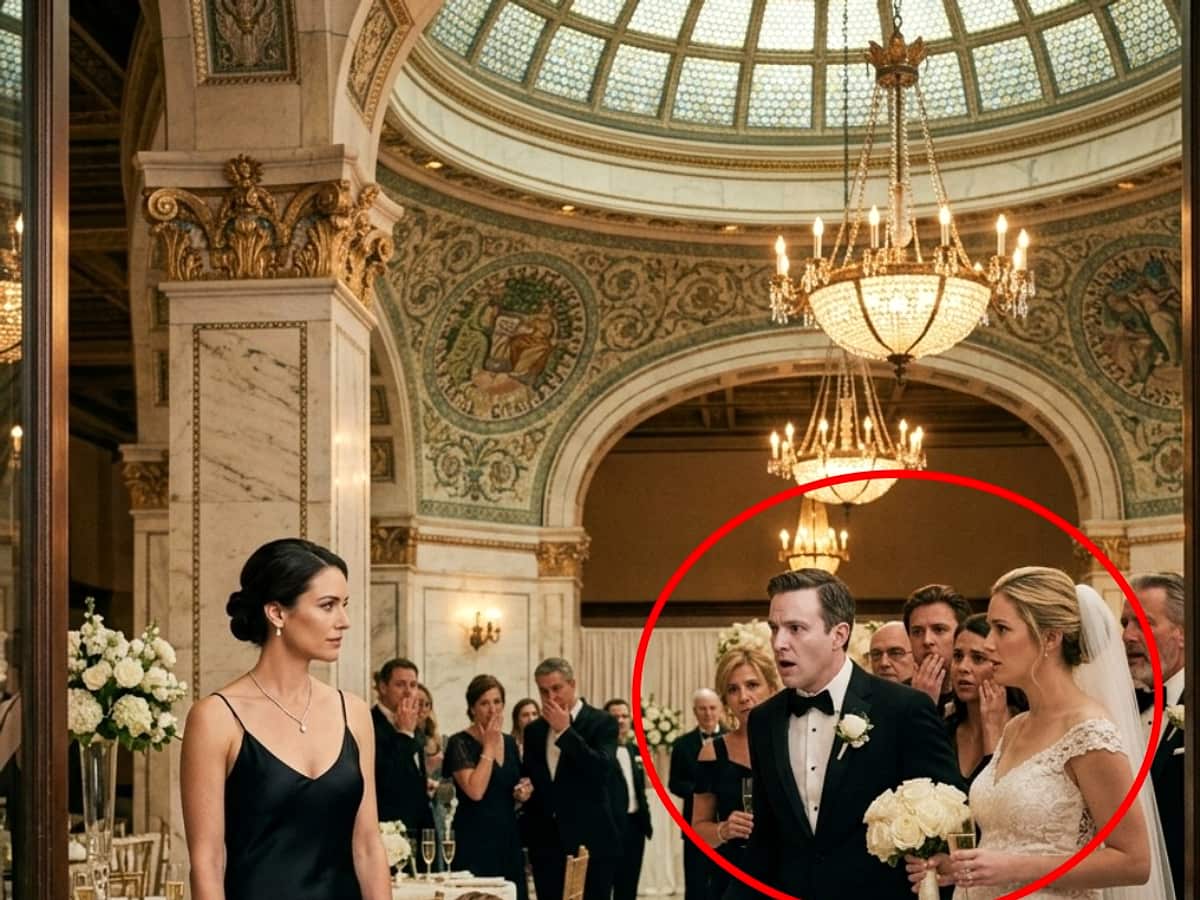
Part 1: The Ivory Envelope and What It Really Said
The invitation arrived on a Tuesday, slipped between a water bill and a catalog for children’s rain boots. I almost missed it entirely.
It was heavier than ordinary mail, sealed inside a cream-colored outer envelope lined with tissue paper so fine it whispered when I unfolded it. The cardstock inside was ivory, thick as a wedding announcement from another era, embossed in gold lettering that caught the morning light coming through my kitchen window in Evanston. It smelled faintly of something expensive — not perfume exactly, more like the inside of a department store where everything costs more than it should.
I read the names at the top twice.
Mark Edward Harrington and Sloane Avery Whitcomb.
Beneath that, in the kind of formal script that takes a calligrapher hours to produce: request the pleasure of your company at their wedding celebration. The Chicago Cultural Center. A Saturday evening in June.
Black tie. Six o’clock.
It was addressed to Mrs. Ava Bennett — my maiden name, restored after the divorce, spelled correctly for the first time in years by people who had spent most of our marriage mispronouncing it at dinner parties.
At the bottom of the card, in handwriting I recognized immediately, was a note in blue ink. Eleanor Harrington’s penmanship had always been precise, the letters leaning slightly right, the kind of script taught in private schools that no longer exist.
Ava — we hope enough time has passed for everyone to celebrate with grace.
Grace. I set the card down on the kitchen island and looked at that word for a long moment.
Grace was what powerful people asked of the people they had hurt. It meant: be quiet, be pleasant, do not remind us of what we did, and smile while we take photographs.
From the living room came the sound of my three-year-old twins in full negotiation. Lily was explaining, with great patience and considerable volume, that dinosaurs could absolutely eat pancakes if the pancakes were big enough.
Noah was countering that dinosaurs were extinct and therefore could not eat anything, which was, he informed her, a scientific fact. Lily told him science was wrong.
I walked to the doorway and watched them for a moment. Lily had syrup on her chin and her dark hair was escaping the braid I had put in twenty minutes ago. Noah was gesturing with a fork, his gray eyes — Mark’s eyes, exactly, the same cool silver-gray — wide with the effort of being correct.
Behind them, through the tall windows, Lake Michigan was doing what it always did in early spring: lying flat and blue and indifferent, as if the world’s small dramas were not its concern.
My phone buzzed on the counter. A text from Caroline Harrington, Mark’s younger sister, who had once told me over champagne at a Lake Forest fundraiser that some women simply were not built for legacy. She had said it gently, as if she were offering condolences.
Did you get it?
I did not answer.
Another message, thirty seconds later: You should come. It would show everyone you’ve moved on.
Then a third: Sloane really just wants peace. And honestly, seeing Mark happy might give you some closure.
I put the phone face-down on the counter.
I understood the invitation now in full. Not as a gesture of reconciliation.
Not as proof that time had softened anyone. The Harrington family had spent five years constructing a very specific story for Chicago society: Mark, the devoted heir, had endured a tragic first marriage to a woman who could not give him children.
He had waited, grieved quietly, and found love again with Sloane Whitcomb — twenty-eight years old, radiant, already pregnant with what every magazine profile called the first Harrington heir. Their engagement announcement had run in two glossy publications.
Their baby shower had been photographed for a lifestyle website with four hundred thousand subscribers.
The story was clean and complete. The only loose thread was me.
If I stayed away, I was the bitter ex, haunting the edges of their happiness. If I came and sat quietly in a ballroom full of Chicago’s oldest money while Mark slid a ring onto Sloane’s finger, I became proof that the story was true — that I had accepted my role as the defective first chapter, the woman who failed, the one who was left behind.
Either way, they won.
Unless I changed the terms.
I picked up the invitation again and looked at it for a long time. Lily wandered in from the living room, climbed onto the barstool beside me, and peered at the gold lettering with great seriousness.
“Is that fancy mail?” she asked.
“Very fancy,” I said.
“Are we going to a party?”
I looked at her — at Mark’s eyes in her small face, at the stubborn set of her chin that she had gotten from me — and felt something settle in my chest like a stone finding the bottom of still water.
“I’m thinking about it,” I said.
What I did not say, what I was only beginning to understand myself, was that the Harrington family had invited me to watch their bloodline continue without me — and their bloodline was currently asking for more orange juice.
Part 2: The Documents He Never Read
Mark Harrington had wanted children the way some men want a corner office: as confirmation of arrival, as evidence that the story of his life was proceeding correctly.
When we were first married, he talked about it often. Sons who would learn to sail on Lake Michigan.
Daughters he would walk through the Art Institute on Sunday mornings. He imagined Christmas cards and family portraits and the particular satisfaction of watching a child carry your name into the next generation.
He said these things warmly, with real feeling, and I believed him.
What I did not understand then — what took me years and two therapists and a great deal of quiet to see clearly — was that Mark wanted the idea of children with a ferocity that left no room for the reality of trying to have them.
We began fertility treatments in our second year of marriage. The first round of IVF failed.
The second failed. The third produced four viable embryos, and I transferred two of them in the spring of our fourth year together.
That transfer failed as well. I was thirty-four years old, lying on a clinic table in a paper gown, and the nurse who told me the news held my hand for a moment longer than was strictly required, which meant she had seen this expression on a woman’s face before.
Mark was in a board meeting. He texted me an hour later: Sorry, babe. We’ll figure it out.
We did not figure it out. What we did instead was stop talking about it in any honest way.
Mark began working later. I began noticing things I had previously explained away.
By our fifth anniversary, we were two people sharing a beautiful apartment on the Gold Coast, sleeping in the same bed, and conducting entirely separate interior lives.
The divorce was filed in October. It was not dramatic. It was worse than dramatic — it was quiet, and efficient, and handled by attorneys who billed by the hour and had seen everything.
In the final weeks of negotiation, Mark’s attorney raised the question of the remaining embryos. Two viable embryos still stored at the fertility clinic, still legally both of ours, still waiting in a freezer on the North Side of Chicago.
Mark’s attorney proposed a release agreement: Mark would relinquish all claim, all parental rights, all future interest. The embryos would be mine to use, donate, or discard as I chose.
In exchange, I would waive any future support claims connected to those embryos.
Mark signed the agreement on a Thursday afternoon. His attorney later told my attorney that Mark had not asked a single question about the document before signing.
He thought he was closing a door on something painful.
He did not understand that he was handing me a key.
I did not use the embryos immediately. I needed time — time to grieve the marriage, time to rebuild something that felt like myself, time to find a life that was mine and not a supporting role in someone else’s narrative.
I moved to San Diego for a year. I found a therapist I trusted.
I ran along the ocean in the mornings and ate dinner alone at restaurants and slowly, carefully, learned what it felt like to want things for my own reasons.
When I was ready, I called my attorney, Julian Ross, and told him I wanted to proceed.
Julian was methodical and calm in the way that only people who have seen genuine legal chaos can afford to be. He reviewed every document, confirmed the chain of custody with the clinic, and worked with a family law specialist to ensure that the process was airtight.
A court order clarified parentage and decision-making authority. Every step was documented, filed, and sealed.
Nine months later, Lily and Noah were born in San Diego at 2:14 and 2:19 in the morning. Lily came first, furious and loud. Noah came five minutes later, blinking at the lights as if he found them mildly interesting.
Maya was there. She had flown down from Chicago two days before my due date and refused to leave until both babies were home and sleeping. She cried in the delivery room, which she later denied, though three nurses witnessed it.
Mark did not know. Not because I had hidden anything illegally. Because he had signed away the right to be informed, and I had no legal or moral obligation to contact a man who had called me a barren failure and moved on within eight months of our divorce.
But there was one matter that extended beyond the two of us.
The Harrington family trust had been established by Mark’s grandfather, Edward Harrington II, a man I had met twice before he died — once at a Christmas dinner where he spoke to me for approximately four minutes, and once at his eighty-fifth birthday party where he did not speak to me at all. He had been cold, precise, and entirely convinced that bloodlines were the only currency that mattered.
His trust reflected that conviction. The language was old and blunt: distributions were reserved for biological descendants of Edward Harrington II, verified by lawful documentation, with specific protections for minor children.
The trust held approximately fifty million dollars in assets. Mark’s unborn child with Sloane would, in time, be recognized as a beneficiary.
So would Lily and Noah.
When the twins were six months old, Julian submitted sealed documentation to the independent trustee: birth certificates, genetic testing results, court orders, the embryo consent agreement, the full chain of custody from the clinic. Everything clean, everything documented, everything exactly as the trust’s own language required.
The trustee recognized Lily and Noah as Harrington descendants before they had learned to pull themselves upright on the furniture.
Mark’s “first heir” was still being photographed in maternity shoots. His actual first heirs were learning to walk in my living room in Evanston.
I folded the wedding invitation and placed it on the counter beside my coffee. Then I called Maya.
She answered on the second ring. “I already know something happened,” she said. “You have your quiet voice.”
“They invited me to the wedding.”
A long pause. “Mark’s wedding.”
“Mark’s wedding.”
“Ava.”
“I know.”
“Tell me you are not considering going.”
I looked at Lily and Noah, who had abandoned the pancake debate and were now constructing something architectural out of couch cushions.
“I’m calling Julian,” I said.
And the thing about calling Julian was that he never told me what I wanted to hear — he told me what was true, which was, in the end, so much more useful.
Part 3: The Night the Marble Floors Remembered Everything
The Chicago Cultural Center was the kind of building that made you feel, the moment you stepped inside, that whatever you were carrying deserved to be carried with more dignity. Its grand staircase rose under vaulted ceilings tiled in mosaic, and the light that evening — soft gold from a hundred carefully placed fixtures — made the marble glow as if the building itself were holding its breath.
I arrived at 6:15, late enough to avoid the receiving line, early enough to find our seats before the ceremony began. Julian had advised me to arrive quietly, to speak to no one unless spoken to, and to remember that I was attending a social event to which I had been formally invited.
I was not there to confront anyone. I was not there to announce anything.
I was simply there.
With my children.
Lily wore a navy dress with white smocking across the chest and white shoes that she had insisted on polishing herself, which meant they were clean in some places and not others. Noah wore a small suit — charcoal gray, a white shirt, a tie that he had allowed me to knot only after I promised him he could take it off after dinner. He looked, in a way that made my throat tighten, exactly like photographs I had seen of Mark at that age.
We walked in together, the three of us, through the tall bronze doors and into the light.
I felt the room before I saw it. The shift in the air when people notice something unexpected. The small pause in conversation, the turned heads, the recalibration happening in real time across a ballroom full of people who had known me as Mark Harrington’s first wife and had not expected to see me here, and had certainly not expected to see me here like this.
A woman I recognized from the charity circuit — Diane something, a board member at a children’s hospital — stopped mid-sentence and stared. Her companion followed her gaze. I smiled at them both and kept walking.
We found our seats near the back of the ceremony space, which suited me perfectly. I settled Lily and Noah on either side of me, produced two small books from my bag — a concession to the reality of asking three-year-olds to sit still through a wedding ceremony — and waited.
Mark came in with his groomsmen from a side entrance. He was forty-one now, and he wore it well — the silver at his temples, the easy confidence of a man who had never had to question whether he belonged in a room. He was laughing at something one of the groomsmen had said, and for a moment, watching him from across the room, I felt the old familiar ache — not for him, not anymore, but for the version of myself who had believed so completely in what we were building together.
Then he turned, scanning the room the way people do when they are looking for someone specific, and his eyes found me.
The laugh stopped.
Not dramatically. Not in a way that anyone else would have noticed.
Just — stopped. Like a clock that had been running perfectly and suddenly encountered a reason to pause.
His gaze moved from me to Lily. To Noah. Back to me.
I held his gaze for exactly three seconds, then looked down at Lily, who was asking me in a whisper whether the flowers at the front were real or fake. I told her they were real. She considered this and said they were very tall for real flowers.
When I looked up again, Mark had turned away.
Eleanor Harrington found me before the ceremony began. She materialized at the end of our row like a woman who had been moving toward me since the moment I walked in, which she probably had.
She was seventy-two, impeccably dressed in dove gray, her white hair swept up in the style she had worn for forty years. She had always been beautiful in the way that certain kinds of cold things are beautiful — precise, controlled, impressive from a distance.
“Ava,” she said. Her voice was perfectly level.
“Eleanor.” I smiled. “You look wonderful.”
Her eyes went to the twins. Lily was examining the program with great concentration. Noah had found a loose thread on his jacket cuff and was winding it around his finger.
“These are—” Eleanor began.
“My children,” I said. “Lily and Noah.”
A beat. Two beats.
“I wasn’t aware you had—”
“Lily,” I said gently, “can you say hello to Mrs. Harrington?”
Lily looked up from the program. She had Mark’s gray eyes and my directness, and she deployed both now without hesitation.
“Hello,” she said. “Are you the grandma of the wedding?”
Eleanor Harrington went very still.
It was the stillness of a woman doing rapid, private arithmetic and not liking the answer she was arriving at.
“We’ll talk later,” she said to me, quietly, and moved away before I could respond.
The ceremony began. Sloane came down the aisle in a gown that had clearly cost as much as a car, her dark hair pinned up, her pregnancy a soft curve beneath the silk.
She was genuinely beautiful, and she looked at Mark with something that appeared to be real love, and I found, to my own surprise, that I felt nothing complicated about that. Whatever Mark and Sloane had between them was theirs.
I had not come here to destroy their wedding.
I had come because they had invited me to be humiliated, and I had decided to decline that particular role.
Noah fell asleep against my arm during the vows. Lily made it to the recessional before asking if we could eat soon.
And somewhere across the room, I could feel Eleanor Harrington watching us with the expression of a woman who had just realized that the story she had been telling for five years had a chapter she had not read.
Part 4: The Trustee Who Was Not on the Guest List
The reception was held in the grand ballroom of the Palmer House, and it was, by any measure, spectacular. Orchids and candlelight and a string quartet playing something that cost more per hour than most people’s car payments. The tables were set with china that had a family crest on the rim — not the Harrington crest, which did not technically exist, but a crest that Eleanor had commissioned in the 1990s and had been using on stationery ever since, which was, in its way, a perfect summary of the Harrington family’s relationship with history.
We were seated at a table near the edge of the room — not the back, not the front, the particular middle distance that communicated: we invited you but we did not plan for you. Our table companions were a retired judge and his wife, a couple from Mark’s college years who clearly did not know who I was, and an empty chair that had been set for someone who had not arrived.
Lily ate her bread roll with great seriousness. Noah asked the judge’s wife if she had ever seen a real dinosaur, and she told him she had not, and he told her that was probably for the best.
I was watching the room — not anxiously, just watching, the way you watch weather when you know something is coming — when I saw Charles Davenport enter through the side door near the kitchen.
Charles Davenport was the independent trustee of the Harrington family trust. He was sixty-four, a former estate attorney, and he had the particular bearing of a man who had spent decades being the person in the room who knew things that other people in the room did not know yet. I had met him twice, both times in Julian’s office, both times in contexts that were entirely professional and entirely private.
He was not on the guest list. I knew this because Julian had confirmed it that morning.
He moved through the room without drawing attention, which was a skill, and found a position near the bar where he could see the head table without being immediately visible from it. He did not look at me. He did not need to.
I understood. The trust required that certain notifications be made in person, in the presence of witnesses, within a specific timeframe triggered by the recognition of new beneficiaries.
The trustee had discretion over timing, but the obligation was not optional. Julian had explained this to me months ago, in the careful, measured way he explained everything: at some point, Ava, the trust will require formal acknowledgment.
We cannot control when. We can only ensure that when it happens, your documentation is complete.
It was happening now.
The confrontation — if you could call it that, because it was not loud, not at first — began during the main course. Filet mignon, asparagus, a sauce that smelled of red wine and thyme.
The speeches had just ended. Mark was leaning toward Sloane, saying something that made her laugh, and the room had the particular warmth of an event going exactly as planned.
Then Eleanor appeared at the head table and bent to say something in Mark’s ear.
I watched his face change. Not dramatically — Mark had always been controlled in public, it was one of the things I had admired and later understood as a kind of armor — but the color shifted slightly, and the set of his jaw changed, and he looked across the room and found me with an expression I had not seen on his face before.
Not anger. Not exactly. Something more like the specific vertigo of realizing that the ground you were standing on was not where you thought it was.
He excused himself from the head table. Eleanor followed. Caroline materialized from somewhere near the bar, and the three of them moved toward a door near the kitchen that led to a private corridor.
Charles Davenport moved in the same direction, unhurried, a glass of water in his hand.
I stayed at my table. I cut Lily’s filet into smaller pieces and told Noah that asparagus was actually a very interesting vegetable if you thought about it the right way.
He told me he did not think about it that way. I told him that was fair.
Twelve minutes later, Mark came back to the ballroom. He looked at me from across the room for a long moment — not with anger, not with the contempt I had expected, but with something that looked, unexpectedly, like grief. The grief of a man who had made a series of decisions without reading the documents and was now standing in the middle of the consequences.
He did not come to my table. I had not expected him to.
What I had not expected was Sloane.
She came to me quietly, while Mark was still at the edge of the room in conversation with his mother. She was still in her wedding gown, her hair slightly loosened from the evening, and she looked — not angry, not hostile, but genuinely uncertain in a way that made her seem much younger than twenty-eight.
“Can I sit for a moment?” she asked.
I gestured to the empty chair. She sat.
We looked at each other across the table. Lily had fallen asleep against my arm. Noah was drawing something on the back of his program with a crayon I had produced from my bag like a magician.
“He told me about the IVF,” Sloane said finally. “He told me it didn’t work.
He never told me—” She stopped. Looked at the twins.
“He never told me there were embryos.”
“No,” I said. “I imagine he didn’t.”
“Are they—” She could not quite finish the question.
“They’re mine,” I said. “Completely and legally mine.
Everything was done correctly. Julian made sure of that.”
Sloane was quiet for a moment. Then she said, very softly: “I’m sorry for what his family said about you.
I didn’t know you then. But I’ve heard things, and I’m sorry.”
It was not what I had expected. It was not what I had prepared for. I looked at this young woman in her wedding dress, carrying a child she had been told was the first, and I felt something I had not anticipated: a kind of sorrow on her behalf, because she had married into a family that curated its stories very carefully, and she was only now beginning to understand what that meant.
“Take care of yourself,” I said. “And your baby.”
She nodded once, stood, and went back to her husband.
And across the room, Eleanor Harrington watched all of it with the expression of a woman who had written a story and discovered, too late, that someone else had already published a different ending.
Part 5: What the Morning Knew
Chicago gossip moves faster than the El on a clear morning, and by the time I was making coffee in my Evanston kitchen the next day, it had already been moving for hours.
Maya called at 8:47, which meant she had been awake since at least seven, which meant she had been reading.
“Two society blogs,” she said without preamble. “Both vague.
Both using the phrase ‘unexpected family developments.’ One of them has a photograph.”
“Of what?”
“Of you walking into the Cultural Center with the twins. Someone must have had a phone out.
Ava, they look—” She paused. “Noah looks exactly like Mark.
It’s not subtle.”
I looked at Noah, who was at the kitchen table eating cereal and explaining to Lily that the marshmallows in her cereal were not actually shaped like the things they were supposed to be shaped like, which was, he felt, a form of false advertising. Lily told him he was being dramatic. He said he was being accurate.
“What are people saying?” I asked.
“Mostly questions. A lot of ‘who are those children.’
Some people who were there are putting things together. Caroline apparently posted something and then deleted it within twenty minutes, which means whatever she said was either very true or very stupid.”
“Probably both.”
“Julian called me this morning, by the way. He said to tell you to stay off social media for the next seventy-two hours and to refer any press inquiries to his office.”
“I don’t have press inquiries.”
“You might by noon.”
She was right. By noon, a reporter from a Chicago lifestyle publication had emailed my old professional address — I had kept it for freelance work — asking if I would like to comment on “the Harrington family situation.” I forwarded it to Julian without responding.
Julian called me that afternoon, calm as always, with the particular steadiness of a man who had anticipated this and prepared accordingly.
“The trustee has formally notified the Harrington family attorneys,” he said. “Lily and Noah’s recognition as beneficiaries is not a surprise to them — they’ve known since the initial filing — but the public visibility has accelerated certain conversations.”
“What kind of conversations?”
“The kind where people who signed documents without reading them discover what those documents said.”
I sat down at the kitchen island. Through the window, the lake was doing its spring thing — gray and restless, the water moving in long, slow rolls that made it look like something breathing.
“Can they challenge it?” I asked.
“They can attempt to,” Julian said. “They will not succeed.
The documentation is complete, the chain of custody is unbroken, the court orders are valid, and the trust language is unambiguous. Mark signed a parental waiver that his own attorney drafted.
If they challenge it, they will be challenging their own paperwork.”
“And Sloane’s baby?”
“Will also be recognized, when born, as a beneficiary. This is not a competition, Ava.
The trust is large enough. It was designed for multiple descendants.
Lily and Noah are not taking anything from Sloane’s child. They are simply — present.
As they always were, legally speaking. The family just didn’t know it.”
I thought about that for a moment. Present. As they always were.
That was the thing that the Harrington family had never understood about me, not in five years of marriage and not in five years after. They had looked at me and seen absence — a woman who could not produce what they needed, a gap in the bloodline, a failure to be corrected. They had written me out of the story so completely that they had invited me to watch the rewrite in person, confident that I would sit in the audience and accept my role as the cautionary first draft.
They had not considered the possibility that I had been writing my own story the entire time.
In the weeks that followed, the Harrington family attorneys sent three letters to Julian’s office. Julian responded to each one. The third letter was notably shorter than the first two, which Julian said was a reliable indicator of how a legal dispute was going.
Mark called me once. I did not answer.
He left a voicemail that I listened to only once, standing in my kitchen late at night after the twins were asleep. His voice was careful, controlled, the voice of a man choosing his words with great precision because he knew they might be heard by other ears someday.
He said he had not known about the twins. He said he understood that was his own doing. He said he hoped, in time, that some arrangement could be discussed.
He did not say he was sorry. I noticed that.
I did not call back. Julian handled the correspondence, as he handled everything: methodically, without drama, with the quiet authority of someone who had all the documents in order.
By summer, the society blogs had moved on to other stories. Chicago always had other stories. The Harrington-Whitcomb wedding became a footnote, then a rumor, then the kind of thing people referenced obliquely at dinner parties without quite saying what they meant.
Sloane had her baby in August — a boy, healthy, named Edward after Mark’s grandfather. I read the announcement in the same checkout line where I had once read about their engagement, with Lily beside me asking if the baby on the magazine cover was real or a doll.
I told her he was real. She said he looked very small.
I said all babies looked small at first.
I did not feel what I had expected to feel. Not grief, not anger, not the particular bitterness of a woman watching someone else receive what she had been denied. I felt, mostly, the steady ordinary warmth of standing in a grocery store line with my daughter, who was currently trying to convince me that we needed the cereal with the cartoon bird on the box.
We did not need that cereal.
We got it anyway.
That fall, I enrolled Lily and Noah in a preschool program two blocks from our house. On the first day, Noah walked in without looking back, which was entirely characteristic. Lily stopped at the door, turned, and held out her hand to me — not because she was scared, but because she wanted me to come with her for one more minute, to stand beside her at the threshold of something new.
I took her hand. We walked in together.
The classroom smelled of crayons and apple juice and the particular optimism of a room designed for children who have not yet learned to be afraid of beginning things. A teacher with a warm voice and paint on her sleeve crouched down to say hello to both of them.
“And what are your names?” she asked.
“Lily,” said Lily.
“Noah,” said Noah.
“And your last name?”
They both looked at me. I had given them both names — Bennett, my name, the name I had reclaimed — and Harrington, because the trust required it and because the truth required it and because I had decided, a long time ago, that erasing things was not the same as surviving them.
“Bennett,” I said. “Their name is Bennett.”
The teacher smiled and wrote it down, and Lily let go of my hand and walked into the room, and Noah was already at the block corner explaining something to a boy he had never met before, and the morning light came through the windows and landed on both of them, and I stood at the door for a moment longer than I needed to.
Five years ago, a man had called me a barren failure in a voice that was quiet and certain and intended to be the last word on the subject.
He had been wrong about a great many things.
But he had been most wrong about that.
Names and identifying details in this story have been changed. This is a dramatized account shared for entertainment and reflection, and any resemblance to real people is coincidental.
