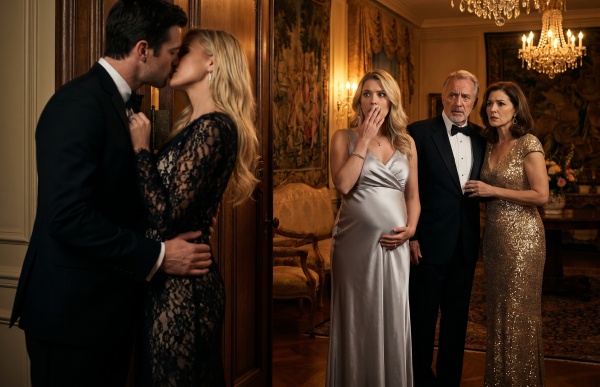
He Told the Nanny He’d Dump His Eight-Months-Pregnant Wife Before the Baby Came—Then the “Nobody” He Threw Away Walked Back In as the Secret Heir to the Fashion Empire
Part 1: The Baby Shower He Didn’t Want to Attend
At eight months pregnant, I had learned there were two kinds of silence in a marriage. There was the peaceful kind, the one that came after dinner when the dishwasher hummed and your husband rubbed your swollen feet while the baby kicked under your ribs. Then there was the other kind—the silence of a man already packing his heart before his suitcase.
My name is Clara Bennett, and until last winter, I thought I was married to a man who simply struggled under pressure. Julian Bennett was charming, polished, and ambitious in the way New York men become when they start believing every room is a ladder. He worked as a luxury brand consultant in Manhattan, advising fashion startups and old-money retailers on how to look expensive without seeming desperate.
We lived in a two-bedroom apartment on the Upper West Side that cost $6,400 a month and still had a radiator that clanked like a haunted ship. Julian called it “temporary,” even though we had been there for four years. He liked saying we were “one big client away” from a townhouse, a driver, and a summer place in the Hamptons.
I was not glamorous. I taught art history part-time at a community college in Queens and freelanced for small museums when I could. I wore comfortable shoes, bought prenatal vitamins in bulk from Costco, and carried a canvas tote bag that had been repaired twice because I refused to throw out something useful.
Julian used to say he loved that about me.
“You’re real,” he told me on our third date, when I admitted I preferred pizza from a corner shop to restaurants where the appetizers looked like decorations. “Everyone in my world is pretending to be someone. You don’t.”
I believed him.
That was before he started resenting the very thing he claimed to love.
By the time I was thirty-four weeks pregnant, Julian had become a guest star in our marriage. He came home late from “client dinners,” took calls from the hallway, and smiled at his phone in a way that made my stomach tighten more than any contraction ever had. When I asked questions, he kissed my forehead and said, “You’re exhausted, Clara. Don’t turn pregnancy hormones into a detective agency.”
That sentence stayed with me.
Not because it was cruel in a dramatic way.
Because it was ordinary enough to sound reasonable if you were already doubting yourself.
The nanny came into our lives because my OB told me to slow down. I had mild pregnancy complications, nothing life-threatening, but enough that I needed help preparing for the baby. Julian insisted we hire someone “temporarily,” even though I told him we didn’t need a nanny before the baby was born.
Her name was Madison Vale.
She was twenty-six, blonde, soft-spoken when she wanted to seem innocent, and always dressed like she was auditioning for a lifestyle brand. She had worked for two families in Brooklyn and came with glowing references. Julian hired her after one interview, then told me I was lucky because “good help in the city is impossible to find.”
Madison was supposed to help organize the nursery, run errands, cook simple meals, and assist me after appointments. At first, she was sweet. She folded tiny onesies into perfect stacks, labeled baskets in the closet, and asked questions about my birth plan with wide, attentive eyes.
But she watched Julian too closely.
Not obviously.
Women like Madison are smarter than that.
She laughed a little too quickly at his jokes. She touched his sleeve when passing behind him in the kitchen. She started wearing perfume at 8:00 a.m. in my apartment while I sat barefoot on the couch with heartburn and a belly so large I had to roll sideways to stand.
I told myself I was being unfair.
Then came the baby shower.
My best friend, Tessa, hosted it at a cozy Italian restaurant in the West Village called Bellafiore. There were white flowers, lemon cookies, pale blue napkins, and a little sign that said Welcome, Baby Bennett in gold lettering. My mother flew in from Denver, cried when she saw me, and spent the first twenty minutes touching my belly like she was greeting her grandson through glass.
Julian arrived forty minutes late.
He blamed traffic, though he had taken an Uber from Midtown and the receipt later showed he had stopped somewhere in SoHo for thirty-two minutes. He wore a navy blazer and an expression of quiet inconvenience. When guests clapped as he walked in, he gave them his perfect public smile.
That smile used to make me proud.
That day, it made me tired.
Madison came too, which Julian said was “helpful” because I shouldn’t be lifting gifts or standing too much. She wore a cream dress that looked almost bridal under the restaurant lights. Tessa noticed immediately and whispered, “Is the nanny trying to get adopted by Vogue?”
I laughed because I needed to.
The shower was beautiful. People gave us tiny socks, board books, diapers, baby monitors, and one absurdly expensive stroller from Julian’s mother that required an engineering degree to fold. Everyone asked if we had picked a name.
“We’re thinking Luca,” I said.
Julian’s smile flickered.
I had chosen Luca because it was Italian, soft but strong, and because my grandmother used to whisper that name in old stories when I was a child. I never knew exactly why the name mattered to her. She died when I was sixteen, taking a box of secrets with her, or so I thought.
After dessert, I excused myself to the restroom.
On the way back, I passed a narrow hallway near the kitchen and heard Julian’s voice behind a partly open office door. I stopped, not because I meant to eavesdrop, but because he said my name.
“She has no idea,” he said.
Then Madison laughed softly.
My whole body went cold.
“You’re really going to do it before the baby comes?” she asked.
Julian sighed like he was discussing a calendar conflict. “Yes. I can’t wait anymore. I’ll file before she delivers, or right after, depending on what my attorney says looks better.”
My hand went to my stomach.
Our baby kicked once, hard.
Madison lowered her voice. “But she’s eight months pregnant.”
“I know what month she’s in,” Julian said. “That doesn’t make me a prisoner.”
I pressed my shoulder against the wall.
Madison asked, “What about money?”
Julian laughed quietly. “Clara? She has nothing. Her mother rents in Denver, and Clara teaches part-time. She’ll get support, sure, but she’s not built for a fight. She’s a nobody.”
A nobody.
I had heard insults before.
Too sensitive. Too sentimental. Too domestic. Too small-town for his industry friends.
But nobody landed differently.
Because in that moment, standing outside a restaurant office with one hand on my unborn son, I realized my husband had not simply stopped loving me.
He had rewritten me into someone disposable.
Madison said, “And us?”
Julian’s voice softened.
The way it used to soften for me.
“Once the baby’s here and the divorce is moving, we can stop hiding. I’ll get through the messy part, and then we start over.”
I walked away before I heard more.
Tessa found me in the hallway near the restrooms, gripping the edge of a framed menu like it was the only solid thing in New York City.
“Clara?” she asked. “What happened?”
I looked at my best friend, then toward the dining room where guests were laughing around unopened gifts and pastel ribbons.
“My husband is leaving me,” I whispered. “And he thinks I’m nobody.”
Tessa’s face changed.
Not with pity.
With fury.
“Then we’re going to make sure he learns your name.”
Part 2: The Letter from Milan
I did not confront Julian at the baby shower.
That decision surprised even me.
Pregnancy makes people imagine women as either fragile or explosive, but I had never felt clearer in my life. If I walked into that office screaming, Julian would call me unstable, Madison would cry, and everyone would remember the scene instead of the truth.
So I returned to the table.
I smiled through the rest of the shower. I opened gifts. I thanked Julian’s mother for the stroller. I ate half a lemon cookie even though it tasted like dust in my mouth.
Julian sat beside me for photos and placed his hand on my shoulder like a devoted husband.
I did not move away.
Not because I forgave him.
Because I wanted one last photograph of his performance.
That night, after everyone left and our apartment filled with baby gifts, Julian said he was exhausted and took a shower. Madison had gone home, though not before giving him one long look from the doorway that made everything inside me harden.
While the shower ran, I opened Julian’s laptop.
I did not hack anything. I did not guess passwords or break into private accounts. His email was already open on the kitchen counter, glowing under the pendant lights like arrogance with Wi-Fi.
There were messages from a divorce attorney.
There were hotel confirmations.
There were transfers to a credit card I had never seen.
And there were dozens of emails from Madison, many dressed up as scheduling notes, a few not dressed up at all.
I took photos with my phone, then backed away.
My hands shook afterward.
Not from fear.
From restraint.
The next morning, I called a family law attorney Tessa recommended, a woman named Miriam Feld who had an office near Columbus Circle and a reputation for being polite until politeness became inconvenient. She listened while I explained the pregnancy, the affair, the nanny, the possible divorce filing, and the fact that I had no real income comparable to Julian’s.
Miriam asked careful questions.
Were we married in New York?
Yes.
Any prenuptial agreement?
No.
Any joint accounts?
Yes.
Any separate inheritance?
I almost said no.
Then I remembered the letter.
It had arrived three days earlier, thick cream paper in a large envelope from Milan, Italy. I had placed it on the entryway table because I thought it was probably junk mail connected to a museum mailing list. The return address said Casa Vellari Holdings.
At the time, I had been too swollen, tired, and emotionally neglected to open it.
Now I picked it up with trembling fingers.
Inside was a formal letter from an Italian law firm, written in English and Italian. It addressed me as Chiara Benedetti-Morelli, a name I had never used but somehow recognized in my bones. The letter requested my immediate contact regarding the estate of Isabella Morelli Vellari, founder of the Vellari fashion house and widow of Alessandro Vellari.
I read the first page three times before the words began to form meaning.
According to the letter, my late grandmother, Rosa Benedetti, had been born Rosa Morelli. She was Isabella’s younger sister. A family fracture after World War II had separated the sisters, and Rosa emigrated to the United States, changed her last name, and refused contact for decades.
Isabella had no surviving children.
Her only grandson had died in a car accident years earlier.
A private genealogical investigation, legal records, and DNA confirmation through distant family lines had identified me as the closest living heir in the Morelli branch.
My vision blurred.
Tessa, who had come over with bagels and righteous anger, read the letter after me.
“Clara,” she said slowly, “do you know what Vellari is?”
“I know it’s fashion.”
“No,” she said. “Vellari is not just fashion.”
She opened her phone and showed me.
Vellari was one of Italy’s most powerful luxury fashion empires, headquartered in Milan, with ateliers in Florence, boutiques in New York, Paris, Tokyo, and Los Angeles. They were famous for structured black gowns, leather handbags that cost more than used cars, and a reputation for destroying copycat brands in court without blinking.
The fashion press called them “the most feared house in Italy” because designers whispered that Vellari lawsuits arrived faster than invitations, and their boardroom discipline was legendary.
Not feared like crime.
Feared like lawyers, legacy, and taste sharp enough to cut glass.
I sat at my kitchen table in maternity leggings while Tessa scrolled through articles about a company valued in the hundreds of millions.
“This can’t be real,” I said.
“Call the law firm.”
I did.
By noon, I was on a video call with an Italian attorney named Lorenzo Conti, a silver-haired man who spoke precise English and looked like he had never once eaten lunch at his desk. Beside him sat a woman named Sofia Marchetti, interim director of the Vellari family office.
They explained carefully.
Isabella Vellari had died six months earlier. Her will had been contested by distant relatives and business parties who hoped to prevent an American heir from entering the structure. But the legal process in Italy had moved forward enough that they were now obligated to notify me formally.
“There are steps,” Lorenzo said. “Verification, acceptance, tax matters, governance limitations. This is not a fairy tale where you sign one paper and become queen.”
“I’m not looking to be queen,” I said.
Sofia smiled faintly. “Good. Queens do not last long in fashion. Operators do.”
The inheritance was complex. Shares in holding companies. Rights connected to the Vellari family foundation. Real estate. Voting interests. A potential board seat after legal confirmation. It would take months to fully settle.
But one fact was clear.
I was not nobody.
Not in the legal sense.
Not in the financial sense.
And suddenly, Julian’s carefully planned abandonment had terrible timing.
Miriam, my attorney, told me to say nothing to him yet.
“Your inheritance may be separate property depending on timing, structure, and applicable law,” she explained. “But your husband’s conduct, spending, and plans are immediately relevant to your divorce and support issues. Do not gloat. Do not threaten. Do not post online. Let documents do what emotions want to do.”
That became my rule.
No gloating.
No threats.
No public drama.
Just documents.
For the next week, I moved through the apartment like an actress in a play Julian did not know had changed genres. He smiled at his phone. Madison came to “help” with nursery baskets. I sat on the couch rubbing my belly and forwarding records to Miriam.
Madison once asked if I wanted her to organize the baby clothes by size.
“No,” I said gently. “I think you’ve done enough.”
She looked at me for a second too long.
Julian noticed.
That evening, he asked if I was upset.
I looked at him over the bowl of chicken soup I had made myself because he said he had “client calls.”
“I’m eight months pregnant,” I said. “Upset is a flexible word.”
He exhaled like a martyr. “I just need you calm until the baby comes.”
Until.
Not after.
Not always.
Until.
That night, while Julian slept, I stood in the nursery doorway. The room smelled like fresh paint and baby detergent. Tiny socks sat in a basket, absurdly small, waiting for feet that had never touched the world.
I placed one hand on my stomach.
“Luca,” I whispered, trying the name aloud.
The baby shifted.
I smiled through tears.
“You and I are going to be okay,” I said. “Even if your father isn’t ready to be decent.”
Part 3: The Day He Called Me Disposable
Julian filed first.
Of course he did.
Men like Julian confuse speed with control.
The papers were served on a rainy Monday afternoon while Madison was in the nursery folding blankets and Julian was supposedly at a meeting downtown. The process server was kind, almost apologetic. I thanked him because I had learned that civility confuses people who expect collapse.
Madison stood in the hallway watching with wide eyes.
“Clara,” she said softly, “are you okay?”
I looked at her.
For one second, I wondered how much energy it must take to pretend concern for a woman whose marriage you helped dismantle.
“I’m fine,” I said.
She stepped closer. “I know this must be hard.”
“No,” I replied. “Labor will be hard. This is paperwork.”
Her face tightened.
I called Miriam immediately. She was not surprised. Julian’s petition requested an “amicable dissolution,” reasonable parenting arrangements after birth, and an efficient financial separation. His attorney’s letter framed him as a responsible father-to-be seeking stability.
Responsible.
I almost laughed.
Miriam filed our response within days.
She requested temporary support, preservation of marital funds, documentation of Julian’s spending, reimbursement review for marital assets used in connection with the affair, and protective language around the baby’s birth and postpartum period. She also asked that Madison no longer work in our home given the conflict of interest and emotional harm.
Julian exploded.
Not in court.
At home.
He came into the apartment at 9:15 p.m., waving a copy of Miriam’s filing as if it were a parking ticket written by God.
“You hired a lawyer?” he demanded.
I was sitting at the kitchen table drinking raspberry leaf tea, wearing compression socks and a sweatshirt from my college.
“Yes.”
“You could have talked to me.”
“I heard you talk to Madison.”
The room went still.
His expression changed so fast it almost fascinated me. Irritation became calculation. Calculation became false sadness.
“Clara,” he said carefully, “whatever you think you heard—”
“I heard enough.”
He put the papers on the counter. “You don’t understand the pressure I’ve been under.”
“No,” I said. “But I understand the words ‘she has nothing’ and ‘she’s a nobody.’”
His face drained.
Madison came out of the nursery behind him.
She must have still had a key.
Or maybe Julian let her in earlier.
At that point, the details barely mattered.
“You told her that?” Madison asked him, offended for herself more than me.
Julian snapped, “Go home.”
She froze.
I stood slowly, one hand on the table because standing at eight months pregnant required choreography.
“Actually,” I said, “that’s the first decent idea you’ve had.”
Madison looked at me with tears shining in her eyes. “I never meant to hurt you.”
I tilted my head. “Did you mean to help him leave me before our baby was born?”
She said nothing.
“That’s what I thought.”
After she left, Julian turned on me.
“You’re going to make this ugly.”
“You already did.”
He laughed bitterly. “You think a lawyer changes reality? You teach part-time, Clara. I pay the rent. I pay for the insurance. I pay for this life.”
I looked around the apartment.
The nursery.
The unopened baby monitor.
The stroller his mother bought as if gifts could compensate for emotional absence.
“You pay invoices,” I said. “That’s not the same as building a life.”
He stepped closer, then stopped himself, perhaps remembering we were in a doorman building with neighbors who heard everything. “Don’t push me.”
That old version of me would have shrunk.
The new one, carrying his son and a secret from Milan, did not.
“Do not speak to me like that again,” I said. “All communication about the divorce can go through attorneys.”
He stared at me like I had slapped him.
I had not touched him.
I had simply stopped obeying the script.
The next morning, Madison’s employment was formally terminated through a written notice drafted by Miriam. It included payment for hours worked, confirmation that she was not to return to the apartment, and a reminder not to contact me outside necessary legal channels. Clean. Professional. Boring in the way good legal documents are boring.
Julian moved into a hotel near Bryant Park two days later.
He told mutual friends I had become “emotionally volatile.”
I said nothing.
He told his mother I was using the pregnancy to punish him.
I said nothing.
Madison posted a vague quote online about “choosing love even when the world judges you.”
Tessa screenshotted it.
I said several words that would not have passed my mother’s dinner table standards, then forwarded it to Miriam.
Meanwhile, the Milan lawyers kept calling.
DNA records, birth certificates, naturalization documents, notarized forms, tax consultations—it was a paperwork storm across two continents. My mother had to dig through old boxes in Denver and found a black-and-white photograph of my grandmother Rosa standing beside a woman who looked exactly like her but dressed like royalty.
On the back, in faded ink, it said: Rosa and Isabella, Milan, 1951.
My mother cried when she saw it.
“She never told me,” she said.
“Maybe it hurt too much.”
“Or maybe she thought America meant starting over completely.”
That sentence stayed with me.
Because I was starting over too.
Just not as quietly as Julian hoped.
At thirty-six weeks pregnant, I flew to Milan with medical clearance, my mother, and Tessa, who claimed she was there for “emotional support” but packed three outfits appropriate for meeting Italian lawyers. Julian’s attorney objected in a sharply worded email, implying I was being reckless.
My OB had cleared the travel.
Miriam responded with that fact and nothing else.
Milan in February was gray, elegant, and colder than I expected. The Vellari headquarters stood on Via Manzoni behind carved stone and black iron gates. Inside, everything smelled faintly of leather, espresso, and power.
Sofia Marchetti met me in the lobby.
She wore a black suit, no visible jewelry, and shoes that looked painful but obedient.
“Signora Bennett,” she said.
“Clara is fine.”
She studied me for a moment.
Then she said, “In this building, names matter. Clara is what your husband called you when he underestimated you. Chiara Benedetti-Morelli is what the law calls you now.”
I did not know whether to laugh or cry.
So I did neither.
She escorted us upstairs to a conference room overlooking the city. On the table were documents, family charts, photographs, and a velvet box containing a gold signet ring engraved with the Morelli crest. I did not put it on. It felt too heavy for a woman still wearing maternity jeans with an elastic waistband.
Lorenzo explained my rights again.
Carefully.
Legally.
No fantasy.
I would not instantly control every Vellari decision. There were existing executives, board structures, shareholder agreements, and pending estate matters. But my recognition as heir changed governance, succession, voting alignments, and long-term control.
My presence mattered.
That afternoon, I was introduced to the board as the acknowledged heir of Isabella Vellari’s Morelli line.
Most of them looked shocked.
A few looked furious.
One older man stared at my belly and asked in Italian whether the American pregnancy complicated succession.
Sofia answered before I could.
“The child does not complicate the future,” she said. “The child is the future.”
For the first time in months, I felt my son kick and did not feel alone.
Part 4: The “Nobody” Returns to New York
The news broke before I returned to the States.
A fashion business publication ran a piece titled: “American Academic Identified as Morelli Heir in Vellari Succession Dispute.” By the next morning, my phone looked like it had been dropped into boiling water. Reporters, acquaintances, former coworkers, distant cousins, and people I had not heard from since high school suddenly remembered my number.
Julian called seventeen times.
I did not answer.
Madison sent one message from a new number.
Is it true?
I blocked her.
Julian finally reached Miriam, who informed him that all communication should remain counsel-to-counsel. According to Tessa, who heard it from a friend of a friend who worked adjacent to Julian’s industry, his reputation detonated quietly. The man who had told people his pregnant wife was unstable now had to explain why he had filed for divorce weeks before she was publicly identified as heir to one of Europe’s most powerful fashion houses.
The luxury world is small.
Cruel, too.
People did not judge Julian for cheating as much as they judged him for miscalculating.
That was almost funnier.
When I landed at JFK, I was exhausted, swollen, and done being invisible. Miriam had arranged a meeting with Julian and his attorney in a conference room on Madison Avenue. My mother thought I should skip it and rest.
But I wanted to be there.
Not to fight.
To witness.
Julian arrived early. He wore his best suit, the charcoal one with the narrow lapels, and looked like he had not slept. His attorney, a polished man named Daniel Hurst, sat beside him with a legal pad and the expression of someone who had learned troubling facts too late.
When I walked in, Julian stood.
For years, I had wanted that instinctive respect.
Now it felt like a receipt from a store I no longer shopped at.
“Clara,” he said.
I sat across from him. “Miriam will handle the discussion.”
His eyes dropped to my belly.
“How’s the baby?”
I looked at him carefully.
“Healthy.”
Relief crossed his face, and for a moment I saw the man he might have been if character had mattered to him more than image. Then he said, “I wish you’d told me about Milan.”
And just like that, the moment ended.
I almost smiled. “You filed for divorce before our son was born.”
He shifted. “That was before I understood the situation.”
“The situation being that I’m no longer nobody?”
His attorney closed his eyes briefly.
Julian’s jaw tightened. “I never meant that.”
“Yes, you did.”
Silence.
Miriam began.
The divorce would proceed with full financial disclosures. Any attempt to claim rights over my inheritance would be addressed firmly under applicable law, including separate property principles, timing, and estate structure. Julian would have parenting rights and responsibilities, but he would not use custody as leverage for money or access.
Daniel Hurst listened carefully.
He was smart enough to know the ground had changed.
Julian tried to interrupt several times, but his attorney stopped him with a hand on his sleeve. That small gesture told me everything. Julian was no longer leading the room.
At one point, he said, “I want to be involved with my son.”
I believed him.
Partly.
People can be selfish and still love in limited ways. That was one of the hardest truths I had learned. Julian might love our child, but I could not let his love become another performance with me doing all the labor backstage.
“You can be involved,” I said. “Consistently. Legally. Respectfully. Not when it suits your image.”
His face reddened.
Miriam slid a proposed temporary parenting framework across the table.
The baby was due in three weeks. Julian would be notified when I went into labor unless medical circumstances required otherwise. He could visit at the hospital if he behaved respectfully and did not bring Madison or any third party. Postpartum visits would be scheduled around the baby’s health, feeding, and my recovery.
Julian looked offended by the boundaries.
Good.
Boundaries often offend people who benefited from their absence.
Two weeks later, my water broke at 3:18 a.m.
Not like in movies.
There was no dramatic gush in a restaurant or taxi. I was in bed eating saltine crackers because pregnancy had made time meaningless. My mother drove me to Mount Sinai while Tessa followed in an Uber carrying a hospital bag, a phone charger, and enough snacks to survive a small natural disaster.
I notified Julian through a group text with Miriam copied, because that was the world he had built.
He arrived at the hospital four hours later.
Alone.
He looked terrified.
Labor lasted eighteen hours. I will not romanticize it. It was painful, undignified, exhausting, and at one point I told Tessa I wanted to move to a country where my lower half did not exist.
Then my son was born.
Luca Bennett Morelli entered the world at 9:46 p.m., weighing 7 pounds, 2 ounces, with dark hair, angry lungs, and one tiny fist pressed against his cheek like he was already judging the room. When the nurse placed him on my chest, every betrayal, every document, every headline fell away.
There was only him.
My son.
My future.
Julian cried when he saw him.
I let him hold Luca later, sitting in a chair beside the hospital bed while a nurse showed him how to support the baby’s head. He looked clumsy and overwhelmed. For a moment, I felt something like grief for the family we almost were.
Then his phone buzzed.
He glanced at it.
Just once.
But I saw Madison’s name.
He put the phone face down immediately.
Too late.
I did not yell. I did not cry. I simply said, “Visit is over.”
“Clara—”
“No.”
He looked at Luca, then at me.
“You can see him again according to the schedule,” I said. “But you will not bring that chaos into this room.”
For once, he did not argue.
He handed our son back.
Three days after Luca was born, a package arrived from Milan. Inside was a handwritten note from Sofia and a tiny cashmere blanket in Vellari black with a discreet silver border. My mother said black was a dramatic color for a newborn.
Tessa said, “It’s Italian. Let them be intense.”
I laughed so hard my stitches hurt.
That laugh felt like survival.
Part 5: The Empire He Thought He Could Use
Six months later, I walked into Vellari’s New York showroom for the first time as a confirmed heir and board participant.
It sat on the top floor of a building in SoHo, all glass, pale stone, and clothes so beautifully constructed they looked architectural. Editors, buyers, stylists, and executives moved through the space speaking in soft voices. Fashion people can make a whisper sound more judgmental than a shout.
I wore a simple black dress, low heels, and Luca in a carrier against my chest.
That was not originally the plan.
The nanny I hired—an actual professional named Mrs. Alvarez with twenty years of references and zero interest in my husband—had a family emergency that morning. I could have canceled, but Sofia told me Isabella once brought a sick child to a fabric negotiation and still closed the deal.
So Luca came to his first fashion meeting.
He slept through most of it.
Which made him more polite than several board members.
Julian was there too.
Not as my husband.
As a consultant whose firm had once hoped to secure a major Vellari strategy contract through contacts he believed he controlled. He did not know I would be present. When he saw me, his face went pale in a way even expensive lighting could not soften.
“Clara,” he said.
Across the room, Madison stood beside him.
That surprised me less than it should have.
Apparently, Julian had brought her as part of a “brand support team,” which sounded like a title invented in an elevator. She wore a fitted white suit and the same fragile confidence she had worn in my apartment. When she saw Luca against my chest, her expression flickered.
Sofia approached from behind me.
“Signora Morelli,” she said in her crisp Italian accent, loud enough for several people to hear. “The board is ready.”
Julian stared.
Madison looked from Sofia to me.
Then down at Luca.
Then back at me.
I could almost see the math failing.
The meeting began with presentations. Julian’s firm proposed a U.S. expansion campaign built around “heritage reborn for the modern woman.” The slides were glossy, dramatic, and filled with words like legacy, authenticity, and feminine power.
I listened quietly.
So did Sofia.
When Julian finished, the room offered polite applause.
Then Sofia turned to me. “Chiara, your thoughts?”
My American life had taught me to make myself approachable.
My Italian inheritance was teaching me that approachable did not mean available for erasure.
I looked at Julian’s slides, then at the executives around the table.
“The campaign is beautiful,” I said. “But it misunderstands heritage.”
Julian’s smile froze.
I continued. “Heritage is not a costume you put on a model. It is responsibility. It is archives, labor, families, craft, mistakes, survival, and the people who were written out but still carried the name.”
The room went silent.
I did not look at Madison.
I did not need to.
“A brand built on women’s labor should be careful about hiring men who dismiss women privately while selling empowerment publicly,” I said. “That is not a moral slogan. It is a reputational risk.”
Julian’s attorney was not there to save him.
No one spoke for several seconds.
Then one of the independent directors asked, “Are there concerns we should know about regarding the consultant?”
Sofia answered before Julian could. “There are documented concerns regarding judgment, conflict of interest, and personal conduct affecting potential public perception.”
No scandalous details.
No screaming.
No defamation.
Just enough truth to close the door.
The contract was tabled.
By the end of the week, it was declined.
Julian called it revenge.
I called it governance.
There is a difference.
The divorce finalized later that year. Julian received fair parenting time, paid child support according to his income, and remained Luca’s father in every way the law required and his consistency allowed. He did not receive access to my inheritance, my shares, or the power he suddenly wished he had respected before it had a name.
Madison did not last.
Not with Julian.
Not in fashion.
People who build their future on someone else’s humiliation often discover there is no foundation under the marble.
I did not celebrate her fall.
By then, I had more important things to do.
Luca grew into a sturdy, cheerful baby who loved bananas, hated hats, and laughed whenever my mother sneezed. I split my time between New York and Milan, learning a business I never expected to inherit while still teaching one online course because part of me refused to surrender the woman I had been before the world found my bloodline useful.
Sofia became a mentor.
Lorenzo became the only attorney I knew who could make inheritance tax sound like opera.
Tessa became Luca’s loudest honorary aunt and told everyone she had “always known Clara was secretly European royalty,” which was completely false but emotionally supportive.
One spring morning, I stood in the Vellari archive in Milan, surrounded by gowns wrapped in tissue paper and sketches drawn by women long dead. On the wall hung a photograph of Isabella Vellari in 1963, severe and elegant, standing beside a younger woman with familiar eyes.
Rosa.
My grandmother.
The nobody who left Italy.
The woman who crossed an ocean, raised a family, and never told us what she had lost.
I touched the glass lightly.
For years, I thought identity was something other people confirmed. Wife. Teacher. Daughter. Mother. Nobody. Heir. Betrayed woman. Powerful woman.
But standing there, listening to Luca babble in his stroller, I finally understood that none of those names mattered if I abandoned myself to fit them.
Julian once told Madison he would dump me before the baby came.
He thought pregnancy made me weak.
He thought my lack of visible wealth made me disposable.
He thought nobody was a fact instead of an insult.
He was wrong on every count.
I did not become powerful because of Vellari. The inheritance gave me resources, lawyers, rooms with heavy doors, and people who returned my calls quickly. But the power itself began earlier—in a hallway outside a baby shower, when I heard the man I loved reduce me to nothing and decided not to help him do it.
I walked away quietly.
Then I came back legally, publicly, and completely as myself.
If there is one thing I would tell any woman being underestimated while she is carrying a child, carrying a marriage, carrying a family, or simply carrying the weight of someone else’s contempt, it is this:
Do not let someone’s inability to see your worth become your evidence.
Sometimes the life they think they are throwing away is the one they were never strong enough to stand beside.
And sometimes, the woman they call nobody walks back in with a baby in her arms, her grandmother’s name in her blood, and an empire at her back—not to destroy them, but to remind herself that she was never small.
Not even when he said it.
Not even when she believed him.
Not ever.
