Part 1: A Postpartum Betrayal No One Tells You to Prepare For
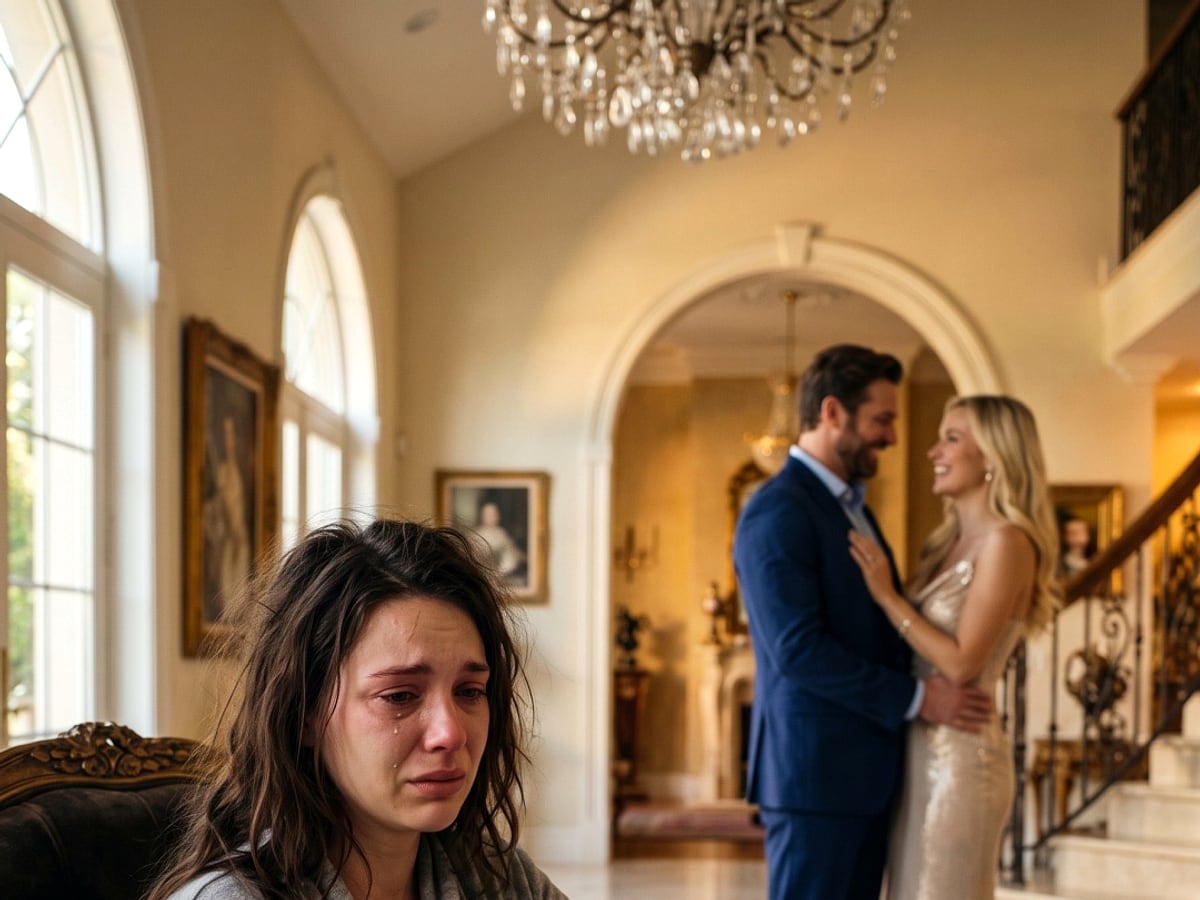
At 9:15 on a Friday night, my husband came home from wherever he had been for three hours and told me our marriage was finished.
My son Lucas was six weeks old, asleep against my chest on the couch, his breathing slow and even.
The television was on but silent. A half-eaten bowl of food sat on the coffee table.
My hair had been in the same knot for two days. My whole body ached in ways that had no useful vocabulary yet.
Ryan set his keys in the ceramic dish by the door the way he always did. Then he looked at me the way someone looks at a contract they have already decided not to renew.
“I can’t keep doing this, Allison,” he said.
I pressed my hand against Lucas’s back and asked what he meant.
“This.” He gestured at the room, at me, at the baby, at the life we had chosen in Nashville. “The pretending.”
That word moved through me like cold water finding a crack.
For weeks I had been too worn down to fully read the shape of his distance. He was always on his phone, always stepping outside for calls, always somewhere else even when he was physically present. I had blamed adjustment, the shock of early fatherhood, the difficulty of change.
He was adjusting. Just not to anything I understood yet.
“Who is she?” I asked.
His expression shifted before his mouth did.
He said the name.
Vanessa.
Vanessa Clarke, who had been my person for fifteen years. Who had organized my baby shower under string lights with lemon cake and handmade decorations. Who had stood in my delivery room because Ryan went pale, and who had wept when the nurse laid Lucas on my chest and whispered, “He’s perfect.”
Who had spent evenings in the nursery folding tiny onesies while my husband was, apparently, falling for her behind my back.
My body understood the postpartum betrayal before my mind assembled it. I made a sound I had never heard from myself before.
Not a scream. Not exactly crying.
Something smaller and rawer than either.
Ryan looked uncomfortable.
That discomfort hit harder than the confession.
I asked how long.
He said it had been emotional for months.
Months.
I thought about Vanessa rubbing my feet in my third trimester. I thought about her texting me lists of baby names. I thought about her folding blue onesies while my husband was apparently choosing someone else.
Lucas shifted against my collarbone. His small fingers opened and closed in the reaching way of newborns, grasping for something they cannot yet name.
He was six weeks old. Warm.
Trusting. Completely unaware that the man across the room had decided he was too much work to stay for.
“I’m going to Vanessa’s tonight,” Ryan said.
I laughed.
Quiet. Brief. Genuine.
“Of course you are,” I said.
He told me not to make it ugly.
I looked at him across the dim room. “You are leaving your wife six weeks postpartum to go to her closest friend. I think ugly arrived before I said a word.”
He said he wasn’t walking away from his son.
“You are walking out while he is lying on me,” I said. “Those two statements are both accurate.”
He looked at Lucas for one moment. Then he said he felt trapped. That he had wanted a family but hadn’t understood what it would actually require of him.
Something settled inside me. Not peace. Recognition.
Ryan had loved every part of becoming a father that carried an audience. The announcement, the confetti, the baby registry, the photo of him painting the nursery in a clean white shirt.
What arrived six weeks earlier was a real child. Hungry, needing, entirely dependent.
Ours.
“Go,” I said.
He seemed surprised I didn’t fight harder. “That’s all?”
“That is all I can say without waking my son.”
He packed a bag and left.
I did not call Vanessa. Not that night. Not any night after.
At 2:37 a.m., while Lucas nursed and rain moved through the neighborhood, I received a text from her. She said it wasn’t planned.
She said they had fallen in love. She hoped I would understand someday.
I read it once. Then I blocked her number.
Some messages should be answered only with silence. Some betrayals are too serious to dignify with a counter-argument.
By sunrise, Ryan had sent me an email.
Not an apology. A demand for an equitable share of Bennett Home and Hearth, the company I had spent eighteen years building on my own before he ever walked through my front door.
He had not only left. He had come prepared.
That changed what this postpartum betrayal was going to cost him in the end.
Part 2: The $4,800 I Started With Before He Learned My Name
Bennett Home and Hearth began when I was twenty-two years old and grieving.
My mother had just died. My father, Henry Bennett, had retired from the small hardware store he had run outside Franklin, Tennessee, for most of his adult life. I had $4,800 in savings, a truck with an air conditioner that worked only when it felt cooperative, and a genuine belief that homes should feel lived-in rather than assembled from a catalog.
I started at farmers markets. Then craft fairs.
Then pop-up events. Then a small storefront with uneven floors and a bathroom that leaked every time it rained hard.
I did everything myself. I swept and invoiced and shipped and designed labels at midnight and answered customer emails before sunrise. I once drove through a tornado warning to deliver thirty centerpieces to a hotel in Chattanooga because a wedding needed them by noon and I had given my word.
My father helped whenever I let him. He fixed shelves, negotiated leases, and told me every Friday something I eventually wrote on a notecard above my desk: “Make something you’d stake your name on for fifty years.”
He meant the business. He also meant everything else.
By thirty-one, I had three stores, an active online shop, and wholesale contracts with boutique hotels across four states. I was tired in the particular way that comes from doing work you love harder than most people think is sustainable.
That was when I met Ryan.
He was a financial consultant, polished and easy in a room, skilled at restaurant conversation. He told me I was brilliant. He said he had never met a woman who knew herself so clearly and didn’t need anyone to confirm it.
That last line became a lie later.
Men like Ryan tend to find female self-sufficiency attractive right up until it stops feeling like a compliment to be near it.
We married two years after meeting. My father was cordially polite about Ryan in the particular way that should have told me more than it did.
Three months before the wedding, Dad called me to his house. There was barbecue from our favorite place, sweet tea, and a thick folder on the kitchen table labeled in his careful print: BHH PROTECTION AGREEMENT.
I groaned. I already had a lawyer.
“Good,” he said. “Then you’ll have two sets of eyes on it.”
The folder held operating agreements, intellectual property assignments, ownership records, and a marital acknowledgment. It required any future spouse to confirm in writing that Bennett Home and Hearth was my sole premarital property and would remain so unless I chose to transfer it deliberately.
I asked if he actually thought Ryan would pursue the company someday.
He leaned back. “I think people’s relationship to money changes when the numbers grow large enough to feel abstract to someone who didn’t earn them.”
I had everything reviewed by my attorney. Ryan signed at Dad’s kitchen table with a joke about lawyers being allergic to romance. “Whatever helps your old man sleep,” he said.
Then we went to dinner. Then life kept moving.
My father died five years later from a heart attack while fixing a cabinet hinge in his garage. Ryan spoke at the service, held my hand, and told everyone Henry Bennett had been like a father to him.
I tried to believe that. For a while, I succeeded.
After Dad died, the company grew faster than I had mapped. A national magazine ran a feature.
A hotel group signed a significant contract. Online sales tripled during the pandemic when everyone decided their homes needed to smell like cedar and something stable.
By the time Lucas arrived, Bennett Home and Hearth had eight stores, over a hundred employees, a warehouse in Murfreesboro, and projected annual revenue just under $28 million.
Ryan loved introducing me at events. “My wife built all of this,” he would say, one arm around my waist.
In private, he started adding: “If you’d had someone with real business experience involved from the beginning, you could have scaled twice as fast.”
Gradually, the story he told others shifted. He was “advising” the company.
Then “helping with strategy.” By the time I was pregnant, he referred to Bennett Home and Hearth as “our business” in front of people who had no reason to correct him.
I pushed back the first several times. He went cold for entire evenings afterward. “You make me look useless,” he would say.
“I make you look accurate,” I would answer.
He would not speak the rest of the drive home.
Vanessa had witnessed every version of that exchange over fifteen years of friendship. She had been there for the late nights, the product crises, the years I skipped vacations to make payroll. She knew what the company was and what it had cost.
She still stood beside Ryan when he decided to claim half.
My divorce attorney, Dana Whitcomb, came to my house the morning after Ryan left. She had dark curls and a calm that registered as certainty rather than patience. She assessed my kitchen the way a doctor assesses a chart.
She asked if I was safe. If Lucas was safe. Then she asked about Ryan’s legal position with the company.
No equity. No employment agreement.
No ownership interest. No board role.
“Did he ever sign anything acknowledging he had no claim?” she asked.
I thought of the folder on my father’s kitchen table. The pen moving in Ryan’s hand.
“Yes,” I said slowly. “Years ago. It should be at the office.”
Dana’s eyes sharpened. “Find it. Tell no one.”
She glanced at Lucas asleep in the carrier on my chest.
“Try to rest.”
“He wakes every two hours.”
“Then rest in two-hour portions. You’ll need to be sharp.”
That was the first time I had smiled since Ryan walked out.
What Dana did not yet know was how carefully my father had prepared for the possibility that I would one day be standing exactly here.
Part 3: The Question That Made an Entire Courtroom Go Still
Ryan filed for divorce before I did. Naturally.
Men like Ryan appreciate paperwork when it makes them appear organized rather than calculated. His petition requested spousal support, a division of all marital assets, and a formal court valuation of Bennett Home and Hearth as a marital asset subject to equitable distribution.
His claimed contributions to the company included the phrase “emotional labor.”
My CFO nearly choked when I read it to her on the phone.
Vanessa posted a quote on Instagram the same afternoon. Something about love sometimes requiring courage to follow your truest path.
I did not respond. Dana would have confiscated my phone.
Lucas was nine weeks old at the first hearing. I wore a navy dress that buttoned down the front because I needed to pump in the courthouse bathroom before we went in. The changing table was broken, so I had changed a diaper on my car’s back seat in the parking garage.
Elaine, Ryan’s mother, was not there. She had called me once after he left, cried for fifteen minutes, and told me she had raised him better than this.
I believed her. Her belief and his behavior occupied entirely different categories.
Ryan arrived with Vanessa.
That was his first error of the morning.
She wore light colors and positioned herself slightly behind him, her expression arranged into something meant to suggest regret. She glanced at Lucas in his car seat, then looked away as if an infant were an awkward detail that complicated her story.
Ryan looked rested. He had shaved. He had clearly slept through the night.
I clocked all of this with a cold kind of clarity.
The courtroom smelled like old carpet and the particular tension of other people’s private disasters being processed in public. The judge was Honorable Patricia Monroe, silver-haired and sharp, with the composure of someone who had been presented with many confident lies by well-dressed people and was no longer persuaded by the packaging.
Ryan’s attorney spoke first. He described Ryan as a devoted partner who had set aside his own professional trajectory to support his wife’s ambition.
He suggested the company’s growth owed something to Ryan’s presence. He told the court I was using financial assets as emotional retribution.
Dana’s pen went still on her notepad.
That is never a favorable sign for whoever has just finished speaking.
When Dana stood, she was even. She noted her client was nine weeks postpartum and had not limited Ryan’s access to the child. She noted Ryan had left the family home six weeks after the birth, moved in with my former closest friend, and had submitted no parenting plan and no specific custody request for an infant.
Ryan straightened in his seat.
Judge Monroe turned to him.
“Mr. Carter.
This is a temporary hearing. What custody arrangement are you requesting for your infant son?”
The room became very quiet.
Ryan looked at his attorney. The attorney leaned close and whispered. Ryan looked at Lucas sleeping in his car seat beside me, one small fist curled near his cheek, his mouth making small unconscious movements.
He had Ryan’s dark hair. He had my father’s chin.
Ryan glanced at Vanessa. Then back at the judge.
“She can keep him,” he said.
Nobody moved for a moment. Not Dana.
Not opposing counsel. Not Vanessa.
The court reporter’s fingers paused before resuming.
I fixed my eyes on a point on the wall ahead of me because I knew that if I looked at Ryan, the woman my son needed in that room would briefly disappear.
Our baby was asleep three feet away from us. His father had just described him as something a person can be offered and kept or given away.
Judge Monroe’s voice dropped by several degrees without rising in volume. “Mr.
Carter. Are you stating that you are not requesting physical custody of your infant son at this time?”
Ryan understood he had miscalculated. He tried to soften what he had said.
He explained the baby needed his mother right now. He said primary custody with me was acceptable for now.
The judge asked him to define his requested parenting time.
He looked trapped.
Vanessa reached over and touched his sleeve at the absolute worst moment she could have chosen.
Judge Monroe saw it. So did I. So did Dana, who then requested a structured parenting schedule tied to Ryan’s demonstrated caregiving ability, with gradual expansion based on consistent participation.
The judge granted most of Dana’s request.
Then Ryan’s attorney moved to the business valuation. Ryan’s posture shifted back toward confidence.
He thought numbers would recover what the custody exchange had cost him. He thought my exhaustion had made me careless with records.
Dana stood again.
“Your Honor, before the court proceeds further on valuation, there is a foundational document for the court’s consideration.”
She presented the folder.
My father’s folder.
The judge opened it. The quality of quiet in the room changed.
More attentive. More charged.
Dana read the core language aloud. A marital acknowledgment, signed by Ryan after independent counsel review, three months before our wedding.
Confirming that Bennett Home and Hearth, including all trademarks, retained earnings, and future appreciation traceable to premarital business assets, remained my sole and separate property. Not transferable by marital status, social participation, or informal advisory input.
Ryan had signed this document.
At my father’s kitchen table.
I watched his face as the judge read the clause. It changed the way a window changes when the light behind it shifts. Gradually, then completely.
Vanessa stared at the table surface in front of her.
Dana leaned close and said quietly, “Your father was a very smart man.”
I pressed my teeth together. “Yes,” I said. “He was.”
Ryan’s attorney asked for a continuance to review the document. The judge granted time, but her meaning was clear: a signed premarital acknowledgment was not going to dissolve because one party found it financially inconvenient.
Ryan was not smiling as we filed out of the building.
But he was not finished yet, either.
Part 4: What Ryan Decided Was Still Worth Arguing
Ryan did not yield after the hearing.
Men like him rarely do when humiliation is still fresh and the loss still feels negotiable. He claimed he had not understood what he signed.
He claimed my father had pressured him. He claimed the agreement was outdated, never meant to apply if the company grew to this scale.
Dana found that last argument genuinely worth addressing.
“So your position,” she said in mediation, “is that the agreement shouldn’t hold because my client built a more successful business than you anticipated when you signed it?”
Ryan’s jaw moved. His attorney called a break.
Vanessa was in the hallway during one of those recesses, near the vending machines. We were briefly alone.
She said my name.
I stopped. Not out of obligation. Out of something more like curiosity about what a postpartum betrayal sounds like once the consequences have started arriving.
She said she had never wanted to hurt me.
I looked at her for a moment.
“You were in my hospital room,” I said. “You held my leg during delivery because Ryan couldn’t manage to stay upright.”
Her eyes filled.
“You brought us soup the first week we were home with the baby.”
“I know,” she whispered.
“Then don’t use the word accident,” I said. “Accidents are things people do not choose. This was a series of choices.”
She began to cry. I did not step toward her.
The woman I had been before all of this would have moved forward by reflex, because I had been the person Vanessa turned to for fifteen years. That version of me had learned something it hadn’t known before.
“Do you love him?” I asked.
“Yes,” she said quietly.
“Then learn something now while it will still be useful,” I said. “Ryan loves being chosen far more than he loves whoever is doing the choosing. Figure that out early.”
I walked back into the conference room.
Ryan’s claims about contributing to the company disintegrated under straightforward questions. He could not identify our wholesale margins.
He did not know the terms of our warehouse lease. He had never been inside a board meeting because no board position had been extended to him.
His single memorable creative suggestion across five years of marriage had been a candle called “Southern Rain,” which our product team tested and rejected because the scent read as damp basement.
That was the sum of his documented strategic involvement.
Meanwhile, my team held everything together. My COO Marcus managed operations during the months I functioned on ninety-minute sleep increments.
My creative director June delivered product samples to my house with sticky notes that said “Approve when human.” My warehouse manager Denise organized a meal rotation and personally addressed anyone who used the phrase boss babe in my vicinity.
I was not graceful that season. I cried during conference calls.
I forgot words mid-sentence. I signed off on the wrong shade of sage green for a fall collection.
But I showed up. Every time. That was the thing that compounded.
Ryan missed two scheduled visits with Lucas. The first time, work had run late. The second time, Vanessa had a headache.
Dana logged both occurrences.
When he did appear, he held Lucas carefully and returned him within ten minutes if the baby grew fussy. He posted one photograph from a visit online with a caption about how fatherhood reshapes a man.
I read it while Lucas slept against my shoulder. Some things reshape slowly, I thought. Others reshape only when they have no other direction to go.
The final settlement conference was in December. Nashville had turned cold and damp in the particular Southern way that gets under a coat and stays. I brought Lucas in a carrier because childcare had fallen through, and because part of me wanted Ryan to face the living child he had reduced to an inconvenience in court.
Ryan arrived without Vanessa.
Dana and I both noticed.
The terms were straightforward by then. I retained Bennett Home and Hearth in full.
Ryan received his portion of shared marital assets unconnected to the company: savings, home equity, retirement adjustments. Child support was calculated from income and parenting time.
Custody remained primarily with me, with structured visitation available when Ryan chose to show up for it.
He read through the papers. “This is less than I was expecting,” he said.
“It often is,” Dana said, “when the expectations were built on something that was never real.”
His attorney closed his eyes for a moment.
Ryan looked at me. He mentioned that I had once told Dana I might let him take whatever he wanted if it meant he would go away peacefully.
I had said that. At 4 in the morning, while nursing, while still physically healing, while trying to prevent the company from becoming collateral damage in someone else’s crisis. I had said let him take it all if it makes him leave.
“I was worn down,” I told Ryan. “When you are running on nothing, peace and surrender look identical.”
Something shifted across his face. He looked at me briefly as a person rather than a problem. As a woman who had been injured, not only inconvenienced.
He signed.
Not because he had changed. Because the agreement my father had prepared years earlier had closed every profitable avenue he had tried to walk down.
In the hallway afterward, he stopped beside me.
“He’s gotten bigger,” Ryan said, looking at Lucas.
“Yes,” I said. “He has.”
Ryan watched his son for a moment. “I don’t know how to do this well.”
“Then learn,” I said. “Start in the ordinary moments.
Not at milestones. Not in photographs.
In the Tuesday morning diaper changes nobody ever witnesses. In showing up when it is unglamorous and he would never remember it anyway.”
He nodded. He said he was trying.
I said I knew that.
I handed him a small tube of hand sanitizer before I let him touch Lucas.
It was not forgiveness. But something had shifted in the space between us, and I was not yet sure what to name it.
Part 5: A Note Written Before Any of This Was Possible
The divorce was finalized in February. Lucas was seven months old. He had two bottom teeth, a complicated stance on pureed peas, and a laugh that caused strangers in grocery store aisles to pause and smile at me as if I had done something extraordinary.
Maybe I had. Keeping a child alive while a marriage dissolves around you deserves acknowledgment. At minimum, a full year of free coffee.
Four months after the papers were signed, Elaine came by on a Sunday with a plate of lemon bars. While arranging them, she mentioned that Vanessa had moved out of Ryan’s apartment.
I thanked her and watched Lucas on the floor, working methodically on the corner of a board book.
I noticed I felt almost nothing about the news. Not satisfaction.
Not relief. Simply the quiet of something that had stopped mattering to me.
There had been a time when I had imagined that moment with some intensity: Ryan alone in a poorly lit apartment, finally measuring what he had traded away. When it arrived, it felt like a dispatch from a country I no longer lived in.
Ryan changed after Vanessa left. Not in a sudden, cinematic way.
Real change moved in quietly and without fanfare. He took the parenting class.
He learned how to pack a diaper bag correctly, how to read Lucas’s tired signals before they became a meltdown, how to warm a bottle to the right temperature on the first try.
He stopped posting about fatherhood on social media.
That, more than anything, suggested something genuine was happening.
One afternoon when Lucas was almost one, Ryan came to my door in jeans and an old gray sweatshirt, no performance in his posture, no one behind him.
“I need to say something,” he said.
I shifted Lucas to my other hip.
“In court,” he said. “When the judge asked what custody I wanted.
What I said.” He stopped.
“I think about that every single day.”
“You should,” I said.
“I was scared. I was humiliated. I was overwhelmed by things I couldn’t articulate, and I said something that should never be said about a child.”
“Yes.”
His eyes went red. “I don’t expect forgiveness for that.”
“Good.”
“But I want to be better for him.”
I looked at Lucas, who was examining Ryan’s zipper pull with intense scientific interest.
“Then be better where it counts,” I said. “Not in conversations.
In ordinary Tuesdays. In early morning wake-ups nobody applauds.
In showing up when it is inconvenient and invisible and he would not remember it in the morning.”
He said he was trying. I said I knew.
It was all I had to give. It was enough for that afternoon.
Bennett Home and Hearth had its strongest revenue year eighteen months after the divorce. People wanted to read it as revenge success, the kind powered by spite.
It was neither. It was the result of good people, careful groundwork, loyal customers, and the simple fact that I was no longer spending half my energy managing someone else’s resentment of my work.
We opened the ninth store in Asheville. We launched a sustainable textile line. We signed a partnership with a nonprofit supporting single mothers returning to the workforce.
At the ribbon cutting, Marcus handed me the scissors.
I told him no speech.
He said my father would have wanted one.
That was not fair of him. So I said something anyway.
I stood in front of the new store holding Lucas, who was wearing overalls and one sock, the other having disappeared somewhere between the car and the entrance as socks do.
I looked at the sign above the door.
Bennett Home and Hearth.
My name. My father’s example. My son’s inheritance, if he ever wants it someday.
“When I started this,” I said, “I thought I was building stores. Then I thought I was building a brand.
Now I think I was building something harder to quantify and more worth keeping. A place where honest work and dignity share the same space.”
My voice shook slightly. I let it.
“My dad used to tell me to make something I intended to pass down. I always thought he was talking about the company. I believe now he was talking about the woman running it.”
People applauded. Lucas clapped because everyone else was clapping, which is one of the better features of being eleven months old.
That night, I sat on the living room floor with the old folder from my father’s kitchen table.
I had read the agreement many times during the legal proceedings. That night I read it differently.
Not as a legal shield. As something that had always been a form of love from a man who understood that protecting what you have built is not cynicism.
It is clarity.
At the back of the folder was a note I had forgotten was there.
His handwriting, small and careful.
Allison, I hope you never need this. But if you do, remember: being careful with something you love is not a failure of trust.
It is the highest form of respect for what you already made. Love, Dad.
I cried hard enough to wake Lucas.
He cried because I was crying. At 1:00 a.m., both of us sat in the rocking chair under a single blanket while the house settled around us in the quiet.
We were, I thought, two very dramatic people doing just fine.
Three years later, Lucas asked why his dad and I don’t share a house.
He was old enough to deserve the truth, young enough that I chose every word carefully.
“Your dad and I made choices that hurt each other,” I said. “We decided we could be better parents living apart.”
He considered this. “Did Daddy leave?”
“Yes,” I said.
“Did he leave me?”
I pulled him into my lap.
“Grown-ups sometimes make choices because they are frightened, or confused, or selfish,” I said. “You were never the reason anyone left. You are the reason I stayed strong.”
He was quiet for a moment. Then he asked for Goldfish crackers.
Children are merciful that way. They ask the most devastating questions available, accept the truest answer you can give, and then redirect to snacks.
Ryan and I did not become friends. People always want that resolution because it makes the whole thing feel tidy. We became something more difficult and more honest: two people with a shared calendar, consistent follow-through, and enough basic respect to refuse to use Lucas as a courier for things we should say directly.
That was not the ending anyone writes a song about. It was a real one.
Vanessa wrote to me about a year after the divorce. A handwritten letter, no return address.
She apologized without requesting absolution. She said she had envied my life before she helped dismantle parts of it, and that Ryan had not chosen her the way she had hoped.
He had moved toward someone who did not yet know him well enough to expect more of him.
I did not write back. Some doors can stay closed without anger standing at the threshold to keep them that way.
Ryan gradually asked for more time with Lucas. We expanded slowly, guided by patterns rather than declarations.
He discovered that fatherhood is not an emotion that arrives when it becomes convenient. It is a practice.
A repeated decision made in small and unremarkable moments that no one is watching.
Lucas loves him. That used to be a complicated thing to hold.
Then it became something else, because I finally understood: my son’s love for his father is not a statement about what Ryan did to me. It is simply a child loving a parent.
Those two facts do not have to be in competition.
My job was never to teach Lucas to resent his father. My job was to make certain he never confused Ryan’s choices with something broken inside himself.
Late some nights I still hear that courtroom.
The judge’s quiet voice. Ryan’s eyes moving to the car seat.
She can keep him.
For a long time those words lived in me like something I could not dissolve.
Now they sound different. Not less cruel.
Finished. Answered.
Because yes, I kept him.
I kept Lucas. I kept the company.
I kept the name over every door I opened with my own hands. I kept the woman Ryan believed would fold if he stopped approving of her.
Ryan did not lose because a legal clause trapped him.
He lost because he had never understood what he was actually up against.
He thought the company was the prize I was protecting.
He thought the money was the fight.
He was wrong on both.
The prize was the baby asleep in that courtroom car seat.
The fight was for the woman holding him.
And the folder my father prepared at his kitchen table years before any of this was even imaginable did not grant me anything I was missing.
It simply confirmed, for everyone present in that courtroom, that I had never given it away.
Names and identifying details have been changed. This is a dramatized personal reflection shared for entertainment and educational purposes only. Any resemblance to real individuals or events is coincidental.
