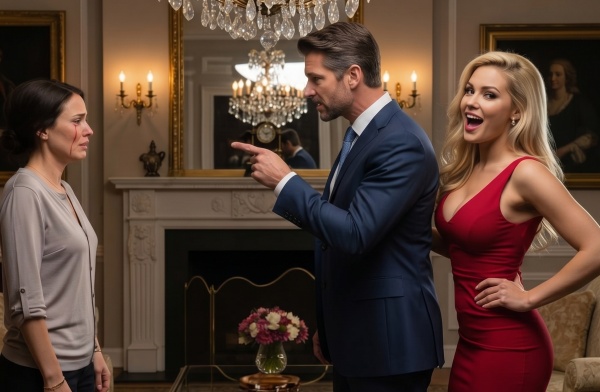
The billionaire husband called her ‘infertile’ and kicked her out just to bring his young mistress home. “I don’t need a broken oven that can’t produce an heir,” he spat, tossing the divorce papers at her face. 15 years later, he met two boys who looked exactly like his younger self….
The Billionaire realized he didn’t just throw away a wife—he threw away the only legacy he ever truly had.
Part 1: The Wife He Called Useless
“I don’t need a broken oven that can’t produce an heir,” my husband spat, tossing the divorce papers at my face.
The papers struck my chest, slid down my blouse, and scattered across the marble floor of the Manhattan penthouse I had helped turn into a home. For seven years, I had stood beside Graham Whitmore while the world called him brilliant, powerful, untouchable. That night, I realized the world had only seen the suit, not the man wearing it.
Behind him stood a woman in a red designer dress, one hand resting on the curve of her stomach.
Her name was Celeste.
She was twenty-six, almost sixteen years younger than me, and she smiled like she had been promised a throne. Graham’s hand rested protectively on her back, the way his hand used to rest on mine at charity galas and investor dinners. The difference was that I had once believed it meant love.
“I want you out by morning,” Graham said.
I looked at him, not the papers.
“Graham,” I said quietly, “you’re ending our marriage like this?”
He laughed, but there was no humor in it. “Don’t act surprised, Evelyn. We both knew this was coming.”
My name is Evelyn Whitmore now, though back then I was still Evelyn Hart in my own mind. Before Graham, I had been an operations consultant from Boston with a master’s degree, student loans, and a habit of fixing problems other people were too arrogant to admit existed. After Graham, I became the billionaire’s wife.
That title sounded glamorous to strangers.
It felt smaller every year.
Graham Whitmore was the founder and CEO of Whitmore Global, a private technology and logistics empire worth nearly $18 billion. His face appeared on magazine covers beside words like visionary, disruptor, and American success story. He owned homes in New York, Palm Beach, Aspen, and the Hamptons, but somehow never seemed satisfied inside any of them.
When we married, he told me he wanted a family more than anything.
At first, I believed him.
We tried for a child for five years. There were doctors in New York, specialists in California, quiet appointments, test results, whispered prayers, and nights when I lay awake while Graham slept beside me as if disappointment belonged only to me. Every negative test felt like a verdict, and every baby shower invitation felt like a small private trial.
The doctors never gave us a clear answer.
“Unexplained infertility,” they called it.
That phrase sounds gentle until you live inside it. It means no one knows what to fix, so everyone silently decides the woman must be the broken part. Graham never said it in the beginning, but I saw the thought growing behind his eyes.
Then Celeste arrived.
She came into our lives as a “brand strategist” hired for one of Graham’s philanthropic initiatives. She was beautiful, charming, and skilled at making powerful men feel misunderstood. At first, I dismissed her as another young woman orbiting money, but by then I had already made the mistake many wives make.
I trusted the history more than the evidence.
Three months before the divorce papers hit the floor, Graham started taking calls on the balcony. He changed passwords. He flew to Los Angeles for “urgent meetings” that were not on his calendar. He came home smelling like expensive perfume and lies.
When I confronted him, he did not deny it.
He seemed almost relieved.
“I need an heir,” he said that night, standing in our bedroom with his cuff links still on. “You know what this family name means.”
I remember staring at him. “This family name?”
He looked annoyed. “Don’t twist my words.”
“You mean your name.”
He turned away.
That was answer enough.
Now Celeste stood behind him in my living room, pregnant with the child he believed proved everything he had been thinking about me. He did not ask where I would go. He did not ask if I had eaten, if I was safe, if I was okay. Seven years of marriage had ended with a stack of legal documents and a sentence I would remember for the rest of my life.
A broken oven.
That was what he called me.
Not his wife.
Not the woman who held his hand when his father died.
Not the woman who helped reorganize his company’s operations when the board nearly forced him out during the European expansion disaster.
Not the woman who gave up her consulting firm because he said marriage to him required “a unified public image.”
Just a broken oven.
I bent down and gathered the divorce papers. My hands were shaking, but not from weakness. They were shaking because something inside me was trying to survive the moment without becoming cruel.
Celeste cleared her throat.
“I’m sorry,” she said softly, though her eyes said she was not.
I looked at her for the first time.
“No,” I said. “You’re not. But one day, you may understand why you should have been.”
Graham scoffed. “Don’t threaten her.”
“I’m not threatening anyone,” I said. “I’m remembering.”
He stepped closer. “You’ll get a fair settlement. More than fair. But you will not embarrass me. You will not fight me in the press. And you will not make this harder than it needs to be.”
There he was.
The billionaire who could buy buildings, politicians’ attention, boardroom silence, and magazine praise, but still thought dignity could be negotiated like a stock option.
I looked at the papers in my hands.
“Did your attorneys write this?”
“Of course.”
“Good,” I said. “Then mine will answer.”
His jaw tightened.
He had expected tears.
Maybe begging.
Maybe rage.
What he got was the first version of me he had never bothered to meet.
I walked past him to the bedroom and packed one suitcase. Not the diamond necklaces he had bought after arguments. Not the gowns from galas where I smiled beside him while feeling invisible. Not the framed wedding photo on the dresser.
I packed jeans, sweaters, my laptop, my passport, my grandmother’s watch, and the small leather notebook I had kept from my consulting days.
When I came back into the living room, Graham was pouring himself bourbon.
Celeste was sitting on my couch.
I stood by the elevator with my suitcase.
Graham looked me over. “That’s it?”
“For tonight.”
“You’re being dramatic.”
“No,” I said. “I’m leaving.”
He smiled coldly. “Finally.”
The elevator doors opened.
Before I stepped inside, I turned back one last time.
“You may have money, Graham,” I said. “But you have never understood value.”
He raised his glass. “And you never understood legacy.”
Fifteen years later, those words would return to him like a debt with interest.
Because by then, he would know the truth.
He had not thrown away a useless wife.
He had thrown away the only legacy he ever truly had.
Part 2: The Secret That Became Two Sons
I spent the first night after my marriage ended in a hotel near Bryant Park.
Not a luxury suite. Not one of Graham’s properties. Just a quiet room with a queen bed, a city view, and a bathroom where I finally sat on the tile floor and cried until my throat hurt. New York moved below me in yellow taxis and sirens, completely indifferent to the fact that my life had collapsed thirty floors above the street.
The next morning, I called my attorney, Nora Kaplan.
Nora had handled my prenuptial agreement before the wedding, back when Graham insisted I would “never need it.” She was the kind of woman who did not waste words, which made her extremely expensive and absolutely worth it. When I told her what happened, she was silent for exactly four seconds.
Then she said, “Do not sign anything. Do not speak to his team without me. And Evelyn, listen carefully—do not let his cruelty rush you into a bad agreement.”
“I don’t want his money,” I said.
“You may not want it, but you are entitled to legal protection.”
“I want out.”
“Then we will get you out properly.”
Properly became the word that saved me.
Nora reviewed the papers and laughed once under her breath. Graham’s attorneys had been aggressive, but not careless. The settlement offer was large enough to look generous in public and restrictive enough to keep me quiet. It included confidentiality clauses, media restrictions, and language that painted our separation as mutual.
Mutual.
As if I had mutually agreed to be insulted, replaced, and escorted out of my own life.
Still, I wanted peace.
I signed nothing for three weeks. During that time, I moved into a small apartment in Brooklyn Heights under my maiden name. I stopped attending events. I turned off social media. I let the gossip columns call me “reclusive” because silence was safer than giving strangers a wound to pick at.
Then, five weeks after Graham threw the papers at me, I fainted in a grocery store.
A woman in line behind me called 911.
At the emergency room, a resident with kind eyes asked when my last period had been. I almost laughed because the question had become a painful routine over the years. But then she returned with a look I had seen before on doctors who were about to change someone’s life.
“Mrs. Whitmore,” she said, “you’re pregnant.”
The room went quiet.
“I’m sorry,” I whispered. “What?”
“You’re pregnant.”
I stared at her.
After five years of needles, tests, specialists, grief, blame, and shame, the answer arrived in an emergency room after my husband had kicked me out for not giving him a child.
Two weeks later, an ultrasound revealed twins.
Two boys.
I remember lying on the exam table while the technician turned the screen slightly toward me. Two tiny heartbeats flickered in the dark. I covered my mouth with both hands and cried so hard the technician had to stop for a moment.
They were real.
They were mine.
And whether Graham deserved to know was not a simple question.
People like to believe life gives clean choices. Tell him or don’t tell him. Fight or forgive. Leave or stay. But real life is often a hallway full of doors, and behind every door is another consequence.
Legally, Nora advised documentation.
“We notify his counsel,” she said. “Not emotionally. Formally. Certified letter, medical confirmation, invitation to discuss next steps through attorneys.”
“And if he says I’m lying?”
“Then the law has procedures.”
So we did it properly.
Nora sent a letter to Graham’s legal team informing them of my pregnancy, the estimated timeline, and the possibility that Graham was the father. The letter was received. We had proof.
Four days later, his attorney responded.
Mr. Whitmore denies any responsibility for unverified claims made during an emotionally charged divorce process.
Two weeks after that, another letter came.
Mr. Whitmore requests no direct contact from Ms. Hart regarding personal matters. Any future claims may be addressed through appropriate legal channels after birth.
Appropriate legal channels.
I read the sentence three times.
Then I placed the letter in a folder and chose my sons.
My divorce finalized before they were born. Graham agreed to a settlement that gave me enough money to live comfortably, but not enough to control me. I kept my name, Evelyn Hart, and signed away nothing related to future legal claims involving children.
Nora made sure of that.
I moved to Austin, Texas, because I needed distance, sunshine, and a city where people cared more about what you were building than who you used to be married to. I rented a modest two-bedroom house in Travis Heights, bought a used SUV, and painted the nursery pale green because I refused to make everything blue just because they were boys.
My sons were born on a rainy Tuesday in November.
I named them Lucas and Noah.
Lucas arrived first, angry and loud, with a strong cry that made the nurse laugh. Noah came seven minutes later, quieter, watching the world with dark eyes as if he had already decided to reserve judgment. They were tiny, perfect, and both looked so much like Graham that I could barely breathe.
His eyes.
His chin.
His stubborn little frown.
I sent one final legal notice after their birth through Nora, including birth details and the option to establish paternity formally. Graham’s team acknowledged receipt and did nothing. Months later, Nora informed me that unless I wanted to initiate a legal action immediately, we could preserve the documents and wait.
I waited.
Not out of revenge.
Out of survival.
Newborn twins leave little room for billionaire drama. There were feedings at 2 a.m., diapers, ear infections, daycare waitlists, freelance consulting projects, and the terrifying math of building a life while holding two babies at once. I learned to answer emails with one child asleep against my chest and the other kicking my laptop.
I also learned that I was not broken.
Not as a woman.
Not as a wife.
Not as a mother.
Not as a businessperson.
Graham’s cruelty had reduced me to what my body had not given him on his timeline. But motherhood did not make me valuable. Success did not make me valuable. I had always been valuable, even when I was alone in a hotel bathroom believing his words might be true.
That realization became the foundation of everything I built next.
I started consulting again from my kitchen table. At first, it was small: operational audits for startups, supply chain reviews, team restructuring plans, cost control strategies. Then a former client introduced me to a clean-energy logistics company struggling to expand across the Southwest.
I fixed their process in six months.
They doubled revenue in eighteen.
Word spread.
By the time Lucas and Noah were five, I had founded Hartline Systems, a logistics and infrastructure firm focused on renewable energy, medical supply chains, and disaster-response networks. It was not glamorous work, but I knew how to build what lasted.
By the time the boys were ten, Hartline had offices in Austin, Denver, Atlanta, and Phoenix.
By the time they were fourteen, we were competing directly with Whitmore Global for federal and private logistics contracts.
Graham did not notice me at first.
That was his second mistake.
His first was throwing me away.
Part 3: The Boys With His Face
Lucas and Noah grew up knowing the truth in pieces.
I never told them their father was dead. I never invented a hero. I never poisoned them with adult bitterness they had not earned. When they were little and asked why they did not have a dad at school events, I told them every family looked different, and ours had more love than space in the car.
When they were eight, I told them their father and I had divorced before they were born.
When they were twelve, I told them I had tried to notify him.
When they were fourteen, I told them his name.
Lucas reacted first, as always.
“Our father is Graham Whitmore?” he asked, staring at me across the kitchen island.
“Yes.”
“The billionaire Graham Whitmore?”
“Yes.”
Noah looked down at his hands.
Lucas pushed back from the counter. “So he knew?”
“I notified his attorneys before you were born and after.”
“And he ignored it?”
I took a slow breath. “He chose not to respond.”
Lucas laughed, but it sounded nothing like humor. “That’s a nice way to say he abandoned us.”
“It’s an accurate way to say what I can prove.”
Noah looked up then. “Did he know we were boys?”
I hesitated.
That hesitation was answer enough.
Noah’s face changed in a way that made my heart ache. He was the quieter one, but quiet children do not feel less. They just bleed inward first.
“He wanted an heir,” Noah said.
I closed my eyes.
I had never told them the exact words Graham used. I never repeated the broken oven line. Some cruelty does not need to be inherited.
“He wanted many things,” I said. “But wanting an heir is not the same as being worthy of children.”
Lucas stood up. “I don’t want his money.”
“I know.”
“I mean it.”
“I believe you.”
Noah asked, “Does he have other kids?”
That question had followed us for years.
Celeste’s pregnancy had ended in a public tragedy I only learned about through the news. She lost the baby late in the pregnancy, and shortly afterward, her relationship with Graham collapsed under the weight of grief, blame, and scandal. I had felt no joy in that news. A child had been lost, and no adult’s sins made that less sad.
Graham never had another child.
Not publicly.
Not legally.
Not according to the family profiles written about him every year by magazines obsessed with powerful men and lonely mansions.
“No,” I told them. “Not that anyone knows.”
Lucas stared at the window.
Noah whispered, “So we’re it.”
I walked around the island and placed one hand on each of their shoulders.
“No,” I said. “You are not an ‘it.’ You are not a legacy project. You are not proof of anyone’s manhood. You are Lucas and Noah Hart, and that is enough.”
That became our rule.
They were never allowed to measure themselves by the father who refused to see them.
But blood has a strange way of standing in the mirror.
As teenagers, both boys grew tall. Lucas had Graham’s sharp jaw and fearless posture, but my grandmother’s sense of justice. Noah had Graham’s dark eyes and calm intelligence, but my patience and my talent for seeing weak points in systems.
They were brilliant, infuriating, funny, and kind in different ways.
Lucas played basketball and argued with teachers when he thought rules were unfair. Noah built drones in the garage and once redesigned our home Wi-Fi so thoroughly that I had to ask permission to print a shipping label. They fought over cereal, music, hoodies, and who had stolen whose phone charger.
They also volunteered once a month with Hartline’s disaster relief logistics program.
That mattered to me more than grades, awards, or college brochures.
I did not raise heirs.
I raised people.
When the boys were fifteen, Hartline Systems was invited to bid on one of the largest infrastructure logistics contracts in the country: a national emergency medical supply network serving hospitals, state agencies, and disaster-response centers. The contract had been expected to go to Whitmore Global.
Graham’s company had the name, the history, and the political relationships.
Hartline had better systems.
For three months, my team worked around the clock. We prepared models, risk maps, delivery simulations, cost analyses, and contingency routes for hurricanes, wildfires, winter storms, and cyber disruptions. I slept four hours a night and drank coffee like it was a legal strategy.
The final presentation took place in Washington, D.C., at a private industry summit.
I brought Lucas and Noah because the summit coincided with their spring break, and they had both become fascinated by the company’s work. They wore suits they hated, ties they loosened within ten minutes, and sneakers I allowed because some battles are not worth fighting.
“You look professional,” I told them.
Lucas glanced down. “I look like I’m about to sell life insurance.”
Noah said, “You look like you were rejected from a boy band.”
They were still arguing when we entered the hotel ballroom.
Then the room changed.
Not visibly.
Not loudly.
But I felt it.
Across the ballroom, surrounded by executives, lobbyists, and people laughing too hard at his jokes, stood Graham Whitmore.
Fifteen years older.
Silver at the temples.
Still handsome.
Still dressed like money had personally tailored him.
He turned just as Lucas laughed at something Noah said.
Graham’s face froze.
I watched recognition move through him slowly, like sunrise over a crime scene.
First, confusion.
Then disbelief.
Then the terrible understanding that blood does not ask permission before announcing itself.
His eyes moved from Lucas to Noah, then to me.
For fifteen years, I had imagined this moment in different ways. Sometimes I was angry. Sometimes I was graceful. Sometimes I walked past him without a word. Sometimes I told him everything he deserved to hear.
In reality, I simply stood there with my sons beside me and felt the past finally see us.
Lucas noticed him first.
“Mom,” he said quietly. “Is that him?”
“Yes.”
Noah did not speak.
Graham took one step forward, then stopped, as if the floor itself had reminded him he was not in control.
An event coordinator approached us with name badges.
“Ms. Hart, welcome. Your panel begins in twenty minutes.”
Graham heard the name.
Ms. Hart.
Not Mrs. Whitmore.
Not the discarded wife.
Not the woman he had called useless.
Evelyn Hart, founder and CEO of Hartline Systems.
His biggest rival.
Part 4: The Legacy He Could Not Buy
The first words Graham said to me after fifteen years were not an apology.
Of course they weren’t.
Men like Graham do not begin with remorse when shock is available.
He approached me near the coffee station during the morning break, his eyes flicking repeatedly toward Lucas and Noah, who stood several yards away pretending not to watch. I could see the questions forming behind his face. Their ages. Their features. The timing.
“Evelyn,” he said.
“Graham.”
My voice sounded calmer than I felt.
He looked older up close. Not weak, not ruined, but weathered in ways magazine lighting could hide and real life could not. There were fine lines around his mouth that had not been there when he called me broken.
“You look well,” he said.
“I am.”
His eyes moved again toward the boys. “Are they yours?”
I almost smiled.
“Yes.”
He swallowed. “Both of them?”
“Yes.”
The arrogance in his face cracked, just slightly.
“How old are they?”
“Fifteen.”
The word landed.
Fifteen.
Not fourteen. Not sixteen. Fifteen years since the divorce, since the letters, since the pregnancy he chose to treat like a legal inconvenience. Fifteen years since he threw me out to make room for a future that never arrived.
He lowered his voice. “Are they mine?”
I looked at him for a long moment.
Then I said, “Your attorneys were notified before they were born and after. You chose not to pursue the answer.”
His face paled.
“That’s not what I asked.”
“No,” I said. “But it is what happened.”
He stepped closer. “Evelyn.”
I held up one hand.
“Do not make this emotional in a hotel ballroom.”
His jaw tightened, and for a second I saw the old Graham. The man who expected rooms to bend toward his discomfort. But we were not in his penthouse anymore.
We were in public.
And I was not his wife.
Lucas appeared beside me then.
Not aggressively.
Just present.
He was almost Graham’s height, with the same dark eyes and the same stubborn chin. Graham looked at him as if seeing a ghost who had grown up without permission.
Lucas looked back without blinking.
“Mom,” he said, “they’re ready for you.”
I nodded. “Thank you.”
Graham stared at him. “What’s your name?”
Lucas hesitated.
I did not answer for him.
“Lucas Hart,” he said.
Graham’s mouth tightened at the last name.
Then Noah joined us, quieter, observant, taking in Graham’s expression like data.
“Noah Hart,” he said before Graham could ask.
The two boys stood beside me, not behind me.
That mattered.
Graham looked from one to the other. There was hunger in his expression now, and grief too, but also something uglier: possession awakening late. He had spent fifteen years mourning an heir he believed life had denied him, never realizing two of them were growing up outside the gates he had built to protect his ego.
“I think,” Graham said slowly, “we need to talk.”
Noah tilted his head. “About what?”
Graham blinked, surprised by the directness.
“About family.”
Lucas gave a short laugh. “That’s a bold opening.”
“Lucas,” I said gently.
“No,” Graham said, recovering himself. “He has a right to be upset.”
That almost angered me more than anything else.
How quickly he became generous with emotions he had caused.
The summit coordinator called my name.
I turned to my sons. “Go sit up front. I’ll be there in a minute.”
They obeyed, though Lucas looked back twice.
When they were out of earshot, Graham leaned closer.
“Why didn’t you tell me?”
I stared at him.
For the first time in fifteen years, I wanted to repeat every word from every letter Nora had sent. I wanted to pull copies from my bag and place them in his hands like evidence in a trial. But the truth was simpler than documentation.
“I did,” I said.
His eyes flickered.
“My attorney notified yours. Twice. You denied responsibility before they were born, then ignored the notice after.”
“I was told you were being manipulative.”
“You chose to believe that.”
His voice dropped. “You should have fought harder.”
There it was.
The billionaire’s final defense.
Even his abandonment was somehow my failure to overcome it.
I stepped closer, close enough that only he could hear me.
“I was pregnant with twins, newly divorced, recovering from public humiliation, and rebuilding my life from scratch. I informed you through proper legal channels. I preserved the record. Then I raised them. Do not stand here fifteen years later and suggest I failed because I did not beg you to be a father.”
His face tightened.
Then, for the first time, he looked ashamed.
Truly ashamed.
Not embarrassed.
Not exposed.
Ashamed.
“I didn’t know,” he whispered.
“You didn’t want to know.”
I walked away before he could answer.
The presentation began ten minutes later.
I stood onstage in front of executives, officials, investors, and competitors. Graham sat in the second row. Lucas and Noah sat in the front, side by side, both pretending to look relaxed and failing completely.
I presented Hartline’s model clearly.
No drama.
No personal story.
Just data, strategy, performance history, cost controls, emergency response reliability, and a national implementation plan that made Whitmore Global’s proposal look expensive and outdated. My team had built something strong enough to stand without gossip holding it up.
During the Q&A, a federal procurement advisor asked how Hartline had scaled so quickly without sacrificing accountability.
I looked briefly at my sons.
Then I answered.
“By building systems that do not depend on one person’s ego.”
A few people laughed politely.
Graham did not.
By the end of the summit, people were whispering. Not because of scandal, though some had clearly noticed the resemblance. They were whispering because Hartline had outperformed Whitmore in the room that mattered.
Two weeks later, the contract was awarded.
Not to Whitmore Global.
To Hartline Systems.
The headline in a major business journal read:
Hartline Systems Defeats Whitmore Global in Landmark Infrastructure Contract
The article called me “the quiet architect of a logistics upset.”
It called Graham “an industry titan facing increasing competition.”
It did not mention that we had once been married.
It did not mention Lucas or Noah.
For that, I was grateful.
Graham called the day the article was published.
I let it go to voicemail.
His message was short.
“Evelyn, please. I need to know them.”
I listened once.
Then I sat at the kitchen table with my sons and told them the decision was theirs.
Part 5: The Billionaire’s Worst Nightmare
Lucas said no immediately.
Noah said nothing for two days.
That was how they processed pain. Lucas rejected it out loud. Noah carried it into silence, turned it over, studied it, and came back with questions sharp enough to cut through bone.
On the third night, Noah found me on the back porch.
Austin was warm, the sky wide and dark, cicadas buzzing somewhere beyond the fence. He sat beside me with two glasses of iced tea and handed me one. For a while, neither of us spoke.
Finally, he said, “Do you hate him?”
I looked out at the yard where he and Lucas had once chased fireflies in pajamas.
“No.”
“Why not?”
“Because hate is heavy. And I had to carry you two.”
He nodded slowly.
“Do you think we should meet him?”
“I think you should do what protects your peace.”
“That sounds like something a therapist would say.”
“It is also something a mother would mean.”
He smiled faintly.
Then his face grew serious again.
“What if he only wants us because we’re boys?”
I closed my eyes.
There it was.
The wound I could not shield him from.
“Then you will learn that quickly,” I said. “And you will still be allowed to leave.”
A week later, both boys agreed to one supervised meeting. Not at Graham’s office. Not at his home. Not anywhere that made him look powerful. Nora arranged it at a family law office in Austin, with a counselor present and clear boundaries.
Graham flew in on a private jet.
The boys arrived in my SUV.
That difference told the whole story.
He entered the conference room wearing a navy suit and carrying two gift bags from an expensive store. Lucas noticed them and immediately looked at me. I gave the smallest shake of my head. Gifts were not the point.
Graham set the bags aside.
Smart choice.
For a few seconds, he just looked at them.
No cameras.
No board.
No assistants.
No magazine writer ready to polish his pain into wisdom.
Just two fifteen-year-old boys with his face and my last name.
“I’m Graham,” he said, then seemed to realize how absurd that sounded. “I mean… I’m your father.”
Lucas leaned back in his chair. “Biologically.”
Graham absorbed that.
“Yes,” he said. “Biologically.”
Noah watched him carefully. “Why didn’t you answer the letters?”
Graham looked at me.
I said nothing.
This was not my question to answer.
He turned back to Noah. “I was told your mother was trying to use the pregnancy during the divorce.”
Lucas laughed coldly. “So you ignored two babies because lawyers made you uncomfortable?”
Graham flinched.
“No. I—” He stopped. “I made a terrible choice.”
Noah asked, “Did you know we were boys?”
Graham’s eyes filled with something like grief.
“I knew she said twins. I didn’t know more.”
That was true enough, though not complete.
Lucas leaned forward. “Would it have changed anything?”
Graham opened his mouth.
Closed it.
For the first time, he did not lie quickly enough to save himself.
Lucas nodded. “That’s what I thought.”
The counselor gently redirected the conversation. They talked for forty minutes. Graham asked about school, sports, engineering, college plans, music, and whether they liked New York. He tried to be warm. Sometimes he almost succeeded.
But children know the difference between interest and repair.
At the end, Graham pushed the gift bags forward.
“I brought these for you.”
Noah looked inside one bag and saw a watch box.
Lucas did not touch his.
“We don’t need watches,” Lucas said.
Graham looked wounded. “They’re not meant to replace anything.”
“Good,” Noah said quietly. “Because they can’t.”
Graham nodded slowly and pulled the bags back.
That was the first respectable thing I saw him do.
After the meeting, Lucas walked ahead to the car. Noah lingered near the doorway.
Graham said, “Could I see you again?”
Noah looked at him for a long time.
“Maybe,” he said. “But not if you call us your legacy.”
Graham looked stunned.
Noah continued, “We’re people. Not proof.”
Then he walked away.
I stood across the hallway, holding my car keys so tightly they left marks in my palm.
Graham turned to me.
“They’re extraordinary,” he said.
“Yes,” I replied.
His eyes reddened. “You did that.”
“I know.”
He looked down.
There was no applause for him in that hallway.
Only truth.
Over the next year, the boys met Graham four more times. Lucas remained guarded, polite when necessary, blunt when pushed. Noah asked questions Graham did not enjoy answering. Neither of them called him Dad.
Graham did not force it.
Maybe because Nora made the boundaries clear.
Maybe because the counselor did.
Maybe because Graham had finally learned that money could open doors, but it could not make children walk through them.
Meanwhile, Hartline grew faster than anyone predicted. The national contract led to partnerships with hospitals, state agencies, and renewable energy networks across the country. We opened a new headquarters in Austin, a glass-and-stone building with solar panels, an employee childcare center, and a wall in the lobby displaying the names of every founding team member.
At the opening ceremony, a journalist asked me what motivated Hartline’s rise.
I could have told the dramatic version.
I could have mentioned the penthouse, the divorce papers, the insult, the mistress, the twins, and the billionaire who had thrown away the very heirs he claimed to want. It would have gone viral by dinner.
Instead, I looked at my sons standing near the ribbon with scissors in their hands.
“Resilience,” I said. “And refusing to let someone else’s definition of your worth become your future.”
That quote did go viral.
Not scandal viral.
The better kind.
The kind women sent to each other at midnight with messages like, I needed this.
Graham saw the clip.
He sent me an email that night.
I called you unforgivable things because I could not face my own fear. I thought legacy meant a name, a son, a company, an empire. I know now that I threw away the only family that ever might have loved me without needing my money. I am sorry.
I read it twice.
Then I closed my laptop.
Some apologies are real.
Some are too late.
Many are both.
Fifteen years earlier, I would have wanted that apology more than oxygen. I would have cried, replied, explained, forgiven too quickly, and tried to turn his regret into proof that I had mattered. But the woman reading it now already knew she mattered.
I did not need Graham’s remorse to validate my survival.
I showed the email to Lucas and Noah because it involved them too.
Lucas read it first.
“He writes like he’s accepting an award,” he said.
Noah took longer.
“He sounds lonely,” he said.
Lucas shrugged. “That’s not our fault.”
“No,” Noah replied. “But it can still be sad.”
That was the difference between them.
Fire and water.
Both strong.
Both necessary.
Years passed, and the story settled into something quieter than revenge.
Graham remained wealthy, but Whitmore Global lost its dominance. He stepped down as CEO after a shareholder dispute and became executive chairman, a title that sounded powerful because titles are designed to do that. Business magazines called it “a strategic transition.”
People who understood boardrooms called it something else.
Hartline became the stronger company.
Not bigger at first.
Better.
More trusted.
More disciplined.
Less dependent on one man’s image.
Lucas went to Stanford to study public policy and economics. Noah went to MIT for engineering. Both kept the Hart name. Graham attended neither move-in day, but he sent handwritten notes that the boys read and placed in drawers.
Not thrown away.
Not framed.
Drawers were honest.
The real ending came on a rainy afternoon in New York, almost exactly fifteen years after Graham threw the divorce papers at my face.
Hartline was hosting a partnership event at a hotel overlooking Central Park. Lucas and Noah, now young men, had flown in for the weekend. Graham requested permission to attend the public portion of the event, and after discussing it with the boys, I agreed.
He arrived alone.
No entourage.
No young woman on his arm.
No cameras trailing his grief.
Just Graham Whitmore, older now, standing near the back of a ballroom while the two sons he had refused grew into men without his name.
During the reception, Lucas crossed the room first.
Noah followed.
I watched from a distance as Graham spoke to them. I could not hear the words, but I saw the moment his face changed. Lucas must have said something sharp, because Graham nodded like a man accepting a sentence. Then Noah placed a hand briefly on Graham’s shoulder.
Not forgiveness.
Not rejection.
Something in between.
Humanity, maybe.
Later, Graham approached me near the windows.
Below us, Manhattan glowed in the rain.
“You built something remarkable,” he said.
“Yes,” I replied.
He smiled faintly. “You never needed me.”
“No.”
“I needed you more than I understood.”
I looked at him then.
Really looked.
The man who had once seemed enormous now looked simply human. Flawed, proud, aging, regretful, and smaller than the shadow he had cast over my life. For years, I had thought my victory would be watching him suffer.
But victory felt nothing like that.
Victory felt like peace.
“You didn’t throw away a legacy, Graham,” I said.
His eyes met mine.
“You threw away people.”
He looked down.
“I know.”
For once, he did.
Across the room, Lucas laughed at something Noah said. Both turned toward me at the same time, and for one strange second, I saw Graham’s younger face twice over. But their smiles were mine.
Their kindness was theirs.
Their future belonged to no man who had failed to earn it.
Graham followed my gaze.
His expression broke quietly.
That was his karma.
Not poverty.
Not public ruin.
Not some dramatic fall from a skyscraper life.
His punishment was standing in a room full of everything he once claimed to want and knowing none of it belonged to him.
The sons.
The company.
The respect.
The woman.
The legacy.
He had spent his life believing money could secure meaning. He learned too late that meaning had been sitting across from him at breakfast, walking beside him at galas, crying alone in doctors’ offices, and eventually carrying two sons into a world he was too proud to enter.
Fifteen years earlier, he called me unproductive.
Now my company outperformed his.
He called me broken.
Now my sons stood whole without him.
He demanded an heir.
Now two young men with his face carried my name.
And me?
I was no longer the wife he discarded.
I was Evelyn Hart.
Mother.
Founder.
CEO.
A woman who had been told she was an empty vessel and went on to build an empire of her own.
Graham Whitmore had once thought karma was something poor people invented to comfort themselves.
He was wrong.
Karma was not loud.
It did not arrive with revenge music or flashing lights.
Sometimes karma walked into a ballroom wearing two tailored suits, looking exactly like your younger self, calling another woman Mom, and carrying the last name of the woman you threw away.
