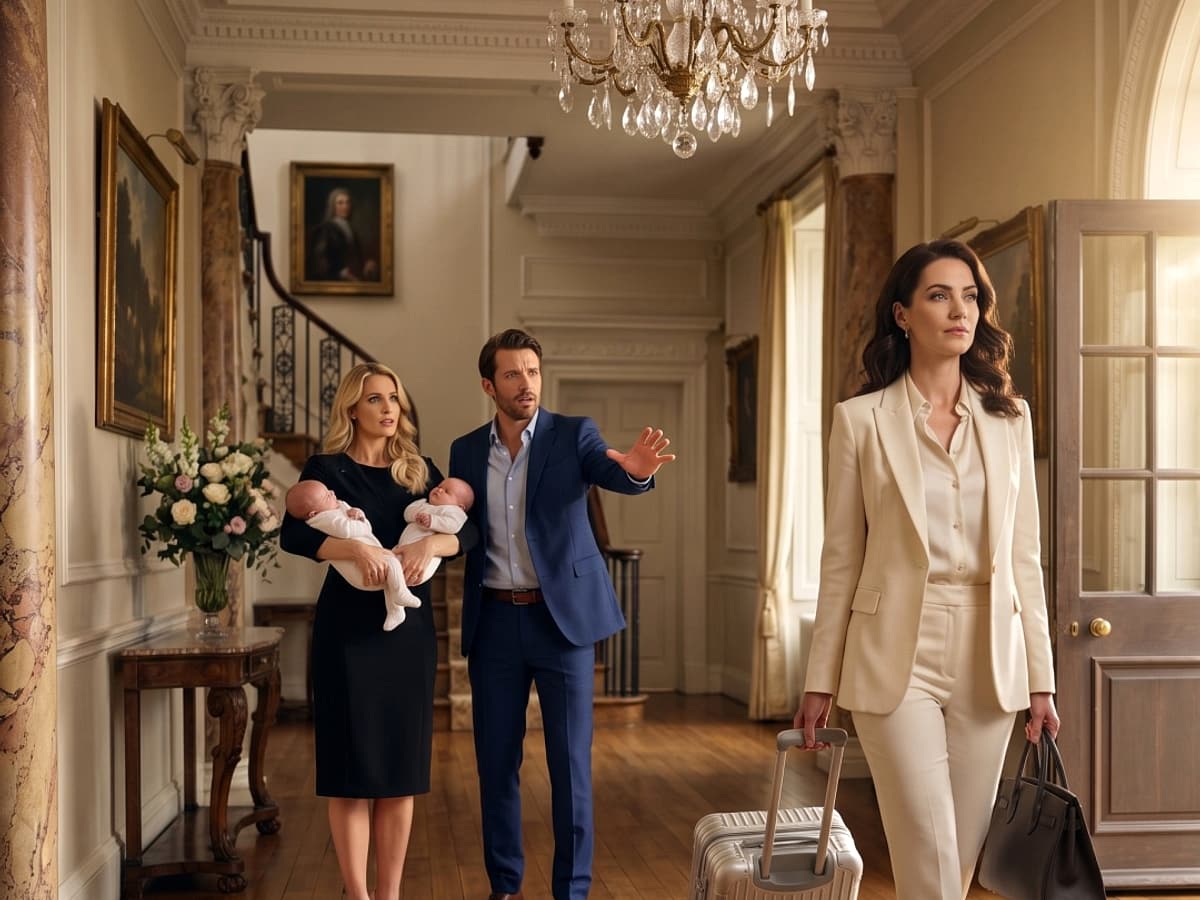
Part 1: A Business Deal Dressed as a Goodbye
The restaurant was the kind of place where money made the walls thicker.
Private dining room, Madison Avenue address, a wine list bound in calfskin, and waiters trained to be invisible while powerful men said devastating things.
Outside, December rain glazed the yellow cabs crawling south on the avenue.
Inside, my husband, Grant Whitfield, sat across from me adjusting his cufflinks.
He did not look ashamed.
He looked like a man who had already filed the paperwork in his head and was simply waiting for the physical world to catch up.
“Sienna had the babies last week,” he said.
“A boy and a girl.”
I kept my hands in my lap and my face still.
“Congratulations,” I said.
His jaw tightened.
He had wanted tears, maybe a raised voice, something he could point to later as evidence that leaving had been the reasonable choice.
I gave him nothing to point to.
Grant had spent his entire adult life building toward fatherhood the way other men build toward corner offices.
Old Connecticut family, Yale degree, vintage watch collection, and an unshakeable belief that legacy was something a man handed down like a last name or a bad habit.
For ten years, he told everyone who would listen that all he wanted was a family.
What he never said out loud was that every failed pregnancy quietly became my fault.
We had done everything medicine could offer: specialists, injections, private clinics, blood draws at 6 a.m., and the particular grief of Mother’s Day brunches where I smiled until my face ached.
Every time a doctor said “unexplained infertility,” Grant heard “Eleanor failed.”
Every negative test made him colder for days.
Then Sienna Vale entered his orbit.
Twenty-nine, polished in the way New York money polishes people, employed as something called a personal brand consultant.
I had met her once at a Plaza charity auction.
Silver dress, too much laughter at Grant’s jokes, and a look she gave me that said she believed she had already won.
At the time, I thought she was just another decorative presence in his world.
I was wrong about that.
“She gave me what you couldn’t,” Grant said.
The sentence arrived quietly, which was somehow worse than if he had shouted it.
I had spent years bracing for that line.
When it finally came, it did not split me open the way I had feared.
It settled somewhere deep and still, as if my heart had long since moved the breakable things out of reach.
“Say exactly what you mean,” I told him.
His eyes went flat.
Grant hated plain language because plain language left nowhere to hide.
“I need heirs,” he said carefully.
“Sienna has given me two children. We have tried for ten years. At some point, we have to face reality.”
Rich men loved that word.
Reality, in their vocabulary, always meant someone else’s inconvenience.
I reached for my water glass just to give my hand something ordinary to do.
Around us, the restaurant continued without interruption.
A couple near the window laughed over oysters.
A man at the bar scrolled his phone.
Somewhere behind the kitchen door, a chef called out an order.
My marriage was ending and New York did not even glance up.
Grant opened a leather folder and slid a document across the white tablecloth.
“I want this handled cleanly,” he said.
I looked at the top of the first page.
Settlement Agreement.
“Cleanly,” I repeated.
“You mean quietly.”
His mouth moved toward something that might have been a smile.
“I mean respectfully.”
That made me laugh.
Not loudly, not dramatically, just once, sharp enough to make his eyes narrow.
“You brought another woman into our marriage, had children with her, and now you’re using the word respectfully?”
He leaned forward.
“Eleanor, don’t make this harder than it needs to be.”
The oldest line in a broken marriage: please make my cruelty convenient for me.
He tapped the folder.
“Eighteen million dollars.”
I stared at him.
“Cash settlement,” he continued.
“Plus your personal accounts, the jewelry, and the Boston condo.”
“You sign, we file uncontested, and we both move forward.”
He said it like a kindness.
To Grant, eighteen million dollars was simply the cost of a clean transition: silence purchased, reputation protected, a clear path for Sienna and the twins to step into his public life without old questions trailing behind them.
“Generous compensation,” he added, “for a wife who failed to give me a child.”
Everything in the room went still.
Not quiet.
Still.
I thought of the first pregnancy we lost at nine weeks.
The second at eleven.
The third so brief the doctor suggested I not allow myself to become attached, as if attachment were something you could switch off like a lamp.
I thought of bathroom floors and bruised arms and baby names written in notebooks and then torn out.
I thought of Grant standing in clinic waiting rooms with one hand in his pocket, checking his phone while nurses searched for a usable vein.
Then I thought of the envelope in my purse.
The one he did not know existed.
I closed the folder.
“All right,” I said.
Grant blinked.
“All right?”
“I’ll have my attorney review it.”
He looked almost disappointed.
He had wanted a fight because a fight would have made him feel justified.
My calm gave him nothing to push against, and men like Grant needed resistance the way engines need friction.
“You understand what this means?” he asked.
“You’ll be out of the Upper East Side apartment by the end of the month.”
“Yes.”
“No public statements about the children.”
I tilted my head.
“I have no intention of involving children in adult failures.”
Something crossed his face.
Shame, maybe, or the shadow of it.
It was gone before it could become useful.
He signaled for the check, though his steak was barely touched.
That was Grant: capable of ending a decade-long marriage before dessert, but constitutionally unable to leave without settling the bill correctly.
When we stood, he reached for my arm.
I stepped back.
His hand stopped in the air between us.
“Eleanor,” he said, softer now.
“This is best for everyone.”
“No,” I said.
“It’s best for you.”
I put on my coat and walked out into the rain.
I did not cry in the car.
I did not cry in the elevator.
I did not cry when I walked into the apartment where I had spent ten years trying to become the kind of wife he would stop punishing.
I went straight to my closet, took down my suitcase, and began packing only what was mine.
My passport. My mother’s pearls.
My grandmother’s recipe cards. A blue cashmere sweater I had bought myself after the second miscarriage because I needed proof my body still deserved softness.
At the bottom of my dresser was the envelope.
I held it for a long moment, then placed it carefully in my carry-on.
Grant believed eighteen million dollars was the final number in our marriage.
He had no idea it was only the opening figure.
Part 2: What the Envelope Knew
My attorney’s name was Marjorie Lane.
She had the kind of measured voice that made powerful men lower their own without quite understanding why.
Her office looked out over Bryant Park, where bare winter trees stood against the gray sky like black lace pressed against glass.
She read Grant’s settlement offer without changing expression.
Her eyebrows moved only once, when she reached the clause about “failure to produce biological issue.”
“Charming,” she said.
“That’s one word for it.”
She removed her glasses and looked at me.
“Do you want to fight this?”
I watched people crossing the street below, carrying coffees and briefcases and the ordinary urgency of lives that had nothing to do with mine.
“No.”
Marjorie studied me the way good attorneys study clients who are being too calm.
“You’re entitled to significantly more, depending on asset classification and what discovery might turn up.”
“I know.”
“He may be concealing assets.”
“I assume he is.”
“Then why accept?”
I opened my purse and set the envelope on her desk.
“Because I don’t need more money from Grant.”
She looked at the envelope, then at me.
“What is this?”
“Something I received last month from Dr. Keller’s office.”
Her expression shifted.
Dr. Thomas Keller had been our reproductive endocrinologist for six years.
His Midtown clinic had white orchids, soft lighting, and a billing department that would have impressed a hedge fund.
Grant had hated the clinic but loved telling people they were “pursuing every option,” as if my body were a project his money could manage into compliance.
Marjorie opened the envelope carefully.
Inside were copies of medical correspondence, a lab summary, and a letter from Dr. Keller addressed to both Grant and me.
I had requested our complete file months earlier, after Sienna’s pregnancy became impossible to ignore.
Not to wound myself with old records, but because something in Grant’s behavior had started to feel deliberately constructed.
The letter confirmed what Dr. Keller had told us privately years before.
The fertility challenges were not mine alone.
In fact, the most significant clinical factors had been Grant’s: low motility, abnormal morphology, a genetic concern requiring further evaluation.
Language softened for patients, but clear enough for anyone willing to read it honestly.
Grant had known.
I had known.
But publicly, emotionally, socially, he had placed the entire burden at my feet because it was easier to be pitied as a man denied heirs than exposed as a man whose biology did not match his ego.
Marjorie read in silence.
Then she looked up.
“Does Sienna know any of this?”
“I doubt it.”
“Does Grant know you have these copies?”
“No.”
“Are you planning to use them?”
“Not publicly.”
She leaned back in her chair.
“Good. Medical information is sensitive. Using it as leverage could create legal and personal problems.”
“I don’t want leverage,” I said.
“I want to leave before he understands what he lost.”
She waited.
“I want the settlement signed, the money transferred, the Boston condo in my name, and the divorce filed cleanly.”
“And then?”
“California.”
Marjorie looked genuinely surprised.
I had spent my entire adult life between New York, Boston, and Connecticut, in the kind of East Coast spaces where everyone knew someone who knew your grandmother.
California sounded like reinvention with better weather.
“Why California?” she asked.
“My best friend lives in San Diego. I can work from anywhere.
I am tired of winter. And Grant hates California.”
Marjorie smiled faintly.
“That last reason isn’t a legal argument, but I respect it.”
The next three weeks were a blur of signatures, disclosures, and the kind of polite hostility that only attorneys can make expensive.
Grant pushed for speed, which told me everything.
He wanted Sienna and the twins installed in his public life before anyone started asking questions.
His mother, Patricia Whitfield, had already begun telling family friends that “life had surprised them in a beautiful way.”
In Patricia’s world, scandals did not occur.
They were rebranded.
Grant texted me twice during the process.
First: I appreciate your cooperation.
Second: Please don’t make this ugly.
I did not respond to either.
Silence had always made him nervous.
For ten years, my silence had meant patience, grief, or exhaustion.
Now it meant something else entirely, and he could feel the difference even if he could not name it.
The final signing happened on a Friday morning in Marjorie’s conference room.
Grant arrived with his attorney, a square-jawed man named Paul who wore a navy suit and the expression of someone who billed in six-minute increments.
Grant looked handsome and faintly triumphant.
I recognized that look from major acquisitions.
He thought he had won.
I wore a cream blouse, black trousers, and my wedding ring.
Not because I still loved it, but because I wanted to remove it only once, at exactly the right moment.
We signed page after page.
When it was done, Grant exhaled.
“Thank you,” he said.
“For what?”
“For being reasonable.”
There were many things I could have said.
I could have told him that reasonable women are often the most dangerous because they keep receipts.
I could have told him that eighteen million dollars was not compensation for my childlessness, because I had never been the only reason children had not come.
Instead, I reached down and removed my wedding ring.
I placed it on the table between us.
“You can keep that,” he said.
“I know.”
The room went quiet.
Paul shuffled papers because men like Paul became uncomfortable when symbolism entered a billable hour.
I stood.
“Goodbye, Grant.”
He frowned slightly.
“That’s it?”
“Yes.”
“You’re not going to say anything else?”
I almost smiled.
“Not to you.”
I walked out with Marjorie beside me.
At the elevator, she touched my arm.
“Eleanor, I’ve watched a lot of people leave marriages. Most are running from something. You look like you’re walking toward something.”
My throat tightened.
“I hope so,” I said.
At 12:07 p.m., eighteen million dollars landed in the account Marjorie had arranged.
At 4:30 p.m., I left the Upper East Side apartment for the last time.
At 7:15 p.m., I boarded a first-class flight from JFK to San Diego with two suitcases, one carry-on, and an envelope Grant still did not know existed.
As the plane climbed above New York, the city glittered beneath me like a place that had always been good at pretending it had never broken anyone.
I looked out the window.
Then I finally cried.
Not because I was leaving Grant.
Because for the first time in ten years, I was not trying to earn permission to stay somewhere.
Part 3: The Life I Built in the Space He Left
San Diego smelled like salt water, eucalyptus, and something I had almost forgotten how to recognize.
Possibility.
My best friend, Naomi Park, met me at the airport just before midnight.
She was wearing leggings, a denim jacket, and sunglasses pushed up into her hair despite the hour.
She hugged me hard enough that I dropped my purse.
Then she picked it up, looked at my face, and said exactly the right thing.
“You’re staying as long as you want.”
Naomi lived in La Jolla in a small Spanish-style bungalow with white walls, blue tile, and bougainvillea climbing the fence like it had never heard of heartbreak.
She was a pediatric surgeon, divorced, child-free by choice, and allergic to wealthy men who used the word legacy too often.
She had disliked Grant politely for years.
The morning after I arrived, she set avocado toast in front of me like it was medicine.
“You are extremely rich and emotionally concussed,” she said.
“What’s the plan?”
I laughed for the first time in weeks.
It came out rusty.
“I don’t know.”
“Good,” she said.
“We’ll start there.”
Starting there meant sleeping ten hours.
It meant walking along the beach in sweatpants while surfers carried boards under their arms and retirees power-walked with the intensity of people training for something serious.
It meant buying groceries without checking whether Grant preferred a particular brand of olive oil.
Freedom, at first, was embarrassingly small.
A bathroom counter with only one toothbrush.
A phone that did not make my stomach clench when it lit up.
A drawer that belonged entirely to me.
But grief is clever.
It waits until the body feels safe before it begins unpacking.
Three weeks after arriving, I sat in a Target parking lot and sobbed because I saw a father lifting twin toddlers into a shopping cart.
They were wearing matching dinosaur hoodies, one green, one orange.
He kissed each of their heads without thinking, the way people do when tenderness has become muscle memory.
A woman loading groceries nearby tapped my window and asked if I was all right.
I told her yes.
It was not yet true, but it was becoming true.
Naomi sent me to a therapist named Dr. Melissa Hart, whose office had plants, soft chairs, and no inspirational quotes on the walls, which made me trust her immediately.
In our third session, she asked what I had lost.
“My marriage,” I said.
“What else?”
“My future.”
“What else?”
I stared at the rug for a long moment.
“My belief that if I loved someone well enough, they would stop hurting me.”
Dr. Hart nodded slowly.
“That one takes longer.”
She was right.
Eighteen million dollars could not buy that back.
Money opened doors, bought safety, created space, funded attorneys and financial advisors and beachfront rentals.
It could not restore the version of me who had believed Grant’s coldness was a weather pattern I could survive if I dressed properly.
So I built something different.
I bought a house in Del Mar with a view of the Pacific from the upstairs balcony.
I hired a financial advisor Naomi trusted, not anyone from Grant’s circle.
I put most of the settlement into conservative investments and carved out a portion for something I had dreamed about before marriage made me small.
I started a fund for women navigating reproductive loss.
I named it the Bennett Health Fund.
Bennett was my maiden name.
The fund helped women pay for fertility counseling, miscarriage support, reproductive endocrinology consultations, and mental health care after pregnancy loss.
Not gala charity.
Not photographed-at-a-fundraiser charity.
Real help for women sitting in exam rooms trying not to fall apart while billing coordinators asked for credit cards.
I built it quietly, hired competent people, and partnered with clinics.
For months, no one from Grant’s world noticed.
That changed in September, when a women’s health conference in Los Angeles invited me to speak on patient dignity after reproductive loss.
I almost declined.
Public speaking had always been Grant’s territory.
I was the wife who sat at Table 3, smiled during his remarks, and reminded him afterward that he had forgotten to thank the foundation chair.
Naomi told me to say yes.
“You have a voice,” she said.
“I know.”
“No,” she said.
“You have a voice that isn’t being used to manage a man anymore. That’s different.”
So I said yes.
I stood on a stage in a navy suit and spoke to four hundred physicians, counselors, advocates, and donors.
I talked about how infertility is treated like a private failure, especially for women.
I talked about language, shame, access, cost, and the silent cruelty of making patients responsible for outcomes they cannot control.
I never said Grant’s name.
I did not need to.
Afterward, a woman in her forties took both my hands in the hallway.
“My husband told everyone it was my fault,” she whispered.
“It was never my fault.”
I squeezed her hands.
“I know,” I said.
That night, back in my hotel room, I found three missed calls from an unknown New York number and a text.
Eleanor, it’s Grant. We need to talk.
I stared at the message for a long time.
Then I blocked the number.
The next morning, Marjorie called.
“Grant’s attorney reached out,” she said.
I stood on the balcony with my coffee, watching Los Angeles traffic move like silver water below.
“About what?”
“Your talk is circulating online. You didn’t name him, but people are connecting dots. More importantly, I believe he finally read his own fertility file.”
My hand tightened around the mug.
There it was.
The truth, arriving late but dressed for impact.
“What does he want?”
“To speak with you privately.”
“No.”
“That was my recommendation as well.”
She paused.
“Eleanor, there may be another reason he’s panicking.”
I already knew what she was about to say.
Sienna’s twins.
If Grant had read his medical file with honest eyes, he had likely arrived at the question he should have asked before he detonated his marriage.
Were the twins actually his?
I did not feel triumph.
That surprised me.
For months I had imagined the moment Grant discovered he had traded a loyal wife for a fantasy built on uncertain biology.
I had expected something sharp and satisfying.
Instead, I felt tired.
The children were innocent.
Whatever adult lies surrounded them, they were babies who deserved safety and love and a life that had nothing to do with Grant’s ego.
“Tell him,” I said carefully, “that I will not discuss children, parentage, or private medical matters. If he has questions, he should speak to his doctor and his attorney.”
“That is exactly what I’ll say.”
“Marjorie, make sure any response protects the children.”
Her voice softened.
“I will.”
After we hung up, I stood there looking at the city haze where the Pacific waited somewhere beyond.
Grant had spent years treating me like the empty room in our marriage.
I had left, and the room had not stayed empty.
It had become entirely mine.
Part 4: When the Heir Story Cracked Open
Grant discovered the truth the way Grant discovered everything.
Not through honest reflection.
Not through an uncomfortable conversation.
Through paperwork.
According to Marjorie, Sienna filed a petition in New York family court six months after the twins were born.
She wanted a formal support agreement, trust provisions, and long-term financial security beyond whatever Grant had privately promised.
Once attorneys became involved, documents followed.
Documents meant dates, questions, and tests that no amount of charm could silence.
DNA testing followed.
I did not ask for the results.
I did not need to.
Grant told me himself, though not directly at first.
He sent a letter.
Not an email, not a text.
A letter, delivered to my Del Mar house in a thick cream envelope that looked like it belonged at a wedding rather than in the wreckage of one.
I let it sit on my kitchen counter for two days.
On the third morning, Naomi came over, spotted it beside the fruit bowl, and pointed.
“Are we burning that or reading it?”
“Neither feels healthy.”
“Then read it with a witness.”
So I did.
Grant’s handwriting was exactly as I remembered: sharp, controlled, slightly slanted to the right.
Eleanor, it began. I owe you an apology that I should have given years ago.
I almost stopped there.
Naomi folded her arms.
“Keep going.”
He wrote that he had reviewed the medical records.
He wrote that he had remembered Dr. Keller’s warnings but had “failed to emotionally process them.”
That phrase was so Grant I nearly laughed out loud.
He wrote that Sienna’s situation had become “legally and personally complicated,” which was the kind of sentence a man uses when the word betrayal finally turns and points back at him.
Then came the line.
The twins are not biologically mine.
I sat very still.
Naomi whispered, “Oh my God.”
The letter continued.
Grant wrote that he had ended his relationship with Sienna.
He wrote that he was arranging financial support for the twins regardless, because they had been in his home and his life, and he would not abandon children for the sins of adults.
He wrote that he had behaved unforgivably toward me.
Then, finally: I told you eighteen million dollars was generous compensation for a wife who failed to give me a child. I understand now that the failure was mine in every meaningful way.
I read that sentence three times.
Not because it healed me.
Because it showed me how long truth can take to reach a man who has been standing directly in front of it.
At the end, he asked to see me.
Not to reconcile, he claimed.
To apologize in person.
I placed the letter on the table.
Naomi watched me carefully.
“No,” I said.
“You’re sure?”
“Yes.”
“You don’t want closure?”
I looked around my kitchen.
Sunlight on white tile. Coffee cooling in my favorite mug. My dog, Scout, sleeping by the back door, because yes, I had adopted a dog, and yes, Naomi claimed full credit.
“I think this is closure,” I said.
Grant did not accept that immediately.
Men like him tend to confuse a boundary with a negotiation.
He sent flowers.
I donated them to a hospice center.
He emailed.
Marjorie responded.
He called from different numbers.
I blocked them one by one.
Then, finally, silence.
But silence from Grant did not mean the story had ended.
It meant he was deciding how to survive it.
New York society learned slowly, then all at once.
Sienna moved out of Grant’s apartment with the twins.
Patricia Whitfield stopped mentioning “beautiful surprises” at family dinners.
Grant took a leave from the board of his family foundation, citing personal matters.
A few gossip sites ran vague blind items about a Manhattan financier, disputed paternity, and a very expensive divorce settlement.
My name stayed out of it.
Marjorie made sure.
I had no interest in being the wronged ex-wife in someone else’s headline.
I had spent enough years being defined by what Grant did or did not give me.
I refused to let his collapse become my identity.
Still, people called.
Old friends. Former friends. Women who had once avoided my eyes at charity luncheons because aligning with Grant had been more socially convenient.
One message came from Lydia Ashcroft, who used to host summer parties in Southampton and who had once told me, after my second miscarriage, that “everything happens for a reason.”
Eleanor, I had no idea what you were going through. I’m so sorry.
I stared at that one for a while.
Then I deleted it.
Some apologies arrive only after the social weather changes.
They are not for you.
They are for the person sending them, so they can feel aligned with the correct version of history.
My real friends had not waited for proof.
Naomi had opened her door at midnight.
My college roommate had mailed soup.
My cousin in Vermont had sent a quilt with a note that said, For the life after.
Those were the people I kept.
A year after the divorce, the Bennett Health Fund opened its first physical support center in San Diego.
We called it The Harbor House.
Not a clinic exactly, not a hospital, not a therapy office, but a place where women and couples could receive counseling referrals, financial guidance, support groups, and help navigating the maze of reproductive medicine.
The walls were warm white.
The chairs were comfortable.
The coffee was free.
In one room, we kept a shelf of journals for women who wanted to write letters to babies they had lost, to bodies they felt angry with, to partners they could not yet forgive, or to future selves they were still trying to believe in.
The first morning we opened, I stood in the doorway and cried.
Not the Target parking lot kind.
Quiet tears, the kind that come when something you built with your own hands finally stands on its own.
A nurse named Carmen handed me a tissue.
“Good tears or bad tears?” she asked.
“Both,” I said.
She nodded.
“Those are usually the honest ones.”
That evening, after everyone had gone, I walked through the empty center turning off lights one by one.
In the largest room, the sunset came through the windows in long gold lines.
Dust moved in the air like tiny drifting stars.
My phone buzzed.
A message from Marjorie: Grant has asked, through counsel, whether you would consider returning a portion of the settlement given changed circumstances.
I laughed so suddenly that Scout lifted his head from across the room.
A second message appeared: I assume your answer is no.
I typed back: Your assumption is correct.
Changed circumstances.
What a phrase.
Grant had paid eighteen million dollars to remove me from his life because he believed another woman had given him what I could not.
Now that the fantasy had collapsed, he wanted to renegotiate the price of his cruelty.
But the money had never been payment for my infertility.
It was payment for his certainty.
And certainty, once purchased, is nonrefundable.
Part 5: The Day He Watched Me Fly
Two years after I signed the divorce papers, I returned to New York.
Not for Grant.
For myself.
The Bennett Health Fund had been invited to receive a national philanthropy award at a conference in Midtown.
The event was held in a hotel ballroom with chandeliers, white tablecloths, and coffee strong enough to qualify as a medical intervention.
I almost declined the invitation.
Naomi told me that hiding from New York gave the city too much credit.
So I went.
I wore a pale blue suit, my mother’s pearls, and no wedding ring.
My hair was shorter than when I had left, brushing my shoulders in a way Grant would have called impractical.
I liked it.
The ballroom was filled with nonprofit leaders, physicians, donors, policy people, and wealthy guests who enjoyed being photographed near compassion.
I was near the stage reviewing my remarks when the room changed.
Not visibly.
Energetically.
I looked up and saw Grant near the entrance.
For a moment, I forgot to breathe.
He looked older.
Still handsome, still expensively dressed, but no longer polished by certainty.
There was a thinness to him that had nothing to do with weight.
Life had taken something from his posture.
Beside him stood Patricia Whitfield.
She saw me first.
Her face tightened, then rearranged itself into the smile wealthy women use when surrounded by witnesses.
“Eleanor,” she said.
“Patricia.”
Grant stepped forward.
“Eleanor.”
“Grant.”
A greeting, not an invitation.
Patricia looked around the ballroom.
“This is quite an accomplishment.”
“Yes,” I said.
“It is.”
Her mouth moved slightly, unused to my refusal to soften the truth for her comfort.
Grant looked at the stage banner: Bennett Health Fund: National Award for Patient Advocacy.
“I’ve followed some of your work,” he said.
“I’m aware.”
He looked surprised.
“Marjorie forwards relevant communications,” I said.
Color rose in his face.
Patricia touched his arm.
“We only wanted to congratulate you.”
“Thank you.”
The conversation should have ended there.
But Grant had never known how to leave a closed door alone.
“Eleanor,” he said quietly.
“Could we speak somewhere private?”
“No.”
The word was not harsh.
It did not need to be.
He absorbed it as though I had placed something heavy in his hands.
“I just want to apologize.”
“You did. In your letter.”
“That wasn’t enough.”
“It was enough for me.”
His eyes lowered.
Patricia looked between us, perhaps realizing for the first time that I was not performing bitterness.
I was simply unavailable.
A conference organizer appeared at my elbow, smiling.
“Ms. Bennett? We’re ready for you.”
I nodded.
Grant stepped back.
As I walked to the stage, I felt his eyes on me.
Two years earlier, he had sat across from me in a Manhattan steakhouse and priced my pain at eighteen million dollars.
He had called me a wife who failed.
He had mistaken my quiet for defeat, my dignity for weakness, and my departure for disappearance.
Now he was standing in a room full of people about to applaud the life I had built with the money he thought would erase me.
I took the stage.
The lights were bright but not blinding.
I looked out at doctors, donors, advocates, and women already wiping their eyes before I had said a word.
Then I saw Grant near the back wall, his face unreadable, Patricia beside him with her pearls and her perfect posture.
I did not speak to them.
I spoke to everyone.
“When people talk about reproductive loss,” I began, “they often talk in whispers.”
“They talk as if grief becomes more respectable when it is quiet.”
“They talk as if infertility belongs to one body, one partner, one person who must carry not only the medical burden, but the shame.”
The room went still.
“I know what it means to be blamed for an absence.”
“I know what it means to sit in a doctor’s office and feel your entire worth reduced to a result you cannot control.”
“I know what it means to rebuild after someone uses your most private pain as evidence against you.”
I paused.
“But I also know this: no one’s dignity should depend on becoming a parent. No woman’s value should be measured by pregnancy. No marriage should survive by making one person the container for everyone else’s disappointment.”
A few people applauded before I had finished.
I continued.
“The Bennett Health Fund exists because silence can protect us for a while, but support is what helps us live again.”
“We are building that support one patient, one family, one honest conversation at a time.”
When I stepped back from the microphone, the room stood.
Not everyone.
Enough.
I had spent years standing beside Grant while rooms stood for him.
I had understood applause as something that belonged to powerful men and traveled to their wives only by proximity.
That afternoon, for the first time, it reached me without passing through anyone else.
After the ceremony, I left quickly.
Not because I was running.
Because I had somewhere better to be.
A car was waiting outside to take me to Teterboro Airport in New Jersey.
Naomi had arranged a weekend in Nantucket with two friends from her medical school days.
“You received a national award,” she had said.
“You are legally required to sit near the ocean and eat overpriced seafood.”
The driver was loading my suitcase into the trunk when Grant appeared on the sidewalk.
Of course he did.
New York traffic moved around us: horns, sirens, wind, the smell of roasted nuts from a cart down the block.
The city kept living because it had always been good at ignoring endings.
“Eleanor,” he said.
I turned.
He stopped a few feet away.
“I saw you up there.”
“Yes.”
“I didn’t know you could speak like that.”
I smiled faintly.
“You never listened long enough.”
He looked down.
“That’s fair.”
The old version of me would have softened that for him.
The current version let it stand.
He swallowed.
“I was cruel to you.”
“Yes.”
“I blamed you because I couldn’t face myself.”
“Yes.”
“I lost everything trying to protect a version of myself that wasn’t real.”
I looked at him carefully.
“No,” I said.
“You didn’t lose everything.”
He frowned.
“You lost control of the story. For men like you, that feels like everything.”
The words landed precisely.
Not violently.
Precisely.
A black SUV pulled up behind my car.
Patricia emerged and watched us from a careful distance, her face unreadable.
Grant glanced at my suitcase.
“Where are you going?”
“Teterboro.”
“You’re flying out?”
“Yes.”
“Back to California?”
“Not today.”
“Where?”
I almost did not answer.
Then I decided the answer belonged to me, not him.
“Nantucket.”
Something like regret moved across his face.
“I keep thinking about that day,” he said.
“The signing. You were so calm. Then you flew away, and I thought you were broken.”
“I was,” I said.
His eyes lifted.
“I was broken,” I said.
“I just wasn’t staying broken somewhere you could watch.”
He looked as if that hurt.
Good, I thought.
Not because I wanted him destroyed.
Because some truths are supposed to hurt when they finally arrive.
“I don’t know what to do with the apology I still owe you,” he said.
“Live differently,” I said.
“That’s it?”
“That’s all apologies are good for after a certain point.”
He nodded slowly.
Then he said the words I had once imagined would heal me.
“I’m sorry, Eleanor.”
The city moved around us.
I waited for something to rise inside me: anger, grief, triumph, love, anything dramatic enough to honor the decade we had lost.
Instead, I felt a clean, quiet space where Grant used to live.
“Thank you,” I said.
His face changed.
He had expected more.
Forgiveness, perhaps, or a tearful embrace, or some kind of opening.
But thank you was not a bridge.
It was a receipt.
I got into the car.
As we pulled away, I looked once through the window.
Grant stood on the sidewalk in his expensive coat, smaller than I remembered, watching the woman he had paid to disappear leave entirely on her own terms.
At Teterboro, a small plane waited under a pale afternoon sky.
A donor had arranged transportation for several award recipients heading to the same weekend retreat, and I found the whole arrangement quietly ridiculous enough to enjoy.
As I climbed the steps, I thought about the title Grant had given me without knowing it.
The wife who failed.
The wife he paid.
The wife who flew away.
I took my seat by the window.
As the plane lifted, New York fell beneath us in silver blocks and winter light.
Somewhere down there, Grant was living inside the consequences of assumptions he had mistaken for facts.
Somewhere beyond the clouds, the Atlantic waited, blue and wide and indifferent to all of it.
I thought about the eighteen million dollars.
People liked that part of the story.
Money made betrayal sound glamorous, as if a large number could polish humiliation into victory.
But the money was never the victory.
It was useful, yes.
It opened doors, funded The Harbor House, bought safety, created space for a life that did not require anyone’s permission.
But it did not save me.
I saved me.
With help from Naomi, Marjorie, Dr. Hart, Carmen, Scout, and every woman who had ever sat across from me and whispered, “I thought it was my fault.”
The truth is, Grant did not pay me what I was worth.
No one could have.
He paid what he thought my silence would cost.
Then I used that silence to build a life loud enough to outlast his version of me.
By the time the plane descended over Nantucket, the island was edged in gold, the water dark and endless beneath us.
Naomi texted that she was already at the rental house and had bought lobster rolls, sweatpants, and champagne.
I laughed out loud, alone in my seat, and the sound felt like proof of something I had almost stopped believing.
That night, I stood barefoot on a cold wooden deck wrapped in a blanket, watching waves break under a sky packed with stars.
I thought of the woman I had been in that Manhattan steakhouse two years before.
Hands folded. Heart bruised. Listening to a man explain that she had failed because another woman had given him twins.
I wished I could go back and sit beside her.
I would tell her not to defend herself yet.
I would tell her to sign, if signing bought freedom.
I would tell her to take the money, take the flight, take back the name that belonged to her before marriage taught her to answer to less.
I would tell her that one day, the man who priced her pain would stand in a room she built and watch her receive an award he could not claim.
I would tell her that one day, the truth would arrive without her chasing it.
And I would tell her this:
You did not fail to give him a child.
He failed to see the woman standing right in front of him.
And by the time he finally understood that, you were already gone.
Disclaimer: This story is a work of fiction created for entertainment purposes. All names, characters, events, and details are entirely fictional.
Any resemblance to real persons, living or deceased, or actual events is purely coincidental. The story does not constitute legal, medical, or financial advice.
Names and identifying details have been changed. This is a dramatized story shared for entertainment and educational purposes only. Any resemblance to real people is coincidental.
