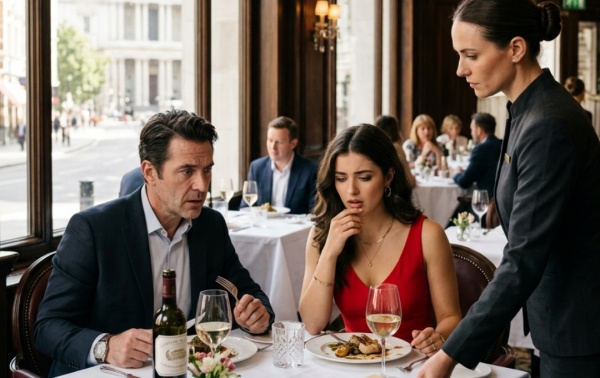
My Husband Took His Mistress to a Fancy Chicago Steakhouse on Our Anniversary—But He Didn’t Know I Had Reserved the Final Surprise
For eighteen years, I believed my husband was just busy building our future. Then I found out he had made dinner reservations at one of Chicago’s most expensive steakhouses—not for me, but for the woman he was seeing behind my back. What he didn’t know was that I had already spoken to a lawyer, and by the time dessert arrived, his perfect little secret was about to fall apart.
Part 1: The Reservation
For eighteen years, my husband Thomas called me his “lucky charm.” He said it at weddings, at company parties, at backyard barbecues where he stood beside the grill with a beer in his hand and a smile sharp enough to sell anything. People loved hearing it because it sounded romantic, and I let them believe it because correcting a room full of people is exhausting.
What they never knew was that I had been more than lucky. I had been the woman who paid his final semester of law school when his father cut him off. I had been the woman who worked double shifts at a hospital billing office while he studied for the bar exam in our one-bedroom apartment in Oak Park. I had been the woman who smiled through cheap coffee, overdue rent notices, and the kind of stress that makes young love either stronger or stupid.
Thomas became a successful commercial real estate attorney in Chicago, the kind of man who wore custom suits and said things like “we should circle back” even at Thanksgiving dinner. I became the wife who remembered everyone’s birthdays, packed the school lunches, handled the mortgage, and kept our life from falling apart whenever he was too busy being impressive. Somewhere along the way, he started believing the version of our marriage that made him look like the main character.
We had two children, Emma and Lucas. Emma was sixteen, already applying to colleges and pretending she didn’t care what either of us thought. Lucas was twelve, still sweet enough to ask if I wanted the last slice of pizza, but old enough to notice when his father came home smelling like expensive whiskey and someone else’s perfume.
I noticed long before Lucas did. Women always notice, no matter how many people tell us we are imagining things. We notice the new phone password, the sudden gym membership, the shirts that come back from “work dinners” folded too neatly by hotel laundry.
Her name was Vanessa Bell. She worked in marketing for one of Thomas’s biggest clients, a luxury condo developer with offices near the Chicago River. She was thirty-four, glossy in the way women are when they have time for Pilates, blowouts, and pretending they do not know exactly what they are doing.
I met her once at a charity gala at the Art Institute. She wore a red dress that looked simple until you realized it probably cost more than my monthly car payment. She shook my hand with both of hers and said, “Thomas talks about you all the time,” which is something women say when they know a man talks about them instead.
I did not make a scene. I did not throw wine. I did not check his phone while he slept, though I wanted to more than once. Instead, I did what I had learned to do after years of living with a man who could argue a lie into sounding like a misunderstanding.
I paid attention.
The first real proof came from a credit card statement. Thomas had always been careless with paperwork because he assumed I would organize it. That month, tucked between a hardware store receipt and a parking garage charge, there was a dinner for two at Marlowe & Ash, one of those Chicago steakhouses where the menus have no dollar signs and the waiters describe butter like it earned a graduate degree.
The charge was $482.17. I remembered that amount because I stared at it for so long the numbers seemed to lift off the paper. Thomas had told me he was eating airport food in Dallas that night because his flight was delayed.
When I asked him about it, he barely looked up from his phone. “Client dinner,” he said. “I probably forgot to mention it.” Then he kissed my forehead like I was a child asking why the sky was blue.
After that, the charges became easier to find. Valet parking downtown. A boutique hotel in River North. Two tickets to a jazz club on a Thursday night when he claimed he was reviewing contracts in the office. He was not even being clever. He was being comfortable.
That hurt more than the affair itself. A careful betrayal would have meant he feared losing me. A sloppy one meant he thought I would never leave.
The breaking point came on a Tuesday morning in February. Chicago was gray and bitterly cold, the kind of cold that makes Lake Michigan look like a sheet of steel. I was folding laundry in our bedroom when Thomas’s iPad lit up on the dresser.
I did not pick it up at first. I truly didn’t. But the message preview was right there, bright as a flare.
Vanessa: “Can’t wait for Friday. Same steakhouse? I want to wear the black dress you liked.”
My hands went still around one of his white dress shirts. The house was quiet except for the dryer humming downstairs and the distant scrape of a snowplow outside. I stood there for almost a full minute, breathing like someone had pressed a hand against my chest.
Friday was our anniversary.
Our eighteenth wedding anniversary.
That morning, Thomas came downstairs wearing a navy suit and the expression of a man who had no idea the ground beneath him had already cracked. “Big day,” he said, pouring coffee into his travel mug. “I might be late Friday. Client thing.”
I looked at him across the kitchen island where our children had eaten cereal, done homework, and cried over math tests. “On Friday?” I asked.
He sighed slightly, the way he did when he wanted me to feel unreasonable. “I know. Bad timing. But it’s a major account, and I can’t move it.”
I nodded. “Of course.”
He smiled, relieved that I had chosen to be easy. “We’ll celebrate Saturday. I’ll make it up to you.”
That was the moment something inside me went cold and clear. Not angry, exactly. Anger is hot and messy. What I felt was cleaner than anger.
I felt done.
I waited until he left. Then I called my attorney, Marjorie Klein, who had handled my mother’s estate two years earlier and had once told me, “If you ever need family law, call me before you call your sister.” I had laughed then.
I did not laugh when she answered.
“Marjorie,” I said, “I need to file for divorce. And I need to do it carefully.”
There was a pause. Then her voice changed from friendly to professional. “Are you safe?”
“Yes.”
“Are the kids safe?”
“Yes.”
“Good. Then take a breath. Tell me what happened.”
I told her enough. Not everything, because everything would have taken eighteen years. I told her about Vanessa, the credit card charges, the anniversary dinner, and the steakhouse reservation I had found when Thomas forwarded the confirmation to his office email by mistake.
Marlowe & Ash. Friday at 8:00 p.m. Table for two.
Marjorie listened without interrupting. When I finished, she said, “Illinois is a no-fault divorce state, so the affair itself is not the centerpiece. But spending marital money on another person can matter. Records matter. Timing matters. Conduct around the children matters. Do not confront him tonight.”
“I wasn’t planning to,” I said.
“What were you planning?”
I looked at the printed reservation on the kitchen counter. “Something memorable.”
Marjorie went silent for half a second. “Define memorable.”
“Legal,” I said. “Public enough that he can’t twist it later. Quiet enough that I don’t embarrass my children. And final enough that he understands I’m not negotiating with the version of him that lies to my face.”
Marjorie exhaled. “Come to my office at noon.”
I looked out the window at the bare maple tree in our front yard. Snow clung to the branches like ash. “I’ll be there.”
Part 2: The Plan
Marjorie’s office was in a limestone building near LaSalle Street, the kind of place where everyone spoke softly because the walls had heard every kind of disaster. She was in her late fifties, with silver hair cut to her chin and glasses she wore low on her nose when she wanted people to stop wasting her time. I trusted her immediately because she did not offer comfort before offering facts.
She explained the process in a way that made my hands stop shaking. In Illinois, I did not need to prove adultery to file. I needed financial records, a parenting plan, a clear picture of our assets, and the discipline not to hand Thomas ammunition by acting recklessly. “You are not trying to win a scene,” she said. “You are trying to protect your future.”
I brought everything I had gathered. Bank statements. Credit card charges. The hotel receipt. Screenshots of the reservation confirmation. A list of accounts, property records, retirement plans, and the college savings accounts for Emma and Lucas.
Marjorie reviewed the papers with the calm expression of a surgeon looking at an X-ray. “This is useful,” she said. “The restaurant service idea is unusual, but serving him in public is not automatically improper. We use a licensed process server. No threats, no confrontation, no performance. He receives the documents, and you leave.”
“I don’t want a screaming match,” I said. “I want an ending.”
“Then we make sure it stays clean,” she replied.
That was when she introduced me to Patrick Doyle, a process server she had used for years. Patrick was in his early sixties, with a round face, careful eyes, and the kind of calm that comes from handing bad news to strangers for a living. He had once been a sheriff’s deputy, he told me, and now worked private service across Cook County.
“I don’t impersonate police, doctors, clergy, or court officials,” Patrick said. “I don’t trespass. I don’t harass. If we do this in a restaurant, management needs to know I’m entering as a guest or temporary event staff with permission. I hand him the envelope, confirm his name, and leave.”
“What if he refuses to take it?” I asked.
Patrick gave a small shrug. “People think refusing paper stops reality. It doesn’t. If I identify him and make clear what it is, service can still count depending on the circumstances. But I prefer simple.”
Simple. That word sounded almost funny beside the ruin of my marriage. Still, I liked Patrick because he was not dramatic. He treated the plan like logistics, not revenge.
Marjorie helped me file the petition that afternoon. Dissolution of marriage. Allocation of parental responsibilities. Temporary financial orders. Preservation of marital assets. Words that sounded sterile enough to belong in a hospital, not in the remains of a life.
When I signed the documents, my hand trembled only once. Marjorie noticed but did not comment. That kindness nearly broke me.
“You don’t have to be brave every second,” she said after I placed the pen down.
“I know,” I lied.
I drove home through traffic on the Eisenhower, moving slowly between brake lights and dirty snowbanks. Chicago looked hard and beautiful in the winter dusk, all glass towers and gray sky. I remembered being twenty-seven, sitting beside Thomas in a used Honda Civic, both of us dreaming about the life we were going to build.
Back then, he used to hold my hand at red lights. He used to call from the grocery store to ask which pasta sauce I liked. He used to look at me like I was the only witness he needed.
I wondered when love had become something he stored in a drawer and took out only when guests came over.
At home, Emma was at the kitchen table with her laptop open and earbuds in. Lucas was on the living room floor building some complicated Lego set he insisted was “not for kids.” I watched them for a moment from the doorway and felt the full weight of what I was about to do.
Divorce is never just two adults leaving each other. It is a house changing shape. It is holidays splitting in half. It is children learning that parents can fail each other and still make breakfast.
Thomas came home at 9:20 p.m., cheerful and smelling faintly of cedar cologne. He kissed the air near my cheek and asked if there was any leftover pasta. I said yes, because even endings have ordinary chores.
Later, after the kids went upstairs, he sat beside me on the couch and scrolled through his phone. “Friday’s going to be brutal,” he said. “Don’t wait up.”
“I won’t,” I said.
He looked at me, maybe hearing something in my voice. “You okay?”
I folded the blanket over my knees. “Just tired.”
He nodded, satisfied. “We’re all tired.”
That was Thomas. He could turn my pain into a weather report. If I said I was lonely, he said everyone got lonely. If I said I needed more help, he said everyone was busy. If I said I missed him, he said he was sitting right there.
On Thursday, Marjorie called to confirm everything. Patrick had spoken to the restaurant manager, who agreed to allow him in briefly as a contracted courier for a private legal delivery. He would wear a black vest and white shirt, not the restaurant’s exact uniform, and he would not pretend to work there if directly asked.
“You will not approach the table,” Marjorie said. “You will be seated at the bar with me. Patrick serves the documents. Thomas sees you only after he has them.”
“Will Vanessa be served too?” I asked.
“No. This case is between you and Thomas. Do not make her the center. That gives her more importance than she deserves.”
That was the first piece of advice I almost enjoyed.
Friday arrived with freezing rain. By noon, the streets were slick, and the local news warned everyone to stay off the roads unless necessary. Thomas spent the morning pretending to be rushed, though I noticed he took extra care shaving and changed ties twice.
At 5:30 p.m., he came downstairs in a charcoal suit I had bought him for his birthday. “I’ll probably be late,” he said, adjusting his cuffs.
I stood by the sink rinsing a mug. “Drive safely.”
He hesitated. “You sure you’re not upset about tonight?”
I looked at him then. Really looked. At the face I had loved, forgiven, defended, and made excuses for. At the man who had chosen our anniversary to sit across from another woman under soft restaurant lighting.
“I’m not upset,” I said.
He smiled, relieved again. “You’re the best.”
No, I thought. I was.
He left at 6:10. At 6:12, I went upstairs, changed into a black wool dress, put on the pearl earrings my mother left me, and stood in front of the mirror. I did not look young. I did not look untouched. I looked like a woman who had survived being underestimated.
Emma knocked on my bedroom door around 6:30. “Are you going somewhere?”
I turned. “Dinner with Marjorie.”
“The lawyer?”
I paused. Emma was too smart for half-truths and too young for the whole truth. “Yes.”
Her eyes narrowed slightly. “Is Dad in trouble?”
I crossed the room and touched her shoulder. “Your dad and I have some adult things to handle. You and Lucas are safe. That is what matters tonight.”
She swallowed. “Are you getting divorced?”
The question hit harder than I expected. Not because I had not prepared for it, but because children can walk straight through walls adults spend years building. I sat beside her on the bed.
“I don’t want to lie to you,” I said. “Things are very difficult between your father and me. I’m going to handle it as carefully as I can.”
Emma nodded once, too mature and not mature enough. “Okay.”
I hugged her, and for a second she was five years old again, climbing into my lap during thunderstorms. Then she pulled away and wiped under her eyes like she was angry at the tears for showing up.
At 7:15, I left the house.
Part 3: The Steakhouse
Marlowe & Ash sat on a corner in River North, glowing gold against the wet pavement. Through the windows, I could see white tablecloths, dark wood, and people laughing over wine that probably cost more than my first couch. Valets moved under black umbrellas while taxis hissed through the rain.
Marjorie met me inside near the host stand. She wore a camel coat and carried a leather folder, looking more like a wealthy aunt than the person holding the legal match to my marriage. “Remember,” she said quietly, “no speeches.”
“I know.”
“I mean it, Caroline.”
My name sounded strange in her mouth, formal and steady. “I know.”
The hostess led us to two seats at the far end of the bar. From there, I could see the dining room reflected in a long antique mirror behind rows of bourbon bottles. I saw Thomas before he saw me.
He was at a corner table with Vanessa.
She was wearing the black dress. Of course she was. Her hair fell over one shoulder in glossy waves, and she leaned toward him like every word he said had been chosen by God.
Thomas looked relaxed in a way I had not seen at home in years. He laughed with his whole face. He touched her wrist when he spoke. He looked like a man on vacation from consequences.
For one painful second, I felt my body remember loving him. Not the man at the table, exactly, but the younger man inside him. The one who held my hand in the hospital when Emma was born. The one who cried when Lucas needed surgery at three months old. The one I thought would grow old beside me, annoying me gently until one of us died.
Then Vanessa lifted her wineglass, and Thomas smiled at her the way he used to smile at me.
Something inside me closed.
Patrick appeared at 8:21 p.m. He wore a white shirt, black vest, black slacks, and the neutral expression of a man delivering weather. He gave Marjorie a small nod as he passed.
I stopped breathing.
He approached Thomas’s table with an envelope tucked against a small black tray. Not hidden. Not theatrical. Just there.
“Mr. Thomas Whitaker?” Patrick asked.
Thomas looked up, irritated by the interruption. “Yes?”
Patrick set the envelope on the table beside his steak knife. “You’ve been served.”
For a moment, nothing happened. The restaurant continued around him, forks touching plates, glasses clinking, someone laughing too loudly near the windows. Thomas stared at the envelope like it was written in a foreign language.
Vanessa blinked. “What is that?”
Patrick had already stepped back. “Have a good evening,” he said, and walked away.
Thomas grabbed the envelope and opened it with the impatient confidence of a man who assumed every document in the world existed for his convenience. I watched his face change. First confusion. Then disbelief. Then a red flush that climbed from his collar to his ears.
He looked around the room.
I did not hide.
His eyes found me in the mirror first, then directly across the bar. I sat beside Marjorie with my hands folded in my lap. I did not smile. I did not raise my glass. I simply looked at him.
Vanessa turned, following his gaze. When she saw me, the color drained from her face in a way no expensive foundation could fix. She whispered something to Thomas, but he was already standing.
Marjorie’s hand touched my arm. “Stay seated.”
Thomas crossed the dining room too quickly. A few heads turned, but not many. Wealthy restaurants are designed to absorb scandal quietly.
“What the hell is this?” he hissed when he reached us.
Marjorie stood before I could answer. “Mr. Whitaker, I’m Marjorie Klein, counsel for your wife. Communication regarding the divorce should go through attorneys from this point forward.”
Thomas looked at me over her shoulder. “Caroline, are you serious?”
I kept my voice low. “Yes.”
“Here?” he said. “You did this here?”
“You chose the restaurant.”
His mouth opened, then closed. Behind him, Vanessa had not moved. She sat frozen beside two untouched steaks and a bottle of cabernet breathing beautifully into the worst night of her month.
Thomas leaned closer. “You are embarrassing yourself.”
That almost made me laugh. Not because it was funny, but because even then, even holding divorce papers in the restaurant where he brought his mistress on our anniversary, he still thought shame belonged to me.
“I’m not the one having an anniversary dinner with someone else,” I said.
Marjorie’s eyes flicked toward me in warning, but my voice had stayed calm. Thomas heard it too. Calm frightened him more than screaming ever had.
“This is insane,” he said. “We need to talk at home.”
“No,” I replied. “We needed to talk years ago. Now we need attorneys.”
His jaw tightened. “You don’t want to do this.”
“I already did.”
For a second, the mask slipped. Not fully, but enough. I saw panic behind his anger. I saw calculation. I saw the man who knew exactly how much of our life was built on accounts, records, titles, and signatures he had assumed I would never question.
Vanessa finally stood and approached, clutching her small purse. “Thomas,” she said softly, “maybe we should go.”
I looked at her then. She had the nerve to look wounded, as if I had interrupted something sacred instead of something stolen. Her lips parted, and I could tell she wanted to speak to me.
“Don’t,” I said.
One word. Quiet. Final.
She stopped.
Thomas looked between us, and for the first time that night, he seemed smaller. Not ruined. Not destroyed. Just smaller than the story he told about himself.
Marjorie stepped in again. “Mr. Whitaker, you’ve been served. Please review the documents with your counsel. Do not contact my client tonight except regarding urgent matters involving the children.”
“The children?” he snapped. “You’re bringing the children into this?”
I stood then. Slowly, because I wanted him to see that I was not shaking. “You brought them into it when you made choices that could break their home.”
His face tightened. I knew that look. It meant he wanted to say something cruel, something designed to cut fast and leave a scar. But the restaurant was too public, Marjorie was too composed, and the envelope was too real.
So he said nothing.
I picked up my coat. Marjorie placed cash on the bar for the sparkling water neither of us had finished. Together, we walked toward the exit.
As we passed Thomas’s table, I noticed the check had already arrived. Two steaks. One seafood tower. One bottle of wine. One dessert with “Happy Anniversary” written in chocolate on the plate.
I stopped for half a second.
Vanessa saw it too. Her face changed as she realized what the dessert meant. Maybe Thomas had told her the reservation was a celebration of something else. Maybe he had told her I was cold, distant, already gone. Men like Thomas rarely cheat with the truth.
Outside, the rain had turned to sleet. The valet stand lights blurred in the wet street. I breathed in the freezing air and felt something in my chest loosen.
Marjorie looked at me. “Are you all right?”
“No,” I said. “But I’m finished.”
She nodded. “That’s a start.”
Part 4: The Morning After
Thomas did not come home that night. He texted at 11:47 p.m. that he was staying at a hotel “to cool off,” as if he were the injured party showing restraint. I screenshotted the message and sent it to Marjorie, who replied with one sentence: “Do not engage.”
So I didn’t.
At 6:00 a.m., I made coffee and pancakes because children still wake up hungry when marriages collapse. Lucas came downstairs first, wearing pajama pants and one sock. He asked if Dad was at the gym.
“Not this morning,” I said. “He stayed elsewhere last night.”
Lucas frowned. “Are you guys fighting?”
I set a plate in front of him. “Your dad and I are dealing with some serious problems. None of it is your fault.”
Kids hear that sentence in every divorce movie, but they still need to hear it in their own kitchen. Lucas looked down at his pancakes. “Is he coming back?”
“He is still your father,” I said carefully. “You will still see him. We are going to figure out what that looks like.”
Emma came in halfway through, already dressed for school though her eyes were red. She did not ask questions. She just sat beside Lucas and poured too much syrup on her pancakes like she needed something sweet enough to cover the taste of the morning.
At 7:30, Thomas called. I let it go to voicemail. He called again at 7:32, then texted.
“We need to discuss what you did last night.”
I replied only after Marjorie approved the wording. “Please contact Marjorie regarding legal matters. For issues involving the children, text only.”
His response came seconds later. “You’re making a huge mistake.”
I stared at the message for a long moment. Then I put the phone face down.
That day moved like a storm trapped inside a glass box. I answered work emails, called the school counselor, and gathered more financial records. By noon, Thomas had hired an attorney from a downtown firm with a reputation for turning divorces into wars.
Marjorie was not impressed. “Good,” she said. “Now everyone has counsel.”
By Friday afternoon, Thomas’s attorney requested an emergency discussion about temporary access to the house. Marjorie replied with a proposed schedule and a reminder that Thomas had voluntarily stayed away. There is a kind of satisfaction in watching a woman with experience translate male outrage into manageable paragraphs.
The first real conversation with Thomas happened Sunday evening in our living room, with Marjorie on speaker and his attorney listening from wherever expensive men spend Sundays. Thomas arrived looking tired, angry, and strangely formal, as if dressing well might restore authority.
Emma and Lucas were upstairs at my sister’s house. I had insisted on that. Whatever happened between Thomas and me, the children did not need to hear us negotiate the wreckage.
“You humiliated me,” Thomas said before anyone could begin.
Marjorie’s voice came through the phone. “Mr. Whitaker, this meeting concerns temporary living arrangements, finances, and parenting logistics.”
He ignored her. “Caroline planned a public ambush.”
I looked at him across the coffee table we bought when Emma was a toddler. There was a tiny scratch on one leg from the year Lucas learned to ride a scooter indoors. Our whole life was in that room, and still he began with his humiliation.
“You took Vanessa to dinner on our anniversary,” I said. “At a restaurant you paid for with our money.”
His attorney cleared his throat. “Thomas, let me respond.”
Thomas leaned back, furious. “Fine.”
The conversation that followed was dry, practical, and brutal in its own way. Mortgage payments. Credit cards. Access to accounts. Parenting time. Who would stay in the house and who would retrieve personal items under agreed conditions.
Thomas wanted to come and go as he pleased. Marjorie said no. Thomas wanted joint access to the main checking account without restrictions. Marjorie said not without transparency. Thomas wanted the children told that we “mutually decided to separate.”
That was when I spoke.
“No,” I said.
Everyone went quiet.
“I won’t tell them details they don’t need,” I continued. “I won’t make them carry adult pain. But I will not help you rewrite this as a mutual decision while you were lying to all of us.”
Thomas’s face darkened. “You want them to hate me.”
“I want them to trust reality.”
That landed. I saw it. Not because he felt guilty, but because he recognized the danger of children who could name what they saw.
Over the next two weeks, the life we had built divided itself into columns. His belongings. My belongings. Joint property. Separate property. Parenting schedule. Temporary support. Every form seemed to ask the same question in different language: What remains when trust is removed?
Vanessa disappeared from public view. Her Instagram went private. A mutual acquaintance told me she had taken “personal leave” from work. I did not ask follow-up questions because Marjorie had taught me the discipline of not feeding curiosity that could only hurt me.
Thomas tried several approaches. First anger. Then charm. Then nostalgia. One night he texted me a photo from our honeymoon in Maine, the two of us young and sunburned on a rocky beach.
“I miss who we were,” he wrote.
I wanted to reply, “So do I.” Instead, I deleted the draft and sent nothing.
The truth was, I did miss who we were. I missed being twenty-eight and poor and certain. I missed the man who once drove forty minutes in a snowstorm because I mentioned I wanted lemon tea. I missed the version of myself who believed loyalty was a permanent structure if you built it carefully enough.
But I did not miss being lied to. I did not miss shrinking my instincts so his stories could fit. I did not miss lying awake beside a man who treated my trust like furniture he could use without noticing.
The children handled it differently. Emma became quiet and sharp, answering Thomas’s calls with one-word responses. Lucas cried twice, both times when he thought I could not hear him.
I put them both in counseling. Thomas complained about the cost until Marjorie reminded his attorney that the children’s emotional health was not optional. After that, he stopped complaining in writing.
One evening, three weeks after the steakhouse, Emma came into my bedroom holding a laundry basket. She sat at the foot of the bed and watched me fold towels.
“Did Dad cheat?” she asked.
I stopped folding.
She was sixteen. Not a baby. Not an adult. Old enough to know when adults were insulting her intelligence, young enough to be wounded by every version of the truth.
“Your father broke our marriage in ways that involved dishonesty,” I said carefully. “Some details are between adults. But you are not wrong to feel that something serious happened.”
Emma’s eyes filled. “Was it Vanessa?”
I closed my eyes for half a second. “Yes.”
She nodded, and a tear slipped down her cheek. “I knew.”
Those two words cracked me open.
I moved to sit beside her. “I’m sorry.”
She wiped her face angrily. “Why are you sorry? You didn’t do it.”
“Because you still got hurt.”
She leaned into me then, and I held her like I had when she was small. Downstairs, the dishwasher hummed. Outside, a train horn sounded far away, lonely and familiar.
I realized then that leaving Thomas was not the hardest part. The hardest part was helping my children grieve someone who was still alive, still calling, still their father. Betrayal does not end when papers are served. It echoes through everyone who believed the lie.
Part 5: What I Kept
Six months later, the divorce was not final, because divorces with houses, children, retirement accounts, and wounded pride do not move like movie endings. They move like paperwork through winter mud. Slowly, messily, and with more signatures than anyone should need to prove a relationship is over.
But life had begun to rearrange itself.
Thomas moved into a high-rise apartment in the West Loop with floor-to-ceiling windows and furniture that looked rented even if it wasn’t. The kids went there every other weekend and one dinner night a week. Lucas liked the building’s rooftop fire pit. Emma said the apartment smelled “like a hotel trying too hard.”
Thomas and Vanessa did not last. I learned that accidentally, through a friend who still worked near his office and assumed I already knew. Apparently, Vanessa had expected romance after the divorce papers. Thomas had offered damage control.
I did not celebrate. Not because I was above it, but because by then she felt less like a rival and more like evidence. She had not stolen a faithful man. She had revealed an unfaithful one.
There is a difference.
The temporary orders gave me primary residential time with the children and required Thomas to maintain household expenses until the financial settlement was complete. Marjorie found additional charges connected to the affair, including hotel stays and gifts. Some of it would likely be accounted for in the settlement, though she warned me not to expect justice to feel poetic.
“Court is not a confessional,” she said. “It is a system. We use it wisely.”
I tried to remember that when Thomas acted wounded in mediation. He spoke about “mistakes” and “privacy” and “moving forward.” He did not say “betrayal” until Marjorie said it first.
At one point, he looked across the conference table and said, “I never stopped loving you.”
I believed him, in the saddest possible way. Thomas had loved me the way some people love a house they assume will always be there. He enjoyed the warmth, the shelter, the history, and the convenience. He simply forgot houses can be sold.
“I know,” I said. “You just stopped respecting me.”
That was the closest we came to honesty.
By summer, I had repainted the bedroom. The walls went from the beige Thomas preferred to a deep blue that made the room feel calm and mine. I bought new sheets, moved the bed to the opposite wall, and threw away the chair where he used to drop his suits after coming home late.
Small changes can feel childish until you understand they are not small. They are declarations. This corner is mine. This morning is mine. This breath is mine.
Emma started laughing again around July. Not all the time, not like before, but enough that I caught myself smiling from the kitchen when she and Lucas argued over the TV remote. Lucas stopped asking if I was sad every night and started asking if we could get a dog.
We did get a dog. A rescue mutt named Walter with one floppy ear and a talent for stealing socks. Thomas objected in a text, claiming we should have discussed “major household changes.” I sent back a photo of Walter asleep on Lucas’s chest and wrote, “The household approved.”
Marjorie said that was not strictly necessary, but she admitted it was funny.
The final settlement came in October. I kept the house until Lucas graduated high school, with terms for sale or buyout later. Retirement accounts were divided. College funds were protected. Thomas was responsible for part of my legal fees because of financial issues connected to the marital estate.
No one clapped. No judge gave a speech. There was no dramatic music swelling in the courthouse hallway. There was only me, sitting in Marjorie’s office with a signed agreement, realizing I had survived the part I thought would kill me.
“Do you feel free?” Marjorie asked.
I thought about it. Freedom sounded too bright, too simple. I did not feel like a woman running barefoot into sunlight. I felt like someone standing in a house after a tornado, grateful the roof still existed.
“I feel real,” I said.
She smiled. “That may be better.”
On what would have been our nineteenth anniversary, I did not cry. I expected to. I even set aside the evening for it, as if grief were a meeting I could schedule. Instead, Emma had a school concert, Lucas forgot his black shoes, Walter threw up on the hallway rug, and we ate drive-thru burgers in the car because nobody had time for a proper dinner.
At a red light, Lucas asked, “Mom, are you happier now?”
Emma looked at him like he had thrown a grenade into the front seat.
I kept both hands on the wheel. Rain tapped softly against the windshield. Ahead of us, Chicago traffic glowed red and white, endless and ordinary.
“I’m more honest now,” I said. “Happiness is catching up.”
Lucas seemed to accept that. Emma looked out the window, but I saw her reflection soften.
Later that night, after the kids went to bed, I found the black dress in the back of my closet. The one I wore to Marlowe & Ash. I held it for a moment, remembering the restaurant lights, the envelope, Thomas’s face, Vanessa’s silence, and the icy air outside.
People might think that was the night I ended my marriage. It wasn’t. My marriage had ended in smaller ways long before that. It ended every time Thomas lied without flinching. It ended every time I made myself easier to love by asking for less.
The steakhouse was not the ending.
It was the receipt.
I put the dress back in the closet, not because I needed to keep it as a trophy, but because it reminded me of something important. I had walked into that restaurant as a wife being humiliated in secret. I walked out as a woman who refused to carry someone else’s shame.
A few weeks later, Thomas asked if we could have coffee. Not through attorneys this time. Just us. The divorce was final, the parenting schedule was working, and maybe he thought enough time had passed to turn consequences into nostalgia.
I agreed to meet him at a café in Oak Park on a Saturday morning. Public. Simple. Close enough to home that I could leave whenever I wanted.
He looked older when he walked in. Still handsome, still polished, but less certain. He ordered black coffee and sat across from me at a small table near the window.
For a while, we talked about the kids. Emma’s college applications. Lucas’s science project. Walter’s ongoing war against socks. Then Thomas stared into his coffee and said, “I handled everything badly.”
I waited.
He looked up. “I hurt you.”
It was the first sentence he had said in months that did not try to protect himself.
“Yes,” I said.
“I don’t expect you to forgive me.”
“That’s good,” I replied, not cruelly. “Because I don’t know what forgiveness means yet.”
He nodded, swallowing hard. “Do you hate me?”
I looked at him then, really looked. The man I had loved. The man who had betrayed me. The father of my children. The stranger with my history.
“No,” I said. “I don’t hate you.”
His face changed, almost hopeful.
So I finished the truth. “I just don’t belong to you anymore.”
That hope disappeared, but not dramatically. It left quietly, like a guest realizing the party had ended hours ago.
When I stood to leave, Thomas did too. For a second, I thought he might try to hug me. He didn’t. Maybe he finally knew better.
Outside, the air was cold but bright. Oak Park families moved along the sidewalks with strollers, coffee cups, and dogs pulling at leashes. Life, rude and generous, kept happening.
I walked to my car and sat there for a moment before starting the engine. Not crying. Not shaking. Just breathing.
The woman I had been would have waited for Thomas to understand the damage before giving herself permission to heal. The woman I was becoming did not need his understanding. She had her children, her house, her dog, her name, and a future that no longer required pretending.
People always ask if revenge feels good.
The truth is, revenge is too small a word for what I felt. What felt good was not watching Thomas receive divorce papers in front of his mistress. What felt good was finally choosing myself in a room where he expected me to disappear.
And if you ask me whether I regret the steakhouse, the answer is no.
He made the reservation.
I just kept it.
