Part 1: The Green Dress and the Gold Hallway
My wife did not make a scene.
I want you to understand what that cost her, because I have spent years understanding what it cost me. Claire was not a woman who swallowed things quietly out of weakness. She was quiet the way a river is quiet before a bend — all that force moving in one direction, beneath a surface that looked perfectly still.
The night everything broke, she was wearing a dark green dress she’d bought on sale at a boutique in East Nashville. I had told her once, early in our marriage, that the color made her eyes look like the sky just before a summer storm — that particular shade of gray-green that means something is coming.
She remembered that. She wore it on nights that mattered to her.
I had stopped noticing.
The conference was a three-day sales summit at a hotel downtown, one of those glass-and-steel towers where everything is slightly too cold and the cocktails cost fourteen dollars and nobody is really there to learn anything. Spouses were invited to the closing dinner on Friday night. Claire had taken a half-day from the elementary school where she taught second grade, driven forty minutes in traffic, changed in our hotel room, curled her hair in the bathroom mirror while I checked my phone, and come downstairs looking like someone worth keeping.
I barely looked at her all night.
That is the detail I return to most. Not the kiss.
The dinner. The way she touched my wrist once and asked if I wanted to dance later, and I said, “Maybe,” while my eyes were already drifting across the table to where Rebecca Shaw was laughing at something the VP of Marketing had said.
Rebecca worked in our regional office. She was sharp, funny, recently divorced, and very skilled at making a man feel like the most interesting person in the room.
I had been enjoying that feeling for about six weeks. I had been telling myself it was harmless for about five.
At nine-thirty, my phone buzzed. Meet me by the terrace?
I told Claire I had to take a work call near the elevators. She nodded without looking up from her wine. I wonder now if she already knew something was wrong, the way you sometimes know a storm is coming before you can name the clouds.
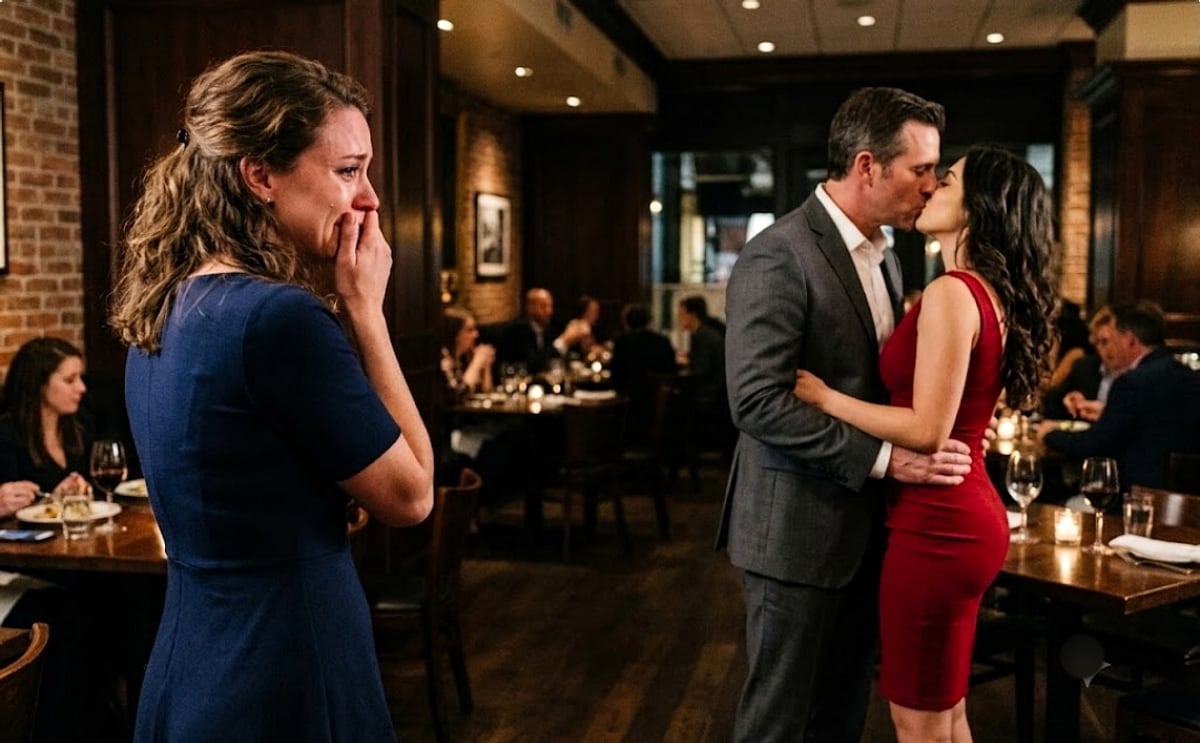
The hallway outside the ballroom was long and dim, lit with amber sconces and lined with framed photographs of old Nashville — the Ryman Auditorium in the 1950s, Lower Broadway before the neon, a black-and-white shot of the Cumberland River flooding its banks. Rebecca was waiting near the terrace door with a glass of white wine and a smile that said we were already past the point of turning back.
I should have turned back.
Instead, I kissed her.
Six seconds. Maybe seven. Long enough to be a choice, short enough that some part of my brain was still pretending it was an accident.
When I stepped back, Rebecca laughed nervously and said, “We really shouldn’t.”
“No,” I agreed. “We really shouldn’t.”
Then I turned around and saw Claire standing twenty feet away, one hand flat against the wallpapered corridor wall, as if the building itself needed to hold her up. Her face was the color of old paper.
Her eyes were not angry. They were something worse than angry.
They were the eyes of a woman watching a story she had been telling herself for years collapse into something she could no longer recognize.
I said her name.
She walked toward me. Slowly.
Deliberately. Rebecca stepped sideways and opened her mouth, but Claire did not look at her once.
She came close enough that I could smell her perfume — soft vanilla, the one she saved for special occasions — and she lifted one hand and pressed two fingers lightly against my chest, the way you might check whether something is still warm.
“I saw you kissing her,” she whispered.
Five words. Then she turned and walked back toward the ballroom, and I stood in that gold hallway with the photographs of a city that had survived floods and fires and all manner of human foolishness, and I understood that I had just done something that could not be undone.
I followed her through the lobby, out past the valet stand, onto the sidewalk where tourists in cowboy boots were taking pictures under neon signs and couples were laughing into the warm Nashville night. Claire did not run.
She moved with the kind of calm that is more frightening than any rage. By the time I reached the curb, she was already in a cab, the window down, her face turned toward me with an expression I had never seen on her before and have never been able to fully describe since — not cold, not hot, just finished.
“Don’t come home tonight,” she said.
The cab pulled away. I stood under the hotel lights with my tie half-undone and my life beginning to split down the center like a piece of wood that has been waiting for exactly the right blow.
I did not go home. Not right away.
I told myself she needed space. Really, I was afraid of what I would find — or wouldn’t find — when I walked through our red front door.
At 1:12 a.m., I finally drove the twenty-five miles south to our house in Franklin. Her car was gone.
Her suitcase was missing. Her toothbrush was not in the bathroom.
The honeymoon photo from Charleston was face-down on the dresser. And on the kitchen table, centered like a period at the end of a very long sentence, was her wedding ring.
No note. No explanation. Just the ring, and the silence of a house that had already started forgetting her.
Part 2: The Divorce, the Quiet, and the House That Stayed Mine
The divorce was handled through lawyers and conducted with the same terrible efficiency Claire brought to everything she decided to do. There was no courtroom.
No screaming through intermediaries. No scorched-earth campaign through our mutual friends.
She took what was fair — her car, her savings, her grandmother’s china, the reading chair from the study, and a small landscape painting we’d bought at a street market in Chattanooga on our second anniversary. She left me the house, the furniture we’d chosen together, and the magnolia tree she had planted in the front yard the first spring we lived there.
I think she left the tree on purpose. I think she knew I would have to watch it bloom every April and remember who she was when she still believed in us.
Her sister Nora handled most of the communication in those early weeks. Nora had never fully trusted me — I understood that now — and she performed her role as gatekeeper with a precision that was almost admirable.
When I called Claire’s phone, it went to voicemail. When I drove to the apartment in Murfreesboro where I suspected Claire was staying, no one answered the door.
When I called Claire’s school, they told me she had taken emergency personal leave and could not be reached through the district.
On the third day, I filed a missing persons report. The officer who came to the house was patient and thorough and not unkind.
He asked the standard questions: Had she taken clothing? Identification?
Medication? Money?
I said yes to all of it. He asked whether there had been a domestic dispute.
I told him the truth, though I softened it at first the way guilty people soften things — not lying exactly, just choosing which words to use.
“My wife caught me kissing someone else,” I finally said.
He wrote it down without expression.
“Mr. Miller,” he said, “if your wife left voluntarily, took her belongings, and is in contact with family members who confirm she’s safe, she has the legal right not to be found.
That’s not a missing persons case. That’s a woman who made a decision.”
That sentence hit me somewhere below the ribs and stayed there for months.
Three weeks after the hotel, Nora called me once. Her voice was like a door closing.
“She’s alive,” Nora said. “That’s all you need to know.”
“Nora, I need to talk to her. I need to explain—”
“Explain what, Owen? What exactly do you think you can explain?”
I didn’t have an answer. She hung up.
The divorce papers arrived four months later. I signed them at my kitchen table on a Tuesday morning in February, with the magnolia tree bare and gray outside the window and a cup of coffee going cold beside my elbow.
My lawyer, a quiet man named Henry Caleb who had handled three of my colleagues’ divorces and seemed to regard the whole institution of marriage with a kind of professional sadness, told me Claire had been represented by a firm out of Chattanooga. He said she had been thorough.
He said she had asked for nothing unreasonable.
“She doesn’t seem angry,” Henry said, in a tone that suggested he found this more unsettling than anger would have been.
“She’s not angry,” I said. “She’s done.”
There is a difference. I was learning that difference the hard way, the way you learn most important things — slowly, painfully, and too late to use the lesson for anything except surviving what comes next.
I stayed in the house. I kept going to work.
I did not pursue Rebecca Shaw, who had transferred to a different regional office within six weeks of the conference and sent me one email that said only: I’m sorry for my part in this. I hope you find your way. I did not respond.
There was nothing to say that would have made either of us feel better.
I saw a therapist named Denise every Thursday evening for two years. She was a small woman with reading glasses on a beaded chain and the particular skill of asking questions that sounded simple until you tried to answer them.
In our third session, she asked me what I had been looking for in those six seconds in the hotel hallway. I said I didn’t know.
She waited. I said maybe I had wanted to feel chosen.
She asked why I hadn’t felt chosen by my wife. I said Claire had always made me feel chosen.
Denise looked at me over her glasses and said, “Then what were you actually looking for?”
I didn’t answer that day. But I thought about it for the next four years.
The answer, I eventually understood, was this: I had been looking for proof that I was still interesting. That I was still wanted.
That the ordinary life I had built — the good job, the quiet house, the steady marriage — had not made me invisible. I had been so afraid of becoming forgettable that I had done the one thing guaranteed to make me unforgettable for all the wrong reasons.
That is not an excuse. It is just the truth, and the truth is the only place you can start from when you are trying to become someone worth knowing again.
The magnolia bloomed that first April without Claire. I stood on the porch and watched it and felt something I could not name — not grief exactly, not guilt exactly, but the specific ache of a man who has broken something beautiful and is only now beginning to understand how beautiful it was.
Part 3: The Children With My Eyes
I did not follow her.
I want to be clear about that, because the man I was before that night in Nashville would have. He would have hired someone, or driven to Chattanooga on a rumor, or shown up at her sister’s door at midnight with flowers and rehearsed apologies.
That man believed his own pain was an emergency that everyone else was obligated to respond to. That man had confused being loved with being managed.
Four years of Thursday sessions with Denise had done something to that man. Not erased him — he was still in there, still capable of selfishness, still capable of fear — but quieted him enough that a different version could make different choices.
So when a mutual friend named Caleb mentioned, carefully, over beers one evening, that he had run into Claire at a farmers market in Chattanooga and that she seemed well and that she had two small children with her, I did not immediately get in my car.
I set down my beer. I looked at the table. I said, “Two kids?”
Caleb nodded. He was watching me the way people watch someone standing near the edge of something high.
“How old?” I asked.
He said he wasn’t sure. Young.
Maybe three and four. Maybe younger.
I did the math in my head the way you do when you already know the answer and are just waiting for your body to catch up with your brain. Claire and I had been trying to have children for the last two years of our marriage.
She had wanted them badly. I had said I wanted them too, and I had meant it, but I had also been distracted and selfish and not fully present in the way that trying for a child requires you to be present.
We had seen a specialist. There had been tests.
Nothing conclusive, just the particular cruelty of unexplained difficulty.
The night of the hotel conference, Claire had been in what the specialist called a “monitoring window.” She had mentioned it that morning at breakfast. I had said, “Mm,” and looked at my phone.
Now I sat across from Caleb in a bar in Nashville and understood that the math was pointing somewhere I was not ready to go.
I called Henry, my lawyer, the next morning. I told him what Caleb had told me. Henry was quiet for a long moment.
“Owen,” he said, “I need you to think carefully about what you’re asking me to do and why you’re asking me to do it.”
“I’m not asking you to do anything yet,” I said. “I’m asking you to tell me what my options are.”
“Your options depend entirely on whether those children are yours,” he said. “And the only way to know that is to ask Claire directly, or to pursue legal channels that will damage whatever chance you have of a civil relationship with her for the rest of your life.”
I thought about that for three weeks. I thought about it on the porch watching the magnolia. I thought about it in Denise’s office, where she listened to the whole story without expression and then asked, “What do you think Claire would want you to do?”
“I think she’d want me to ask her,” I said. “Directly.
Without lawyers. Without pressure.”
“Why?”
“Because that’s who she is. She’s always been someone who respected a direct question more than a strategy.”
Denise nodded slowly. “And who do you want to be when you ask her?”
That was the question I carried with me to Chattanooga on a Saturday morning in October, four years and three months after the night in the gold hallway. I had written Claire a letter — not an email, a letter, handwritten on plain paper — and asked if she would be willing to meet me once, in a neutral place, with no agenda except honesty. I had mailed it to Nora’s address, because it was the only address I had, and I had asked Nora to pass it along only if she thought it was safe to do so.
Nora had called me two days later. Her voice was still sharp, but there was something different in it now — not warmth exactly, but the absence of active hostility, which felt, under the circumstances, like progress.
“She’ll meet you,” Nora said. “Once.
A conference room at her lawyer’s office. You bring Henry.
She brings her attorney. You ask your question.
She answers it. That’s all.”
“That’s all I need,” I said.
There was a pause. Then Nora said, quietly, “Owen.
Whatever she tells you — you handle it like a grown man. You hear me?”
“Yes,” I said. “I hear you.”
I drove home and sat in the kitchen for a long time, looking at the spot on the table where her ring had been, and I tried to prepare myself for either answer.
Part 4: The Truth Claire Carried
The conference room was on the fourth floor of a building in downtown Chattanooga, with a window that looked out over the Tennessee River and a table long enough to seat twelve people, though there were only four of us: Claire, her attorney — a composed woman named Four who spoke in precise, unhurried sentences — Henry, and me.
Claire looked well. That was the first thing I noticed, and it landed somewhere between relief and grief.
She had cut her hair shorter than I remembered, and she was dressed simply, in a gray blazer and dark jeans, and she looked like a woman who had built a life she was comfortable in. She did not look like someone who had been waiting for this meeting.
She looked like someone who had decided to get it over with.
She did not smile when I walked in. She did not look away, either. She met my eyes briefly, nodded once, and sat down.
I had rehearsed what I was going to say. I had written it out and practiced it in the car on the drive down. But when I sat across from her and the room was quiet and Henry had his notepad open and Four had her hands folded on the table, all the rehearsed sentences dissolved and I said the only true thing I had.
“Claire. I’m not here to ask for anything.
I’m not here to apologize again, because I know an apology from me is worth nothing to you at this point. I’m here because a friend told me he saw you in Chattanooga with two young children, and I did the math, and I need to know if they’re mine.
Not to disrupt your life. Not to make a claim on anything you’ve built.
Just to know the truth.”
The room was very quiet. The river moved outside the window.
Claire looked at her attorney. Four gave a small nod.
Claire looked back at me.
“Their names are Nora and Eli,” she said. “They’re three and four.
And yes. They’re yours.”
I had told myself I was prepared for either answer. I was not prepared for that one.
Not really. You can rehearse a fact in your head a hundred times and still have it arrive like a physical thing when it’s finally spoken aloud in a quiet room with afternoon light coming through a window over a river.
I pressed my hands flat on the table and looked at them for a moment.
“Why didn’t you tell me?” I asked. My voice was steadier than I expected.
Claire was quiet for a moment. When she spoke, she was careful — not cold, but careful, the way someone is careful when they have thought about something for a very long time and want to say it exactly right.
“I found out I was pregnant six weeks after I left,” she said. “By then I had already filed.
By then I had already decided who I needed to be without you. And I thought about telling you.
I thought about it a lot. But every time I picked up the phone, I thought about that hallway.
I thought about the way you looked at her. And I thought about what it would mean to tie my children’s lives to a man I wasn’t sure had the capacity to be present for them.”
She paused.
“I wasn’t punishing you,” she said. “I was protecting them. There’s a difference.”
I nodded. I understood the difference. I had learned it the hard way.
“I know I don’t deserve anything,” I said. “I know I have no right to walk back into your life.
But I would like the chance to know them. On whatever terms you set.
Whatever pace you’re comfortable with. I’m not asking you to trust me.
I’m asking you to let me try to earn it.”
Four spoke then, outlining what a formal co-parenting arrangement might look like, what legal protections Claire would have, what the process for establishing paternity would involve. Henry took notes. Claire listened with her hands folded and her eyes on the table.
When Four finished, Claire looked at me again.
“I need you to understand something,” she said. “This is not reconciliation.
This is not forgiveness, not yet, maybe not ever. This is two people deciding whether they can be decent to each other for the sake of two children who didn’t ask for any of this.”
“I understand,” I said.
“Do you?” She tilted her head slightly. “Because the Owen I was married to understood things in the moment and then forgot them when something shinier came along.”
That one landed exactly where she meant it to.
“I know,” I said. “I’m not asking you to believe me today.
I’m asking you to watch me over time. That’s all I can offer.”
She held my gaze for a long moment. Then she looked back at Four and said, “Send him the paternity paperwork.”
It was not a yes. It was not a no. It was a door left slightly open, and I understood that it was more than I had any right to expect, and I intended to walk through it as carefully as I had ever walked through anything in my life.
Part 5: The Family I Had to Earn
Fatherhood did not arrive the way I had imagined it would in the years when Claire and I were trying. I had imagined a hospital room, a phone call, a moment of announcement. Instead it arrived in a paternity report on a Tuesday afternoon, followed by a phone call from Henry, followed by a long drive home during which I pulled over twice because I could not see the road clearly.
The first time I met Nora and Eli, it was a Saturday morning in November, at a park near Claire’s apartment in Chattanooga. Claire had chosen the location carefully — open, public, neutral, with a playground in full view and a coffee cart nearby where she could stand and watch without being part of the introduction.
She had told them, in whatever age-appropriate language a four-year-old and a three-year-old can absorb, that they were going to meet someone. She had not told them who I was yet.
That was her decision, and it was the right one.
Eli was four. He had Claire’s coloring — dark hair, gray-green eyes — but something in the set of his jaw that I recognized from photographs of myself at that age.
He was cautious at first, standing close to Claire’s leg, watching me with the particular seriousness of a small person who has learned to take the measure of new things before committing to them. I crouched down to his level and said hello.
He said hello back, very formally, and then asked if I liked dinosaurs.
I said I did.
He considered this for a moment, then said, “The T-rex is the best one but the Brachiosaurus is underrated,” and walked toward the swings.
Nora was three and had Claire’s fearlessness. She walked straight up to me, looked at my face with enormous gray eyes, and said, “You’re tall.”
“I am,” I said.
“My mom is not tall,” she said, as if this were a matter of some concern.
“No,” I agreed. “But she’s the best person I know.”
Nora seemed to find this satisfactory. She held out her hand, and I shook it, and she walked away to find her brother.
I stood up and looked at Claire. She was watching from ten feet away, her coffee cup in both hands, her expression unreadable.
I did not try to read it. I just nodded, and she nodded back, and we stood in the thin November sunlight while our children played on the swings, and that was the beginning of something I did not yet have a name for.
The months that followed were not easy. They were not supposed to be easy.
Claire had set clear terms: supervised visits at first, always in public, always with her present or nearby. No overnight stays until trust was established.
No introducing the children to anyone I was dating — not that I was dating anyone, but she was right to say it. No promises I couldn’t keep.
No grand gestures. Just showing up, consistently, on the days I said I would show up.
I showed up.
Every Saturday. Every other Sunday.
Every school pickup I was given. I drove the hour and forty minutes from Franklin to Chattanooga and I was never late and I never canceled and I never showed up distracted or half-present the way I had been for so much of my marriage.
I learned which child needed the dinosaur plate at dinner and which one would dissolve into tears if her cup was the wrong color. I learned that Eli processed big feelings by going quiet and needed to be given space before he could talk, and that Nora processed big feelings by talking immediately and loudly and needed to be listened to without interruption.
I learned that both of them loved the same picture book about a bear who couldn’t sleep, and that if I read it in a particular silly voice, they would ask for it three times in a row.
I learned fatherhood the way I should have learned marriage — by paying attention, by showing up, by understanding that love is not a feeling you have, it is a practice you maintain.
Claire watched all of this from a careful distance. She was not warm with me, but she was fair.
She answered my questions about the children promptly. She told me when Eli had a bad week at preschool and when Nora had an ear infection.
She did not use the children as leverage or as messengers. She was, in every practical sense, a better co-parent than I deserved.
One evening in the spring — the children’s second spring, my first spring knowing them — I was dropping them off after a Saturday in the park. Eli had fallen asleep in his car seat.
Nora was telling me about a caterpillar she had found and named Gerald. Claire came out to the car to help carry Eli inside, and we stood in her driveway for a moment after she had settled him on the couch, and the evening light was coming through the magnolia tree in her front yard — she had planted one here too, I noticed, and I did not know what to do with that — and she looked at me and said, quietly, “They talk about you now.
During the week. Eli told his teacher his dad knows about dinosaurs.”
I could not speak for a moment.
“That’s the first time he’s called me that,” I said.
“I know,” she said.
We stood there in the driveway for a moment longer than was strictly necessary. Then she said, “You should go. It’s a long drive.”
“It’s not that long,” I said.
She almost smiled. Not quite. But almost.
I drove home with the windows down and the spring air coming in and something in my chest that felt, for the first time in four years, like it might be moving in the right direction. Not healed.
Not forgiven. Not restored to anything I had lost.
But moving. Slowly, carefully, in the direction of something worth building.
I do not know what Claire and I are to each other now. We are not friends.
We are not enemies. We are two people who share the most important thing in the world and are trying, with great care and no guarantees, to be worthy of that responsibility.
Some weeks it is easier than others. Some weeks I drive home from Chattanooga feeling like I might actually become the man I should have been all along.
Some weeks I drive home aware of everything I cost her and wondering if any amount of showing up will ever fully settle that debt.
Denise told me once that the goal is not to settle the debt. The goal is to stop running from it.
I think about that a lot.
I think about the gold hallway, and the six seconds, and the way Claire’s face looked when she pressed her fingers against my chest and said five words that changed the shape of everything. I think about her ring on the kitchen table, and the magnolia tree blooming every April, and a three-year-old girl who shook my hand like a businesswoman and a four-year-old boy who told me the Brachiosaurus was underrated.
I think about the man I was and the man I am trying to be, and the distance between them, and the two small people who are watching me cross it.
That is the story. Not a redemption story — I am not sure I have earned that word yet. Just a true one, about what it costs to be careless with something irreplaceable, and what it looks like to spend the rest of your life paying attention.
Names and identifying details in this story have been changed. This is a dramatized account shared for entertainment and reflection, and any resemblance to real people is coincidental.
