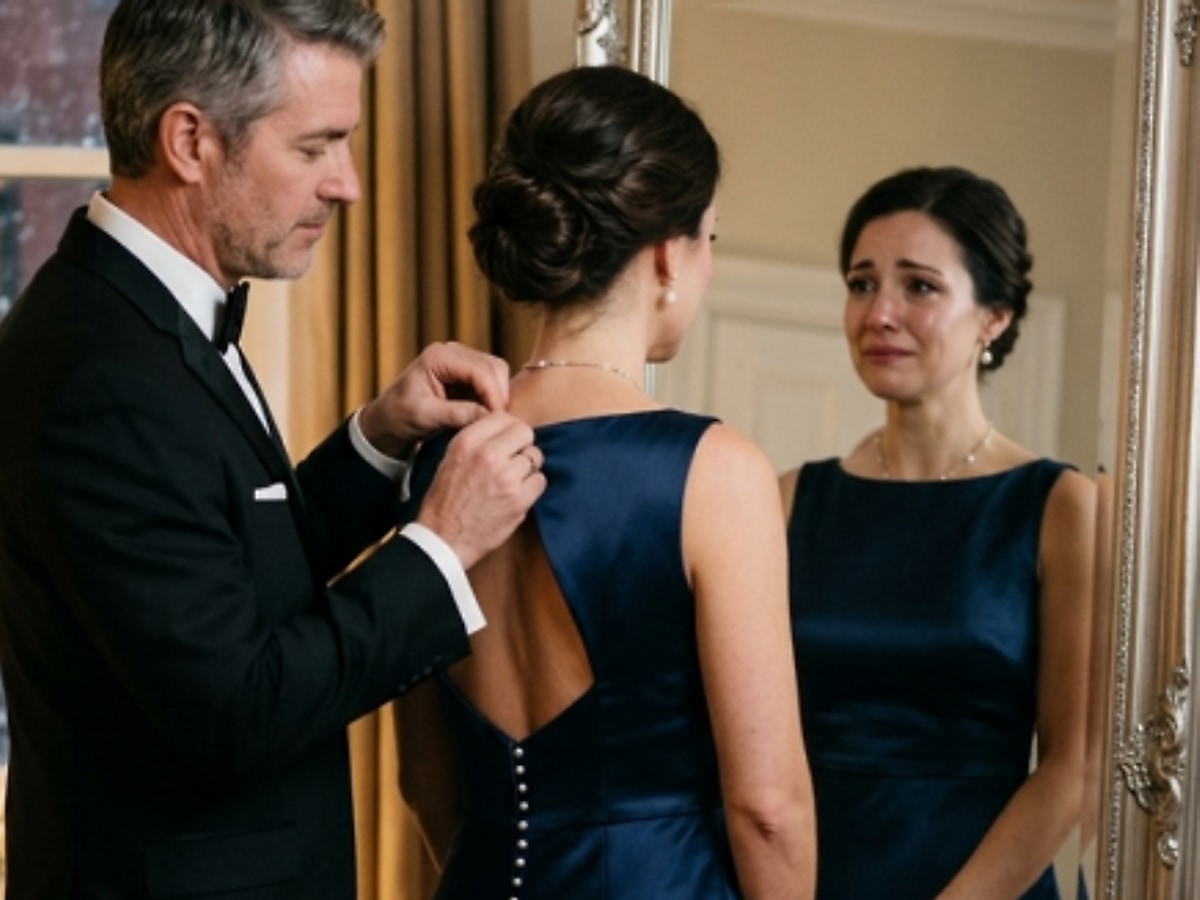
Part 1: The Buttons Nobody Warned Him About
I buttoned her dress for the gala because her husband was downstairs taking a business call.
That was the innocent version.
That was the version I told myself while I stood behind Claire Whitmore in the guest bedroom of my sister’s house in Boston, carefully fastening the tiny pearl buttons running from the middle of her back to the nape of her neck.
The occasion was the annual Harbor House winter fundraiser, an organization helping women and kids escape unsafe living situations. My sister Audrey sat on its board, her husband’s construction firm sponsored the whole thing, and the evening promised tuxedos, silent auctions, and wealthy guests posing beside ice sculptures while pretending they hated the attention.
Claire was Audrey’s closest friend.
She also happened to be married.
That fact alone should have settled everything.
Downstairs, her husband Grant Whitmore stood in the foyer, phone pressed to his ear, bragging that he could shuffle numbers before Monday. He was exactly the kind of man who put calls on speaker in other people’s houses, wore a loose expensive watch so people noticed it, and joked that his wife didn’t understand finance while other men chuckled along.
I’d met Grant on four separate occasions.
I disliked him by the end of the first.
Not because he was rude toward me. Men like Grant rarely waste rudeness on people they consider socially valuable. He shook my hand hard, remembered I practiced family law in Cambridge, asked me hollow questions about the courtroom, and called me “counselor” every single time, like the joke had never gotten old to him.
But watching how he treated Claire told me everything I needed to know.
Claire was thirty-six, quietly elegant, with soft brown hair and gray-blue eyes, carrying a smile people trusted before they even understood why. She taught art history part time at a small college outside the city, volunteered with Harbor House, and raised two kids, Lily, nine, and Miles, six.
Warm toward everyone else.
Guarded with herself.
That distinction took me far longer to notice than it should have.
The dress was midnight blue silk, deceptively simple in front but stubborn in back, a row of pearl buttons climbing her spine. She’d tried fastening them herself in the mirror, laughing nervously when Audrey shouted up that the car would arrive in fifteen minutes.
“I can help,” I offered.
I shouldn’t have said that.
I could have called Audrey from the hallway instead.
But Audrey was arguing with the caterer downstairs, Grant remained glued to his call, and Claire looked caught between needing help and apologizing for needing it.
So I walked in.
“Only if it’s not a bother,” she said, voice light, shoulders anything but.
“Not a bother,” I told her.
She turned away and lifted her hair off her neck.
That was when the room got too quiet.
Snow tapped softly against the window while downstairs people scrambled for coats and car keys and someone yelled about missing black heels. But in that guest room, there was only Claire standing barefoot on the rug, the open back of her dress showing pale skin and the faint line where a bra strap had rested earlier.
I focused on the buttons.
Not her skin.
Or I tried to.
My name is Daniel Mercer, forty-one that night, divorced three years, no kids, a family attorney who spent his days watching marriages disintegrate under money problems, betrayal, neglect, addiction, or sometimes nothing more dramatic than two people quietly turning into strangers.
I understood boundaries.
I built them into custody agreements for a living.
I argued them in courtrooms.
I told clients constantly not to mistake loneliness for permission.
And there I stood anyway, closing another man’s wife into her dress while my heart acted like I was twenty-five and reckless.
The first button slid through.
Then the second.
Claire let out a soft breath. “Sorry, these things are ridiculous.”
“You didn’t design them.”
“No, but I did buy the dress.”
“Then I’ll allow you partial blame.”
She laughed, small and unguarded.
I’d heard her laugh around Grant before, but those laughs came placed carefully, like coasters set under drinks to protect the furniture.
This one slipped out before she could smooth it over.
I fastened the third button, then the fourth.
My fingers grazed the back of her neck.
She froze.
Not obviously.
Not enough for anyone else in the room to catch, if anyone else had been there.
But I caught it.
“Sorry,” I said.
“It’s fine,” she answered, her voice suddenly different.
I kept going, button after button, the room somehow shrinking around us. I told myself to hurry, to say something harmless about the weather or how Audrey would blame everyone for being late. Instead my hands slowed, torn between fear of touching her and fear of stopping.
That part still shames me.
Nothing happened.
Nothing at all.
But wanting something can betray a person long before their hands ever move.
I reached the last button.
Claire let her hair fall back into place.
The dress fit like it had been made for her, which of course it had.
She studied herself in the mirror, and for one unguarded second I saw her real expression before she rearranged it into something presentable.
She looked exhausted.
Not just physically, though maybe that too.
She looked like someone who’d spent years being admired for holding herself together and was starting to wonder what would happen the moment she let go.
“All done,” I said.
“Thank you.” She turned slightly. “Does it look okay?”
Okay.
That word irritated me more than it should have, not at her, but at whoever taught her to ask that question while looking like she’d stepped straight out of a painting.
I should have kept it light. Instead I leaned closer than necessary and said quietly, “You look beautiful, Claire.”
She shivered visibly, a quick tremor across her shoulders, as if those words had reached her more intimately than my fingers ever had.
She shut her eyes for one second.
When she opened them, she was watching me through the mirror.
Not flirting.
Just afraid.
That fear is what saved us both.
Because whatever was moving through that room wasn’t simple attraction. It was grief. Hunger. The dangerous relief of being seen by the wrong person after being invisible to the right one for far too long.
Footsteps approached in the hallway.
Claire stepped back from me.
Audrey appeared in the doorway already wearing her coat. “There you are, car’s here.”
Her eyes flicked from Claire to me, just once. Thirty-nine years as my sister had trained her to read silence the way lawyers read contracts.
“Everything all right?” she asked.
“Yes,” Claire said. “Daniel saved me from the buttons.”
Audrey looked at me. “Heroic.”
“My law degree finally earns its keep,” I said, forcing a smile.
Claire grabbed her clutch.
Grant’s voice carried up the stairs. “Claire? We’re going to be late.”
The way he said her name made my jaw tighten, not angry, just possessive, impatient, like she was some misplaced accessory.
Claire’s expression shifted instantly, softness gone, shoulders straightened, gala smile firmly back in place.
“Coming,” she called.
She passed me at the door, orange blossom and cedar trailing after her.
I stood there a beat too long.
Once Claire was out of earshot, Audrey said quietly, “Daniel.”
I looked at her.
“Don’t.”
One syllable, loaded with older sister warning and worry all at once.
“I know,” I said.
“Do you.”
“Yes.”
She studied me, then softened. “Good. Because she’s not just lonely. She’s stuck in something she hasn’t even admitted to herself yet.”
“What do you mean?”
“Not tonight,” she said.
That was the moment I should have walked away emotionally.
I didn’t.
I went to the gala anyway, watching Claire stand beside Grant under the chandeliers at the Museum of Fine Arts, accepting compliments on her dress while Grant kept one hand pressed to her lower back like a brand. He interrupted her twice, corrected her once, and joked to donors that she “collects causes the way other women collect shoes.”
People laughed.
Claire smiled.
I didn’t.
Later, during the silent auction, I found her standing alone near the marble staircase, snow drifting past the windows behind her, a glass of sparkling water clutched in both hands.
I should have stayed put.
I walked over instead.
“Break time?” I asked.
“Trying to remember why heels were invented,” she said.
“To remind us civilization was a mistake.”
She laughed, the real kind, then glanced down at her glass. “Thank you,” she said, “for earlier.”
“For the heel commentary?”
“No. For earlier.”
I nodded. “It was nothing.”
“No,” she said softly. “It wasn’t.”
The air shifted again, and this time we both felt it.
Before either of us could speak, Grant appeared, sliding an arm around her waist. “There you are, been looking everywhere.”
He hadn’t. I’d watched him spend twenty minutes chatting up a blonde donor near the bar.
He glanced at me. “Counselor. Keeping my wife entertained?”
“Discussing shoes,” I said.
“Dangerous topic.”
Claire’s smile stayed frozen while Grant squeezed her waist and steered her toward the mayor’s deputy, joking that she was much better than him at pretending to care about arts funding.
He laughed.
She didn’t.
His grip tightened as he guided her off, not roughly, not enough for a room full of strangers to notice, but Claire’s shoulders went rigid all the same.
I watched them vanish into the crowd, something dark twisting inside my chest.
Audrey appeared beside me. “You saw that.”
“Yes.”
“Has he always been like that?”
“Worse at home, I’d guess,” she said.
“How do you know?”
“Because women like Claire don’t flinch unless they’ve had practice not flinching.”
That line stayed with me the rest of the night.
By midnight the gala wound down, and by one in the morning I sat alone in my condo above the Charles River, still thinking about buttons, shivers, and fear.
I poured a drink I never touched.
I told myself none of this was mine to feel.
Claire was married.
I was an attorney who understood exactly how stories like this destroyed people.
So I decided.
Stay away. No texts. No questions to Audrey. Don’t become the man who mistakes someone else’s pain for an invitation.
I kept that promise three weeks.
Then Claire showed up at my office with a bruise buried under makeup, asking if privilege started before she’d even said the words aloud.
Part 2: The Question She Almost Couldn’t Ask
Claire arrived at my office on a Tuesday afternoon, no appointment, nothing scheduled.
My assistant Marta knocked and said a woman was asking whether I had fifteen minutes free.
I looked up from a custody file. “Who?”
“Claire Whitmore.”
The name landed harder than expected. I kept my face steady. “Did she say why?”
“No, but she looks like she might bolt if we make her wait.”
That was enough. “Send her in.”
Claire walked in wearing a camel coat, dark jeans, and a cream sweater, hair pulled back, makeup applied with careful precision, the kind meant to hide rather than enhance.
I stood. “Claire.”
“Daniel.”
Marta shut the door.
Claire lingered near the chair, gripping her purse.
“Sorry to show up unannounced.”
“It’s fine.”
“I wasn’t sure I should come.”
“Sit down.”
She sat, barely, on the very edge of the seat.
I walked back to my desk slowly, giving her room to breathe.
“Before I say anything,” she asked, “is this private?”
“Yes. Consultations with an attorney seeking advice stay confidential even if you never hire me. I’ll run a conflict check, but you can speak generally first.”
She nodded, swallowed hard.
“I think I need to leave my husband.”
The words seemed to physically cost her something.
I’d heard versions of that sentence hundreds of times, from clients with bruises, drained accounts, terrified about custody, or emotionally gone years before they admitted it out loud.
Hearing it from Claire tilted the whole room.
Not because I wanted her marriage over.
Because part of me had already guessed it was ending before she had.
I folded my hands. “Are you safe right now?”
Her eyes filled instantly.
That alone answered me.
“Claire,” I said carefully, “has Grant hurt you?”
She stared out the window. “Not the way people mean when they ask.”
I never accepted that phrase easily.
“What way do you mean?”
She laughed once, bitter. “He doesn’t hit me, that’s what everyone really wants to know. No punched walls, no broken plates, no marks a doctor could photograph.”
I stayed quiet.
“He grabs my arm when I try to walk away from an argument. He blocks doorways. He takes my phone and calls me hysterical. He monitors my spending even though most of our money came from my grandmother’s inheritance. He tells me I’d be nothing without him, then tells our friends I’m spoiled.”
Her hands shook.
“And last night?”
She looked at me sharply. I glanced at the faint shadow along her jaw, something someone had tried carefully to erase.
She touched it without thinking. “He didn’t mean to.”
Cold anger moved through me, though I kept my voice level. “What happened?”
“We argued after dinner. He’d promised Lily he’d help with her school project, then bailed for a call. She cried. I told him he’d disappointed her. He accused me of turning the kids against him.”
Her breath shook.
“I tried heading upstairs. He grabbed my arm, I pulled back, he caught my shoulder, and I hit the doorframe.”
“Did the kids see?”
“No, thank God, they were in Lily’s room.”
“Has this happened before?”
She hesitated, then said, “Yes.”
I reached for a legal pad, not because I needed it, but because taking notes gave us both structure.
“I need to be transparent about something,” I said. “Since I know you socially through Audrey, I may recommend another attorney represent you directly. I can still explain your options today.”
“I figured you’d say that.”
“Want a referral?”
“Yes. I came here because…” She stopped.
Because of the dress. Because of the shiver. Because of everything unsaid between us.
I didn’t let her finish that sentence.
“Because Audrey trusts me,” I said instead.
Relief crossed her face. “Yes.”
Safer that way.
I gave her three excellent Massachusetts attorneys handling high conflict divorce and protective orders, along with a domestic violence advocacy contact, explaining that emotional and financial control counted as abuse even without repeated physical violence.
She flinched at the word abuse.
Most people do, the first time.
“I don’t know if it counts,” she whispered.
“It counts if you’re afraid inside your own home.”
Tears slipped down her cheeks, and she wiped them away almost angrily. “I hate sounding like this.”
“Like what?”
“Weak.”
I leaned forward. “Weak people don’t walk into a law office asking hard questions before their whole life collapses. Weak people don’t protect their kids while sorting out what’s even true.”
She looked at me the same way she had in that mirror.
Seen.
Terrified of being seen.
I stood, started around the desk, then stopped halfway. Too close. I sat back down.
Her eyes tracked the movement, and we both understood exactly what I’d almost done.
Comfort turns dangerous fast when attraction is already sitting in the room.
I cleared my throat. “Somewhere safe to go if things get worse?”
“My sister’s in Newton. Audrey said—”
“She knows?”
“Some. Not everything.”
“Tell her everything.”
Claire nodded. “I’m embarrassed.”
“Don’t be. Shame belongs to whoever creates the fear, not whoever survives it.”
She closed her eyes. “Sounds like courtroom material.”
“It is.”
“Does it work?”
“Sometimes.”
“It’s working on me.”
I felt warmth I shouldn’t have at that.
Before leaving, I told her to document everything, protect financial records, change passwords from a secure device, avoid tipping off Grant early, and consult counsel before relocating the kids.
She listened like someone memorizing directions underwater.
At the door she turned back. “Daniel?”
“Yes?”
“That night at the gala.”
I held my breath.
She looked down. “When you called me beautiful, I realized I couldn’t remember the last time someone said that without wanting something back.”
I said nothing, because every possible reply felt like a trap.
She gave a small sad smile. “I know. Not your problem.”
Then she left.
I stood there long after she’d gone.
Marta eventually knocked. “You okay?”
“No.”
“Coffee?”
“No.”
“Bourbon?”
“It’s three in the afternoon.”
“Coffee, then.”
I nearly laughed.
Once she shut the door, I called Audrey. She answered fast. “Is she okay?”
“You knew she was coming?”
“Hoped.”
“She needs real help.”
“I know.”
“Why didn’t you tell me?”
“Wasn’t my story to tell.”
I rubbed my forehead. “She asked for referrals. I gave them.”
“Good.”
“Audrey. I can’t be involved.”
Silence, then, “Professionally or personally?”
“Both.”
“Can you actually manage that?”
I hated the question. “I have to.”
She sighed. “You’re a good man, Danny. Good men still make selfish choices when they convince themselves someone’s already emotionally gone.”
“I know.”
“Then don’t.”
“I won’t.”
For months I didn’t see Claire alone. Audrey gave me updates in broad strokes. Claire hired Elena Marquez, one of the attorneys I’d recommended. She started therapy, kept records, told her sister everything, built a safety plan, and eventually, after Grant grabbed her car keys during a fight, filed for divorce and got temporary orders in place.
Grant, predictably, turned charming in public and vicious behind closed doors.
He claimed Claire was unstable.
He claimed bitter divorced women had manipulated her.
He claimed she was exaggerating ordinary conflict for custody leverage.
He also claimed another man was involved.
There wasn’t one.
But I understood why he said it. Men like Grant can’t fathom a woman leaving simply because peace beats him. There has to be another explanation, another man, something that keeps him central to the story.
For six months, Claire and I only communicated once, through Elena, over an unrelated legal question. Formal. Documented. Dull.
That was exactly how it needed to stay.
Still, I thought about her more than I should have. Walking past the Museum of Fine Arts. Seeing midnight blue silk in a shop window. Representing women who reminded me of her, and reminding myself that care isn’t love, and love isn’t permission.
Then in late September, Audrey invited me to Lily’s tenth birthday party.
“She asked if Uncle Daniel was coming,” Audrey said.
“I’m not her uncle.”
“You’re every kid’s uncle if the gifts are good enough.”
“Will Claire be there?”
“It’s her daughter’s party.”
“Grant?”
“No, separate celebration on his end.”
“I don’t know if I should go.”
“Daniel, she’s not radioactive. She’s rebuilding. You can eat cake in a backyard without staging a Victorian tragedy.”
“I’m being careful.”
“Careful isn’t the same as absent.”
So I went.
The party filled her sister’s backyard in Newton with balloons, cupcakes, a rented bounce house, and ten screaming kids blissfully unaware of taxes.
Claire stood near the picnic table cutting cake, wearing jeans, a white blouse, sneakers. No silk, no pearls, no Grant.
Tired.
But lighter too.
She saw me and smiled, not gala ready, just real. “Daniel.”
“Claire.”
For a moment the party noise faded, then Miles sprinted past yelling that the floor was lava, stomping directly into a flower bed.
Claire closed her eyes. “Have to save my sister’s hydrangeas.”
“Duty calls.”
She laughed and chased after him.
Nothing inappropriate happened that day. We chatted among other guests, I helped assemble a toy rocket, Claire thanked me for the gift, and Audrey watched us with hawk eyes and perfect mascara.
Walking me to the gate afterward, Claire said, “Thanks for coming.”
“Lily invited me, apparently.”
“She likes you.”
“Questionable judgment on her part.”
“She also likes sour gummy worms, so yes.”
We smiled, then her expression shifted. “I’m doing better,” she said.
“I can tell.”
“Not always.”
“Nobody does better always.”
She studied me. “I’m not ready for anything.”
I nodded. “I didn’t ask.”
“I know.”
The silence held weight.
“But someday I might be,” she added.
I should have said nothing. Instead I said, “Then someday can decide what it wants when it gets here.”
Relief washed over her face.
That was the start of waiting. Not passive waiting. The ethical kind, letting someone heal without turning yourself into a prize sitting at the finish line of their survival.
Part 3: A Year of Paperwork and Small Victories
Divorce didn’t hand Claire freedom overnight.
People assume freedom starts the moment papers get filed. Often that’s exactly when real pressure begins.
Grant fought everything, the temporary schedule, the house, the accounts, Claire’s inheritance, even her credibility whenever she tried to speak plainly about what had happened at home.
His attorney threw around the term parental alienation whenever Claire set a boundary. He accused her of poisoning the kids against him because Lily hesitated about overnights at first. He called Claire financially reckless, emotionally unstable, and too dependent on her sister’s opinion.
Then he came after me.
Not through court filings initially. Through whispers, at school pickup, at the club, to mutual acquaintances. Audrey heard he was telling people Claire had “developed an inappropriate attachment” to some lawyer before ever filing, that I’d coached her, seduced her, pushed her toward destroying her marriage.
None of it was true.
But lies stick when repeated confidently enough by men who wear arrogance like armor.
Elena called me directly one afternoon. “Need to ask you something.”
“Go ahead.”
“Any romantic or sexual involvement with Claire before or during her separation?”
“No.”
“Any inappropriate contact?”
“No.”
“Legal advice beyond the initial consultation and referral?”
“No.”
“Can you document that?”
“Yes.”
“Good, because Grant is fishing.”
I’d expected as much. Hearing it confirmed still made me furious, not for my sake, for Claire’s. Grant couldn’t control her anymore, so he tried poisoning the courage it took her to walk away.
Elena’s office eventually warned him formally, since unsubstantiated accusations could backfire on him. He quieted down after that, though not exactly kindness.
Claire and I saw each other rarely that year, and only in groups, a Harbor House event, Audrey’s Thanksgiving dinner, a school fundraiser where we stood ten feet apart pretending not to notice each other’s presence.
Each time, she looked more like herself.
Or maybe like a self I’d never actually known before.
She cut her hair to shoulder length in January, picked up more teaching hours, moved with the kids into a rental townhouse in Brookline after Grant insisted on selling the marital home, then changed his mind once he realized the sale wouldn’t punish her the way he’d imagined.
She learned to assemble furniture.
Badly, at first.
Audrey sent me a photo of a bookshelf leaning like it had lost all confidence in itself.
“Do not go fix it,” Audrey warned.
“Wasn’t planning to.”
“Liar.”
I didn’t fix it. Claire eventually did, on her own.
That mattered. Someone escaping control needs more than rescue. They need competence handed back to them, piece by piece.
In March, almost a year after the gala, I bumped into Claire at a bookstore in Harvard Square.
Rain hammered the windows outside. She stood in the poetry section holding a Mary Oliver collection, coat damp at the shoulders. I’d stopped in for Marta’s birthday gift and was failing badly, since Marta hated sentimental things and already owned too many lawyer-joke mugs.
Claire spotted me first. “Daniel.”
“Claire.”
We both glanced around instinctively, checking for witnesses. Then she smiled. “This is scandalous.”
“Two adults in a bookstore.”
“Near the poetry section.”
“Practically criminal.”
She laughed softly while rain tapped the glass. No gala, no kids, no Audrey, no Grant, no courtroom shadow hovering. Just the two of us.
That made it more dangerous, not less.
“How are you,” I asked.
“Today, or generally?”
“Today.”
She thought about it. “Wet. Tired. Mostly okay.”
“Mostly okay is respectable.”
“You?”
“Buying my assistant a gift.”
“What does she like?”
“Efficiency, and judging my lunch order.”
Claire smiled. “Gift card and expensive coffee. Skip the candles.”
“Feels impersonal.”
“Trust me, women running offices don’t want decorative candles from men trying too hard to seem thoughtful.”
“Noted.”
We walked up front together, I bought coffee and a gift card, she bought her book. Outside the rain fell in sheets, neither of us carrying an umbrella.
“Walk you to your car?” I asked.
She gave me a look. “Daniel.”
“Public sidewalk. No romance, just rain management.”
“It’s four blocks away.”
“Then I’ll be wet and noble.”
“Not always the same thing.”
“Today I’ll attempt both.”
She laughed and we stepped into the storm, soaked by the second block, laughing by the third, real, unguarded laughter.
At her car, rain streaming down her face, hair stuck to her cheek, she looked nothing like the woman in midnight blue and somehow more beautiful than ever.
“Thank you,” she said.
“For terrible rain management?”
“For never making me feel like I owe you something for basic kindness.”
That sentence hit me hard.
“You don’t,” I said.
“I know.” A pause. “I’m learning that.”
I wanted to touch her face.
I didn’t.
She noticed, which somehow made it worse.
“Divorce could be final by summer,” she said softly.
“Glad to hear it.”
“Are you?”
“Yes. For you.”
“For me,” she repeated, testing whether that kind of gladness came with strings attached.
I stepped back. “Drive safe.”
She got in the car, and I walked off into the rain before I could become someone I didn’t respect.
That night she texted for the first time personally.
Audrey gave me your number years ago for emergency pickup lists, so I’m choosing to believe this isn’t improper. Thank you for today.
I stared at the message, typed and deleted six replies, finally settling on, You’re welcome. For the record, Marta loved the coffee.
Smart woman, she wrote back.
That was it. Small. Harmless. But every boundary starts with deciding what small things get permission to grow.
The next day I called my own therapist. Yes, lawyers need therapists too, at least the good ones, unless they want to turn into walking case files with a bar card.
Dr. Evelyn Park had helped me understand my first marriage’s failure without turning my ex into a villain.
I told her everything about Claire, the dress, the shiver, the consultation, the waiting, the rain.
She listened, then asked what I was afraid of.
“Hurting her.”
“And?”
“Becoming a complication in her life.”
“And?”
I sighed. “Wanting someone who might be vulnerable because I saw her at her most wounded.”
“Valid concern,” she said. “But concern doesn’t automatically mean exploitation. It means you need patience, honesty, and accountability.”
“I’ve been patient.”
“Patience isn’t only waiting for legal availability. It’s waiting for emotional clarity.”
That annoyed me, mostly because it was true.
Claire’s divorce finalized in July. Grant didn’t go quietly, but legally he went. The custody arrangement gave him structured time with safeguards around exchanges and communication. Finances settled privately, Claire kept her inheritance separate, and Grant kept his ego, apparently his most prized possession all along.
Two weeks later Audrey hosted a small dinner, not a divorce party, Claire hated that phrase, just a new apartment, new chapter dinner with no speeches unless wine demanded them.
I almost skipped it.
“If you skip it, that’s weirder,” Audrey said.
So I went.
Claire opened the door in a green dress, barefoot, the townhouse smelling of lemon chicken and crayons, kids’ drawings covering the fridge, a half built Lego castle on the coffee table.
Not glamorous.
Alive.
“Hi,” she said.
“Hi.”
For the first time since I’d known her, no husband lurked in the background, no legal crisis, no immediate danger, just a woman standing in her own doorway.
The evening stayed gentle. Audrey and her husband bickered affectionately about overcooked chicken. Lily showed me a dragon wearing glasses she’d drawn. Miles asked if lawyers got badges, and I told him unfortunately not.
After dinner, Audrey herded the kids upstairs to look at something on Lily’s tablet, entirely fabricated to give Claire and me five minutes alone.
Subtlety was never Audrey’s strength.
Claire stood rinsing plates at the sink. I joined her.
“This feels familiar,” she said.
“What does?”
“Standing near you in a room, trying not to say something.”
“What do you want to say?”
She shut off the water, looking terrified for a moment. “I’m not the woman you saw that night.”
“At the gala?”
“Yes.”
“I know.”
“I’m also not fully healed.”
“I know that too.”
“I have kids.”
“Yes.”
“Complicated custody exchanges, therapy appointments, nights when Miles cries missing the old house.”
“I understand.”
“Do you?”
“Not as a parent. As someone who’s watched enough families rebuild to know love isn’t the hard part. Logistics are.”
She laughed quietly, then her eyes filled. “I don’t want to be rescued.”
“I don’t want to rescue you.”
“What do you want?”
The true answer felt too big for a kitchen, so I offered the smallest honest piece. “I want to take you to dinner when you’re ready, no secrets, no pressure, no one else’s marriage standing between us.”
She looked down. “And if I’m not ready?”
“Then I’ll still be Audrey’s brother, Lily’s fake uncle, and a guy who thinks your bookshelf deserved better instructions.”
She laughed through tears. “That bookshelf is sturdy now.”
“Proud of you both.”
She wiped her face. “Ask me in three months.”
So I did. Not a day sooner.
Part 4: The First Honest Dinner
Three months later, I asked Claire to dinner. Not through a late night text, not after wine, not during some emotionally blurry moment where loneliness could disguise itself as romance.
I called on a Saturday, after confirming with Audrey that Claire wasn’t in crisis, the kids were with Grant, and I wasn’t about to become an emotional rebound parachute.
She answered on the third ring. “Hi.”
“Hi. Good time?”
“Depends whether Audrey told you to call.”
“No, she just created favorable social conditions for courage.”
She laughed. “Different thing entirely.”
“Exactly.”
A pause. “Would you like dinner with me next Friday?”
Silence, weighted but not rejecting.
“A real dinner?” she asked.
“Yes.”
“A date?”
“Yes.”
Another pause. “I’m scared.”
“I know.”
“That’s not a no.”
“Hoping it isn’t.”
“Also not an easy yes.”
“Easy yeses are overrated.”
She exhaled slowly. “Okay. Dinner.”
I grinned like a fool alone in my kitchen.
“Friday.”
“Daniel?”
“Yes?”
“Slow.”
“Absolutely.”
She picked an unassuming Italian spot in Somerville, nothing too romantic, nothing connected to shared social circles. We arrived separately since together felt too intense to her. I wore a navy sweater instead of a suit, since she said suits reminded her too much of courtrooms.
She wore burgundy with simple gold earrings, and every careful line I’d prepared vanished the moment she walked in.
“You look beautiful,” I said, then froze, remembering the last time those words left my mouth she’d shivered in fear inside another man’s house.
This time she smiled, nervous but not afraid. “Thank you. I can actually hear that now.”
We ordered pasta and talked three hours straight, barely touching Grant or the divorce, mostly covering books, terrible first jobs, childhood trips, music, Audrey’s total inability to whisper, and why school fundraisers always turned one parent frighteningly competitive over raffle baskets.
She mentioned she used to paint, just for herself, before Miles came along stole her time, then her space, then her sense that anything she made still mattered.
“Painting again?” I asked.
“A little. Badly.”
“Good.”
“Badly?”
“No, again.”
She smiled.
I told her about my divorce, how Rachel and I hadn’t betrayed each other dramatically, just slowly became efficient roommates sharing insurance and separate dreams, both too scared to be the one who called it over.
“Still talk?” she asked.
“Sometimes. Holiday texts, mutual friends. She remarried last year.”
“Hard?”
“A little. Mostly clarifying.”
“How so?”
“Realized I didn’t want her back, just wanted proof our marriage hadn’t been wasted time.”
Claire looked at me gently. “Was it?”
“No, it taught me what kindness without real intimacy looks like, and why that isn’t enough.”
She absorbed that, then said, “My marriage taught me being needed can feel like love right up until you realize love shouldn’t demand your disappearance.”
I reached across the table slowly, not to take, only to offer.
She glanced down, then placed her hand in mine, trembling slightly.
“Too much?” I asked.
“No. Just new.”
We sat like that, two adults holding hands over unfinished tiramisu, like teenagers who’d somehow survived court filings and therapy bills instead.
Walking her to the car afterward, cold air biting, she turned under the streetlight.
“I want to kiss you,” she said. My pulse jumped. “But I also want to go home proud of myself.”
I nodded. “Then go home proud.”
Relief crossed her face, followed by something warmer. She stepped closer and kissed my cheek, soft, brief.
“Goodnight, Daniel.”
“Goodnight, Claire.”
I watched her drive off, grinning on the sidewalk like a man who’d just won a case in a courtroom called patience.
We dated slowly, painfully slowly according to Audrey, who compared us to “two emotionally literate turtles.”
But slow felt right. Dinner every other week, coffee after school drop-off when schedules allowed, long riverside walks along the Charles, no sleepovers, no rushing to introduce me to the kids as “Mom’s boyfriend” before Claire felt ready. I already knew Lily and Miles, but we kept my role in their lives moving slowly. They’d already watched one man leave the house. They didn’t need another arriving with adult promises before anyone understood what those meant.
Grant noticed, of course.
He messaged Claire through the co-parenting app. So the lawyer finally got what he wanted. Classy.
Claire showed me. Her face stayed pale but steady. “Respond?”
“What does Elena say?”
“No.”
“Then no.”
She stared at the screen. “He still knows how to make me feel dirty for wanting something good.”
I sat beside her on the park bench. “You know why he said it.”
“To hurt me.”
“Yes. If this started after your marriage ended, the story becomes that you left for peace. He’d rather believe someone stole you than admit you simply walked.”
She exhaled. “I wasn’t stolen.”
“No.”
“I walked.”
“Yes.”
She deleted her half-written response. Progress sometimes looks exactly like an unsent paragraph.
Six months after our first dinner, Claire introduced me to the kids formally, during a Saturday museum trip.
“You already know Daniel,” she told them. “He and I have been spending time together, and he matters to me.”
Lily, now eleven, studied me with the suspicion of a kid who’d already learned adults could disappoint you badly.
“Are you Mom’s boyfriend?”
Claire looked at me. I looked back at her.
“Yes,” she said.
Lily nodded. “Are you going to be weird about it?”
“Almost certainly,” I said, “but never on purpose.”
Miles asked, “Does this mean you’ll come to my soccer games?”
Claire’s eyes went glassy.
“If your mom says it’s fine,” I told him.
Miles shrugged. “Okay. I’m hungry.”
Kids can be profound and demand snacks in the same breath.
The first soccer game I attended, Grant stood across the field in sunglasses and a fleece vest, arms crossed, glancing at me once before looking straight through me. I didn’t engage.
Claire stood tense between Audrey and me at first, until Miles accidentally scored a goal off his own shin, and she screamed loud enough that three parents turned around.
Grant didn’t cheer.
I did.
Miles spotted us and grinned.
Afterward, Claire whispered, “Thanks for not making that about him.”
“Wasn’t about him.”
“I’m learning that too,” she said.
A year after the gala, Harbor House held its winter event again.
Claire almost skipped it. “I don’t know if I can wear a dress in that world again,” she admitted.
“You don’t have to.”
“I want to. I hate that he took that from me.”
“Then take it back.”
She chose black this time, no impossible buttons, just a simple zipper. Still, before we left her townhouse, she turned and asked, “Can you?”
I stepped behind her, memory arriving instantly, midnight silk, pearl buttons, her shiver, my whisper, Audrey’s warning.
This time Claire stood in her own bedroom, divorced, safe, choosing.
I pulled the zipper up slowly, stepped back once it reached the top.
“You look beautiful,” I said.
She turned, no shiver, no fear, just a smile.
Then she pressed a hand to my chest. “I know,” she said.
Nothing she’d ever said sounded more beautiful than that.
Part 5: What Beauty Meant on the Other Side of Fear
We never became a flawless love story. Flawless love stories usually get edited by people who leave out the hard Tuesdays.
We had plenty of hard Tuesdays.
Custody exchanges left Claire shaking sometimes. Grant swung between cooperation and sudden hostility whenever he felt control slipping away. Lily hit middle school and started asking harder questions about why her father spoke to her mother with such cold politeness. Miles missed the old house at random moments, crying over cereal bowls.
I learned that loving a woman with kids means accepting you’re not the center of anything.
You’re part of the weather.
Hopefully warm.
Hopefully steady.
Never the sun.
Claire and I argued too, carefully at first, more honestly later. She sometimes heard criticism where I only meant concern. I sometimes turned lawyerly during emotional talks, organizing feelings like courtroom evidence. She hated when I said “let’s define the issue.” I hated her retreating into silence, since silence in my world usually meant an ambush was coming.
We learned, slowly.
Once, after Grant refused to return Miles’s winter coat and accused Claire of “creating drama,” I found her scrubbing an already clean pan with too much force.
“Claire,” I said.
“I’m fine.”
“You’re not.”
“I said fine.”
The old instinct rose in me, argue, cross-examine, prove. Instead I remembered what her body had learned long before me, that pressure can sound calm, that persistence can become a trap.
I stepped back. “I’ll be in the living room. Company or space, your choice.”
Ten minutes later she joined me on the couch. “I hate that I still react like he’s in the room,” she whispered.
I offered my hand palm up.
She took it. “He trained fear into ordinary moments,” I said. “Ordinary will take time to feel ordinary again.”
“I’m tired of time.”
“I know.”
“Will you get tired of it too?”
That question hurt, not because she asked, but because someone had taught her love expires the moment healing becomes inconvenient.
“I might get tired,” I said honestly, “but never of you. If I struggle, I’ll say so without making it your debt.”
She cried quietly then, the kind of crying that happens when a new answer finally reaches an old wound.
Two years after the gala, I proposed. Not at a gala, not before donors, not with anyone waiting to applaud.
I asked her in her own kitchen while Lily and Miles stayed at Audrey’s, because Claire once told me every major decision in her old life had been staged for someone else’s approval. This one belonged only to her.
Tulips sat on the counter, not roses, because she loved tulips for “looking like they’re trying their best.”
I cooked badly. She pretended not to notice the dry chicken.
After dinner I pulled the ring box from behind a pancake mix box in the cabinet.
She saw my face and started crying before I’d said a word.
“Haven’t even given the speech,” I said.
“I recognize the box shape.”
“Fair point.”
I knelt. “Claire, the first time I really saw you, you wore a dress someone else expected you to perform in. Since then I’ve watched you build a life that belongs to you, protect your kids, find your voice, and learn beauty doesn’t have to be earned through suffering.”
She covered her mouth.
“I love you,” I said. “Not because you needed saving, because you saved yourself and still made room for me. I’d be honored to build whatever comes next beside you.”
She cried harder, then said, “Ask the actual question, counselor.”
“Claire Whitmore, will you marry me?”
“Yes.” Then she laughed. “Yes, but slowly.”
“We’ve dated two years.”
“I know. I like the brand.”
I slid the ring onto her finger, a vintage sapphire flanked by small diamonds, chosen because she once said blue felt peaceful when it wasn’t being worn as armor.
Miles asked if this meant he could officially bring me on the family camping trip.
Lily asked to speak with me privately.
We sat on the back steps, her twelve years old, old enough to understand more than adults wished she did.
“Are you going to change?” she asked.
“In what way?”
“Men are nice at first.”
That sentence nearly broke me. I took my time answering.
“I’ll change because people always do. But I promise I won’t use love as an excuse to control your mother, and I won’t ask you to pretend things are fine when they’re not.”
She studied me for a long moment. “Mom smiles more now.”
“I know.”
“If you make her stop, I’ll hate you.”
“I’d deserve it.”
She nodded, then said, “Okay. You can marry her.”
I only told Claire about that conversation years later. Some blessings deserve privacy.
Our wedding stayed small, a garden ceremony in Concord with close family and friends, no ice sculptures anywhere. Audrey cried so hard during her toast her husband had to finish it for her. Marta showed up with a card reading, Please find enclosed my formal approval.
Grant didn’t come, obviously, but he sent the kids on time, dressed properly, Miles’s shoes even matching for once. Claire noticed. She didn’t overpraise him for it, just accepted that small real progress still counted.
Before the ceremony, Claire stood in a quiet upstairs room wearing ivory with a row of buttons down the back, chosen deliberately.
Audrey handled most of them, then opened the door and called, “Daniel, she wants you for the last one.”
I stepped in. Claire faced the mirror, hair pinned up, eyes meeting mine in the glass.
Time folded for a moment, the gala, the guest room, midnight blue silk, the shiver, the fear, the warning, the waiting, the rain, the first dinner, the kitchen proposal, all of it leading to one small pearl button at her neck.
I stepped behind her. “Sure?”
She smiled. “Yes.”
I fastened it, fingers brushing her skin.
This time no fear moved through her. She leaned back slightly, trusting the space behind her completely.
That trust felt more intimate than any kiss.
“You look beautiful,” I whispered.
She closed her eyes, opened them full of tears. “I feel beautiful.”
I kissed her shoulder, then stepped back before ruining Audrey’s careful makeup work.
Twenty minutes later we married under a white arbor while Miles dumped most of the flower petals in one pile and Lily read a poem Claire had helped her pick.
For my vows, I didn’t promise to save her.
I promised to listen when her voice went quiet.
I promised to respect no the first time it was spoken.
I promised to remember love without freedom isn’t love at all.
I promised her children I wouldn’t replace anyone, only show up honestly wherever they’d let me stand.
Claire cried. I cried.
Disclaimer: Names and identifying details have been changed. This story is dramatized for entertainment purposes.
