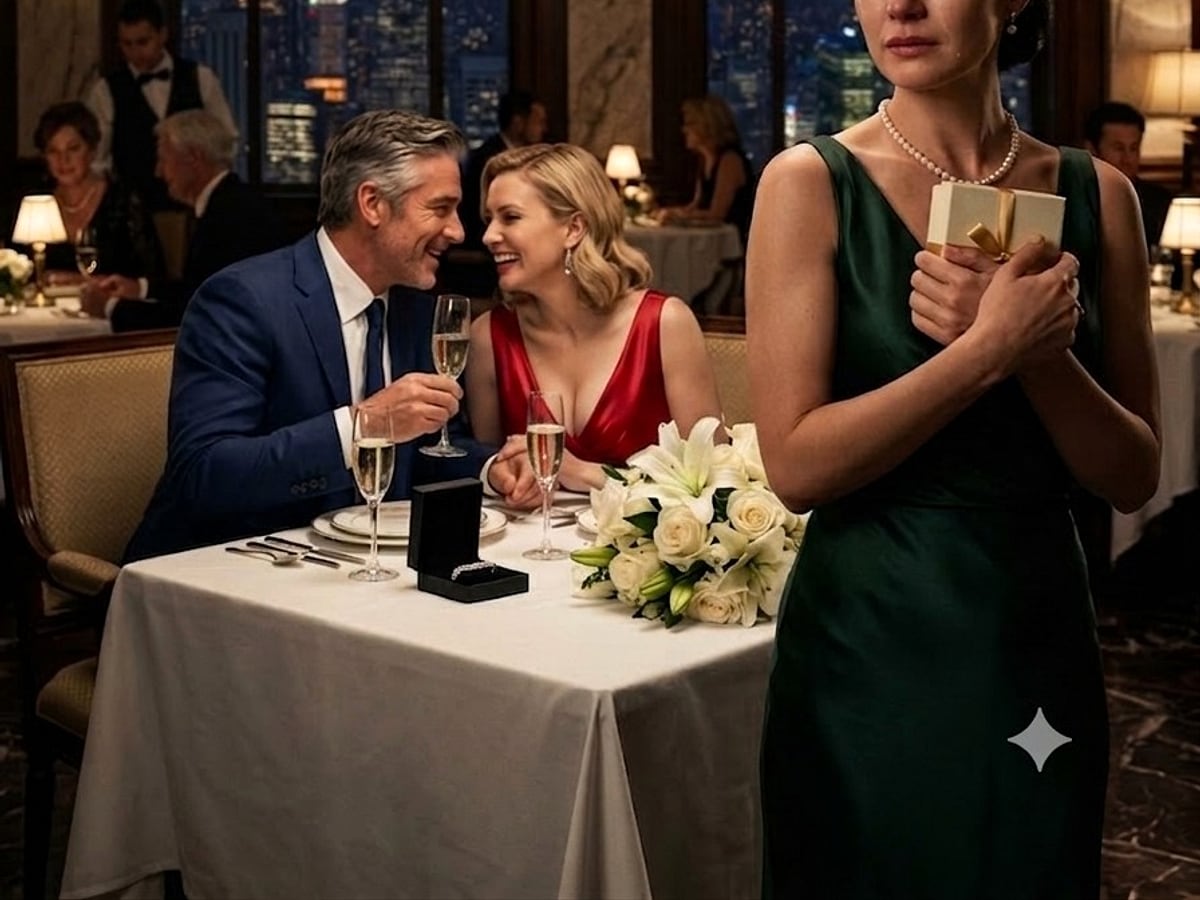
Part 1: The Gift Box at the Anniversary Table
She arrived at Lumiere near Central Park South at a quarter to eight, and she did not yet know she was walking into an anniversary dinner betrayal that would change everything she thought she understood about her marriage.
She was carrying a small gift box wrapped in ivory paper and tied with a thin gold ribbon, the same colors from their wedding five years earlier.
Inside was a card she had written four times before getting the words right: Five years ago, you asked me to build a life with you. Today, I found out we already have.
Beneath the card lay a pregnancy test she had taken that morning in their marble bathroom, the winter sun cutting a clean line across the floor tile.
Positive. Three tests. She had sat on the edge of the bathtub and covered her mouth and cried the way you cry when joy arrives carrying the memory of everything it cost to find.
Her name was Audrey Vale Bennett, and she had walked six blocks from the stationery shop on Madison Avenue to slow her heartbeat before telling Grayson he was going to be a father.
The hostess at Lumiere smiled when she arrived. Happy anniversary, Mrs.
Bennett. Mr.
Bennett is already seated.
That was the first wrong thing. Grayson was rarely early unless someone important was waiting.
She followed the hostess toward the mezzanine. The restaurant glowed the way it always did, cream walls and dark wood and candlelight arranged so precisely that even shadows looked curated.
She heard laughter before she reached the top of the stairs. She recognized one of the voices.
Grayson Bennett, founder and CEO of Bennett Urban Capital, sat beneath the central chandelier where he had once proposed to her. He was not alone.
Across from him was Valentina Cross, thirty-two, a supermodel whose face had appeared on magazine covers and perfume campaigns in every airport Audrey had passed through in the last decade. She wore a silver dress that moved when she breathed.
Her hair was swept back. Her laughter was low and familiar, the kind that assumes its welcome.
Near her elbow lay a small black velvet jewelry box. Not Audrey’s.
On the table: a bottle of Krug champagne in a silver ice bucket, two flutes, a plate of oysters.
Grayson’s hand was partially hidden beneath the table. His thumb moved in slow circles over the inside of Valentina’s wrist.
Audrey knew that gesture. He had used it on her for years when he wanted to quietly remind her of his claim.
The hostess had stopped. Audrey had stopped first.
Grayson looked up. Their eyes met.
His face traveled through shock, then annoyance, then calculation, all in the span of two seconds. She caught each one.
Valentina turned and looked at her with curiosity, not guilt. That detail would stay with Audrey longer than anything else from that night.
She looked at the velvet jewelry box. At the Krug. At his extended hand.
This is our anniversary dinner, she said. Her voice was calm.
Not because she felt calm. Because something inside her had gone very quiet.
Let’s not do this here, Grayson said, lowering his voice.
Valentina said, I didn’t realize.
Audrey looked at her. You didn’t know he was married?
One glance from Valentina toward Grayson told her enough. She knew.
Not all of it. But enough.
Audrey’s fingers tightened around the gift box.
For one terrible second, she thought about opening it. Setting the pregnancy test on the white tablecloth between the champagne and the oysters. Watching his face recalculate everything.
She imagined him choosing her. Sending Valentina away.
Taking her hands. Becoming the man she had needed for two years, simply because she was now carrying something he wanted most.
That image saved her. Because it told her something she could not unhear.
Grayson did not need another person to love. He needed heirs.
Legacy. Optics.
Continuation. A child born to Bennett Urban Capital would stop being a child before it learned to walk.
She thought of Eleanor Bennett, who had told her once over lunch that Bennett men are difficult, but Bennett children are born to lead.
She thought of the trust documents she had once seen at his attorney’s office, not fully understanding them at the time. The private schools he admired.
The building he wanted to name after his father. The way he talked about bloodlines without ever using the word.
He expected her to make a scene. He had seen her cry after each miscarriage.
He had seen her argue with doctors. He had seen her break a glass once, the night his mother implied that stress might have caused the losses.
He was prepared for that version of her.
So she smiled. Small. Costly.
Happy anniversary, Grayson.
His face tightened in a way she had not seen before.
She turned and walked out. Not fast.
Not dramatically. Down the stairs, past the hostess who looked devastated on her behalf, through the door, and into the cold November night with the gift box still in her hands.
Outside, she opened her phone and called her brother.
Nathan answered on the first ring. Are you okay?
I’m pregnant, she said. And I need to be somewhere else before he figures out why the box matters.
Part 2: The Empire Behind the Anniversary Dinner Betrayal
Every powerful man who grew up without money eventually builds a myth. Grayson Bennett’s was the useful kind: specific enough to sound honest, its rougher edges sanded smooth until poverty looked like character and ambition looked like vision.
The version he gave at fundraising dinners went like this: a delivery truck driver’s son from Queens, earned scholarships, worked construction in summers, got a finance degree from NYU, bought his first distressed building with borrowed money and enough confidence to make investors nervous in the best way.
Parts of that were true. What the story skipped: the leverage, the debt structure, the particular pressure applied to people who couldn’t yet afford to walk away.
Bennett Urban Capital bore Grayson’s instincts throughout. It bought neglected properties, rezoned parcels, converted warehouses, partnered with hotel groups, and gave speeches about urban revitalization that rarely mentioned the tenants priced out in the process.
Audrey was twenty-eight when she met him at a charity panel in Tribeca. She worked for a nonprofit housing coalition.
She said no to dinner twice. The third time, he sent a handwritten note and a donation to the tenant legal defense fund with no conditions attached.
She thought any man who could be persistent and generous without demanding credit deserved one dinner. That was how it started.
One dinner became three. Three became a weekend in Hudson Valley.
He proposed at Lumiere six months later, under the same chandelier where she would one day find him with Valentina Cross. White roses.
A string quartet. A diamond ring that felt too heavy for her hand.
He said: I want to build a life with you, Audrey. She believed him because he seemed to believe himself.
People like Grayson can mean things in the moment. That is what makes them convincing for so long.
The first two years felt like a story she was almost embarrassed to enjoy. A Hudson River penthouse.
Paris, Napa, Aspen, Martha’s Vineyard. Donor dinners where Grayson introduced her as the conscience of the operation, a phrase she found romantic before she understood it was also a job description.
Then came the miscarriages. Two in eighteen months. The first at nine weeks, the second at eleven.
Grayson was kind in the immediate aftermath. He attended appointments, sent flowers, held her hand.
But grief bored him after the first week. He was not incapable of feeling it.
He just could not figure out how to win against it, and things Grayson could not win against eventually became obstacles he moved around rather than through.
He emailed specialists while she was still bleeding. He discussed trying again while she was still raw. After the second loss, he stopped touching her stomach when they lay in bed at night.
His mother, Eleanor Bennett, was elegant the way certain women are: polished by decades of practice until it resembled warmth without quite becoming it. She told Audrey once over tea at Bergdorf Goodman that stress was terrible for the body, that women today faced such pressure, that sometimes the body protests.
Audrey set down her cup. Are you suggesting the miscarriages were caused by my work?
Eleanor’s smile did not shift. I’m suggesting the body speaks.
Audrey drove home and cried in the shower so Grayson would not hear. When she told him what his mother had said, he asked her not to make him choose sides.
I thought marriage meant you already had, she said.
He said nothing. That silence became the foundation of everything that came after.
Valentina Cross entered their orbit through a hotel development near NoMad. Bennett Urban Capital was partnering on a mixed-use building with branded residences and a rooftop restaurant, and Valentina was hired as the face of the launch campaign. At the preview event, Audrey told Grayson: She’s impressive.
He said, That sounded like a trap.
It wasn’t, she said. She’s useful for the launch.
So am I.
He smiled faintly. You’re my wife.
She let that reassure her. She should not have. In Grayson’s vocabulary, wife meant secured asset at least as often as it meant partner.
Her brother Nathan had seen it first. He was forty-two, a cybersecurity consultant in Greenwich, Connecticut, married to Marisol, a family law attorney who would turn out to be the most important phone call Audrey ever made. Nathan had watched Grayson for years with the patience of a man who had once worked in federal contracting and knew exactly how powerful people behaved when they believed the rules applied to other people.
Three weeks before the anniversary dinner, he told her: If you ever need to protect something before Grayson knows about it, call me first.
She laughed uneasily. She did not understand what he meant.
Standing outside Lumiere in the cold, she understood completely.
Part 3: One Letter and a Legally Clean Exit
Nathan sent a car under the name A. Vale. The driver was a retired NYPD officer named Frank who worked private transport for clients who needed discretion and did not ask questions.
He drove her from the Peninsula New York, where she had waited in the lobby with the gift box balanced on her knees, to a private residence in Westchester County owned by a friend of Marisol’s family.
Grayson called fourteen times during the drive. He texted between calls.
The messages started reasonably: Where did you go. Answer me.
You misunderstood what you saw. Come home and we’ll talk like adults.
Then, later: Whatever is in that box, don’t weaponize it.
That one made the car feel very cold. He knew the box mattered. He had no idea why.
Marisol met her at the Westchester house with tea and a legal pad. She hugged Audrey first, because Marisol understood that comfort and strategy were not enemies. Then she became an attorney.
She asked the questions attorneys ask: immediate danger, physical harm, coercion, medical decisions. Audrey paused at that last one.
Marisol’s eyes sharpened. We’ll come back to that.
Audrey told her everything. Grayson.
Valentina. The black velvet jewelry box.
The thumb tracing Valentina’s wrist. The gift with the pregnancy test inside.
Eleanor’s speech about bodies and stress. The trust documents she had once seen at his attorney’s office and not fully read.
The way Grayson talked about bloodlines without using the word.
Marisol listened without interrupting. Then she said, You are not required to announce your pregnancy to him tonight, by text, or on his schedule.
You are an adult. You can seek safety and legal counsel before disclosure.
Audrey exhaled. She had not realized she was waiting for someone to say that out loud.
At 1:12 a.m., a text arrived from Grayson: If you are trying to punish me, remember who you are married to.
Marisol took the phone, read it, and set it on the table between them. That one, she said, we save twice.
The next morning, Audrey met Helena Park.
Helena was a Manhattan family law attorney with a reputation for handling divorces involving men who confused private wealth with unlimited authority. She wore a black suit, no jewelry except a watch, and carried an expression that suggested nonsense had a short shelf life in her office.
She reviewed the texts, the Lumiere timeline, and Audrey’s account of the miscarriages and Eleanor’s comments. Then she said, First, you are not going to panic.
Panic makes expensive mistakes. Second, do not post anything, speak to press, access his private accounts, or remove marital property beyond your own essentials.
Third, we protect your medical privacy while preparing for the legal realities ahead.
Grayson already had his own counsel by noon. Men like Grayson have attorneys who answer phones on anniversaries.
Helena sent a letter stating that Audrey was safe, represented, and requesting all communication go through counsel. It warned against harassment, public statements, and interference with medical privacy.
Grayson’s first response was outrage. His attorney characterized her departure as abandonment without cause.
Helena replied with a timeline, restaurant witnesses, and copies of selected text messages. The word abandoned did not appear in any correspondence again.
When Grayson sent flowers to the Westchester house without having been given the address, Nathan moved her immediately to his property in Greenwich, behind a security gate. He arranged for Lumi, a midwife he knew through a colleague, to begin weekly prenatal visits.
Audrey attended appointments in Connecticut under her maiden name for scheduling privacy. Every blood test felt like waiting for a verdict. Every ultrasound made her hold her breath until sound filled the room.
At six weeks, she heard a heartbeat. She recorded it on her phone, not for Grayson, but for herself. For the nights when fear tried to convince her that hoping again was reckless.
At twelve weeks, she wrote the letter.
Not the legal notice. The personal one.
One page. No accusations she could not support, no threats, no mention of Valentina beyond what she had witnessed with her own eyes.
It said she had come to Lumiere to tell him she was pregnant, wrapped in ivory paper and tied with gold ribbon, under the chandelier where he had proposed. It said she had understood in that moment that the child she carried would not be safe inside the version of family he performed for the world.
It said she was not hiding to punish him. She was stepping away to protect her health, her pregnancy, and a child who deserved to be loved as a person, not absorbed into an empire.
Helena read it. This is controlled, she said. Send it through counsel.
Three days later, Grayson’s formal response arrived. He demanded confirmation of the pregnancy.
Access to medical records. Participation in appointments.
Then, in the fourth paragraph: assurance that the child would bear the Bennett name.
Not: Are you okay. Not: I’m sorry. Not: How can I support you.
The name. The continuation. The claim.
Helena looked up from the letter. Predictable, she said.
Part 4: The Wall That Money Could Not Move
Eleanor Bennett called Audrey’s mother within a week.
Diane Vale was a retired high school principal from Boston who had spent thirty years managing parents, teenagers, and school board members who mistook volume for authority. She had what certain women develop through decades of keeping institutions running: a complete intolerance for theater dressed up as concern.
Eleanor said Audrey was emotionally fragile and being influenced by people who did not understand the Bennett family’s circumstances.
Diane said, My daughter is represented by counsel, under medical care, and unavailable for family theater. Then she hung up and drove to New York.
Grayson escalated through attorneys. He requested mediation regarding cooperative family planning, which Helena declined as an attempt to pre-negotiate custody of an unborn child as though pregnancy were a pending transaction. She agreed only to structured discussions about communication boundaries and pregnancy-related financial responsibilities.
Grayson had built Bennett Urban Capital on the assumption that enough money and enough sustained pressure eventually moved any obstacle. In Helena, Nathan, Marisol, and Diane Vale, he encountered people who were not particularly interested in that assumption.
His public image began fraying. The anniversary dinner betrayal at Lumiere became a Page Six blind item, then named gossip after a restaurant guest’s photograph appeared online: Grayson leaning toward Valentina Cross, hand near her wrist, champagne between them.
His team issued no statement. Silence can look like dignity when the facts underneath it are expensive enough to suppress.
Privately, he tried managing a different narrative through intermediaries: a devastated husband, an emotionally overwrought pregnant wife, an unfortunate misunderstanding, a family hoping for reconciliation.
Helena ended it with one attorney statement threatening legal action against any publication running false claims about Audrey’s medical condition or marital circumstances. No details.
Just enough steel. The story quieted.
But Grayson’s financial picture grew more complicated. Helena had been reviewing marital records, and Lumiere had not been the first dinner. Hotel suites, jewelry, travel expenses, transactions routed through business accounts in ways that would produce questions his CFO would not enjoy answering in court.
Adultery would not rewrite the prenuptial agreement in New York. But waste and dissipation of marital funds made leverage real, and Grayson wanted discretion above almost everything else. Helena communicated through counsel that discretion required cooperation.
At sixteen weeks, Audrey learned she was carrying a daughter.
Grayson sent a message through counsel suggesting the name Eleanor Grace Bennett if the baby was a girl.
Audrey laughed hard enough that Diane looked up from across the room.
Helena’s official response: No.
At twenty-four weeks, Audrey agreed to a single in-person meeting in Helena’s conference room. Attorneys present.
Grayson arrived in a navy suit with his wedding ring on and his face thinner than she remembered. He looked at her stomach.
She wore black and let the pregnancy show.
Are you okay? he asked.
I’m healthy, she said.
That’s not what I asked.
It’s the answer I’m giving.
He said he had read her letter every day for two weeks. Hated it at first.
Then hated that he hated it. He admitted, looking down at his hands, that yes, he had thought of a child as legacy, not only that, but yes, a continuation of what he had built.
She felt the baby move. A small, insistent pressure.
She is not proof of you, Audrey said.
His eyes lifted. She?
She had not meant to say it that way. But there it was.
A girl, he said softly. His face changed in a way she had not seen in years.
Almost undid her. Almost.
He asked what she wanted from him. She told him: respect the boundaries, cooperate with the legal process, stop managing the public narrative, stop sending Eleanor, stop treating access as ownership.
I’ll try, he said.
No, Audrey said. You either do it, or you let a judge watch you fail.
Helena’s expression remained perfectly still. But Audrey felt something close to approval in the room.
That was the last time they met before the birth.
Part 5: The Daughter Who Was Never an Empire
Lila Rose Vale Bennett was born on a rainy morning in May.
Not with drama. Not with billionaires pounding on hospital doors.
There was pain, fluorescent light, and a nurse named Tanya who called her mama with such complete confidence that Audrey stopped being afraid of the word. Her mother Diane held one hand, Marisol held the other.
Nathan waited in the hallway and cried before anyone came to tell him the baby had arrived.
Lumi had checked Audrey’s vitals that same morning, two hours before anything began, and told her the heartbeat was strong and steady. She said it the way people say things they have said to many frightened women and still mean every word.
Vale came first in the name because it belonged to Audrey. Bennett came second because Lila deserved to know where she came from, all of it, and decide for herself what to do with the history.
Seven pounds, one ounce. Dark hair.
Lungs that announced her presence. Fingers long enough that Diane Vale declared would either play piano or cross-examine witnesses.
When they placed Lila on her chest, the world narrowed to warmth and weight and someone small who had no idea how much she had already survived.
Grayson was notified through counsel after the birth, as previously arranged. He came the following day.
He did not bring Eleanor. He washed his hands without being asked.
When he saw Lila in the bassinet, he went quiet in a way Audrey had never seen before.
He held her the way a man holds something he has no right to govern.
Hi, he said softly. Hi, Lila.
Audrey watched. She did not forgive him in that hospital room.
Birth is powerful, but it is not a legal settlement or a moral reset. Still, she saw something begin that had the word possibility somewhere inside it.
The divorce settlement was finalized when Lila was ten months old. The prenuptial agreement protected Grayson’s premarital wealth, as designed. But the anniversary dinner betrayal and what Helena had documented about financial behavior during the marriage made discretion very expensive, and the settlement reflected that.
Audrey walked away with financial security, child support properly structured, documented protections around Lila’s privacy, and a co-parenting plan that prioritized her daughter’s needs over her father’s image.
She also walked away with her name. Audrey Vale. She cried when she signed it the first time, in a parking garage, ugly unselfconscious crying with no audience and no performance to maintain.
Valentina Cross was gone before Lila was born. The campaign contract ended.
She resurfaced in Los Angeles, photographed outside a recording studio in sunglasses and silence. The black velvet jewelry box from Lumiere never appeared on her social media.
The story of the anniversary dinner betrayal belonged to no one who profited from carrying it.
Eleanor Bennett did not meet Lila for four months. When she did, the meeting was in Helena’s office playroom, with written conditions: no social media, no photographs, no commentary on the Bennett name, no observations about legacy or inheritance or what Bennett children are born to.
Eleanor cried when she saw her granddaughter. Audrey did not comfort her.
That was no longer her job.
Grayson changed in the ways that were possible for him. He attended parenting classes without announcing it to anyone.
He learned to warm bottles. He showed up to pediatric appointments on time.
He stopped trying to use Lila’s image at charity events after Audrey looked at him for ten full seconds and said, Do not make me regret civility.
He laughed once. Then realized she was not joking.
Lila is three now. She has Audrey’s eyes and Grayson’s stubborn chin.
She has strong opinions about blueberries, pigeons, board books, and any object that has inconvenienced her. She shouts I do it myself with the conviction of someone who has never lost an argument she cared about.
She calls Grayson Daddy Gray because she heard someone use his full name and decided titles needed variety.
Once, when she was two, Grayson called her my legacy while she stacked blocks on his living room floor.
Audrey looked at him.
He stopped. Corrected himself: My daughter.
Small corrections, repeated consistently, eventually become structure.
Last year, Lumiere invited Audrey to a charity dinner honoring the housing coalition she still supported. She went.
She wore navy. No gift box, no wedding ring, no version of herself left to perform.
During dessert, she glanced up at the mezzanine. The chandelier still hung there, glittering over the white tablecloths and the careful illusions people pay for when they want to feel close to something they cannot quite name.
She saw herself standing there five years earlier, gift box in her hands, watching her husband trace another woman’s wrist under the light he had once used to propose to her.
The image faded. Not completely. But far enough.
She stepped outside and called Nathan. He answered on the first ring.
I’m okay, she said.
He was quiet a moment. Then: I know.
People still tell the story wrong. They say a pregnant wife vanished after catching her millionaire husband at their anniversary dinner betrayal in a Manhattan restaurant.
They say she left one letter. They say she disappeared with the secret he wanted most.
Stories need drama more than they need precision.
The true version is quieter. She left because staying would have given Grayson time to convert her pregnancy into a possession.
She wrote the letter because she needed one place where the truth stood without negotiation. She protected her daughter because love without limits is not love.
It is surrender with better lighting.
On that November evening, Audrey Vale Bennett walked out of Lumiere carrying an ivory-paper gift box that no one else ever opened.
Inside it was a secret that became Lila. Loud.
Sticky-fingered. Alive.
No longer a secret, and never an asset.
A daughter. And the most expensive lesson Grayson Bennett ever received at the cost of one anniversary dinner:
A man can own buildings, companies, and rooms full of people willing to flatter him. He cannot own the woman who has already decided what she is worth, long before he remembered to wonder.
Names and identifying details in this story have been changed. This is a dramatized personal reflection shared for entertainment and educational purposes only. Any resemblance to real individuals or events is coincidental.
