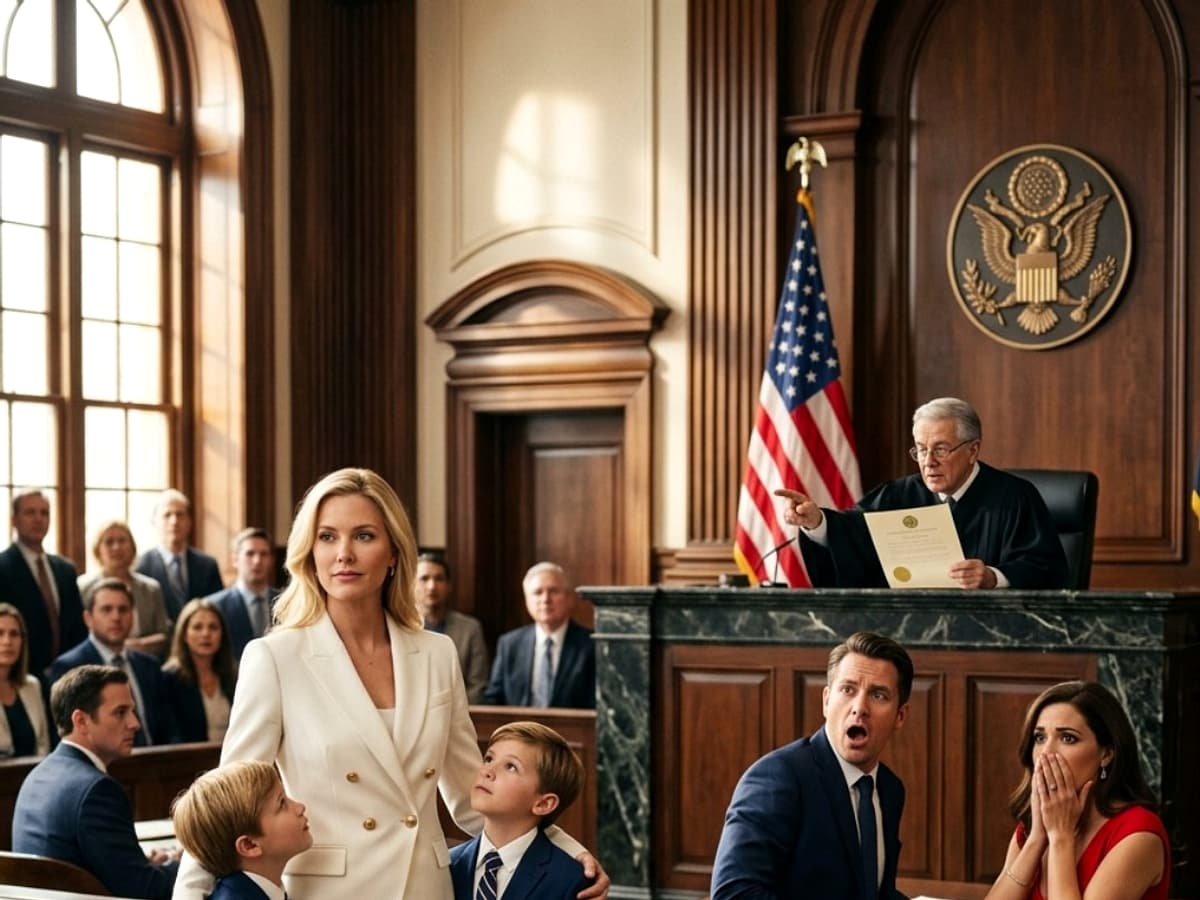
Part 1: The Woman in the Cream Coat
The morning of the hearing, I made waffles.
Not because I was calm. Not because I had slept. I made waffles because Oliver would only eat them if the squares were pulled apart first, and Noah would only eat them if Oliver ate first, and I needed both of my six-year-old boys to leave for school with full stomachs on the day their mother walked into a courtroom to fight for the right to keep tucking them in at night.
My neighbor, Donna, took them at seven-thirty. Noah wrapped both arms around my waist and pressed his face into my coat.
Oliver stood very straight, the way he always did when he sensed something serious, and said, “Mom, you look like a lawyer.” I told him that was the plan.
He nodded like that satisfied him. Then they were gone, and the house was so quiet I could hear the refrigerator hum.
I drove downtown alone. Laura Kim had offered to pick me up, but I needed those forty minutes on the expressway. I needed the radio and the gray November sky and the particular loneliness of the Dan Ryan at rush hour, where everyone is moving fast and no one is watching you fall apart.
I arrived at the Daley Center at eight-forty. Courtroom 4B was on the sixth floor, past a long marble corridor that smelled like floor wax and old paper. I found a bench near the window and sat with my folder on my lap and my hands folded on top of it, watching the elevator doors.
Grayson arrived at eight fifty-seven.
He did not walk into that hallway. He processed into it.
There is a difference. Walking is something a person does to get somewhere.
What Grayson did was a performance — charcoal suit, silver tie, the kind of shoes that announce themselves on marble floors. Behind him came three attorneys in a tight formation, the lead one already murmuring into his ear, and behind them, unhurried and perfectly assembled, came Vivienne Cross.
I had seen photographs. I had found her name in a hotel receipt, her voice on a voicemail Grayson had forgotten to delete, her diamond bracelet described in a text message as “the thing from the Mag Mile” sent to a number I did not recognize until I did. But I had not seen her in person, and there is something about seeing the actual human being that photographs cannot prepare you for.
She was beautiful in the way expensive things are beautiful — deliberately, precisely, without accident. Cream coat, red-soled heels, a bracelet catching the fluorescent light. She found a seat two rows behind Grayson’s table and crossed her ankles and looked around the courtroom with the mild curiosity of someone attending a play she had already read the script for.
Then she looked at me.
It was not a hostile look. That would have been easier.
It was a look of assessment, the kind a person gives something they believe they have already surpassed. A small, composed smile.
A slight tilt of the head. Then she looked away, as if I were a detail she had already filed and moved past.
I turned back to my folder.
Laura arrived at nine-oh-one, set her bag down beside me, and said nothing for a moment. Then she said, “She actually came.”
Not surprised. Not outraged.
Just noting a fact.
“She did,” I said.
“Good,” Laura said, and opened her own folder.
I had hired Laura Kim eight months earlier, after Grayson’s first attorney sent a letter suggesting I accept a settlement that included the house in Winnetka, a lump sum I will not repeat because it still makes my jaw tighten, and no primary custody of my children. A friend who had been through her own divorce told me Laura was the attorney you hired when the other side thought they had already won.
She was not theatrical. She did not make speeches in hallways or send press releases.
She was methodical in the way a surgeon is methodical — every movement deliberate, every instrument in its place, no wasted motion.
Grayson’s team had clearly done their research on her and decided she was not a threat. I know this because Victor Sloane, his lead attorney, barely glanced at her when he entered. He shook hands with the clerk, adjusted his cufflinks, and set his leather trial binder on the table with the satisfied thud of a man who considers the outcome a formality.
Judge Margaret Hensley entered at nine-oh-four exactly.
She was in her mid-sixties, silver-haired, with rimless glasses and the expression of someone who had spent decades in this room listening to people mistake financial leverage for moral authority. Everyone rose. Grayson rose slowly, almost as an afterthought, the way a man rises for a flight attendant’s safety announcement — technically compliant, privately unbothered.
The hearing opened with temporary custody arrangements.
Grayson’s attorneys presented him as a devoted father, a stable provider, a man of structure and vision. They mentioned the private school waitlist, the pediatric therapist he had retained six weeks ago — eight months after I had first asked him to consider one for Oliver’s anxiety — the college savings accounts, the house, the neighborhood, the zip code. They spoke about “continuity of environment” and “financial security” and “the children’s established routine” as though Grayson had been present for any of it.
Then they spoke about me.
They said I had become emotionally destabilized since learning the marriage was ending. They said I had restricted Grayson’s access to the children, though the canceled visits and early drop-offs were all documented in my phone and in the boys’ school pickup logs. They said I lacked independent income, held no current executive title, and might use the children as leverage in the financial dispute.
I sat completely still while they said all of it.
That stillness cost me more than anything else I did that day.
Laura’s hand found my wrist under the table. One brief, firm press. Not yet.
I breathed. I waited. And across the room, Vivienne watched me with that same composed smile, certain she was watching the last chapter of a story that had already been written.
She had no idea the story hadn’t started yet.
Part 2: The Filing My Father Made in 1987
The first document Laura placed before Judge Hensley was not dramatic to look at. It was a standard Illinois Secretary of State business filing, the kind printed on paper so thin it almost translucent, with a state seal in the corner and a date typed in a font that hadn’t been updated since the Reagan administration.
It was the original articles of incorporation for Bennett Foods, Inc.
Filed by my father, Robert James Bennett, on March 14, 1987.
Listed as sole shareholder and principal officer: Robert James Bennett.
Listed as secondary officer, added by amendment in 2003: Amelia Rose Bennett.
That was me. Sixteen years old, sitting in my father’s office after school while he explained what a balance sheet was and why it mattered that every number told the truth.
He had put my name on the amendment not because he needed to, but because he said a business was only as honest as the people who understood it. He wanted me to understand it.
He wanted me to own it — not just emotionally, but legally, structurally, on paper.
My father was a careful man.
Victor Sloane had built Grayson’s entire financial argument on one premise: that Caldwell Harvest Group was Grayson’s separate property, protected by the prenup, because the business had been titled in Grayson’s name since the rebranding in 2014. The prenup said separate property stayed separate.
Future appreciation of separate assets stayed with the titled owner. It was, as Grayson had told me more than once, ironclad.
What Victor Sloane had not accounted for was the chain of title that existed before the rebranding.
Laura walked Judge Hensley through it methodically, the way she did everything.
Bennett Foods had been incorporated in 1987. My father had added me as an officer in 2003.
When my father died in 2009, his estate attorney — a meticulous woman named Patricia Osei who had worked with my father for twenty years — had executed the succession documents that transferred his ownership interest to me as sole heir. Not to the estate in general.
To me, specifically, by name, with a notarized transfer of shares dated October 3, 2009.
I became the sole owner of Bennett Foods on that date.
When Grayson and I married in 2011, I brought that company into the marriage. The prenup acknowledged it as my separate property. What the prenup also said — in language Victor Sloane had apparently read quickly and Grayson’s original attorney had apparently not flagged — was that any rebranding, restructuring, or renaming of a separate property business did not automatically transfer ownership unless accompanied by a signed, notarized share transfer agreement executed by both parties.
There had been no such agreement in 2014.
Grayson had changed the name. He had changed the logo, the letterhead, the website, the email signatures, the vendor contracts.
He had installed himself as CEO and chairman and filed the new corporate documents under his name. He had told investors, clients, and eventually me that the company was his.
But he had never executed a legal transfer of my shares.
Because he had assumed I didn’t know they still existed.
Laura set the 2009 share transfer document on the table beside the 1987 filing. Then she set down the 2011 prenup with the relevant clause highlighted in yellow. Then she set down a letter from Patricia Osei, my father’s estate attorney, confirming the chain of title and attesting that no transfer of Amelia Bennett’s ownership interest in Bennett Foods or its successor entities had ever been filed with her office or with the state.
The room was very quiet.
Victor Sloane was on his feet before Laura finished speaking. He said the rebranding documents clearly demonstrated Grayson’s operational control.
He said the corporate restructuring had effectively superseded the original incorporation. He said the prenup had to be read in its entirety and in context.
Judge Hensley looked at him over her rimless glasses.
“Mr. Sloane,” she said, “operational control and legal ownership are not the same thing. You know that.”
Sloane sat down.
I looked at my hands in my lap. They were not shaking.
I was surprised by that. I had expected them to shake.
Grayson turned in his chair and looked at me for the first time since we had entered the room. Not with anger. With something closer to recalculation — the expression of a man running numbers in his head and arriving at a sum he had not expected.
I did not look away.
Behind him, two rows back, Vivienne’s smile had gone very still.
Part 3: The Recess at 10:36 a.m.
Judge Hensley called a brief recess at ten thirty-six.
I know the exact time because I looked at the clock on the courtroom wall the moment the gavel came down, the way you look at a clock during a medical procedure — needing to anchor yourself to something measurable, something that moves at a predictable rate regardless of what is happening to you.
Laura and I went into the hallway. The marble corridor was emptier now, most of the morning’s other cases already dispersed to their respective rooms.
Our footsteps were the loudest thing. When the courtroom door swung shut behind us, my knees did something they had not done all morning — they softened, just slightly, just enough that I had to put one hand on the wall.
Laura didn’t make a production of it. She simply stepped close and said, “You’re doing exactly right. Keep doing that.”
“Is it enough?” I asked.
“The ownership chain is solid,” she said. “Hensley sees it.
Sloane knows she sees it. Watch his posture when we go back in — he’ll be two inches shorter.”
I almost laughed. Almost.
I thought about calling Donna to check on the boys, then decided against it. Oliver would be in math.
Noah would be in music. They were fine.
They were in their classrooms eating the snacks I had packed and not thinking about courtrooms, and that was exactly where I needed them to be.
The door to the courtroom opened and Grayson stepped out.
He was alone. No attorneys, no Vivienne. Just Grayson in his Tom Ford suit, looking at me with an expression I had not seen on his face in years — something unguarded, something almost human.
“Amelia,” he said.
Laura took one step forward. I put my hand up slightly, and she stopped.
“Grayson,” I said.
He was quiet for a moment. In the old days, in the early years, silence between us had been comfortable.
We used to sit on the back porch of the first apartment we shared and say nothing for long stretches, just watching the alley and drinking coffee. I had loved that about him once.
The ease of it.
“I didn’t know about the 2009 transfer,” he said finally.
“Yes you did,” I said. “You were there when Patricia sent the estate summary. You signed the acknowledgment letter.”
He looked at me for a long moment. Then he said, “I thought you’d just let it go.”
I had nothing to say to that. Not because I was speechless, but because there was nothing left to say that the documents hadn’t already said more clearly.
He went back inside.
Laura and I stood in the hallway for another minute. Down the corridor, the elevator opened and Vivienne stepped out, holding two cups of coffee from the cart downstairs.
She stopped when she saw me. We looked at each other across about thirty feet of marble floor.
She had the kind of face that was trained not to show much. But something moved behind her eyes — not guilt, not shame, something more practical than either of those. The look of a person quietly revising a plan.
She walked past us without speaking and went back into the courtroom.
“She brought him coffee,” Laura said, not unkindly.
“She’s going to need it,” I said.
When we returned to the courtroom, Victor Sloane was indeed two inches shorter. He sat with his legal pad in front of him and a pen in his hand, but he was writing nothing. The lead attorney who had entered the room that morning with the binder and the certainty was now a man doing arithmetic he did not like.
The second half of the morning session moved into the financial valuation of Caldwell Harvest Group.
Grayson’s team had hired a forensic accountant who valued the company at a figure that, while impressive in absolute terms, was structured to minimize the marital estate’s share. The methodology relied entirely on the assumption that Grayson was the sole owner and that any contribution I had made was compensated through my role as a spouse and co-parent — in other words, that I had been paid in the currency of being married to him.
Laura’s forensic accountant had a different methodology.
She had gone back to the original Bennett Foods revenue records from 2009 through 2014 — the years I ran the company before the rebranding — and traced the growth curve. She had documented the vendor relationships I had built, the freight contracts I had renegotiated, the client accounts I had personally retained during the transition. She had calculated the value of the operational infrastructure I had created and that Caldwell Harvest Group had inherited wholesale when the name changed.
The number she arrived at was not the same number Grayson’s accountant had used.
It was considerably larger.
And because I still legally owned the shares that had never been transferred, that larger number had a different owner than Grayson had spent years telling everyone it did.
Judge Hensley asked both accountants to submit their full reports within thirty days.
She looked at Grayson’s table when she said it.
Then she adjourned the morning session.
In the row behind Grayson, Vivienne set down her coffee cup very carefully, as if she were afraid of making a sound.
Part 4: What My Father Left Inside the Numbers
The months that followed were not a victory lap. Anyone who has been through a contested divorce will tell you that a good hearing is not a finish line.
It is a door. And on the other side of that door is a hallway full of more doors, most of them labeled with words like “deposition,” “motion to compel,” “emergency custody hearing,” and “forensic review of corporate communications.”
I learned to live in that hallway.
I learned to pack the boys’ lunches and answer Laura’s emails and sit across from Grayson’s attorneys in conference rooms and not let my voice do anything my face wasn’t doing. I learned to read financial documents at the kitchen table after the boys were asleep, with a glass of water and a highlighter and the particular focus that comes from understanding that every number on every page was once something my father or I had built with our hands.
Grayson’s team filed three motions to dismiss Laura’s ownership argument. All three were denied.
They attempted to introduce evidence that I had “abandoned” my executive role voluntarily, which would constitute a waiver of ownership rights. Laura filed a counter-brief that was, according to the paralegal who called me to say it had been submitted, forty-seven pages long. The motion was denied.
They subpoenaed my personal emails from 2013 and 2014, looking for any message in which I had described the company as Grayson’s. They found emails in which I had used the phrase “Grayson’s vision” and “his company” in the context of investor pitches I had helped him prepare. Laura pointed out, in a response that I imagine Victor Sloane did not enjoy reading, that writing marketing language for someone else’s public-facing narrative does not constitute a legal transfer of equity.
That motion was also denied.
Meanwhile, the custody evaluation was underway. A court-appointed evaluator named Dr.
Sandra Pruitt spent six weeks interviewing both of us, observing us with the boys, speaking to their teachers, their pediatrician, Donna next door, and three other people from their daily lives. She asked Oliver and Noah questions in a playroom with a one-way mirror, using toys and drawings to understand what they understood about home.
Oliver told her he wanted to live where the dog was.
Noah told her he wanted to live where Mom made waffles.
I am not going to pretend those answers didn’t matter. They mattered enormously.
But what mattered more, in the formal language of Dr. Pruitt’s report, was the documented record of primary caregiving — school pickups, medical appointments, teacher conferences, therapy sessions, emergency contacts, permission slips, birthday parties, sick days, and the forty-seven other invisible categories of labor that constitute raising a child and that Grayson’s name did not appear in.
His name appeared in the college savings accounts.
Mine appeared in the school nurse’s phone.
Dr. Pruitt’s recommendation was primary residential custody with the mother, with generous and structured parenting time for the father.
Grayson’s attorneys filed an objection.
Judge Hensley read the objection and the report and issued a temporary order consistent with Dr. Pruitt’s recommendation within two weeks.
The boys came home on a Tuesday afternoon and Noah ran straight to the dog and Oliver asked if we could have waffles for dinner. I said yes. I stood at the stove and made waffles for dinner on a Tuesday in February and cried quietly into the steam from the iron, and neither of them noticed because they were arguing about whether dinosaurs would have liked waffles.
I decided they would have.
Grayson, during this period, was also dealing with consequences that had nothing to do with me directly.
Three of Caldwell Harvest Group’s largest retail clients had become aware, through the discovery process and the business press coverage that followed, that the company’s ownership structure was in active legal dispute. Two of them put their contracts on hold pending resolution. One terminated early, citing a clause about material changes in corporate governance.
The company Grayson had spent years building his identity around was bleeding quietly while he fought me in court.
I did not feel triumphant about that.
I felt tired, and sad, and occasionally, in the middle of the night when the house was dark and the boys were asleep and the dog was snoring at the foot of my bed, I felt something that was not quite grief and not quite relief but lived in the space between them — the feeling of a person who has survived something and is only now beginning to understand the shape of what it was.
My father had put my name on that amendment in 2003 because he believed in being careful. He believed that love and legal protection were not opposites. He believed that the people you trusted most deserved the clearest documentation, because clarity was a form of respect.
He had been right about that.
He had been right about a lot of things I had spent twelve years being too busy to remember.
Part 5: The Settlement He Signed Alone
The final settlement conference was held eleven months after the first hearing, on a Thursday morning in October when the trees along the river were doing their best work and the city looked, from the sixth floor of the Daley Center, like a place where things could still go right.
Grayson arrived with two attorneys. Not three.
Victor Sloane was still there, but the iPad attorney and the woman with the sharp cheekbones were gone. Grayson himself looked different — thinner in the face, quieter in the body, wearing a suit that was still expensive but no longer seemed to be making a statement.
He sat down at the conference table and put his hands flat on the surface and looked at the window instead of at me.
Vivienne was not there.
I had heard, through the particular grapevine that operates in the margins of a public legal dispute, that she had ended things with Grayson sometime around the third month of the proceedings, approximately two weeks after the business press ran a piece about the ownership dispute and the departing clients. I did not know if that was true.
I did not spend much time thinking about it. She had made her choices and she would live inside them, the same as everyone else.
The settlement Laura had negotiated over the preceding four months was not a punishment. It was an accounting.
Because I had never legally transferred my shares in Bennett Foods or its successor entity, I retained a controlling ownership interest in Caldwell Harvest Group. The settlement formalized that interest, bought out Grayson’s operational stake at a valuation both forensic accountants had agreed upon after three rounds of mediation, and restructured the company’s governance with a new board that included two independent directors.
The company would be renamed.
Not Caldwell Harvest Group. Not Bennett Foods, which belonged to a different era and a different version of me.
We settled on Harvest & Bennett, which was Laura’s suggestion and which I liked because it sounded like something that had been grown rather than built — which, in the ways that mattered, it had been.
Grayson received a buyout that was fair by any objective measure. He was not left with nothing.
He was left with what he had actually earned, which was less than what he had spent twelve years telling himself he deserved, but more than what a man who had tried to take his wife’s inheritance and her children deserved from a purely moral standpoint. The law does not operate on purely moral standpoints, and I had long since made peace with that.
Primary custody of Oliver and Noah remained with me.
Grayson would have them every other weekend and one evening per week, with provisions for holidays and school breaks. The arrangement was structured, documented, and enforceable.
It was not what he had asked for. It was what the evidence had supported.
He signed the agreement at eleven forty-two in the morning.
I watched his pen move across the signature line and felt nothing dramatic. No surge of victory, no collapse of relief. Just a quiet settling, like a house after a long storm, when the wind finally drops and you can hear the ordinary sounds again — the refrigerator, the dog’s nails on the floor, two boys arguing about dinosaurs in the next room.
Outside in the hallway afterward, Grayson stopped beside me while our attorneys spoke to the clerk.
He said, “I should have done this differently.”
I thought about the twelve years. The company my father built.
The name that got erased. The bracelet described as a client gift.
The earring in the car. The apartment in River North.
The custody petition designed to break me. The word “assisted.”
“Yes,” I said. “You should have.”
He nodded once, and walked to the elevator, and that was the last real conversation we had.
It is now fourteen months since that morning.
Oliver is seven and has started asking questions about how companies work, which I answer as honestly as I can for a seven-year-old, because my father taught me that understanding is a form of protection. Noah is seven and still sings made-up songs to the dog and still leaves toy cars in my shoes, and I have stopped moving them because I have decided they are a feature, not a flaw.
Harvest & Bennett had its best revenue quarter last spring. Two of the clients who had paused their contracts came back.
We added a regional line of specialty grains that I had been wanting to develop for three years and that Grayson had always called “too niche.” It is not too niche.
It is doing extremely well.
I think about my father sometimes when I walk through the warehouse at five-thirty in the morning, before the trucks arrive and the day gets loud. I think about him teaching me to read invoices at sixteen, and the amendment he filed in 2003, and the estate documents Patricia Osei executed so carefully in October of 2009.
I think about how he never once told me that love and legal clarity were in conflict. He understood that the people you love deserve both.
He was a careful man.
I am his daughter.
And Grayson Caldwell, for all his charcoal suits and silver ties and absolute confidence, made the oldest mistake a man like him can make.
He forgot that the foundation he was standing on had someone else’s name on it.
Names and identifying details in this story have been changed. This is a dramatized account shared for entertainment and reflection, and any resemblance to real people is coincidental.
