Part 1: The Rain She Walked Into
Thursday nights in Chicago have a particular cruelty in late autumn. The rain doesn’t fall so much as it presses — cold and sideways, turning streetlights into smeared watercolors and making the whole city feel like it’s being slowly erased.
That was the night Sarah Whitaker left her marriage.
She was thirty-one weeks pregnant. She had spent the afternoon at a prenatal appointment where her doctor had noted elevated blood pressure, swollen ankles, and a baby positioned so high under her ribs that every deep breath required negotiation.
The doctor had told her to go home and rest. So she did.
She had not expected to find Alexander’s black Rolls-Royce already in the driveway of the Lincoln Park house — the one he had purchased before their wedding for $14.7 million and described, with the particular satisfaction of a man who equates square footage with virtue, as “a proper family home.”
Sarah had always found that phrase slightly hollow. Proper for whom, exactly?
She let herself in through the front door. The foyer smelled of expensive candles and the white roses Alexander kept on the entry table because a designer had once told him they photographed well.
Her coat was damp. Her boots were quiet on the marble floor.
She heard music first. Jazz, drifting down from the second floor like smoke.
Then laughter. A woman’s laughter, easy and unguarded, the kind you only produce when you believe you are completely safe.
Sarah stood very still beneath the staircase. She told herself there were reasonable explanations.
His assistant. A colleague.
Someone with a legitimate reason to be in her home at ten o’clock on a Thursday night while she had been at the hospital measuring her blood pressure and worrying about her son’s heartbeat.
Then she heard the woman say, “Alex, stop — what if she comes home?”
And Alexander laughed. “She won’t. She’s probably still at the doctor’s, crying because a nurse looked at her sideways.”
The baby moved. One sharp kick, as if he too had heard his father’s voice and found it unfamiliar.
Sarah climbed the stairs. She did not rush.
She did not announce herself. She simply walked up through the too-warm, too-bright house that she had spent two years filling with furniture and art and small hopeful objects, until she reached the half-open door of the primary bedroom.
A dress on the floor. Not hers.
Heels near the nightstand. Not hers.
A silk robe on the woman sitting at the edge of the bed — that one, Sarah recognized immediately. It was hers.
The woman was Vanessa Cole. Twenty-nine, a former lifestyle journalist turned media consultant, and the same person who had written a glossy profile of Alexander titled The Billionaire Who Still Believes in Family.
Alexander stood near the window, shirt untucked, sleeves rolled. He turned when he sensed her presence.
His expression moved through several things in quick succession. Surprise.
Calculation. And then — the thing that would stay with Sarah long after everything else faded — annoyance.
The mild, slightly impatient look of a man whose meeting has been interrupted by someone who should have known better than to walk in unannounced.
“Sarah,” he said. “You’re home early.”
Vanessa stood, pulling the robe tighter. “I should go.”
“Stay,” Alexander said, without looking at her.
Sarah looked at her husband across the room where their son’s bassinet had been assembled two weekends ago, when Alexander had supervised from the doorway while a hired crew did the actual work. She looked at the pearl earrings he had given her for their anniversary, sitting on the vanity beside another woman’s lipstick.
“In our bed,” Sarah said. It wasn’t a question.
Alexander sighed. “Don’t make this uglier than it needs to be.”
There are sentences that don’t cut like knives. They cut like the soft click of a door being locked from the other side.
Sarah nodded once. She turned and walked back downstairs.
In the kitchen, her hands were steady. She removed her wedding ring — five carats, custom cut, the kind of ring chosen by a man who understood that objects communicate status — and set it on the marble island.
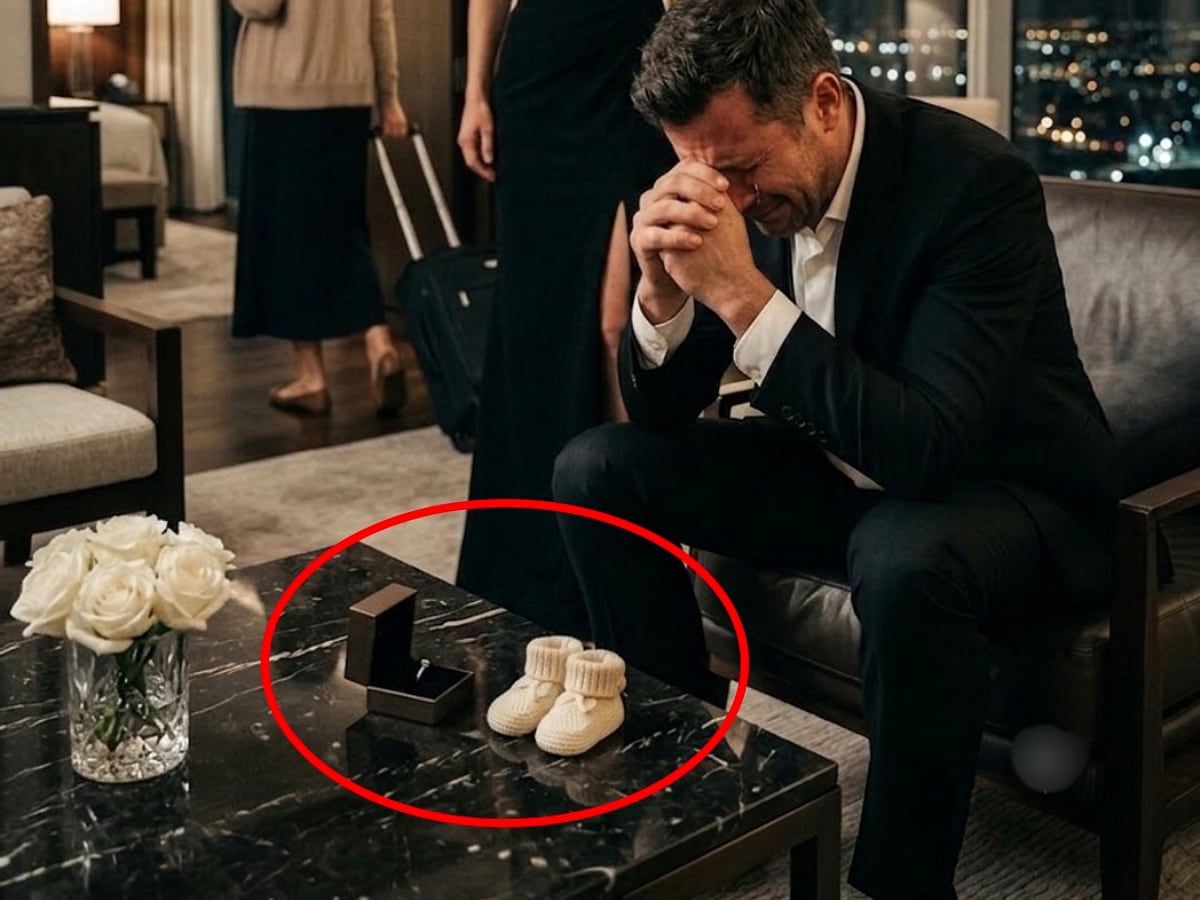
Then she reached into her coat pocket and placed beside it the pair of yellow baby socks she had bought that afternoon at a shop near the hospital. She had planned to show them to Alexander over dinner.
Can you believe his feet will be this small?
Instead, they became the only goodbye she left him.
She took her phone, her driver’s license, her medical folder, and the worn canvas bag her mother had carried for twenty years before she died. She walked out the back door into the rain.
No note. No scene. No final words.
Twenty minutes later, Alexander came downstairs and found the ring, the socks, and the back door still open, rain darkening the kitchen floor. Vanessa stood behind him, fully dressed now, her composure reassembled.
“She’s being dramatic,” Vanessa said.
Alexander picked up the baby socks. He held them for a moment without speaking.
“She’s pregnant,” he said.
He called Sarah’s phone. Voicemail.
Called again. Voicemail.
At 11:43 p.m., Alexander Whitaker — founder of a private equity firm that managed more money than most countries — began making calls to find the wife he had spent the better part of a year ignoring.
By 6:12 a.m., he had contacted four hospitals and filed a missing person report with the Chicago Police Department.
At 6:37 a.m., Vanessa Cole called a contact at an entertainment news outlet.
By 8:00 a.m., three gossip sites were running the same story: Billionaire’s Pregnant Wife Vanishes — Sources Say She Left With Another Man.
The source was Vanessa. The other man did not exist. And Sarah was already somewhere safe — which was the last thing Vanessa had counted on.
Part 2: The Story Vanessa Sold
Alexander found out about the articles the way powerful men usually find out about things they should have anticipated: someone placed a screen in front of him and waited for his face to change.
His security chief did it without a word, setting a tablet on the desk in the home office where Alexander had been sitting in yesterday’s shirt, running searches on hospital admissions and rideshare records. Alexander read the headline once.
Then again. The color left his face in stages.
He could hear Vanessa in the hallway, speaking in the low, measured tone she used when she was managing a narrative. He had admired that quality in her once. It had seemed like competence.
He walked out and stood in front of her until she ended the call.
“What did you do?” he asked.
“I protected you.”
“You told them she left with another man.”
Vanessa’s chin lifted slightly. “I told them she seemed unhappy.
I implied there may have been other factors. I was protecting your reputation before this became a story about a billionaire who—”
“She is missing,” Alexander said. “She is pregnant. And you called a reporter.”
Something shifted in Vanessa’s expression. Not guilt, exactly. More like the recalibration of someone who has misjudged the room.
“She’s hiding,” Vanessa said. “Women like Sarah don’t actually disappear. They want to be found on their own terms.”
Alexander looked at her for a long moment. “You don’t know anything about Sarah.”
He walked back to the kitchen. The ring and the socks were still on the counter.
He had not moved them. He wasn’t sure why — maybe because they felt like evidence of something he wasn’t ready to name yet.
He thought about who Sarah had been when he met her. A pediatric speech therapist at a nonprofit clinic in Pilsen, the kind of woman who sat cross-legged on the floor with four-year-olds for hours and called it the best part of her day.
She drove a car with a cracked dashboard and packed her lunch in a bag with a broken zipper. She had told him once, on their third date, that wealthy people were often just “regular people with better lighting and worse self-awareness.”
He had laughed so hard he’d nearly choked on his wine.
He had pursued her with everything he had — dinners, trips, gestures calibrated to impress. She had been unimpressed by most of it, which made him want her more.
She asked about his father’s failed business in Ohio, about the years he’d spent turning that shame into fuel. She listened without performing admiration.
He had mistaken her steadiness for unconditional acceptance.
After the wedding, the world loved their story. After the pregnancy, Alexander changed — or perhaps the pregnancy simply removed the conditions under which he had been pretending not to.
He worked later. He traveled more.
He told Sarah her worry was excessive, her need for connection was exhausting, her emotions were “a lot right now.” When she asked him to come to appointments, he sent flowers.
When she said she missed him, he said he was doing all of this for her.
Vanessa had arrived during that season, polished and frictionless, full of questions that felt like compliments. Sarah asked if he had eaten.
Vanessa asked what legacy felt like. He chose the easier conversation.
Now Sarah was gone, and Vanessa had handed the press a lie to explain it.
At 2:15 p.m., Detective Laura Medina arrived at the house. She was in her forties, unhurried, with the particular patience of someone who had spent years listening to wealthy people explain why their version of events was the only one that mattered. She interviewed Alexander in the living room with his attorney present and reviewed the hallway security footage without comment.
The footage showed: Sarah arriving at 10:12 p.m. Sarah on the upstairs hallway camera at 10:19 p.m.
Sarah leaving through the rear entrance at 10:27 p.m. Alexander’s first call to Sarah at 11:43 p.m.
— more than an hour later. Vanessa leaving the property at 12:08 a.m.
Detective Medina did not editorialize. She simply asked, “Why did you wait over an hour to call her?”
Alexander had no answer that didn’t condemn him.
“We’ll continue reviewing footage,” the detective said as she stood to leave. “If your wife contacts you, notify us immediately. Do not attempt to manage this privately.”
At 5:04 p.m., his phone rang. Unknown number.
“Mr. Whitaker, this is Dr. Elaine Foster at Northwestern Memorial.”
His chest seized. “Is my wife there?”
“Mrs. Whitaker was seen here last night. She and the baby were stable when she was discharged.”
“Where did she go?”
“I’m not able to share that without her consent.”
“I’m her husband. She’s carrying my child.”
“I understand,” the doctor said, with a gentleness that somehow made everything worse. “She was safe when she left our care.”
The call ended. Alexander sat alone at the kitchen island, staring at the ring and the yellow socks, while Vanessa’s texts accumulated unread on his phone.
Sarah had gone to a hospital instead of to him. That was the sentence he couldn’t stop turning over.
Part 3: The House Ruth Kept Open
Sarah did not run to another man. She ran to a seventy-two-year-old retired nurse in Oak Park who had promised Sarah’s mother, on the day she died, that the door would always be open.
Ruth Donnelly had been Sarah’s mother’s closest friend since their nursing school days in the 1970s. After the cancer took Sarah’s mother five years ago, Ruth had quietly assumed the role of the person who called every Sunday, remembered every hard date on the calendar, and showed up with soup when showing up was the only thing that helped. She lived in a brick bungalow with a bad-tempered cat named Walter and a guest room that smelled like cedar and old quilts.
At 1:06 a.m., Ruth opened her front door and found Sarah on the porch, soaked through, one hand pressed to her belly, unable to speak.
Ruth didn’t ask questions. She brought towels and dry socks and a blood pressure cuff. When Sarah admitted she’d been having cramps, Ruth called Northwestern’s triage line, then drove her to the hospital herself, one hand on the wheel and one eye on Sarah the whole way.
In the car, Sarah cried once. Quietly, the way people cry when they’ve been holding something too heavy for too long and their arms finally give out.
“He brought her into our bed,” she said.
Ruth kept her eyes on the road. “Then right now, the only thing that matters is you and this baby. The marriage can wait its turn.”
At the hospital, Sarah was monitored through the early morning hours. The baby’s heartbeat was strong and steady.
Her blood pressure came down. The cramps eased.
A social worker asked, gently, whether she felt safe at home. Sarah stared at the ceiling for long enough that Ruth answered for her.
“Not tonight,” Ruth said.
Sarah didn’t correct her.
By morning, Sarah had made three decisions. She would not return to the Lincoln Park house.
She would not speak to Alexander without legal representation. And she would not allow a lie about her character to become the official record of her son’s earliest days.
Ruth helped her reach Margaret Hill, a family law attorney who had handled Ruth’s niece’s divorce and who approached billionaires with the same brisk, unimpressed energy she brought to everything else.
“Are you physically safe?” Margaret asked.
“Yes.”
“Baby stable?”
“Yes.”
“Good. Then here’s what we do.”
Margaret walked Sarah through the steps: notify law enforcement through counsel that she was safe without disclosing her location, preserve all communications, make no public statements, document everything. When Ruth opened her laptop and showed Sarah the articles Vanessa had seeded — including the line about Sarah having been “emotionally involved with another man” — Sarah read it twice without speaking.
Then she said, “Screenshot everything.”
Margaret’s voice sharpened with something that sounded almost like approval. “Already on it.”
For the next several days, Sarah stayed inside Ruth’s house while Chicago argued about her on the internet. She slept in pieces.
She ate because Ruth stood over her until she did. She watched rain clear and return.
At night, when the baby shifted and rolled, she whispered to him in the dark.
On the third day, Detective Medina called Margaret and requested a welfare check by video. Sarah agreed. She sat at Ruth’s kitchen table with Margaret beside her and spoke to the detective on a laptop screen.
“Are you being held against your will?”
“No.”
“Do you need emergency assistance?”
“No.”
“Do you want your location shared with your husband?”
Sarah’s hand tightened around her mug. “No.”
“Understood,” Detective Medina said. “That is your right.”
Those four words did something to Sarah that no amount of legal strategy could have done. Not that’s the rule.
Not we’ll pass that along. Your right. Hers.
Not contingent on Alexander’s approval or Vanessa’s narrative or the public’s verdict.
Meanwhile, Vanessa’s story began to unspool. A producer leaked emails in which Vanessa had pitched herself to an entertainment outlet as someone with “inside knowledge” of the Whitaker marriage, and had written: Sarah has likely staged this to punish Alex.
She may have another man helping her. I can speak on background.
When those emails surfaced, the tide turned. The same commenters who had speculated about Sarah’s motives now called Vanessa calculating and cruel. Sarah’s attorney issued a brief statement asking the public not to harass anyone — Sarah had insisted on that line — and then released a single paragraph on Sarah’s behalf:
Sarah Whitaker is safe and receiving appropriate medical care. She did not leave with another man.
She asks for privacy as she focuses on her health and her baby. False claims about her personal life are being addressed through legal channels.
No emotion. No appeal. Just the truth, delivered with a locked door behind it.
That night, Ruth found Sarah in the guest room, folding a pair of yellow baby socks.
“You took them?” Ruth asked.
“I had bought two pairs,” Sarah said. “I left one. I kept one.”
Ruth sat beside her on the edge of the bed.
“I thought leaving them was showing him what he was losing,” Sarah said. “But these ones—” she held them up, small enough to disappear in her palm — “these are a reminder of what I’m keeping.”
Part 4: What Money Cannot Undo
On the fourth day after Sarah left, Alexander stood in the nursery and looked at the mural on the wall.
Sarah had chosen it herself — soft green hills, a tiny painted Chicago skyline in the distance, a sailboat on the lake, a rabbit tucked near the baseboard that you only noticed if you were paying attention. He had approved it between phone calls without really looking. Now he stood in the middle of the room and saw every detail, and understood that he had been present for none of it.
His attorney, James Alden, appeared in the doorway. “We need to talk about Vanessa.”
“I already fired her.”
“Firing her doesn’t close the defamation exposure. Her attorney is claiming she never named Sarah directly and was only offering personal impressions.”
“She lied about my wife to a reporter while my wife was in a hospital.”
“Yes,” James said carefully. “And Sarah’s legal team may have stronger standing on that than we do.”
Alexander turned back to the mural. Sarah’s legal team. A year ago, that phrase would have been inconceivable.
Sarah had been his team. His family.
His home. He had never considered that she might one day need protection from him.
James had brought a printed timeline. Alexander hated it on sight, the way you hate a mirror that shows you something you already knew but had been successfully avoiding.
10:12 p.m. — Sarah arrives home.
10:19 p.m. — Sarah on upstairs hallway camera.
10:27 p.m. — Sarah exits through rear.
11:43 p.m. — Alexander’s first call to Sarah.
12:08 a.m. — Vanessa exits property.
1:14 a.m. — Sarah checks in at Northwestern Memorial.
Seventy-six minutes between Sarah walking out into the rain and Alexander picking up the phone. He had assumed she would come back.
He had assumed her pain had a radius determined by his convenience. He had assumed wrong, and the timeline made sure he could never pretend otherwise.
When Sarah’s attorney sent the formal letter — confirming she was safe, requesting all contact go through counsel, demanding preservation of surveillance footage, warning against further public statements, and arranging medical expense coordination without requiring direct contact — Alexander read it twice and then asked James, “Does she think I would deny her medical care?”
James looked at him with the patience of a man who had watched powerful people ask that question before. “She is documenting expectations,” he said. “Because you let her walk into the rain.”
Alexander had no answer.
He was advised not to be present when Ruth came to collect Sarah’s belongings. For once, he listened.
He stayed in his office while a moving service packed Sarah’s maternity clothes, her journals, her prenatal vitamins, the family photographs, and the baby items she had chosen herself. But when Ruth carried down a framed photo of Sarah’s mother, Alexander was standing in the hallway.
Ruth stopped. She looked at him.
“She loved you,” Ruth said.
His throat tightened. “I love her.”
Ruth’s expression didn’t soften. “Love that only shows up when it’s convenient isn’t much protection.”
She continued down the stairs. That sentence followed him for days in a way that no legal document had.
Margaret eventually agreed to allow Alexander to send a written letter, reviewed by counsel. Sarah did not promise to read it. She simply allowed it to be delivered.
Alexander spent most of a day writing and deleting. He deleted every sentence that began with context or pressure or explanation.
He deleted every line that mentioned Vanessa as though she had been something that happened to him rather than something he had chosen. What remained, finally, was plain:
What I did was a betrayal. Bringing Vanessa into our home, into our bedroom, while you were carrying our son, was cruel.
Letting you walk out into the rain was a failure. Not calling sooner was another.
I will cover every expense without requiring contact. I will receive updates only as you permit.
I love you, but I understand that love is not a claim on you. If there is any version of a father I can still become worthy of being, I will start by respecting the mother of my child.
James read the final draft and said, “No edits.”
Sarah received it at Ruth’s kitchen table. She read it once, set it beside her tea, and looked out the window at the gray November sky.
After a long silence, she said, “This is the first time he’s sounded like a person instead of a press release.”
“Does it change anything?” Ruth asked.
Sarah touched her belly. Her son moved slowly beneath her hand, a long unhurried roll.
“Yes,” she said. “But not enough.”
Part 5: What Sarah Chose
Sarah filed for legal separation before she filed for divorce. That surprised the press, which had been waiting for the dramatic filing. It did not surprise Ruth or Margaret.
Separation gave Sarah what she needed most: time, financial protection, medical security, and legal structure — without requiring her to make permanent decisions about the shape of her life while she was still waking at three in the morning with her heart pounding and her son pressing against her ribs. It allowed temporary orders for support, privacy, and future parenting arrangements.
It was not a retreat. It was a foundation.
Alexander signed the temporary agreement without contest. He moved into a condo at the St.
Regis and left the Lincoln Park house to the staff. He also had the bedroom furniture removed.
Not as a gesture. He simply could not be in that room anymore.
Vanessa made one final attempt at rehabilitation, appearing on a morning segment to say she had been “unfairly blamed for a marriage that was already broken.” It did not land.
The emails had been seen. The timeline had been published.
The public had watched Sarah’s quiet dignity hold through weeks of speculation, and they had made up their minds. Vanessa lost consulting contracts.
Alexander’s foundation removed her from its advisory network. She sent Sarah a letter through attorneys expressing regret for “any pain caused by the situation.”
Sarah did not respond. Some apologies are written to reduce liability. She was no longer available to absorb them.
In December, during the first real snow of the season, Sarah gave birth at Northwestern Memorial. She named him Henry Grant Whitaker.
Henry because it had been her mother’s favorite name. Grant because Ruth said every boy needed a middle name that could belong to either a federal judge or a minor league outfielder.
Alexander was not in the delivery room. That was Sarah’s choice, and he accepted it. He waited down the hall in a family room with James, while Margaret and Ruth managed the logistics of a situation that would have seemed absurd to describe a year earlier.
Three hours after Henry was born, Ruth came to get him.
He stood so fast his coffee tipped.
“Is she okay?” he asked.
Ruth studied him for a moment. “She’s tired.
The baby is healthy. You have ten minutes.
You will not discuss the marriage. You will not touch her unless she offers.
You will thank her. Then you will leave.”
He nodded.
When he entered the room, Sarah was sitting up in bed with Henry bundled against her chest, her hair loose, her face pale and exhausted and more real than any version of her he had ever seen at a gala or a magazine shoot or a charity dinner where they had both performed the role of a perfect couple.
Alexander stopped near the door.
“This is Henry,” Sarah said.
Something in his face gave way — not loudly, not dramatically, just a quiet collapse of the pride that had kept him at a careful distance from every honest thing for years.
“He’s beautiful,” Alexander said.
He came closer only after she nodded. Henry’s face was red and new, his mouth working in sleep. Alexander looked at him and thought of yellow socks on a marble counter, and understood for the first time what he had nearly lost.
“Thank you,” he said.
“For what?”
“For keeping him safe when I didn’t keep you safe.”
Sarah’s eyes filled. Her voice stayed level. “You don’t get forgiven just because you finally found the right sentence.”
“I know.”
“But you can start there.”
His ten minutes ended. He left when Ruth told him to. That was when Sarah first believed something might genuinely be shifting in him — not because he cried, but because he obeyed a boundary that cost him something.
The months that followed were structured and slow. Alexander saw Henry on a supervised schedule, first at Ruth’s house, then at a neutral family center, then eventually at his condo with a parenting coach present.
He learned bottle temperatures by trial and error. He changed diapers badly.
He discovered that infants are magnificently indifferent to net worth, and that Henry screamed at him with the same democratic fury he directed at everyone else.
Sarah found that deeply satisfying.
She moved into a townhouse in Evanston, close enough to the lake that she could walk Henry in his stroller on gray mornings and feel her lungs open. The lease was in her name.
The furniture was hers. The locks were hers.
Those things mattered in ways she hadn’t fully understood until she had them.
At night, after Henry slept, she wrote. Not for publication. Just notes to herself, so the story would not be rewritten by people with louder voices and different agendas.
I left because betrayal walked into my home and called me dramatic for noticing. I left because my son deserved a mother who knew when to protect peace. I left because love without safety is only a beautiful trap.
By spring, the separation became a divorce filing. Alexander did not contest the grounds.
The settlement took months, but when it was done, Sarah had financial security, parenting rights, medical autonomy, and the freedom to rebuild her life without asking permission. Alexander had parenting time, financial obligations, and the permanent knowledge that the family he had wanted was one he had broken himself.
On the anniversary of the night she disappeared, Sarah returned to the Lincoln Park house one last time. Alexander was selling it. Ruth came with her, carrying Henry on her hip.
The house was empty. No candles, no roses, no wedding photo on the landing.
Sarah walked into the kitchen and stood at the marble island in the afternoon light. She could see herself there — soaked coat, steady hands, the ring placed down with the careful deliberateness of someone who has made a decision they will not take back.
She had thought she was leaving everything that night.
She had been taking herself back.
Alexander was near the doorway, hands in his coat pockets. He placed a small box on the counter. Inside were her wedding ring and the pair of yellow socks she had left behind.
“I kept them,” he said. “Not because I thought they were mine. Because I needed to remember what I was capable of losing.”
Sarah looked at the ring for a moment. Once it had felt like proof she was chosen. Now it was just a beautiful object attached to an old wound.
“Keep the ring,” she said.
He nodded.
“And the socks?”
Sarah picked them up. Henry, ten months old and grabbing at everything, reached for them immediately. Sarah smiled and let him hold one.
“These come with us,” she said.
Alexander’s eyes shone. He did not ask her to stay. That was how she knew he finally understood at least part of it.
Outside, Chicago was cold and bright, lake wind moving through the bare trees. Ruth buckled Henry into his seat while Sarah stood for a moment on the sidewalk. Alexander walked her to the gate.
“I’m sorry,” he said.
“I know.”
“I’ll be sorry for the rest of my life.”
Sarah looked at him. “That’s your work,” she said. “Not mine.”
He accepted that. She got into the car.
As Ruth pulled away from the curb, Sarah looked back once at the house where she had vanished from one life and quietly entered another. The world had called her missing, unstable, dramatic, unfaithful.
Vanessa had tried to turn her pain into a headline. Alexander had tried, too late, to turn regret into repair.
But Sarah knew the truth of it.
She had not disappeared because she was weak. She had disappeared because she finally understood that staying visible in the wrong place can erase you slowly, without anyone ever raising their voice.
She walked into the rain because the house behind her was colder than the storm.
And when morning came and Alexander searched hospitals and camera feeds and police reports for the wife he had lost, Sarah was never truly lost at all.
For the first time in years, she knew exactly where she was.
Names and identifying details in this story have been changed. This is a dramatized account shared for entertainment and reflection, and any resemblance to real people is coincidental.
