Part 1: The Buzzing Phone
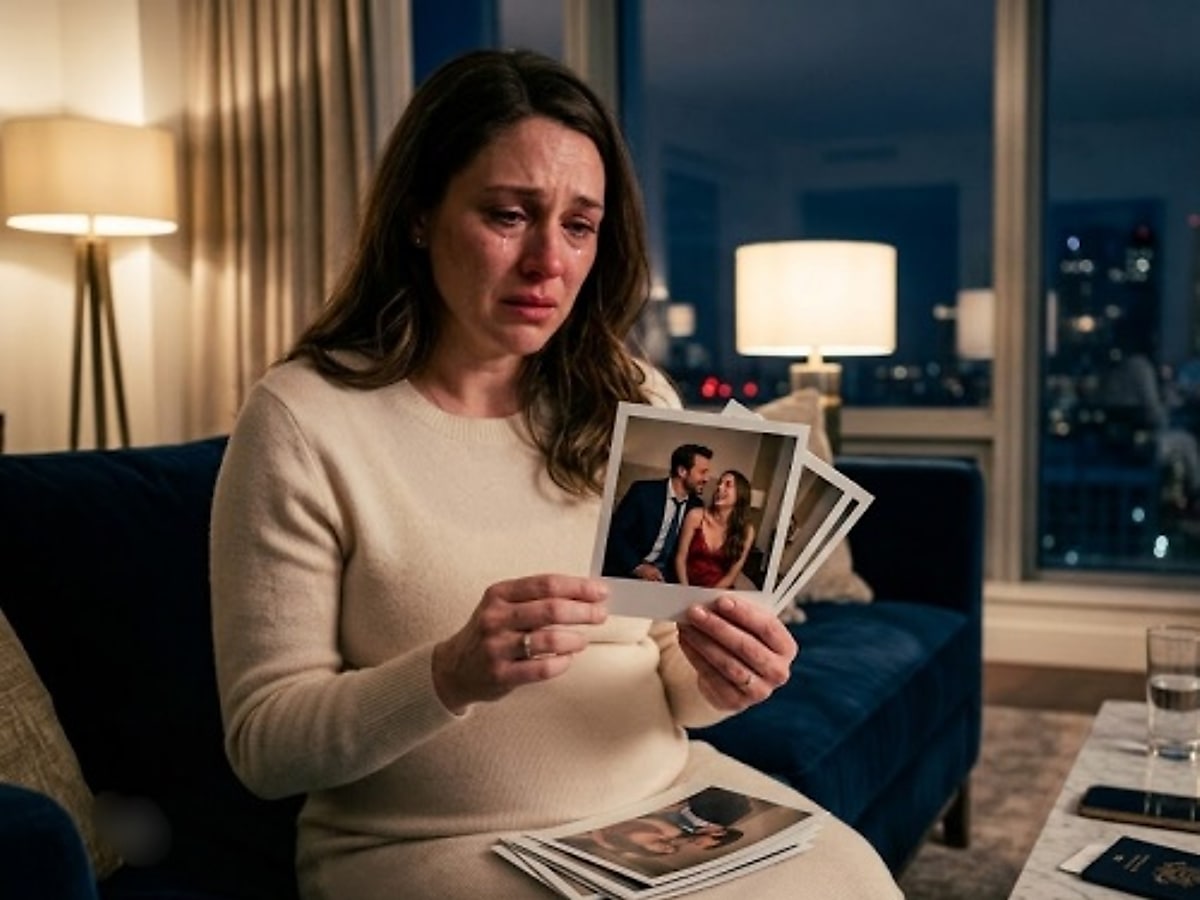
I was eight months pregnant the night I learned my husband was still in love with another woman.
Not suspected.
Not wondered.
Learned.
The evidence sat glowing in his phone on the nightstand, inside a Greenwich, Connecticut mansion that always felt more like a museum exhibit than a home built for two people.
My name is Emma Whitfield, and I was thirty-two years old that night, standing barefoot on cold marble, holding a phone in one hand and the wreckage of my marriage in the other.
Alexander Whitfield was exactly the man everyone told me I’d been lucky to catch.
Old family money, a private equity job in Manhattan, closets full of navy suits that all looked identical to me, and a surname stamped onto donor plaques across half of New York City.
He was handsome in a controlled, practiced way, the kind of man mothers approve of instantly.
But under all of it, something in him stayed locked away, no matter how close I tried to get.
We met years earlier at a benefit dinner in the city, back when I worked event coordination for a small nonprofit arts group.
He was quiet at his table, but when he finally spoke to me, his focus felt like a spotlight, and I mistook that intensity for closeness.
White flowers arrived the next morning.
Dinners followed.
Weekend trips followed those.
Then came a ring so large my sister Maggie joked it needed its own zip code.
Everyone around me celebrated.
My mother cried at the sight of the diamond.
I let myself believe in the fairy tale too, because loneliness can dress luxury up as love if it shows up polite enough.
Alexander never raised his voice or embarrassed me at a party.
He never cheated in any obvious way I could point to.
He simply withheld the deepest parts of himself, and I spent four years trying to become soft enough, patient enough, or eventually pregnant enough to be let inside.
That’s when I found the name attached to the door he kept locked.
Victoria Hale.
I already knew about her before the wedding, since everyone in his circle knew.
She and Alexander had been together nearly six years, all the way from college into their late twenties, and people used to assume marriage was inevitable for them.
Then she left, supposedly wanting a different life, though the rumor floating around was that she’d fallen for a photographer and moved to Paris for a year.
By the time Alexander and I got serious, he called her ancient history, and I believed him because I needed the story to be that simple.
Whenever her name surfaced at dinner parties, though, he went still in a way that unsettled me more than sadness would have.
It looked closer to reverence.
Once, early on, I asked him outright if he still loved her.
He looked annoyed, not guilty, and told me he’d married me, as if that answered the actual question.
It didn’t, but I swallowed it anyway because his ring already sat on my finger.
Pregnancy convinced me our daughter would rewrite everything between us.
Looking back, that hope seems naive, but at the time it felt like the most human thing in the world.
I pictured him softening at every kick, reading baby books, worrying about strollers, becoming a different kind of man once fatherhood arrived.
Instead he vanished further into his office, staying later in the city, taking calls behind closed doors, coming home smelling like rain and expensive scotch.
He showed up to appointments when his calendar allowed, then expected credit simply for appearing.
When the ultrasound revealed a girl, I cried, and he offered a polite smile, saying only, a daughter, like he was confirming a shipment.
I named her privately before we even left the parking garage.
Lila Rose.
He wanted to wait on names.
I didn’t wait.
By my eighth month, I was swollen, uncomfortable, and living inside a house that echoed with every footstep. The nursery had been designed to perfection by someone else, cream wallpaper dotted with gold stars, a crib nobody had rocked a baby in yet, shelves arranged for symmetry instead of comfort.
At night, standing there, I used to whisper to my belly that it wouldn’t feel this heavy forever.
I meant the pregnancy.
I had no idea I also meant the marriage.
The night it all cracked open started, predictably, with a donor dinner in Manhattan.
I stayed home with a sore back, following doctor’s orders to avoid stress.
Alexander returned after midnight, loosened his tie by the door, kissed my forehead, and said only, you’re still awake, as if that were the strange part of the evening.
Not how are you.
Not did she move today.
I told him sleep wasn’t coming easily, and he nodded like it was a minor inconvenience before heading to shower.
Within minutes of lying down, he was asleep.
At 1:17 a.m., his phone buzzed on the nightstand.
Then again.
Then a third time.
I told myself to leave it alone, since checking someone’s phone had never been my habit, though I now wonder if that restraint was ever really pride at all.
The fourth buzz shifted him just enough that the phone slid off the edge onto the rug.
I reached down and picked it up.
The screen lit with a name I recognized instantly.
Victoria.
My chest locked.
The preview read that the night had felt like old times, and that she shouldn’t have let him kiss her.
For a moment the whole room seemed to disappear except for the phone, my heartbeat, and the small, insistent movement of my daughter inside me.
I looked over at Alexander, sleeping peacefully, as though betrayal required no effort from him at all.
I should have shaken him awake and demanded an explanation right then.
Instead I typed in the passcode I already knew, since he reused it everywhere, the month and day tied to his mother’s birthday.
The screen opened, and a long thread with Victoria stretched back for months.
At first I scrolled hoping to be proven wrong.
A coffee meeting.
A shared memory.
A joke referencing Martha’s Vineyard.
A photo from somewhere in SoHo.
The older messages gave way to newer ones, and the tone shifted from friendly to intimate fast.
He’d written that he often wondered what life would look like if she’d never left.
She’d written back that he was the only person who had known her before everything changed.
Another message from her said Emma’s due date was close and that this was wrong.
His reply said he knew, but that he couldn’t pretend he didn’t feel alive around her.
I pressed a hand over my mouth.
There were photos too, nothing explicit, which somehow made it worse.
His palm resting against her waist outside a hotel entrance.
Her head tilted against his shoulder in the back seat of a car.
A rooftop selfie where his smile looked younger than anything he’d given me in years.
Then a picture from that very night, Victoria in black, his hand at the small of her back, his mouth near her temple.
Underneath it she had written that they always fit, and that this was the problem.
Sitting on the edge of our bed, eight months pregnant, I finally understood something I’d been avoiding for years.
I wasn’t his wife so much as his recovery plan, the acceptable choice who arrived after heartbreak and made him look healed to everyone watching.
Lila kicked hard right then, and I rested my hand over the spot.
Something shifted inside me, quiet and cold and completely clear.
I could survive being loved second.
But I refused to raise a daughter inside a house where she’d learn that being someone’s leftover choice was still worth gratitude.
I stood slowly, every part of my body aching, but I moved anyway.
I photographed the screen, sent the images to my own email, deleted the outgoing message from his phone, and set it back on the rug exactly where it had fallen.
Then I walked into our closet, bigger than my old apartment, rows of designer bags his friends’ wives always recognized on sight.
I pulled a suitcase down and packed only what mattered, comfortable clothing, my prenatal records, vitamins, passport, laptop, a folder of personal papers, and the small silver bracelet my grandmother had given me.
I also grabbed cash from an emergency envelope Maggie had once insisted I keep, because, as she’d said, even rich men act like men sometimes.
I left behind every piece of jewelry that hadn’t been mine before the wedding, along with anything from his family that could later be used to paint me as unstable.
At 2:06 a.m., I called Maggie in Austin, Texas.
She answered on the second ring, immediately alert, asking whether it was the baby.
I told her no, that I needed to leave that night, and she didn’t waste time asking why.
She only asked if I was safe, if I needed the police, and whether I needed a flight, before promising to book me first class if she had to sell her car to manage it.
I told her I could pay, and she said that wasn’t the point.
Within half an hour, a car was scheduled toward LaGuardia Airport, a seat was held on the earliest flight to Austin, and my doctor’s after-hours line had confirmed I could safely travel as long as I hydrated, stayed mobile, and watched for warning signs.
Before leaving, I stood once more in the nursery under a strip of moonlight.
I told my daughter I was sorry, then corrected myself immediately.
I wasn’t sorry.
I was getting her out.
At 3:14 a.m., I walked down that grand staircase wearing leggings, sneakers, and Alexander’s old Yale sweatshirt, dragging a suitcase behind me through a silence only money could buy.
I set my wedding ring on the marble entry table and left a short note beside it.
Eight words, nothing more.
I know about Victoria. Do not call me.
Then I stepped into the cold Connecticut night, one hand resting protectively over my belly, and did not look back once toward that house.
Part 2: Landing Somewhere New
Alexander started calling before my plane even left the runway.
The first call landed at 5:42 a.m., while I sat near my gate with swollen ankles, a paper cup of ginger tea going cold, and a suitcase pulled close like a shield.
I watched his name flash and let it ring out.
More calls came.
More texts followed right behind them.
He wanted to know where I was, called it dangerous given my condition, and demanded to know what I’d done, which nearly made me laugh out loud in the terminal.
What had I done?
I had left, and somehow that single fact seemed to shock him more than anything on his own phone had shocked me hours earlier.
He never texted an apology.
He never asked if I was okay.
His messages read like a man reporting stolen property.
I silenced the notifications and called my old friend from the nonprofit world, Rachel Stein, now a family law attorney in New York.
She picked up half asleep but alert enough the second she heard my voice.
I told her simply that I had left Alexander, and she said, immediately, good.
Then I gave her the short version, the messages, the photos, Victoria, the note, the flight already in motion.
She listened without cutting in once.
Once I finished, she switched fully into lawyer mode, first confirming I was medically fine, then instructing me to see an OB in Austin right away and document that my departure was about safety, not disappearance.
She warned me not to cut off contact completely, since he could later claim I’d hidden the baby from him, but told me to keep every exchange in writing from that point forward.
I asked if I was even allowed to leave the state while pregnant, and she explained that since the baby hadn’t been born yet, there was no custody order to violate, though things could get complicated fast once Lila arrived depending on where everyone ended up living.
She warned me plainly that Alexander would likely escalate once his sense of control started slipping.
Maggie echoed something close to the same warning once I landed in Austin.
She stood waiting at baggage claim in cowboy boots and a sweatshirt reading TEXAS WOMEN DON’T RUN, THEY RELOAD, which was almost comical given that Maggie once cried after accidentally stepping on a beetle.
The moment she saw my face, hers crumpled too.
I held together until her arms wrapped around me, and then I completely fell apart.
A stranger near the luggage carousel pretended very hard not to notice.
Maggie just held on and reminded me that I was there, and Lila was there, and that was what mattered.
She drove me straight to her cluttered, warm bungalow in South Austin, dog hair on every cushion, a guest room already stacked with extra pillows for my back.
Compared to Alexander’s mansion, her house was tiny.
Compared to that mansion, it felt like the first real breath I’d taken in years.
Within two hours she had booked an OB appointment, made scrambled eggs, washed my travel clothes, and threatened, only half joking, to answer Alexander’s calls using a fake British accent.
I told her not to, though barely.
At 1:15 p.m., I sent Alexander exactly the message Rachel had suggested.
I told him I was safe, the baby was moving, I needed space, and that future communication needed to happen in writing.
His response came almost instantly, demanding my location.
I didn’t answer that one, and when he wrote that I couldn’t simply vanish with his child, I noticed the wording immediately.
His child.
Not our daughter.
Not are you all right.
I wrote back that I would share necessary medical updates and nothing further for now, then forwarded the whole exchange to Rachel, who told me plainly not to take the bait.
By evening, he’d already called my mother in New Jersey, who called Maggie first because she knew I wouldn’t pick up if she came in hot.
Maggie put her on speaker so I could hear everything directly.
My mother said Alexander sounded frantic, pointed out I was eight months pregnant and had left in the middle of the night, and asked what on earth had happened.
I told her flatly that he was involved with Victoria Hale.
Silence stretched on the line before she asked, more gently, if I was sure.
I asked her, in my head, why anyone questions certainty in a voice that already sounds like wreckage, then simply said yes.
She said, oh honey, and that single response cracked something open in me all over again, not because it fixed anything, but because she believed me instantly.
She never told me to think of the baby or go home or excuse his behavior as a simple mistake.
She only asked what I needed.
What I needed, really, was an entirely new life, though that felt far too large to say over speakerphone, so instead I asked her not to tell him where I was yet.
She agreed without hesitation, adding that if he pressured her, she’d let him, since thirty-five years of teaching kindergarten had left her unafraid of any man in an expensive suit.
The following weeks blurred together through OB visits, legal calls, aching feet, and Alexander’s messages swinging wildly between fury, apology, blame, and panic.
He insisted Victoria meant nothing, claimed I’d misread everything, told me to come home so we could talk like adults, warned that my behavior looked reckless to his lawyers, and eventually simply wrote that he loved me.
That last message stopped me cold for a long while.
I cried, not because I believed him, but because for years I had wanted so badly to hear it under any circumstances at all.
I decided love arriving only after consequences didn’t count as love, and repeated that to myself like a rule I refused to break again.
Maggie wrote the same line on a sticky note and stuck it to her bathroom mirror, and every morning I read it while brushing my teeth over a belly too big to comfortably reach the sink.
About ten days after I left, Alexander flew down to Austin himself.
I never learned exactly how he tracked the city, whether through flight records or a careless slip from someone close to me, though Maggie’s house was hardly a mystery given how obvious a destination it was.
He didn’t have her address, but he sent flowers to nearly every hospital system in the city with instructions to alert him if I appeared.
Rachel was furious when she heard, and Maggie was even angrier.
My OB’s office flagged my chart for privacy, and I learned an entirely new vocabulary of protections meant to shield expecting mothers from exactly this kind of pursuit.
He texted that he was in Austin and had no plans to leave until he saw me, and I replied that he wasn’t to appear at appointments or Maggie’s home, and that any further contact should go through attorneys.
He answered that he’d made a mistake, that I was still his wife, that Lila was still his daughter, and that I had no right to shut him out entirely.
Part of me wanted to answer every wound at once.
Instead I said nothing, and Rachel filed what needed filing, including a divorce petition coordinated carefully across two states due to residency questions.
None of it moved simply.
Marriage, pregnancy, assets, jurisdiction, and future custody all turned into one long maze of paperwork and strategy, but emotionally, at least, one fact stayed unshakable.
I wasn’t returning to that mansion.
Three weeks after landing in Texas, contractions woke me at 4:30 a.m.
At first I assumed it was a false alarm, until my water broke in Maggie’s hallway while her rescue dog Pickle stared at me like I’d personally ruined his entire morning.
Maggie panicked for a handful of seconds before switching instantly into command mode, listing towels, bags, shoes, and reminding me firmly not to deliver on her hardwood floors.
At the hospital, a nurse asked whether the baby’s father would be joining us.
My voice shook as I said no, and Maggie squeezed my hand while the nurse simply nodded, the way someone does after hearing a story she’s heard in different shapes before.
She promised we’d be well taken care of.
Labor stretched across eighteen hours, pain unlike anything language really covers, though strangely it also felt like the first honest thing my body had experienced in months, no guessing, only breath and monitors and Maggie’s voice beside me.
At 11:46 p.m., our daughter arrived, six pounds, eleven ounces, dark hair, furious lungs, absolutely perfect.
The moment they placed her against my chest, I said her name before anyone thought to ask.
Lila Rose.
For half a second she stopped crying at the sound of my voice, and though I know newborns don’t understand language yet, I will always believe she recognized me anyway.
Maggie cut the cord, then cried so hard a nurse handed her tissues and told her, quite seriously, good job, auntie.
The next morning I sent Alexander a single message through counsel, letting him know his daughter had arrived safely, that her name was Lila Rose, and that further contact should run through attorneys.
He replied directly anyway, saying I’d had his child without him.
I looked down at Lila sleeping in her clear bassinet, tiny fists curled near her face, and typed a response about giving birth safely surrounded by people who genuinely cared for me.
I never sent it.
I forwarded his message straight to Rachel instead, then picked my daughter up and held her close while sunlight poured into the Austin hospital room.
For the first time in months, something close to peace settled over me.
Not happiness yet.
Just peace, small but real, and enough to begin building on.
Part 3: Learning to Stand on My Own
Alexander showed up at the hospital carrying roses.
Not at my bedside, though.
He was stopped at the front desk since his name wasn’t on my visitor list, and I only heard about it afterward from a nurse who called him polite but persistent.
That description fit him perfectly.
The flowers were white peonies, the exact bloom he’d sent after the night we first met.
When a hospital volunteer brought the arrangement to my room, I stared at it for a long stretch before asking if another patient on the floor might want it instead.
The nurse looked at me once, understood completely, and said she’d handle it.
Maggie watched from a chair beside my bed, Lila asleep in her arms, and asked quietly if I was okay.
I told her no, and she called that a solid answer.
I admitted I thought his arrival would break something loose in me, and she pointed out that it had, just not in the way either of us expected.
What I actually felt, mostly, was exhaustion.
I was simply too tired to stage heartbreak for his benefit anymore, and that exhaustion became the theme of my entire first year as Lila’s mother.
Too tired to wonder if he missed me.
Too tired to decode his texts.
Too tired to worry about his mother’s opinions or feel embarrassed about raising a newborn out of my sister’s guest room while his mansion sat silent.
Newborns, it turns out, are relentless little healers who refuse to let you stay collapsed for long.
Lila needed feeding, changing, rocking, and appointments, and none of that waited for my grief to finish, so I simply kept moving forward for her sake.
Word of the divorce spread quietly through wealthy circles the way these things usually do, whispered at lunch tables instead of printed anywhere.
Alexander’s family stayed publicly silent, though his mother, Eleanor Whitfield, sent me an email I still remember word for word.
She wrote that depriving Alexander of witnessing his first child’s birth had been needlessly cruel, that a daughter deserved her father’s presence and protection, and that she hoped I’d reconsider before doing lasting damage.
I read it at 3:00 a.m. while pumping and crying because everything hurt and Lila had finally, mercifully, fallen asleep after hours of screaming.
I almost answered her directly, but Maggie took the phone right out of my hand.
I told her Eleanor thought I was cruel, and Maggie reminded me that Eleanor had raised Alexander, so her judgment already carried a giant asterisk.
Rachel advised against any direct reply, so we responded through counsel instead, using language full of respectful communication and appropriate channels, phrases wealthy people apparently dislike because they can’t argue with punctuation.
Alexander pursued parenting time immediately, and legally he did have standing to pursue it.
He had betrayed me, yes, but I promised myself early on that Lila would never become a weapon in that fight.
With guidance from doctors and lawyers, we arranged brief supervised visits once I’d recovered enough, not out of trust, but because I wanted every choice I made to hold up eventually in court and, more importantly, in my daughter’s future understanding of me.
Lila was six weeks old the first time Alexander held her, inside a neutral visitation room with Maggie beside me and a supervisor present.
He arrived in a gray sweater, wearing the expression of someone attending the funeral of his own self-image.
When he saw Lila, something in his face genuinely gave way.
He whispered that she was so small, asked to hold her, and once the supervisor nodded, I placed her carefully in his arms.
He fumbled at first, then steadied, and Lila blinked up at him, entirely unimpressed by generational wealth.
He said she had my mouth, and I told him she had herself.
Looking at me then, really looking, he saw someone in leggings, no makeup, hair pulled back, heavier than before, exhausted, and stronger than I’d ever been.
He apologized quietly, without any theater to it, and I told him I knew.
He asked if it mattered, and I said it mattered for the man he’d become, but nothing about it undid what he had already done.
He flinched at that, and honestly, I let him.
Over the following year, Alexander flew down under our temporary arrangement, first twice a month, then according to a more structured custody plan as the divorce moved forward. He wanted Lila eventually settled in Connecticut, while I wanted stability for her here.
The court wanted evidence, plain and simple, so I provided every record I had.
Medical files, communication logs, travel documentation, proof I had never hidden her or acted recklessly with her wellbeing.
His attorneys tried painting my departure as impulsive and reckless.
Rachel answered with the affair evidence, my medical consultations, my support system, and confirmation that Lila’s birth had been handled safely from start to finish.
The final agreement wasn’t a clean victory for either of us, since family court rarely offers those, but it kept Lila’s primary home with me in Texas, granting Alexander increasing time as she grew, along with structured travel and communication requirements.
He resented it at first, then eventually accepted it.
Money became its own separate fight entirely, and while he had more of it, I hadn’t married him for nothing, nor was I willing to walk away from motherhood with empty hands.
The settlement stayed private but fair enough to help me stand on my own instead of leaning on Maggie forever.
I moved into a small house in Tarrytown near downtown Austin, three bedrooms, a fenced yard, a porch that creaked in a way I actually liked.
It looked nothing like the mansion.
It felt exactly like home.
Work slowly returned to my life too.
Part time event consulting turned, over time, into a small business I named Rose & Rail Events, borrowing from Lila’s middle name and the old railway tracks nearby where she loved watching freight trains roll past.
Nothing about it grew overnight, since genuine rebuilding rarely does, but referrals and long nights and careful budgeting eventually built something solid.
I planned charity lunches, museum openings, weddings under live oak trees, and even one memorable dog rescue fundraiser where a Labrador ate part of someone’s pledge card.
I’d always been good at this work.
The difference now was that the success belonged fully to me.
Lila grew into a funny, watchful toddler with dark curls and serious brown eyes, obsessed with blueberries, sidewalk chalk, and saying no thank you with devastating politeness.
Alexander kept his scheduled calls and visits, often bringing gifts far too extravagant for a toddler, a crystal music box for her first birthday, a coat she outgrew before Texas ever produced weather cold enough to justify it, and a tiny gold bracelet I tucked away rather than risk on a child covered in finger paint.
Still, he tried, and I’ll give him that much credit.
He learned her favorite books, discovered she hated peas, stopped scheduling calls during nap time, and eventually learned to write through our co-parenting app without folding apologies into every single message.
Victoria didn’t last, unsurprisingly.
Rachel later heard, secondhand through someone in Manhattan, that Alexander and Victoria tried building something together after I left, only for it to fall apart within months.
Old memories, it turns out, are easier to love than the daily reality of sharing a life with someone.
When Alexander told me himself, nearly a year after Lila was born, I felt no satisfaction at all.
Only a quiet kind of sadness, realizing our marriage hadn’t been destroyed for some grand love story, but for a memory he’d never fully let go of.
During one video call when Lila was eighteen months old, he asked if we could talk once she went to bed, and I agreed.
His face on the screen looked thinner than I remembered.
He admitted he’d once believed he loved Victoria, or maybe he really had, years earlier, but that when she came back, what he’d actually loved was who he used to be before expectations piled up, before the firm, before his father’s death, before everything felt assigned to him.
He acknowledged that didn’t excuse anything, and I agreed.
He said he hadn’t realized how empty the house felt until I left it.
I asked if he’d truly not noticed while I was still living inside it, and he admitted, quietly, that might have been the whole problem.
That honesty landed softly, not enough to bring love back, but enough to mark where it had died.
I told him I hoped he’d grow into a better man for Lila’s sake, and when he asked about my sake, I told him plainly that I no longer needed him to become anything for me at all.
He closed his eyes at that, and I understood, right then, that I was finally free, not legally, since that had already happened, but somewhere deeper than paperwork could reach.
Part 4: The Man Who Waited to Be Asked
I met Noah Bennett because a bride’s original florist backed out twelve days before her wedding.
Not the Noah tied to my past, obviously, but a patient, sun weathered florist who ran a small studio in Austin called Bennett Blooms, a name he joked made him sound like a lonely orphan carrying a watering can.
At thirty-seven, widowed, and helping raise his teenage niece part time, he drove an old Ford truck, wore denim shirts, and could apparently identify flowers by scent alone, which I found suspiciously endearing.
The bride was in a full panic, and after calling every florist in the city, Noah was the only one willing to say he couldn’t promise miracles, only that he wouldn’t make anything worse.
I decided immediately that was my favorite kind of person to work with.
He arrived at the venue sleeves rolled up, hands rough from years of work, radiating a calm that spread through the room like shade on a hot day.
When the bride’s mother started crying over centerpieces, he simply handed her a tissue and told her he’d seen flowers recover from far worse, and marriages survive plenty less.
She laughed, the crisis dissolved, and afterward I sent him a short thank you email.
He wrote back that my timeline document was terrifying and beautiful in equal measure, and I smiled at my laptop like a complete fool.
For months we stayed strictly professional, then friendly, then something quietly more than that.
He already knew I had a daughter, since Lila occasionally appeared on video calls wearing fairy wings while demanding crackers, and Austin’s event world isn’t exactly discreet about anyone’s personal life.
He never pushed for details, waiting instead until I offered them myself, sitting outside a coffee shop on South Congress after a venue walkthrough.
I gave him the short version, the affair, the flight, the divorce, my daughter.
He listened without interrupting once, and when I finished, he didn’t say what people usually said.
He never claimed he’d never behave that way, never called Alexander an idiot, never told me how strong I was in that tone people use when they want your pain wrapped up quickly.
He simply said that must have been lonely, and I looked away because my eyes filled instantly.
I told him yes, and he said he was sorry, and I thanked him, and then he gently shifted the conversation, not out of indifference, but because he sensed I didn’t want to live inside that wound all afternoon.
That was Noah completely.
He never forced doors open.
He waited until he was invited in.
Our first real date was tacos from a food truck and a slow walk around Lady Bird Lake.
I wore jeans and worried privately that my life was far too complicated for anyone new, while he wore boots and looked nervous asking if he could hold my hand.
I laughed, not at him, but at the simple kindness of someone actually asking first.
I told him yes, and he held my hand like it meant something, never like a claim staked on me.
Lila met him slowly, deliberately slowly, because I’d already learned hope should never outrun a child’s need to feel safe.
At first he was Mr. Bennett from the flower place.
Then Mommy’s friend Noah.
Eventually, simply, Noah.
He never tried buying her affection with grand gestures, choosing instead to sit on the floor accepting wooden blocks she handed him, reading the same picture book four times without skipping a page, and taking imaginary tea from tiny cups very seriously, insisting it needed more lemon.
Lila adored him long before I ever admitted, even to myself, that I loved him too.
One afternoon, when she was two and a half, she climbed into his lap during a backyard barbecue and fell asleep against his chest, and Noah froze completely still, eyes wide, as though something rare had landed on him by accident.
I whispered that he could breathe, and he whispered back that he didn’t want to ruin it.
That was the moment I knew.
Not because he loved me, but because he understood exactly how much weight came with being trusted by my daughter.
Alexander eventually noticed Noah’s presence.
During one custody exchange, Noah stayed inside the house to avoid unnecessary tension, but Alexander clocked his truck parked in the driveway anyway.
He asked who was there, and when I said a friend, his tone sharpened, asking pointedly if it was a male friend.
I told him plainly that he no longer got to use that tone with me.
He looked embarrassed, then irritated at feeling embarrassed, and asked if this person spent time around Lila.
I said, when appropriate, yes, and he insisted he had a right to know who surrounded his daughter.
I told him he’d receive relevant details through our parenting app, and that he didn’t get to interrogate me on my own driveway.
Right then Lila called from the porch that she had stickers, and Alexander’s whole face softened instantly.
He wasn’t a monster, which honestly would have simplified everything.
He was a man who loved his daughter deeply while having wounded her mother badly, and both truths sat there permanently, inconvenient as they were.
Later he messaged asking for Noah’s full name, occupation, and whether he had any criminal history.
I provided the reasonable basics, and Noah joked he could send references, since his fifth grade teacher had apparently liked him quite a bit.
I told him not to tempt fate, and he pointed out, fairly, that Alexander was still Lila’s father, entitled to some worry.
Over the following year, Noah folded naturally into our daily life, Sunday pancakes, farmers market mornings, short truck rides where Lila waved out the window like visiting royalty, movie nights, stomach bugs, a broken water heater, ordinary life in every sense.
That kind of life reveals fast whether love can survive genuine inconvenience, and ours did.
Noah proposed one spring morning at Zilker Botanical Garden, standing near a bed of roses that hadn’t quite opened yet.
He admitted nervously that the timing felt symbolic, maybe too symbolic, and that he probably should have checked the bloom schedule first.
I laughed while Lila stayed home that morning with Maggie, meaning there was no audience, no orchestra, no grand production, only Noah holding a small ring box and looking more frightened than he ever had during any flower emergency.
He told me he knew my life already contained chapters he hadn’t written, including Lila and even the complicated presence of her father, and that he wasn’t asking to erase any of it, only to build something honest right alongside me.
I started crying before he even finished the sentence and said yes anyway.
He blinked, pointing out he hadn’t technically asked yet, and I told him he was simply taking too long.
He laughed, asked properly, and I said yes a second time.
When we told Lila, she was three years old.
She studied the ring, then looked at Noah, then back at me, and asked if there would be cake.
I told her yes, and she said, then okay, and that became her full blessing on the whole arrangement.
Alexander’s reaction was quieter than I expected.
I told him through the parenting app before Lila had a chance to mention it herself, explaining that Noah and I were engaged, that Lila seemed happy about it, and that nothing about our custody arrangement would change.
He didn’t respond for seven hours.
Eventually he wrote that he hoped Noah would be good to both of us, and I answered simply that he was.
A minute later he replied with a single word.
Good.
That should have closed the subject entirely.
It didn’t, because regret has a habit of showing up uninvited, dressed for an event nobody asked it to attend.
Part 5: Flowers That No Longer Belonged to Me
Noah and I got married on a warm October afternoon at a small vineyard just outside Fredericksburg, Texas.
It was nothing like the wedding Alexander would have understood or approved of.
No marble ballroom, no society photographer, no seating chart engineered around family influence.
Just string lights strung through oak trees, long wooden tables, wildflowers, barbecue, peach cobbler, and roughly ninety guests who genuinely wanted us happy.
Maggie stood as my matron of honor, and Lila served as flower girl, taking the job extremely seriously right up until she stopped halfway down the aisle to gather up dropped petals, explaining later that she hadn’t wanted to waste any.
Noah cried the moment he saw me walking toward him, fully and openly, no attempt at composure, his niece handing him a tissue before I’d even reached the front.
I wore a simple ivory dress with lace sleeves, my grandmother’s small silver bracelet tied into my bouquet, my hair redone three times by Maggie, who muttered threats at the humidity the entire morning.
During our vows, Noah promised patience, laughter, honesty, and a willingness to assemble furniture without turning it into some kind of gender contest.
Everyone laughed.
I promised to choose peace without confusing it for boredom, and to never punish him for wounds he hadn’t caused while still trusting him to notice when they ached.
Lila stood nearby holding a tiny bouquet of her own, watching us with serious, careful eyes.
Afterward, during photos, she asked if Noah was married to us now.
I crouched down carefully in my dress and told her he was married to me, but that he loved her very much too.
She asked if she could keep calling him Noah, and I told her of course, and she declared, with total confidence, that Mr. Bennett was simply too many words.
At the reception, the sun dropped low behind the vines while music played and everyone danced badly and happily.
Lila ate frosting straight off a cupcake and tried convincing three separate adults that dinner was entirely optional that evening.
I was happy, not the flawless kind of happy, but the real kind, the sort that knows exactly what it survived to get here.
Then, right as Noah and I were stepping toward the cake, the whole atmosphere shifted.
Maggie’s face changed first, then my mother’s, then Noah turned slightly toward the entrance of the tent.
Alexander stood there, in Texas, at my own wedding, holding a bouquet of white peonies.
For a second every sound blurred together.
He wore a dark suit without a tie, hair windblown as if he’d rushed here from somewhere far away, and he looked older than the man I’d left, not villainous, just late, always somehow late.
Maggie leaned in and asked if I wanted him removed, adding that she’d genuinely enjoy the assignment.
Noah looked at me, not possessive, not threatened, only concerned, and told me it was entirely my call.
That, right there, was love.
Not grabbing my arm or storming over or turning it into theater.
Simply, your call.
I took a slow breath and told them I’d handle it myself.
Walking toward Alexander, my dress brushing the grass, conversation around us dimmed noticeably while people pretended, badly, not to watch.
He looked at me the way someone looks at the past after finding it rebuilt entirely without them.
He said my name, and I said his, and his eyes moved over my dress, my hair, the ring now on my finger.
He told me I looked beautiful, and once those exact words would have fed something starved inside me.
Now they landed softly and simply didn’t stay.
I thanked him anyway, and he glanced down at the flowers, admitting he probably shouldn’t have come.
I agreed, and he said he knew, adding that he’d told himself he only wanted to wish me well.
I asked, gently, if that required peonies specifically.
He flinched, saying he remembered they’d once been my favor
Disclaimer: Names and identifying details have been changed. This story is dramatized for entertainment purposes.
