Part 1
Lucian Castellano measured people the way other men measured debts.
He knew the exact weight of a handshake, the interest hidden inside a favor, the true cost of a smile offered too quickly. He had learned young that warmth was usually a bill someone intended to hand you later, and he had built an empire by refusing to be surprised by anyone.
Which was why the night everything nearly collapsed unsettled him so deeply.
It began with a dinner.
Three families were coming to the Castellano estate: the Ferros, who controlled the harbor cranes; the Dumont brothers, who moved money the way rivers move silt; and old Ezio Barone, who owned half the judges in the city and pretended he owned the other half too. For two years these families had bled one another over the eastern docks. Men had died. Shipments had burned. A truce had finally been arranged, delicate as spun sugar, and tonight it would be sealed over food and wine, or it would shatter and take another hundred lives with it.
Lucian had planned every detail for eleven weeks.
The seating. The lighting, warm and low. The wine, chosen so that no family could claim they had been served something cheaper than a rival. The music, quiet enough to feel like intimacy rather than performance. And the food, above all the food, because Lucian understood something most violent men never learned: a man who has just eaten well is slower to reach for a knife.
He had imported a chef from the coast, a temperamental genius named Etienne who cooked like he was settling a grudge with beauty.
At six o’clock, ninety minutes before the first car, Etienne was gone.
“Gone how?” Lucian asked, and the kitchen went so quiet he could hear the ovens ticking.
Matteo, his second, stood in the doorway with the particular stillness of a man delivering bad news to someone who did not forgive it. Matteo had been at Lucian’s side for sixteen years, since they were both boys with empty stomachs and dangerous ideas. He was the only person alive permitted to tell Lucian the truth without being asked.
“He took a car an hour ago,” Matteo said. “Left his knives. Left a note that said family emergency. His phone’s off. And, Lucian—” He paused. “There was a wire into his account this morning. Big one. Foreign routing.”
“Someone bought him.”
“Someone bought him.”
Lucian looked at the ruined kitchen. Half-finished sauces going cold. Trays of delicate things that meant nothing without the hands that knew how to finish them. Two young cooks frozen against the tiles, terrified to move.
No chef. No dinner. And in ninety minutes, three families arriving to be honored, who would read an empty table as an insult, and an insult as weakness, and weakness as an invitation.
Lucian did not raise his voice. He never did when it mattered. “Call every restaurant that owes me a favor.”
“Already did,” Matteo said. “It’s a Friday. No one can move a full service in an hour. Not one that would survive Ezio Barone’s opinion.”
For the first time in years, Lucian Castellano stood inside a problem he could not buy, threaten, or outmaneuver.
Then a voice came from the hall.
“I can do it.”
Soft. Unhurried. So out of place in that room of panic that every head turned at once.
Nora Castellano stood beneath the arched doorway in a plain gray dress, sleeves already pushed to her elbows, her hair twisted up and pinned with something that looked suspiciously like a pencil. She wore none of the jewelry Lucian had given her over two years of marriage. No armor of makeup. Just herself, warm and round and entirely unbothered by the disaster breathing down the necks of everyone else in the house.
His wife had never fit the picture people expected beside him.
Lucian was all sharp lines, black suits, silence heavy enough to bruise. Nora hummed when she walked. She learned the names of the men who guarded the gates and asked whether they had eaten, which embarrassed them into pretending they had not heard. She had come into his house two years ago with one suitcase, a battered recipe box, and eyes that saw far more than she ever said.
Their marriage had been arranged to settle an alliance with her late father’s shipping brokerage. Lucian had given her courtesy, distance, protection, a name that made people step aside. He had not given her his trust. He had never asked what she loved, or what she knew, or who she was when he was not looking.
Now she stood in his kitchen as if she had been waiting three years for exactly this.
“This is not a family supper,” Lucian said. “These are men who weigh disrespect by the gram.”
“I know who they are.”
“You have never cooked a dinner like this.”
Something flickered in her eyes. Not hurt. Amusement, which unsettled him more.
“You never asked me to cook anything at all.”
The kitchen went utterly still. Matteo found something fascinating to study on the floor.
Headlights swept the courtyard windows. The first car had turned up the hill early.
Nora stepped forward and tied an apron around her waist. “Give me the kitchen, Lucian. Eighty minutes.”
He should have said no. Any other night he would have. But the headlights were real, and his options were not, and there was something in the way she said it—not pleading, not performing, simply certain—that rearranged the room around her.
“Do what she says,” Lucian told the staff.
He leaned close to her, voice low. “If this fails, they will not blame you. They will blame me.”
Her eyes softened for half a second. “Good. Then we are both safe. I do not plan to fail.”
Then she walked into the chaos like a woman stepping onto a battlefield she had trained for all her life.
Lucian left, because staying was useless, and because watching his wife command his kitchen made him feel something he had no time to name.
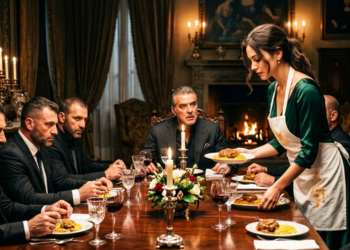
The dining room glittered with candlelight when the families were seated.
Ezio Barone, old and sour, his face carved by decades of suspicion. The Ferro patriarch, broad and loud, laughing at jokes no one else had made. The Dumont brothers, elegant and cold, finishing each other’s threats. And at Lucian’s right, Matteo, who kept glancing toward the kitchen door as if expecting disaster to walk out carrying a tray.
Wine was poured. Pleasantries sharpened into veiled blades.
“Quiet tonight, Castellano,” Ferro said, leaning back. “I expected more of a show.”
“You mistake me for a man who needs noise to prove anything,” Lucian replied.
A few men chuckled. Then, from behind the kitchen doors, came a crash of metal, and every conversation stopped.
Lucian did not look toward the sound. Neither did Matteo. That discipline alone kept the table from smelling blood.
Then came another sound. A low sizzle. And then the scent.
Garlic first, blooming warm through the room. Then rosemary. Then something dark and smoky and rich enough to pull even Ezio Barone’s attention off his own suspicion. One of the Dumont brothers inhaled before he could stop himself.
The doors opened, and the plates came out.
Not the architectural towers Etienne loved to build. This food looked alive. Torn rustic bread, steam rising when it broke. Bowls of dark braised short rib, glossy with wine and thyme, fragrant enough to silence a man mid-threat. Roasted vegetables glazed in honey and char. Hand-rolled pasta folded around wild mushrooms. A saffron risotto so tender it looked like it had been coaxed rather than cooked.
Lucian watched men who had ordered killings before breakfast lean over their plates like children invited back into a warm house on a cold night.
Ezio Barone took one bite of the short rib. He closed his eyes. For a long moment, no one spoke.
Then the conversation changed. Not weakly. The edges simply softened. The Dumont brothers argued about whose grandmother had made better bread. Ferro demanded to know what was in the braise and grew offended when no one answered fast enough. Matteo, who had been prepared to shoot someone before dessert, quietly asked for a second helping.
By the main course, business was moving. The harbor cranes were discussed without raised voices. The dock dispute narrowed from impossible to negotiable.
Then Ezio Barone set down his fork and looked directly at Lucian.
“Who made this?”
Silence. The answer mattered. If Lucian claimed the work of a chef who had fled, every servant in the room would know he was a liar. If he told the truth, he admitted he had underestimated his own house, his own wife, in front of his enemies.
The kitchen doors opened as if summoned.
Nora walked in carrying the last platter herself, cheeks flushed with heat, a loose curl stuck to her temple, flour dusting one soft arm. The apron should have made her look domestic and out of place among killers and silk. Instead she looked like the only person in the room who understood what power could be when it did not need to threaten anyone.
“My wife,” Lucian said.
Every eye turned to her.
Nora dipped her head. “I hope it was enough.”
Ezio Barone lifted his empty bowl an inch. “Enough? Madam, if my mother were alive, she would be jealous.”
Real laughter moved through the room. Not the polite kind.
By dessert, the truce was sealed. Not because Nora had understood territory maps or bribes. Because she had fed a table full of frightened, dangerous men something none of them had expected to feel again: safety.
By midnight the cars rolled away one by one down the long dark drive. No threats. No blood. No insult left to fester.
Lucian found her in the kitchen, washing the last of the knives, humming under her breath. The staff had offered to clean. She had refused.
“Why didn’t you tell me you could cook like this?” he asked from the doorway.
Her hands slowed. “You never asked.”
There it was again. Not accusation. Not bitterness. A simple fact more damning than any anger. He looked around the kitchen, which had become hers in under an hour—not by force, but by competence, by care, by a kind of authority he had never recognized because it wore an apron instead of a gun.
“I underestimated you,” he said.
“Yes,” she agreed, and the honesty landed like a blade placed carefully between his ribs.
Before he could answer, Matteo appeared in the doorway, and his face had changed.
“Lucian. The delivery log for tonight’s produce—it was signed for with a staff code.” He hesitated. “Nora’s code.”
The kitchen went still.
Someone had tried to ruin the dinner. Someone had used her name to do it. And in Lucian’s world, a forged signature was not merely evidence.
It was a target painted on the back of the woman everyone had just watched save his empire.
Part 2
By sunrise, everyone in the Castellano house knew two things: Nora had saved the truce, and someone had tried to frame her for sabotaging it.
The first truth brought warmth into the halls. The second brought fear.
Guards spoke in low voices at the gates. Maids lingered too long outside doorways. The mechanics in the garage, men who usually cursed loud enough to wake the dead, worked in grim silence under raised hoods. Lucian noticed all of it. Most of all he noticed the way people looked at Nora now—with gratitude, yes, but also with worry. That disturbed him more than suspicion would have. In his house, people feared him and obeyed him. But with Nora, something new was happening.
People wanted to protect her.
She came downstairs before dawn anyway, and he found her in the kitchen kneading dough as if no one had tried to destroy her name twelve hours earlier.
“You should rest,” he said.
“You should sleep.”
“I don’t sleep when enemies are inside my walls.”
“And I don’t rest when people are frightened and hungry.” She shaped the dough and set it under a cloth. “Someone wanted me to look careless, or cruel. I understand that. But the guards still changed shifts at six. The maids still woke before dawn. Fear sits in the stomach, Lucian. If I cannot remove it, I can at least feed around it.”
“You think bread solves betrayal?”
“No.” She looked at him. “But betrayal wants everyone isolated. Bread invites them to sit together.”
He had no answer to that. So he watched her carry a tray to the front gate herself.
The guard there was a broad, silent man named Bruno who had been with the family nine years and looked more comfortable facing bullets than a pastry from the boss’s wife.
“I heard you don’t like sweet things in the morning,” she said, handing him a plate. “So yours has egg and cheese.”
Bruno stared. “You remembered that?”
“I asked around.”
Over the following days, Lucian watched from the steps, unseen, as she moved through the estate. Gate guards. Gardeners. Cleaners. The two men stationed at the far wall who rarely got anything hot before noon. By the second day she knew names. By the third, preferences. By the fourth, stories. Bruno sent half his pay to a mother in the hills. A gardener named Toma had a daughter learning to read. The old housekeeper, Mrs. Fenn, had arthritis in both hands and never once complained. A young driver had not eaten a proper breakfast in weeks because he arrived before the kitchen opened and was too proud to ask.
Nora learned all of it, and then she fed them accordingly.
The house changed. Not overnight—a fortress does not become a home that fast. But guards who used to stand in cold silence began sharing coffee near the courtyard. Cleaners lingered at the kitchen island, laughing before their shifts. Men who obeyed Lucian out of fear now moved with sharper attention, because Nora might pass by and ask whether they had eaten.
“You should be careful,” Matteo told him on the seventh afternoon, as they watched her from the study window hand a bowl to the youngest guard, a boy barely twenty who looked at it like a medal.
“Of the bread?” Lucian said.
“Of what she’s building. Fear keeps men in line. It’s clean. Predictable. But this answers to something else.” Matteo nodded toward the courtyard. “Ask yourself—if you gave an order that hurt her, how many men in this house would hesitate?”
Lucian’s first instinct was anger. His second was to answer. His third was the quiet realization that he did not know.
That night he found her in the kitchen again. “You do not have to keep doing this. Learning every name. It is not your job.”
“Feeding people is not a job,” she said.
“What is it, then?”
“How you tell someone they matter, before they believe it.”
The answer slipped under his armor with humiliating ease. He thought of his own childhood, of a long table where meals had been silent tests of obedience, of the night at twelve when he had reached for bread before his father allowed it and learned that hunger taught discipline. Nora believed food taught worth. He did not know what to do with the difference.
Before he could speak, Mrs. Fenn cleared her throat from the doorway. “Sir, there’s a call from the countryside house. It’s about Renzo.”
Lucian’s attention sharpened at once.
Renzo Vale had been one of his most trusted captains for fourteen years. Cold under pressure, loyal without theater, the kind of man who could stare down five guns and complain afterward only about the coffee. An ambush had left him wounded a week ago. His body was healing. His mind, apparently, was not.
“He won’t eat,” Matteo reported over the phone. “Won’t talk. Doctor says no infection. He’s just… shutting down.”
“I’m going.”
“I’m coming too,” Nora said from the doorway.
“No.”
She lifted one brow. “You mean it is dangerous. You mean your instinct is to lock me in marble and call it protection.” She picked up a woven basket from the table. “I packed food. I am coming.”
He should have refused. But power had failed with Renzo. Fear had failed. Command had failed. He looked at the basket, then at his wife.
“Stay beside me.”
“When danger requires it,” she said. “Not when your pride does.”
The drive took three hours into gray hills. In the armored car she told him, unprompted, about the grandmother who had raised her while her parents chased money and each other’s attention. “Her kitchen was the only place that stayed warm,” Nora said. “She fed everyone. Widows. Children whose fathers drank. Men who pretended not to cry after funerals. She never called it charity. She said charity could embarrass people if you handled it carelessly.”
“What did she call it?”
“Setting another place at the table.”
The safehouse sat alone near a line of bare trees. Inside, Renzo sat wrapped in a blanket despite the fire, hollow-faced, staring at a field beyond the glass. A bowl of untouched soup had gone cold beside him.
Nora did not approach him. She went to the kitchen and unpacked bread, onions, herbs, dried beans soaked overnight, a jar of preserved tomatoes. For an hour the farmhouse filled with the scent of garlic and rosemary and something old and kind. Renzo’s eyes drifted toward the kitchen once. Lucian saw it. So did Nora, though she gave no sign.
When the stew was ready, she carried two bowls to the small table by the fire. One she set in front of Renzo. The other she kept.
“You don’t have to eat,” she said. “I just didn’t want you sitting alone.”
Then she sat across from him and began to eat. No questions. No pleading.
Minutes passed. Steam curled upward. Slowly, as if his hand belonged to someone else, Renzo picked up the spoon. He took one bite. Then another. On the third, his hand began to shake.
“My brother,” he said suddenly, in a voice cracked from disuse. “He was beside me when the shooting started. Nineteen. I promised our mother I’d keep him out of this life.”
“What was his name?” Nora asked gently.
“Dario.”
“Tell me about Dario.”
And the words broke him open. Renzo folded over the bowl and wept like a man whose grief had finally found a door—not quietly, not with dignity, but fully. Lucian, who had seen him shot and silent, stabbed and silent, stepped back into the hall so his captain could fall apart without his boss watching every piece drop.
On the drive home after dark, Renzo had eaten two bowls and fallen into real sleep for the first time in a week.
“I sent doctors,” Lucian said. “Priests. Men he respected. Nothing worked.”
“They tried to fix him,” Nora said. “I sat with him where he was.”
He looked at his hands—hands that had built order out of violence, that knew how to punish the cause of pain but not how to sit beside it. Nora reached across the space between them and touched his wrist, lightly. He could have moved away. He did not.
Part 3
The old riverside market had raised her, and it was dying.
Nora had complained for a week that the estate’s expensive suppliers sent beautiful vegetables with no soul. Lucian had thought it poetic nonsense until he tasted the tomatoes himself and realized she was right. She wanted to shop where she had grown up. He hated the idea immediately—the market sat outside his cleanest territory, a maze of stalls and side streets and too many rooftops—so he assigned Bruno and three men, then changed his mind and came himself.
The vendors knew her within minutes.
“Little Nora?”
“Saints above, look at you.”
“Your grandmother would weep to see you.”
An old herb seller kissed both her cheeks. A baker came around his stall with flour on his shirt and tears in his eyes. Women who had known her as a round-faced girl trailing behind her grandmother pulled her into embraces without any fear of Lucian’s men. He watched from a short distance, used to people recognizing his name, unused to this. No one loved him from memory.
As Nora moved deeper into the market, her smile faded. Stalls stood empty. Shutters rusted shut. A bakery she had spoken of on the drive had a foreclosure notice peeling off its door. Vendors glanced at Lucian’s men, then lowered their voices.
“Extortion,” the herb seller whispered when Nora asked. “Not your husband’s people. Smaller crews. Men with no code and no shame. Old Tomas lost his bakery two months ago. Others will follow.”
Nora grew very quiet. Lucian recognized the change now—that soft stillness before she made a decision stronger men would call impossible.
Instead of going home, she asked Bruno to take her to a small business consultancy two streets over. There, using her own personal accounts and no Castellano name at all, she quietly bought out three vendors’ debts from predatory lenders and replaced them with low-interest loans and generous terms. Lucian watched the clerk go pale when he recognized him, then paler when Nora began correcting the contract language with calm precision.
“You understand financing,” Lucian said when they left. It was not a question.
“My father’s brokerage was why you married me, remember?”
His silence answered.
“You did not ask then either,” she said, looking ahead.
At the market, Tomas the baker found her near the fruit stalls, trembling. “They told me someone paid what I owed. Said I can reopen. Said the terms are fair.” He studied her, then smiled through tears. “Your grandmother fed children every winter and never took a coin. She used to say kindness was the only investment that never lost value.”
By the time they returned to the estate, Lucian understood Matteo’s warning better than before. Nora was not building an army. She was building the thing armies follow.
Hope. And hope, in his world, was more destabilizing than dynamite.
The danger arrived disguised as a rumor.
Three days later, Matteo entered the study with a folder and a face like bad weather. “Silas Kane is talking. He says your wife is buying territory through charity. Feeding villages. Paying debts. Turning working people loyal to the Castellano name.”
Nora looked up sharply from her seat by the window. “I did not use the family name.”
“No,” Matteo said. “But people saw Bruno. They saw Lucian. They drew conclusions.”
“I only wanted to help,” she said quietly.
“I know,” Lucian said.
“Do you?”
The question struck harder than an accusation. He walked toward her. “In our world, kindness looks like strategy to men who have never seen it honestly.”
Her hands tightened. “Then your world is starving.”
Before he could answer, an explosion sounded in the distance—not close enough to shake the estate, but close enough for every guard outside to shout. Lucian was at the window in seconds. Smoke rose beyond the western road, dark against the evening sky. His phone rang.
“Boss.” Bruno’s voice, breathless. “The community kitchen at Saint Vale. Kane’s men hit it. We got Mrs. Castellano’s volunteers out before the fire took the building.”
Lucian’s blood went cold. He turned slowly. Nora had already stood, her face pale.
The community kitchen. The one she had not told him she was building yet. The one meant to feed families year-round after the harvest.
He took her coat from the chair and draped it over her shoulders himself. “We’re going.”
By the time they reached the village, the kitchen was rubble. Smoke rose from blackened beams. The new stove lay twisted. Tables she had chosen herself were reduced to charred legs and ash. Villagers stood in clusters, crying, furious, frightened. Bruno had soot on his face and blood on one sleeve, but when Nora approached, he bowed his head.
“I’m sorry, ma’am. Did everyone get out?”
“Everyone?”
“Everyone.”
Only then did her knees weaken. Lucian caught her before she fell. For a moment she leaned into him—not wife in name, not political alliance, but a woman struck where she had tried to give her heart away.
“I’ll handle this tonight,” he said, his voice soft enough to frighten everyone who heard it.
Nora pulled back. “No.”
“Kane attacked what you built.”
“He attacked a building.”
“He threatened you.”
“He failed.” Her eyes shone with tears, but her voice did not break. “I know what you want to do. You want to burn his territory. You want men dragged from their beds. And innocent people will pay first—drivers, cooks, boys too young to understand whose anger they’re carrying. If you answer fire with fire, this village becomes the first page of a war.”
“What do you want me to do?” he asked, his voice rough.
“Rebuild it.” She looked at the ruins. “Bigger. Brighter. Open by Sunday. Let Kane learn that burning kindness does not destroy it. It only proves why it was needed.”
Silence fell. Even the villagers listened. She was not asking him to be weak. She was asking him to be stronger than instinct.
Lucian turned to Matteo. “Rebuild it. Twice the size. Tonight we secure the village. Tomorrow the materials arrive. Pay every worker triple.”
“And Kane?”
Lucian’s eyes darkened. “Find out who lit the match. Quietly. No innocent blood.”
Silas Kane had expected panic. He got construction crews.
By Sunday morning the kitchen stood again—larger, stronger, painted a warm yellow because, Nora said, hungry children should not have to walk into gray rooms. Villagers came with flowers. Farmers donated crates. Tomas brought bread from his reopened bakery, weeping openly while insisting the oven smoke had bothered his eyes.
Lucian stood at the back, watching Nora tie an apron on a little girl who wanted to help stir soup.
Matteo appeared beside him. “Kane is furious. He also knows you held back.”
“Let him wonder why.”
“You’re changing,” Matteo said. “Because of her.”
“Yes,” Lucian admitted, and the ease of the admission was how he knew it had become dangerous.
That evening Nora asked to visit her grandmother’s cottage for old pots and pans. It sat two hours outside the city, wrapped in ivy and memory, dust softening the furniture. She moved slowly through the rooms, touching the table, the old stove, the cracked tile.
“This is where she taught me to knead dough,” she whispered. “She said bread knows when your hands are angry.”
“Bread would dislike me,” Lucian said.
“At first.”
One floorboard near the stove creaked differently beneath her foot. She stopped. “She always said this floor complained in only one place.”
Together they pried the loose board free. Beneath it lay a leather journal tied with a faded red ribbon. Inside, her grandmother’s handwriting filled page after yellowed page. Recipes, yes. But not only recipes.
For the Alvez family, father lost work at the mill. Extra bread this week. Let them think it was a mistake in the count.
For old Mateo, grieving his wife. Made her fennel soup. Sat until he finished.
For the girl who stopped speaking after her mother’s funeral. Honey cakes. She smiled today.
Near the back, one entry stopped them both.
For my Nora. She has my hands and my heart, though she believes the world prefers sharper things. One day she will understand that feeding someone is never only about food. It tells them without words: you matter. I pray life never makes her forget it.
A tear dropped onto the page. Nora closed the journal and held it to her chest. “She knew,” she whispered. “Before I did.”
Lucian looked at his wife in the dusty kitchen where her power had first been taught, and something in him finally broke fully open.
“I did not marry you properly,” he said.
“We had three hundred guests.”
“I don’t mean the wedding.” He stepped closer. “I married an alliance. A name. The daughter of a man whose business helped my territory. I did not marry you the way a woman should be married.”
“And how is that?”
“Seen,” he said. “Chosen. Wanted for herself. Protected without being caged. Respected before she has to save a room full of men to earn it.”
Her eyes filled again. He lifted a hand, then stopped just short of her cheek, waiting. She leaned into his palm. The trust of it nearly undid him.
“Do not call me a miracle,” she whispered, before he could. “Miracles are too easy to admire and too hard to understand.”
“What should I call you?”
“Your wife,” she said. “If you mean it.”
“I want to.” It was the most honest sentence he had ever spoken.
Before he could kiss her, the radio at his belt crackled. “Boss. We have a problem.”
Nora smiled through tears. “Your timing is terrible.”
“Speak,” Lucian said.
Matteo’s voice came grim. “Kane has called a neutral summit at the Hillcrest vineyard. Says he wants peace after the kitchen. But our source says he’s hired outsiders to hit the meeting. He wants every family there dead—then he blames you. It’s tomorrow night.”
Part 4
The Hillcrest vineyard had been neutral ground for generations. No blood on the soil. No guns in the courtyard. No insult to wives or the dead. Those rules had outlived most marriages and half the men who swore to keep them.
Silas Kane intended to break all of them.
Three outside shooters. No family insignia. No traceable weapons. Their job was simple: wait until the bosses relaxed over dinner, strike from the vineyard’s edge, kill enough important men to trigger chaos, and let rumor do the rest. Lucian would be blamed. The region would fracture. Kane would survive with a heroic scratch and seize whatever was left after the funerals.
Lucian stood over the map Matteo had spread across the desk. Renzo stood nearby, thinner but steadier, grief still shadowing his eyes but no longer drowning him.
“We cancel,” Bruno said.
“No,” Lucian replied. “Without proof, exposing him looks like fear. Going armed and ready is what he wants—one nervous guard reaches into his jacket and every family starts shooting.”
From the doorway, Nora said, “Then no one reaches for a gun first.”
Every man turned. She entered carrying her grandmother’s journal against her chest.
“Absolutely not,” Lucian said.
“You asked me, in my grandmother’s cottage, to believe you could be my husband properly.”
“This is not about that.”
“It is exactly about that. You want to protect me by deciding for me.” She set the journal on the desk. “Kane’s plan depends on everyone behaving like rivals. His shooters expect the guards to protect only their own bosses. They expect panic. Division. We change that. With a meal.”
He stared.
“Listen before you dismiss me,” she said, and the quiet command stopped him. “My grandmother cooked for people who hated one another. She learned something I have now seen with your men, with Renzo, with the market, with Saint Vale. People who eat together begin to recognize one another as human. Not always enough. Not forever. But enough for a moment.”
Matteo leaned slowly over the map. “You want the guards to eat together before the meeting.”
“Together. Not in separate rooms. Shared dishes tied to each family’s childhood and pride. Give them something to talk about besides who they might have to kill. If attackers come, the guards will not scatter into factions. They will move as one crowd protecting one table.”
Renzo looked at Lucian. “It could work.”
“It could also put you in the center of the trap,” Lucian said to her.
“I am already there. Kane made sure of that when he burned the kitchen. Let him watch me feed the room he hoped would become a grave.”
Something fierce moved through Lucian’s chest—pride, terror, and a word he had not yet earned the right to say. “What do you need?”
Matteo exhaled. “Here we go.”
By late afternoon, the vineyard courtyard smelled of memory rather than war. Nora had spent the day cooking dishes based on what she knew or had quietly learned about every family attending. Seafood stew for the Barones, made with safe local fish and saffron. Slow-roasted lamb with rosemary for the Ferros, whose grandmother came from a hill town where lamb marked every wedding. White bean soup for the Dumonts, whose father had grown up poor and still pretended not to love peasant food. Fresh bread for Silas Kane, baked from a recipe an old vendor swore Kane’s grandmother had made before ambition curdled him.
Guards from different families arrived early and were directed—by Nora, not Lucian—to long tables near the courtyard wall.
“At least eat before you glare at each other,” she told a Ferro guard hesitating beside a Barone man.
The Barone guard snorted. “She talks like my aunt.”
“Then listen like you value your ears,” Nora said, handing him bread. The men laughed.
Lucian stood in the archway, stunned not by the food but by the obedience. No one questioned her—not from fear, but because refusing her felt rude in a way men with blood on their hands still understood.
The bosses arrived at sunset. They entered expecting tension and found long tables set with linen, candles, and food that reached beneath suspicion before pride could stop it. Silas Kane came last, in a charcoal suit and a red tie too bright for peace, charm on his face that never reached his eyes.
“Mrs. Castellano,” he said. “Still feeding strays?”
Lucian moved. Nora touched his wrist under the table, and he stopped.
She smiled at Kane. “Only the hungry ones, Mr. Kane. Sit down before the bread gets cold.”
A few men laughed. Kane’s jaw tightened. Public humiliation did not always require an insult. Sometimes it was simply a room choosing not to fear the man who expected it.
For nearly two hours, business barely surfaced. Men who had arrived prepared to posture found themselves remembering mothers, grandmothers, lean winters, first griefs. The meal did not erase crimes or make cruel men good, but it loosened the grip of performance.
Then the bread reached Kane. He tore it once, chewed, and his face changed—only for a second. Nora saw. Lucian saw. Kane hated that they saw.
“My grandmother made this,” Kane said flatly.
“So I was told,” Nora replied. “By a woman at Riverside who remembered when you were small enough to steal figs and cry when you were caught.”
The courtyard went quiet. For a moment the violent man looked less angry than wounded. Then his expression hardened. “Careful where you collect your stories.”
“Careful what kind of man your stories become.”
Lucian placed his hand over hers beneath the table—not to silence her, but to steady them both.
Negotiations began after dessert. Tense, but possible. Boundaries. Reparations for the burned kitchen. A shared fund—Nora’s idea, though Lucian presented it—to protect villages caught between territories. Kane looked ready to refuse.
Then a shot cracked from the vineyard’s edge.
The world exploded. Tables overturned. Glass shattered. Lucian was on his feet instantly, pulling Nora behind him—but she twisted free.
“Kitchen staff! Behind the stone wall, now!” Two young volunteers stood frozen near the serving table. Nora ran toward them. Lucian’s heart stopped.
A second shot struck the fountain, spraying water and stone. Bruno tackled an attacker emerging from the vines. A Barone guard, who had shared bread with Bruno an hour earlier, covered him without hesitation. Two Ferro men dragged vineyard staff behind overturned tables. Renzo shoved a boss down as a bullet tore through the chair where his head had been.
Exactly as Nora had predicted, the guards did not scatter into family lines. They moved as one.
Lucian reached Nora as she pushed the last volunteer behind the wall and wrapped his body around hers just as a shot punched into the stone near his shoulder.
“I’m fine,” she breathed.
“You are impossible.”
Within moments the three attackers were subdued—alive. Lucian had ordered it. Proof mattered more than bodies. A recovered phone showed messages, a payment trail, coordinates. Kane’s name appeared nowhere. But his lieutenant’s did—a man named Dell Roan, standing just behind Kane, who began backing away.
Renzo saw it first. “Gun!”
Roan grabbed Nora. A knife appeared at her throat, and Lucian’s entire world narrowed to one line of silver against his wife’s skin.
“Everyone stay where you are,” Roan snarled, dragging her back. “She’s ruined everything. Burning the kitchen only made them love her. Tonight made them trust each other. You think there’s room for men like us if women like her start feeding everyone into peace?”
Kane went pale. “Roan, what are you doing?”
“What you were too weak to finish.”
Lucian’s voice became terrifyingly gentle. “Take the knife away from my wife.”
“Or what? You shoot through her?”
Nora’s eyes locked on Lucian’s. She did not say no. She did not need to. Her hand moved slowly toward the pocket of her apron.
“Don’t,” Roan warned.
“It’s a handkerchief,” she whispered. “Please. I’m bleeding.”
Lucian saw the lie—saw her fingers curl around her grandmother’s old tin of ground chili and salt, the one she had used all day to season the bread. Nora trembled like a frightened woman. Then, at the exact moment Roan shifted to look toward Lucian, she flung a sharp cloud of chili and flour into his eyes.
Roan screamed. She dropped hard, twisting away from the blade. Lucian moved. So did Bruno. So did Kane—which surprised everyone. Kane struck Roan first, knocking the knife loose. Within seconds Roan was restrained, howling, blinded by spice and betrayal.
Lucian turned Nora toward him, and his hands—his hands—were shaking.
“Are you cut?”
“No. I’m not cut.”
He scanned her throat, her face. A thin red mark near her collarbone where the blade had pressed but not broken skin. Then he pulled her into his arms in front of every family, every guard, every rival who had ever believed Lucian Castellano loved nothing enough to weaken him.
He held his wife like the empire could burn if it meant she kept breathing.
“I’m all right,” she whispered.
“No,” he said into her hair. “You are brave. Those are not the same.”
Roan confessed before midnight. He had grown furious watching his boss hesitate after the kitchen was rebuilt; he believed Nora’s influence would soften territories and make violent men unnecessary. He had hired the outsiders and meant to blame Lucian.
Kane looked older when it ended. “I burned the kitchen,” he admitted publicly, to a silent courtyard. “I thought it would frighten her. I thought kindness was a weakness I could damage from a distance.”
“And now?” Nora asked.
Kane swallowed. “Now I think I was afraid it was stronger than anything I had.”
Nora stood. “You will repay Saint Vale. Not me—the village. You will sign protections for the markets and the farming roads. Your crews stop collecting from vendors, kitchens, bakeries, clinics, and schools. If your men break that, every family here will know you broke peace over hungry children and old women selling herbs.”
Kane looked around at rival bosses, guards, witnesses, and the woman his violence had failed to break. Then he nodded. “I’ll sign.”
By dawn the agreement was sealed—a pact none of them had expected to make, written, in truth, by the quiet wife in the apron.
Part 5
Word spread through the underworld within days. Not only that Lucian Castellano’s wife had stopped a war—but that she had done it with bread, memory, courage, and a tin of chili.
On the fourth morning, Lucian ordered the entire household into the courtyard. Every guard. Every cook. Every cleaner. Every gardener. Every driver. Every person who made the estate breathe while powerful men pretended houses ran themselves.
Nora had no idea. She was in the kitchen preparing lunch when Bruno appeared, awkward and solemn. “Ma’am. The boss is asking for you by the fountain.”
“Did something happen?”
“Yes,” Bruno said, and would say nothing more.
She stepped into the courtyard with flour on one cheek and her hair escaping its pins, and stopped. Nearly seventy people stood gathered beneath the noon sun. Guards in black suits. Gardeners with soil on their boots. Mrs. Fenn already wiping her eyes though nothing had begun. Renzo near the front, alive and steady. Matteo beside him, arms crossed, pretending this was not emotional.
Lucian stood at the center, and for the first time since Nora had known him, he looked nervous. Not because of danger. Because of truth.
“When I married Nora,” he began, his voice carrying, “I told myself I was giving her protection. Wealth. A respected name. A safe place in a dangerous world. What I did not give her was the one thing every person deserves in their own home. I did not give her the dignity of being fully seen.”
The courtyard went silent.
“I looked at my wife and saw softness, and mistook it for weakness. I saw warmth and thought it had no place in an empire built on fear. I saw a woman who smiled too easily in a house full of armed men, and I thought she did not understand power.” His voice roughened. “I was wrong.”
He turned to the household. “Every one of you knows what she has done. She fed men who thought they only needed orders. She learned names I should have known. She sat with Renzo when grief nearly took him. She saved market vendors who had nothing to offer her but gratitude. She rebuilt what Kane burned and made his fear look small. At the vineyard she stood in front of the staff while bullets flew. She stopped a war by reminding enemies they were human before they remembered they hated each other.”
Mrs. Fenn began crying openly.
“I built a mansion,” Lucian said. “She made it a home. I built an empire men obeyed because they feared me. She built loyalty people choose freely. And today, in front of every person whose life she has touched, I want to say what I should have said long ago.”
He walked toward her, and the courtyard seemed to hold its breath. Then Lucian Castellano lowered himself to one knee.
A sound moved through the staff. Nora covered her mouth.
He took her flour-dusted hand. “We are married by law. But law is not love. An alliance is not a vow. A ring given for strategy is not the same as one given with a whole heart.” He opened his palm. Inside rested a new ring—gold, shaped delicately like braided wheat, a small warm diamond at the center and tiny green stones like herbs set along the band. “I had this made from my mother’s wedding gold and stones from the earrings your grandmother left you. With your permission.”
Nora laughed through tears. “Mrs. Fenn.”
The housekeeper sobbed harder. “He asked so politely.”
“Nora,” Lucian said, serious again. “I love you. Not because you saved my reputation. Not because you saved my men. Not because every family in the region now speaks your name like a blessing and a warning. I love you because you saw a house full of frightened people and chose to feed them. Because you saw a man made of armor and chose not to fear what was underneath. Because you taught me that power without tenderness is only a colder kind of hunger. I am asking you to marry me again. Not for territory. Not for alliance. As my real wife. My equal. The heart of this house—if you still want the man who was foolish enough to overlook his own miracle.”
Tears slipped down her cheeks. “I told you not to call me a miracle.”
“I remember. I am nervous.”
A warm, relieved laugh broke over the courtyard. Nora looked down at this ruthless man kneeling on stone in front of guards and servants, offering not possession but repentance. For three years she had been his wife in name—protected but lonely, respected but unseen. Now he looked at her as if seeing her had changed the shape of his world.
She held out her hand. “Yes. But only if this time you eat in the kitchen sometimes.”
He slid the ring onto her finger. “I will eat wherever you tell me.”
Matteo muttered, “God help us all.”
Applause broke over the courtyard—not polite, but thunderous. Guards clapped. Cooks cried. Renzo smiled for the first time without grief pulling it down. Lucian rose and kissed his wife in front of them all—not a possessive performance, but a promise, his hands framing her face like something precious and powerful, while the coldest boss in the region kissed her like a starving man finally invited to a table set for him.
Their second wedding took place six weeks later—not in a cathedral crowded with political guests, but in the rebuilt Saint Vale community kitchen, painted warm yellow, long tables pushed aside, wildflowers from the village gardens filling old jars. Her grandmother’s journal sat open near the entrance beneath glass, at the page written for Nora. Guests came from the estate, the market, the village, and—to everyone’s surprise—a few rival families who had begun to understand that ignoring Nora Castellano was more dangerous than attending.
She wore ivory lace that hugged her curves with dignity and grace, her hair pinned with rosemary and tiny white flowers. No one hid her body. No one softened her into someone smaller. When she walked toward Lucian, the room saw exactly what he saw: a woman who had fed an empire until it remembered how to feel.
Their vows were simple. Nora promised to feed him truth before comfort, to build warmth without losing strength, to remain herself inside his world and never let fear teach her cruelty. Lucian promised to protect without possessing, to listen before commanding, to never again confuse gentleness with weakness, and to spend the rest of his life earning the privilege of a seat at her table.
When they kissed, the kitchen erupted. Later, during the meal, Lucian carried the first tray himself.
Matteo watched in disbelief. “The region’s most feared boss is serving stew.”
“And?” Lucian said calmly.
Matteo raised both hands. “Nothing. Just admiring my survival in strange times.”
Years of fear had taught men to obey Lucian. One month of Nora had taught Matteo to obey faster.
Near the end of the evening, a little girl from the village approached Nora with a serious face. “Are you the lady who made the kitchen come back?”
“A lot of people helped,” Nora said, crouching.
“But did you start it?”
“Yes.”
“Why?”
Nora glanced across the room. Lucian stood near the stove, listening intently while Tomas explained bread crust like statecraft. Bruno carried empty plates. Renzo laughed with village children. Mrs. Fenn was dancing with the herb seller. The house that fear had built had emptied its people into a kitchen built by love, and no one seemed eager to return unchanged.
“Because everyone deserves a place where someone asks if they’ve eaten,” Nora told the child.
The girl nodded as if this made perfect sense. Because it did.
The region settled into a fragile new peace. Markets reopened. Extortion faded where Nora’s protections reached. The Castellano estate became known for two things: the danger of crossing Lucian, and the greater danger of underestimating his wife.
Inside the estate, breakfast became tradition. Not every day cooked by Nora—she taught others, shared recipes, made the kitchen everyone’s instead of hers alone. But on Sundays she still woke early. Bread rose before sunrise. Coffee simmered. Guards came off the night shift smiling before they reached the door.
Lucian always appeared first, sleeves rolled, ready to chop parsley badly.
One Sunday, as sunlight spilled across the counters, Nora watched him knead dough with fierce concentration.
“You are overworking it,” she said.
“I am intimidating it.”
“Bread does not respond to intimidation.”
“It should learn.”
She laughed until he looked up, flour on his jaw, and smiled—not the cold smile that once made enemies lower their eyes, but a real one. Hers.
Nora walked over and brushed the flour from his face. “The dough needs gentleness.”
Lucian caught her hand and kissed her palm. “So did I.”
Around them the kitchen warmed. Staff voices approached down the hall. Soon the room would fill with noise and food and complaints and jokes and the ordinary chaos of people who knew they mattered.
The ruthless boss had once believed his gentle wife could not possibly cook. He had been wrong in the most spectacular way. She could cook. She could heal. She could humble violent men with bread. She could turn guards into family, enemies into witnesses, and a mansion built on fear into a home worth protecting.
And Lucian Castellano, who had once believed power meant never needing anyone, now began every week in the kitchen beside his wife—grateful beyond words that she had fed everyone in his house until, at last, there had been room at the table for him too.
— The End —
