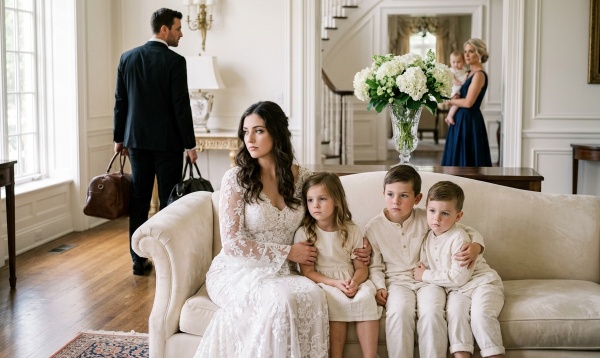
He Abandoned Me While I Was Carrying His Triplets for Another Woman’s Baby—Three Years Later, His Silent Triplets Taught Him the Truth…
He walked away from his pregnant wife and their unborn triplets to play hero for another woman and her child. Three years later, when he finally showed up at a speech therapy session, he realized his children’s silence was not emptiness—it was the sound of every day he had missed.
Part 1: The Night He Chose Someone Else’s Baby
People in North Jersey called my husband a don long before I ever understood what that word could cost a family.
His real name was Salvatore Bellandi, but everyone called him Sal. In public, he was the owner of Bellandi Hospitality Group, a collection of Italian restaurants, event spaces, and commercial properties from Hoboken to Atlantic City. In private, people lowered their voices when his name came up, not because anyone could prove anything in court, but because some families carry reputations the way old houses carry smoke.
I married him when I was twenty-nine and still believed love could soften any man.
My name is Elena Bellandi, born Elena Russo in Queens, raised by a nurse mother and a father who fixed subway signal equipment for the MTA. I was not naïve exactly, but I was hopeful in a way that now embarrasses me. Sal was twelve years older, handsome in a severe way, with dark eyes, perfect suits, and the kind of attention that made a woman feel chosen in a crowded room.
When Sal loved you, it felt like shelter.
When he stopped loving you, it felt like a door locking from the outside.
For the first two years of our marriage, he treated me like something precious. He sent orchids to my office, remembered my mother’s birthday, and learned how to make espresso the way my father liked it. He told me he wanted a house full of children and Sunday dinners so loud the neighbors would complain.
Then I got pregnant.
Not with one baby.
With three.
The ultrasound technician laughed first, then apologized because I immediately burst into tears. Sal stood beside the exam table, staring at the screen like he had just watched lightning strike our future. Three tiny heartbeats flickered in black and white, and for one strange minute, I thought I saw fear and wonder fighting inside him.
“Triplets,” he whispered.
“Yes,” the technician said gently. “Three.”
On the drive back to our house in Alpine, he was quiet. Alpine, New Jersey, is the kind of town where houses sit behind gates, lawns look painted, and nobody admits they are lonely. Sal’s estate had eight bedrooms, a pool house, a wine cellar, and cameras at every gate.
That day, it felt less like a home than a compound.
At first, Sal performed joy beautifully. He told his mother. He told his closest business partners. He kissed my belly in front of relatives and said the Bellandi name was about to triple.
But at night, when the house got quiet, he changed.
He stopped touching me with ease.
He took more calls outside.
He stared at my growing stomach like it belonged to a problem he had not approved.
By twenty-two weeks, my pregnancy was classified high-risk. The doctors at Hackensack University Medical Center told me to rest, monitor symptoms, and prepare for the possibility of early delivery. My mother moved into one of the guest rooms to help because Sal was suddenly “buried in expansion meetings.”
That was the phrase he used.
Expansion meetings.
I later learned her name was Marisa Vale.
She was not part of his business, at least not officially. She was the widow of one of Sal’s old associates, a woman with glossy black hair, a soft voice, and a six-month-old baby boy named Nico. Her husband had died of a heart attack the year before, and Sal had stepped in, as he liked to put it, “to make sure she and the kid were looked after.”
I thought that meant money.
I did not know it meant my marriage.
The night Sal left, I was twenty-eight weeks pregnant and so swollen I could barely wear slippers. My back hurt constantly, and the babies moved like they were trying to rearrange my organs. My mother had gone to Queens for one night to handle a medical appointment, and I remember feeling nervous being alone in that huge house.
Sal came home around 10:30 p.m.
He smelled like cold air, expensive cologne, and someone else’s laundry detergent.
I was sitting in the nursery, surrounded by three unfinished cribs. We had painted the walls pale sage green because I said gendered colors felt too predictable. Tiny white onesies lay folded on a chair, waiting for babies whose names we still had not agreed on.
Sal stood in the doorway and did not come in.
“We need to talk,” he said.
Nobody says that when love is safe.
I turned carefully in the rocking chair. “What happened?”
He looked at the cribs instead of me.
“I can’t do this, Elena.”
My hand went automatically to my stomach.
“Do what?”
“This.” He gestured toward me, toward the room, toward the life growing inside my body. “Three babies. Doctors. Your mother in my house. Everyone looking at me like I’m supposed to be happy.”
I stared at him.
“You’re their father.”
His jaw tightened.
“I know what I am.”
“No,” I said, feeling something cold move through me. “I don’t think you do.”
He rubbed his face with both hands. For the first time since I had known him, he looked less like a powerful man and more like a boy who wanted someone else to clean up what he had broken.
“There’s someone else,” he said.
The words did not surprise me.
That was the terrible part.
“Marisa,” I said.
His eyes snapped to mine.
That was my answer.
I waited for him to deny it. He did not.
“She needs me,” he said.
I almost laughed, but the sound caught in my throat.
“I am pregnant with your triplets.”
“It’s different.”
“Different how?”
He looked ashamed for exactly one second.
“Her son already lost a father.”
The room went still.
Outside, rain tapped lightly against the windows. I remember the sound because my brain clung to it while the rest of me tried not to fall apart.
“And your children?” I asked. “What are they losing tonight?”
He did not answer.
That was when I understood the shape of his cowardice.
Sal was not leaving because he loved Marisa more. He was leaving because her child represented rescue without responsibility. Nico already existed. Nico needed a hero. My babies needed a father who would show up through sleepless nights, medical bills, fear, diapers, and the terrifying uncertainty of premature life.
Sal wanted worship.
Not work.
I stood too quickly and had to grab the side of the crib.
He stepped forward.
“Don’t,” I said.
He stopped.
“I’ll take care of you financially,” he said, as if that sentence could cover the hole he had opened in the room. “The babies will have everything.”
“They won’t have you.”
His face hardened.
“I’m not disappearing.”
“No,” I said. “You’re just choosing someone else’s child before yours are even born.”
He flinched.
Good.
Some truth deserves to land.
He left that night with two suitcases, three phone calls, and no goodbye to the nursery. I watched from the upstairs window as his black Escalade rolled down the driveway and through the gate. The taillights disappeared into rain, and I pressed both hands to my belly as the babies shifted inside me.
“You are not unwanted,” I whispered to them.
I said it again and again until I believed it enough to breathe.
Part 2: Three Cradles, No Father
The triplets were born seven weeks early on a cold February morning.
I remember bright hospital lights, masked faces, machines beeping, and my mother’s hand gripping mine so hard my fingers ached. Sal was not in the delivery room. He was notified, as my attorney had advised, but he did not arrive until six hours after the babies were delivered.
By then, our children were already in the NICU.
Matteo Joseph Bellandi weighed 3 pounds, 11 ounces.
Lucia Rose Bellandi weighed 3 pounds, 6 ounces.
Gabriel Anthony Bellandi weighed 3 pounds, 9 ounces.
They were impossibly small, wrapped in wires and tubes, their skin too delicate for the world they had entered too soon. I was wheeled into the NICU after surgery, still numb, still shaking, and the first thing I noticed was not fear. It was fury.
Not at the babies.
Never at them.
At the fact that their first fight for life was happening without the man who had helped create them.
Sal arrived in a charcoal suit with dark circles under his eyes. He stood outside the NICU glass, staring at the incubators. For a moment, I saw something break open in his face.
Then his phone buzzed.
He looked at it.
That one glance told me everything.
“Is it her?” I asked from the wheelchair.
He looked away.
I laughed once, quietly, because I did not have enough strength to scream.
My attorney, Karen Feldman, had already begun preparing temporary orders. In New Jersey, custody and support are determined based on the children’s best interests, not a father’s reputation or a mother’s anger. Karen reminded me of that often.
“Your pain matters,” she said. “But in court, we lead with the children’s needs.”
The children’s needs were enormous.
NICU bills.
Specialists.
Feeding schedules.
Monitors.
Follow-up appointments.
A night nurse for a while because three premature infants do not sleep in shifts convenient to human survival.
Sal paid what he was ordered to pay and more when it made him look generous. That was his way. He sent checks quickly, approved medical expenses, and had his assistant coordinate insurance paperwork. But fatherhood through wire transfers is not fatherhood.
He visited the NICU four times in five weeks.
Marisa visited him more than that.
I know because people talk, especially in communities built on secrets. She moved into one of his properties in Edgewater, a luxury condo overlooking the Hudson River. Sal was photographed once carrying baby Nico into a restaurant while Marisa walked beside him in a cream coat.
The photo appeared on a local society page.
Someone sent it to me while I was pumping milk at 3:00 a.m. for babies too small to nurse.
I stared at the image until the pump timer beeped.
Then I deleted the message.
Not because it did not hurt.
Because pain had become a luxury I could not afford to indulge every time it knocked.
When the babies finally came home, my mother moved in full-time. My cousin Ariana came every weekend from Staten Island with trays of baked ziti, clean laundry, and the kind of practical love that never asks permission. The house Sal had once filled with men in suits and family dinners became a command center of bottles, burp cloths, oxygen checks, and whispered prayers.
I did not live in his Alpine estate anymore.
Three weeks after the birth, Karen helped me petition for exclusive use of a smaller house in Montclair that had been purchased during our marriage but titled through one of Sal’s property companies. The legal details were messy, but the court was not amused by the idea of three medically fragile infants moving between unstable environments for appearances.
So we stayed in Montclair.
The house was old, warm, and imperfect. The floors creaked. The radiators hissed. The kitchen cabinets stuck when it rained. But it had sunlight in the nursery, a fenced yard, and neighbors who brought soup without asking questions.
For the first year, survival was measured in ounces and appointments.
Matteo had reflux so severe he screamed after feedings.
Lucia developed breathing issues that sent us to the ER twice before her first birthday.
Gabriel was quiet from the beginning, watching everything with huge dark eyes as if deciding whether the world was trustworthy.
People told me they would catch up.
“Preemies just need time,” they said.
And they were right, partly.
But as months became years, something else became clear.
The triplets did not speak.
Not at twelve months adjusted.
Not at eighteen months.
Not at two.
They babbled occasionally as infants, then grew quieter. They communicated with gestures, eye contact, crying, pointing, leading me by the hand, and later picture cards recommended by a speech therapist. But words did not come.
We saw pediatricians, neurologists, audiologists, developmental specialists, speech-language pathologists, and early intervention teams. Hearing tests were normal. Genetic screening showed nothing immediately explanatory. Autism evaluations were complicated: some signs fit, others did not, and every specialist cautioned against reducing three different children to one story.
The final working diagnosis was severe expressive language delay with anxiety-related mutism features, shaped by prematurity, medical stress, and environmental instability.
In simpler words: my children were healthy in many ways, bright in many ways, loved deeply, and still unable or unwilling to speak.
I refused to let anyone call them broken.
Sal’s visits were inconsistent. He would come twice in one week, then vanish for a month. He brought expensive gifts the children did not want and stood awkwardly in the living room while they hid behind my legs.
“They don’t know me,” he said once, sounding offended.
I looked at him over Gabriel’s head.
“No, Sal. They don’t.”
He crouched and held out a toy Ferrari.
Matteo stared at it, then turned away.
Sal stood up, wounded.
“You’re turning them against me.”
I almost laughed.
“They don’t speak, Sal. But somehow you think they’re running a conspiracy?”
His face darkened, but he said nothing.
That was one thing I had learned about powerful men: they often mistake the consequences of absence for sabotage.
By the triplets’ third birthday, we had a routine. Speech therapy three times a week. Occupational therapy twice. Music therapy on Saturdays. A preschool program in Montclair with teachers who understood that communication is bigger than words.
The children used picture boards, signs, and expressions.
Matteo tapped twice when he wanted more.
Lucia pressed her forehead to mine when she was overwhelmed.
Gabriel drew circles whenever he was anxious, filling page after page with loops that seemed to calm his breathing.
They were not silent to me.
I heard them every day.
But to the outside world, the story became cruelly simple.
The don’s abandoned triplets still hadn’t spoken a word.
And then, three years after he left, Sal finally realized silence could be louder than any accusation.
Part 3: The Birthday Party He Wasn’t Invited To Control
I did not invite Sal to the triplets’ third birthday party because I wanted drama.
I invited him because Karen told me to document reasonable co-parenting efforts, and because my children deserved the chance to be loved consistently by both parents if he could become capable of it. The party was small, held in our Montclair backyard on a clear Saturday in March. We had balloons, cupcakes, a sensory-friendly play tent, and no loud music because Lucia hated sudden noise.
Sal arrived fifteen minutes late.
Not alone.
Marisa came with him, holding Nico’s hand.
I saw them from the kitchen window and felt my entire body go still.
My mother muttered something in Italian that would have gotten her scolded by a priest.
Karen had advised that significant others should not be introduced during parenting time without agreement. Sal knew this. He knew because the temporary order said it plainly, and because I had repeated it in writing through the co-parenting app.
Still, there he was.
Sal walked into my backyard wearing a navy suit at a toddler birthday party. Marisa wore white jeans, a silk blouse, and an expression that mixed apology with entitlement. Nico, now almost four, clutched a wrapped gift and looked confused.
I felt sorry for the child.
That made me angrier at the adults.
Matteo saw Sal first and moved behind my leg.
Lucia covered her ears though no one had made a sound.
Gabriel stared at Marisa’s son, then began rubbing his fingers together, his anxious habit.
Sal noticed.
For a flicker of a second, shame crossed his face.
Then he covered it with authority.
“Elena,” he said quietly, “don’t make a scene.”
It is amazing how often men create the scene and then ask women not to notice it.
I stepped closer, keeping my voice low.
“You need to leave.”
His eyebrows lifted.
“This is my children’s birthday.”
“And you brought someone I explicitly told you not to bring.”
Marisa shifted behind him.
“I didn’t want to cause trouble,” she said.
I looked at her.
“Then why are you here?”
Her mouth closed.
Sal’s jaw tightened.
“Nico wanted to meet them.”
“Nico is a child,” I said. “He didn’t make this decision.”
Ariana appeared beside me, arms folded. My mother stood near the patio door. Two other parents pretended not to listen while absolutely listening.
Sal hated being challenged in public.
But the backyard was not his restaurant, his boardroom, or one of the private rooms where men nodded because his last name made them careful.
This was my children’s home.
And I was done lowering my voice in it.
“You can return alone another day after confirming through the app,” I said. “Today is not about your image, your guilt, or your new family.”
His eyes flashed.
“They are my family too.”
I held his gaze.
“Then start acting like it when nobody is watching.”
The words landed.
Behind me, Lucia began to cry silently, her mouth open but no sound coming out. That was how she cried when overwhelmed, and it broke me every time. I turned immediately, kneeling to pull her into my arms.
She pressed her face into my neck, trembling.
Sal saw it.
Really saw it.
For once, he did not argue.
He looked at Matteo hiding behind the play tent, Gabriel rocking slightly on his heels, and Lucia clinging to me as if the ground had shifted. The expensive gift bag in his hand suddenly looked absurd.
Marisa whispered, “Sal, we should go.”
He stared at the children another second.
Then he set the gift bag on the patio table and left.
The party recovered slowly. My neighbors were kind enough not to ask questions. The teachers from the preschool helped redirect the children to frosting, bubbles, and a quiet corner with soft blocks. By the end of the afternoon, Matteo had icing on his nose, Lucia was asleep against my mother, and Gabriel had drawn blue circles on twelve paper napkins.
That night, after the children were in bed, I received a message from Sal through the co-parenting app.
I want to talk about the kids. Something is wrong.
I stared at the words for a long time.
Then I replied.
Nothing is wrong with them. They need consistent support. If you want information, attend their next speech therapy session. Tuesday at 10:00 a.m. Confirm by Monday noon.
He confirmed within five minutes.
I did not trust it.
But I documented it.
On Tuesday, Sal arrived at the therapy center in Livingston ten minutes early. He wore no suit this time, just jeans and a black sweater. He looked uncomfortable in the waiting room among children’s books, sensory toys, and posters about language milestones.
The speech-language pathologist, Ms. Turner, greeted him warmly but professionally.
She had been working with the triplets for eight months and did not care who Sal thought he was. To her, he was just another parent who needed to learn how to support communication without demanding performance.
The session began with play.
Not flashcards.
Not pressure.
Play.
Matteo sorted toy animals by color. Lucia fed a doll with a plastic spoon. Gabriel lined up wooden cars with mathematical precision. Ms. Turner narrated softly, modeling simple words and signs.
“More.”
“Open.”
“Help.”
“Go.”
Sal watched like someone seeing a foreign country where his passport did not matter.
At one point, Matteo reached for a container he could not open. Ms. Turner waited, giving him space. Matteo looked at her, tapped the lid twice, then signed “help.”
“Great asking,” she said, opening it.
Sal leaned forward.
“He understands.”
Ms. Turner looked at him.
“Of course he understands.”
The gentleness of her correction made it sharper.
Later, Gabriel became frustrated when a car rolled under the cabinet. Sal started to reach for it immediately, but Ms. Turner lifted a hand.
“Wait. Give him a chance to communicate.”
Gabriel looked at the cabinet, then at me, then at Sal.
For one suspended moment, everyone froze.
Then Gabriel pointed.
Not a word.
But a bridge.
Sal’s eyes filled.
He got down on one knee and retrieved the car slowly, placing it in Gabriel’s hand like it was something sacred.
Gabriel did not smile.
But he did not move away.
After the session, Ms. Turner explained the children’s progress, needs, and the importance of predictable routines. She did not blame Sal directly. She did not have to.
“Children with significant language delays often need emotional safety before communication expands,” she said. “Consistency matters. Calm matters. Showing up matters.”
Sal nodded as if receiving a sentence.
Outside, in the parking lot, he stood beside his SUV and looked at me.
“Why didn’t you tell me it was this serious?”
I almost lost my patience.
“I sent you reports. Therapy schedules. Pediatric summaries. Videos. You had access to all of it.”
He looked down.
“I didn’t know how to look.”
That was the closest he had ever come to honesty.
I adjusted Lucia’s jacket.
“That’s not the same as not being told.”
He nodded slowly.
For the first time in three years, Sal Bellandi had no answer.
Part 4: The Courtroom Where Power Did Not Matter
Change, when it came, did not arrive like a miracle.
It arrived like paperwork.
Sal requested increased parenting time. Karen and I did not refuse automatically, but we insisted on structure: therapeutic reunification guidance, parenting education, regular attendance at speech sessions, no introduction of romantic partners without written agreement, and strict respect for the children’s routines.
Sal’s attorney objected to some of it.
Karen did not blink.
Family court in New Jersey does not care how feared someone is at a steakhouse. It cares about best interests, stability, safety, cooperation, and evidence. Sal learned that slowly and with visible discomfort.
At the hearing, he looked different than he had during our early divorce proceedings. Less polished. More tired. Marisa was not there. His mother was not there either, which I considered a blessing because Bellandi women could weaponize silence more effectively than most men used threats.
The judge reviewed the history carefully.
The abandonment during pregnancy.
The inconsistent visits.
The medical fragility of the children.
The documented therapy schedule.
The birthday party incident.
The recent improvement in attendance.
Sal’s attorney tried to frame him as a father eager to reconnect after being “kept at a distance.”
Karen stood.
“Your Honor, Mr. Bellandi was not kept from information. He was sent it repeatedly. The issue is not whether he loves his children in theory. The issue is whether he can demonstrate consistency in practice.”
That sentence became the center of everything.
Consistency in practice.
Not money.
Not guilt.
Not last names.
Not dramatic declarations.
The judge ordered a gradual plan. Sal would attend therapy sessions twice a month, have supervised parenting time initially with a therapeutic professional’s guidance, and communicate through the co-parenting app. Any missed visit without proper notice would delay expansion.
Sal hated the word supervised.
I could see it in his face.
But he agreed.
That was new.
For months, he showed up.
Not perfectly, but steadily.
He learned how to use picture cards. He learned not to crowd Lucia when she covered her ears. He learned that Matteo liked deep-pressure hugs only when he initiated them. He learned that Gabriel needed warnings before transitions or he would shut down into silent panic.
The children did not suddenly speak.
This is not that kind of story.
Speech delay is not cured by a father’s regret, and trauma does not dissolve because someone finally feels guilty. Progress came in tiny steps that would seem invisible to people who measure children by performance.
Matteo began bringing Sal objects instead of avoiding him.
Lucia let Sal sit beside her during music therapy.
Gabriel once placed a blue crayon in Sal’s hand and guided him to draw a circle.
Sal cried in his car afterward.
I saw him through the window and looked away.
Some grief is private even when it is deserved.
Meanwhile, Marisa left.
Not because I defeated her.
I did not compete with her.
From what I heard, she grew tired of being the symbol of a choice Sal no longer understood how to defend. She wanted a peaceful life for Nico, and eventually she moved to Westchester to be near her sister. Sal continued supporting Nico through a private arrangement because, to his credit, he did not punish a child for adult failure.
That mattered.
Not enough to erase what he did.
But enough to acknowledge.
One afternoon, Sal asked if he could speak to me after therapy. We stood outside the center while the children sat in the minivan with my mother, watching a quiet cartoon.
“I thought taking care of Nico made me a good man,” he said.
I said nothing.
He continued, “His father died. Marisa was alone. Everyone expected me to step in.”
“And your own children?”
He closed his eyes.
“I told myself they’d have you. Your mother. Doctors. Money.”
“That is a list of things you used to excuse absence.”
“I know.”
The words were soft.
I looked at him carefully.
Sal Bellandi had apologized before, but always like a man offering a settlement. This sounded different. Smaller. Less useful to him.
“I was afraid,” he said.
I laughed once, not kindly.
“So was I.”
He nodded.
“I know.”
“No,” I said. “You don’t. You were afraid of responsibility. I was afraid our children might not survive.”
His face collapsed.
Not dramatically.
Just enough.
“I’m sorry,” he said.
I believed he meant it.
I also knew meaning it did not make me whole.
“Apologies are good,” I told him. “But the children need Tuesdays.”
He looked confused.
“Tuesdays?”
“Therapy. Ten a.m. Every other Tuesday. They need you there more than they need you sorry.”
He nodded.
“I’ll be there.”
And he was.
For the next six months, he missed only one session, and that was because he had the flu and sent proper notice with a doctor’s note like a man who had finally learned courts like documentation more than reputation.
Then, on an ordinary Tuesday in November, everything changed.
Not loudly.
Not in a courtroom.
In a therapy room with foam mats and plastic animals.
Part 5: The First Word Was Not His Name
The first word came from Lucia.
If you had asked me to guess, I would have said Matteo might speak first because he was the most outwardly frustrated by silence. Or Gabriel, because he watched mouths carefully as if studying language like a puzzle. But it was Lucia, my quiet, sensitive daughter who hated loud rooms and loved the moon.
We were in Ms. Turner’s therapy room.
Sal sat on the floor near the play kitchen, not too close because Lucia needed space. She was pretending to pour tea into tiny cups while Matteo sorted fake fruit and Gabriel rolled a wooden car along the edge of a rug. I sat by the wall, trying not to hover.
Ms. Turner held up a small stuffed cat.
Lucia loved that cat.
She reached for it.
Ms. Turner smiled. “What do you want?”
Lucia made her usual sign for “please.”
Ms. Turner nodded. “Please what?”
I held my breath.
Sal looked down, remembering not to pressure her.
Lucia stared at the cat, then at Ms. Turner, then at me.
Her mouth moved.
At first, no sound came.
Then, barely above a whisper, she said, “Mama.”
The room stopped.
Not because “mama” was unusual for a three-year-old.
Because it was the first spoken word any of my children had ever given the world.
I covered my mouth with both hands.
Ms. Turner’s eyes filled immediately, though she stayed professional enough not to startle Lucia. Sal froze, his face pale, his hands resting open on his knees.
Lucia looked frightened by the power of what she had done.
I moved slowly toward her.
“Yes,” I whispered. “Mama is here.”
She pressed the stuffed cat to her chest and leaned into me.
I cried into her hair as quietly as I could.
Sal did not interrupt.
He did not ask her to say Daddy.
He did not make the moment about himself.
That may have been the first truly fatherly thing he ever did.
On the drive home, my mother cried so hard she missed our exit.
That evening, Matteo tried to say “more” during dinner. It came out like “mo,” small and rough, but he looked proud afterward. Two weeks later, Gabriel whispered “go” while pushing a car down a ramp.
Words came slowly after that.
Not like a flood.
Like snow melting.
A sound here.
A syllable there.
Some days they spoke; other days they retreated into signs and pictures. We celebrated without demanding repeat performances. We learned that communication grows best when it is invited, not dragged into the light.
Sal heard Lucia say “Mama” before he ever heard any of them say his name.
I think that was right.
Not as punishment.
As truth.
He had not been the safe center of their world.
I had.
Their first spoken word belonged to the person who stayed.
A year later, the parenting order expanded. Sal earned unsupervised daytime visits, then short overnights once the children adjusted. The court moved carefully, and so did we. The children’s therapists remained involved, and Sal followed routines with almost religious seriousness.
His house changed too.
Gone were the endless visitors, loud dinners, and men who treated children like decorations. He converted a sunroom into a sensory playroom, labeled toy bins with pictures, installed soft lighting, and kept three identical blue cups because Matteo refused any other color for six months.
I did not confuse improvement with redemption.
But I respected effort where it was consistent.
The children eventually called him “Da.”
Not Daddy.
Not at first.
Just “Da.”
The first time Gabriel said it, Sal turned away and wiped his face with the back of his hand. Matteo repeated it because he liked the reaction. Lucia rolled her eyes, which was very much her personality by then.
Our divorce finalized with clear custody terms, child support, medical expense provisions, education planning, and strict boundaries around public exposure. Sal’s world remained powerful, but it no longer entered mine without permission. That was the true victory.
Not taking him down.
Not humiliating him.
Not proving that a man with a feared name could be brought low.
The victory was building a life where my children’s nervous systems did not have to orbit his choices.
People still told the story wrong.
They said the Mafia don abandoned his pregnant wife for another woman’s child, and three years later his triplets still could not speak. They said it like a curse, like scandal, like karma sharpened into gossip. They wanted the silence to mean something simple.
A punishment.
A mystery.
A dramatic symptom of betrayal.
But children are not symbols.
They are people.
My children’s silence was not a message from God to shame their father. It was not revenge written into their little bodies. It was a complicated mixture of prematurity, stress, temperament, anxiety, and time.
What mattered was not why words were delayed.
What mattered was who stayed long enough to hear them when they arrived.
On the triplets’ fifth birthday, we held another backyard party in Montclair. This time, Sal came alone. He arrived on time, wearing jeans, carrying three wrapped books instead of expensive toys, and he asked before entering the play area.
Lucia wore a silver paper crown.
Matteo had frosting on both sleeves before anyone sang.
Gabriel carried a blue marker in his pocket because he said it made him “ready,” which nobody fully understood but everyone respected.
When it was time for candles, we placed one cupcake in front of each child. Loud singing still overwhelmed them, so we sang softly. My mother cried before the first note, as usual.
Sal stood across the table from me.
For a moment, our eyes met over the heads of the children we had made and the wreckage we had survived.
He mouthed, “Thank you.”
I nodded once.
Not because everything was forgiven.
Because some things had finally become peaceful enough not to bleed.
After the candles, Lucia climbed onto the patio chair and announced, very seriously, “Cake now.”
Everyone laughed.
Matteo shouted, “More cake!”
Gabriel whispered, “Blue plate.”
Three voices.
Different.
Imperfect.
Ours.
Sal covered his mouth and stepped away toward the fence. I let him have that moment.
Later, when the party ended and the children were asleep in a pile of blankets on the living room rug, I sat on the porch with a cup of coffee gone cold. The Montclair street was quiet. Somewhere down the block, a dog barked.
My mother sat beside me.
“You did good,” she said.
I leaned my head against her shoulder.
“We did.”
She patted my hand.
“No, Elena. You stayed.”
That was the whole story, really.
Sal had been feared by men who thought power lived in silence, reputation, money, and closed doors. But my children taught me another kind of power. The power of showing up. The power of repeating small tasks until they become safety. The power of hearing communication before the world calls it speech.
Three years after he left, the triplets had not spoken a word.
But they had been speaking to me all along.
In gestures.
In drawings.
In tears.
In reaching hands.
In the way Lucia pressed her forehead to mine.
In the way Matteo tapped twice for more.
In the way Gabriel drew circles until the world felt manageable again.
Their first words did not erase the years before them.
They honored them.
And if Sal learned anything, I hope it was this: a child’s voice is not owed to the parent who shares blood. It is entrusted to the people who make the world safe enough for it to appear.
He abandoned us chasing the image of himself as a rescuer.
He came back years later and found that the real rescue had already happened.
Not by money.
Not by fear.
Not by the Bellandi name.
By ordinary hands.
By therapy rooms.
By court orders.
By a grandmother’s sleepless nights.
By a mother who refused to let silence mean emptiness.
And when my children finally spoke, the sound did not turn his world to ashes.
It did something more powerful.
It showed him the life he had missed.
And it showed me the one I had built without him.
