I Spent One Stormy Night With a Quiet Stranger — Five Years Later, a Billionaire Walked Into My Bakery and Stared at My Triplets…
Five years ago, Grace Miller met a quiet stranger during a hurricane in Charleston, and by morning, all she had left of him was a ruined business card with one readable word: “Hart.” Six weeks later, she found out she was pregnant — with triplets. She raised them alone, built a small bakery in Asheville, and convinced herself their father was just a lost chapter from another life. Then one Saturday morning, a billionaire walked through her bakery door and stared at her children…
Part 1: The Storm That Changed My Life
My name is Grace Miller, and I am thirty-two years old. I own a small bakery in Asheville, North Carolina, tucked between a used bookstore and a flower shop on a brick-lined street where tourists take pictures of everything. Most mornings, my life smells like cinnamon rolls, dark roast coffee, buttercream frosting, and fresh bread cooling by the window. People who come into Blue Ridge Bakery think they know my story. They see a single mother with flour on her apron, three little children drawing at the corner table, and a smile that looks easier than it is. They tell me I am strong, brave, inspiring, and all the other words people use when they do not know what else to say.
What they do not know is that my entire life changed because of one stormy night five years ago. Back then, I was twenty-seven and working as a pastry chef at a hotel restaurant near Charleston, South Carolina. I had dreams that were bigger than my paycheck but smaller than reality. I wanted my own bakery, a tiny apartment with good light, and maybe one day a family that did not feel like something I had to beg life for. I had grown up in foster care after my mother died and my father disappeared into addiction. By twenty-seven, I had learned not to expect rescue. If something broke, I fixed it. If I cried, I did it in the shower where no one could hear.
That September, a hurricane was moving up the coast. The hotel had warned guests to stay indoors, but storms have a way of making people reckless. Roads flooded, power flickered, and the wind pushed rain sideways against the windows like the whole sky was angry. I was supposed to leave work at 6:00 p.m., but the bridge near my apartment closed because of rising water. My manager told the remaining staff to stay overnight at the hotel if needed. I had no family to call, no husband waiting at home, and no one who would worry if I did not show up. That was the part that hurt most.
Around 9:30 p.m., while I was cleaning the dessert station in the empty restaurant, a man walked in soaked from the rain. He was tall, maybe early thirties, with dark hair dripping onto the collar of his navy jacket. He looked exhausted, not drunk or dangerous, just tired in a way that seemed older than his face. “I’m sorry,” he said, stopping near the hostess stand. “Is there any chance the kitchen is still open?” His voice was low and polite. I should have told him no.
The restaurant was closed, the kitchen staff had gone upstairs, and I was technically only there to clean. But something about him made me pause. “I can make coffee,” I said. “And I have leftover apple turnovers.” He looked at me like I had offered him shelter instead of pastry. “That sounds perfect.”
His name was Elliot Hart. At least, that was the name he gave me. He said he was in Charleston for business and had been stranded after a meeting ran late. His phone was dead, his rental car was stuck two blocks away, and the hotel lobby was packed with travelers arguing over cancellations. I poured him coffee and warmed two apple turnovers in the small oven behind the counter. He sat near the window, watching rain blur the streetlights, and thanked me like he meant it. Not the casual “thanks” of someone used to being served, but a quiet, careful gratitude.
We talked for hours. Not in a dramatic, romantic way at first. Just two strangers trapped by bad weather and too much silence. He asked about baking, and I told him how bread dough taught patience better than people did. I asked about his work, and he said he helped build companies, though he said it like the answer embarrassed him.
There was sadness in him. I recognized it because I carried my own. He told me his mother had died the year before and that he had spent most of his life believing achievement could outrun grief. I told him I had no family, not really, and that I had learned to bake because recipes were the first things in my life that made sense. If you measured honestly and waited long enough, something good could rise.
At some point, the power went out. Emergency lights glowed red along the hallway. Rain beat the windows, thunder rolled over the city, and the hotel suddenly felt like an island. Elliot and I sat across from each other in that dim restaurant, drinking lukewarm coffee and talking like people who knew they might never meet again.
By midnight, the storm had worsened. The hotel staff began assigning unused conference rooms and service areas for stranded guests and employees to sleep safely away from windows. Elliot was given a foldout cot in a small meeting room. I was told I could sleep in the employee lounge, but when I walked past the restaurant, I found Elliot standing alone near the dark windows.
“You okay?” I asked. He gave a small smile. “Not really.” Neither was I. That night became something I did not plan and did not regret. We were both adults, both lonely, both honest about the fact that the morning might separate us. I will not dress it up or pretend it was more innocent than it was, but I will also not let anyone make it ugly. It was tender.
It was human. And when morning came, the storm had passed, but the roads were still flooded and chaotic. Elliot had to leave quickly after receiving a call on a borrowed phone. I was called back to the kitchen because the hotel was short-staffed and guests needed breakfast.
He found me near the service hallway before he left. “Grace,” he said, holding a damp business card in his hand, “I’d like to see you again.” I wanted to say yes. But a manager shouted my name from the kitchen, someone dropped a tray, and a crowd of guests pushed through the hallway. Elliot pressed the card into my palm, and I shoved it into my apron pocket without looking.
Then he was gone. By the time I finished a fourteen-hour shift and reached my tiny apartment, the card was ruined. The ink had bled from rainwater and melted chocolate from my apron. All I could read was one word: Hart. I told myself it was for the best. One night. One stranger. One storm. Then six weeks later, I stood in my bathroom holding a positive pregnancy test. And my whole world tilted.
Part 2: Three Heartbeats and No Last Name
I took five pregnancy tests before I believed the first one. Then I sat on the cold bathroom floor and laughed until I cried, because fear and joy can sound almost the same when they hit at the same time. I was pregnant by a man whose full name I did not know, whose number had dissolved in my pocket, and whose face I could still remember more clearly than I wanted to.
At my first ultrasound, the technician went quiet. That is never what you want during an ultrasound. She moved the wand over my stomach, frowned in concentration, and then turned the screen slightly toward me. “Grace,” she said gently, “I’m seeing more than one heartbeat.” My mouth went dry. “Twins?” She smiled in a way that was both kind and careful. “Three.”
Triplets. For a second, I thought I had misunderstood the word. Three babies. Three tiny flickering heartbeats on a black-and-white screen. Three lives growing inside a woman who had barely figured out how to take care of herself. I walked out of the clinic with a folder of prenatal instructions and sat in my old Honda Civic for forty minutes without turning on the engine.
Then I put both hands on my stomach and whispered, “Okay. I don’t know how, but okay.” The pregnancy was considered high-risk immediately. There were more appointments, more scans, more warnings about bed rest, early delivery, blood pressure, nutrition, stress, and money. Always money.
I tried to find Elliot. I searched online for “Elliot Hart Charleston business,” “Hart company investor,” “Hart executive,” and every possible combination I could think of. There were too many results and none that clearly matched the quiet man from the storm. I called the hotel and asked if they could identify a guest from that night, but privacy rules meant they could not give me information.
I understood. I also cried after hanging up. Some people later asked why I did not try harder. Those people have never been twenty-seven, pregnant with triplets, working on swollen feet, and choosing between rent and prenatal vitamins. Survival shrinks your world until the next doctor appointment feels like the horizon.
At twenty-two weeks, my doctor put me on modified bed rest. At twenty-six weeks, I had to stop working. At thirty-one weeks, my babies were born by emergency C-section at Medical University of South Carolina. They were tiny. Noah came first, fierce and red-faced, weighing 3 pounds 4 ounces. Lily came second, quieter, with one hand curled near her cheek, weighing 3 pounds 1 ounce.
Caleb came last, the smallest at 2 pounds 13 ounces, but he screamed so loudly the nurse laughed and said, “That one has opinions.” I did not get to hold them right away. They were taken to the NICU, wrapped in tubes, wires, monitors, and prayers. I lay in recovery feeling like my body had been split open and my heart had been placed in three plastic boxes down the hall.
For six weeks, the NICU became my world. I learned the language of oxygen levels, feeding tubes, weight gain, alarms, and tiny victories measured in grams. I pumped milk every three hours. I sat beside incubators and read children’s books to babies too small to understand words but somehow calmed by my voice. No one from my family came because I had no one to call.
A nurse named Denise became the closest thing I had to a mother during that time. She taught me how to change diapers around wires, how to hold a baby no bigger than a loaf of bread, and how to cry without apologizing. When the triplets were finally discharged, I brought them home in three car seats borrowed from a hospital assistance program. My apartment was too small, my bank account was nearly empty, and my body still hurt. But my babies were alive. That was enough for the first day.
The next years were a blur of exhaustion and love. I moved to Asheville when the triplets were eight months old because Charleston rent had become impossible. A woman I knew from culinary school told me about a bakery looking for overnight help, and Asheville felt like the kind of place where a person could start over without too many questions.
I rented a two-bedroom apartment above a garage and turned the living room into a nursery with thrift-store cribs. I worked nights while an older neighbor, Mrs. Patterson, watched the babies for a small amount of cash and fresh bread. During the day, I slept in fragments, fed three hungry mouths, washed endless bottles, and learned to do everything one-handed. I could carry two babies while rocking the third with my foot.
When the triplets were two, the owner of the bakery where I worked decided to retire. I had no business buying anything, but he offered generous terms because he said I had “good hands and stubborn eyes.” With a small business loan, a local grant for women entrepreneurs, and every ounce of courage I had, I bought the bakery. I renamed it Blue Ridge Bakery. By the time the triplets turned five, we had become a little local fixture. Noah was serious and protective, always asking how machines worked.
Lily loved drawing flowers on napkins and correcting everyone’s grammar. Caleb was wild, funny, and born with the confidence of a mayor. They all had their father’s eyes. Gray-green, storm-colored, impossible to ignore. Sometimes customers asked if their dad was involved. I learned to answer without flinching. “It’s just us,” I would say. That was true. Until the morning a billionaire walked into my bakery and stared at my children like he had seen ghosts.
Part 3: The Billionaire at Table Six
It happened on a Saturday in late October. The air was crisp, the mountains were turning gold and red, and downtown Asheville was packed with tourists in fleece jackets carrying paper coffee cups. Blue Ridge Bakery was busier than usual because we had just gone viral on a local food blog for our maple pecan sticky buns. I was behind the counter boxing pastries when the bell over the door rang. I looked up automatically and nearly dropped the tongs.
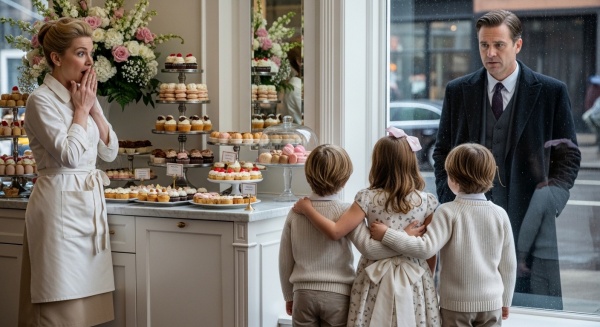
The man standing in the doorway was older than I remembered, sharper around the jaw, dressed in a charcoal overcoat that looked too expensive for our little bakery. His dark hair had a little silver at the temples now, and his face carried the polished exhaustion of someone who lived in airports and boardrooms. But I knew him. Before my mind found the name, my body remembered the storm. Elliot Hart. He stepped inside with two men in suits behind him, but he barely seemed aware of them. His eyes moved around the bakery, past the display case, past the chalkboard menu, past the line of customers. Then he saw the triplets.
Noah, Lily, and Caleb were at the corner table, coloring on paper bags while sharing a cinnamon roll the size of a dinner plate. Lily looked up first, curious. Noah followed, cautious. Caleb waved because Caleb waved at everyone. Elliot froze. His face lost all color. I knew exactly what he saw. Three five-year-old children with his eyes. “Grace,” he said. The sound of my name in his voice after five years nearly took my knees out from under me. One of the suited men leaned toward him. “Mr. Hart, are you all right?” Mr. Hart. The title hit me strangely.
Because in the years since that storm, Elliot Hart had become a name I had finally seen in magazines and business articles. Elliot Hartwell, founder and CEO of Hartwell Capital, a private investment firm based in New York, valued in the billions. The world called him a billionaire, a tech investor, a private equity genius, and one of the most influential young financiers in America. I had spent years thinking I had lost a card from an ordinary man. I had actually lost the only direct way to contact someone whose face appeared on business magazine covers. His full name was not Elliot Hart. It was Elliot Hartwell.
Noah slid out of his chair and walked toward me. “Mom?” I forced myself to breathe. “It’s okay, sweetheart.” Elliot’s eyes moved from Noah to me, then to Lily and Caleb. His voice was barely above a whisper. “How old are they?” I did not answer right away. The bakery was full. Customers were waiting. My employees were pretending not to listen and failing badly. “Five,” I said. He closed his eyes for one second. When he opened them, there was pain there. “Grace,” he said again, softer this time. “Can we talk?”
I wanted to say no. Not because I hated him. I had spent too many years surviving to keep hate warm. But I knew what would happen once that door opened. Questions, lawyers, DNA tests, custody discussions, explanations to children who still thought fatherhood was something other families had. “My office,” I said. I asked my assistant manager, Tara, to watch the counter and keep the kids busy. Elliot told the two men with him to wait outside. They looked uncomfortable but obeyed.
The bakery office was barely bigger than a pantry. It had a desk, a filing cabinet, a shelf of invoices, and a framed crayon drawing Lily had made of me wearing a crown and holding a rolling pin. Elliot stepped inside and looked too tall, too rich, and too shocked for the room. For a moment, neither of us spoke. Then he said, “Are they mine?” I leaned against the desk because my legs felt weak. “Yes.” He covered his mouth with one hand and turned away. I expected anger. Accusations. Maybe suspicion that I had hidden them on purpose for money. Instead, his shoulders shook once, and I realized he was trying not to cry.
“You knew?” he asked. “I knew there was a chance. Then they were born with your eyes, and I knew.” “Why didn’t you tell me?” The question was fair. It still hurt. “I tried,” I said. “Your card was ruined. I only had ‘Hart.’ I didn’t know your full name. The hotel wouldn’t give me your information. By the time I figured out who you might be, I had three premature babies, medical bills, no sleep, and no idea how to reach you without looking like someone chasing a billionaire for money.” He looked back at me, stunned. “You thought I would believe that?” “I didn’t know what you would believe. I knew you for one night.” His face twisted with guilt.
“I looked for you,” he said. That stopped me. “What?” “I went back to Charleston three months later. The hotel said you no longer worked there. No one would give me your contact information. I only knew your first name and that you baked apple turnovers like they belonged in a museum.” A laugh escaped me, broken and painful. “I searched for Grace, pastry chef, Charleston,” he continued. “For months. Then my mother’s estate issues exploded, my company went through a merger, and I told myself maybe you didn’t want to be found.” “I thought the same about you.” The silence between us filled with five lost years.
From outside the office, Caleb’s voice rang out. “Mom! Lily says I can’t be a dragon because dragons don’t eat muffins!” Lily shouted back, “I said real dragons don’t!” Elliot looked toward the door with an expression I could not name. “They’re really mine,” he whispered. “Yes.” He pressed his hand to the wall as if the room had tilted. “I missed everything.” I did not soften the truth. “Yes,” I said. “You did.”
Part 4: DNA, Lawyers, and Three Children Who Wanted Answers
Elliot did not try to buy his way into our lives that day. That was the first thing that surprised me. He did not demand the children be brought to him. He did not wave money around or threaten court. He asked what I needed, and when I said, “Time,” he nodded like it cost him something but he understood. We agreed to start with a DNA test.
Not because either of us truly doubted the truth, but because children deserve legal clarity, and adults need documents when emotions are this large. Elliot’s attorney coordinated with a family law attorney in Asheville, and I hired my own lawyer using money from my business savings because I wanted everything done properly.
The test came back three weeks later. Probability of paternity: 99.9999% for all three children. Noah, Lily, and Caleb Miller were Elliot Hartwell’s biological children. Seeing it in writing made me sit down in the bakery kitchen and cry into a stack of clean dish towels. I had thought confirmation would feel like relief. Instead, it felt like the past had become legally real.
Elliot cried too. He told me later he read the report alone in his hotel room and sobbed until he could not breathe. I believed him because when he came to the bakery the next morning, his eyes were red, and for once he looked less like a billionaire and more like a man who had discovered grief with three names.
We decided to tell the triplets carefully, with the help of a child therapist named Dr. Melanie Ross. The first conversation happened in her office, which had soft rugs, shelves of toys, and a bowl of peppermints near the door. Elliot sat beside me on a small couch that made him look absurdly tall. The triplets sat on the floor with stuffed animals.
Dr. Ross began gently. “Sometimes families learn new information that helps explain where people come from.” Caleb raised his hand like he was in school. “Is this about babies?” “In a way,” Dr. Ross said, smiling. I took a breath. “You know how you’ve asked about your dad before?” All three of them looked at me.
Noah’s face became serious. Lily held her stuffed rabbit tighter. Caleb stopped swinging his feet. I continued, “When you were born, I didn’t know how to find your dad. But recently, he found us.” Lily looked at Elliot. Elliot’s eyes filled, but he kept his voice steady. “I’m your father. I didn’t know about you until I came into the bakery. If I had known, I would have wanted to be there.” Noah stared at him. “All this time?” Elliot nodded. “All this time.” Caleb frowned.
“So you’re late?” A sound came out of Elliot that was almost a laugh and almost a sob. “Yes,” he said. “Very late.” Lily asked the question that broke my heart. “Are you going to leave?” Elliot looked at me first, as if asking permission to promise something. I gave a small nod. “No,” he said. “I am not going to leave. But I also won’t rush you. I’d like to get to know you if you want to get to know me.”
The triplets did not run into his arms. Real children rarely behave like movie children in moments that big. They watched him, questioned him, and spent the next hour testing him in small ways. Noah asked what kind of car he drove. Lily asked if he knew how to braid hair. Caleb asked if billionaires were allowed to eat cookies before dinner. Elliot answered every question seriously. “A black SUV, usually.” “No, but I can learn.” “I think billionaires have the same cookie rules as everyone else, unless your mother says otherwise.” Caleb looked disappointed by that last answer.
After that day, Elliot began visiting Asheville regularly. At first, he came once a week, then twice, staying at a hotel instead of trying to insert himself into our home. He attended therapy sessions, came to the bakery after closing, and sat at the corner table while the children taught him their rules. Noah warmed slowly. He watched Elliot like a small security guard, protective of me and suspicious of change. Elliot never pushed him. He let Noah decide when to sit beside him, when to ask questions, and when to walk away.
Lily was cautious but curious. She brought him drawings and asked if his office had a refrigerator for artwork. When Elliot said it did not, she looked personally offended. The next week, he texted me a photo of her drawing taped to a cabinet in his New York office with the caption: I have corrected the oversight.
Caleb accepted him fastest. Mostly because Elliot let him talk for thirty minutes straight about dragons, construction trucks, and why broccoli looked like tiny trees with bad attitudes. Caleb climbed into his lap during the fourth visit and fell asleep mid-sentence. Elliot looked at me over Caleb’s head with tears in his eyes. I had to look away.
Not because I was angry. Because part of me had imagined that sight for five years, and seeing it hurt more than never seeing it at all. The legal process moved slowly and respectfully. Elliot petitioned to establish paternity and parental rights, but he did not seek sudden custody. We worked with attorneys on a gradual parenting plan that centered the triplets’ emotional stability.
Then the tabloids found out. Someone saw Elliot at the bakery too many times. A photo appeared online with the headline: BILLIONAIRE INVESTOR’S SECRET TRIPLETS IN SMALL-TOWN BAKERY? By sunrise, my bakery phone would not stop ringing. Reporters came to the sidewalk. Customers whispered. Strangers online called me a gold digger, a liar, a saint, a victim, and a woman who had “trapped” a rich man.
None of them knew me. Elliot acted fast. His legal team sent privacy notices, and his public statement was short: “Three children are involved. Their privacy and well-being are my only priority. I ask the public and media to respect their safety.” He did not deny them. He did not hide us. That mattered more than I expected.
Still, the attention scared me. For years, my world had been small enough to manage. Suddenly, my children were being discussed by strangers who did not know their favorite bedtime songs or how Caleb cried when his socks felt “wrong.” One night, after the bakery closed, I found Elliot standing in the kitchen looking helpless. “I can make this quieter,” he said. “How?” “I can buy the building. Put security outside. Move you somewhere private. Pay off every loan. You’d never have to work this hard again.” His intentions were good. But my spine stiffened anyway. “Elliot,” I said, “I built this bakery before you walked through that door.
I raised those children before you knew their names. I don’t need you to rescue me.” He absorbed that. Then he nodded. “You’re right.” I expected defensiveness. He gave me humility instead. “What do you need?” he asked. I looked through the kitchen doorway at the corner table where our children had colored hundreds of paper bags. “I need you to be their father,” I said. “Not my landlord. Not my savior. Their father.” His voice softened. “I can do that.” And slowly, he did.
Part 5: The Family We Chose to Build
The first time the triplets visited Elliot’s home in New York, they behaved like tiny museum inspectors. His apartment overlooked Central Park and had more windows than walls. Noah asked how much the windows cost. Lily asked why there were no colorful pillows. Caleb asked if rich people were afraid of carpet because there was “too much shiny floor.” Elliot took every question seriously. By then, the parenting plan allowed weekend visits with me present, then eventually short visits without me. We did everything gradually because five-year-old hearts do not follow adult calendars. Elliot learned that money could speed up travel, lawyers, and logistics, but it could not speed up trust.
Trust came in smaller ways. It came when Noah let Elliot help him build a model airplane. It came when Lily asked him to attend her preschool art show. It came when Caleb woke from a nightmare during a weekend visit and called for “Dad” before remembering to be embarrassed. Elliot called me that night at 2:17 a.m. “He asked for me,” he whispered. I could hear Caleb sniffling in the background. “Then go be with him,” I said. There was a pause. “I don’t know what to do.” “Sit on the floor. Rub his back.
Tell him he’s safe. Don’t turn on all the lights.” “Okay,” he said, like I had given him instructions for defusing a bomb. The next morning, he sent a picture of Caleb asleep sideways across his bed, one foot on Elliot’s stomach. The caption read: I did not move for three hours. I may never walk normally again. Worth it. I laughed for the first time in days.
As months passed, Elliot and I became something harder to define than co-parents but more cautious than lovers. We had history, but it was only one night. We had children, but children are not a shortcut to romance. We had attraction, yes, but we also had five years of absence standing between us. He asked me to dinner one evening after the triplets’ sixth birthday. Not a business dinner. Not a custody discussion. A real dinner. I said no at first. He accepted it. That made me reconsider. Two weeks later, I said yes.
We went to a small restaurant in Asheville where the tables were too close together and the cornbread came in a cast-iron skillet. Elliot wore jeans, which made him look less like a magazine cover and more like the quiet stranger I had met during the storm. We talked about everything except lawyers, schedules, and money. He told me he had never married. There had been relationships, but none that lasted because he had become very good at leaving emotionally before anyone could leave him. His mother’s death had made him afraid of needing people. That stormy night in Charleston, he said, was the first time in years he had felt like someone saw the man under the success.
I told him I had been angry with him in ways that did not make sense. Angry that he had not found me. Angry that he had not known. Angry that I had done the hardest years alone while he lived in a world where private jets existed and childcare was probably something assistants arranged. He listened without interrupting. “I can’t give those years back,” he said. “But I can spend the rest of my life showing up for the ones ahead.” That was the first time I believed we might have a future not built only on accident.
A year later, Elliot moved part of his firm’s operations to Charlotte and bought a house outside Asheville. Not a mansion, though he could have. A warm, beautiful house with a big kitchen, a backyard, and enough bedrooms for the triplets to stop arguing over who had to share with Caleb. I did not move in. Not immediately. People online had opinions about that too. They thought I was foolish for not marrying him instantly or suspicious for not accepting more money. But I had learned that security is not the same thing as surrender. Elliot never pressured me.
He came to school events. He learned the pediatrician’s name. He kept snacks in his car and extra jackets in the trunk. He memorized which child hated tags in their shirts, which one needed quiet after social events, and which one would eat blueberries until physically stopped. He also learned to braid Lily’s hair. Badly at first. Then better. The day he finally managed two even braids, Lily looked in the mirror and said, “Acceptable.” Elliot texted me: This is the best performance review I have ever received.
When the triplets were seven, Blue Ridge Bakery expanded into the empty flower shop next door. Elliot offered to invest, and I said no. Then I changed my mind and asked if he would help me find a fair small-business advisor instead. He did. Not by taking over. By respecting the fact that the bakery was mine. That, more than any gift, made me love him. Because love, I learned, is not someone solving your life without permission. Love is someone standing beside the life you built and asking where they can place their hands.
Two years after Elliot walked into the bakery, he proposed. It happened on a rainy Saturday morning before opening. The triplets were in on it, which should have made me suspicious because they were terrible at secrets. Noah kept staring at me like a tiny FBI agent, Lily was wearing her “fancy” cardigan, and Caleb had powdered sugar in his hair at 7:00 a.m. Elliot stood near the same corner table where he had first seen them. “I met you during a storm,” he said. “Then I lost you. Then I found you again because three children with my eyes were eating a cinnamon roll in your bakery.”
I started crying before he even knelt. “You gave them life, Grace. You gave them a home, a family, and a mother strong enough to carry what should never have been carried alone. I cannot change the years I missed, but if you let me, I want to spend every year I have left loving you and raising them with you.” Caleb whispered loudly, “This is where you say yes.” Lily elbowed him. Noah said, “Let Mom think.” I laughed through tears and said yes.
We did not have a huge wedding. We married the following spring in a garden outside Asheville, with mountain views, wildflowers, and three children who insisted they were not ring bearers but “family representatives.” Denise, the NICU nurse, came from Charleston and cried harder than anyone. During the ceremony, Elliot made vows not only to me but to the triplets. “To Noah,” he said, “I promise to answer every question honestly, even the ones about engines, money, and why adults make mistakes.”
Noah nodded solemnly. “To Lily, I promise to hang every drawing in my office, even if my board members don’t understand unicorns.” Lily smiled. “To Caleb, I promise to keep emergency muffins available and to respect the emotional complexity of dragons.” Caleb gave him a thumbs-up. Then Elliot turned to all three and said, “Most of all, I promise I will never again let a day pass without being grateful that I get to be your dad.” There was not a dry eye in the garden.
Today, the triplets are nine. Noah wants to be an engineer, Lily wants to own an art museum and a cat café, and Caleb says he plans to be either a firefighter, a dragon scientist, or “the president of snacks.” Elliot is still learning fatherhood, and I am still learning how to let someone share the weight without feeling like I have failed. Blue Ridge Bakery is thriving.
There is now a framed photo near the register: me, Elliot, and the triplets standing outside the bakery under a soft gray sky. Customers ask about it sometimes, and I tell them the short version. A storm brought us together, life pulled us apart, and three children brought us back.
But the real story is more complicated. It is about loneliness, timing, fear, pride, and the strange mercy of second chances. It is about a ruined business card, a woman who raised triplets alone, and a man who walked into a bakery expecting coffee but found the family he never knew he had. Five years after one stormy night with a quiet stranger, a billionaire walked into my bakery and stared at my children like his soul had recognized them before his mind could. And maybe it had. Because some people enter your life like weather. Unexpected. Uncontrollable. Impossible to forget. And sometimes, after the storm passes, something beautiful is left behind.
