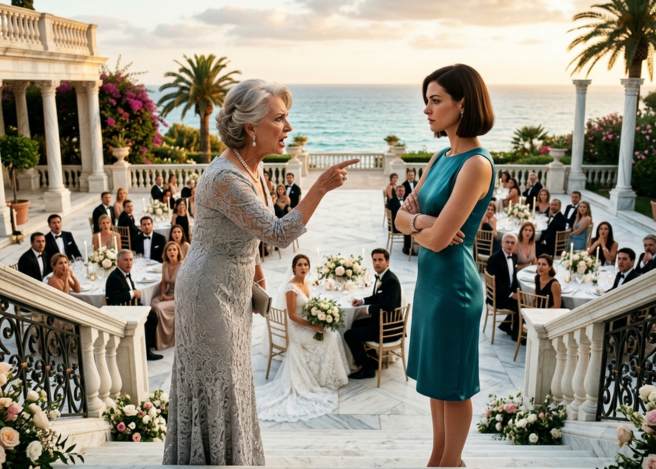
The Grand Ballroom at The Pierre Hotel in Manhattan smelled like old money and ten thousand imported white lilies, and the crystal chandeliers above us — each one the size of a small car — were casting a cold, brilliant light over four hundred people who had arrived in cars they did not drive themselves. It was the kind of room that has been designed, very deliberately, to make certain people feel they belong there and to make dissent feel like bad manners. I had been inside enough rooms like this to know the architecture was not accidental. Everything about The Pierre — the gold-leafed ceilings, the white tablecloths, the unhurried movement of waitstaff in black — was engineered to communicate that the appropriate response to whatever happened inside it was composed, gracious silence.
My father knew this. That was why he chose this room.
He tapped his crystal glass with a silver spoon at 7:42 PM, and the twelve-piece string orchestra stopped instantly, the way music stops when a man who signs the checks clears his throat. He walked to the podium with the deliberate pace of someone who has rehearsed the moment — not frantically, but carefully, the way you rehearse something you want to look unrehearsed. The spotlight caught the silver at his temples. Arthur Sterling had always been a handsome man, the kind whose authority reads as warmth from a distance, whose control looks like ease. He was very good at podiums. He was very good at rooms like this one. He had been performing versions of this gesture — the gathered family, the grand announcement, the theatrical gesture of generosity — since before I was old enough to understand that the generosity was always funded by someone other than himself.
He spoke about legacy first. He spoke about what it means to carry a name like Sterling, about the weight and privilege of a family that understands what it means to give, to sacrifice, to build something worth handing down. He used the word love four times in the first two minutes, which was three more times than he had used it in any private conversation with me in the past decade. The room listened with the attentiveness that well-dressed people reserve for moments they can feel will be retold at other dinners, at other parties, in other rooms just like this one. Then he said my name.
He said that I had decided — in the spirit of sisterly devotion, in the tradition of Sterling generosity, in the fullness of love for my younger sister on the most important day of her life — to give Vanessa and James the East Hampton waterfront estate as their wedding gift. The cliff mansion. The four-bedroom property on the Atlantic bluff that I had purchased four years earlier, in cash, on a quiet Tuesday afternoon. The home that had cost ten million dollars and belonged entirely, legally, and without encumbrance to me. He said all of this clearly, warmly, with the confidence of a man who had decided that announcing a transaction in front of four hundred witnesses was the same thing as completing it.
The room rose before he finished the sentence. Four hundred people stood. The applause was immediate and enormous, the kind that fills a ballroom and makes the air feel different, makes the chandeliers seem to sway. Four hundred phones went into the air simultaneously — the reflexive documentation of a moment that feels too good to risk not capturing. My sister Vanessa, standing at the reception dais in her $60,000 Vera Wang gown, pressed both hands over her mouth. Her eyes filled with tears that arrived with perfect timing, the way tears do when they have been considered in advance. She turned toward me across the ballroom and said, into a microphone that was closer than she had perhaps calculated, that I was giving her the mansion. The estate on the cliff.
My mother, seated two chairs to my left, was already looking at the room rather than at me — taking in the reflected approval of New York’s social elite, the image of the Sterling family that this moment was cementing in four hundred memories at once.
I sat perfectly still and gave them eight seconds of applause.
Then I stood up.
Part 2: The Woman No One Was Looking At
Before I stood up, there was a moment — maybe three seconds, maybe five — in which I sat at the family table in that ballroom and experienced the specific, clarifying sensation of seeing a situation completely. Not angrily. Not panicked. With the same precision I bring to a term sheet or a due diligence call, the kind of seeing that happens when emotion steps aside long enough for assessment to take over. I had been in negotiations where the counterparty used announcement-as-fait-accompli — where a term was declared publicly, early, in front of stakeholders, in the calculated hope that the social cost of contradiction would exceed the cost of compliance. I had sat across tables from men who did this with a great deal more sophistication than my father had just deployed, and I had corrected the record every time, calmly and without drama, because the alternative was agreeing to something I hadn’t agreed to.

The mechanics of the trap were not subtle. The room was perfect — four hundred members of New York’s elite, all of whom would carry this story forward, most of whom would remember me either as the woman who gave her sister a mansion or the woman who refused to, and in a social ecosystem like this one, refusal would be the version with the sharper edges. The timing was perfect — my sister’s wedding, the highest-stakes emotional venue a family can manufacture, a room full of white flowers and sentimental music where no one expects a woman to do anything other than cry or smile. My sister’s performance was perfect — the hands at the mouth, the tears, the soft whispered repetition into a live microphone. Even the applause was a weapon, the kind of sound that makes everyone in the room feel they have already witnessed a resolution and any amendment to it would be cruel.
What they had miscalculated was very simple. They had confused my quietness with softness. I had been quiet for eleven years because silence had been the efficient choice, not because I lacked the capacity for something else.
I thought about the East Hampton estate in the moment before I stood. I thought about the morning I had driven out to see it for the first time, before the purchase was final, when the real estate agent had left me alone on the bluff for twenty minutes and I had stood looking at the Atlantic and felt — for the first time in a professional life spent in offices, on calls, in conference rooms with insufficient light — that I was standing in a place that had room enough for the version of myself I had not yet become. I thought about the Tuesday afternoon I had signed the papers and wired the funds and driven back to the city alone, not telling anyone for three days because I wanted to hold the fact of it privately, cleanly, before the family found a way to absorb it into their own narrative. I had known, even then, that once they knew about the estate, it would begin to belong a little less to me and a little more to the idea of what the Sterlings owned collectively.
I had been right about that. And now I was watching the logical endpoint of eleven years of that pattern play out on a podium in the Grand Ballroom of The Pierre Hotel, in front of four hundred witnesses and three dozen video recordings, and I had perhaps thirty more seconds before silence became consent.
I stood up.
Part 3: What I Gave Them — And What It Cost Me
To understand the evening in the ballroom, you need to understand the eleven years that preceded it, because what happened at that wedding was not a single incident. It was a culmination. It was the final expression of a family dynamic that had been operating quietly, efficiently, and entirely at my expense for longer than I had been willing to name.
I had built Sterling Capital Management from a $40,000 personal loan I took from a credit union in Hoboken, New Jersey, when I was twenty-seven years old, with one client — a retired civil engineer named Harold Beaumont who had $200,000 in retirement savings and trusted me more than I had earned. I had taken his trust seriously enough to build something real around it. By thirty-two, I had eight clients and $12 million under management. By thirty-six, I had forty-one clients and just under $300 million. By thirty-eight, when my father tapped his crystal glass in the Grand Ballroom, Sterling Capital was managing $1.9 billion in assets for a client base that included institutional investors, family offices, and seven individuals with a net worth above nine figures. I had built it alone, in the sense that no one from my family had contributed capital, connections, or labor. They had contributed something else. They had contributed the specific form of emotional leverage that families are very good at — the language of love used to justify extraction.
The first transfer had been Vanessa’s college tuition. I was twenty-nine and my firm was two years old and barely profitable, and my parents had called to say that the tuition payment for Vanessa’s junior year at Georgetown was going to require them to liquidate a portion of my father’s retirement account, and they were asking whether I was in a position to help. They used the word help. I wired $38,000 within the week because the alternative was watching my father reduce his retirement security and I had decided I could absorb the cost. I did not frame it as a loan. I did not ask for documentation. I told myself that family didn’t work that way, that the accounting would balance itself out in other currencies over time, and I believed this because I was twenty-nine and I had not yet learned that the accounting never balances itself out unless someone insists on keeping it.
The next transfer was the Connecticut renovation, the year I turned thirty-three, when my parents’ kitchen and master bath were deemed uninhabitable by standards that seemed to have risen significantly after my firm’s first strong performance year. I paid $127,000. It was framed as a loan. We both understood it was not. The year after that, Vanessa needed a down payment on a West Village apartment, and the year after that she needed the moving costs and the furniture and the first and last month’s rent on a studio she could not afford while she pursued a career in art that required, apparently, a very great deal of financial infrastructure. I paid all of it. Not because I was asked in a way I could refuse, but because the asking was always done in the language of family, of love, of what do you do with abundance if not share it, and I had not yet developed a clean vocabulary for drawing a boundary in that language without sounding like someone who had forgotten where they came from.
What I had actually forgotten was something different. I had forgotten — or perhaps allowed myself not to notice — that the giving never produced reciprocity, never produced acknowledgment, and most critically, never produced an endpoint. Every transfer recalibrated what the family expected from the next one. Every inch of generosity expanded the perimeter of what they considered their right to access. By the time I purchased the East Hampton estate, I had transferred — not lent, transferred — just over $1.3 million to my family over eleven years, and not one of those transfers had been met with anything that resembled a conversation about whether the arrangement was sustainable, equitable, or likely to change.
What it had produced was the announcement in the Grand Ballroom. They had looked at my track record of quiet, uncontested giving, and they had concluded that the estate on the cliff was simply the next thing. They had not thought to ask. They had not thought to wonder whether I might have a different view of the matter. Giving this family an inch had not earned me respect. It had convinced them they owned the mile.
Part 4: The Refusal
I stood up in the Grand Ballroom and I did not rush.
That is the part that surprised people in the room, I think — the absence of urgency. The people who tell this story afterward often mention that what they expected was a flustered objection, a red-faced correction, a woman scrambling to manage a situation that had gotten out from under her. What they got was the opposite. I had been standing in front of rooms full of people who needed to hear something they didn’t want to hear since I was twenty-seven years old. I had delivered news that reduced portfolios, adjusted expectations, and revised terms that clients had become emotionally attached to, and I had learned — through a great deal of trial and error — that the delivery is almost entirely a matter of pace. People hear what you say if you say it slowly enough for them to actually receive it. If you rush, they hear the urgency and miss the content.
I said first that I was grateful for the evening and that my sister was beautiful and that I wished her and James every happiness they had the capacity to build together. I meant all of it. My difficulties with my family had never extended to Vanessa herself, who was a person with her own complications and her own limited understanding of what had been happening on my end of the arrangement. I said the kind things first because they were true and because the room needed to understand that what came next was not a tantrum.
Then I said that the East Hampton estate was mine, that no gift had been discussed or agreed to, and that the announcement my father had just made — in front of four hundred people, into a live microphone — had been made without my knowledge or consent. I said this clearly, at the same pace I had used for the kind things, with the same level of vocal steadiness, looking at the room rather than at my father, because I was not correcting him privately. He had made a public statement. I was making a public correction.
The room made no sound at all.
My father’s smile held for approximately four seconds. It was interesting to watch — you could see the precise moment it shifted from genuine to effortful, from the expression of a man executing a plan to the expression of a man recalculating. He did not speak. Beside him at the dais, James had gone very still in the particular way of a man who has just understood that the transaction he believed completed is not, in fact, completed. Vanessa’s hands were still pressed to her mouth, but the tears had stopped, the way tears stop when the performance they were supporting has encountered an unforeseen variable.
My mother moved first.
She came across the ballroom floor with the specific velocity of a woman who has never been publicly contradicted and has no intention of allowing the experience to continue. She reached me at the family table and she did not lower her voice. She said I was humiliating the family in front of everyone who mattered. She said my success had made me cold, transactional, and difficult to love. She said Vanessa deserved more from a sister who had so much to give, and she said all of this at the volume of someone who understood, on some level, that the microphones in the room were live and the phones were still recording, and who had decided that making me the aggressor in the narrative was worth any cost.
Then she slapped me across the face.
Open palm. Left cheek. In a room I had funded, at a wedding I had paid for, wearing jewelry that had been a birthday gift from me three years prior. The sound was sharp and very clear in the silence of the ballroom. Four hundred people heard it. The phones that had gone up to record the announcement were still recording.
Nobody moved. Nobody spoke. The only sound in the Grand Ballroom at The Pierre Hotel was the settling of that moment into the memory of everyone who witnessed it.
Part 5: The Clause
I touched my cheek once, the way you confirm a thing you already know.
I had been hit before — not by my mother, but I had been in rooms where people lost control in the specific way that people lose control when they realize they are not going to get what they came for. I had learned that your response in those seconds shapes everything that comes after. If you match the energy, you become part of the chaos and the chaos belongs to both of you equally. If you don’t — if you take the moment and hold it, quietly, and let the room see the difference between what just happened and how you’re choosing to respond — then the moment belongs entirely to you.
I set my evening bag down on the table. I looked at my mother for a long moment. And then I said to her, quietly and only to her, in a voice that did not carry to the microphones: that she had just triggered the morality clause.
She did not know what I meant. That was fine. She would.
In 2019, the year after I purchased the East Hampton estate, I had restructured my personal financial arrangements on the advice of my attorney, Elena Marsh, who had been working with me for six years by that point and who understood my family situation with enough precision to anticipate scenarios that I had not yet articulated clearly even to myself. The Sterling Family Holding Trust — the legal vehicle through which I had been organizing and executing transfers to my family — had been rewritten to include two specific provisions. The first required written and witnessed consent from all named parties before any Sterling family asset could be publicly announced, transferred, pledged, or described as a gift to any third party. The second provision specified that any documented act of family coercion — including but not limited to physical aggression witnessed by third parties, financial threats, or reputational manipulation — would initiate an immediate and automatic asset review, during which all distributions from the trust would be suspended pending resolution.
My mother had slapped me in front of four hundred witnesses and an undetermined but substantial number of video recordings. The first provision had already been violated by my father’s announcement. The second had just been violated comprehensively.
I picked up my evening bag. I said goodnight to the room — to the room, not to my family — and I walked out of the Grand Ballroom through the main lobby of The Pierre and through the revolving door onto Fifth Avenue. It was a warm June evening. The city was still moving — taxis, couples walking, the steady indifferent traffic of Manhattan on a Saturday night. I stood on the sidewalk for a moment, in my teal cocktail dress, and I felt — with a clarity that surprised me — nothing that needed to be managed. I was not shaking. I was not crying. I was not running the scenario backward looking for the moment I could have prevented it, because there was no such moment. The evening had gone exactly the way it was always going to go once my family decided to do what they had decided to do. The only variable had been my response, and I had responded correctly.
I took out my phone and called Elena Marsh. She answered on the second ring, the way she always does, because I pay her retainer at a level that makes the second ring a professional obligation. I told her it had happened. She said she had the paperwork staged. She asked whether there had been physical contact. I said yes, in front of four hundred witnesses and multiple video recordings. I heard her exhale — not with surprise, but with the particular satisfaction of a lawyer whose preparation has just been entirely vindicated. She said she would have the review initiated within the hour and the formal notification sent to all parties before midnight.
I thanked her. I hung up. I stood on Fifth Avenue and watched a man walk a very old dog with the careful, tender slowness of someone who has nowhere to be and understands that this is a privilege.
Part 6: What the Trust Review Found
The review was initiated at 9:47 PM, while the reception at The Pierre was still serving its third course. Elena had assembled the documentation quickly because the documentation had been sitting ready in a folder labeled with the date range I had told her to expect — not the exact date, because I had not known the exact date, but the window. I had told her in March, after the wedding invitation arrived and I understood from its tone and its timing and the six preceding months of my mother’s increasingly pointed remarks about the estate what was being planned, that the event would likely occur at the wedding or in the weeks surrounding it. I had told her to keep the review paperwork accessible. She had, and now it was filed, and what it would reveal over the following weeks was something I had known was there but had not looked at directly in some time.
The Sterling Family Holding Trust had been funding my parents’ Connecticut lifestyle for six years. Not partially — comprehensively. The property tax on the Connecticut home, which was substantial, had been running through the trust since 2020. The maintenance and staffing costs — a groundskeeper, a housekeeper who came twice weekly, a landscaping service that maintained the property through four seasons — had been running through the trust since the same year. My parents’ health insurance supplemental coverage, their vehicle insurance on two cars, the membership at the club in Westport where my father played golf — all of it had been structured through the trust in arrangements that, I had been told by the accountant who set them up, were efficient and unremarkable. I had not reviewed the arrangements in detail in eighteen months because I had been managing a firm and I had trusted the people I had hired to manage the arrangements.
The review found that the total annual cost of maintaining my parents’ lifestyle through the trust had been running at approximately $340,000 per year for the past three years. Not including the direct transfers I had made for specific requests. Not including the wedding funding. Three hundred and forty thousand dollars annually, automatically, through structures that had been so normalized in the accounting that I had stopped registering them as choices. What the review also found — and this was the part that Elena called me about at 11:15 PM, still on Fifth Avenue because I had not moved far — was that my father had, in the previous four months, quietly engaged a real estate attorney on a question related to the East Hampton estate. He had not told me. He had not consulted Elena. He had engaged his own attorney to explore the question of what conditions would need to exist for an announced familial gift to have standing as a binding commitment, if the announcement had been made publicly and the recipient had expressed reliance on it.
He had been building a legal argument. Before the wedding. Before the announcement. He had been building a legal argument for why the estate should transfer to Vanessa whether I agreed or not, predicated on the public announcement he was planning to make. The announcement had not been spontaneous. It had been the last step in a strategy.
Elena’s voice, when she told me this, was very calm and very specific, the voice of someone who has seen a great deal and is no longer surprised by most of it. She said that the pre-planning changed the character of the event significantly — that it moved the evening from an impulsive overreach to a coordinated attempt to use the public announcement to create a fait accompli, which, combined with the physical coercion that followed, gave us a position that was substantially stronger than a simple refusal would have produced. She said the word position the way lawyers say it, meaning advantage. She said we had it.
I thanked her again. I went home. I made tea. I sat in my apartment on the forty-third floor and watched the city below me, the way I had watched it the night I took on Harold Beaumont as a client and understood, for the first time, that I was building something real.
Part 7: By Midnight
By midnight, the trust review was formally underway and the distributions had been suspended. The suspension was automatic — a provision of the morality clause, not a decision I made in anger or in real time. It was a mechanism that had been designed and agreed to by my attorney and structured into the trust for exactly the circumstances that had occurred. I had not made it happen. The evening had made it happen, and the evening had been made by choices that were not mine.
By the following Tuesday, my parents had received formal notification from Elena’s office that the Sterling Family Holding Trust was under review and that all distributions, including the property tax coverage, the maintenance and staffing costs, and the supplemental insurance coverage, had been suspended pending the outcome of that review. My father called me once, on Wednesday morning, and I did not answer. He did not leave a message. My mother called three times over the following week, and I did not answer those either, because there was nothing she could say that would change what the review had already found, and there was nothing I wanted to say to her that would not be better said through the process that was already underway.
Vanessa called on the Thursday after the wedding, not from her honeymoon — she and James had apparently delayed their departure — and what she said surprised me slightly, which is to say that it was more honest than I had expected. She did not begin with an apology, but she did not begin with an accusation either. She began by asking whether I was alright. I said that I was. She was quiet for a moment and then she said that she had not known about the announcement in advance — that my father had told her it would be a surprise, and that she had understood there had been some prior arrangement, some conversation she had not been included in. I believed her about not knowing the specifics, because Vanessa had always been good at receiving without asking too many questions, which is a different thing from being complicit. We talked for twenty-two minutes. We did not resolve anything. But we talked, which was more than we had done honestly in years, and it was something.
Three months after the wedding, my parents’ access to the trust remained suspended pending resolution of the legal proceedings that had developed from the review. The Connecticut home required, in the absence of trust distributions, a restructuring of expenses that my parents were managing with some difficulty. My father had retained his own attorney — a different one from the real estate attorney, a litigator — and the question of whether the public announcement constituted a binding commitment was still, as of this writing, being argued. Elena was not concerned. The evidentiary position was straightforward, particularly given the video documentation of the evening and the discovery of my father’s pre-planning. The morality clause provision had been drafted specifically to address scenarios of coordinated family coercion, and what the discovery had found was that the scenario was more coordinated than even I had understood at the time.
Vanessa and James moved from their West Village apartment — the one I had funded the down payment on — to a rental in Brooklyn three months after the wedding, for reasons related to their own financial situation that I did not entirely understand and did not ask about. We text occasionally. I am not sure what we will be to each other when the legal process is complete, and I have stopped trying to know in advance. The East Hampton estate is still mine. I was out there the first weekend of every month through the summer, the way I always am. The Atlantic faces the bluff the same way it always has, indifferent to the drama of the previous season, doing what it has always done.
I did not build a private equity empire by being a doormat. I built it by understanding, eventually, that generosity without limits is not love — it is a slow, polite transfer of power to people who did not earn it and will not stop taking it until something stops them.
Something stopped them.
