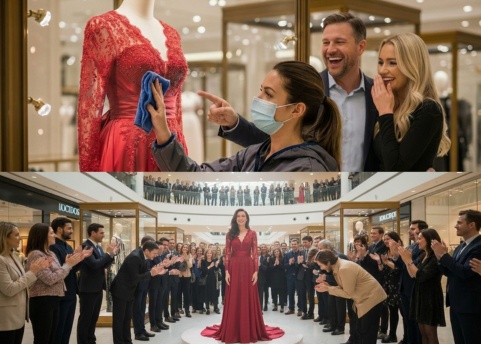
He flicked three crumpled bills onto a maintenance cart and told her she couldn’t afford a single sleeve of that dress if she saved every cent for ten lifetimes. Four minutes later, the entire ballroom rose when she entered the room. And the dress she was wearing was the exact one he had just mocked her for staring at.
He didn’t see it coming. Nobody in that atrium did. But Emily had always understood something about power that Daniel never learned: the people who hold it quietly tend to hold it longest.
This is the story of what happened at Sterling Crown Center on a Friday evening in November. It is also the story of what happened in the seven years before that — the years nobody saw, the years that built everything worth having, the years that made the moment in that ballroom inevitable.
I am going to tell you all of it.
Part One: The Man Who Arrived Desperate
Daniel Hayes had the shoes of a man who had made it and the shoulders of a man who knew he hadn’t. Italian leather, bespoke fit, polished to a mirror finish — and yet, to anyone watching him walk through the entrance of Sterling Crown Center that Friday evening, something in the way he carried himself suggested that the exterior was working harder than the interior. His hand straightened his jacket at the door. His jaw was set in the particular way of men who are performing confidence rather than feeling it.
He had been performing for almost a year.

Hayes Urban Development had once been a legitimate force in New York’s commercial real estate sector. Three years ago, Daniel’s name had appeared on a dozen industry lists. Two years ago, he had been featured in a profile piece about rising developers under fifty. Eighteen months ago, the wheels had started coming off — quietly at first, then loudly, then catastrophically. Three flagship projects had stalled. One had collapsed entirely. Contractors were filing claims. Lenders were sending letters that stopped sounding polite. Shareholders were making calls that stopped being questions and became demands.
By the time Daniel walked into Sterling Crown Center that November evening, his company had roughly thirty days before it ceased to exist in any meaningful legal sense. The only thing standing between him and complete financial ruin was a renewal agreement with Sterling Crown Holdings — the parent company of the building he was standing in, and the company whose private gala he had spent four weeks pulling every available string to be invited to. If he secured a new contract tonight, he bought time. Time to restructure, time to recover, time to possibly save what was left.
If he failed, the market would hear about it by morning.
Beside him was Vanessa, his companion for the evening. She was twenty-six years old and striking in the way of someone who had always relied on being noticed. Her white dress sparkled under the atrium chandeliers, though a closer inspection would have revealed it was the kind of sparkle that needs the right lighting to maintain its illusion — an observation Emily, had she been paying attention, would have made in about four seconds and said nothing about. That was always the difference between those two women. Vanessa said everything she noticed. Emily said only what mattered.
The Grand Atrium of Sterling Crown Center was, by any objective measure, beautiful. Marble floors the color of cream. Crystal chandeliers that made the light itself feel expensive. Designer storefronts glowing behind polished glass. A soft piano arrangement floating through the air as though even the acoustics had a dress code. This was not a shopping center. It was a cathedral built for commerce, and it asked everyone who entered it to perform accordingly.
Daniel and Vanessa walked through the luxury wing toward the private elevators.
That was when he saw her.
Part Two: The Woman in the Gray Jumpsuit
She was standing near the display window of an elite couture boutique, and there was nothing about the first glance that should have made him stop. A woman in a gray work jumpsuit. Hair pinned back in a loose bun. A folded microfiber cloth in one hand. Eyes fixed on the glass as though memorizing what was on the other side.
Daniel slowed.
He knew that silhouette. Not the clothes — he had never seen those clothes — but the way she stood. The particular tilt of weight to the left. The stillness. The quality of attention she gave to whatever she was looking at, complete and unperformed, as though no one in the world was watching and it wouldn’t matter if they were.
He had not seen Emily in seven years. He had not thought about Emily in far less time than he wanted to admit.
She turned slightly, and the breath left his chest.
Seven years older. Faint lines near the eyes that had not been there before. But those eyes — the same steady clarity, the same unhurried calm — those were exactly as he remembered them, and for one strange, tilted second, he was back in a different time entirely. He was twenty-nine years old and nobody, and she was sitting across from him in a small apartment, reading his proposal drafts aloud and marking the weak sentences, telling him he would build something worth building.
He said her name. She turned.
She looked, if anything, mildly inconvenienced by the interruption.
Behind the glass, on the mannequin she had been studying, was a deep crimson evening gown — fitted, luminous, covered in hand-sewn stones that caught the light like live embers. A placard beside it read: Ember Reborn. Exclusive. One of One. It was the kind of piece that existed not to be sold but to be witnessed, the centerpiece of a collection, the dress that made everyone in the room understand what the designer was trying to say about beauty and endurance and the things that survive fire.
Daniel looked at the dress. Then he looked at Emily. Something ugly moved across his face.
He had spent seven years telling himself the divorce had been reasonable. Strategic. Necessary. Emily had been wonderful in the early years — patient and capable and genuinely good in the way of people who haven’t yet learned that goodness can be used against them. But once his career took off, her quietness became liability. She didn’t perform well at business dinners. She didn’t say the right things at the right parties. She didn’t fit the image he was building, and the image, Daniel had decided, was everything. So he had restructured his personal life the same way he restructured deals: cut what wasn’t performing, acquire what would.
He had handed her a settlement centered around a deteriorating house on the outskirts of town — one that needed more in repairs than it was worth — and walked away without once looking back.
And now here she was, standing in a janitor’s uniform, pressed against a boutique window she could not afford to enter.
The satisfaction that moved through him was immediate and ugly and, in the way of small people in large moments, irresistible.
He walked over.
Part Three: Five Crumpled Bills
He came with Vanessa on his arm and the particular posture of a man who has decided that someone else’s fall is evidence of his own rise. His heels clicked across the marble like punctuation.
Emily turned to face him fully. She said nothing. She held his gaze with the same calm she had always held difficult things — not detachment, not coldness, but a settled quality, like a person who has long since decided what they will and will not give to a moment.
Daniel glanced at the gown behind the glass. He said it was beautiful. Emily agreed that it was. He gave a low laugh and told her beauty like that belonged to women who moved in the right circles. Vanessa added something about cleaning the windows. Daniel laughed louder, encouraged, and reached into his pocket.
He pulled out a few crumpled bills. He dropped them onto the maintenance cart near where Emily stood. He told her it was a tip. For her hard work. He told her that if she saved every cent, she might — in ten lifetimes — be able to afford one sleeve of that dress. He leaned closer and lowered his voice and said: women like you wipe the fingerprints off the glass so women like Vanessa can admire what’s inside.
Vanessa laughed.
Emily looked at the bills on the cart.
Then she bent, picked them up carefully, smoothed them with her fingers, and held them out toward him.
Daniel stared.
She told him he should keep it. She had heard his company was delaying contractor payments again. As for the dress — she said it quietly, without drama, looking directly at him — sometimes people don’t need to touch something to know it already belongs to them.
She placed the bills into his open hand.
She turned and walked through a discreet door marked Staff Access Only, and the door closed behind her without a sound.
Daniel stood with the bills in his palm. Vanessa said something he didn’t register. He told her Emily was poor and delusional. He said it with conviction. But something about the way Emily had spoken — the completeness of it, the absence of any need for his reaction — settled in the back of his mind like a stone dropped into still water.
He checked his watch. The gala would begin in minutes.
He put the bills back in his pocket and walked toward the elevator.
Part Four: The Woman They Were All Waiting For
The Crown Ballroom occupied the entire top floor of Sterling Crown Center, and it was the kind of room designed to remind you that you were in the presence of serious money. Arched ceilings. Crystal chandeliers. String musicians near the far wall. Staff in white gloves. The floor was polished to a mirror finish, and the people standing on it had been carefully selected — investors, executives, policy advisors, board members — because an event like this was not a party. It was a negotiation conducted in formal wear.
Daniel worked the room with practiced skill. He smiled. He shook hands. He spoke with calm authority about the future of urban development, the resilience of his firm, his vision for the next phase. He was very good at this — the performance of confidence — and it served him well for the first half hour.
But everywhere he moved, he heard the same thing.
She was coming in person.
She had inspected the building herself that afternoon.
They said she noticed everything.
They said she never forgot a face.
Daniel’s champagne glass was very cold in his hand.
Then the lights shifted. The music paused. The master of ceremonies stepped forward. The room gathered itself, the way rooms do when someone worth waiting for is about to arrive.
The name announced was: Emily Sterling.
The doors at the top of the sweeping staircase opened.
A woman stepped into the spotlight.
She was wearing the crimson gown.
Not something similar. Not an identical copy. That exact dress — Ember Reborn, the one from the boutique window, the one Daniel had mocked her for looking at twenty minutes ago. It moved like liquid fire around her as she descended the staircase, the stones catching the chandelier light and scattering it across the entire room. Her hair, the same hair he had seen pinned back in a loose bun, was now swept into an elegant arrangement that revealed the line of her neck and made everything else in the room look like it was adjusting to accommodate her. She moved without hurry. Without uncertainty. As though the building had been designed around the expectation of her arrival, because it had been — she had designed it that way herself.
At the base of the stairs, in a single coordinated motion, the staff lining the ballroom bowed.
Good evening, Madam Chairperson.
The words moved through the room like a tide.
Daniel’s champagne glass slipped slightly in his hand.
Vanessa’s fingers tightened painfully around his arm. No, she whispered. No way.
But every face in that ballroom confirmed it. Respect without performance. Deference without theater. The particular stillness of people in the presence of someone who actually holds power rather than merely claiming it. International investors turned toward her. Board members straightened. City officials waited for her attention the way people wait for weather.
Emily Sterling.
Chairperson and CEO of Sterling Crown Holdings.
The empire.
The building.
The dress.
All of it, hers.
Daniel thought: impossible. And then, immediately: how.
And then — because even desperate men sometimes arrive at honesty under sufficient pressure — he thought: of course.
Part Five: The Reckoning in the Ballroom
She moved through the crowd with the command of someone who had long ago stopped needing rooms to adjust for her — they simply did, because she had built the habit of deserving that in thousands of smaller rooms, over many years, before anyone was watching. She greeted people by name. She accepted congratulations with a composed smile and listened more than she spoke. People leaned toward her. Waited for her reaction. Watched her face for signs of favor.
Then her gaze found Daniel across the room.
He saw the recognition. He saw the absence of surprise. He saw the small, quiet thing that moved across her expression and settled into something that was not quite pity and not quite contempt — something more precise than both.
She excused herself from the diplomat she was speaking with. She handed her champagne to a server. She walked toward him, and the crowd parted in the way crowds do when they understand without being told that something important is happening.
Daniel tried to assemble a sentence. What came out was broken and small.
He said he was sorry for what happened downstairs. He said if he had known —
She finished the sentence for him: if he had known she owned the building.
His mouth opened and closed.
She asked how she looked in the dress.
A ripple of uneasy amusement moved through the people nearest to them. Daniel stared at the floor for half a second and said she looked beautiful. Her lips curved, but the smile held no softness.
She asked: am I smudging it?
Laughter — cautious, controlled — from the people around them who had been pretending not to listen.
Daniel’s face burned. He said he had made a mistake. He said he was under pressure. He said he hadn’t meant —
She told him he had meant every word.
There was no anger in her voice. Somehow that made it worse. Anger would have given him something to argue against. This was something else — the particular precision of a person who has spent years thinking carefully and speaks only when the thinking is complete.
She told him what she had been doing downstairs. Not visiting. Not shopping. Not cleaning. She had been inspecting the display herself, the way she always does before a major event, because she wanted to see her properties with her own eyes. She wanted to know whether her teams were being supported, whether standards were being met, whether details were respected. She told him that every role mattered to her: the cleaner, the server, the assistant, the driver — the people who actually keep a place running while men in Italian shoes walk through and assume they built it.
She said: the only thing I find embarrassing is a person who mistakes dignity for status.
Vanessa quietly detached herself from Daniel’s arm and took a step back.
Daniel drew in a shaky breath and said something about change. He said seven years was a long time. He said people grow. He said he had grown.
For the first time, something harder moved behind Emily’s eyes.
She said: have you. Because seven years ago, you discarded a marriage the moment loyalty stopped being useful to your image. And ten minutes ago, you mocked a woman you believed had fallen below you. That is not change. That is consistency.
The words landed with surgical precision and no particular heat. She was not performing this. She was just saying it.
Daniel’s shoulders sagged.
He no longer looked like a CEO. He looked like a man seeing himself reflected with brutal clarity for the first time in a very long time.
Natalie Brooks, Sterling Crown’s chief legal officer, appeared at Emily’s side. Emily turned slightly toward her. She said, in a voice that carried just enough for the nearest guests to hear: I’ve made my decision regarding Hayes Urban Development.
Daniel’s head snapped up. Emily. Please.
She did not look at him.
There will be no extension, she said. No restructuring agreement. No renewal.
Daniel stepped forward. His voice was ragged. If this falls through, he said, my company is finished.
Emily met his gaze one final time.
She said: if a man can discard loyalty in his personal life so easily, I have no reason to trust him in business. Sterling Crown does not partner with people who confuse arrogance with leadership.
A pause. Then, calm and final:
And I don’t rescue men who had no mercy when they held the power.
Two security officers in dark suits stepped forward. Polished. Professional. Inevitable. Vanessa was already gone — somewhere in the crowd, moving away, gathering her clutch, making the particular calculation of a woman who understands that a sinking ship requires departure rather than loyalty. Daniel was escorted across the polished floor under the eyes of everyone who mattered in his industry, in full view, with no remaining illusion of dignity.
The whispers had already begun by the time he reached the elevator.
Part Six: The Corridor Outside
In the corridor beyond the ballroom, Daniel stood motionless.
The company was finished. That was the first thought, clinical and factual, arrived before the emotions could crowd it out. The contract was dead. By morning, the news would travel — these things always did, and this particular humiliation had happened in front of too many people with too many phones and too many industry connections for it to stay contained. Investors would withdraw. Lenders would accelerate timelines. Board members would distance themselves before the week was over.
That was the practical reality.
But underneath it, slower and heavier, came the other truth.
He had built his career on a set of beliefs about worth. About who deserved what. About which qualities were valuable and which could be discarded. Emily had been patient when patience was useful to him, capable when capability was useful to him, devoted when devotion was useful to him. And when none of those things fit the image anymore, he had reclassified her as expendable. He had handed her a broken house and called it fair and walked away and told himself she would be fine because she had always been fine and people like Emily just were, without any particular effort or design.
He had been wrong about that.
He had been wrong about almost everything.
She had not simply survived the years after the divorce. She had worked with a deliberateness he could not have imagined, because imagining it would have required him to believe that her capabilities had always existed and he had simply chosen not to see them — and that was a thought he had not been equipped, at thirty-two, to hold. She had renovated the house herself. Sold it at a profit. Studied. Built partnerships. Acquired properties everyone else overlooked. Learned to negotiate in rooms full of men who assumed she was decorative until she outperformed them. Brick by brick, deal by deal, she had built something so solid that when the past finally appeared in a shopping mall atrium, mocking her for looking at a dress she already owned, she didn’t need to do anything. She just picked up the bills and told him to keep them.
He stood in the corridor for a long time.
At no point did she come through the doors after him.
Part Seven: What Was Happening Inside
While Daniel stood in the corridor, Emily accepted a glass of champagne and thanked the server by name. She asked a staff member whether his daughter’s school play had gone well. She complimented the floral director on the arrangement at the main entrance. She noticed a junior employee standing too rigidly near the stage and offered a reassuring smile that immediately softened the young woman’s posture.
That was the thing Daniel had never understood. That was the thing most people who had only ever thought about power as performance couldn’t understand.
Power was not in being feared by those below you.
It was in making people stand taller in your presence.
She moved through the room for another hour, meeting with a visiting investment delegation from Singapore, approving a partnership outline with a Scandinavian hospitality group, quietly redirecting a conversation that was heading somewhere unproductive. She did all of this without drama, without display, without any of the theatrical authority that smaller people mistake for leadership.
Later, after the formal program ended, she stepped alone onto the private terrace overlooking the city.
Manhattan stretched before her in rivers of light. Traffic murmured below like distant surf. She had stood on this terrace before, many times — during negotiations, after difficult meetings, on evenings when the decisions had been harder than they looked from the outside. She had learned to find a specific kind of quiet here, not emptiness but proportion. The city below reminded her of scale. Of the fact that most problems, seen from sufficient height, resolved themselves into something manageable.
Natalie joined her quietly.
They stood together for a moment without speaking.
Then Natalie said: you handled that better than most people would have.
Emily looked out at the skyline. She said: I didn’t do it for revenge.
I know, Natalie said.
Do you regret seeing him?
Emily considered the question honestly, which was the only way she considered things.
Seven years ago, being left had felt like being erased. Not because she loved him in the way she once had — that had been quietly ending for the two years before the divorce, as she watched him mistake her patience for blankness and her quietness for nothing — but because the manner of it, the brisk efficiency, the settlement built around a house that barely stood, the absence of any acknowledgment that she had been present and important, had communicated something devastating: that he had looked at her and found nothing worth keeping. That had taken a long time to undo.
Not through anger. Not through bitterness, though both visited in the early months. Through work. Through the particular dignity of choosing what to build next.
She had renovated the house because it was hers and she refused to let it stay broken. She had sold it because its value was real even if no one had noticed. She had used the money to acquire a small commercial property in a neighborhood no one was paying attention to yet, and then another, and then another, until the portfolio was large enough to attract partners, and the partners were serious enough to attract capital, and the capital was sufficient to allow her to make one very large, very deliberate bet that had taken three years to pay off and had ultimately become the foundation of Sterling Crown Holdings as it now existed.
She had not built an empire to prove something to Daniel.
She had built it because building was what she knew how to do, and because she had needed something to be true about herself that didn’t depend on whether someone else saw it.
The Daniel moment was not the goal. It was simply what happened when you became so complete in yourself that the past had nothing left to offer you — not pain, not triumph, not even a good story. It was just a footnote. A man in Italian shoes who didn’t know what he was standing next to.
No, she said at last. I don’t regret seeing him.
Natalie smiled faintly. Good.
Neither woman spoke for a while.
Inside, the orchestra began something new.
Emily set down her glass.
Part Eight: The Only Kind of Fire That Matters
People often imagine transformation as dramatic. A single moment. A reveal. A room full of people bowing. A man’s jaw going slack.
Those moments exist. They happen. But they are not the transformation — they are just the evidence of it, surfacing after years of invisible work in rooms where nobody was watching and nobody would have cared.
The actual transformation is quieter than that.
It is choosing not to break in the months when breaking would have been the easier choice.
It is learning to work without applause — to build something real without needing anyone to witness the building.
It is spending years becoming so certain of your own worth that when someone tries to assign you a lesser value, the assessment doesn’t land. Not because you are defended against it, but because you no longer have the architecture for it to enter.
It is renovating a broken house.
It is studying things that feel too large.
It is making one decision, and then another, and then another, in the ordinary daylight of a life that most people would describe as unremarkable.
It is, eventually, walking into a room where the man who once told you that you would never belong — and wearing the dress he told you you’d never touch — and feeling nothing about it except the mild inconvenience of the interruption.
Emily walked back through the terrace doors into the ballroom.
Staff straightened as she entered. Executives smiled. Conversations shifted. The crimson gown caught the chandelier light and scattered it across the room in all directions, the way fire scatters light — not contained, not controlled, but alive and moving and impossible to ignore.
There was still business to do.
There were still people in this room worth speaking to, agreements worth making, ideas worth pursuing. The night was young and the city was outside and the work, as always, continued.
She moved toward the center of the room.
Not the kind of woman who survives.
The kind who builds.
Not the kind of fire that destroys.
The kind that endures.
Full story continues in the comments. The complete version is available on our website. 👇👇
