I thought I was just paying $1,000,000 for an heir. But the moment that child was born, I realized how wrong I was — not about the money, not about the arrangement, but about everything I had believed a person could be bought.
This is not a story I am proud of. I am telling it anyway, because the only thing worse than the mistake is pretending it didn’t happen. My name is Mark Sterling. I am forty-two years old, and I own more square footage of Manhattan than most men will ever see in their lifetimes. I have been in boardrooms where a single sentence determined the fate of a hundred million dollars. I have negotiated with people who play chess three moves deeper than the conversation you think you’re having. I was very good at all of that. I was very bad at the things that turned out to matter.
Part One: The Man on the 68th Floor
My previous marriage lasted four years and achieved very little that either party found meaningful. Margaret was beautiful in the way of a building that has been designed to impress rather than to shelter — all surface, no warmth, and extremely expensive to maintain. She had a following, a brand, a team of people whose job was to manage the image of being her. I had understood, somewhere in the second year, that I was one of those people. The divorce was handled efficiently. We divided assets, shook hands, and went back to our respective lives, which had never actually merged in any way that would make separation complicated. It was, if I am honest, the most painless large transaction I have ever completed.

What it left behind was a silence I had not anticipated. The penthouse at Hudson Yards was ten thousand square feet of precisely curated emptiness, and I moved through it each evening with the growing suspicion that I had optimized myself into something that no longer had a center. I had money, and I had influence, and I had exactly the life I had spent twenty years building — and I came home to it every night and felt nothing. Not unhappiness, exactly. Nothing is the word. A complete and total absence of anything worth feeling. I was forty-one years old and I was standing in a glass tower above the most alive city in the world and I was profoundly, structurally alone.
Margaret had been clear before she left: if I wanted a child to inherit my billions, I should find someone whose life wasn’t as valuable as hers. I had absorbed this without argument, because arguing with Margaret required energy and the conclusion was always the same. But the idea stayed. A child. Not a trophy, not a legacy instrument, not an heir in the abstract — a reason to come home. Someone who would need me in ways that had nothing to do with my net worth or my square footage. I turned the idea over for months, and the more I turned it, the more real it became, and the more real it became, the more I began to notice how far I was from anything like it.
Part Two: The Woman with the Vacuum
Elena Vasquez joined the night-shift cleaning crew at Sterling Tower in September. I did not notice her for the first three weeks, which says something about how little attention men like me paid to the people who kept our buildings running. She was twenty-two, from a small town in West Virginia whose name I could not have located on a map, and she moved through the marble corridors of my building with a kind of quiet diligence that was invisible to everyone who wasn’t paying attention. Most people weren’t. I began paying attention by accident, and then by choice, because there was something in the way she worked that I found difficult to categorize and therefore difficult to dismiss.
She was not trying to be noticed. That was the first thing. In a world that had taught me to read performance — to distinguish between the person and the performance they were giving — Elena’s absence of performance was striking. She cleaned because the cleaning needed to be done. She moved quickly because efficiency mattered. She kept her head down not out of submission but out of focus. There was a gravity to her, the gravity of a person carrying something heavy, and I recognized that weight because I had seen it before — in people who were managing a crisis alone, without complaint, because they had no choice and complaining would use energy they couldn’t afford.
The night I overheard her in the stairwell, I had stayed late to review a proposal that needed work. It was past eleven. The building was mostly empty. I heard her voice through the stairwell door — not the words at first, just the sound of someone trying to hold something together by sheer force of will. I pushed the door open enough to hear without intruding. She was telling her mother the doctors had given her father one more month without the transplant. She was telling her mother she would find the money. She would take every extra shift. Just keep him alive. Her voice broke once, a single fracture in an otherwise controlled sentence, and then she gathered herself and kept talking. I stood in the doorway for thirty seconds. Then I went back to my office and sat at my desk for a long time without reading anything.
Part Three: The Offer
I told myself the decision I made that night was logical. I had a need. She had a need. The needs were compatible. This is what I told myself, and it was not entirely false, but it was also not the whole truth, and the part I was leaving out was the part that mattered most: there is a difference between two people choosing to meet each other’s needs and a powerful person presenting a solution to a desperate person who has no practical alternative. I knew the difference intellectually. I chose not to apply it.
I had my assistant arrange a meeting the following afternoon. Elena appeared in my office doorway looking exactly like what she was — a young woman who had been summoned by someone with authority over her employment and had no idea whether she was about to be fired. She stood on the edge of the rug. She did not sit until I asked her to. Her hands were folded in her lap, and she was very still, in the particular way of people who are managing fear through absolute physical control. I told her I knew about her father’s situation. I told her the surgery, the recovery, the debt — it was approximately five hundred thousand dollars. She went pale. I told her I was not firing her. I told her I was offering her an arrangement.
I laid it out clearly, the way I would lay out any business proposition. I needed an heir. The traditional methods of acquiring one were complicated by my circumstances — I was not interested in marriage for its own sake, and adoption timelines were long and uncertain. What I proposed was a private surrogacy arrangement, outside the standard agency process: she would carry the child, I would ensure her father received immediate, full-cost treatment at the Mayo Clinic, and upon the birth of a healthy child, she would receive one million dollars in addition to the medical coverage, with no legal claim made on her afterward, no obligations, no strings. Full legal documentation. Complete confidentiality. Everything clean, everything settled, everything done. She could walk away with her father alive, her debt cleared, and a million dollars to start again. I said all of this in the tone I used for complex deals — calm, precise, giving her time to process each clause before moving to the next.
Elena looked at me for a long time without speaking. Her expression did not tell me what she was thinking, which surprised me, because I was good at reading expressions. Finally she asked if she could have until the next morning to decide. I told her she could. She stood, thanked me, and walked out of my office. I watched her go and told myself it had gone well. I had presented the terms clearly. The terms were generous. This was a fair transaction. I sat back in my chair and returned to the proposal I hadn’t finished the night before, and I did not think about the look on her face when I had finished speaking — the look that was not gratitude, not relief, but something more complicated than either. Something that looked a great deal like a person calculating the cost of a choice they had already made before they walked into the room.
Part Four: The Arrangement Begins
She came back the next morning and said yes. I had my legal team prepare the documents by noon. Elena read every page — slowly, carefully, asking two questions that were specific and intelligent, which surprised my attorney, who had expected someone young and desperate to sign without reading. She signed. I signed. The medical transfer authorization went through that afternoon. Her father was admitted to Mayo within forty-eight hours. The surrogacy process began through a discreet clinic in New Jersey, under the supervision of a physician who had worked with high-net-worth clients for fifteen years and understood that the primary service he was providing was confidentiality.
The months that followed were strange in ways I had not planned for. I had structured the arrangement to be clean: minimal contact, no entanglement, the transaction proceeding on schedule toward its conclusion. This was what I wanted. What happened instead was that a person became impossible to not see once you had started seeing her. Elena continued working the night shift for the first four months, until the pregnancy made it impractical. During that period I found myself — not by design, not by any plan I had consciously made — aware of her schedule, aware of how she was, aware of small things that had nothing to do with the terms of our agreement. She ate lunch alone in the service corridor because she was not sure whether she was permitted to use the employee lounge on the executive floor. When I found this out, I told building management to make the lounge available to her, and I did not examine too closely why it bothered me that she had been sitting in a hallway.
She was gracious about everything in a way that made grace look effortless, which meant it was the opposite of effortless and she had simply gotten very good at it over years of managing difficult situations with limited resources. She never asked for more than what had been agreed. She never created complications. She kept her side of the arrangement with the same quiet diligence she had brought to the cleaning work, and watching her do this, I began to understand — slowly, uncomfortably — that what I had identified as the absence of ambition was actually something else entirely. It was the presence of integrity in conditions where integrity costs something real.
Part Five: The Night Everything Changed
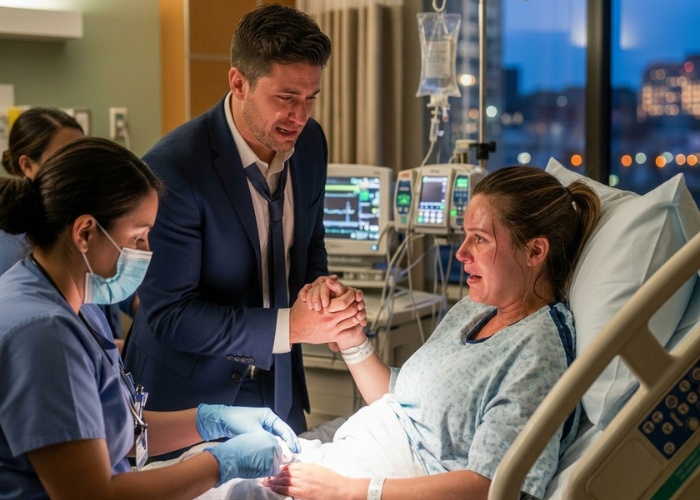
The baby came at 3:17 in the morning on a Tuesday in June. The clinic called me when Elena went into labor, and I arrived forty minutes later in a car I drove myself because my driver was asleep and I was not, because I had not been sleeping particularly well for the previous six weeks, for reasons I was not examining directly. I sat in a waiting room that smelled of antiseptic and low-grade anxiety, and I answered emails on my phone with the one-handed competence of a man pretending to be calm, and at 3:17 the physician came through the door and told me I had a son.
A son. Seven pounds, four ounces. All measurements normal. Both mother and child doing well. The doctor shook my hand and went back through the door, and I sat in the waiting room alone and held that fact in my mind and waited to feel whatever I expected to feel. Pride, maybe. Satisfaction. The clean resolution of a long transaction. What arrived instead was something I had no category for — a sudden, absolute awareness that I had been thinking about this entirely wrong for the past nine months, and that the error was not small and was not correctable by any mechanism I currently possessed.
I asked to see Elena before I saw the child. The nurse looked at me with an expression that suggested this was unusual but not unprecedented, and led me down the corridor. Elena was sitting up in the bed, which surprised me — I had expected her to be asleep. She was not holding the baby. She was looking at a spot on the wall across from her with the careful blankness of a person maintaining control by keeping very still. When I came in, she looked at me. Neither of us said anything for a moment. Then she told me he was beautiful. She said it the way people state facts they have already processed and accepted, without drama, without any request for response. I told her I knew she had done everything she had agreed to do and that I was grateful. These were the right words and they were also completely inadequate and we both knew it, and the knowing sat in the room between us like a third person.
I asked her if she was alright. She said she was fine. I looked at her and she looked back at me, and I thought: this is not a person who is fine, this is a person who has decided that being fine is what the arrangement requires and she is going to honor the arrangement no matter what it costs her, because that is who she is and has always been, and I structured nine months of her life around her inability to refuse a person in power without understanding that the thing I was counting on was the worst thing about what I was doing.
Part Six: The Weight of What I Had Done
They brought my son in. His name — the one I had selected months ago from a shortlist my assistant had compiled — was James. James Arthur Sterling. I had chosen it for its weight, its history, its boardroom legibility. Looking at him now, six pounds of entirely new person wrapped in a hospital blanket, the name felt like a document filed about someone I had not yet met. He turned his head slightly toward the warmth of the room, or toward sound, or toward something none of the adults in the space fully understood, and I sat with him for a long time without thinking about anything at all.
Elena was transferred to a recovery room. I visited twice in the following days, which was not required by any term of the agreement and which I told myself was courtesy and nothing more. She was composed each time — not cold, not distant, but contained in the particular way of someone who has decided that composure is the most dignified available option and is committing to it fully. She asked about James once. I told her he was healthy, sleeping well, already developing the personality of someone who had opinions about the temperature of his immediate environment. She laughed at that — a real laugh, brief and unguarded, the first time I had heard her laugh without effort — and then the composition returned and she thanked me and said she was glad he was well.
The money transferred on schedule. The legal documentation was completed. Everything clean, everything settled, everything done — exactly as I had proposed in my office nine months before. Elena left the clinic with her life restructured, her father recovering, her debt cleared, and a million dollars in an account that I had ensured was set up with tax efficiency and some basic investment architecture, because even then, even in the process of completing a transaction I was beginning to understand had been wrong from the beginning, I was still, by reflex, trying to optimize the outcome for someone I was responsible for.
Part Seven: The Years After
I raised James alone, which is to say I raised James with a nanny named Patricia who was sixty-one years old, profoundly capable, and deeply skeptical of me for the first year and a half. She became the primary constant of his daily life, and I became the person who arrived in the mornings and in the evenings and on weekends with the particular intensity of a man who has decided that being present is the most important thing and is learning, slowly and imperfectly, what presence actually requires. I was not good at it at first. I was too efficient about it, too structured — I read the parenting literature and I applied the parenting literature with the same systematic rigor I brought to a building acquisition, and the results were technically correct and emotionally approximate in ways that James, as he grew older, communicated with a clarity that was both devastating and clarifying.
He was three when he asked why he didn’t have a mommy the way his friend at the park did. I had a prepared answer. I used the prepared answer. He looked at me with his very serious, very dark eyes — eyes I recognized from a face I had seen in a clinic waiting room — and he said: but where is she. Not as a challenge, not with anger, just with the plain factual curiosity of a child who is interested in accurate information. I told him she was someone who had done something very kind and very hard and that we owed her a great deal of gratitude. He nodded slowly, as though filing this for future reference, and then asked what we were having for lunch. He was, in many ways, already more composed than I was.
I thought about Elena more often than I had anticipated. Not with guilt, exactly — guilt would have been simpler, guilt would have given me something to perform and resolve. What I felt was something more persistent and less manageable: the understanding that I had encountered a person of extraordinary character and had processed her as a resource, and that this error said something specific and uncomfortable about who I had been at the time. She had been twenty-two years old and desperate and carrying a situation that would have broken most people, and she had still, in my office with her hands folded in her lap, taken twenty-four hours to think it over before she signed, because she was the kind of person who made her decisions fully, even when the decisions were terrible.
Part Eight: Finding Her Again
I found her three years later, not because I went looking, but because she walked into a meeting I was chairing at Sterling Tower. She was thirty-five minutes early. She was wearing a tailored gray suit, her hair down, a leather portfolio in her hand, and the specific posture of a person who has stopped having to perform confidence because it has become actual. She worked, I discovered, for Meridian Capital — a mid-size investment firm with an excellent reputation and a growing presence in commercial real estate, precisely the sector I occupied. She was there to discuss a potential co-development opportunity. She had not known I would be in the room. I could tell by the fraction of a second before she controlled her expression when she saw me — not shock, not hostility, something more nuanced than either, a rapid internal calculation completed faster than most people can blink.
I stood. I said her name. She met my eyes and said good morning, Mr. Sterling, and sat down and opened her portfolio and was, within thirty seconds, explaining the proposal with a precision and insight that made three of my executives lean forward in their chairs. I did not say anything that was not relevant to the meeting. I watched her work. She was remarkable at it — not in the way of performance, but in the way of someone who has spent years becoming genuinely good at something because the work itself demanded it, and who brings to every room the full weight of that accumulation. The meeting lasted ninety minutes. At the end of it, two of my people came to me separately and said they thought the opportunity was worth serious consideration. I told them I agreed.
Part Nine: What I Owed Her
I asked to speak with her alone after the others left. She agreed without visible discomfort, which told me she had anticipated this might happen and had prepared accordingly, because that was how she operated. I told her she didn’t have to stay if she preferred not to. She said she had time. We sat across the conference table from each other, the same table where I had once pitched a nine-month arrangement to a twenty-two-year-old girl who had been too desperate to say no, and I said: I owe you an apology that I should have given three years ago.
She looked at me carefully. She did not perform surprise or generosity. She asked what I was apologizing for, specifically, and I understood immediately that she was not asking because she didn’t know — she was asking because she wanted to know if I knew. So I told her. I told her I had understood the power differential and used it. I told her I had identified her desperation and structured a solution that was generous in financial terms and deeply wrong in human terms, because there is no such thing as a free choice made under conditions of that kind of urgency by a person with that kind of limited alternative. I told her that every time I had told myself the terms were fair, I was measuring fairness by the only standard that was convenient for me, which was the money, and that the money, however real it was, could not be the whole measure of what I had asked her to give. I told her that the year James turned three, he had asked me where she was, and I had given him the prepared answer, and the prepared answer was true and also insufficient, and I had sat with that insufficiency ever since.
She was quiet for a moment. Then she said: I knew what I was doing. I want you to understand that. I made a choice. I don’t regret it because my father is alive and that would not have been possible without that choice. She paused. And I want you to know that I am not broken by it. I rebuilt. You can see that I rebuilt. She gestured at the portfolio on the table, at the room she had walked into and held without flinching, at the entire fact of who she was now. But what you said about the power — she looked at me evenly — you’re right. And I’m glad you said it.
Part Ten: The Thing About James
I asked if she wanted to know about him. She was still for a moment, and I saw the cost of the answer move across her face before she controlled it. She said: tell me one thing. I told her he was curious and serious and stubborn and kind, that he had recently decided that the most interesting question in the world was why the sky was blue and had spent two weeks investigating this with a thoroughness that exhausted his teacher, that he laughed exactly like someone who is surprised by the laugh before it arrives, that he had his mother’s eyes and he had never been told that but it was true.
She looked at the table for a long moment. Then she looked back at me. She said: thank you. And I understood, from the particular quality of those two words, that she did not need more and I should not offer more, because there is a version of generosity that is actually a continuation of the original transgression — giving people what you think they need rather than what they have asked for — and I was trying, slowly and imperfectly, to stop doing that.
The business meeting led to a partnership, and the partnership was excellent — she was, professionally, as good as I had suspected in that conference room, and the project returned strongly. We worked together for eighteen months on two more developments before we had dinner that was not about business, and that dinner was the most honest conversation I had in years, and what came after it took a long time and was built on foundations that were not romantic but were real: the kind of understanding that exists between two people who have already seen each other at the worst intersection of power and vulnerability and chosen to keep being honest anyway.
Part Eleven: What the Arrangement Actually Cost
I have told this story because I think men like me need to hear it from men like me. Not as a confession designed to be absolved, not as evidence of change offered in exchange for forgiveness, but because the thing I got wrong was a thing that a lot of powerful people get wrong in the same way, and getting it wrong in the same way at the same level of wealth and influence causes a specific kind of harm that is almost never named correctly. The harm is not the money. The money was real. The harm is the condition under which the choice is made — the architecture of desperation that removes the actual freedom from what is technically a voluntary agreement — and the ease with which a man in my position can tell himself the architecture doesn’t matter because the terms are generous.
Elena did not need me to rescue her in the conference room three years later. She had already rescued herself, in the years between the clinic and the moment she walked into my meeting with her portfolio and her tailored suit and her precision. She had done that work. I had provided the capital that made the original crisis survivable, and I do not pretend that was nothing, but I also did not provide the thing that made her who she is now. The thing that made her who she is now was already there, in a stairwell at eleven at night, in a girl holding herself together while she told her mother to keep her father alive, before I ever walked into that stairwell and calculated what I could gain from it.
James is six now. He knows her name. He knows, in the age-appropriate terms I have been updating as he grows, that she is someone who matters to his story. She sends him a card on his birthday, which is the arrangement we arrived at together — her words, her decision, her boundary, and one I respect entirely. He asked me once whether she was good. I told him she was one of the best people I had ever been in a room with. He accepted this with the particular seriousness of a six-year-old who is filing information for future use, and went back to his investigation of why the sky was blue.
Some things you understand too late to change how they started. What you can change is every choice that comes after. That is not absolution. That is not the ending I would have written if I were the kind of man I wanted to be. But it is what is true, and the truth — plain, complete, without the benefit of revision — is what I owe every person in this story, starting with her.
