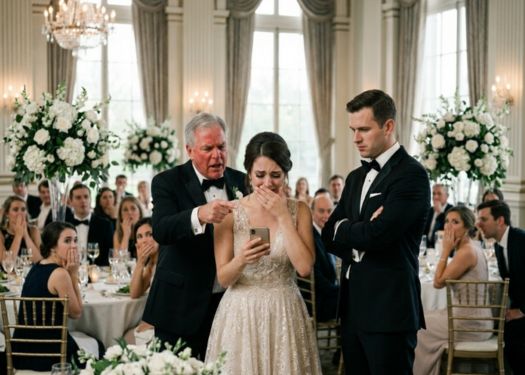
My husband slapped me in front of 600 guests at our anniversary gala. Then he produced divorce papers. He had never once asked who my father really was.
Part 1: The Sound That Stopped the Orchestra
The slap sounded louder than the orchestra. One second, six hundred people were murmuring beneath crystal chandeliers, forks tapping against porcelain, champagne bubbling in tall glasses. The next, my face snapped to the right, and the ballroom went quiet in the way that rooms only go quiet when something has happened that cannot be taken back. My earring struck the marble floor near my left foot. I heard it land clearly, because six hundred people had stopped breathing at the same moment.
My husband, Ethan Marlowe, stood less than a foot away with his right hand still raised. There was no shock on his face, no instant regret — not even a flicker of the man who had once waited outside my apartment in the rain because I had forgotten my umbrella. What I saw instead was contempt, clean and practiced, the expression of a man who has made a decision and is satisfied with it. He told me, quietly and precisely, never to speak to his father that way again.
One of his cousins near the front table laughed first. It was the laugh of someone who had been told in advance that it would be appropriate to laugh, and who was fulfilling their role in the evening. A second person joined in, then a third, and the sound moved through the ballroom the way things move through crowds — not because everyone agreed, but because enough people wanted to be on the safe side. My father-in-law Richard Marlowe held a glass of twelve-year Scotch at the center table and watched me with the satisfied expression of a man whose evening had just arrived at its intended moment.
I tasted blood where my teeth had caught the inside of my lip. I turned my head and looked at the enormous screen behind Richard, which displayed a photograph from our wedding day: Ethan smiling, me looking at him as if he were the safest place in the world. That woman felt like a stranger to me now. I could not account for what she had been thinking, standing in that church, believing what she believed.
Richard lifted the microphone. He told the room not to be concerned, that his daughter-in-law had always struggled with emotional regulation, and that they should please return to their champagne. More laughter followed — looser this time, the relief laughter of people who have been given permission to look away. I stood under the stage lights in the pale ivory gown that Diane Marlowe had sent to my room that morning with a handwritten note, and I began to understand what the evening had always been.
Part 2: The Architecture of the Trap
I did not cry again. I stood in the center of that ballroom and reconstructed the evening from the beginning, piece by piece, the way my father had taught me to approach any structure — start with the foundation, find where the weight is being carried, and you will understand what the thing was built to do. The gown had arrived that morning with Diane’s note. It said the ivory would look beautiful on me and that she was so glad we were celebrating together. I had been touched by the gesture. I had been wrong to be touched. The ivory had been chosen to read as fragile under stage lighting, and the stage lighting had been positioned directly above my assigned seat.
The guest list had bothered me during cocktail hour, though I had told myself it was nothing. I had recognized almost no one. When I asked Ethan, he had said it was business, an opportunity, that it was important to present a unified front to the people who needed to see it. I had accepted this, because I had spent three years learning to accept Ethan’s explanations without pressing them. That, I now understood, had been part of my education in this family — they had been teaching me to ask fewer questions, and I had been a cooperative student.
The microphone was the detail I should have caught from the beginning. Who gives a microphone to a father-in-law at a private anniversary dinner? Someone who planned for him to speak at length, and who needed his voice to carry clearly to every corner of a ballroom built for six hundred. Richard had taken the microphone at nine-fifteen, after three glasses of Scotch had expanded his confidence and after enough champagne had moved through the room that reactions would be unguarded. The timing was not spontaneous. It was production.
The security guards at the door who had not moved. The event coordinator who looked away the moment my eyes found her. The waiters frozen between tables with trays balanced in their hands, standing exactly still, as if they had been briefed on the nature of the evening and instructed to observe rather than intervene. Every person in this room was either an audience member or a prop. I had been cast as the example — the cautionary figure the Marlowes intended to leave behind as they moved into their next chapter.
She had mistaken performance for love, and that was her only mistake, and it had cost her three years and one night she would spend the rest of her life knowing the full meaning of. I stood under those lights and did not move. I let the understanding complete itself, because understanding was the only thing in the room that was entirely mine, and I was not going to waste it.
Part 3: The Leather Folder

Ethan stepped toward me when the laughter died down. He kept his voice beneath the room, the way he always spoke when he wanted to sound reasonable while delivering something unreasonable. He told me to go upstairs, that they would discuss the terms tomorrow, as if there were terms — as if this were a negotiation I had been party to from the beginning. I asked him what terms.
He did not answer directly. He let his eyes move to the leather folder sitting beside his father’s Scotch glass. It was a small movement, calibrated, designed to convey inevitability without drama. The folder was dark brown with a Marlowe Group monogram in the lower right corner, the kind produced in the Marlowe legal office for documents of significance — the kind Marcus Webb, Richard’s senior attorney, had been carrying under his arm when he arrived at the venue two hours before the guests. I had noticed Marcus arriving. I had thought nothing of it.
The folder had been prepared at least two weeks prior, because that is how long it takes to arrange a property division that looks generous on paper while concealing six months of quiet asset rearrangement beneath the surface. I had not known, until this moment, that the asset rearrangement had been happening. I understood now that it had. When you know how a trap is built, you can read backwards from the mechanism to the hand that set it, and every element of the past six months rearranged itself in my mind into a sequence that was entirely coherent.
Something inside me went very still. Not the stillness of shock — I was past shock. It was the stillness my father carried into every room where someone held more information than they were sharing. He had described it to me once as the pause before the count. You never move before you have counted what you are actually looking at. I counted the gown and the lights and the guest list and the microphone and the folder and the six hundred witnesses and the guards at the door. I counted all of it. Then I reached into my bag and took out my phone.
Richard made a joke about it. He said it in the warm voice he used for moments he had decided to find amusing — asked who I planned to call, reminded the room that I had told them myself I had no family worth mentioning. He had arranged for me to say that sentence, early in the marriage, at a dinner where I had believed I was simply making conversation. He had kept it and used it here, in front of six hundred people, as evidence. He was right that I had said it. I had said it because Ethan had asked me to, and because at twenty-seven, loving someone sometimes means agreeing to sentences that are not entirely true because they feel, in that moment, like a small and manageable sacrifice.
I found the number. My thumb rested above it for one second. Then I pressed call. The line connected before the second ring, and my father’s voice said my name in the tone he has used my entire life when he knows something has gone wrong and is already deciding what to do about it. I said three words: Dad, please come. He said he knew where I was, that he was already moving. I lowered the phone and raised my eyes back to the room.
Part 4: Who James Aldren Actually Is
The line was still warm in my hand when I thought about the first time I understood who my father was — not the version of him I had been asked to present to the Marlowes, but the actual version, the one built over thirty years of work that was never loud and never announced itself and therefore never attracted the kind of attention that would have allowed a family like the Marlowes to take a measure of it in advance. My mother died when I was twelve years old. It was a Tuesday in November, cold and clear, and the funeral was held at a small church near the house where she and my father had lived since before I was born. My father wore a gray suit that did not quite fit. He stood at the graveside with his hands in his pockets and did not cry in front of anyone.
He cried later, in the kitchen, when he thought I was asleep. I heard him through the wall. I was eleven days past twelve years old, and I lay in my bed and listened to my father cry in the kitchen, and I decided not to tell him I had heard — because I understood already, at twelve, that some forms of grief are private and should be allowed to be. I kept that secret for twenty years. I kept it from everyone, including him. It is the kind of thing you carry when you have been raised by someone who taught you, by example, that the heaviest things are carried quietly.
He raised me alone after that. He worked in infrastructure development — not the visible end of it, not the glass towers with architectural awards in the lobby, but the foundations, drainage systems, access roads, and utility corridors that run beneath every ambitious building that has ever been photographed for a magazine cover. He was up before sunrise every day. He drove the same car for eleven years, and when it stopped running he bought a secondhand replacement and drove that one for nine more. He grew vegetables in the back garden because, he told me once, if you grow something yourself you know you have done at least one real thing today, regardless of what else happened.
By the time I graduated from college, Aldren Holdings controlled infrastructure access agreements on fourteen major commercial developments across four cities. My father had built this over three decades without a publicist, without an industry award, and without a single profile in any business publication. He was known, in the specific circles where he was known at all, as the man whose cooperation you did not want to lose quietly and without warning. He did not negotiate loudly. He did not threaten. He moved his decisions into position the way he moved everything else — steadily, early, and without announcing the direction of travel until the destination was already decided.
When Ethan proposed to me, my father had reviewed the Marlowe Group’s holdings and financing within seventy-two hours of the announcement. He had found three areas of contact between Aldren Holdings subsidiaries and Marlowe Group projects — including one active development, the Riverside Quarter, a forty-two floor mixed-use tower on the eastern waterfront, where the Marlowes had signed a fourteen-month infrastructure access agreement with an Aldren Holdings subsidiary eight months before Ethan placed a ring on my finger. The Marlowe legal team had processed the contract through standard arm’s-length review. No one had cross-referenced the holding company principals against the personal relationships of the Marlowe family. No one had connected the name on the paperwork to the man whose daughter Ethan was about to marry.
My father had found this and said nothing. He told me only one thing at the engagement dinner: I trust your judgment, and if you need me, call. I had understood this as approval. I understand now that it was something more precise — it was the statement of a man who has looked at everything he needs to look at, who has decided to allow his daughter to make her own choice, and who has made certain that the door will be there when she is ready to use it. Ethan asked me, in the third month of our marriage, to keep my relationship with my father low-profile — the Marlowes were traditional, mixing the two worlds would create friction I didn’t need, and it would simply be easier if I described my background in simple terms. I had introduced my father to Ethan once, briefly, at a holiday dinner. My father shook Ethan’s hand, said very little, and drove home. Ethan described him afterward as a nice quiet man. I had agreed to the arrangement, because I was twenty-seven and in love and still believed that love required a certain kind of accommodation, and I had maintained it for three years without complaint, and my father had never commented on it, not once.
He had simply remained where he had always been, at the distance I had agreed to keep him, watching.
Part 5: Richard Presses the Knife
I lowered my phone and returned my eyes to the room.
Richard Marlowe still held the microphone. He had the particular energy of a man who has reached the satisfying part of his evening — the part where the outcome is assured, the witnesses are in position, and the remaining work is simply to close gracefully. He began talking about the Marlowe Group’s future, about the coming year as a period of significant growth, gesturing briefly toward Marcus Webb at the front table as if to indicate that the legal architecture for this growth was already in capable hands. The language was corporate and warm and designed to make six hundred people feel they were in the presence of a family that managed its affairs with foresight and composure.
He did not mention me again directly. He did not need to. He had already said what he needed to say about me, and the leather folder was sitting in plain sight, and Ethan was standing close enough to the center table that his positioning made clear which side of the evening he was on. The omission was the statement. I was already being discussed in the past tense while I was still standing in the room.
I set my phone on the table beside the leather folder. I folded my hands. I stood still — not as performance, not as defiance, but because stillness is what my father had built into me over thirty years of watching him hold his position while rooms around him shifted. He had taught me that the person who speaks first when the silence becomes uncomfortable has already told the room everything about how much information they do not have. I had nothing to prove and nothing to say. I had made my call.
Ethan came closer. He kept his voice low, offering me the graceful exit — upstairs, private, terms tomorrow, no uglier than necessary. He said the settlement was fair. He used the word fair three times in four sentences, which is what people do when the thing they are describing is not fair but they need the record to reflect that the word was used. Something in his expression told me that my stillness had produced in him the first edge of a feeling he could not yet name.
I asked him whether he knew the name of the company that held the infrastructure access agreement for the Riverside Quarter development. The question came out in the same tone I would use to ask someone to pass the salt. Ethan stared at me with the expression of a man who has decided the thing being said to him is irrelevant. He said he had no idea what I was referring to. I told him to find out before he had another glass of champagne, and I said nothing further.
At the front table, Marcus Webb had been watching me since the phone call. He was the only person in the room who had conducted a full background review on Claire Aldren for the divorce proceedings. He had a file. He had opened it four weeks ago and found a flag in the holding company cross-reference section — a notation that required follow-up, which he had intended to address the following week and then had not addressed because the other elements of the arrangement had absorbed his attention. He opened his phone under the table now and ran the search he should have run four weeks ago. His expression did not change. He set down his champagne glass. He stood, crossed the room to Richard’s chair, and leaned close. He said one sentence near Richard’s ear, quietly enough that the microphone did not carry it.
Richard Marlowe set down his Scotch for the first time all evening.
Part 6: The Name Arrives Before the Man
The ballroom doors opened at nine forty-seven.
Not dramatically — they simply opened, the way doors open when someone who has somewhere specific to be has decided to arrive. My father walked in wearing a dark suit: not expensive in the Marlowe sense, not the kind of suit that announces itself, but the kind that has been fitted properly and worn before and therefore carries a different kind of authority — the authority of someone who does not need his clothing to make his case for him. He did not look around the room to locate me. He already knew where I was. He walked in a direct line across the marble floor, and the room, which had been murmuring in the aftermath of the evening’s events, went quiet again as he crossed it.
He stopped in front of me. He looked at my face — at the redness on my left cheek where Ethan’s hand had landed — and he held my face in both his hands for a moment, the way he had when I was twelve years old and came home from school on the first day after my mother’s funeral. He did not say anything for a breath. Then he said, very quietly: I see it. He stepped back and turned to face the room.
Richard Marlowe, standing near the center table with the microphone still in one hand, attempted authority. He asked, in his amplified voice, who this man was and what he was doing at a private event. The question was designed to establish dominance, to frame my father’s arrival as an intrusion that required justification. Six hundred people turned to see how it would be answered.
I said: this is my father. James Aldren.
The name did nothing to Richard. He had never heard it attached to a person standing in a room — had never had cause to connect the name on a subsidiary holding company’s infrastructure access agreement to the face of a sixty-two-year-old man in a dark suit crossing a hotel ballroom. Richard dealt with principals and board members. He had paid Marcus Webb to deal with holding companies.
He had paid Marcus Webb to deal with everything that did not require Richard’s personal attention.
Marcus was already crossing the room. He reached Richard’s side and held out his phone, screen forward, showing him the result of the search that should have been completed four weeks ago. Richard looked at it. Something shifted beneath his face — not quickly, not with any visible drama, but with the quality of a load-bearing element beginning to move, a process that, once started, could not be recalled. He looked from the screen to the man standing across the ballroom, who had not moved and was watching him with the patient expression of someone who has kept a very long appointment.
Hana Park, seated at the side table where I had placed her at dinner, had covered her mouth with one hand. Hana had known my father for eleven years — had known him since before Ethan, since a period of my life I had been asked to set aside and had set aside. She watched James Aldren stand in the center of the Marlowe family’s carefully constructed evening, and she understood, before anyone else in the room had finished understanding, exactly what was happening beneath the surface.
I reached across the table and picked up the leather folder — the one with the Marlowe Group monogram in the lower right corner, the one Marcus Webb had prepared two weeks prior with the settlement terms already decided — and I placed it in my bag without opening it. Not because I intended to sign it on Ethan’s timeline. Because I intended to have my own attorney examine what six months of quiet asset rearrangement looked like on paper, and what could be recovered from it, and what the appropriate legal response was to a divorce proceeding initiated through public humiliation in front of six hundred witnesses, at least three of whom had been recording since the moment the slap landed.
I turned to my husband. I told him: he had asked me, early in our marriage, to keep my father at a distance. I had done that. I had done it because I loved him and believed he was worth the accommodation, and I had been wrong about that, and I would like to correct the mistake now. I took my father’s arm. We walked toward the door.
Part 7: My Office. Next Week.
The doors were ten feet away when Ethan stepped in front of us.
He had recovered enough to attempt control. He said the negotiation was not complete, that the settlement was fair, that I had nothing without the Marlowe name, that I should think very carefully about the decision I was making right now because some decisions could not be walked back. He said several things in the practiced language of a man who had learned that pressure, applied consistently and with confidence, produces compliance. He had applied it successfully for three years. He believed it would work now.
James Aldren, who had not spoken to Ethan at any point during the evening, said one sentence. He did not raise his voice. He did not step toward Ethan. He said only: the Riverside Quarter midterm review is in four months.
Ethan stared. The sentence meant nothing to him, and his face showed it — the specific blankness of a man confronting information that does not yet have a category in his understanding.
Behind him, it meant everything.
Richard Marlowe appeared in the lobby doorway with Marcus Webb one step behind. His composure was intact — Richard Marlowe had held his composure through forty years of difficult boardroom moments, and he was not going to abandon it in a hotel lobby — but something beneath it had been displaced, the way a foundation shifts without the surface cracking immediately. He said my father’s name. Not as an accusation. Almost carefully, the way you say a word aloud when you are still confirming that you have understood what it means.
My father turned.
They stood approximately fifteen feet apart — two men in their sixties who had been connected for more than a year by infrastructure agreements and arm’s-length paperwork and fourteen months of transactions that had never required them to be in the same room, meeting in person for the first time. Richard began to speak. My father raised one hand, slightly, just enough. Richard stopped.
My father said: we will talk. Next week. My office.
He turned back toward the exit. I walked beside him. Behind us, I heard nothing for a moment — no resumed conversation, no orchestra, no returning murmur of six hundred people deciding the event was over. Just the lobby, marble and cold and still.
We stepped through the outer doors. The night air arrived the way it always does after a room like that — clean, indifferent, full of the ordinary sounds of a city that does not know and does not care what happened on the fourteenth floor. Taxis moved below. A couple walked past without looking up. The street continued, as streets do.
After half a block, I said I should have called sooner.
My father kept walking. He said: you called when it was time.
I thought about that for the rest of the walk to his car. I thought about the three years of carefully maintained distance, the sentences I had agreed to say, the accommodations I had made because I believed they were the fair cost of the love I was choosing. I thought about my father rising before the sun every day for thirty years to build something durable, while teaching me, without ever stating it directly, that the only things worth building are the things that hold their position under weight.
The leather folder was in my bag. The Riverside Quarter review was in four months. Marcus Webb was back in that lobby explaining to Richard Marlowe what the midterm review clause meant in practice, and what James Aldren’s signature — or the deliberate absence of it — would mean for the forty-two floor tower on the eastern waterfront that was the centerpiece of the Marlowe Group’s next decade. Ethan was still inside, still trying to understand a sentence that his father already understood completely.
We drove to a diner my father had been going to since I was eleven years old — checkered floor, coffee too strong, a counter that had not changed in twenty years. We sat there until midnight. We talked about other things. He asked if the coffee was still too strong and I said yes and he said it had always been too strong and he had been coming here for thirty years anyway because some things you keep returning to not because they are perfect but because they are yours.
I understood what he meant. I had always understood what he meant.
That was the night everything ended. It was also the night everything else began.
This story is a work of fiction created for entertainment and storytelling purposes. All characters, names, events, organizations, and dialogue are entirely fictional. Any resemblance to real persons, living or dead, or to actual events or institutions is purely coincidental. This story does not represent the views or positions of any real individual, company, or organization. The author does not condone any form of domestic violence or public humiliation depicted in the narrative.
