How I Reclaimed My Voice in French — And Discovered a Billionaire’s Hidden Secret
Section 1: The Life I Never Planned For
I never imagined I’d be carrying wine glasses for a living.
That sounds ungrateful, I know. There’s dignity in every kind of work — my mother drilled that into me before I left for college. But when you’ve spent five years studying French literature, when you’ve stood in front of professors and delivered Flaubert analyses with enough confidence to earn a standing ovation from a room of graduate students, there’s a particular kind of ache that comes with hearing someone snap “Table Seven needs a refill” like it’s the most important sentence in the world.
My name is Clara. I’m twenty-nine years old. And for the past three years, I’ve worked as a waitress at Éclat — one of those restaurants that exists somewhere between beautiful and pretentious, the kind of place where the chandeliers cost more than most people’s cars and the menu changes with the mood of the chef rather than the season.
I got the job because I needed it. My student loans were a wall I couldn’t see over, and when my graduate program ended without the academic fellowship I’d counted on, I did what you do: I adapted. I found a job. I told myself it was temporary.
Temporary had a way of stretching.
The work was fine. Physically exhausting in ways I hadn’t anticipated, but manageable. The clientele, on the other hand, required a particular kind of patience I had to practice daily. Wealthy people, I’d learned, existed in two distinct categories: those who were gracious precisely because they understood the distance between themselves and others, and those who were careless precisely because they’d never had to consider it.
Table Seven had always been a magnet for the second type.
It was the corner booth — leather seats, better lighting, a direct sightline to the floor that told you, without words, that the person sitting there expected to be seen while also expecting to see everything. Politicians sat there. Tech founders sat there. Once, a European countess sat there and returned every single dish to the kitchen while speaking about the staff in German, presumably believing no one would understand.
I speak a little German, too. But that’s a different story.
The evening that changed my life was a Thursday. I remember because Thursdays were always slightly slower, which meant our manager had fewer excuses to hover, which meant the staff could breathe. I’d worked a double shift. My feet were doing that specific kind of aching that moves up the calves and parks itself somewhere behind the knees, and I was operating on exactly one cup of coffee and a determination to make it to 10 PM without incident.
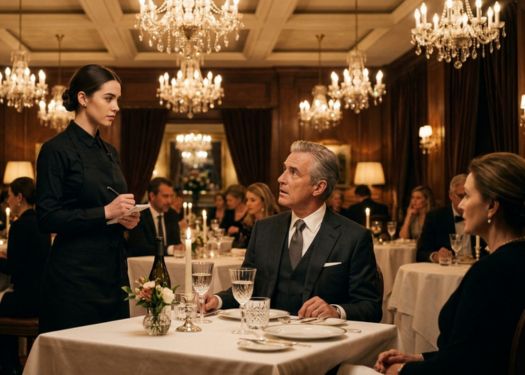
The reservation at Table Seven was for six. They arrived at seven-thirty, fashionably late in the way that communicated they didn’t consider punctuality a social obligation when it came to staff waiting for them. The host seated them with the practiced warmth our training required. I watched them settle — three men and two women, each dressed with the kind of intentional casualness that costs a significant amount of money to achieve.
And then there was him.

He sat at the head of the table without appearing to do so deliberately. It was less a choice than a gravitational fact: everyone else orbited slightly around him. He was perhaps forty, with dark hair that was going silver at the temples in a way that read as distinguished rather than aging. He wore a charcoal jacket with no tie, his collar open exactly one button — the universal signal among a certain class of man that he was relaxed without being careless.
I approached the table with menus and water. He didn’t look up.
That, I would come to understand, was not rudeness. That was habit. When you’ve never had to notice the people who serve you, you simply don’t — not because you’re cruel, but because no one has ever required you to.
I took their drink orders, moved efficiently, and returned with the wine. Standard choreography. Table Seven, Round One: complete.
Section 2: The French That Cut Through the Room
I was standing near the service station when it started.
The table had been going for about forty minutes. The wine was flowing, the appetizers had been cleared, and the conversation had reached that particular pitch of social lubrication where people stop performing restraint. I wasn’t listening — not intentionally. I was running mental calculations about the night’s remaining tasks: two dessert orders pending at Table Three, a birthday cake that needed to come out at Table Eleven, a check that had been waiting at Table Two for longer than was polite.
Then I heard it.
The language came first — French, smooth and unhurried, the accent of someone educated in Europe rather than an American classroom. And then the content, which arrived in my ears with the blunt clarity of something not meant to be understood by anyone in the vicinity.
He was talking about the restaurant.
Specifically, he was talking about the staff.
The words were elegant, the way cruelty often is when filtered through a sophisticated vocabulary. He described the service as perfunctory. The staff, he suggested, had the alertness of people performing tasks they were too accustomed to. His companion laughed — a light, conspiratorial sound. He continued: in his experience, American service culture had a particular quality of enthusiasm that masked fundamental indifference. It was, he said, like watching someone mime caring.
I set down the tray I was holding.
Not loudly. Not dramatically. Just quietly, carefully, the way you set something down when you need both hands free.
I want to be clear about what I felt in that moment. It wasn’t anger, exactly. Anger is hot and immediate, and what moved through me was cooler than that — more like the feeling of a decision crystallizing, the way a solution appears in chemistry when the conditions are finally right. Three years. Three years of swallowed comments, of smiling at people who spoke about me as though I weren’t present, of translating my education into something invisible because the room didn’t require it to be visible.
My mother’s voice arrived, the way it always does when I’m standing on the edge of something: Don’t you dare stay quiet.
I walked back to Table Seven.
I refilled his water glass — unhurried, professional, every movement carrying the practiced ease of someone who has done this hundreds of times. And then, when I straightened, I looked at him directly and said, in French, with the diction of my graduate thesis defense:
“Perhaps, sir, you’ve overlooked some talent.”
The silence that followed was the kind that has texture. You could feel it pressing against the walls. His companion’s glass stopped halfway to her mouth. One of the other men at the table actually leaned back slightly, as though recalibrating something.
And he — the man at Table Seven, the billionaire who had never needed to notice the people who served him — looked up at me for the first time all evening.
His expression wasn’t embarrassment. It wasn’t the flushed, sputtering reaction of someone caught in a petty cruelty. It was something more complicated: surprise, yes, but underneath the surprise, something I could only describe as attention. Real attention. The kind that meant he was actually seeing me.
“You speak well,” he said. In English. Then, correcting himself, he repeated it in French — correctly, naturally, without performance.
I thanked him. In French. And walked back to the service station.
The restaurant did not, of course, hold its collective breath — not literally. But there was a perceptible shift in the energy of the room, the way a room shifts when something unrehearsed occurs in a space built for choreography. Several tables near us had caught the exchange. I could feel it in the way conversations resumed at slightly different angles.
My colleague Maya appeared at my shoulder within thirty seconds. “What did you just do?” she whispered.
“My job,” I said. And smiled.
Section 3: The Secrets That Ran Deeper Than French
What I didn’t expect was what came after.
I’ve worked in enough restaurants to understand the lifecycle of a table. Appetizers give way to entrees, entrees to desserts, desserts to the slow unwinding of the check. People leave. The table is reset. The story ends.
Table Seven didn’t follow that pattern.
When I brought the dessert menu — forty minutes after my French exchange had apparently settled into the mythology of the evening — he stopped me. Not rudely. Precisely.
“I’d like to understand,” he said, in French, “how you learned to speak like that.”
It was a genuine question. I recognized genuine questions because I’d been asking them most of my life, and I’d spent years in rooms where they were rare.
I told him briefly — graduate program, five years, a particular passion for the literature that had made the language feel like a discovery rather than a requirement. He listened without interrupting, which, in my experience, is one of the most reliable indicators of intelligence in another person.
“What happened to the graduate program?” he asked.
“Life,” I said. “The specific kind that doesn’t care about your plans.”
He nodded. Not sympathetically — I didn’t want sympathy — but with the recognition of someone who understood that the space between what you intended and what occurred could be enormous.
“I owe you an apology,” he said then. And he said it in English, which I understood as deliberate: some things need to be said in the language you actually mean them in.
“You don’t owe me anything,” I said. “But I’ll take it.”
He smiled. And it was different from the wry, public smile he’d given me when I first responded — smaller, less performed, more real. “I’m Marcus,” he said.
I told him my name.
“Clara,” he repeated. And then: “I believe I’ve been rude in two languages tonight.”
“Only one counts,” I said. “The one you thought I couldn’t understand.”
He laughed — a real one, the kind that doesn’t have advance warning.
What I didn’t know then, and wouldn’t learn until much later, was that Marcus wasn’t simply a wealthy man with a gift for languages and a habitual carelessness about the people around him. He had grown up speaking French — not as a cultivated acquisition, but as a first language, the language of his mother, of his earliest memories, of a childhood spent between two countries and two cultures that never quite resolved their tension in him.
He’d left that part of himself behind. Or tried to.
My French, it turned out, hadn’t just surprised him. It had knocked loose something he’d spent years carefully burying.
But I didn’t know that yet. What I knew, standing at Table Seven with a dessert menu in my hand, was that something had shifted — in the room, in him, and in me. I was more than a reflection of his arrogance, I realized. I was something older than that. An echo of a story that predated our meeting.
He asked for the dessert menu. I handed it to him. Our fingers didn’t touch — this is real life, not a movie — but there was a deliberateness in the handoff, a small formality that felt like the beginning of a different kind of conversation.
Section 4: The Moment I Stopped Playing Small
I went home that night and stood in my apartment for a long time without turning on the lights.
Not dramatically. Just processing, the way you process things when something has happened that you don’t yet have a category for.
I’d spoken French. That was all. And yet it hadn’t been all — and I knew it, the way you know when something small has cracked something open. I’d spent three years making myself invisible. Not because I was ashamed — I wasn’t — but because invisibility felt like the practical choice. Don’t complicate things. Don’t make the room uncomfortable with what you know. Smile, refill, move on.
But invisibility had a cost I’d stopped calculating because I’d stopped looking at the bill.
I sat down at my kitchen table and opened a journal I hadn’t touched in eight months. Not because I had something profound to write, but because I needed to confirm to myself that I was still the person who’d had things worth writing down.
I wrote: I spoke tonight. It mattered.
The next morning, Marcus left a message at the restaurant. He’d asked the host to pass along his card. Simple. Professional. A note that said he was looking for a language consultant for an overseas project and would be grateful for a conversation if I was interested.
I held the card for a long time.
I want to be honest here: my first instinct was suspicion. I’d been in enough spaces where power operated as both invitation and trap, where what looked like opportunity was actually leverage in disguise. I showed the card to Maya, who said immediately, “Clara, you have to call him.” I showed it to my friend Dani, who said, “Do a background check first.” I did the background check first. Then I called.
What followed was not a fairy tale. I want to be clear about that.
What followed was a series of conversations — first over the phone, then in a neutral location of my choosing (a coffee shop in my neighborhood, not his preferred hotel lobby), then over several weeks during which I learned that Marcus was not simply a wealthy man with a language habit. He was the kind of person who had built his success on a specific kind of intelligence: the ability to understand what other people wanted before they said it, and to position himself as the person who could provide it.
He was also, I came to understand, lonely in the specific way of people who have spent so long being the most powerful person in any room that they’ve forgotten what it feels like to be genuinely surprised.
I had surprised him. That was real.
“You made me feel like a student,” he told me once, during our third meeting, with a self-deprecating honesty that I hadn’t expected. “I haven’t felt like a student in a long time. It’s uncomfortable. I’m grateful for it.”
I told him it was the most honest thing anyone had said to me in three years.
He asked if I’d consider consulting on a French-language project involving a cultural exchange initiative he was funding. The terms were fair — more than fair, actually, which I flagged directly, and which he appreciated. “I have a policy,” he said, “of paying people what they’re worth rather than what they’ll accept. Most people accept too little.”
I told him I was beginning to understand why.
Section 5: What I Found on the Other Side
I’m writing this six months after that Thursday night at Table Seven.
I’m no longer waitressing at Éclat. I left on good terms — I gave two weeks’ notice, trained my replacement, and said goodbye to Maya, who hugged me for longer than I expected and whispered “you were never just a waitress” into my shoulder. I cried in the parking lot for about four minutes and then drove home and made dinner.
The cultural exchange project turned into a full-time consulting position. It turned into connections I hadn’t imagined. It turned into the thing that people talk about when they talk about “opportunity” — except that in real life, opportunity is rarely as tidy as that word suggests. It comes wrapped in uncertainty. It asks for things you’re not sure you have. It requires you to stop pretending you’re less than you are.
That’s the part that took the most work.
Not the language. Not the professional deliverables. Not even navigating the complicated dynamics of working with someone who was, by any external measure, enormously more powerful than I was. The hardest part was unlearning three years of practiced smallness. The habit of making myself easier to overlook. The muscle memory of dimming down, of not speaking first, of waiting to be asked rather than walking up to Table Seven and saying what needed to be said.
Marcus and I are not a love story. I want to manage that expectation, because I know it’s the narrative people reach for — waitress meets billionaire, transformation follows, credits roll. The reality is more interesting than that, and also more sustainable.
We are people who surprised each other. We are people who, for different reasons and from different directions, had grown accustomed to not being surprised. That shared condition created something — a friendship, a mutual respect, a collaboration built on the understanding that the most valuable thing you can offer another person is honest engagement rather than the performance of it.
He is not the man he appeared to be at Table Seven. I knew that the moment he looked up and actually saw me.
I am not the woman I appeared to be, either. I knew that the moment I opened my mouth and spoke.
What I’ve learned from all of this — and I’ve turned it over enough times to feel confident in the lesson — is that the stories we keep silent eventually demand to be told. Not loudly, necessarily. Not dramatically. But with precision. With the voice you actually have, in the language that costs you something to use.
My mother used to say that a gift left unopened is a story that ends before it begins.
I left mine unopened for three years. I carried it through closing shifts and polite smiles and tips that never quite added up to what I’d planned for. And then one night, a man at Table Seven gave me the involuntary gift of underestimating me.
And I responded. In perfect French. Right in front of everyone.
That was the beginning. And the beginning, it turns out, was everything.
Conclusion
Sometimes the most important things we know about ourselves are the things we’ve been waiting for someone to accidentally make necessary.
I didn’t plan to speak that night. I didn’t plan for any of what followed. But I’ve come to believe that readiness — the kind that builds quietly over years of work and study and accumulated experience — doesn’t wait for the right moment. It simply responds when the moment arrives.
If you’re carrying a gift you’ve set aside because the room didn’t seem to require it: the room is rarely going to ask. You will have to decide, on some ordinary Thursday, to use it anyway.
That’s the lesson I’m still living. And I wouldn’t have it any other way.
Want to continue following this story? Comment below — Clara and Marcus’s journey is still unfolding.
