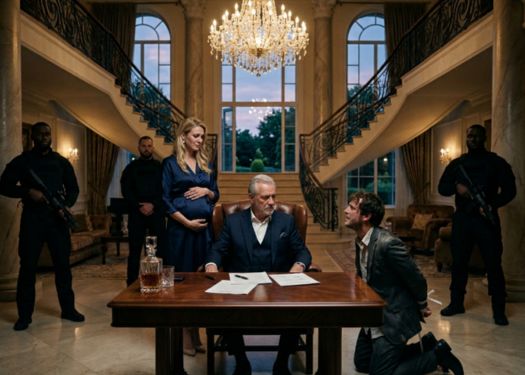
How My Husband’s Burner Phone and a Pregnancy Test Destroyed His Plan to Destroy Me
Section 1: The Night Everything Arrived at Once
There are moments that divide a life into before and after.
Not the kind you can feel coming. Not the ones with atmosphere — the gathering storm, the slowing of time, the cinematic signal that something is about to shift. The real ones arrive without warning and without ceremony, in ordinary rooms under ordinary light, while you’re still wearing the same clothes you put on that morning when the world was still the world you thought you lived in.
Mine arrived on a Tuesday.
I was thirty-one years old, newly married, four weeks pregnant — though I didn’t know the last part until that night. My name isn’t important for the purposes of this story, but what is important is what I was: an heiress by birth, a woman who had worked hard to become more than that title implied, and a wife who had believed, with the particular sincerity of someone who had chosen carefully, that she had chosen well.
I had met Marcus at a charity gala two years before. He had been exactly what he appeared to be: intelligent, attentive, financially successful in his own right — or so he said — and possessed of the kind of focused charm that made you feel, when he turned it toward you, that you were the most interesting person in any room. I had dated men who used their charm like a tool. Marcus had felt different. He had felt genuine.
That was the first thing I should have understood about him: how completely genuine he seemed.
I had gone to the pharmacy alone that Tuesday evening. A late period, a tiredness I couldn’t explain, a quiet intuition I wasn’t ready to name. I bought the test the way you buy something you’re not entirely sure about — quickly, without lingering — and drove home in the dark with it sitting in my purse like a small, unremarkable object that was about to rearrange everything.
Marcus wasn’t home. He’d texted that he was running late — a client dinner, the usual. I went upstairs, set my bag down in our bedroom, and noticed his nightstand drawer slightly open. He’d been looking for something before he left, apparently, and hadn’t pushed it closed all the way.
I don’t know what made me look.
I’ve thought about this moment many times in the months since. I was not a suspicious wife. I was not the kind of person who checked phones or searched drawers or catalogued inconsistencies. I had, if anything, erred too far in the direction of trust — a trait my father had gently named as early as the year Marcus and I started dating. You give people the benefit of the doubt before they’ve earned it, he’d said once. I had taken it as a compliment.
The drawer was open. I pushed it fully open to close it properly.
And there it was.
A phone. Inexpensive, prepaid, the kind that doesn’t connect to an iCloud account or leave a digital trail in the usual places. Turned face down, the way you turn something down when you want to be able to check it quickly without anyone seeing the screen light up.
I stood there for a long time.
Then I picked up the phone.
Then I went to the bathroom and took the pregnancy test first, because some part of me — the part that was still operating on the logic of the world as I had known it that morning — felt that I needed to know both things at the same time, or not at all.
I stood at the bathroom counter and watched the test process, the phone face-down in my right hand, the test in my left. The bathroom was very quiet. The house was very quiet. Outside, the neighborhood was doing what neighborhoods do on Tuesday evenings: settling into its ordinary rhythms, entirely unaware that eighteen feet away, a woman was holding the beginning and the end of a chapter in the same two hands.
Two lines.
I set the test on the counter. I turned over the phone.

Section 2: What the Text Said
The most recent message was at the top of the screen.
It was dated that day. The contact had no name — just a number, local area code, nothing distinguishing. The message was forty-seven words long. I know because I counted them afterward, the way you count things when you’re trying to make an experience into data, trying to give your mind something precise to hold onto so it doesn’t unravel entirely.
He had written to her — and I understood immediately, in the way that you understand things you have been peripherally not-letting-yourself-know — that he was almost done. That he was just acting the part a little longer. That once he secured the payout, he would be gone.
The word he used for me was the heiress.
Not my name. Not my wife. Not any word that implied I was a person to him.
The heiress.
I read it three times. Not because I didn’t understand it the first time, but because my mind was performing a function I recognize now as a kind of self-protective processing: giving itself permission, in increments, to accept what it was seeing.
He had married me for money.
Not in the complicated, half-conscious way that people sometimes allow wealth to influence their romantic choices — the way that financial security can make an already appealing person more appealing, the way that comfort factors into decisions without fully determining them. Not like that.
Like a plan. Like a long game, executed with patience and skill, by a man who had identified his target, positioned himself strategically, and spent two years performing a marriage with enough conviction that I had never, not once, experienced a flicker of doubt.
I sat down on the edge of the bathtub.
The pregnancy test sat on the counter.
The phone sat in my hand.
I thought about the proposal — the speech he had given, which had been specific enough about our relationship that I had cried, which is a hard thing to fake with someone who does not cry easily. I thought about the way he’d navigated my family, charming my father’s skepticism with consistency rather than performance — or what I had taken for consistency. I thought about the late nights, the small considerations, the accumulated texture of what I had experienced as a real relationship.
All of it had been a role.
And I had been the audience who believed it most completely.
My father’s voice arrived then, as it often did when I most needed something firm to stand on: I want you to be careful with him. Not because I see something wrong. Because I don’t see anything wrong, and that, to me, is unusual.
I had told him he was being paranoid. I had told Marcus, laughing, that my father was suspicious of men who seemed too good. Marcus had laughed too and said he supposed he’d just have to prove himself over time.
He had known, even then, what the long game looked like.
Section 3: The Mask That Fell
Marcus came home at ten-fifteen.
I was sitting in the living room when he came through the door. I had put the phone back in the drawer exactly as I had found it. The pregnancy test was in the pocket of my cardigan. I had spent forty-five minutes deciding how I wanted to be when he walked in, and what I had decided was this: still. Entirely still. Because stillness, I had understood somewhere in those forty-five minutes, was the only thing I had that he didn’t know to account for.
He was smiling when he opened the door — the reflexive, end-of-day smile of a man who had learned to wear warmth like a default expression. It disappeared before he had fully crossed the threshold.
I was not crying. I was not disheveled. I was not holding the phone.
I was simply sitting in a chair, in the light, looking at him.
And that was enough. Because whatever calculation Marcus had built his marriage on, it had not included this particular equation: a wife who already knew everything, presenting him with nothing to react to.
For one unguarded moment, I saw his face do something I had never seen it do before.
It flickered.
Not into guilt — I want to be precise here, because guilt would have meant something different about what kind of person he was. What flickered across his face was something colder and more honest: the brief, involuntary expression of a man recalibrating. Running variables. Assessing what I might know and how I might have come to know it and what his optimal response was.
The whole thing lasted perhaps two seconds. Then the charm came back, smooth and automatic, like a program reloading.
“You okay?” he said. “You look tired.”
I told him I was fine.
He poured himself a drink in the kitchen. We sat together. He talked about the client dinner — details that were, I assumed, real enough to survive scrutiny if I asked, because a man who had planned this thoroughly would have covered the routine lies. I listened. I said the right things. I did not let him see anything.
He went to bed before I did.
I sat in the living room until midnight, holding the pregnancy test in my closed fist, trying to understand what I was going to do.
It was, I think, the most alone I have ever been.
Section 4: The Threat He Made
I waited three days.
I want to be clear about this because it matters: I did not wait out of fear. I waited because I needed to know exactly what I was dealing with before I acted, and because a decision made in the first hours of shock is rarely the right one. My father had taught me that. The person who acts first in a crisis, he once said, is often the one who has thought least about it.
I spent those three days doing three things: sleeping as much as I could, because I was pregnant and I needed it. Behaving exactly as I normally would, because Marcus was watching, and I was not going to let him know he’d been found. And thinking, with everything I had, about what came next.
On the fourth day, I asked Marcus to sit down with me.
I put the burner phone on the table between us.
His face did the recalibration again — faster this time, more practiced, as if he’d had three days of his own to prepare contingencies. He looked at the phone. He looked at me. And in the space between those two glances, he made the decision I had already assumed he would make: he chose offense.
He did not drop to his knees. He did not beg.
He picked up the phone, put it in his pocket, and sat back in his chair with the composure of a man who had run this scenario in his head before.
He told me what would happen if my father triggered the infidelity clause in the prenuptial agreement.
He was calm when he said it. That was the thing I still think about — the absolute calm of a man describing the destruction of a life he had helped build. He would file counter-suits. He would drag the case through years of depositions, every detail of our marriage re-examined in courtrooms and leaked to tabloids. He would describe me to the press as mentally unstable. Unfit. The kind of language, carefully chosen, that settles into public perception and does not easily wash out.
He would make sure photographers were outside every medical appointment for the duration of my pregnancy.
And then he leaned forward, and he said the thing I will never, for the rest of my life, unhear.
He said that women lose babies under that kind of stress. And we both knew it.
I have replayed that sentence more times than I can count. Not because it surprised me — I think some part of me had already understood that Marcus was capable of something like it — but because of what it clarified. There are people who will use money, reputation, leverage, opportunity. There are people who will take a great deal from you and call it strategy. And then there are people who will look at an eight-week heartbeat and use it as a bargaining chip.
He wanted fifty percent of the assets. He wanted the prenup canceled. He wanted it signed and sealed within two weeks, or he promised that neither I nor our child would have a single peaceful day until the legal process concluded — however many years that took.
I looked at him for a long time.
I said nothing.
Not because I had nothing to say. Because what I had to say was not for him.
Section 5: What My Father Had Already Built
What Marcus did not know — what he could not have known — was that he had been watched.
My father is not a dramatic man. He does not make speeches. He does not, to my knowledge, ever act impulsively or on incomplete information. What he does — what he has always done — is observe. Quietly, patiently, with the specific kind of attention that looks like nothing until it becomes everything.
He had been watching Marcus since before the engagement.
Not intrusively — my father understood the line between protection and control, and he respected it. But from the beginning, there had been something about Marcus that he could not name and would not dismiss. A smoothness that seemed more constructed than natural. A career history with gaps that answered too cleanly when examined. A relationship with money — other people’s money — that had certain patterns my father, who had built a great deal of wealth and therefore understood how it could be lost, recognized.
He had hired people to be thorough about it.
I did not know this. My father had not told me because he understood that I would not have welcomed it, and because — this is the part I have come to understand only in retrospect — he was not certain yet. He was building a case, not an accusation. He was waiting for evidence that would be complete, not just suggestive.
The night I called him, shaking, barely able to speak, and told him what I had found and what Marcus had said — including the part about our baby — my father did not gasp. He did not raise his voice. He was silent for a moment, and then he said:
“Let him think he has won.”
Five words. And in those five words, I heard everything my father had not said over the previous two years: that he had known this moment was possible, had prepared for it, and that the preparation was complete.
What Marcus had done, by threatening our child, was remove any legal ambiguity about his character. My father’s team had documented the financial manipulations over eighteen months. They had traced the mistress, the offshore accounts, the communications. All of it. Marcus had been so certain of his leverage — so confident that the threat of press exposure and a prolonged legal battle would force my hand — that he had never considered the possibility that the other side had been playing its own long game.
The prenup’s infidelity clause was ironclad. The evidence of misconduct was airtight. And Marcus’s threat — the one about stress and babies, the one he had made with such cold composure — had been recorded.
He had walked into the conversation holding what he believed was every card.
He had not known that my father held the deck.
Conclusion
Marcus left with nothing.
The legal process was not long, because there was nothing to contest. The documentation my father’s team had assembled was comprehensive. The recording of Marcus’s threat was, in the words of our attorney, “unusually clear.” The infidelity clause was triggered and held. The counter-suit Marcus threatened was filed and dismissed within sixty days.
He was gone before my pregnancy showed.
I have thought a great deal, in the months since, about what I want to take from this experience. Not the betrayal — that part I’ve put down. It doesn’t serve me or my child to carry it. But the lesson underneath it: that the people who love you most are sometimes doing more to protect you than you can see, and that trust, real trust, is not naive. It is earned and specific and sometimes it looks like a man who makes his daughter’s fiancé sign a contract with one absolute clause before the wedding.
My father wasn’t cold when he insisted on the prenup. He was paying attention.
I am paying attention now, too. To everything. To the things that feel too smooth, too clean, too perfectly assembled. To the gap between what a person presents and what they are. And to the fact that I am not alone — that the people who love me are, in the quiet and without fanfare, building things that will hold me up when I don’t yet know I’m about to fall.
My child will be born in the spring.
And my father will be in the room.
