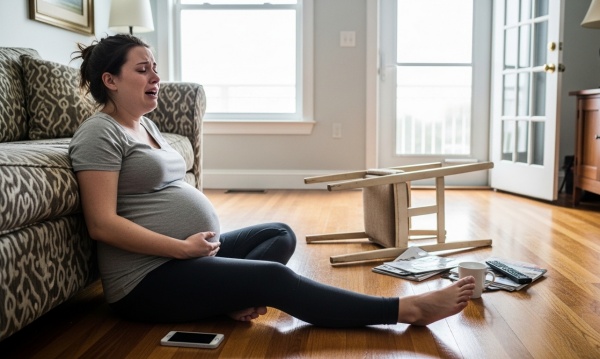
I Called My Husband Begging for Help at 8 Months Pregnant — He Said I Was Being Dramatic. Then I Started Bleeding….
At 8 months pregnant, I had severe pain and called my husband Jason at work. “Something’s wrong. I’m scared. Please come home.” He said, “You’re being dramatic. I have a meeting”. He hung up. The pain got worse. I was bleeding on the living room floor….
Part 1: The Morning the Pain Started and the Husband Who Wouldn’t Come Home
My name is Emily Carter, and I am 29 years old, and I am writing this from my mother’s house in Portland, Oregon, where I have been living for the past three months with my newborn daughter after the day my husband Jason left me alone and bleeding on our living room floor while I was eight months pregnant, and where I finally understood that the man I married was not capable of being the partner or father I needed him to be.
I am writing this because what happened on that Friday in January when I called Jason begging for help and he told me I was being dramatic has become the defining moment of my marriage, my motherhood, and my decision to leave. I am also writing this because I think there is value in sharing stories about medical emergencies during pregnancy, about partners who fail when they are needed most, and about the moment when you realize that being alone is safer than being with someone who does not care if you live or die.
I need to describe the morning the pain started and Jason’s response before I describe what happened when he finally came home that evening, because understanding how he reacted when I was in crisis makes everything that followed both inevitable and necessary. That Friday morning in mid-January started normally. I woke up at 7:00 a.m., made breakfast, and got ready for a quiet day at home. I was 34 weeks pregnant — eight months along — with our first child, a daughter we had already named Sophie.
I had stopped working as a graphic designer two weeks earlier because my pregnancy had become physically exhausting. My feet were swollen, my back ached constantly, and I was so tired that even simple tasks like grocery shopping left me breathless. Jason, who worked as an account manager at a marketing firm making $78,000 per year, had been supportive of my decision to take early maternity leave. Or at least, that was what I thought at the time.
Around 9:30 a.m., I was walking from the kitchen to the living room of our two-bedroom rental house in the suburbs of Portland when I felt a sudden, sharp pain low in my abdomen. It was not like the normal pregnancy discomfort I had been experiencing for months. This was different — intense, twisting, and frightening. I stopped mid-step and grabbed the edge of the kitchen counter, my breath catching in my throat. The pain lasted about thirty seconds, then faded to a dull ache. I stood there for a moment, my hand on my belly, trying to decide if I should be worried. Then another wave hit, stronger than the first, and I gasped out loud.
I pulled my phone from my pocket and called Jason. He answered on the third ring, his voice distracted. “Hey, what’s up? I’m about to go into a meeting.” I tried to keep my voice steady, but I could hear the fear in it. “Jason, something’s wrong. I’m having really bad pain in my stomach. It’s not normal.
I think something might be wrong with the baby. Can you come home?” There was a pause, and then Jason sighed — not a sigh of concern, but a sigh of irritation. “Emily, you’re eight months pregnant. Everything feels dramatic right now. You’re probably just having Braxton Hicks contractions or something. I have a meeting in twenty minutes. Just lie down, drink some water, and stop panicking. You’ll be fine.”
I felt tears spring to my eyes. “Jason, this doesn’t feel like Braxton Hicks. This feels different. I’m scared. Please come home.” Jason’s voice hardened. “Emily, I can’t just leave work every time you get nervous. You’re pregnant, not dying. Call your doctor if you’re that worried. I have to go.” Then he hung up. I stood there in my kitchen, staring at my phone, tears streaming down my face, another wave of pain making me double over and grip the counter. My husband — the man who had promised to love and protect me, the father of the child I was carrying — had just dismissed my fear and hung up on me.
Ten minutes later, the pain intensified. I tried calling Jason again. No answer. I texted him: “Jason, the pain is getting worse. I really need you. Please come home.” He replied five minutes later with three words that I will never forget: “You’ll be fine.” I was not fine.
Part 2: The Blood, the 911 Call, and the Paramedics Who Saved My Life
By 11:30 a.m., I was on the living room floor. The pain had become unbearable — sharp, cramping waves that radiated from my abdomen down my legs and up my back. I could not stand. I could barely breathe. I was lying on my side on the carpet, one arm wrapped around my belly, trying to stay calm and failing.
I tried calling my mother, but she was on a flight from Chicago to visit me and would not land until that evening. I tried calling my best friend Ava, but she was teaching a class and did not see her phone. I was alone in my house, eight months pregnant, in excruciating pain, and terrified.
I reached for the hospital bag I had packed weeks earlier and left by the couch, thinking maybe I needed to get myself to the hospital somehow. But as I stretched my arm toward the bag, another cramp hit — the worst one yet — and I cried out and collapsed back onto the floor. That was when I felt it. Wetness. I looked down and saw blood on my leggings. Not a lot, but enough to make my heart stop. Enough to make me understand that this was not normal pregnancy discomfort. Something was very, very wrong.
Panic flooded my body. I grabbed my phone from under the coffee table where it had fallen and dialed 911 with shaking hands. The dispatcher, a woman with a calm, steady voice, answered immediately. “911, what’s your emergency?” I was sobbing so hard I could barely speak. “I’m pregnant. Eight months. I’m bleeding.
I’m having terrible pain. I think something’s wrong with my baby. Please help me.” The dispatcher said, “Okay, ma’am, I need you to stay calm. I’m sending paramedics to you right now. Can you tell me your address?” I gave her my address, and she stayed on the line with me, asking me questions, telling me to breathe, telling me help was coming.
The paramedics arrived within eight minutes. Two men and a woman in dark blue uniforms came through my front door, which I had managed to unlock before collapsing again. They knelt beside me, checked my vital signs, asked me questions about the pain and the bleeding, and reassured me that they were going to take care of me. One of the paramedics, a man in his forties named Tom, asked, “Is your husband home? Is anyone here with you?” I shook my head, tears streaming down my face. “He’s at work. I called him. He wouldn’t come home. He said I was overreacting.”
Tom’s expression changed — just for a second, a flicker of something that looked like anger or disbelief — but he quickly refocused on me. “Okay, we’re going to get you to the hospital. You’re going to be okay. Is there anyone we can call for you?” I gave them my mother’s number and Ava’s number, and one of the paramedics made the calls while the others lifted me onto a stretcher.
As they carried me out of my house and into the ambulance, Tom asked, “Do you want us to try calling your husband again? To let him know we’re taking you to the hospital?” I looked at my phone, at the text thread with Jason, at his cold, dismissive message: “You’ll be fine.” I said quietly, “I don’t know if he’ll come.”
The ambulance ride to Oregon Health & Science University Hospital was a blur of pain, fear, and the sound of sirens. The paramedics kept me talking, kept monitoring my vitals, kept reassuring me that I was going to be okay. But I did not feel okay. I felt like I was losing my baby. I felt like I was dying. And I felt utterly, devastatingly alone.
Part 3: The Emergency, the Surgery, and the Husband Who Finally Showed Up
At the hospital, I was rushed into the labor and delivery unit where a team of doctors and nurses immediately began examining me. An ultrasound revealed that I had a partial placental abruption — a serious condition where the placenta separates from the uterine wall before delivery, cutting off oxygen and nutrients to the baby.
The doctor, a woman in her fifties named Dr. Patricia Lin, explained that I needed an emergency cesarean section immediately to save the baby’s life and possibly my own. I was terrified, crying, asking if my baby was going to be okay. Dr. Lin held my hand and said, “We’re going to do everything we can. But we need to move fast.”
I was prepped for surgery within minutes. As they wheeled me into the operating room, a nurse asked if there was anyone they should call. I gave them Jason’s number again. The nurse stepped out to make the call, and when she came back, she said quietly, “I left a message. I told him it was an emergency and that you were having surgery.” I nodded, too scared and too exhausted to feel anything about Jason’s absence anymore. All I cared about was my baby.
The surgery was a blur. I was given a spinal block so I was awake but numb from the chest down. I could hear the doctors talking, could feel pressure and tugging, but no pain. And then, at 1:47 p.m., I heard the most beautiful sound in the world: my daughter crying. Dr. Lin lifted Sophie into view for just a moment — a tiny, red-faced, perfect baby — and said, “She’s here. She’s breathing. She’s okay.” I sobbed with relief. Sophie was taken immediately to the NICU for monitoring because she was premature and had been in distress, but she was alive. She was okay.
I was moved to a recovery room after the surgery, groggy and exhausted but overwhelmed with gratitude. A nurse named Karen stayed with me, checking my vitals and updating me on Sophie’s condition. Sophie weighed 5 pounds, 2 ounces, and was breathing on her own. She was small but strong. Karen said, “You did great, Emily. You and your baby are both going to be fine.” I asked, “Has my husband called? Has he come?” Karen checked her notes and shook her head gently. “Not yet. But your mother and your friend Ava are on their way. They’ll be here soon.”
Jason finally arrived at the hospital at 4:30 p.m. — more than five hours after I had called 911, more than two hours after I had given birth to his daughter. He walked into my recovery room looking annoyed and inconvenienced, not relieved or apologetic. He said, “Emily, what the hell happened?
I got like five voicemails from the hospital saying you were in surgery. You scared the crap out of me.” I stared at him in disbelief. “Jason, I almost lost our baby. I had a placental abruption. I had emergency surgery. Sophie is in the NICU. Where were you?”
Jason shrugged. “I was at work. I told you I had meetings. I didn’t think it was that serious. You’re always so dramatic about every little thing.” I felt a cold, hard clarity settle over me. “I called you this morning begging you to come home. I told you I was in pain. I told you I was scared. And you told me I was overreacting. I was bleeding on our living room floor, Jason. I had to call 911 because you wouldn’t help me. Our daughter could have died. I could have died. And you’re calling me dramatic?”
Jason’s face flushed. “Don’t put this on me. You’re the one who panicked instead of handling it calmly. If you had just gone to the doctor like I told you, none of this would have happened.” I said, “Get out.” Jason blinked. “What?” I said, louder, “Get out of this room. Get out of this hospital. I don’t want to see you right now.” Jason stared at me, shocked, then turned and walked out without another word.
Part 4: The Police Officer, the Discovery, and the Truth About Jason
What I did not know until later that evening was that while I was in surgery, something else was happening at our house. When the paramedics had taken me to the hospital, they had left our front door unlocked in the rush. A neighbor, Mrs. Helen Kowalski, who had seen the ambulance and was worried about me, had gone over to check on the house and lock the door.
While she was there, she noticed that the living room was in disarray — my phone on the floor, the hospital bag knocked over, a small bloodstain on the carpet. Concerned, Mrs. Kowalski called the non-emergency police line to report what she had seen and to ask if someone should secure the house properly.
A police officer named Officer Daniel Marsh was dispatched to our house to check on the situation. Officer Marsh arrived around 3:00 p.m., secured the house, and decided to wait for someone to return home so he could get more information about what had happened. At 5:45 p.m., Jason arrived home from the hospital.
He walked into the house, saw Officer Marsh standing in the kitchen, and froze. “Who the hell are you? What are you doing in my house?” Officer Marsh identified himself and explained that a neighbor had called about a possible medical emergency and that he was there to make sure everything was secure and to get information about the situation.
Jason, instead of explaining that his wife had been taken to the hospital, became defensive and evasive. “There’s no emergency. My wife is fine. You need to leave.” Officer Marsh, who had been briefed by dispatch about the 911 call and the ambulance transport, said, “Sir, I’m aware that your wife was taken to the hospital this morning with a medical emergency. I’m here to make sure the house is secure and to get a statement from you about what happened. Can you tell me where you were when your wife called 911?”
Jason’s face went pale. “I was at work. I didn’t know she called 911. She didn’t tell me it was that serious.” Officer Marsh looked at Jason with an expression that was hard to read. “Sir, according to the 911 call records, your wife called you multiple times this morning reporting severe pain and asking you to come home. Is that correct?” Jason stammered, “Yeah, but I thought she was just being dramatic. She’s pregnant. She’s always worried about something.”
Officer Marsh said, “Sir, your wife had a life-threatening medical emergency. She had a placental abruption and required emergency surgery. She and your baby could have died. And you’re telling me you thought she was being dramatic?” Jason did not answer. Officer Marsh continued, “I’m going to need to file a report about this incident. I’m also going to recommend that the hospital social worker speak with your wife about her home situation and whether she feels safe.”
Jason exploded. “Safe? Are you implying I did something wrong? I didn’t hurt her! She had a medical problem! That’s not my fault!” Officer Marsh said calmly, “Sir, I’m not accusing you of anything. But when a pregnant woman calls her partner multiple times begging for help during a medical emergency and that partner refuses to come home, that raises concerns about neglect and the safety of both the mother and the child. The hospital will be conducting a welfare check.”
Jason, realizing the situation was spiraling out of his control, tried to backtrack. “Look, I made a mistake, okay? I should have come home. But I didn’t know it was that serious. I’m not a bad guy.” Officer Marsh handed Jason a card with a case number and said, “You’ll need to speak with the hospital social worker and possibly with Child Protective Services. They’ll want to make sure your wife and baby are in a safe environment.” Then Officer Marsh left, leaving Jason standing alone in the house, finally understanding the consequences of his actions.
Part 5: The Decision, the Divorce, and the Life I’m Building Without Him
I learned about Officer Marsh’s visit to our house the next day when a hospital social worker named Linda came to speak with me. Linda explained that the police had filed a report expressing concerns about potential neglect and that the hospital was required to conduct a welfare assessment before discharging me and Sophie.
Linda asked me detailed questions about my relationship with Jason, about whether I felt safe at home, about whether Jason had ever been neglectful or abusive before. I told her the truth: Jason had always been emotionally distant and dismissive of my concerns, but I had never thought of it as abuse or neglect until that day when he refused to come home while I was in crisis.
Linda said, “Emily, what happened to you was a medical emergency. Your husband’s refusal to help you when you were in pain and bleeding could have resulted in the death of you and your baby. That is not acceptable. I want to make sure you have support and resources if you decide you need to leave this relationship.” She gave me information about domestic violence resources, legal aid services, and temporary housing options. I took the pamphlets, not sure yet what I was going to do, but grateful that someone was taking my situation seriously.
Jason came back to the hospital the next day with flowers and apologies. He said he was sorry, that he had made a terrible mistake, that he would do better. But his words felt hollow. I looked at him and realized that I did not trust him anymore. I did not trust him to protect me or our daughter. I did not trust him to be there when we needed him. And I did not want to spend the rest of my life wondering if he would abandon us again the next time there was a crisis.
I told Jason I wanted a separation. He was shocked and angry, but I did not back down. My mother, who had arrived in Portland the night of the surgery, supported my decision and offered to let me and Sophie stay with her. Two weeks later, after Sophie was discharged from the NICU healthy and strong, I moved into my mother’s house with my daughter.
I filed for divorce three weeks after that. Jason contested it at first, but when his attorney learned about the police report and the hospital social worker’s concerns, Jason agreed to a settlement. I was granted primary custody of Sophie, and Jason was ordered to pay child support of $950 per month.
I am 29 years old and I am writing this from my mother’s house in Portland, where I have been living for three months with my beautiful daughter Sophie. He left me alone in agony at eight months pregnant, refused to come home when I begged for help, and told me I was being dramatic while I was bleeding on our living room floor.
But he never expected what was waiting when he got home: a police officer, a report filed with CPS, and a wife who finally understood that she deserved better. I am divorced, I am a single mother, and I am building a life where my daughter and I are safe, loved, and never alone. And I have never been happier.
