My Husband Tried to Hit Me in My Hospital Bed After a Serious Car Crash. The accident exposed his crimes and saved my life
Part 1: The Crash, the Hospital, and the Husband Who Arrived Angry Instead of Afraid
My name is Rachel Brennan, and I am 34 years old, and I am writing this from a safe house in Cedar Rapids, Iowa, where I have been living for the past six weeks after the car accident that nearly killed me also saved my life by exposing the truth about my husband Derek and the danger I had been living in for years.
I am writing this because what happened in that hospital room when Derek tried to drag me out of bed and raised his hand to hit me in front of witnesses was the moment when everything I had been denying, excusing, and hiding finally became undeniable. I am also writing this because I think there is value in documenting how domestic abuse can escalate to attempted murder, how a traumatic event can become a turning point, and how sometimes the people who are supposed to protect you are the ones you most need to be protected from.
I need to describe the accident and the hours that followed before I describe what Derek did in that hospital room, because understanding how badly I was injured makes his behavior even more shocking and cruel. The accident happened on a Tuesday afternoon in late February, just outside Des Moines on Highway 65.
I was driving to meet with a private investigator named Thomas Garrett, whose office was in a strip mall about twenty miles from our home in Ankeny. I had made the appointment three days earlier after discovering text messages on Derek’s tablet that suggested he was stealing money from our joint checking account and lying about where he spent his evenings when he claimed to be working late.
I never made it to that appointment. At 12:17 p.m., according to the police report, a red Ford F-150 pickup truck ran a red light at the intersection of Highway 65 and Hickman Road and slammed into the driver’s side of my Honda Accord at approximately 55 miles per hour. The impact spun my car across two lanes of traffic and into a metal light pole.
The airbags deployed, the windshield shattered, and I remember the sound of metal crunching and glass breaking and then nothing. I blacked out for several minutes. When I came to, there were people surrounding my car, someone was on the phone with 911, and a woman was holding my hand through the broken window telling me to stay awake and that help was coming.
The paramedics arrived within eight minutes. They cut me out of the car, stabilized my neck and spine, and loaded me into an ambulance. I was conscious but disoriented, in excruciating pain, and terrified. One of the paramedics, a young man named Chris, kept talking to me the entire ride to Mercy Medical Center in Des Moines, asking me questions to keep me alert: What’s your name? How old are you?
Who should we call? I gave him my name, my age, and my husband’s phone number. Chris called Derek from the ambulance and left a voicemail explaining that I had been in a serious car accident and was being transported to the trauma center.
At the hospital, I was rushed into the emergency department where a team of doctors and nurses examined me, took X-rays and CT scans, and assessed my injuries. The damage was extensive: a fractured left clavicle (collarbone), three cracked ribs on my left side, deep bruising across my chest and abdomen from the seatbelt and airbag, a laceration above my right eyebrow that required twelve stitches, a severely sprained right knee, and a moderate concussion.
The doctors told me I was lucky to be alive, that if the truck had hit me six inches further forward, I would likely have died on impact. They admitted me to the trauma floor for observation and pain management. I was given morphine for the pain, fitted with a neck brace and a sling for my fractured collarbone, and told I would need to stay in the hospital for at least two or three days.
I tried calling Derek from my hospital bed around 3:00 p.m., but he did not answer. I left a voicemail: “Derek, I’ve been in a car accident. I’m at Mercy Medical Center. I’m hurt pretty badly. Please come as soon as you can.” Two hours later, at 5:00 p.m., Derek finally responded — not with a phone call, but with a text message: “In a meeting. What happened?” I stared at the screen in disbelief.
I was lying in a hospital bed with broken bones and a concussion, and my husband was texting me like I had interrupted his day with an inconvenience. I typed back with trembling, pain-medication-slowed fingers: “Car accident. Hospital. Serious injuries. Please come.”
Derek did not arrive until after 8:00 p.m. — more than seven hours after the accident. When he walked into my hospital room, he was wearing a suit and tie, his hair was perfectly styled, and he smelled like expensive cologne and cold night air. He did not rush to my bedside. He did not ask if I was okay.
He did not take my hand or kiss my forehead or show any sign of relief that I was alive. Instead, he stood in the doorway with his arms crossed and said, in a voice loud enough that the nurse checking my IV could hear, “You couldn’t wait until I got off work to scare me like this? I had to leave in the middle of a client dinner.”
Part 2: The Question That Revealed His True Fear
I thought I had misheard him. I thought the morphine was distorting his words or that I was hallucinating from the concussion. But the nurse — a woman in her fifties named Paula who had been kind and gentle with me all evening — froze for half a second and glanced at Derek with an expression I could not quite read. Then she quietly finished adjusting my IV and left the room, closing the door behind her.
Derek walked closer to the bed, his eyes scanning my injuries: the neck brace, the sling, the bandage above my eyebrow, the bruises spreading like dark clouds across my chest and arms. But there was no concern in his face. No fear. No tenderness. Only irritation and something else — something that made my stomach clench with dread.
Then Derek asked the question that made everything click into place. “Did you tell the police where you were going?” I turned my head slowly toward him, wincing from the pain in my neck. “What?” Derek’s jaw tightened. “Before the accident. Did you tell the police where you were headed? Did you tell them why you were on that road?” I stared at him, my mind struggling to process what he was asking. “I told the state trooper I was driving to Des Moines. That’s all. Why does it matter?”
Derek’s face changed. Not softer. Worse. More desperate. He leaned closer, gripping the side rail of my hospital bed. “You need to get up.” I laughed — a short, painful sound that made my ribs scream. “Derek, I can’t even sit up by myself. I have a fractured collarbone and cracked ribs. What are you talking about?” Derek’s voice dropped to a harsh whisper. “You need to leave with me right now. Before people start asking questions. Before the police come back. We need to go home.”
I felt a cold wave of clarity wash over me despite the fog of pain medication. Derek was not worried about me. He was worried about himself. He knew where I had been going when the accident happened. He knew I was on my way to meet with a private investigator. And he was terrified that the police or the hospital staff would find out and start asking why. “No,” I said quietly. “I’m not going anywhere. I’m injured. I need to stay here.”
Derek’s expression twisted into something ugly and frightening. “You’re going to ruin everything,” he hissed. “Do you understand that? If you start talking to people, if you tell them what you think you know, you’re going to destroy me. And I’m not going to let that happen.” He reached for my wrist, his fingers digging into my skin hard enough to make me cry out.
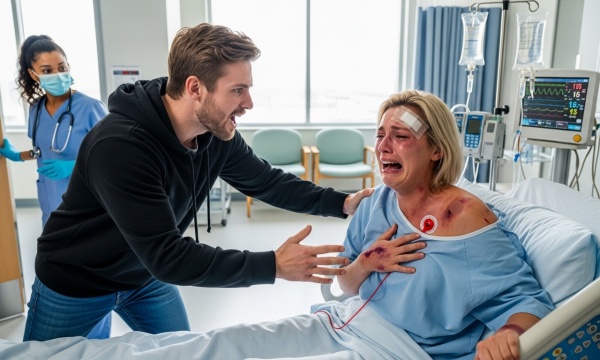
Then he grabbed my shoulder — my injured shoulder, the one with the fractured collarbone — and tried to pull me toward the edge of the bed. The pain was so intense I screamed. The monitors attached to my chest started beeping frantically. Derek ignored them. He was trying to drag me out of the bed, muttering under his breath about how I was “making a scene” and how I needed to “shut up and cooperate.”
I tried to push him away with my good arm, but I was too weak and too injured. Derek raised his hand, his face contorted with rage, and I knew he was going to hit me. I had seen that look before — in smaller moments over the years, moments I had convinced myself were not what they seemed. But now there was no denying it. My husband was going to hit me while I lay broken and helpless in a hospital bed. I closed my eyes and braced for the impact.
But it never came.
Part 3: The Security Guard, the Police, and the Protection Order
The door to my hospital room flew open, and a large man in a security uniform burst in, followed immediately by Nurse Paula and another nurse I had not met. The security guard — his name tag read “Marcus” — grabbed Derek’s raised arm and pulled him away from my bed with such force that Derek stumbled backward and nearly fell. “Sir, you need to step away from the patient right now,” Marcus said in a voice that was calm but absolutely authoritative. Derek tried to jerk his arm free. “Get your hands off me! That’s my wife! I have every right to be here!”
Marcus did not let go. “Sir, I just watched you try to drag an injured patient out of bed and raise your hand to strike her. You do not have the right to assault anyone in this hospital. You need to leave immediately, or I will call the police.” Paula was at my bedside, her hand on my good shoulder, her voice soft and urgent. “Rachel, are you okay? Did he hurt you?” I was shaking, tears streaming down my face, my shoulder throbbing where Derek had grabbed me. “He tried to pull me out of bed,” I whispered. “He was going to hit me.”
Paula’s face hardened. She turned to Marcus. “Call the police. Now.” Marcus nodded and spoke into the radio clipped to his shoulder. Within minutes, two Des Moines police officers arrived at my hospital room. Derek was escorted out of the room and into the hallway, protesting loudly the entire time.
One of the officers — a woman in her forties named Officer Janet Reyes — came to my bedside and asked me to describe what had happened. I told her everything: Derek’s anger when he arrived, his strange questions about whether I had told the police where I was going, his attempt to drag me out of bed, his raised hand. Officer Reyes took notes and photographs of the bruises on my wrist and shoulder where Derek had grabbed me.
Officer Reyes said, “Mrs. Brennan, based on what you’ve told me and what the security guard and nurses witnessed, I have probable cause to arrest your husband for assault. But I need to ask you something important: has he ever hurt you before?” I hesitated. The truth was complicated. Derek had never hit me before, but there had been other things — moments when he grabbed my arm too hard during arguments, times when he blocked doorways so I could not leave a room, incidents when he threw objects near me or punched walls.
I had always told myself those things were not abuse, that Derek just had a temper, that I was overreacting. But sitting in that hospital bed, injured and terrified, I could not lie anymore. “Yes,” I whispered. “Not like this. But yes. He’s hurt me before.”
Officer Reyes nodded. “I’m going to arrest him tonight for assault. And I’m going to recommend that you file for an emergency protective order. That will legally prohibit him from contacting you or coming near you. The hospital social worker can help you with that process. You don’t have to make any decisions right now, but I want you to know that you have options and that we will help you.”
I nodded, too overwhelmed to speak. Officer Reyes left the room, and a few minutes later I heard Derek shouting in the hallway as he was handcuffed and led away. “This is insane! I didn’t do anything! She’s lying! You’re all going to regret this!”
After Derek was gone, a hospital social worker named Karen came to my room. She was in her early sixties, with kind eyes and a calm, reassuring presence. She sat beside my bed and said, “Rachel, I know this is overwhelming, but I need you to listen to me. What happened tonight is not okay.
Your husband tried to physically remove you from a hospital bed while you were seriously injured, and he tried to hit you. That is assault, and it is also a sign of escalating domestic violence. I want to help you get a protective order, and I want to connect you with resources that can keep you safe. Will you let me help you?”
I nodded, tears streaming down my face. “I don’t know what to do. I don’t have anywhere to go. We live together. All my things are at our house.” Karen squeezed my hand gently. “We’re going to figure this out together. You’re not alone.”
Part 4: The Investigation, the Financial Fraud, and the Truth About Derek
Over the next three days, while I remained in the hospital recovering from my injuries, several things happened that changed my understanding of my marriage and my husband. First, Officer Reyes returned to my hospital room with a detective named Mark Sullivan. Detective Sullivan explained that after Derek’s arrest, the police had obtained a warrant to search Derek’s phone and our home.
What they found was evidence of extensive financial fraud and theft. Derek had been systematically stealing money from our joint checking account — a total of $47,000 over the past eighteen months — and funneling it into a separate account I did not know existed. He had also taken out a $30,000 personal loan in my name without my knowledge or consent, using forged documents.
Detective Sullivan said, “Mrs. Brennan, your husband has been committing identity theft and financial fraud. He forged your signature on loan documents, he opened credit cards in your name, and he’s been using your money to fund a lifestyle you weren’t aware of. We also found evidence that he’s been having an affair with a woman named Stephanie Morris for the past two years.
He’s been renting an apartment for her in West Des Moines and paying her rent and expenses with money stolen from your account.” I felt like I had been hit by another car. Derek had been cheating on me, stealing from me, and destroying my credit — all while I worked full-time as a paralegal making $52,000 per year and believing we were building a life together.
Detective Sullivan continued, “We believe that when you scheduled that appointment with the private investigator, Derek found out somehow — maybe he saw it on your calendar or heard you on the phone. He knew you were about to discover the truth about the money and the affair. That’s why he was so desperate to get you out of the hospital before you could talk to anyone.
He was trying to control the narrative and prevent you from exposing him.” I asked, “Is that why he asked if I told the police where I was going?” Detective Sullivan nodded. “Exactly. He was afraid you had already told someone about the private investigator, which would have led to questions about why you hired one, which would have led to the discovery of his crimes.”
The second thing that happened was that Karen, the hospital social worker, helped me file for an emergency protective order. A judge granted the order within 24 hours, legally prohibiting Derek from contacting me, coming within 500 feet of me, or returning to our home. The police escorted me to our house three days later when I was discharged from the hospital, and I was able to collect my personal belongings, important documents, and my cat.
Karen had arranged for me to stay at a confidential safe house run by a domestic violence organization in Cedar Rapids, about 30 miles away. The safe house provided free temporary housing, counseling, legal advocacy, and support services for survivors of domestic violence.
The third thing that happened was that Derek was formally charged with assault, identity theft, financial fraud, and forgery. His bail was set at $50,000, which he could not afford because all the money he had stolen was frozen by the court. He remained in jail while awaiting trial. His mistress Stephanie, when contacted by police, claimed she had no idea Derek was married and that he had told her he was divorced. She cooperated with the investigation and provided evidence of the money Derek had been giving her.
Part 5: The Divorce, the Recovery, and the Life I’m Rebuilding
I am 34 years old and I am writing this from the safe house in Cedar Rapids where I have been living for six weeks. I have filed for divorce from Derek on grounds of adultery, fraud, and domestic violence. My attorney, a woman named Lisa Park who specializes in cases involving financial abuse, has assured me that I will not be held responsible for the debts Derek incurred in my name and that I will be able to recover at least some of the money he stole from our joint account. Derek’s criminal trial is scheduled for June. He faces up to ten years in prison if convicted on all charges.
My physical injuries are healing slowly. My collarbone is still fractured but no longer requires a sling. My ribs are less painful, though I still cannot take deep breaths without discomfort. The stitches above my eyebrow have been removed, leaving a small scar that I have decided not to hide. My concussion symptoms — the headaches, the sensitivity to light, the difficulty concentrating — have mostly resolved.
But the emotional injuries are harder to measure and harder to heal. I am in therapy twice a week, working through the trauma of the accident, the abuse, and the betrayal. I am learning to recognize the warning signs I missed, to understand that what Derek did was not my fault, and to believe that I deserve better.
I am also rebuilding my life in practical ways. I have opened a new bank account in my name only. I have changed all my passwords. I have notified my employer, my family, and my friends about the protective order and asked them not to share my location with Derek or anyone connected to him. I am looking for a new apartment where I can live safely and independently. And I am working with a credit repair specialist to undo the damage Derek did to my credit score.
The accident that nearly killed me also saved my life. If that truck had not hit me, if I had made it to the private investigator’s office, I would have discovered Derek’s crimes — but I would have discovered them alone, without witnesses, without protection. Derek might have hurt me worse. He might have convinced me to stay silent. He might have destroyed evidence.
But because the accident happened, because I ended up in a hospital surrounded by people who saw what Derek tried to do, the truth came out in a way that could not be hidden or denied. The nurses, the security guard, the police — they all saw. They all believed me. And they all helped me.
After I was rushed to the hospital with serious injuries, my husband tried to drag me from the bed and hit me. But everything changed after that. The people who witnessed his violence protected me. The police arrested him. The courts gave me a protective order. And I finally found the strength to leave. I am not lucky. I am a survivor. And I am free.
