I Came Home 4 Days Early to Surprise My Family — A Pair of Women’s Heels by the Front Door Told Me Everything
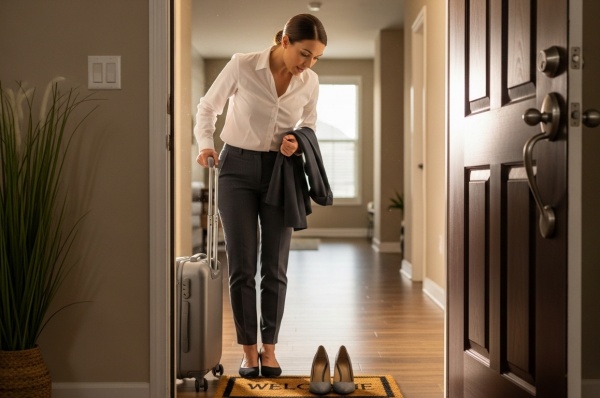
After four months on assignment in Baton Rouge, I booked an early flight home to Nashville to surprise my husband and my six-year-old son. I pulled into the driveway at 5:52 PM on a Thursday, heart full, rolling suitcase behind me — and stopped two steps from my front door. Beside the welcome mat, placed neatly and carefully, were a pair of blush strappy heeled sandals that were not mine.
Size seven. The kind you wear when you want to look good somewhere. I stood on my own front path and looked at those shoes, and my project manager’s brain — trained to assess situations accurately — assessed the situation with a precision that felt like ice water. I put my key in the lock. I walked into my house. What I found in my kitchen changed everything.
Part 1: The Woman Who Came Home Early
My name is Lauren Prescott, and I am 34 years old, living in Nashville, Tennessee. I am a senior project manager for a federal infrastructure consulting firm, making about $127,000 a year, and my job requires me to travel — sometimes for weeks, sometimes for months — to oversee large-scale construction projects in locations that are rarely convenient and never glamorous. I drive a gray Honda Pilot, live in a four-bedroom craftsman house in the Sylvan Park neighborhood that my husband and I bought together in 2020 for $574,000, and I have a six-year-old son named Owen who has his father’s dark hair and my inability to sit still and a laugh that can fill every room in the house simultaneously.
I am telling this story because I have spent the last seven months trying to figure out how to tell it, and I have finally decided that the only way to tell it is straight — no softening, no editorializing, just the facts in the order they happened and what they cost and what came after.
I need to explain what four months away from home actually feels like, because I think people who haven’t done it imagine it as something cleaner than it is. My assignment had been in Baton Rouge, Louisiana — a federal levee reinforcement project that had gone over schedule and needed a senior PM to come in and stabilize the timeline. I had taken the assignment in January, kissed my husband Marcus and my son Owen goodbye on a Sunday morning, and driven to the airport with the particular mixture of professional focus and personal guilt that working mothers carry like a second carry-on bag.
I called home every night. I video-chatted with Owen every morning before school. I sent Marcus a text every evening that said some version of “thinking of you” because I had read somewhere that small consistent gestures matter more than grand occasional ones, and I was trying, from 500 miles away, to be a present wife.
Marcus Prescott was 37, a high school history teacher at Hillsboro High School in Nashville, making $62,000 a year. He was, by every account I had access to, a devoted father and a steady, reliable presence in Owen’s daily life during my absences. He managed the school drop-offs and pickups, the soccer practices, the homework, the bedtime routines, the thousand invisible logistics of keeping a six-year-old’s life running smoothly. I was grateful for this.
I told him I was grateful, regularly and sincerely. I believed, completely and without reservation, that our marriage was solid — tested by distance and schedule, certainly, but solid in the way that things are solid when they are built on genuine love and mutual respect. I believed this on the morning of May 9th, when I made the decision to come home four days early.
The Baton Rouge project had hit a milestone two weeks ahead of the revised schedule — a small miracle of logistics and contractor cooperation that my supervisor called “the most efficient turnaround she’d seen in fifteen years.” She told me to take the long weekend, go home, see my family. I booked a flight for Thursday afternoon instead of Monday morning, and I did not tell Marcus. I wanted to surprise him.
I wanted to walk through the door and see Owen’s face when he realized his mom was home early. I wanted to sit in my own kitchen and drink coffee from my own mug and sleep in my own bed and feel, for four days before the next assignment, like my life was fully mine again. I was so focused on what I was going to feel walking through that door that I gave almost no thought to what I might find on the other side of it.
Part 2: The Drive Home and the Detail That Stopped Me Cold
My flight landed at Nashville International at 4:47 PM on a Thursday. I had one rolling suitcase and a laptop bag and the specific, buzzing anticipation of someone who has been away from home for four months and is forty-five minutes from their own front door.
I picked up my car from long-term parking — it took twenty minutes to find it, which felt like the universe testing my patience — and I drove the familiar route home through the late afternoon traffic on I-40, past the exits I knew by heart, through the neighborhood streets I had driven a thousand times, and pulled into the driveway of my house at 5:52 PM on a Thursday in May with the windows down and the radio on and my heart genuinely full.
The house looked exactly as it always looked. The front yard was mowed — Marcus kept up with that, he always had. Owen’s soccer ball was on the porch, which meant he’d been playing in the yard after school. The lights were on inside, warm and yellow through the front windows, and I could see the flicker of the television in the living room. Everything looked normal. Everything looked like home.
I turned off the engine and sat for a moment just taking it in — the specific, irreplaceable sight of your own house after a long absence — and then I got out of the car and walked up the front path with my rolling suitcase bumping behind me and my key already in my hand.
I was two steps from the front door when I saw them. They were placed neatly to the right of the welcome mat — the kind of careful placement that suggests someone who is tidy by habit, someone who takes their shoes off at the door and sets them where they won’t be tripped over. They were women’s shoes. Not mine.
I knew they were not mine because I know every pair of shoes I own, and because these were a style I would not have chosen — strappy heeled sandals in a pale blush color, size seven by the look of them, the kind of shoes you wear when you are going somewhere you want to look good. They were not work shoes. They were not the shoes of a friend who had stopped by to drop something off. They were the shoes of a woman who had come inside and taken them off and had not yet put them back on.
I stood on my front path for what felt like a long time but was probably thirty seconds, looking at those shoes with the focused, disbelieving attention of someone whose brain is receiving information that it is not yet willing to process. I am a project manager. My entire professional life is built on the ability to assess a situation accurately and respond to it effectively.
I assessed the situation. The shoes were a size seven blush strappy sandal placed neatly beside my front door at 5:52 PM on a Thursday when my husband believed I was in Baton Rouge until Monday. I did not need a project management certification to understand what I was looking at. I understood it immediately, completely, and with a clarity that felt like being doused with cold water. I put my key in the lock. I opened the door. I walked into my house.
Part 3: What I Found and What I Did With It
The living room was empty. The television was on — a cartoon, which meant Owen had been watching it recently, which meant Owen was home, which meant whatever was happening in my house was happening with my six-year-old son present. That detail — that specific detail — moved through me like electricity and settled somewhere in my chest as a cold, hard point of fury that I have never felt before or since. I set my suitcase quietly by the door. I set my laptop bag beside it. I stood in my living room and listened.
I could hear voices from the kitchen — the back of the house, past the hallway. I could hear Owen’s voice, which was the first thing I identified, and the relief of hearing him was immediate and physical. He sounded fine. He sounded like himself — animated, talking about something with the enthusiastic run-on energy of a six-year-old explaining something important.
I could hear a woman’s voice responding to him, warm and engaged, the voice of someone who was comfortable in that kitchen, comfortable with my son, comfortable in a space that was not hers to be comfortable in. I did not hear Marcus’s voice. I walked down the hallway.
The kitchen scene that I walked into was, on its surface, entirely domestic. Owen was sitting at the kitchen island with a bowl of mac and cheese, talking at considerable speed about something that had happened at school. A woman was standing at my stove, stirring something in my favorite pot, wearing a floral sundress and the easy posture of someone who had been in this kitchen before.
She was about 30, with light brown hair pulled back, pretty in an uncomplicated way, and she had her back to me when I walked in. Owen saw me first. His face went through approximately four emotions in two seconds — shock, joy, confusion, and then a child’s instinctive reading of adult tension that made him go very still. “Mommy,” he said. The woman turned around.
I want to be precise about what happened in the next few minutes, because I think precision matters here. I did not scream. I did not throw anything. I did not say anything to the woman that I am ashamed of, which required more self-control than I knew I possessed. I looked at her, and she looked at me, and her face went the specific color of someone who has been caught in something they cannot explain their way out of.
I said, very calmly, “Where is my husband?” She said, in a voice that was barely above a whisper, “He’s upstairs.” I looked at Owen. I said, “Baby, go get your shoes and your backpack. We’re going to Grandma’s for a little while.” Owen, who is six years old and smarter than most adults I know, slid off the stool without a word and went to his room. I looked at the woman one more time. I said, “You need to leave my house.” She left. She took her blush sandals from the front porch. She did not say anything else to me, which was the correct decision.
Part 4: The Conversation Upstairs
I took Owen to my mother’s house, which was twelve minutes away in the Green Hills neighborhood. My mother, Carol, opened the door, took one look at my face, and said nothing except “Come in, baby” — to Owen, not to me, which was exactly right. I kissed Owen, told him I would be back soon, told him I loved him more than everything, and drove back to Sylvan Park. The whole round trip took thirty-four minutes.
Marcus was sitting at the kitchen island when I came back — the same stool Owen had been sitting on — with his hands flat on the counter and the expression of a man who has had thirty-four minutes to prepare for a conversation and has not managed to prepare for it at all.
I sat down across from him. I did not cry. I want to be clear about that, not because crying would have been wrong but because I think people expect the crying to come first, and it didn’t. What came first was a kind of terrible calm — the calm of someone who has been managing crises professionally for ten years and whose brain defaults to assessment and documentation even when the crisis is personal. I asked him how long.
He said four months. Four months. The same four months I had been in Baton Rouge. The timeline landed with a specific, nauseating precision — he had not waited until I was gone to begin something. He had begun something that ran parallel to my absence, as if my absence had been the permission rather than the cause.
Her name was Jess. She was 29, a PE teacher at a middle school in Brentwood. They had met at a teachers’ professional development conference in February. Marcus told me this with the halting, careful honesty of a man who has decided that the only remaining option is the truth, and I listened to all of it without interrupting because I needed the complete picture before I decided what to do with it. He said he was sorry. He said it multiple times, in multiple ways, and I believed that he meant it, which did not make it matter less.
He said he had not planned for it to happen. He said he had not planned for Owen to be around her, that it had “just happened” that afternoon, that she had come over to talk and Owen had been there and he hadn’t known how to handle it. I told him that “just happened” was not a sentence I was willing to accept as an explanation for any part of what I had walked into.
I asked him one question that I needed the answer to before anything else: had Owen met her before that afternoon? Marcus was quiet for a moment. Then he said yes — twice, he said. They had gone to Centennial Park together on a Saturday three weeks earlier. Owen had been told she was “a friend from work.” I absorbed this information.
My six-year-old son had spent time with the woman his father was having an affair with, introduced to her under a false premise, in a situation he had no framework to understand. That was the moment the cold fury in my chest became something else — something that was not about Marcus and Jess at all, but about Owen, and about what my son had been navigating without knowing he was navigating it, and about the fact that the one person in our house who had done nothing wrong was the one who had been most exposed to the consequences of everyone else’s choices.
Part 5: The Accounting and the After
I am going to tell the rest of this story the way it actually went, without the shortcuts that make hard things sound cleaner than they are. Marcus and I separated the following week. I retained a family law attorney in Nashville — Rebecca Holt, who was recommended by three people I trusted and who turned out to be exactly as good as advertised. Under Tennessee law, our divorce was filed on grounds of inappropriate marital conduct, supported by documentation that my attorney advised me to gather carefully and completely.
The divorce was finalized five months later. The house was sold — we listed it in August, sold it in three weeks for $641,000 in a market that had been kind to Sylvan Park, split the equity after the mortgage payoff, and walked away with approximately $87,000 each. I found a three-bedroom rental in the Bellevue neighborhood while I figured out my next permanent move. Marcus moved into an apartment in East Nashville.
The custody arrangement was the part that required the most careful navigation, and I want to be honest about how I approached it: I did not use Owen as a weapon. I want to be clear about that because I think it matters, and because I think the temptation to do exactly that is real and understandable and ultimately harmful to the one person you are trying to protect. Owen loves his father.
Marcus, whatever he did to our marriage, is a present and devoted father, and those two things — what he did to me and who he is to Owen — are separate facts that I had to hold simultaneously without letting my anger about the first one contaminate my judgment about the second. We established a joint custody arrangement: Owen spends the school week with me and alternating weekends with Marcus. We share holidays. We communicate through a co-parenting app that keeps things documented and businesslike, which is what we both need right now.
Owen has been in therapy since September — a child therapist named Dr. Amy Pearson who works with kids navigating family transitions and who Owen has described as “the lady with the cool fish tank,” which I take as a sign that he is comfortable there. He has asked me questions about the divorce with the direct, unsentimental curiosity of a six-year-old who wants information rather than reassurance, and I have answered every question honestly and in age-appropriate terms, without assigning blame and without pretending that everything is fine when it isn’t.
He knows that Mommy and Daddy don’t live together anymore. He knows that both of us love him more than anything. He knows that none of this is his fault. Dr. Pearson says he is processing it well. I check in with her every three weeks. I will keep checking in.
As for me — I am rebuilding, which is the honest word for what I am doing, and I am choosing to use it without apology. I bought a house in the Sylvan Park neighborhood again — a three-bedroom bungalow two streets from our old house, because Owen’s school is there and his friends are there and his life is there, and my disruption of his geography ends at the front door of his school.
The new house cost $498,000 and it is mine alone, in my name, purchased with my income and my credit and my decade of professional work, and I have spent the last four months making it into something that feels like us — Owen and me, the family we are now, with his drawings on the refrigerator and his soccer cleats by the back door and Biscuit the rescue beagle asleep on the couch in direct violation of the no-dogs-on-furniture rule that I have entirely stopped enforcing.
I went back to Baton Rouge in September for a follow-up project review, and I sat in my hotel room on the first night and thought about the woman who had left Nashville in January believing her life was one thing and come home in May to find it was another. I thought about those blush sandals on the front porch. I thought about Owen’s face when he said “Mommy” and the world shifted.
I thought about the thirty-four minutes I spent driving my son to my mother’s house and back, and what I had decided in those thirty-four minutes about who I was going to be on the other side of this. I had decided to be precise. I had decided to be fair. I had decided to protect my son first and my pride second and my anger last, and to build something from what remained that Owen could grow up inside of and feel safe. I think I am doing that. Some days are harder than others. But I am doing that.
The last thing I want to say is this: I came home early to surprise my family, and I was the one who got surprised. The shoes by the door were not the end of my story. They were the end of a chapter — a painful, clarifying, ultimately necessary end to something that had been quietly wrong in ways I hadn’t fully seen.
What came after the shoes is mine. The house is mine. The career is mine. The Saturday mornings with Owen and Biscuit and too much maple syrup on the pancakes are mine. I did not choose the surprise I came home to. But I have chosen, every day since, what to do with it. And what I have done with it is build something that is honest and solid and entirely, completely mine.
