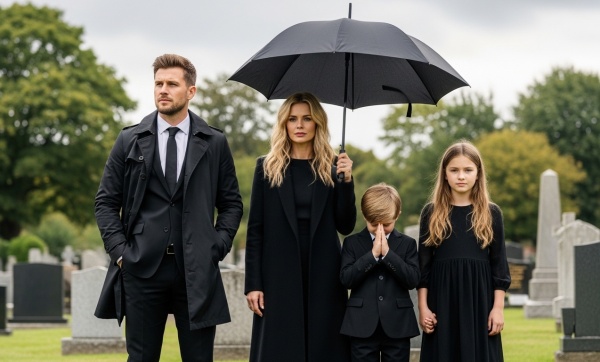
At My Mother’s Funeral, I Looked Up and Saw My Ex-Wife — Then Two Children Looked Back With My Eyes. Seven Years After Our Divorce, the Truth Finally Came Out
I was burying my mother at Woodlawn Memorial Park in Nashville when I saw her — Allison, my ex-wife of seven years, standing at the back of the crowd in the rain with two small children. I hadn’t seen or spoken to her since our divorce in 2019.
When I walked over, the children looked up at me, and I felt something stop in my chest. They had my eyes. Exactly my eyes. My mother had known the entire time. She had kept the secret for six years. And she had taken it into the ground with her that morning.
Part 1: The Funeral That Changed Everything
My name is Daniel Mercer, and I am 38 years old, living in Nashville, Tennessee. I am a civil engineer at a mid-sized infrastructure firm, making about $94,000 a year, driving a four-year-old Ford F-150, and living alone in a two-bedroom house in the Germantown neighborhood that I bought three years ago with the quiet resignation of a man who has accepted that his life will be smaller than he once imagined.
I am not a dramatic person. I do not tell stories about myself at dinner parties. I do not post about my feelings on social media. But what happened at my mother’s funeral on a cold Saturday morning in February has been living inside my chest like a splinter for four months now, and I need to get it out before it works its way somewhere I can’t reach.
My mother, Patricia Mercer, died on February 3rd at the age of 67, from complications following a stroke she’d suffered six weeks earlier. She’d been in a care facility in Brentwood for most of those six weeks, and I’d driven out to see her every day after work, sitting beside her bed and talking even when she couldn’t respond, because the nurses said hearing familiar voices mattered and because I didn’t know what else to do. She was my only family. My father had died when I was eleven, and I was an only child. When Patricia Mercer died, I became the last Mercer standing, which is a lonelier feeling than I can adequately describe.
The funeral was held at Woodlawn Memorial Park, a large cemetery in Nashville that my mother had pre-arranged years ago with the practical efficiency of a woman who didn’t want to leave a mess for anyone else to clean up. About sixty people came — former colleagues from the school where she’d worked as an administrative assistant for thirty years, neighbors, members of her church, a few of my own friends who came to support me.
It was a gray February morning, the kind where the cold gets into your bones and the sky looks like it can’t decide whether to rain or just stay heavy and threatening. The service was at the graveside, brief and dignified, exactly as my mother would have wanted.
I was standing at the front, nearest the casket, wearing the black suit I’d bought specifically for the occasion because my mother had always said a man should own a proper black suit. I was holding myself together with the focused effort of someone who has decided that grief is a private matter and public composure is a form of respect.
I was doing fine, or something close to fine, until I looked up across the open grave and saw a woman standing at the back of the gathered crowd, half-hidden under a black umbrella, with two small children standing close on either side of her. And the world went very quiet around me, the way it does when your brain encounters something it doesn’t know how to process.
Part 2: The Marriage I Lost and Never Fully Understood
The woman under the umbrella was Allison Mercer — Allison Crane now, I assumed, or maybe she’d gone back to her maiden name. She had been my wife for four years, from 2015 to 2019, and I had not seen her or spoken to her in seven years. She looked different and exactly the same simultaneously, the way people do when time has changed the surface but left the essential person intact.
Her dark hair was longer. She was thinner than I remembered. She stood with the careful stillness of someone trying not to be noticed, which was not working, because I couldn’t look away from her.
Allison and I had met in 2012 at a work conference in Atlanta, where she was working as a landscape architect and I was presenting a paper on stormwater management systems — which sounds deeply unglamorous but was apparently compelling enough that she approached me afterward and asked a question that turned into a two-hour conversation that turned into dinner that turned into two years of long-distance dating between Nashville and Atlanta before she relocated to Nashville and we got married in June 2015 at a small ceremony in Centennial Park. It was a good wedding. It was, for several years, a good marriage.
The problems started around year two and built slowly, the way structural damage builds — invisible until suddenly it isn’t. We wanted different things, or we wanted the same things on different timelines, or we communicated in ways that consistently missed each other. We tried counseling twice. We had long, earnest conversations that went nowhere. We were not cruel to each other — there was no dramatic betrayal, no explosive fight that ended everything.
There was just a gradual, painful recognition that we had become people who loved each other but couldn’t make each other happy, and that staying was doing more damage than leaving. In March 2019, we filed for divorce by mutual agreement. It was finalized in August. We had no children, no shared property beyond a joint savings account we split evenly, and no reason to maintain contact. So we didn’t.
My mother had liked Allison. More than liked — she’d genuinely loved her, in the way she loved people she considered fundamentally decent. When the divorce happened, my mother had been sad but not judgmental, which was characteristic of her. She’d asked me once, about a year after the divorce was finalized, whether I thought Allison was doing okay.
I’d told her I didn’t know, that we weren’t in contact. My mother had nodded and said, “I hope she’s well. She was a good person.” I’d agreed and changed the subject, because talking about Allison made me feel a specific kind of grief that I hadn’t fully processed and wasn’t ready to examine.
What I had never known — what I was standing at my mother’s graveside beginning to suspect, with a cold that had nothing to do with the February weather — was why Allison had come to this funeral. We had been divorced for seven years. She had no ongoing relationship with my mother, as far as I knew. There was no reason for her to be here, standing in the rain with two children, watching from the back of the crowd with an expression I couldn’t read from across the grave. No reason except one that I was not yet ready to name.
Part 3: The Children With My Eyes
The service ended. People began moving toward their cars, stopping to offer me condolences, pressing my hand and saying the things people say at funerals. I accepted every expression of sympathy with the automatic gratitude of someone running on autopilot, my eyes tracking Allison across the cemetery. She hadn’t moved toward me. She was crouching down, talking quietly to the two children, her back partially turned. I excused myself from a conversation with my mother’s former colleague and walked toward her.
She heard my footsteps on the wet grass and stood up, turning to face me. Up close, I could see that she’d been crying — not recently, but the evidence was there in the slight redness around her eyes. She looked at me with an expression that contained about six different emotions simultaneously, none of which I could fully identify. “Daniel,” she said. Her voice was steady. “I’m so sorry about Patricia. She was a wonderful woman.” “Thank you for coming,” I said, which was the automatic response, the polite response, the response that bought me time while my brain caught up with what I was seeing.
Because I was looking at the two children now. They were standing close to Allison, one on each side, holding her hands with the instinctive gravity-seeking of young children in unfamiliar situations. They were, I estimated, somewhere between five and seven years old — close in age, possibly twins, though not identical. A boy and a girl. The boy had dark hair and a serious expression. The girl had lighter coloring but the same watchful quality.
And they were both looking up at me with eyes that I recognized with a certainty that bypassed logic and went straight to something cellular, something that exists below conscious thought. They had my eyes. The specific shade of gray-green, the particular shape, the slight downward tilt at the outer corners that I’d seen in my own reflection every morning for thirty-eight years. They had my mother’s eyes. They had the Mercer eyes.
I looked at Allison. She was watching me with the careful attention of someone waiting for a reaction they’ve been anticipating for a long time. “Allison,” I said. My voice came out lower than I intended. “Who are these children?” She took a breath. “Their names are Owen and Lily,” she said. “They’re six years old.” Six years old. I did the math without wanting to, the numbers arranging themselves with brutal efficiency.
Allison and I had finalized our divorce in August 2019. But six-year-old twins born in late 2019 or early 2020 would have been conceived in early to mid 2019 — while we were still married. While we were in the process of divorcing. While I had believed, completely and without question, that there was no pregnancy, no child, nothing that complicated the clean and mutual ending of our marriage.
“Are they mine?” I asked. The question came out barely above a whisper. Allison closed her eyes for a moment. When she opened them, they were wet. “Yes,” she said. “They’re yours, Daniel.”
Part 4: The Truth My Mother Had Carried
I don’t remember the next several minutes clearly. I remember that people were still nearby, still moving through the cemetery, and that I was aware of not wanting to have this conversation in public, in front of my mother’s grave, with sixty people within earshot.
I remember asking Allison to wait, going back to accept the last of the condolences, thanking the funeral director, watching the remaining guests leave. I remember that Owen and Lily sat on a bench near a large oak tree and shared something from a small bag Allison had brought, with the patient adaptability of children who are used to waiting for adults to finish adult things.
When the cemetery had emptied enough, I walked back to Allison and we sat on a bench about twenty feet from my mother’s grave, and she told me everything. She had discovered she was pregnant six weeks after we filed for divorce — March 2019, the same month we’d begun the legal process of ending our marriage. She had been in shock, then terrified, then faced with a decision that she described as the hardest of her life. She had wanted to tell me.
She had picked up the phone multiple times. But we had been in the middle of a divorce that was, by mutual agreement, clean and final, and she had been afraid — afraid that telling me would complicate the legal process, afraid that I would feel trapped, afraid that a child would become a point of conflict in a separation that had been, until that moment, remarkably civil.
So she had called my mother. She and Patricia had always been close, and Allison had needed to tell someone, needed guidance from someone who knew both of us. My mother had listened, and then she had said something that Allison had spent six years trying to make peace with. She had told Allison not to tell me.
Not out of cruelty, not out of any desire to keep me from my children, but because she had believed — genuinely, with the best intentions she was capable of — that telling me would destroy whatever chance Allison had of building a stable life, that I would feel obligated rather than willing, that a child born from obligation was worse than a child raised by one devoted parent. My mother had believed she was protecting everyone. She had been catastrophically wrong.
Allison had moved back to Atlanta, where her parents were, and had raised Owen and Lily there for the first four years of their lives. She’d worked part-time as a landscape architect while her parents helped with childcare. She’d built a life that was smaller than she’d planned but full in the ways that mattered.
Three years ago, she’d moved back to Nashville for a job opportunity — a senior position at a landscape architecture firm that had doubled her salary to about $88,000. She was living in East Nashville, about four miles from my house in Germantown, and had been for three years. Three years. My children had been four miles away for three years, and I hadn’t known.
She had kept in loose contact with my mother over the years — occasional calls, a Christmas card, photos of the twins that my mother had apparently kept in a box in her closet that I had not yet gone through. My mother had known Owen and Lily existed.
She had seen photographs of them growing up. She had carried this secret for six years, and she had taken it with her when she died, and the only reason I was sitting on this bench in this cemetery knowing the truth was that Allison had decided, sometime in the six weeks of my mother’s illness, that she could not let Patricia Mercer die without at least giving me the chance to know. She had come to the funeral not to confront me, not to make a scene, but to be present in case I looked up and saw her, in case the universe decided that today was the day the truth came out. The universe, apparently, had decided exactly that.
Part 5: Learning to Be a Father at Thirty-Eight
In the four months since my mother’s funeral, I have had a DNA test done — Allison agreed without hesitation, understanding that I needed the legal and biological confirmation even though neither of us had any real doubt. The results confirmed what the gray-green eyes had already told me: Owen and Lily Crane are my biological children.
I have since retained a family law attorney in Nashville to formalize a parenting arrangement, and Allison has been cooperative in a way that I find both deeply appreciated and quietly heartbreaking — cooperative in the way of someone who has been carrying guilt for six years and is relieved to finally set it down.
The first time I met Owen and Lily as their father — not as a stranger at a cemetery, but as someone they’d been told was their dad — was on a Sunday afternoon in March, at Centennial Park, which felt both accidental and appropriate given that it was where Allison and I had gotten married fourteen years earlier.
Allison had prepared them as best she could, explaining in the careful language of a thoughtful parent that their father had not known about them, that this was not anyone’s fault, that he very much wanted to know them now. Owen had listened with the serious attention of a child processing complex information. Lily had asked, with the directness of a six-year-old, whether I liked dogs. I told her I did. She told me they had a dog named Biscuit. I told her that was an excellent name for a dog. She decided, apparently on the basis of this exchange, that I was acceptable.
Owen took longer. He was quieter than his sister, more watchful, and I recognized in him something I recognized in myself — the habit of observing before committing, of needing to understand a situation fully before deciding how to feel about it. He didn’t warm to me in that first meeting, or the second, or the third. But at our fourth Sunday afternoon together, at the Nashville Zoo, he walked up beside me while we were watching the giraffes and said, without preamble, “Mom says you’re an engineer.”
I told him I was. He said, “I want to build bridges.” I told him that was one of the best things a person could want to build. He thought about this for a moment, and then he put his hand in mine, and we stood there watching the giraffes together, and I had to look away because I didn’t want him to see me cry.
I have not fully processed my feelings about my mother’s role in this. I’ve tried. I’ve sat with my therapist, Dr. James Whitfield, in his office on Charlotte Avenue every Tuesday for four months and talked about Patricia Mercer and the box of photographs in her closet and the phone calls she’d had with Allison over six years and the decision she’d made that she believed was right and that cost me the first six years of my children’s lives.
I’ve moved through anger and grief and a complicated tenderness that I can’t fully resolve — because she was my mother, and she loved me, and she was wrong in a way that cannot be undone, and all of those things are true simultaneously. I’ve decided, with Dr. Whitfield’s help, that I am not going to spend the rest of my life being angry at a woman who is no longer here to hear it or respond to it or make it right. I am going to spend the rest of my life being present for the children she kept from me, which is the only form of repair available to me now.
As for Allison — that is the most complicated question of all, and I want to answer it honestly rather than the way it would be answered in a movie. We are not together. We have not rekindled anything. We are two people who loved each other once, made each other unhappy, divorced for legitimate reasons, and now share two children who deserve parents who can be in the same room without tension. We are working on being those parents.
Some days it is easier than others. She is a good mother — an extraordinary mother, actually, and watching her with Owen and Lily has given me a respect for her that is different from what I felt when we were married, deeper and less complicated by the friction of daily life together. I am grateful to her for raising them well. I am grateful to her for coming to that funeral. I am grateful to her for giving me the chance to know them at all.
Owen and Lily are seven now — they turned seven in October, and I was there for their birthday, at Allison’s house in East Nashville, sitting at a kitchen table covered in blue and yellow streamers while they demolished a chocolate cake with the focused enthusiasm of children who take birthdays seriously.
Owen got a model bridge-building kit that I’d ordered from an engineering toy company, and he looked at me when he opened it with an expression that I am going to carry with me for the rest of my life. Lily got a book about dogs and a stuffed animal that looked like Biscuit, and she immediately named the stuffed animal Biscuit Two and informed everyone that they were now a family of Biscuits.
I see them every Wednesday evening and every other weekend, per the parenting agreement. I am learning, at thirty-eight, what it means to be a father — learning it without the benefit of the first six years, without the accumulated knowledge of a thousand small moments, learning it from scratch with two children who are already fully formed people with opinions and preferences and inside jokes I don’t yet understand. It is humbling and terrifying and the best thing that has ever happened to me.
I am not a dramatic person. I do not tell stories about myself. But I am telling this one because I want other people to understand something I’ve learned the hard way: secrets kept out of love are still secrets. And the truth, however complicated, however painful, however poorly timed — the truth is always the kindest thing you can give the people you love. My mother didn’t know that. I’m spending the rest of my life making sure her grandchildren do.
