Her Husband Punched Me for Driving Her Home — I Didn’t Explain. The Next Morning She Called Me Into Her Office and Said Something I Never Expected
Part 1: The Rainy Night That Started Everything
My name is Ryan Callahan, and I am 27 years old, and I work as a project coordinator at a mid-sized marketing firm in Austin, Texas, and until about three weeks ago my life was the kind of ordinary, predictable, quietly satisfying existence that I had no particular complaints about and no particular reason to examine too closely. I drive a dark blue Honda Accord that I bought used two years ago and that has a small dent on the rear bumper from a parking garage incident I prefer not to discuss.
I live in a one-bedroom apartment in the South Congress neighborhood that costs $1,450 a month and that I have furnished with the specific, functional minimalism of a young man who is not yet sure what his aesthetic is but knows it is not whatever came before. I am telling this story because it is the strangest and most unexpectedly significant thing that has happened to me in my adult life, and because I have been carrying it around for three weeks trying to make sense of it, and because writing it down is the only way I know how to make sense of things.
I need to describe my boss before I describe anything else, because she is the center of this story even though she would probably prefer not to be described at all. Her name is Victoria Chen, and she is 32 years old, and she is the Director of Client Strategy at our firm, which means she manages a team of eight people including me and is responsible for the accounts that represent approximately 60 percent of the company’s annual revenue.
She is five foot six, with dark hair she usually wears pulled back in a way that looks effortless and probably isn’t, and she has the specific, composed authority of someone who has been the smartest person in most rooms for long enough that she has stopped needing to prove it. She is not warm in the conventional, approachable sense — she is precise and direct and expects the same from the people who work for her, and in the two years I have worked on her team I have learned more about how to do my job well from watching her than from any other source.
She is also, and I say this as a fact rather than a complication, the most compelling person I have ever been in a room with. I had been aware of this for approximately twenty-two months. I had been doing nothing about it for exactly the same amount of time.
The night in question was a Thursday in late October. The entire office had cleared out by seven, which is early for a Thursday during our busy season, but there had been a happy hour for a colleague’s birthday that most of the team had gone to and that Victoria and I had both skipped — she because she had a client deliverable due at midnight, and I because I had told myself I was staying to finish a report and had not examined too carefully whether the staying was entirely about the report.
By nine-thirty, the office was completely empty except for the two of us, and the Austin night outside the windows had turned into the kind of hard, driving October rain that comes in fast off the Hill Country and makes the city look like it’s been rinsed clean. Victoria shut her laptop at nine forty-five and stood up and looked out the window at the rain with the expression of someone doing a rapid practical calculation.
She had taken an Uber to work that morning, which I knew because I had seen her get out of one in the parking garage. She lived in the Tarrytown neighborhood, which was about twelve minutes from the office on a clear night and probably closer to twenty in this rain. I had my car. Her neighborhood was more or less on my way home, in the loose geographic sense that most of Austin is more or less on the way to most other parts of Austin if you are not being precise about it.
I said, “I can give you a ride if you need one.” She looked at me for a moment with the evaluating expression she uses when she is deciding whether something is a good idea. Then she said, “That would be helpful. Thank you, Ryan.” She said it with the specific, professional courtesy of someone accepting a practical offer, and I said, “Sure, no problem,” with the specific, professional courtesy of someone making one, and we both pretended that the offer and the acceptance were entirely ordinary, which they were, and also somehow were not.
Part 2: The Drive, the Silence, and the Moment at the Door
The drive to Tarrytown took eighteen minutes in the rain, which was longer than usual because Lamar Boulevard was backed up from a fender-bender near 38th Street and we had to take a detour through the neighborhood streets. Victoria sat in the passenger seat with her laptop bag on her lap and her head resting against the seat back, and she was quiet in the way that very tired people are quiet — not uncomfortable, not withdrawn, just absent, present in the car but somewhere else in her mind.
I focused on driving and did not try to fill the silence with conversation, partly because I could see she was exhausted and partly because the silence felt, in the specific acoustics of a car in heavy rain, like something that should be left alone. The windshield wipers kept time. The rain hit the roof in the steady, white-noise way of a heavy downpour.
I was aware of her in the way that I was always aware of her, which was more than I had ever admitted to myself directly, and I kept my eyes on the road and my hands at ten and two and I drove.
Her house was a craftsman bungalow on a tree-lined street in Tarrytown, the kind of neighborhood where the houses have front porches and the oak trees are old enough to form a canopy over the street and the whole thing looks, even in the rain, like a place where people have chosen to put down roots.
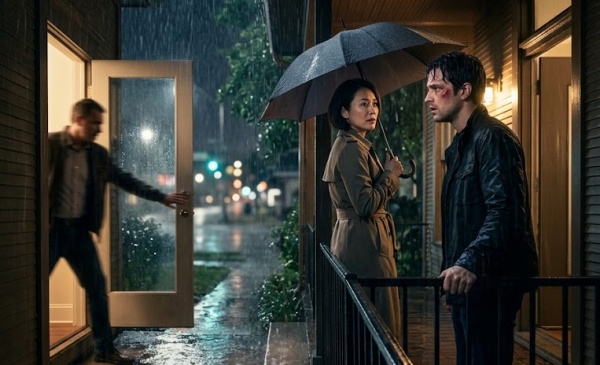
I pulled up to the curb in front of the house and put the car in park, and I looked at the distance between the car and the front door — maybe thirty feet, but the rain was coming down hard enough that thirty feet was enough to get thoroughly soaked — and I did what seemed like the obvious, practical thing. I got out of the car, opened the umbrella I keep in the back seat, walked around to the passenger side, and held it over Victoria while she got out.
We walked up the front path together under the umbrella, close enough that I could smell her perfume over the rain, and I held the umbrella over her until we reached the covered porch and she was out of the rain.
She was reaching into her bag for her keys when the front door opened from the inside. The man who came through it was about six feet tall, broad-shouldered, in a dark jacket, and he was moving fast — not the measured, purposeful movement of someone who has seen something and is going to address it calmly, but the fast, forward-leaning movement of someone who has been waiting for something and has decided, in the moment of seeing it, that the time for waiting is over. He looked at me.
His eyes were the specific, unfocused red of someone who has been drinking or has been crying or both. He said something — I did not catch what, because what happened next happened faster than the words. He pulled back and hit me. One punch, right side of my face, connecting just below my cheekbone with the full, unrestrained force of a man who is not thinking about consequences. I went sideways into the porch railing and grabbed it with both hands to keep from going down.
Victoria moved between us before I had fully processed what had happened. She put both hands flat on the man’s chest and she said, in a voice that was not loud but was absolutely, completely firm: “Stop. Right now.” He was breathing hard. He looked at her and then at me and then back at her, and whatever he saw in her face stopped him — not calmed him, but stopped him, the way a wall stops something rather than the way a hand does. Victoria looked at me over her shoulder with an expression that was equal parts apology and something harder to read, and she said, “Ryan, I’m so sorry. Please go.
I’ll explain tomorrow.” Then she turned back to the man and said, in a lower voice that I was not meant to hear but did: “Get inside. Now.” She did not look back at me again. The door closed. I stood on the porch in the rain for a moment, holding the railing, with the right side of my face beginning to register what had just happened to it. Then I walked back to my car and I drove home.
Part 3: The Night I Spent Not Sleeping and the Morning She Called Me In
I want to describe the drive home honestly, because I think the honesty is the point. I was not angry, exactly — or rather, I was, but the anger was complicated by other things that I was not ready to examine directly. The side of my face hurt in the specific, spreading way of a hit that is going to be worse in an hour than it is right now.
My hands were steady on the wheel, which surprised me slightly. I drove south on Lamar with the rain still coming down and the Austin night doing what Austin nights do — being warm and lit and entirely indifferent to the specific difficulties of any individual person moving through it — and I thought about what had just happened and what it meant and what I was supposed to do with it.
I did not blame the man. That is the honest thing, and I want to say it clearly because I think it matters. I did not know who he was or what his situation was or what he had seen when he opened that door, but I understood, in the basic, human way that you understand things that have happened to you, that a man who opens his front door at ten o’clock on a rainy night and sees his wife coming up the front path with another man under an umbrella is not operating from a position of calm rationality.
He had seen something that looked, from his angle, like something it wasn’t, and he had reacted from that angle with the specific, unthinking force of someone who is already in pain and has just been handed what looks like confirmation. I understood it. I did not enjoy it. But I understood it.
What I could not stop thinking about, lying on my couch at midnight with a bag of frozen peas against my cheekbone, was the look on Victoria’s face in the moment before she turned back to the man. Not the apology — I had expected the apology, and it was genuine, and I accepted it. The other thing.
The thing that was harder to read and that I kept returning to, running it through my mind the way you run your tongue over a sore tooth — not because it feels good but because you cannot quite leave it alone. I had worked with Victoria Chen for two years. I had seen her face in a hundred different professional contexts — in client meetings, in difficult conversations, in the specific, focused intensity of someone working through a problem.
I knew her professional face the way you know the face of someone you have been paying attention to for a long time. The look she had given me on that porch was not her professional face. It was something else. I could not name it precisely. I fell asleep at two in the morning still trying.
The next morning I arrived at the office at eight forty-five with a bruise on my right cheekbone that was, by then, the specific yellow-purple of something that had been hit hard and was making no effort to hide it. Three colleagues asked what happened.
I said I walked into a cabinet door in my kitchen, which is the kind of explanation that no one fully believes and no one pushes on because the alternative — asking the real question — requires more investment than most people are willing to make before their second cup of coffee. At nine-fifteen, my phone buzzed with a message from Victoria’s assistant: Ms. Chen would like to see you in her office when you have a moment. I finished my coffee. I went upstairs.
Part 4: The Office, the Explanation, and the Thing She Said That I Was Not Expecting
Victoria’s office is on the third floor of our building, corner position, with windows on two sides that look out over the South Congress corridor and that, on a clear morning, give you a view of the downtown skyline to the north. It is a well-organized space — not sterile, but deliberate, the kind of office that reflects the person who occupies it in the specific way of someone who has thought about what they want their environment to say.
She was sitting at her desk when I knocked, and she looked up and said, “Close the door, please,” in a voice that was different from her usual office voice — quieter, less managed. I closed the door. I sat down across from her. She looked at my face for a moment without speaking, and the looking had a quality that I noticed and filed without examining.
She said, “Ryan, I owe you an apology and an explanation, and I’m going to give you both.” I said she didn’t need to explain anything. She said, “I do. Please let me.” She took a breath — the specific, preparatory breath of someone who has decided to say something they have been organizing in their head and wants to say it correctly.
She said that the man at the door last night was her husband — or rather, her soon-to-be ex-husband, a man named David, from whom she had been separated for four months and with whom she had filed for divorce in August. She said the divorce was her decision, and that the reason for it was that David had been involved with someone else for approximately eight months before she found out, and that the separation had been, by any honest description, painful and complicated and not yet fully resolved in the practical sense even though it was entirely resolved in her own mind.
She said David had come to the house last night for what was supposed to be a final conversation about the division of their remaining shared property, and that he had arrived in a state that suggested he had been drinking, and that when he opened the door and saw her coming up the path with me under an umbrella he had reacted in a way that she was deeply sorry for and that she had told him, in the conversation that followed, was completely unacceptable.
I listened to all of this and I said I understood, and I meant it, and I told her again that I did not blame him — that I understood what it must have looked like from his angle and that I was not interested in making the situation more complicated than it already was. She nodded. She was quiet for a moment.
And then she did something I was not expecting: she stood up from behind her desk, walked around it, and stood in front of me — not at the professional distance of a manager addressing an employee, but closer, the distance of a conversation that is not professional. She looked at me directly, with the full, unguarded attention that I had seen on her face on the porch the night before and that I had been trying to name ever since.
She said, “Ryan, I want to tell you something honestly, and I want you to hear it as honestly as I mean it.” I said okay. She said, “Last night, in the car — the drive home — I was thinking about something that I have been not thinking about for a while. And I realized, somewhere on Lamar Boulevard in the rain, that not thinking about it was a choice I had been making deliberately, and that I wasn’t sure I wanted to keep making it.”
I was very still. She continued, her voice steady but her eyes doing something that her voice was not quite doing: “You’ve been on my team for two years. You’re good at your job — genuinely good, not just competent. You’re kind in a way that most people in this building aren’t, and you think before you speak, which is rarer than it should be.
And you buy me coffee on the mornings when I come in looking like I haven’t slept, which I have noticed every single time and never said anything about.” She paused. “I’ve noticed a lot of things. I’ve been choosing not to act on them because the situation was complicated. It’s less complicated now. And I think you feel something too. I think I’ve known that for a while.”
Part 5: The Question She Asked and the Answer I Gave
I sat in the chair across from Victoria Chen and I did not speak for what felt like a long time but was probably about four seconds. My heart was doing something that I was aware of in a physical, specific way — not the anxious, adrenaline-driven hammering of the night before on the porch, but something steadier and more insistent, the kind of heartbeat that is trying to tell you something. I thought about the two years of coffee.
I thought about the Thursday evenings when I had stayed late and told myself it was about the work and known, somewhere underneath the telling myself, that it was not entirely about the work. I thought about the drive in the rain and the silence in the car and the way she had looked at me on the porch before the door closed. I thought about the five-year age difference, which I had always been aware of and which had never felt like a reason and did not feel like one now.
I thought about the fact that she was my direct supervisor and that the professional complications of what she was suggesting were real and not trivial. I thought about all of these things in approximately four seconds, which is not enough time to think about any of them properly, and then I looked at her and I said, “I think you’re right. About what I feel.”
She did not smile immediately — she is not a person who smiles immediately at things, which is one of the things I have always found compelling about her. She held my gaze for a moment with the specific, evaluating attention of someone who is making sure they have heard correctly.
Then something in her face shifted — not dramatically, not in the performed way of a movie moment, but in the small, real way that faces shift when they have been holding something and are allowed to put it down. She said, “I’m not asking you to decide anything right now. I know this is a lot to process, and I know the situation at work is something we’d have to think about carefully.”
She said it with the direct, practical honesty that she brings to everything — not hedging, not softening, but acknowledging the real complexity of what she was proposing. “But I wanted to say it. I didn’t want to keep not saying it.”
I want to be honest about what I felt in that moment, because I think the honesty is the only thing that makes this story worth telling. I felt, simultaneously, several things that did not entirely resolve each other. I felt the specific, warm, slightly disorienting happiness of hearing something you have wanted to hear from someone you have wanted to hear it from.
I felt the genuine, practical anxiety of a young man who is being invited into a situation that is more complicated than most — his boss, five years older, in the middle of a divorce, in a professional environment where the power differential is real and the potential for things to go wrong is not hypothetical.
I felt the specific, clarifying recognition of someone who has been making a choice without fully acknowledging it as a choice — the choice to stay late on Thursday evenings, to buy the coffee, to drive in the rain — and who is now being asked to make the choice consciously and openly.
I held all of these things at once and I looked at Victoria Chen and I thought about what I actually wanted, stripped of the anxiety and the complication and the professional calculus. What I actually wanted was clear. It had been clear for twenty-two months. I had just been very careful not to look at it directly.
I said, “I don’t need time to think about it.” She raised an eyebrow — the specific, slight raise that means she is paying attention and is not entirely sure what is coming. I said, “I’ve been thinking about it for two years. I just didn’t know I was allowed to.” She was quiet for a moment.
Then she said, “You’re allowed to.” I nodded. She nodded. We looked at each other across the small distance between us in her corner office with the Austin skyline in the windows behind her, and the morning light coming in at the angle it comes in at in late October, and the office outside her closed door doing what offices do — humming, ringing, moving through its ordinary Tuesday — and something settled between us that felt, for all its newness and its complication and its genuine uncertainty about what came next, like something that had been waiting to settle for a long time.
We did not make any dramatic declarations. We did not immediately resolve the professional complexity of the situation, which is real and which we have since addressed by disclosing the relationship to HR in accordance with the company’s policy, which requires notification and a conflict-of-interest management plan but does not prohibit relationships between colleagues at different levels provided the disclosure is made.
We did not pretend that the bruise on my face or the divorce she was navigating or the Thursday evenings I had spent telling myself I was staying for the work were not what they were. What we did was agree — quietly, practically, in the specific, unromantic way of two people who are both more comfortable with honesty than with performance — that we were going to try. That the trying was worth the complication.
That the two years of coffee and late evenings and careful, deliberate not-looking had been pointing toward something, and that the rainy Thursday night and the punch I had not seen coming and the morning conversation in the corner office had been, in their strange and unlikely way, the thing that finally made the pointing visible.
I drove home that evening on South Congress with the Austin sunset doing what Austin sunsets do — going enormous and orange over the Hill Country to the west — and I thought about the sequence of events that had produced the previous eighteen hours. A rainy night. An umbrella. A punch from a man I did not blame.
A bag of frozen peas on my couch at midnight. A closed office door at nine-fifteen in the morning. And a woman who had looked at me across a professional distance for two years and had finally, in the specific, direct way that she did everything, decided to close it. I touched the bruise on my cheekbone, which was still tender and would be for another week. I thought about how the worst moment of the previous night had been the thing that made the best moment of the following morning possible.
I thought about how the most significant things in a life rarely arrive through the door you left open for them. Then the light changed and I drove on, and the city was warm and lit around me, and I was, for the first time in a long time, not thinking about what I was not allowing myself to think about. I was just thinking about what was.
