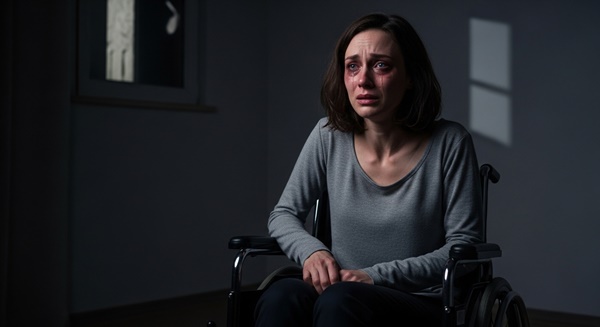
I LEFT MY PARALYZED WIFE ALONE FOR A WEEK TO BE WITH ANOTHER WOMAN. WHEN I CAME HOME, THE SILENCE WAS DEAFENING
(Warning: This is a confession of a broken man. Read it before you make the same mistake.)
My wife, Sarah, was a force of nature. She was a marketing executive in downtown Chicago, the kind of woman who ran marathons on weekends and hosted dinner parties on Fridays. Then came the car accident on I-90.
In a split second, the tires screeched, metal crunched, and our lives shattered.
For the last 14 months, Sarah has been confined to a wheelchair, paralyzed from the waist down. The vibrant woman I married disappeared, replaced by a ghost who spent her days staring out the window at the gray sky.
I became her primary caregiver. I worked 50 hours a week to keep our health insurance, then came home to be a nurse. I cooked, I cleaned, I changed her sheets, I bathed her.
At night, we lay in our King-sized bed, separated by an ocean of silence. I am 32 years old. I am healthy. I have needs. But every time I looked at her, I felt guilty for even thinking about intimacy. We became roommates. No, less than that. We were two strangers trapped in a tragic routine.
The Burnout and The Temptation
People talk about “in sickness and in health,” but no one tells you about the suffocating loneliness of being a caregiver. The resentment builds up like plaque in your arteries.
That’s when Emily stepped in.
Emily was a junior associate at my firm. She was everything my life currently wasn’t: light, uncomplicated, and admiring. It started with coffee runs. Then late lunches. Then, lingering conversations in the parking lot where she would touch my arm and say, “You’re doing so much, Mark. You deserve a break. You deserve to be happy too.”
Those words were like water to a man dying of thirst. I didn’t want to leave Sarah, but I desperately wanted to feel alive again. I wanted to be a man, not just a nurse.
The Decision

The breaking point came two weeks ago. The stress was eating me alive. Emily suggested a “work trip” – a week-long conference in Miami. Sun, ocean, and freedom.
I looked at Sarah one evening. She was asleep in her chair, the TV flickering. I felt a sudden surge of selfish anger. Why is this my life?
So, I did the unthinkable.
I told Sarah I had a mandatory business trip. I stocked the fridge. I put water bottles within her reach on the nightstand. I set up her medication organizer. I told myself she would be fine. She could transfer herself to the bathroom with the bars we installed. It was just a week.
I convinced myself I “deserved” this.
The Escape
Miami was a dream. For seven days, I turned off my phone. I drank cocktails by the pool with Emily. We laughed. We felt no guilt—or at least, I buried it deep under the sand. I forgot about the wheelchair. I forgot about the smell of medicine. I was just Mark again.
The Return
I flew back into O’Hare airport on a rainy Tuesday evening. The guilt only started to creep back in as my Uber pulled into our driveway.
The house was dark.
I unlocked the front door. “Honey? I’m home,” I called out, trying to sound cheerful.
Silence.
The air inside felt stale, heavy.
I walked into the living room. Empty. I walked into the bedroom, flipping on the light switch.
I froze. My suitcase dropped from my hand with a thud.
Sarah wasn’t in bed.
The scene before me was a nightmare. The bedsheets were half on the floor, tangled in a chaotic mess. Her wheelchair was tipped over against the dresser, one wheel caked with dried mud.
On the nightstand, the water jug was overturned, empty. A bottle of painkillers lay on its side, pills scattered across the carpet like white confetti.
My heart hammered against my ribs.
“Sarah?!” I screamed, panic constricting my throat.
I ran to the bathroom. Empty. The kitchen. Empty.
Then I saw it. The back door leading to the patio was wide open. Rain was blowing in, soaking the hardwood floor.
I looked down.
On the floor, leading from the hallway to the back door, were scuff marks. Drag marks. Faint scratches on the wood where someone had pulled themselves, inch by agonizing inch, across the floor.
I fell to my knees, unable to breathe.
The Call
Just then, my phone buzzed in my pocket. It was an unknown number.
“Is this Mark, Sarah’s husband?” a gruff male voice asked.
“Yes! Where is she? Is she okay?”
“This is Mr. Henderson, from across the street,” the voice was cold, filled with judgment. “She’s at Northwestern Memorial Hospital. I found her yesterday morning. She had crawled out onto the porch trying to get help. She was hypothermic and dehydrated.”
The silence on the line felt like a physical blow.
“You’re lucky I called the ambulance and not the police for elder abandonment, son,” he hung up.
The Reality Check
I don’t remember driving to the hospital.
When I got to her room, she looked smaller than I had ever seen her. Pale. Fragile. Tubes were connected to her arm.
The doctor intercepted me in the hallway. He didn’t shake my hand.
“She has a severe kidney infection from dehydration,” he said, his eyes drilling into mine. “But the physical damage isn’t the worst part. Social services have been notified. She was alone for days, Mark. She fell trying to get to the bathroom and couldn’t get back up into the chair.”
I felt like vomiting. While I was drinking margaritas in Miami, my wife was dragging her paralyzed body across a cold floor, crying for help that never came.
The Final Conversation
I walked into the room. Sarah opened her eyes. She didn’t cry. She didn’t scream. She just looked at me with a terrifying calmness.
“Sarah, I…” I sobbed, falling to my knees beside her bed, reaching for her hand. “I am so sorry. I was weak. I just… I needed a break. I’m so sorry.”
She pulled her hand away.
“I know about Emily,” she whispered.
My blood ran cold.
“You left your iPad at home, Mark. Messages kept popping up.”
She turned her head to look at the ceiling.
“For the last year, I hated myself,” she said softly. “I hated that I was a burden to you. I felt guilty every single day that I ruined your life. When I was lying on that floor for two days, waiting for someone to hear me screaming, I realized something.”
She looked me dead in the eye.
“You aren’t a victim, Mark. You made a choice.”
“Please,” I begged. “We can fix this. I’ll hire a nurse. I’ll never leave you again.”
“I’ve already signed the papers,” she said. “My parents are coming to get me. I’m moving to a rehab facility near them in Ohio. I’m filing for divorce.”
“Don’t do this,” I cried.
“On the day of the accident, I lost my legs,” she said, her voice cracking for the first time. “But last week? Last week, I lost my husband.”
The Aftermath
That was three months ago.
Today, I heard from a mutual friend that Sarah is learning to stand again using a specialized frame. She’s fighting. She’s healing.
Me? My company’s HR department found out about the affair and the situation with my wife—rumors travel fast in corporate Chicago. I was “let go” for conduct unbecoming. Emily left me the moment things got “too complicated.” I am currently living in a studio apartment, surrounded by boxes I haven’t unpacked.
Every night, I stare at the ceiling and replay the moment I opened that door.
I thought I was trapped in a marriage with a disabled wife. I thought I was the one suffering. I didn’t realize that loyalty isn’t just for the sunny days in Miami. Loyalty is for the storms.
There are no “what ifs” in life. There are only choices, and the price you pay for them.
If you have someone who loves you, someone who trusts you with their life… don’t let a moment of weakness destroy it. Because once that trust is broken, it is the one thing you can never, ever fix.