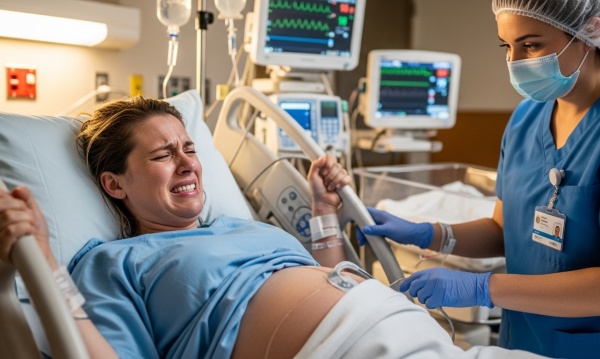
Sarah Mitchell’s contractions started at 1:47 a.m., and she was completely alone. Her husband David wasn’t asleep in the next room—he was three thousand miles away in Miami Beach, posting beach photos with another woman while his wife was in active labor.
By the time Sarah delivered their daughter Emma fourteen hours later, she had made a decision that would change everything. When the hospital asked if David should still be listed as her spouse, her answer was so powerful that it left the entire staff speechless.
PART 1: THE NIGHT THAT SHATTERED EVERYTHING
Sarah Mitchell’s contractions started at 1:47 a.m. on a cold February morning in Portland, Oregon. She was alone in the master bathroom of their Craftsman-style home in the Pearl District, one hand gripping the marble countertop, the other pressed firmly against her swollen belly at thirty-nine weeks. Her breathing came in sharp, controlled bursts—in through the nose, out through the mouth, just like the birthing class had taught her.
The pain was unlike anything she’d ever experienced, a tightening that started at her lower back and wrapped around her entire abdomen like an invisible vice. She tried not to panic. She tried to remember that this was natural, that millions of women had done this before, that her body knew what to do. But panic was creeping in anyway because there was one crucial problem: her husband wasn’t there.
David Mitchell was not asleep in the bedroom down the hall. He was not downstairs making coffee or checking his phone nervously. He was three thousand miles away in Miami Beach, Florida, and according to the Instagram posts he’d uploaded just ninety minutes earlier, he was not there alone. The first image showed a rooftop bar overlooking Biscayne Bay, the ocean glittering like liquid diamonds under the moonlight.
The second showed two mojitos with fresh mint leaves, condensation beading on the glasses. The third image was the one that had made Sarah’s heart stop: David, wearing an expensive Tom Ford shirt unbuttoned at the collar, leaning in close to a blonde woman in a red dress, his hand resting on the small of her back. The caption read simply: “Sometimes you need to remember what it feels like to be alive. #MiamiNights #FreedomFeels.”
Sarah had been sitting on the edge of their California king bed when she saw that post, her phone trembling in her hands. She’d read the caption three times, hoping the words would somehow rearrange themselves into something that made sense. They didn’t. She’d immediately texted him: “I’m in labor. I’m having contractions. Please call me right now.” She’d waited for the three dots that indicated he was typing. They never appeared. Instead, his status changed to “Active Now” and then disappeared entirely. He had read her message and chosen not to respond.
By 2:15 a.m., the contractions were coming every four minutes, and Sarah knew she couldn’t wait any longer. She called her best friend Marcus, who lived across the street, but his phone went to voicemail—he was working the night shift at Oregon Health & Science University Hospital. She thought about calling her mother in Seattle, but it was the middle of the night, and her mother had a heart condition that stress aggravated.
Pride had already prevented her from calling anyone else after months of making excuses for David’s business trips, his late nights, his emotional distance. She couldn’t bear the pity in anyone’s voice, the unspoken “I told you so” that hung in the air every time she mentioned another canceled dinner or forgotten anniversary.
PART 2: THE JOURNEY TO THE HOSPITAL
At 2:33 a.m., Sarah called a Lyft. The driver who arrived was a woman named Patricia, probably in her early sixties, with silver hair pulled back in a practical bun and kind eyes that had clearly seen a lot of life. She took one look at Sarah—pale, sweating, gripping the door frame—and immediately asked, “How far apart are the contractions, honey?” When Sarah told her three to four minutes, Patricia didn’t waste any time with small talk.
She helped Sarah into the back seat, adjusted the air conditioning, and drove through the empty Portland streets with the steady competence of someone who had done this before. “I had four kids,” Patricia explained, keeping her eyes on the road and her voice calm. “My youngest came so fast we almost didn’t make it to the hospital. You’re going to be okay. We’re going to get you there.”
Sarah wanted to believe her, but another contraction hit at a red light on Southwest Alder Street, and she couldn’t help the small cry that escaped her lips. Patricia reached back and squeezed her hand. “Breathe through it. You’re stronger than you think. And sweetheart, whatever man isn’t here right now—that’s his loss, not yours. You’re about to do the most incredible thing a human being can do, and you’re going to do it like the warrior you are.”
Those words, spoken by a complete stranger at 2:47 a.m., somehow meant more to Sarah than anything David had said to her in the past six months. Patricia drove through the empty streets of Portland like she owned them, and twenty-three minutes later, they pulled up to the emergency entrance of Providence Portland Medical Center.
The labor and delivery nurses took one look at Sarah and moved with practiced urgency. A nurse named Jennifer, with kind brown eyes and an air of competence that immediately put Sarah at ease, helped her into a wheelchair and started asking questions while they moved through the corridors. “Do you have someone coming to be with you?” Jennifer asked, already knowing the answer from the way Sarah’s face fell.
Sarah told her the truth because there was no point in pretending anymore, no point in protecting anyone’s reputation except her own. “My husband is in Miami with another woman. He’s not coming.” Jennifer’s expression didn’t change, but she squeezed Sarah’s shoulder and said quietly, “Okay. Then I’m going to be your person tonight. You’re not alone.”
They got Sarah into a labor room on the third floor, and within minutes, she was changed into a hospital gown and hooked up to monitors. The fetal heart rate monitor showed a steady, reassuring rhythm—the baby was doing fine, which was the only thing that mattered. A resident named Dr. Patel came in to check her cervical dilation and announced that Sarah was already at seven centimeters.
“You’re progressing beautifully,” Dr. Patel said with an encouraging smile. “This baby is ready to meet you.” Jennifer started an IV line, explaining each step as she went, and when Sarah asked for an epidural, the anesthesiologist was there within fifteen minutes. As the medication began to take the edge off the pain, Sarah felt tears streaming down her face—not from the pain, but from the overwhelming realization that she was truly alone in this.
The man who had promised to be by her side for every major moment of their lives had chosen a beach vacation and another woman over his own child’s birth.
PART 3: FOURTEEN HOURS OF LABOR AND TRUTH
The next fourteen hours were a blur of contractions, breathing exercises, and the steady presence of Jennifer and the other nurses who rotated through her care. Around 6 a.m., as the sun began to rise over Portland, Sarah’s labor intensified. The epidural had worn off enough that she could feel the pressure building, the sensation of her body opening up to make room for new life.
She gripped the bed rails, focused on the breathing techniques, and tried not to think about the man who should have been there holding her hand, whispering encouragement, being part of this sacred moment. Instead, she had Jennifer, who had worked in labor and delivery for eighteen years and had the patience of someone who understood that birth was both a medical event and a deeply personal transformation.
Around 9 a.m., Sarah’s phone buzzed with a text from David: “Hey, I saw your message from earlier. Everything okay?” She stared at those words in disbelief. Everything okay? She was in active labor, her body was being torn open to bring their daughter into the world, and he was asking if everything was okay as a casual afterthought, probably between drinks at some poolside bar.
She didn’t respond. What was there to say? The words that came to mind—anger, betrayal, heartbreak—all seemed too small for the enormity of what was happening. Instead, she focused on the labor, on the work her body was doing, on the fact that in a few hours, she would be a mother, and that was something no one could take from her.
By noon, Sarah was in transition, the most intense part of labor where the body is preparing to push. The pain was primal, ancient, something that connected her to every woman who had ever given birth. She found herself making sounds she didn’t know she was capable of making, low groans that seemed to come from somewhere deep within her soul. Jennifer stayed right there with her, wiping her forehead with a cool washcloth, adjusting her position, reminding her to breathe.
“You’re almost there,” Jennifer kept saying. “Your baby is almost here. You’re doing amazing.” At 12:47 p.m., Dr. Patel came back in and said it was time to push. Sarah had been in labor for nearly eleven hours, and her body was ready. She took a deep breath, gripped the bed rails, and began to push with everything she had.
The pushing phase lasted forty-one minutes. Forty-one minutes of bearing down, of feeling her body work in ways she never thought possible, of being stripped down to her most primal self. There was no room for vanity, no room for self-consciousness, no room for anything except the pure focus of bringing her daughter into the world.
Jennifer counted with her during each push, and Dr. Patel kept saying encouraging things like “I can see the head!” and “You’re doing great, Sarah, keep pushing!” And then, at 1:28 p.m. on that cold February afternoon, with one final push that felt like her entire body was turning inside out, Sarah felt the baby slip out of her.
There was a moment of intense pressure, and then suddenly it was gone, and she heard the most beautiful sound she had ever heard in her life: her daughter’s cry, angry and indignant and absolutely perfect.
PART 4: THE MOMENT EVERYTHING BECAME CLEAR
They placed the baby on Sarah’s chest immediately, and she sobbed. Not quiet tears, but deep, wrenching sobs that came from somewhere in her core. The baby was slippery and warm and weighed only six pounds, four ounces, but she felt like the most precious thing in the entire universe. She had a full head of dark hair, just like David’s, and her tiny fists were clenched as if she was ready to fight the world.
Sarah looked down at this perfect little human that she had created, that she had brought into the world alone, and something shifted inside her. In that moment, she understood with absolute clarity that she had never been truly alone. She had her own strength, her own body, her own power. She had done this. Not David. Her.
They named the baby Emma, and after the nurses cleaned her up and ran all the standard newborn tests, Emma was placed back in Sarah’s arms. Sarah sat there in the hospital bed, her body exhausted but her heart fuller than it had ever been, and she made a decision. She didn’t know exactly what it would look like yet, but she knew that her life was going to change.
She knew that she couldn’t stay in a marriage with a man who had abandoned her at the most vulnerable moment of her life. She knew that she deserved better, and more importantly, Emma deserved better. Emma deserved a father who showed up, and if David couldn’t be that man, then Sarah would figure out how to be both mother and father to this beautiful little girl.
Later that afternoon, around 4 p.m., a hospital administrator named Ms. Chen came into the room with a clipboard. She was professional and kind, and she explained that she needed to update Sarah’s emergency contact information and confirm the details for insurance purposes. “I see here that David Mitchell is listed as your spouse,” Ms. Chen said gently.
“Is that still correct?” Sarah looked down at Emma, who was sleeping peacefully in her arms, her tiny mouth slightly open, her chest rising and falling with each breath. She thought about David in Miami, probably still at some bar or beach club, probably not even thinking about her or the fact that his daughter had been born. She thought about the next eighteen years, about raising Emma alone if that’s what it took, about being the parent who showed up.
“No,” Sarah said quietly but firmly. “I want him listed as the biological father for legal and medical purposes, but not as my spouse. We’re done. Put him down as ‘Father’ and change my status to ‘Single.'” Ms. Chen nodded without judgment and made the changes to the file. “I’ll make sure the paperwork reflects that,” she said.
“Is there anything else you need?” Sarah shook her head. She had everything she needed right there in her arms. What she didn’t need was a man who had proven he couldn’t be trusted, who had shown her exactly what his priorities were, and who had made his choice the moment he decided a vacation with another woman was more important than his wife’s labor and delivery.
PART 5: THE RECKONING AND THE BEGINNING
It wasn’t until 6:15 p.m. that David finally called. Not because he was worried about Sarah or concerned about his daughter. Not because he had suddenly realized what he had done or felt a wave of guilt and shame. He called because the hospital had left him a voicemail.
A professional, polite voicemail from the billing department at Providence Portland Medical Center, informing him that his daughter had been born and that they needed to confirm insurance information. The voicemail had addressed him as “Mr. Mitchell, father of the newborn,” and it had included a callback number. That was what finally got his attention.
When he called back, he got Jennifer, who had stayed past the end of her shift because she wanted to make sure Sarah and Emma were settled and comfortable. Jennifer answered the phone with professional courtesy, and David immediately demanded to know why the hospital had addressed him as “Mr. Ex” in the voicemail.
Jennifer paused for just a moment, and then she answered with the kind of calm, devastating precision that only comes from years of experience in healthcare: “Sir, we used the relationship status provided by the mother of the newborn. She indicated that you are the biological father, but that your relationship status is no longer spouse. If you have questions about that, I’d suggest you speak directly with Ms. Mitchell.”
There was silence on the other end of the line. Sarah, lying in the hospital bed with Emma sleeping on her chest, could hear David’s voice through the phone, but she couldn’t make out the words. She didn’t need to. She already knew everything she needed to know. She had known it the moment she saw those photos from Miami. She had known it during every contraction, every hour of labor, every moment she pushed her daughter into the world without him. And she knew it now, as she held Emma close and felt the weight of her daughter’s tiny body against her heart.
Jennifer hung up the phone and came back into the room with a knowing smile. “You did good, mama,” she said, adjusting the monitors and checking Emma’s vitals one more time. “You did real good.” Sarah nodded, and as the sun set over Portland and the hospital settled into the quiet rhythm of evening, she held her daughter close and whispered a promise: “It’s going to be you and me, baby girl. And we’re going to be just fine. Better than fine.
We’re going to be strong.” Emma stirred slightly in her sleep, and Sarah could have sworn she heard a tiny sound of agreement. The life she had imagined with David was over, but a new life—a better life, a life defined by her own strength and her daughter’s beautiful potential—was just beginning. And for the first time in months, Sarah Mitchell felt truly free.
