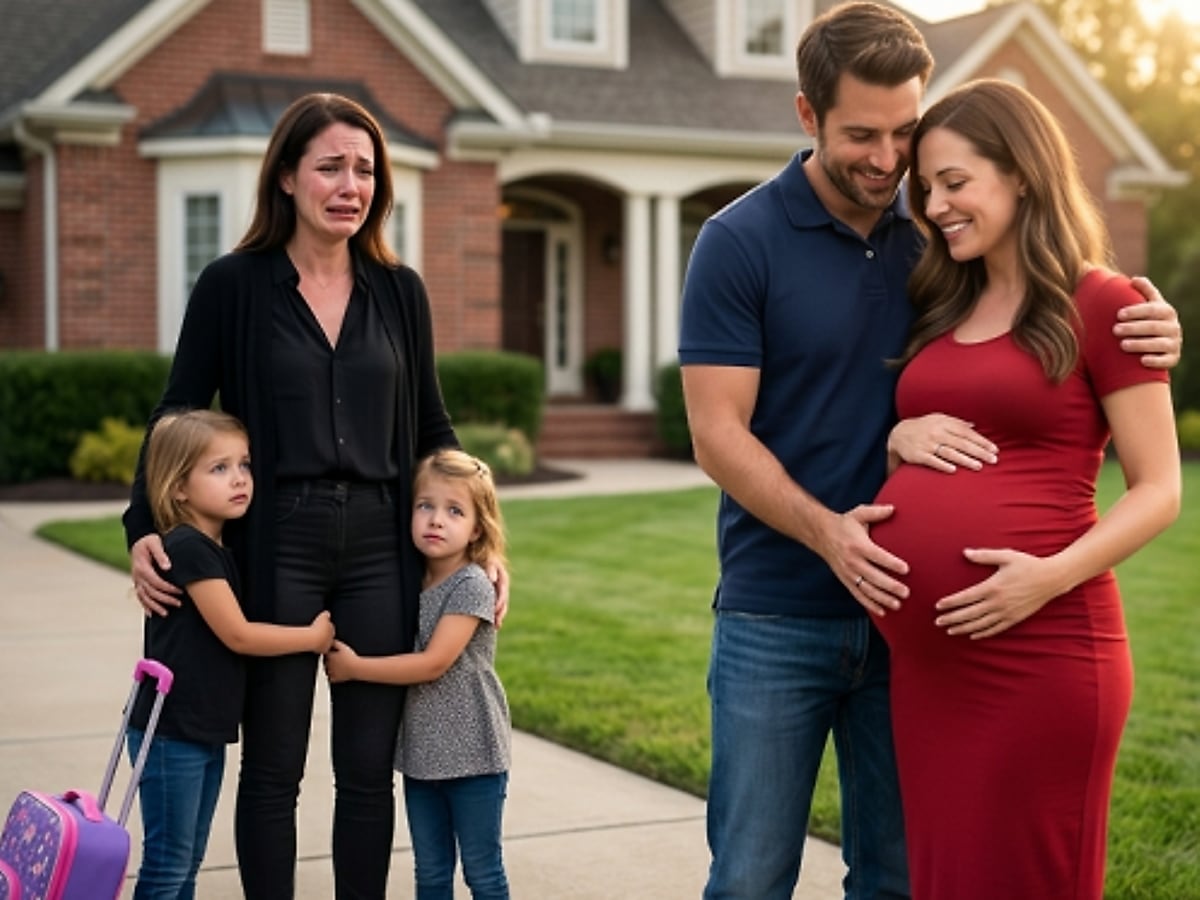
Part 1: The Family I Already Had
My name is Robert Mitchell, and I am thirty-eight years old. I am writing this from a studio apartment in Portland, Oregon, where the rent is $1,400 a month, the walls are thin, and the silence is louder than anything I have ever lived with before.
A mattress leans against one wall. A cheap desk sits under the window. The microwave buzzes too loud, and I bought a folding chair from Target because real furniture felt like something reserved for people still building a life, not burning one down.
I used to have a home, a real one, a three bedroom craftsman across the river in Vancouver, Washington, with a maple tree out front and pencil marks climbing the kitchen doorframe every birthday.
There were backpacks piled by the door, cleats scattered in the garage, crayon drawings stuck to the fridge, and dinner smells drifting from the kitchen where my wife Jessica always seemed to be cooking something.
I had a wife who loved me steadily. I had two daughters who sprinted to greet me at the door. I had parents proud of who I’d become and neighbors who waved when I cut the grass on Saturdays.
I had everything most men claim they’re chasing, and I traded it away for a fantasy.
I’m not writing this looking for sympathy. There’s no angle where I come out looking decent. I’m writing it because guilt tracks me everywhere now, and maybe some other man reads this before he makes my exact mistake.
Maybe he ignores a text from someone who isn’t his wife. Maybe he looks harder at his own kids. Maybe he realizes the fantasy he thinks he’s owed could cost him the only real thing he has.
Jessica and I met eleven years ago at a startup in Seattle, her in project coordination, me in operations. She was sharp, calm, and funny in a way that made even bad meetings bearable.
She wasn’t loud. She didn’t need to be. Chaos naturally organized itself around her presence. I first noticed her during a launch crisis when a vendor blew a deadline and the CEO started threatening layoffs while I stood near a whiteboard bluffing competence.
Jessica walked in with a legal pad, asked a few sharp questions, made some calls, and had a workaround ready before lunch.
I asked her out two weeks later. She turned me down, not out of dislike, she told me later, but because she didn’t date coworkers casually. I spent a month becoming less casual until she finally agreed to coffee, then dinner, then a rained-out Mariners game we refused to leave early.
We dated two years before I proposed on a ferry through the San Juan Islands, wind nearly knocking the ring box out of my hand. She laughed before she cried, and I remember promising myself I’d always make her laugh first.
We married on Orcas Island, small and simple, surrounded by pine trees and water. My father cried during his toast, telling everyone I’d found a woman worth spending a lifetime trying to deserve.
He was right. I just didn’t grasp how completely I’d eventually fail that job.
Jessica was the kind of wife other men quietly envied, though that sentence bothers me now since it reduces her to something I possessed instead of a whole person who kept choosing me long after I stopped earning it.
She worked full time for years while still making our house feel like a home, remembering birthdays, calling my mother every Mother’s Day I forgot, making sure my dad got his favorite pie every Thanksgiving.
Then our daughters arrived. Emma came first, dark haired, furious lunged, with Jessica’s eyes. Holding her in the hospital, I felt overwhelmed with love and terrified by her tininess, and underneath all of it sat a thought I never said out loud.
I had quietly hoped for a boy.
I hate admitting that. I hate that it was true. Somewhere during Jessica’s pregnancy I’d already pictured a son, a baseball glove too big for small hands, fishing trips on the Columbia, a boy who’d carry my name and say Dad in a voice that echoed mine.
When the ultrasound confirmed a girl, I smiled and squeezed Jessica’s hand, told her a daughter was amazing, and meant it. Emma became the center of our entire world instantly.
But that old wish never fully left. It just went quiet.
Two years later, Jessica got pregnant again, and I told myself I’d be happy either way while secretly watching that ultrasound screen with a shameful hunger. When the technician announced another girl, Jessica cried happy tears while I kissed her forehead and said I was thrilled.
Part of me was. Another part went cold and resentful.
Sophie arrived on a freezing January morning, smaller and softer than Emma, curling tiny fingers around mine like she’d been waiting specifically for me. Jessica hemorrhaged badly afterward, nurses rushing, doctors clipped and urgent, my mother pulling Emma from the room while I stood frozen against the wall.
Jessica survived, barely, and her doctor later told us another pregnancy could be life threatening, not simply risky. Jessica nodded through tears because she already understood what mattered most, staying alive for the two daughters she had.
I said I understood. I said our family felt complete. I said all the right words while quietly carrying all the wrong feelings for years afterward.
Jessica stepped back from her career after Sophie was born, turning down a promotion requiring travel so she could stay present for the girls, handling every school form, dentist visit, and bedtime routine that kept our household running.
She coached Emma’s soccer team despite never having played herself, volunteered in Sophie’s kindergarten class, and somehow tracked every spirit day and pajama day the school ever invented.
I contributed too, paying bills, fixing things around the house, reading bedtime stories when exhaustion didn’t win first. But Jessica carried our family’s actual heartbeat, and I quietly carried a resentment I refused to name out loud.
It surfaced in small moments, a tightness in my chest hearing a coworker mention Little League, a flicker of envy watching a neighbor teach his son to ride a bike, a private sting when my father joked the Mitchell name ended with me.
It wasn’t a joke to me.
I never told Jessica any of this because even I understood how ugly it would sound. I loved Emma and Sophie completely, but that love never stopped me from treating what I had as somehow incomplete.
That was the actual poison, not simply wanting a son, but believing that want mattered more than the gratitude I owed the family already in front of me.
By the time Amber entered my life, that poison had been sitting inside me for years. All she had to do was find the wound and press against it.
Part 2: The Woman Who Found the Wound
I met Amber Hayes on a Thursday night two years ago at a downtown Portland bar, out with coworkers after a long week, drinking whiskey I didn’t need just to feel briefly unaccountable.
She was our server, twenty eight or so, dark hair, a bright easy smile, and eye contact that felt like it carried a secret. She laughed at jokes that weren’t funny and touched my shoulder asking if I wanted another round.
That isn’t an excuse. It’s just an explanation of how weak I turned out to be.
At home, Jessica noticed me in real, ordinary ways every single day, my exhaustion, my stress, my forgotten lunch. But being seen by someone who knows your worst habits doesn’t feel like being admired by a stranger who wants nothing from you yet, or so I convinced myself.
Amber wrote her number on the receipt with a small smiley face. I folded it into my wallet and told myself in the Uber home I’d throw it away later.
I didn’t.
The next morning Jessica made pancakes while Sophie sat in unicorn pajamas and Emma complained about weird feeling soccer socks. Jessica asked me to grab milk on the way home. I nodded, thinking about a folded receipt in my wallet.
That was the day’s first betrayal.
I texted Amber that evening. She replied almost instantly that she’d hoped I would. That single sentence lit something in me I should have been ashamed of, but instead it just felt like being alive again.
We met for coffee, and when I mentioned my daughters, she smiled and guessed I’d always secretly wanted a boy.
I should have walked away right there. Instead I told her a truth I’d never once said to my own wife.
Yeah, I said. I did.
She tilted her head and told me she could tell. That’s exactly how she got in, not through beauty, not even through sex yet, but by spotting my deepest shame and making it sound reasonable.
We moved from coffee to dinner to her one bedroom Pearl District apartment, exposed brick, cheap candles, a mattress on the floor she blamed on procrastination.
The first night I slept with her, I sat in my own driveway afterward for fifteen minutes staring at the porch light Jessica always left on when I was out late.
I told myself it was one mistake, one selfish slip I’d never repeat.
Then I saw Amber again the following week, and the week after that, my internal excuse shifting from this is the last time to this doesn’t mean anything to I deserve to feel wanted, until eventually I was insisting Jessica and I were basically just roommates, a lie I only made true by acting like it already was.
I lied constantly after that, fake late nights, invented client dinners, a Boise trip stretched an extra day while I was actually near Cannon Beach with Amber.
I locked my phone, deleted messages, opened a separate email, bought prepaid cards to hide charges, mistaking secrecy for cleverness the way guilty people always do.
I spent heavily too, dinners, clothes, cash for her rent because she said she was behind, eventually paying her full $1,200 monthly rent directly because her bartending job exhausted her and she wanted to build something better.
I even got a friend to help her land a receptionist job, which she quit after three months over the office manager’s supposed bad energy. I kept paying her rent anyway.
Jessica noticed the money eventually, since she managed our budget better than I did, asking why my spending had jumped. I blamed gas and inflation. She studied me a long moment and asked if there was something I needed to tell her.
I looked my wife straight in the eyes and said no.
She wanted to believe that lie, which is one of the cruelest parts of cheating, the person who loves you often helps you hide the truth from her because facing it would cost too much.
Amber offered the opposite of my real life, which made her addictive. She never asked about homework, trash duty, or dental appointments. She wanted attention, money, entertainment, nothing resembling partnership.
I mistook that emptiness for freedom. With Jessica, love meant responsibility. With Amber, desire felt like escape, and I was too immature to see one was real while the other was rented, paid for entirely in lies.
About fourteen months in, lying in her apartment late one night while she traced circles on my chest, Amber asked if I’d leave my wife if she got pregnant with my son.
I laughed at first, not from humor but from how blunt it was. She said it was a real question, and asked if I’d choose them over everyone else.
There it was, the exact wound she’d been circling all along.
I should have said no. I should have said a child isn’t leverage. Instead I told her that if she gave me a son, I’d leave anyone.
She smiled, not softly, but like she’d just won something. I had no idea yet that I’d just handed her the blueprint for destroying my life.
Part 3: The Ultimatum
Three months later, Amber called me at work and told me to come over immediately. I drove across town imagining every disaster except the one waiting for me.
She met me in the kitchen holding a positive pregnancy test.
My first feeling was panic. My second was excitement. My third was shame, because the excitement outweighed the panic.
She cried into my shirt saying she was scared but happy, maybe this was fate, maybe we’d been pretending not to know what we truly were to each other.
I believed exactly what I wanted to believe.
She showed me an early ultrasound blur I held like something sacred. Once I asked if she was certain it was mine, and she recoiled like I’d struck her, calling the question unbelievable.
I apologized instantly, ignoring another warning sign, letting my guilt make me easy to steer.
We waited weeks for the anatomy scan while I lived two increasingly exhausting lives, discussing summer camp and reading projects at home while secretly counting days until I’d learn if she carried the son I’d fantasized about for years.
I grew distant at home, not cruel exactly, worse, absent, missing dinners and school events, snapping at questions, blaming stress while quietly checking out and making Jessica feel responsible for a gap I’d created myself.
One evening Emma found me hiding in the garage pretending to organize tools and asked if I was mad at them. I hugged her too fast and said I was just tired.
She nodded, believing a weak answer because the truth might have hurt worse.
In February, Amber called saying to come immediately. My heart pounded the whole drive. She handed me an ultrasound photo the second I walked in.
It’s a boy, she said. Four months along.
I broke down completely, sobbing in her living room, picturing baseball gloves and fishing trips and a boy carrying my name, confusing every shallow symbol with genuine love.
She hugged me, then said she wanted me to leave Jessica, refusing to raise this baby as a secret, refusing to be some hidden woman while I went home to my wife and daughters.
I tried explaining divorce was complicated, that Jessica hadn’t done anything wrong, that the girls would be devastated. Her face hardened with every excuse I offered.
She accused me of choosing them. I denied it. She said staying meant exactly that, and she wouldn’t do this alone.
Then came the ultimatum. File for divorce within two weeks, or she wouldn’t continue the pregnancy.
I begged her not to say that, insisted we could figure something out. She said she already had, and either I chose her and our son, or there would be no son at all.
I wish I’d gone home and snapped out of it. Instead I went home, looked at Jessica reading with Sophie asleep against her leg and Emma doing homework nearby, and saw my family as an obstacle between me and a fantasy.
That’s the ugliest truth in this whole story. I turned my wife and daughters into barriers.
Two nights later, once the girls were asleep, I told Jessica I wanted a divorce. She stared at me in disbelief, and I recited rehearsed cowardly phrases about growing apart and not feeling like myself.
She asked if there was someone else. I said no, automatically, reflexively.
She studied me and whispered not to insult her by lying on top of everything else. When I finally admitted there was someone, and that she was pregnant, the sound Jessica made wasn’t a scream, it was worse, the sound of someone realizing the floor beneath her entire life had vanished.
She collapsed sobbing so hard she couldn’t breathe. I panicked and called 911 while our daughters woke crying upstairs, Emma standing on the landing demanding to know what was wrong with Mommy.
I told her to go back to bed. She didn’t. Neighbors came. Jessica’s sister Megan arrived furious and barefoot inside her boots, riding with Jessica to the hospital for what doctors called acute distress and a severe panic attack.
Emma wouldn’t let me touch her afterward. Sophie kept asking if Mommy was sick. I told them Mommy was upset but would be fine, another lie stacked on the pile.
Jessica filed for divorce two weeks later, without begging, without chasing me, without competing with Amber. Something in her simply closed, and by our first legal meeting she looked like she’d aged five years in one month.
My mother cried on the phone. My father yelled, then went quiet, which was worse, telling me I was making the biggest mistake of my life, that I understood perfectly and was sacrificing my daughters for an idea of a son.
I hung up on him, because he was right.
The divorce moved fast since I barely contested anything, telling myself I was being generous when really I was rushing toward the life I thought waited for me. Jessica kept the house and primary custody. I agreed to $2,800 monthly child support, half our savings, and limited visitation since the girls refused overnight stays with me at first.
I signed in March. It finalized in May. Walking out of the courthouse, Amber texted a blue heart and wrote that now we could finally be a real family.
I felt proud reading that.
Proud. That’s how far gone I already was.
Part 4: The Wedding and the Waiting Room
I married Amber in June, two weeks after my divorce finalized, a courthouse ceremony in Multnomah County with two of her friends as witnesses. My parents stayed away. My sister stayed away. My daughters didn’t even know until afterward, since Jessica told me through the co-parenting app she wouldn’t let them be used as decoration for the fallout of my affair.
I thought that was bitter at the time. Now I understand it was protective.
Amber wore a clinging white dress, one hand resting on her stomach in nearly every photo, visibly pregnant by then, and I remember feeling proud of that belly, proud of the son I believed was growing inside it, proud despite everyone hating me for it.
We moved into a $2,200 monthly apartment in Beaverton, more than I could comfortably afford between child support and legal fees, though I told myself sacrifice was expected while building a new family.
She sent me crib links and stroller links, liking expensive things I found charming at first since I still believed I was providing for my son, buying a $900 stroller, a ridiculous designer diaper bag, an unnecessary gender reveal shoot for a sex we already knew.
I suggested William, James, Robert Jr. She wrinkled her nose at the last one, calling it too old fashioned. I laughed, thinking she was joking. She wasn’t.
By July I was constantly exhausted, losing weight, falling behind at work, watching my relationship with my daughters crumble. Emma ignored most calls. Sophie talked briefly before asking when Mommy would appear on screen.
During one supervised visit, Emma sat across from me arms crossed, ignoring the book I brought, telling me flatly I’d missed everything when I apologized for one missed game.
I cried in my car afterward, then drove home and let Amber distract me with baby talk, my usual pattern whenever guilt threatened to surface.
In late July, we had a prenatal appointment. I took the morning off, excited to hear the heartbeat again, already browsing tiny Beavers onesies online despite being a Washington grad myself.
Sitting in the waiting room surrounded by pregnant women and toddlers, Amber scrolled her phone and casually said we didn’t actually need to go in.
I asked what she meant. She said she’d canceled it. I asked why. She sighed like I was annoying her and said there was no appointment anymore because she’d ended the pregnancy the week before.
For a second the words didn’t register. The room felt like it tilted. Somewhere a child laughed, a phone buzzed, a nurse called a name, and my entire life split open in the middle of an ordinary Tuesday.
I whispered what, and she rolled her eyes, telling me not to make that face, that she’d made a medical decision because she wasn’t ready, she was twenty nine, she wanted to travel, she hated how her body was changing.
I told her she’d said we were having a son. She said we could have one later, when she was ready.
I stood too fast, drawing a look from another woman nearby. Amber grabbed her purse and told me to sit down, that I was embarrassing her.
That word detonated something in me completely. Embarrassing. I’d left my wife, shattered my daughters, signed away half my life, married her, funded her rent and clothes and appointments, burned every bridge because she claimed to carry the son I’d foolishly valued above everything real.
And she was embarrassed by my reaction.
We left without seeing a doctor. In the parking lot I asked when she’d decided. A while ago, she admitted, adding she hadn’t wanted me trying to talk her out of it.
So you lied, I said. She said she’d changed her mind. I told her she’d used him. She snapped at me not to say him like that.
I put my hands on my head, shaking, refusing to become some viral parking lot meltdown, refusing to pretend this was merely a disagreement about scheduling.
I reminded her she’d given me an ultimatum, that I’d left Jessica, divorced her, married Amber specifically because of that ultimatum. She said now we were married, so we could have a baby whenever the timing felt right.
Looking at her then, I think I finally saw the real person instead of the fantasy I’d constructed, someone inconvenienced rather than remorseful.
I asked if it was ever really about the baby. She hesitated too long before answering. My stomach dropped. I asked again. She looked away and said she’d wanted me to choose her.
Six words that ended whatever illusion remained.
I drove home in silence while she complained I was being dramatic, that couples wait to have kids all the time, that I should feel relieved given child support already draining me, that it was her body and her choice.
Legally, she was right about her body. Morally, I couldn’t move past the lie underneath it.
The worst part, one I had to face completely alone, was realizing Amber hadn’t destroyed my family by herself. She manipulated me, yes, but she never made vows to Jessica. I did.
She never abandoned Emma and Sophie. I did. She never turned my wish for a son into an excuse for betrayal. I did that entirely on my own.
That night I packed two duffel bags while she sat texting someone on the couch, asking if I was really leaving over this. I told her I’d already left my family over this.
For once she had nothing clever to say back.
I lived in a cheap extended stay hotel for three weeks before finding this studio in Portland, my credit cards nearly maxed, my savings gutted, my paycheck split between rent, child support, legal bills, and the price of my own stupidity.
My attorney explained Oregon annulments were narrow and fact specific, that a short marriage alone wouldn’t erase it and fraud would be hard to prove the way I imagined, so I filed for divorce instead.
Amber didn’t contest it. By the time she was served, she was already posting bar photos with a man wearing a nicer watch than mine.
The divorce finalized in November. I didn’t feel free. I felt hollowed out.
Part 5: What I Learned Too Late to Use
After Amber and I split, I became obsessed with understanding my own stupidity, which was still pride wearing a different mask.
I wanted to believe I’d been uniquely deceived by some mastermind, but the truth ran deeper. She hadn’t outsmarted me. She’d simply offered exactly what I wanted more than I wanted honesty.
Slowly, carefully, then desperately, I started asking around. Mutual acquaintances told me I wasn’t the first stable or married man she’d attached herself to.
I can’t prove every detail, and I’m not making legal claims here, but enough separate stories lined up that the pattern became impossible to ignore.
One man reportedly handed her $15,000 after she claimed pregnancy and disappeared from his life months later. Another supposedly left a long term partner over her pregnancy claim, only to learn the ultrasound she’d shown him likely wasn’t even hers.
A woman who used to work alongside her told me Amber studies exactly what men feel insecure about, then becomes the answer to it.
That sentence made me sit down, because it described precisely what had happened to me. She hadn’t invented my weakness. She’d simply noticed it.
But here’s what I can’t dodge. She could never have weaponized my longing for a son if I’d valued my daughters the way they deserved. She couldn’t have pulled me from my marriage if I’d been standing firmly where a husband belongs.
After Amber, I tried reaching Jessica again, which shames me differently. Not because I regretted losing her, since I still grieve that daily, but because my remorse only surfaced once the fantasy collapsed, making even my apology feel selfish in origin.
I called. She didn’t answer. I wrote letters. They came back unopened. I emailed once and got a single reply telling me to contact her only through the co-parenting app or attorneys, that I’d chosen a fantasy over my family and didn’t get to return now that the fantasy had disappeared.
I went to the house once anyway, standing in the rain like some man in a film hoping weather might earn him sympathy. Jessica opened the door only because the girls weren’t home, looking thinner, stronger, exhausted in a way I’d caused and could never undo.
I asked her to just let me explain. She said she understood perfectly. I said Amber had lied to me. She said, and you lied to me. I said I’d been manipulated. She said maybe, but you were available to be manipulated.
I broke down crying, apologizing, saying I missed everything, our home, the girls, her, offering to do anything. She let me finish, then told me I didn’t miss them the way they deserved to be missed, I missed who I used to be when I had them.
I had no response, because once again, she was completely right.
Behind her the house looked warm, something baking, new curtains in the front room, and on the wall I caught the edge of a framed photo I no longer appeared in.
She told me to leave. I did. The next day her attorney warned mine that unannounced visits would affect custody talks. I haven’t gone back uninvited since.
My daughters remain the hardest part to write about. Emma is eight now, angry in a way she doesn’t fully know how to handle, sitting far from me during visits, answering in single words, sometimes refusing to come entirely.
The first time she said she hated me, it came secondhand through Jessica’s sister. I deserved it. That doesn’t make hearing it easier.
Sophie is six, gentler with me, which somehow hurts worse. She sometimes forgets what we used to do together, asking if my apartment is where I live for now, and I say yes because I don’t know how to explain that for now is simply the shape forever choices take.
At a supervised visit last month she drew a house with three people inside, Jessica, Emma, and Sophie. I asked gently where I was. She looked at the paper and guessed maybe at work.
I’d used that exact lie so often during the affair that it had literally become my location inside her memory. At work. Elsewhere. Absent.
I went home and got sick.
Right now the court allows four supervised hours twice a month, something that might expand eventually if I stay consistent, keep attending therapy, and prove I can put their needs ahead of my own guilt. I’m trying, though trying now doesn’t erase failing then.
My parents remain civil but distant. My mother sends short texts asking if I’ve eaten. My father talks to me on holidays with something guarded behind his voice. My sister says she loves me as her brother but doesn’t like who I became.
I don’t argue with any of it.
I’m in real therapy now, not the performative kind men start hoping to win someone back. My therapist won’t let me hide behind Amber’s manipulation, asking questions I dread.
What did having a son represent to you. Why weren’t your daughters enough. What did you believe masculinity required you to pass forward. Who taught you legacy lived through boys.
The answers are messy. My father loved me but seemed proudest when I performed the version of manhood he understood, sports, toughness, the family name, and I absorbed all of it without question, letting it quietly rot inside my marriage.
That doesn’t make him responsible. It makes me responsible for never examining what I inherited from him.
Jessica once told me early in our marriage that daughters teach men whether their love is expansive or conditional. I laughed then, thinking it sounded like a parenting book quote.
Now I think about that sentence daily. My love was conditional in ways I refused to admit. I loved Emma and Sophie fully, but still believed something essential was missing because they weren’t sons, thinking the wish was harmless since I never said it aloud.
Unspoken beliefs still shape choices though. Mine shaped the worst choice of my entire life.
I’m thirty eight, living alone. My ex wife will never take me back, and she shouldn’t. My daughters may forgive me someday, or they may not, and I have no right demanding either outcome.
The son I thought I was choosing isn’t here. Whether he ever truly existed the way Amber presented him is something I may never fully know. What I do know is that I used the idea of him to justify walking away from children who were already real, already alive, already loving me completely.
That’s the truth that breaks me now. Not simply that Amber lied, not simply that the pregnancy ended, not simply that my marriage collapsed.
The truth is that my daughters were always enough. Jessica was always enough. My life was already enough.
I was the one who was empty, confusing that emptiness with destiny, confusing selfishness with longing, confusing a mistress’s promise with a second chance, when really it was just a mirror showing exactly how much damage an ungrateful man could cause.
If you’re a husband reading this with a good wife, don’t wait until you’re alone in some apartment to understand what that actually means.
If you’re a father with daughters, don’t treat them like a runner up prize for the son you imagined instead. They aren’t practice. They aren’t almost. They are whole people who will remember whether your face lit up when they walked into a room.
If an affair makes you feel alive, ask yourself honestly what part of your conscience had to die first to get there.
If someone offers you the exact fantasy your family supposedly failed to provide, slow down before anything else. Fantasies never ask you to be honorable. They ask you to pay, and the bill always arrives eventually in names, birthdays, bedrooms, and empty chairs at school events.
I once had a wife who left the porch light on for me every single night. I had daughters who ran to greet me at the door. I had a home with pencil marks climbing a kitchen doorframe.
Now I have a studio apartment, a folding chair, a limited visitation schedule, and a regret heavy enough to feel physical.
I’m not asking anyone to feel sorry for me. I’m only asking to be believed when I say this.
The thing you convince yourself you cannot live without may be exactly the thing that costs you the life you already loved.
I wanted a son more than I valued the family standing right in front of me. Now I have no son, no wife, no home, and two daughters slowly learning to live with the fact that their father chose a fantasy over them.
That is my legacy now. Not a name carried forward by a boy. Not a Little League glove or a fishing trip on some river.
My legacy is the pain I caused the two girls who loved me first, completely, before I ever gave them a reason not to.
And I will spend whatever time I have left understanding that I destroyed everything good in my life because I couldn’t see that everything good was already standing right there in front of me the whole time.
Names have been changed and this story has been dramatized for entertainment purposes only.
