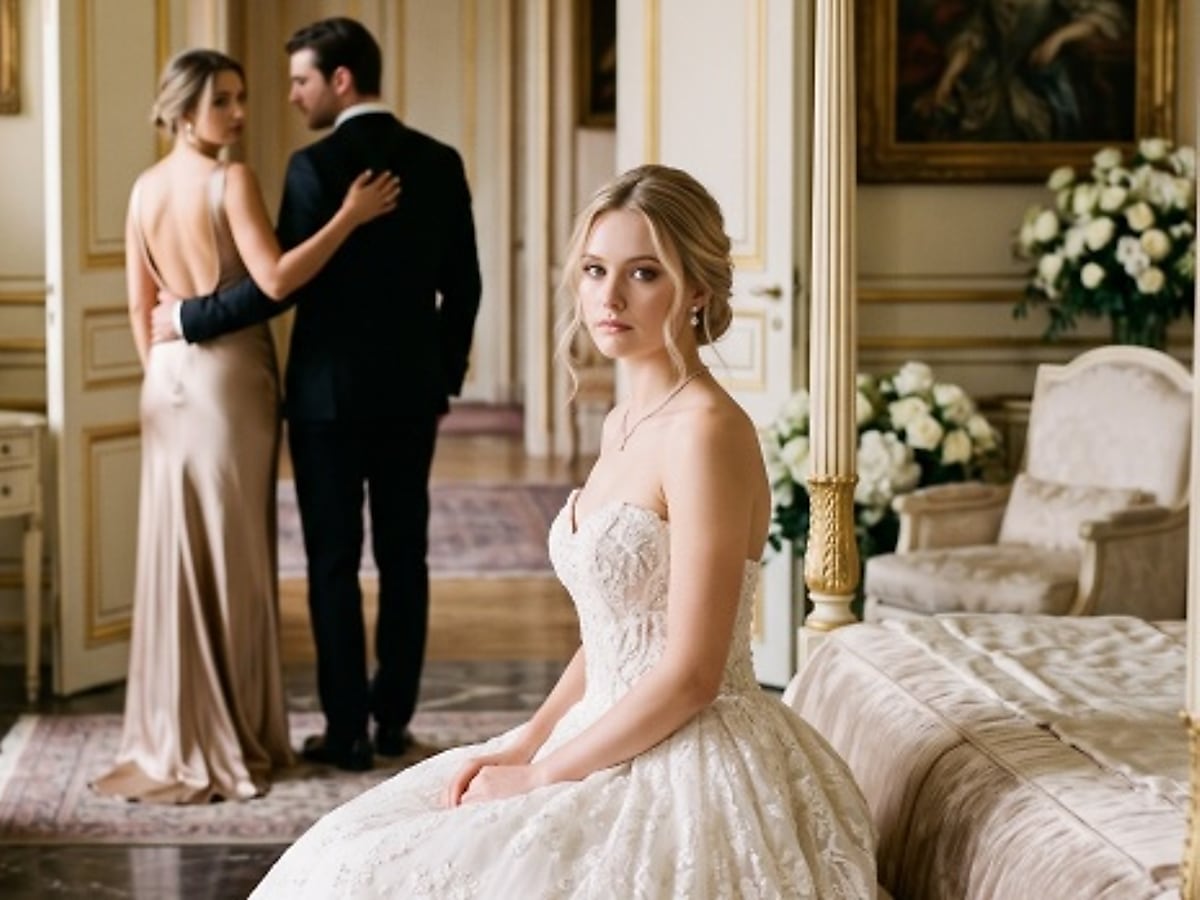
Part 1: The Door That Closed at 10:16
My husband left our wedding suite at 10:16 p.m. to spend our wedding night with the woman he claimed was “just a friend.”
Six hours earlier, Mark had stood beside me beneath thousands of white roses and promised, in front of five hundred guests, that I was the woman he wanted for the rest of his life. He had looked into my eyes with tears shining in his own, his voice shaking just enough to make half the ballroom dab their faces with linen napkins. My mother had squeezed my father’s hand, my bridesmaids had smiled through mascara, and I had believed every word.
Now I sat on the edge of the bed inside our suite at the Grand Whitmore Hotel, still dressed in every layer of my wedding gown.
The beading felt heavy against my skin, weight I’d once dreamed about for years before I could actually afford a dress like it.
My veil had slid to the floor like something discarded, and my peonies were already curling on the nightstand.
Mark’s phone sat glowing on the dresser.
One name kept flashing on the screen.
Lauren.
It disappeared, then returned. Then returned again.
I watched that phone the way you’d watch smoke sliding under a shut door, already knowing what waited on the other side.
For three years straight, Lauren had lived in the cracks of our relationship. A call during our anniversary dinner. A text mid vacation. Some crisis timed perfectly for whatever we were supposed to be celebrating without her.
She was always fragile.
Always without anyone else.
Always someone I was expected to accommodate quietly.
Mark stepped out of the bathroom, tuxedo pants on, shirt hanging open, hair still damp from the shower. The scent of cedar soap clung to him, the same bar I’d packed for our honeymoon.
For one absurd heartbeat I thought he’d look at me sitting there in my gown, realize how strange it was that another woman was calling on our wedding night, and simply shut the phone off.
Instead he reached for it.
His expression shifted while reading, subtle but unmistakable to me by now. That guarded, guilty focus took over his face, the same look I’d learned to recognize whenever Lauren pulled him back toward her.
“Everything okay?” I asked.
He didn’t answer right away.
That pause told me plenty.
“Mark,” I said. “This is our wedding night.”
“I know,” he said, still staring at his screen.
The room seemed to drop several degrees. Outside, Chicago glittered against the dark, horns drifting up faintly from Michigan Avenue, laughter rising from somewhere below where the world still felt ordinary.
He started hunting for his cufflinks on the dresser top.
“What are you doing?” I asked.
“She needs me,” he said.
That line was so familiar my body almost reacted the old way. Almost asked what happened. Almost softened. Almost slipped into the role he’d trained into me over years: patient, generous, never jealous, never inconvenient.
But I was still in my wedding dress.
“She needs you tonight?” I asked again.
He exhaled, annoyed, like I’d questioned something obvious. “She’s having a panic attack. She’s alone.”
“She has friends.”
“She doesn’t, not really.”
“She has a therapist.”
“It’s Saturday night, Amelia.”
“There’s 911 if it’s that serious.”
He spun toward me. “That’s cold.”
Cold. That word again, the one he pulled out whenever I refused to rearrange my life around her pain. He never said it harshly, never in a way that made him sound unkind. He said it with disappointment, and somehow that stung worse.
I stood carefully, holding the front of my dress so I wouldn’t stumble.
“You promised me tonight.”
“I married you today,” he said, like that alone should settle things. “Don’t turn one phone call into a disaster.”
“One phone call?” I repeated.
He looked away.
Because neither of us actually believed it had ever been one phone call.
For three years she’d shown up every time Mark and I reached toward something good. When we got our first place together in Lincoln Park, she cried because her landlord was selling the building she lived in. When he proposed at Navy Pier, she texted him an old photo from a birthday card he’d given her years earlier, saying she missed simpler times. When we announced our engagement, she posted something vague online about being left behind.
And every single time, Mark ran to her.
Once, I thought that instinct made him a good man. He was the type who remembered how everyone took their coffee, carried groceries for elderly neighbors, tipped generously no matter how slow the service was. He noticed the quiet, uncomfortable person at a party and pulled them gently into the conversation.
But kindness without limits eventually becomes an open door for anyone to walk through.
Lauren had walked through and never left.
“Don’t go,” I said.
His jaw locked. “I’ll be back in an hour.”
“You said that on my birthday.”
“That was different.”
“You said it when my dad was hospitalized.”
Something flickered across his face, shame maybe, though not enough of it. “That’s not fair.”
“No,” I said, my voice starting to shake. “What’s not fair is standing here begging my husband not to leave our own wedding suite for another woman.”
He grabbed his jacket off the chair.
Something inside me shifted then, permanently.
For years I’d avoided asking the one question I feared most, telling myself that if I never asked directly, he’d never have to lie directly either. But maybe a marriage that depended on silence to survive had already failed long before we said any vows.
“Do you love her?” I asked.
He froze near the door.
The whole room seemed to hold its breath with me.
He didn’t laugh it off. Didn’t look offended. Didn’t rush to say of course not, Amelia, I love you. He didn’t even seem shocked that I’d finally asked out loud.
He shut his eyes.
And that was the moment the pretending ended.
“I don’t know how to explain it,” he said quietly.
My hands turned cold.
“Try.”
He turned to face me, and the man who’d said vows under white roses now looked like a total stranger wearing his features. “Lauren and I go back a long way.”
“So do we.”
“It’s different.”
“How is it different?”
“She knows sides of me nobody else does.”
I almost smiled, the pain sharp enough to feel unreal. “Meaning sides you never showed me?”
He said nothing.
There are certain moments when screaming feels pointless because your body understands it would just waste the breath. I looked at the man I’d married, at the ring on his finger, at the jacket now in his hand, and felt something old and humiliating move through my chest. I hadn’t been chosen. I’d been cast in the role of wife while another woman remained the wound he preferred returning to again and again.
“Did you marry me because you loved me,” I asked, “or because I made your life look normal from the outside?”
His face fell apart. “That’s not fair.”
“You keep saying that.”
“I love you, Amelia.”
“But do you love her?”
He stared at the carpet.
Outside, the city kept moving. Somewhere downstairs, music from the reception cleanup still played faintly. Our cake, four tiers of almond buttercream layered with raspberry, was probably being boxed up for guests to take home in slices.
Finally, Mark whispered, “Part of me never stopped.”
I sank back down onto the bed because my legs stopped holding me up.
He looked scared then, but not scared enough to stay.
“I’m sorry,” he said. “I need to make sure she’s alright.”
He opened the door.
“Mark,” I said.
He paused.
“If you walk out that door tonight, don’t expect a wife waiting when you come back.”
His eyes went glassy. For one second I thought maybe he understood, that love might finally outweigh whatever guilt kept pulling him toward her.
Then his phone buzzed again.
He left anyway.
The door clicked shut behind him, and I would hate that soft little sound for the rest of my life.
Part 2: Twelve Years of “Just a Friend”
I first met Lauren two months into dating Mark.
It happened at a rooftop bar in River North, one of those Chicago evenings where the air feels like it costs money and everybody pretends not to be dazzled by the skyline. Mark called her an old friend from college, and she hugged him three seconds longer than felt normal. When she finally turned to me, her smile stopped at her mouth.
“So you’re Amelia,” she said, like I was a substitute part she hadn’t signed off on.
She was pretty in a fragile, unfinished sort of way, pale blond hair, wide gray eyes, a voice that made even ordinary sentences sound wounded. She kept a cream sweater sliding off one shoulder all night and only laughed whenever Mark glanced her direction.
They’d gone to Northwestern together, never dated, according to Mark, just “very close” during a rough patch in his life. That description sounded mature and harmless, until I noticed every rough patch in Mark’s history somehow circled back to her.
His mother passed away during his junior year, and Lauren sat with him outside the chapel afterward. When he bombed his first finance exam, she stayed up all night helping him cram. When his first startup collapsed, she brought groceries and camped on his couch for a week because he was “too depressed” to be alone.
“She was there before anyone else,” he told me once, as if that settled things permanently.
I tried respecting that history.
I genuinely tried.
I understood people arrive with pasts. I had one myself, a man named Daniel who taught me how to order wine and then taught me how quietly someone can vanish from your life. I knew it was naive to expect a partner untouched by anything before me.
But Lauren wasn’t merely history.
History stays trapped inside photographs.
Lauren, though, called during dinner. Texted through movies. Sent long midnight voice memos, then apologized for “being too much,” which always sent Mark rushing to reassure her otherwise. She forgot her wallet at coffee dates on purpose it seemed. She needed her résumé reviewed, her prescription picked up, her bookshelf assembled, her ride to O’Hare, her Wi-Fi fixed, her nerves talked down, talked through, talked into sleep.
Whenever I brought it up, Mark would say, “You knew she mattered to me.”
Knowing she existed wasn’t the same as knowing she’d never leave.
The first time I almost walked away was Thanksgiving.
We’d been together a year by then, and he was supposed to join me at my parents’ place in Naperville. My mother had ordered a fresh turkey specially because she wanted everything flawless. My father cleaned out the garage, which in his language meant approval.
Mark showed up an hour late.
He blamed traffic, kissed my cheek, apologized. But during dessert, a message popped up on his Apple Watch that he clearly hadn’t meant to leave visible.
Thank you for not leaving me alone today. I couldn’t have gotten through it without you.
Lauren.
I waited until we were driving back on I-88, city lights ahead, my uneaten pumpkin pie sitting wrapped in foil on my lap.
“You went to see her,” I said.
His grip tightened on the wheel. “She had nobody else to turn to.”
“She knew you had plans with my family.”
“She was crying, Amelia.”
“So was my mother, wondering why you didn’t care enough to show up on time.”
“That’s completely different.”
“How?”
“Because your family is stable.”
That single word, stable, became a kind of cage for me.
Stable meant I could absorb disappointment and bounce back. Stable meant I could be hurt quietly without it becoming an emergency. Stable meant I had parents, savings, friends, a career, and therefore somehow less right to need anything urgently. Lauren’s instability made her urgent. My steadiness made me optional.
I ended things with him that night.
For eleven days I ignored his calls completely. On day twelve he showed up at my apartment with flowers, red eyes, and a handwritten letter on yellow legal paper. He admitted he’d been unfair, said he’d confused obligation with friendship, insisted he loved me and wanted a future with me instead of her.
I wanted so badly to believe him that I mistook desperate hope for good judgment.
We got back together.
For a stretch, things genuinely improved. Mark started setting what he called boundaries, though in retrospect they resembled curtains more than actual walls. No calls from her past 10 p.m. No visits to her apartment alone anymore. He told her outright that I felt uncomfortable, which somehow made the whole boundary sound like my personal insecurity rather than his responsibility to fix.
Lauren reacted exactly the way I feared she might.
She started posting old college photos, football games, ugly holiday sweaters, the two of them asleep on opposite ends of a shared couch. One caption read something like home finds you no matter how far life takes you. When I mentioned it, Mark told me I was overanalyzing.
I asked him to block her entirely.
He called that extreme.
I asked him to stop listing himself as her emergency contact.
He said she truly had no one else.
I asked whether he understood how humiliating it felt to keep competing with a woman he swore I had no reason to worry about.
“You’re not competing,” he said.
But I absolutely was.
The competition just wasn’t fair, because Lauren got to remain fragile forever while I was expected to remain reasonable forever.
When he finally proposed, I actually believed I’d won something.
It happened on a freezing December evening at Lincoln Park ZooLights, walking through a golden tunnel of lights. My fingers were numb, my nose bright red, and I was laughing because he’d spilled hot chocolate down his own coat sleeve. Then he dropped to one knee, pulled out a small box, and asked me to marry him.
Strangers cheered. A little girl yelled for me to say yes. I did.
For three days I floated in pure happiness, weightless in a way I hadn’t felt in years.
Then Lauren sent him a message that read something close to I always knew you’d end up choosing someone like her. Someone easy.
I only saw it because he was showing me a different photo on his phone, and he yanked it back so fast he might as well have confessed outright.
“What does that even mean?” I asked.
“She’s upset.”
“I bet she is.”
“She always thought…” He stopped mid sentence.
“Thought what?”
He dragged both hands down his face. “That maybe someday, if things had gone differently…”
I stared at him, waiting.
“If things had gone differently, what exactly?”
He offered nothing else.
I should have handed the ring straight back that instant. I understand that now, looking back. But an engagement has a strange power to turn warning signs into decorative details. Once both families are excited, deposits are already paid, and your own mother is crying happily over venue brochures, doubt starts to feel like some kind of betrayal against everyone else’s joy.
So I planned a wedding instead.
A massive one.
Honestly, too massive. Five hundred guests, because Mark’s father was a retired state senator, my parents ran a successful chain of dental clinics, and both families approached the guest list like a delicate diplomatic negotiation. We booked the Crystal Garden Ballroom, hired a string quartet, and ordered white roses from three separate florists because my mother didn’t trust a single vendor to handle that much abundance alone.
Lauren was left off the list.
That was the one line I refused to move on.
Mark pushed back gently at first, then with real anger. Excluding her felt cruel, he argued. I told him including her would feel cruel to me. He reminded me she’d been part of his life for twelve years running. I reminded him I was supposed to be part of everything after that.
Eventually he backed down.
Or I assumed he had.
On the morning of the wedding, while my bridesmaids sipped mimosas and the photographer arranged my shoes next to the rings, a small unmarked white envelope arrived at the bridal suite. Inside sat a note written in slanted handwriting.
He’s marrying you because you make sense. That isn’t the same thing as being loved.
I knew instantly who’d written it.
Rachel, my maid of honor, wanted to march straight to Mark. My mother wanted hotel security pulled in. My father wanted five minutes alone with whoever left it. I told everyone to stand down.
Because I was getting married in two hours, and a bride can only absorb so much truth before walking down an aisle.
I folded the note and slid it into the hidden pocket sewn inside my gown.
Yes, the dress had actual pockets.
I’d been thrilled about that detail during fittings. Now one pocket held lipstick, and the other held a warning from a woman my fiancé insisted I had no reason to fear.
When the music started, I walked out anyway.
Mark cried the second he saw me.
That was somehow the cruelest part of the whole day.
His tears looked completely genuine. His hands shook as he took mine. His vows weren’t generic filler; he mentioned my laugh, my stubbornness, the night we ate gas station donuts during a blizzard because every restaurant nearby had closed early. He called me his peace.
Five hundred people heard him say that out loud.
I heard it too.
And because love has a way of making even a sharp woman foolish, I believed every word for six more hours.
Part 3: The Hour Everyone Found Out
After the door shut behind him, I couldn’t move for several long minutes.
The suite went quiet except for the hum of the air conditioning and the distant pulse of traffic below. His champagne sat half finished on the table, a faint print from his mouth on the rim. Mine remained untouched because I’d spent the evening watching my new husband pick another woman in real time.
At 10:23 p.m., Rachel called.
I let it ring through.
At 10:29, my mother texted, asking if everything was fine, mentioning the planner said we’d vanished quickly, adding good for you and love you at the end.
I stared at those words until they blurred completely.
Good for you.
If I’d been built differently, maybe I’d have washed off my makeup, changed into something comfortable, and waited quietly for Mark’s explanation. Maybe I’d have let him touch my shoulder and tell me Lauren was in a “dangerous headspace.” Maybe I’d have slept beside him simply because the wedding was already paid for and the certificate already signed.
But the dress made waiting impossible.
It wasn’t just fabric anymore. It was proof, evidence, every bead and every seam testifying to the life I’d assumed I stepped into hours earlier. Sitting there in it while my husband comforted somebody else felt like being forced to perform in a theater already burning down around me.
I stood up slowly.
The train dragged across the floor as I crossed to the dresser and picked up a single cufflink he’d left behind, silver, his initials engraved into it. I turned it over in my palm, thinking about all the small things I’d once mistaken for closeness, his toothbrush next to mine, his order at the coffee shop, the side of the bed he always claimed near the door.
Then I looked into the mirror.
My makeup hadn’t smudged at all.
That fact somehow offended me.
I looked like a bride pulled from a magazine spread, soft curls, glowing skin, while inside something felt like it was tearing away from bone. I reached back to unhook the first buttons of my gown, but my fingers wouldn’t cooperate. After three failed tries, I grabbed the hotel phone and dialed Rachel.
She picked up instantly. “Amelia?”
“I need you here.”
Her tone shifted. “What’s wrong?”
“Mark left.”
A pause followed.
“Left how?”
“For Lauren.”
Rachel said something my grandmother would’ve scolded her for.
Then she added, “I’m on my way up.”
Within about ten minutes, Rachel, my sister-in-law Jenna, and my cousin Tessa were crowded into the suite. Rachel still wore her dusty blue dress, heels abandoned somewhere on the way up. Jenna carried a water bottle and an expression ready for war. Tessa, a family law attorney in Milwaukee, shut the door behind them very deliberately.
None of them bothered asking if I was certain.
Women simply know.
Rachel helped peel me out of the gown while Jenna pulled pins loose from my hair. Tessa gathered Mark’s belongings into a tidy pile beside the door. That practical, quiet care almost undid me completely.
Once the dress finally dropped away, I stood in my slip, shivering.
Rachel wrapped a hotel robe around my shoulders. “Want to call him?”
“No.”
“Want me to call him?”
“No.”
“Want Jenna to call and emotionally destroy him instead?”
Jenna raised her hand. “Volunteering.”
I almost laughed for the first time that night, though it came out closer to a sob.
At 11:04 p.m., a text arrived from Mark.
He wrote that he was with Lauren, that she was calmer now, but he needed a little more time, and asked me not to blow it out of proportion.
Jenna read it over my shoulder and looked ready to bite the screen in half.
“Don’t answer that,” Tessa said.
“Wasn’t planning to.”
But I did screenshot it.
I screenshotted the missed calls from Lauren that had lit up his phone before he left. Screenshotted old messages I’d let slide. Screenshotted the note that landed at the bridal suite that morning. Not because divorce was already on my mind exactly, but because some instinct sharper than heartbreak told me to preserve the truth before anyone tried rewriting it later.
At 11:30, my parents arrived upstairs.
My mother came first, still dressed in her silver mother-of-the-bride gown. My father followed, bow tie loosened, face pale in a way I’d never seen on him before. Parents can sense pain in their child before knowing a single detail.
“Where’s Mark?” my father asked.
“With Lauren,” I said.
My mother sat beside me on the bed, no gasping, no demanding an explanation. She simply took my hand between both of hers, the way you’d hold a child who’d just fallen off a bike.
My father turned toward the window and stood there a long time, watching the city.
Then, very quietly, he said, “I paid for the roses.”
Such a strange thing to say that I just stared at him.
He turned back, eyes wet. “I paid for them because he told me you deserved to feel like the most important woman alive that day.”
That’s what finally broke me.
Not Mark leaving. Not Lauren calling. Not the ruined start to a marriage.
My father remembering roses.
I cried hard and messy after that, my mother’s arms around me, Rachel sitting on the floor by my feet. I cried for ignoring the note in my pocket. For the version of me who thought being chosen at an altar guaranteed being chosen everywhere else. Humiliation has a taste, metallic and hot, one I couldn’t get rid of that night.
At 12:42 a.m., Mark came back.
He used his key card, but the security latch caught, keeping the door from opening fully. Through the gap, his face looked exhausted, irritated, and startled to find my father standing right there.
“Mr. Whitaker,” he said.
My father didn’t budge. “This isn’t a good time.”
“I need to talk to my wife.”
My father’s voice stayed level. “Your wife needed you two hours ago.”
Mark tried peering past him. “Amelia, please.”
I got up from the bed.
Everyone turned to watch me.
I walked to the door in the robe, barefoot, face washed clean, hair falling loose and uneven around my shoulders. I looked at the man I’d married hours earlier. He seemed smaller standing in that hallway than he had under all those roses.
“Did you sleep with her?” I asked.
The question landed like a shockwave through the room.
Mark recoiled. “No.”
“Did you want to?”
His mouth opened, then closed again.
That silence answered enough.
“She was falling apart,” he said. “I couldn’t just leave her like that.”
“But you could leave me.”
“That’s not what happened.”
“That’s exactly what happened.”
His eyes darted toward my father, then my mother, then Rachel. “Can we not do this with everyone watching?”
I nearly smiled. Now he cared about embarrassment.
“You left our wedding suite on our wedding night for another woman,” I said. “Everyone’s already inside this story.”
His face flushed. “You’re making it sound worse than it was.”
Tessa stepped forward, but I raised a hand to stop her.
“No,” I said. “Let him finish.”
Mark seemed relieved, mistaking my calm for an opening.
“She was in a bad place,” he said. “Said she didn’t know if she’d make it through the night. I know the timing was awful, but she needed somebody. I meant to come right back.”
“You told me part of you never stopped loving her.”
Silence again.
My father’s expression darkened.
My mother closed her eyes.
Mark whispered, “I was overwhelmed.”
“People tell the truth when they’re overwhelmed.”
He gripped the doorframe. “I love you, Amelia.”
“I know,” I said. “But you love me the way you’d love a house you enjoy living in. You love her the way you keep running back into a fire.”
He had nothing rehearsed left to say to that.
I slid off my wedding ring. It resisted briefly since my fingers were swollen from the long day. Once it finally came loose, I held it under the hallway light for a second.
Then I set it into my father’s open palm.
Mark made a sound like I’d physically struck him.
“Amelia, don’t do this.”
“You already did this. At 10:16.”
I stepped back.
My father closed the door.
The latch clicked shut, and Mark’s voice came through the wood, begging me to open it again.
I turned away instead.
For the second time that night, a door closed between us.
This time, I was the one who chose it.
Part 4: The Ten Minutes Before the Photos
By morning, half the guests already sensed something had happened.
Large weddings work that way. Five hundred people can clap politely through vows, but five hundred people cannot contain a scandal quietly. Someone saw Mark leave. Someone spotted Lauren waiting near the valet in a black dress. Someone watched him climb into a rideshare with her while I sat upstairs, still in my gown.
The story traveled through the hotel by the time continental breakfast opened.
By 8 a.m., seventy three unread messages waited on my phone.
Some were kind. Some pretended concern while fishing for gossip. A few came from Mark’s relatives, urging me not to overreact before knowing the “full picture.” His aunt Denise wrote that marriage was about forgiveness and that I shouldn’t let one emotional night wreck our future.
I read that message while chewing dry toast in bed.
One emotional night.
People love shrinking a wound down when it isn’t their own blood on the floor.
Mark texted constantly.
He wrote that he’d made a terrible mistake, that nothing physical happened, that Lauren had manipulated the moment, that he’d been confused, that he chose wrong but could fix it.
At 9:12 a.m., Lauren messaged me on Instagram.
I’d never followed her account, but her profile photo was unmistakable. She wrote a long paragraph that opened with woman to woman and closed with claiming she never meant to hurt me. In between, she explained she’d been in crisis, that her bond with Mark was complicated, and she hoped I wouldn’t punish him for having a good heart.
I read it twice.
Then blocked her.
At 10 a.m. I met Mark in a small conference room on the second floor. Not alone this time. Tessa came along with a yellow legal pad, apparently a lawyer’s version of a security blanket. My father waited outside the door, a compromise reached after my mother talked him out of coming in himself.
Mark looked like sleep hadn’t found him at all.
His tuxedo shirt was wrinkled, hair messy, eyes rimmed red. He stood when I walked in, but I sat far from him. The room smelled like stale coffee, carpet cleaner, and flowers dying from some corporate event the day before.
“Thanks for meeting me,” he said.
“I’m here for answers.”
He nodded fast. “Of course.”
“Did Lauren know which hotel we were staying at?”
He hesitated.
“Mark.”
“Yes.”
“You told her?”
“She asked.”
That was so absurd I nearly laughed. “She asked where we’d spend our wedding night, and you just told her?”
“I didn’t think she’d actually show up.”
“She came here? To this hotel?”
He looked down at the table.
Tessa scribbled something on her pad.
I gripped the table edge. “Was she here before the ceremony or after?”
“Amelia—”
“Before or after?”
“Before.”
The floor tilted under me.
“Before we got married?”
“She said she needed closure.”
My own heartbeat filled my ears.
“And you saw her?”
His silence answered.
“When exactly?”
He rubbed his forehead. “Before the photos. Maybe ten minutes.”
I remembered that gap in the schedule now. The photographer looking for him. His best man claiming he was on a call with his father. I’d been upstairs getting my lipstick touched up, no idea my fiancé was somewhere in that same building with another woman while I prepared to marry him.
“What happened during those ten minutes?”
“Nothing.”
“Don’t insult me with that word.”
He looked up, wounded. “We talked.”
“About what?”
“She was upset.”
“About what specifically?”
“Me getting married.”
I leaned back in the chair.
There it was, finally, out in the open.
Not disguised as panic. Not dressed up as friendship. Lauren was upset that Mark was marrying me, and he’d made space for her feelings on the very day he vowed the rest of his life to me.
“Did you tell her you loved her?”
His expression cracked.
Tessa’s pen stopped moving.
Mark whispered, “She said it first.”
I closed my eyes.
“That’s not what I asked.”
He began crying then, quietly, helplessly, like a boy caught wrecking something valuable. “I told her I loved her, just not that way.”
I opened my eyes. “There’s no version of that sentence that belongs on a wedding day.”
“I know.”
“You clearly don’t, or we wouldn’t be sitting here.”
He reached across the table. I pulled my hands into my lap instead.
“I got scared,” he said. “Everything felt so permanent all of a sudden. The wedding, forever, all of it. Lauren reminds me of who I was before expectations and appearances and money mattered. With you, everything carried weight. With her, I could just fall apart.”
I stared at him.
For three years I’d been told Lauren was the broken one who needed constant rescue. Now I understood the uglier version. Mark needed her fragility, because it gave him permission to stay weak. He got to be the hero with her, the unfinished man with her. With me, he had to actually become the man he claimed to want to be.
And apparently he resented me for believing that claim.
“So I was the future,” I said, “and she was the exit.”
He buried his face in his hands.
“That isn’t love, Mark. That’s cowardice.”
He flinched at the word.
Tessa’s pen kept moving across the page.
I stood.
He stood too. “What happens now?”
“Annulment if it’s possible. Divorce if it isn’t.”
His face drained pale. “Amelia, we’ve been married less than twenty four hours.”
“And you stayed faithful for less than twelve.”
“I didn’t sleep with her.”
“You left me for her.”
“That’s not the same thing.”
“It is to me.”
He looked genuinely floored, as if skipping physical betrayal should have earned him some kind of discount. Maybe in certain courtrooms it would. Maybe in certain families too. Not in the room where I was deciding the rest of my own life.
“I can change,” he said.
“I hope you actually do.”
“Then why won’t you give me one more chance?”
I looked at him for a long stretch of silence.
“Because you already had three years of chances. Thanksgiving. My birthday. My father’s hospital stay. Our engagement. Yesterday morning. The ten minutes before the photos. The moment in the suite when I begged you to stay.”
His eyes filled again.
“You never lacked chances,” I said. “You lacked consequences.”
I left the room before he found a response.
The weeks that followed were their own strange kind of public mourning. Thank you cards for gifts I couldn’t bear to look at. Vendors to settle. Honeymoon reservations to cancel. My mother offered to handle it all, but some of it I needed to do myself, because each cancellation felt like severing another rope.
We’d booked first class to Maui, a resort in Wailea, ten days pretending to be people without any history. Instead I stayed in my townhouse in Oak Park, Rachel camped on my couch that first week because she didn’t trust me alone with my own thoughts. She ordered Thai food, confiscated my phone every night after 9, and made lists titled things we are not doing, which included texting Mark, stalking Lauren online, and impulsively cutting bangs.
Mark tried everything he could think of.
Flowers, which I donated to a nursing home. Letters slipped under my door, which Rachel collected into a shoebox labeled evidence or kindling. A long apologetic email to my parents asking for their help, which my father printed out, highlighted furiously in yellow, and refused to discuss further.
Lauren kept posting vague things online, quotes about soul connections, songs about impossible love, a photo of a coffee cup beside a hand that might or might not have belonged to Mark. I learned about all of it against my will, because apparently a wounded woman always needs updates she never asked for.
After the third screenshot arrived from a “concerned” cousin, I finally posted one message myself, saying I was aware people were curious, that I was safe and supported, and asking everyone to stop sending updates about other people. It was polite, restrained, mature.
Then I threw my phone onto the couch and screamed into a pillow for a solid forty seconds.
Healing didn’t make me graceful.
It made me honest.
The annulment turned out complicated. Illinois law, according to Tessa, didn’t erase a marriage just because the groom acted like a fool before midnight. There had to be legal grounds, and emotional betrayal alone didn’t always qualify. So we filed for divorce instead.
Mark contested nothing.
That should have felt like relief. Instead it just made me sad. He signed everything quickly, settled what he owed, agreed I’d keep the townhouse since it had been mine before we married. He behaved decently through the whole process, which complicated my anger in ways I hadn’t expected.
That’s one of the unfair parts of betrayal.
The person who hurts you doesn’t always keep acting like a villain afterward. Sometimes they become apologetic, respectful, even genuinely broken themselves. Then you’re left grieving not only what they did, but the proof that some part of them knew better all along.
Two months after the wedding, Mark asked to meet one final time.
I almost declined.
Then I agreed, mostly to see whether my body still mistook him for safety.
We met at a park near Lake Michigan, October by then, wind biting sharp. He wore a navy coat I’d helped him pick out the year before. I wore sunglasses despite the gray sky.
He looked thinner.
“Thanks for coming,” he said.
I nodded.
“I’m in therapy now,” he said.
“Good.”
“Haven’t seen Lauren.”
I said nothing.
“She called constantly at first. Then got angry. Then said if I really loved her, I wouldn’t abandon her too.”
I looked out at the water.
“And?”
“And I realized I’d taught her that love meant unlimited access.”
That sentence hung between us a long moment.
It was exactly the kind of insight I’d once begged him to have back when it might’ve actually saved us.
“I’m sorry,” he said. “Not just for the wedding night. For making you feel like you had to keep auditioning for a role you already had.”
My throat tightened painfully.
I hated that he’d finally found the right words.
“I loved you,” I said.
His eyes filled. “I know.”
“No,” I said. “I don’t think you ever fully did. You loved being loved. You loved the life I offered. But real love means guarding the place someone holds in your life. You kept handing mine away instead.”
He cried openly then, and I let him.
Not out of revenge.
Because his tears weren’t my responsibility anymore.
When we finally said goodbye, he asked if he could hug me. I considered it a moment, then shook my head.
“No,” I said. “I’m still learning not to comfort people who hurt me.”
He nodded.
I walked back to my car alone, wind off the lake brutal against my face, but for the first time in months, I could finally breathe all the way down.
Part 5: What Was Waiting Under the Maple Tree
A year later, my wedding dress still hung in the back of my closet.
Not out of sentiment. Not because I imagined wearing it again someday. I kept it around because for a while I simply didn’t know what else to do with the physical proof of a day that had split my life cleanly in two.
My mother wanted me to sell it.
Rachel wanted a controlled, legally sound bonfire.
Tessa suggested donating it to a program that repurposed wedding gowns into burial clothing for infants, then immediately apologized for the suggestion after seeing my face. “Too dark?” she asked.
“A little,” I admitted.
Eventually I donated it to a high school theater program on the South Side.
The drama teacher emailed me a thank you note saying the students had never handled a gown quite like that up close, and they planned to alter it carefully for their spring production so it could survive multiple performances. Something about that settled me.
That dress deserved a better story than mine.
So did I.
By then the divorce had finalized. Legally, our marriage lasted 141 days. Emotionally, it had ended long before the certificate ink dried. People sometimes asked if that number embarrassed me, like a short marriage was a failed business venture.
I used to explain myself.
Eventually I just said I left the moment I understood everything clearly.
That answer satisfied people who respected me, and it was more than enough for people who didn’t.
Mark relocated to Denver about six months after our divorce finalized. I heard through his sister Jenna, who called ahead of time so I wouldn’t hear it secondhand from strangers. He was working remotely, hiking often, still attending therapy. Lauren wasn’t with him.
I genuinely wished him peace.
Not the fake kind people fake while secretly hoping someone gets struck by karmic lightning. Real peace, the kind where he’d finally stop mistaking chaos for closeness and stop asking women to compete for a version of himself he hadn’t bothered healing.
Lauren sent one final message after everything settled legally.
It came from a brand new account since I’d blocked her original one. She wrote that she was sorry, that she’d been selfish, that she’d convinced herself Mark belonged to her because he’d never clearly told her otherwise. She said she hoped I understood she’d been hurting too.
I deleted it without responding.
Not because I doubted her pain was real.
Because I no longer needed to make room for it in my life.
That was the lesson my wedding night taught me at full price: compassion without self-respect eventually becomes self-abandonment. You can understand exactly why someone hurt you and still decide they don’t get access to your life anymore. You can wish someone healing from far enough away that your own peace never has to hear their footsteps again.
Life quieted down considerably after Mark.
At first that silence terrified me. I’d grown used to constant background static, wondering who texted him, why he stepped outside, whether some crisis would interrupt dinner plans, whether I was being reasonable or difficult. Without all that noise, my nervous system didn’t quite know what to do with itself.
So I built new sounds instead.
Saturday morning farmers markets. Jazz playing while I cooked dinner. My neighbor’s dog barking passionately at squirrels. Rachel laughing in my kitchen while we shaped pancakes into countries no map would ever recognize.
I threw myself back into work at the nonprofit managing literacy programs for underfunded schools, buried in grant writing, classroom visits, book drives. Kids remain wonderfully unimpressed by adult heartbreak. They only care whether you brought good stickers and whether the library finally got the next dragon book in the series.
One afternoon a third grader named Marisol asked why I wasn’t wearing my shiny ring anymore.
I froze for a second.
Then said, “Because I decided it didn’t belong on my hand anymore.”
She thought about that seriously, then nodded. “Sometimes stuff doesn’t belong.”
Exactly right, Marisol.
Sometimes stuff simply doesn’t belong.
My parents took longer to recover than I expected. My father took the whole thing personally, not because of the money wasted, though a frightening amount had gone into that wedding. He was hurt because he’d trusted Mark with his daughter. Fathers don’t always have the vocabulary for that kind of grief, so instead he expressed it by fixing things around my townhouse that weren’t actually broken.
One Saturday I caught him replacing a perfectly functioning cabinet hinge.
“Dad,” I said.
“What?”
“That hinge was fine.”
“It squeaked.”
“It really didn’t.”
“It might someday.”
I hugged him from behind while he pretended to study his screwdriver intensely.
My mother handled her grief by becoming aggressively supportive. She joined a yoga class with me despite hating yoga, spending most of the first session whispering that downward dog looked like “a lawsuit waiting to happen.” She also stopped mentioning grandchildren for the first time in a decade. That’s how I knew she truly grasped the weight of everything.
As for me, I finally went to therapy.
Not because something was broken in me, but because I’d grown tired of being a mystery to myself. I wanted to understand why I’d stayed through Thanksgiving, through the engagement text, through the note hidden in my pocket. Why I’d been more afraid of looking jealous than of actually being disrespected.
My therapist, Dr. Harris, wore silver glasses and had a gift for asking questions that ruined my whole week.
One session she asked, “What did being chosen mean to you exactly?”
I gave some long answer about love, partnership, stability.
She just waited.
Eventually I admitted, “It meant I was safe.”
“And when Mark chose Lauren instead?”
“I felt unsafe.”
“And before that night at the hotel?”
I opened my mouth, then closed it again.
Because the truth was, I’d felt unsafe for years already. I’d just relabeled it patience because patience sounded noble. Called it trust because trust sounded mature. Called it understanding because understanding felt less like powerlessness.
That realization stung.
It also set something loose in me.
A year and a half after the wedding, Rachel talked
Disclaimer: Names and identifying details have been changed. This story is dramatized for entertainment purposes.
