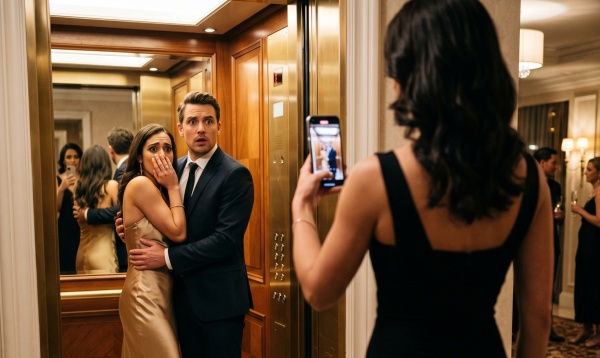
My Husband Said He Was Working Late—But The Elevator Doors Opened and I Saw My Husband Kissing My Best Friend. I Took Three Photos Before They Knew I Was There. Then I Made One Phone Call — and Within 30 Minutes, Both of Their Lives Started to Fall Apart.
Part 1: The Elevator Doors
The elevator doors opened at exactly 8:17 p.m., and my life split cleanly into before and after.
I had been holding a paper bag from a bakery in downtown Boston, the kind with twisted handles and a little grease stain blooming at the bottom from warm almond croissants. My husband, Evan, had texted me that afternoon saying he would be stuck late at the office, buried under a client presentation. I felt sorry for him, so I decided to surprise him with coffee and pastries.
That was the kind of wife I had been for eleven years.
Thoughtful. Loyal. Predictable in the ways unfaithful men find convenient.
Evan worked on the twenty-second floor of a glass building in the Seaport District, where the lobby smelled like polished stone, expensive cologne, and people trying too hard to look busy. He was the chief financial officer of Hartwell & Lowe, a fast-growing healthcare tech company with investors, board members, and a CEO who treated Evan like the adult in every room.
I knew that because I had helped him get there.
Back when Evan and I married, he was an exhausted accountant with a used Honda Civic, $68,000 in student loans, and two suits he rotated like uniforms. I was working in nonprofit operations then, managing budgets, vendors, donor reports, and all the invisible systems that keep organizations from collapsing. When he wanted to make the leap into corporate finance, I edited his résumé, prepped him for interviews, and stayed up with him at midnight while he practiced answers in our tiny apartment in Somerville.
He used to say I was his secret weapon.
Later, he said it less often.
Eventually, he stopped saying it at all.
My best friend, Lauren Pierce, entered our life six years into our marriage. She and I met at a charity planning committee for a children’s hospital fundraiser. Lauren was glamorous in a way I never tried to be — perfect blond waves, designer boots, a laugh that made people turn their heads before they knew why.
I liked her immediately.
That is the part that still embarrasses me.
I liked how she remembered details, how she texted after my mother’s surgery, how she made me feel less lonely during the years Evan’s career started swallowing him whole. She was divorced, childless, successful in public relations, and always seemed to know which restaurant had the best lighting, which boutique had the best sale, and which people mattered before anyone else realized they did.
When Evan’s company needed an outside communications consultant, I recommended Lauren.
I did that.
I opened the door.
At first, it seemed harmless. Professional. Convenient. Lauren helped Hartwell & Lowe prepare for investor events and media outreach. Evan praised her work, and I felt proud, as if I had connected two people I loved in a way that helped both of them.
Then she started appearing in his stories too often.
“Lauren thinks the investor deck needs more narrative.”
“Lauren says the CEO should stop improvising on panels.”
“Lauren is incredible with crisis messaging.”
I joked once that he sounded like the president of her fan club.
He kissed my forehead and said, “Don’t be jealous. She’s your friend.”
That was the first time I remember feeling something go still inside me.
Jealous.
The word was too easy. Too useful. A label men hand women when they want instinct to sound like insecurity.
For months, I ignored the signs because I did not want to become suspicious of my husband and my best friend. I ignored the phone turned face down at dinner. I ignored the “strategy calls” that happened after 10:00 p.m. I ignored the way Lauren stopped sharing details about her dating life, as if a woman with a secret boyfriend no longer needed pretend ones.
I ignored the new dress.
The emerald green silk one she wore to Hartwell & Lowe’s annual investor reception, the one Evan glanced at for one second too long. I was standing beside him in a navy cocktail dress I had worn twice before, holding a glass of sparkling water and trying not to feel foolish. Lauren hugged me tightly that night and told me I looked “classic.”
Classic.
Not beautiful. Not stunning. Classic.
The word felt like a polite obituary.
Still, I trusted them because trust is not always confidence. Sometimes trust is exhaustion. Sometimes trust is the story you keep telling yourself because the alternative would require tearing your life apart with your bare hands.
Then came that Thursday night.
Evan texted at 6:04 p.m.
Still at the office. Don’t wait up. Board prep is a nightmare.
I had already made soup. I had already lit the candle on the kitchen table because November in Boston gets dark too early and I was trying to make our condo feel warm. I stared at the text for a long moment, then looked at the untouched place setting across from mine.
I decided to go to him.
Not to check on him. Not consciously. I told myself I was being kind. I bought coffee from the café near his building and croissants from the bakery he loved, then walked through the cold wind toward the Seaport with my coat pulled tight.
The security guard in the lobby recognized me.
“Mrs. Bennett,” he said. “Late night?”
“Apparently,” I said, lifting the bakery bag.
He smiled and waved me through.
The elevator ride was quiet. I remember watching the numbers climb: 12, 15, 18, 21. I remember thinking I should have worn warmer shoes. I remember wondering if Evan would be annoyed by the interruption or grateful for it.
The doors opened on twenty-two.
And there they were.
Evan and Lauren stood near the reception desk, half-hidden by the curve of the hallway, but not hidden enough. His hand was in her hair. Her fingers were wrapped around his tie. They were kissing like people who had done it before and expected to do it again.
For a second, my brain refused to translate what my eyes were seeing.
Then Lauren laughed softly against his mouth, and the sound snapped something awake in me.
I did not step out.
I did not gasp.
I did not drop the bag.
Instead, I stayed inside the elevator, held the door open with one hand, and lifted my phone with the other.
I took one photo.
Then another.
Then a third.
The third one caught Evan’s wedding ring clearly, his left hand pressed against Lauren’s waist. It also caught the Hartwell & Lowe logo glowing on the wall behind them and the timestamp on the lobby monitor. It was not romantic. It was evidence.
Only after the third photo did Lauren open her eyes.
She saw me first.
Her face emptied of color so quickly it almost looked theatrical.
Evan turned.
For one tiny, terrible moment, all three of us stood frozen in the bright corporate hallway.
Then the elevator doors began to close.
I let them.
Part 2: The Phone Call
The elevator descended in silence, except for the soft mechanical hum and the sound of my own breathing.
I looked down at the bakery bag in my hand. The bottom had gone translucent from butter. One of the coffee cups had leaked slightly onto the cardboard tray. It seemed absurd that pastry could still be warm when a marriage had just gone cold.
My phone started ringing before I reached the lobby.
Evan.
I watched his name flash across the screen.
Then Lauren.
Then Evan again.
I did not answer.
The security guard looked up when I walked out. His smile faded when he saw my face.
“Mrs. Bennett? Everything okay?”
I wanted to say yes because women are trained to protect rooms from discomfort even when our lives are falling apart. Instead, I gave him the bakery bag.
“Would you like these?” I asked.
He blinked. “Ma’am?”
“They’re still warm.”
Then I walked out into the cold.
Boston wind hit my face so hard my eyes watered, or maybe that was finally me. I stood under the awning outside the building while my phone vibrated again and again in my hand. Evan called six times in four minutes.
Lauren texted first.
Mia, please. It isn’t what you think.
That almost made me laugh.
Not what I think.
What an ambitious sentence to send to someone with three photos.
Evan texted next.
Come back upstairs. We need to talk.
Then:
Mia, don’t do anything crazy.
That message changed everything.
Crazy.
He had chosen his first defense before I had even spoken.
I looked up through the glass building at the twenty-second floor. Somewhere above me, my husband and my best friend were probably scrambling, whispering, deciding which story would make me seem unstable enough to dismiss. I knew Evan. I knew how fast he could turn numbers, facts, and blame into a presentation.
I also knew Lauren. She built narratives for a living.
If I walked back upstairs, I would be walking into a room with two people who had already begun rehearsing the version where I misunderstood, overreacted, invaded privacy, or embarrassed everyone.
So I made one phone call.
Not to Evan.
Not to Lauren.
Not to my sister, although I wanted to.
I called my attorney.
Her name was Denise Kaplan, and she had handled the postnuptial agreement Evan asked me to sign two years earlier after his company stock options became valuable. I had not wanted that agreement. Evan said it was “just prudent planning,” but Denise had read every line and made sure I did not sign away my dignity in the name of marital harmony.
She answered on the fourth ring.
“Mia?” Her voice sharpened immediately. “Are you safe?”
“Yes.”
“Is anyone hurt?”
“Not physically.”
“Tell me.”
I told her everything in short, clean sentences. Elevator. Evan. Lauren. Photos. Hartwell & Lowe office. Board prep lie. Company consultant. Possible conflict of interest.
Denise went quiet.
Then she said, “Do not post the photos. Do not send them to friends. Do not threaten either of them. Do you understand?”
“Yes.”
“Good. Now listen carefully. If Lauren is a company consultant and Evan is the CFO who approved payments, contracts, access, or expenses involving her while they were in an undisclosed personal relationship, this may be more than marital infidelity. It may involve governance, conflicts of interest, misuse of corporate resources, and employment policy violations.”
My hand tightened around the phone.
“That’s why I called you.”
“Smart,” she said. “Where are you now?”
“Outside his building.”
“Leave. Go somewhere public or home if you feel safe. Forward the photos to me, but do not alter them. Also send any records you already have involving Lauren’s contract, payments, travel, or gifts, if you legally possess them.”
“I have some things.”
Of course I did.
Not because I had been investigating in a dramatic way, but because I managed our household finances. Evan was brilliant with corporate structures but careless at home. He left receipts in jacket pockets, forwarded travel itineraries to our shared calendar by mistake, and once asked me to find a wire confirmation while his laptop was open on the kitchen counter.
For weeks, little things had bothered me.
A $6,400 “communications strategy retainer” paid to Lauren’s LLC outside normal vendor timing. Two hotel charges in New York when Evan claimed he stayed with a colleague. A business-class ticket to San Francisco for Lauren on the same flight as Evan, even though the CEO had not attended that conference.
I had screenshots.
I had calendar entries.
I had enough to ask questions.
Denise asked, “Who is the board chair?”
“Thomas Reardon.”
“General counsel?”
“Anita Shah.”
“Do you know them?”
“I’ve met them at events.”
“Good. I’m going to draft a short notice. Not emotional. Not accusatory beyond what the evidence supports. We are not sending a revenge blast. We are sending a preservation and governance concern to the appropriate company contacts. If records are at risk, timing matters.”
I looked back at the building.
“What happens after that?”
“If the company takes compliance seriously, within thirty minutes, Evan and Lauren will know the situation is no longer private.”
Thirty minutes.
That was the phrase that stayed with me.
Within thirty minutes, the kiss would become more than betrayal. It would become a problem with lawyers, policies, investors, and board minutes. Evan had always respected those things more than feelings.
Denise sent me the draft at 8:43 p.m.
I read it while sitting in my car, heat blasting, hands shaking.
The subject line was:
Urgent Notice: Potential Undisclosed Conflict of Interest and Document Preservation Request
The email stated that I had observed Evan Bennett, CFO of Hartwell & Lowe, engaged in an intimate interaction with Lauren Pierce, an outside communications consultant whose firm had received payments and privileged access through company channels. It requested preservation of records related to consultant contracts, travel, reimbursements, vendor approvals, communications, and any applicable conflict-of-interest disclosures.
It included the three photos.
Denise had cropped nothing because nothing was explicit. The photos showed a kiss, a company office, and context. They were not posted publicly. They were not sent to embarrass. They were evidence delivered to the people responsible for reviewing misconduct.
I attached the payment screenshots.
I attached the travel itinerary.
Then I typed one sentence above Denise’s formal language.
I am submitting this through counsel because I believe the issue may involve corporate resources and undisclosed conflicts, not merely a private marital matter.
At 8:52 p.m., I sent the email to Denise, Thomas Reardon, Anita Shah, and the chair of the audit committee.
Then I turned off notifications.
At 9:18 p.m., exactly twenty-six minutes later, Evan called from a number I did not recognize.
I let it ring.
At 9:21, Lauren texted.
What did you do?
I stared at those four words until they blurred.
Then I whispered to the empty car, “What you should have known I would.”
Part 3: The Story They Tried to Tell
I went home that night to our condo in Back Bay and locked the door behind me.
The place looked exactly as it had that morning, which felt almost insulting. The gray sofa. The framed print from our honeymoon in Maine. The bowl of lemons on the kitchen counter because Lauren once told me a “good kitchen always has citrus,” and I had believed her taste was friendship.
I took the bowl and dumped every lemon into the trash.
Then I sat on the kitchen floor.
For twenty minutes, I did nothing but breathe.
At 9:47 p.m., Denise called again.
“The company acknowledged receipt,” she said. “General counsel has initiated a preservation hold.”
“What does that mean?”
“It means Evan and Lauren cannot delete relevant communications or records without serious consequences. It also means this is officially not just between the three of you anymore.”
I closed my eyes.
“Good.”
“Evan’s attorney may contact you. Lauren may contact you. Do not engage directly. Also, Mia, I need to ask: do you feel safe if Evan comes home?”
I looked at the door.
Evan had never hit me. He had never threatened me physically. But power has many temperatures, and I had lived long enough in a marriage where displeasing him changed the weather in every room.
“I don’t know,” I said.
“That is enough. Pack a bag. Go to your sister or a hotel. Text Evan once, through language I’ll send you, stating that you are safe and all communication should go through counsel tonight.”
“My sister lives in Newton.”
“Go there.”
So I did.
I packed a duffel with clothes, documents, my passport, medication, and the small velvet box where I kept jewelry my grandmother left me. I took my laptop. I took the hard drive with household financial records. I did not take our wedding album.
Evan came home while I was still packing.
I heard his key in the door.
My whole body went cold.
“Mia?” he called.
His voice sounded normal.
That almost made me angrier than shouting would have.
I stepped into the hallway with my coat already on. He stood near the entryway, tie loosened, face pale, phone in his hand. For the first time since I had known him, Evan looked like a man who could not calculate his way to safety.
“We need to talk,” he said.
“No.”
He blinked. “No?”
“I’m leaving for tonight.”
“Mia, you sent photos to my board.”
“I sent evidence to the appropriate company officials through counsel.”
His mouth tightened. “You humiliated me.”
I looked at him then.
Really looked.
At the man who had kissed me on our wedding day with tears in his eyes. At the man who once drove through a snowstorm to bring me soup when I had the flu. At the man who had stood in an office hallway with his hand on my best friend’s waist and thought the greatest damage was being seen.
“I did not humiliate you,” I said. “I documented you.”
His face flushed.
“That was private.”
“Our marriage was private,” I said. “Your relationship with a company consultant whose invoices you approved may not be.”
His eyes changed at that. The husband mask slipped, and the CFO appeared.
“You don’t understand what you’re interfering with.”
“There it is.”
“What?”
“The part where you treat me like I’m too stupid to know what I saw.”
He stepped closer. “Mia, listen. Lauren and I made a mistake.”
I laughed once.
A mistake.
People love that word because it makes choices sound like weather.
“A mistake is grabbing the wrong coat,” I said. “A mistake is putting salt in coffee. You did not accidentally kiss my best friend in your office after lying about a board meeting.”
His jaw clenched.
“It wasn’t like that.”
“Then what was it like?”
He had no answer ready.
That was when I knew the affair had been going on long enough for lies but not long enough for truth.
My phone buzzed.
Denise had sent the text I should send him.
I copied and pasted it while he watched.
I am safe. I will not discuss this tonight. All legal matters should go through Denise Kaplan. Company matters should go through Hartwell & Lowe counsel. Please do not follow me.
His phone lit up a second later.
He read it and looked at me with something like disbelief.
“You’re treating me like I’m dangerous?”
“I’m treating you like I’m done being alone in rooms where you control the story.”
That landed.
For a second, I saw the panic beneath his anger. Not remorse. Not yet. Panic.
“Mia,” he said, softer. “Please. We can fix this.”
“No,” I said. “You can face this. That is not the same thing.”
Then I walked past him.
He did not stop me.
My sister Caroline opened her door in Newton at 10:31 p.m. She was wearing flannel pajamas and holding a baseball bat, because when I called her from the car crying too hard to explain, she skipped questions and prepared for war.
When she saw my face, she dropped the bat.
“Oh, honey,” she said.
That was when I finally broke.
Not in the elevator. Not in the car. Not in front of Evan.
In my sister’s kitchen, under warm lights, while her dog sniffed my boots and a half-finished mug of tea sat on the counter, I cried so hard my ribs hurt.
Caroline held me and said nothing cruel about Evan or Lauren.
That came later.
The next morning, the story they tried to tell began.
Evan’s first version, according to Denise, was that Lauren had “blurred boundaries” during a stressful work period. He suggested I had misread a “comforting moment” after an emotional conversation. He implied marital strain had made me reactive.
Lauren’s version was worse.
She told Hartwell & Lowe’s outside counsel that Evan had said we were separated. She said I knew our marriage was “functionally over.” She said she was shocked by my hostility because she had always tried to support me as a friend.
I read that part in Denise’s summary and felt something inside me go very still.
Support me.
The woman who had helped me choose a dress for my anniversary dinner was now claiming she thought my marriage was over.
The woman who sat on my couch drinking wine while I talked about trying to reconnect with Evan was now saying she believed we had already separated.
I opened my phone and scrolled through old messages.
Lauren: You and Evan are honestly couple goals.
Lauren: He adores you, don’t overthink it.
Lauren: Marriage has seasons, babe. Don’t let work stress make you insecure.
I forwarded them to Denise.
Then I forwarded photos from three months earlier: Lauren at our housewarming party, one arm around me, one arm around Evan, smiling like a sister.
Denise called within ten minutes.
“Well,” she said, “that complicates her credibility.”
By noon, Hartwell & Lowe had placed Evan on administrative leave pending review.
By 12:17 p.m., Lauren’s consulting contract was suspended.
By 12:31 p.m., Evan texted me from his personal phone.
You’re destroying everything.
I stared at the message for a long time.
Then I sent it to Denise.
I did not reply.
Part 4: The Company Was Only the Beginning
The internal investigation moved faster than I expected.
Companies do not always care about morality, but they care deeply about exposure. Hartwell & Lowe had investors, pending funding, and a board that did not want a CFO approving contracts for a secret romantic partner. The issue was not just betrayal. It was judgment, controls, and whether company funds had been used improperly.
Within a week, outside counsel requested records.
Lauren’s LLC had been paid $312,000 over eighteen months.
Some of that work was legitimate. I will not lie and say Lauren was incompetent. She was excellent at shaping perception, which made her betrayal almost poetic. But the invoices told a story even charm could not polish.
A “crisis messaging retreat” in Newport with only Evan and Lauren listed as attendees.
A “stakeholder dinner” in New York charged to Evan’s corporate card, while Lauren’s Instagram from that weekend showed a hotel view from the same block.
A $14,000 “expedited brand positioning fee” approved two days after a weekend Evan had told me he spent in Chicago.
The board did not need to know they had been kissing to know something was wrong.
The kiss just made them look.
Meanwhile, my personal life became paperwork.
Denise referred me to a divorce attorney named Judith Ross, who had a soft voice and the calmest eyes I had ever seen. Her office overlooked Boston Common, and the first thing she said after hearing my story was, “Do you want to end the marriage, or do you need time to decide?”
“I want to end the lie,” I said.
“That is not always the same answer.”
I hated that she was right.
Massachusetts is an equitable distribution state. Judith explained that adultery itself would not guarantee a certain outcome, but financial misconduct, misuse of marital assets, emotional impact, and conduct affecting the marriage could matter in context. She also told me not to expect the legal system to feel like emotional justice.
“Courts divide property,” she said. “They do not repair souls.”
I filed anyway.
Not because I wanted revenge, but because my marriage had become a place where the truth needed representation.
Evan was served at his temporary office, since Hartwell & Lowe had restricted his access to the executive floor. Denise told me later that he accepted the papers without speaking. I did not ask how he looked.
I already knew.
Like a man surprised that consequences had a mailing address.
Lauren tried to call me once.
I let it go to voicemail.
Her voice was softer than I expected.
“Mia, I know you hate me. I know you have every right. But Evan lied to me too. He said you two were basically done. He said you stayed because of finances and appearances. I know that doesn’t excuse anything, but I need you to understand—”
I stopped the recording there.
I did not need to understand.
Understanding is sometimes just another unpaid job handed to women after betrayal.
I saved the voicemail and sent it to Denise because it confirmed Evan had misrepresented our marriage. Then I put the phone down and made tea. That felt like growth.
Evan moved out two weeks later.
Not voluntarily at first. He wanted to stay in the condo “while we figured things out,” as if living in the same space would give him access to my softness. Judith advised boundaries, and Evan eventually agreed through counsel to stay in a furnished apartment near Kendall Square.
The first night alone in the condo was strange.
I expected to feel free.
Instead, I felt haunted.
Every room contained some version of us. The kitchen where we had danced barefoot after closing on the condo. The hallway where Lauren once helped me hang art while Evan made margaritas. The bedroom where I had slept beside a man who was already learning how to lie without moving.
I slept on the couch.
At 3:00 a.m., I woke up reaching for someone who had broken me.
That made me angrier than the photos.
Grief is rude that way. It does not respect evidence. It does not care that the person hurt you. It still arrives wearing their face.
Over the next month, Evan tried every version of apology.
The strategic apology.
“I understand this affected you deeply.”
The romantic apology.
“You are the love of my life. I lost myself.”
The defensive apology.
“I never meant for this to happen.”
The corporate apology.
“I take full accountability for the situation.”
I forwarded all of them to Judith and responded only when necessary.
Finally, one Friday evening, he sent a message that sounded different.
I told the board the relationship was ongoing and undisclosed. I told them I approved her invoices and should have recused myself. I don’t expect that to change anything with you. I just wanted you to know I stopped lying about that part.
I read it twice.
Then a third time.
I did not answer for an hour.
When I finally did, I wrote:
Good. Keep going.
That was not forgiveness.
It was instruction.
The board investigation concluded in January. Evan resigned as CFO. The company publicly described it as a leadership transition, but anyone close enough understood. Lauren’s contract was terminated, and Hartwell & Lowe revised its vendor conflict policies.
No one went to jail.
No one was dragged out in handcuffs.
Real life is rarely that theatrical.
But Evan lost the job that had become his identity. Lauren lost the client that had made her firm look bigger than it was. And both of them lost the version of the story where they were tragic lovers misunderstood by a bitter wife.
That mattered more than I expected.
Not because I wanted them destroyed.
Because I needed the truth to live outside my body.
Part 5: The Life After the Elevator
Six months after the elevator doors opened, I ran into Lauren at a bookstore in Cambridge.
Of all places.
Not a gala. Not a courtroom. Not a dramatic restaurant scene with wine thrown and strangers gasping. A bookstore, under fluorescent lights, while I was holding a paperback on rebuilding after major life transitions, which felt annoyingly on the nose.
She saw me near the memoir section and froze.
She looked thinner. Less polished. Still beautiful, but tired in a way makeup could not fully negotiate with. For a moment, I saw the friend I had loved before I saw the woman who betrayed me.
That hurt more than I wanted it to.
“Mia,” she said.
I could have walked away.
Instead, I stayed.
“Lauren.”
Her eyes filled quickly. Lauren had always cried beautifully, which sounds cruel but is true. Even her tears knew where to sit.
“I’m sorry,” she said.
I said nothing.
She swallowed. “I don’t expect you to forgive me.”
“Good.”
She flinched, but nodded.
“I was jealous of you,” she said. “Not at first. But then… your home, your marriage, the way Evan talked about you before everything changed. I wanted to be chosen like that.”
I almost laughed.
“You wanted to be chosen by a man who was lying to his wife?”
“I know how that sounds.”
“Do you?”
She looked down.
“No,” I said quietly. “You wanted my life because you saw the staged parts. You saw dinner parties, vacations, the condo, the husband in a suit. You didn’t see me crying in the shower because he hadn’t looked at me in weeks. You didn’t see me trying to save a marriage he was already spending somewhere else.”
A tear slipped down her cheek.
“I’m sorry,” she whispered again.
This time, the words sounded smaller.
Maybe more real.
“I loved you,” I said.
Her face crumpled.
“That is the part I don’t think either of you understood. Evan betrayed his wife. You betrayed the woman who told you where she kept the spare key, who sat with you after your divorce, who trusted you in her home.”
Lauren covered her mouth.
I put the book back on the shelf.
“I hope you become someone who never does this again,” I said.
Then I left.
Outside, Cambridge was cold and bright. Students hurried past with backpacks and coffee. Life had the nerve to continue, as it always does.
My divorce finalized the following fall.
I kept the condo for a while, then sold it because some walls remember too much. I moved into a smaller place in Brookline with big windows, old hardwood floors, and a kitchen just large enough for one person to cook without bumping into ghosts.
I went back to using my maiden name professionally.
Mia Hart.
It looked strange on documents at first. Then it started to look like mine.
Evan and I spoke once after the divorce was final. He asked to meet at a coffee shop near Boston Common, and I agreed because enough time had passed for curiosity to feel safer than longing. He looked older, humbled, and less expensive somehow, though his coat probably cost more than my monthly grocery budget.
“I’m consulting now,” he said.
“I heard.”
“I’m in therapy.”
“I’m glad.”
He nodded, staring into his coffee.
“I used to think the worst thing you did was send those photos,” he said.
I raised an eyebrow.
“I don’t think that anymore,” he added quickly. “I think the worst thing was that I gave you a reason to need them.”
That was the closest he had come to wisdom.
I sipped my coffee.
“You and Lauren?” I asked.
He shook his head. “It ended almost immediately. I think the secrecy was doing most of the work.”
That did not surprise me.
Some relationships cannot survive daylight because daylight reveals they were never love. They were escape, ego, fantasy, and the thrill of being seen by someone who did not know the whole truth.
“I’m sorry, Mia,” he said. “Not the way I was before. Not because I got caught. I’m sorry because I turned you into someone who had to protect herself from me.”
I looked at him for a long moment.
The strange thing was, I believed him.
The stranger thing was, it did not change what came next.
“Thank you for saying that,” I replied.
His eyes softened with hope, just a little.
So I finished the truth before hope could grow in the wrong direction.
“But I’m not coming back.”
He nodded slowly.
“I know.”
After coffee, we walked out separately. No hug. No dramatic goodbye. Just two people who had once promised forever and now respected the boundary of an ending.
That night, I found the three photos again in a legal archive folder Judith had returned to me. I had not looked at them in months. My hand hovered over the file before I opened it.
There they were.
Evan’s hand in Lauren’s hair.
Lauren’s fingers on his tie.
The Hartwell & Lowe logo behind them like a witness.
For a long time, those photos had felt like the worst things I owned. Proof of humiliation. Proof that the two people closest to me had built a room inside my life where I was not welcome.
Now they looked different.
They looked like a door.
Not a door I wanted to walk through, but one I had needed opened. Without those photos, maybe I would have argued with my instincts for another year. Maybe Evan would have explained it away. Maybe Lauren would have held my hand and told me not to be insecure.
I deleted two of them.
I kept one in the legal file, not for pain, but for recordkeeping. There is a difference.
People often ask what I felt in the elevator.
Shock, yes.
Rage, eventually.
But the first thing I felt was clarity.
The doors opened, and for once, nobody had time to lie before I saw the truth. No story. No spin. No “you’re imagining things.” Just my husband, my best friend, and the end of a life I had been trying too hard to save.
The phone call did not destroy them.
Their choices did.
The phone call only made sure I was not the only one carrying the evidence.
I am not proud of needing three photos. I am not proud of the marriage ending in board emails, legal notices, and corporate investigations. Nobody dreams of becoming the woman who stands in an elevator and documents the betrayal before she lets herself cry.
But I am proud of what I did next.
I did not scream in the hallway.
I did not post my pain for strangers.
I did not let two people who knew how to shape stories turn me into the unstable wife in theirs.
I called someone who knew the law, told the truth cleanly, and chose myself before they could ask me to protect them.
And that is the part I hope every woman remembers.
Sometimes the most powerful thing you can do is not revenge.
It is record the truth, make the right call, and walk away before the elevator doors close on you too.
