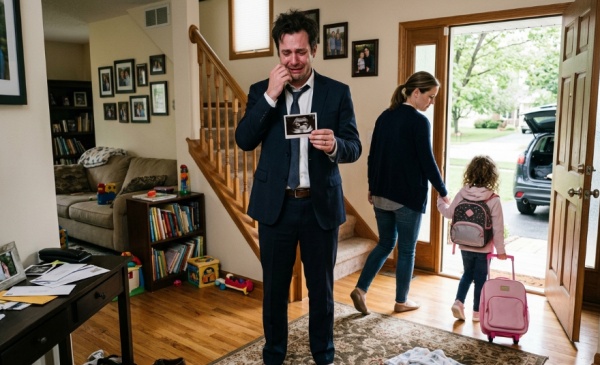
I abandoned my family for a sonogram. That is the sentence I will carry for the rest of my life. My mistress cried when she gave it to me, and I was foolish enough to believe those tears meant truth. Today, she finally told me what I should have seen from the beginning—and now I have to live with the fact that I traded a loyal wife and two innocent children for the biggest lie of my life.
Part 1: The Picture I Chose Over My Family
I abandoned my family for a sonogram.
That is the sentence I will carry for the rest of my life. Not “I made a mistake,” not “I got confused,” not “I fell in love with the wrong person.” Those words are too soft for what I did.
My mistress cried when she gave it to me. She held the small black-and-white picture between trembling fingers, her mascara running down her face, and I was foolish enough to believe those tears meant truth. I looked at that blurry image and decided it mattered more than my wife’s wedding ring, my daughter’s drawings on the refrigerator, and my son’s baseball glove by the back door.
My name is Matthew Collins. I am forty-one years old, a project manager for a construction company in Columbus, Ohio. Until last year, I had a wife named Rebecca, two children named Sophie and Luke, and a house on a quiet street where people put out American flags on Memorial Day and pumpkins on their porches every October.
Rebecca and I had been married for thirteen years. She was not dramatic, not flashy, not the kind of woman who demanded attention when she walked into a room. She was steady in a way I used to mistake for ordinary.
She remembered dentist appointments, packed lunches, mailed birthday cards to my mother, and stayed up late helping our daughter build a solar system model out of foam balls and fishing line. She knew exactly how I liked my coffee and which knee hurt when the weather turned cold. She built a life so quietly around me that I stopped noticing the labor it took to keep it standing.
That was my first failure.
My second failure had a name.
Lauren Avery.
Lauren worked in the leasing office of one of our apartment developments near Short North. She was thirty-two, funny, charming, and very good at making a man feel like the most misunderstood person in the room. She laughed at my jokes before I finished them and looked at me like I had some deep sadness only she could see.
At first, it was harmless. That is what every guilty person tells themselves at the beginning. A few conversations after site meetings. A coffee run. A text about work that turned into a text about life.
Then harmless became lunch.
Lunch became drinks.
Drinks became secrets.
And secrets became a second life I carried in my pocket while my real life waited at home.
Rebecca noticed before I admitted anything. Of course she did. Wives notice the shift in tone, the phone turned face down, the sudden need for privacy from a man who used to leave his email open on the kitchen counter.
One night in March, she asked me if there was someone else.
We were standing in the laundry room. She was folding Luke’s soccer uniform, smoothing the little blue jersey across the dryer. I remember that detail because she did not stop folding when she asked the question.
“Is there someone else, Matt?”
I should have confessed.
Instead, I got angry.
That is what cowards do when truth knocks too loudly. I told her she was paranoid. I told her work was stressful. I told her she was making me feel like a criminal in my own home.
She looked at me for a long time.
Then she said, very quietly, “I hope you understand that once trust is gone, love has nowhere safe to live.”
I rolled my eyes.
God help me, I rolled my eyes at the woman who was trying to save our marriage.
Two months later, Lauren handed me the sonogram.
It happened in the parking lot behind a restaurant in Dublin, Ohio, where I had told Rebecca I was meeting a client. Lauren was sitting in her white Lexus, crying so hard she could barely speak. When I opened the passenger door, she pushed the picture into my hand.
“I’m pregnant,” she said.
The world stopped.
At least, that is how I remember it. The sound of traffic faded, the sun seemed too bright, and my heart began pounding like someone had struck a drum inside my chest. I stared at the sonogram, unable to understand how something so small could destroy so much.
“How far along?” I asked.
“Nine weeks.”
I did the math badly because panic makes fools of men who already lack courage. Nine weeks put us near a weekend in Cleveland when I had told Rebecca I was at a conference. A weekend when Lauren and I had crossed a line so clearly that even I could no longer pretend we were just caught up in emotion.
“What do you want to do?” I asked.
Lauren cried harder. “I want my baby to have a father.”
My baby.
Those two words wrapped themselves around my guilt and pulled tight. I thought of my own father, who left when I was eleven and mailed birthday cards with twenty-dollar bills inside like that was parenting. I had spent my entire adult life promising myself I would never become that kind of man.
So, in the cruelest irony of my life, I became something worse.
I told myself I was being honorable.
That is the lie that ruined everything.
I told myself Rebecca was strong. I told myself Sophie and Luke would adjust. I told myself children survived divorce all the time in America, especially when parents stayed “mature.” I told myself leaving my wife for a pregnant woman was painful, but abandoning an unborn child would be unforgivable.
Notice how every sentence began with “I told myself.”
That is because nobody else would have believed me.
When I came home that night, Rebecca was at the kitchen table helping Luke with fractions. Sophie was on the floor with our golden retriever, Maple, brushing fur from her tail with a pink comb. The house smelled like spaghetti sauce and garlic bread.
It should have stopped me.
That ordinary scene should have brought me to my knees.
Instead, I waited until the kids went upstairs, then told Rebecca we needed to talk.
She sat across from me in the living room, still wearing the gray cardigan she wore when the house was chilly. I remember her hands folded in her lap. I remember the way she looked at me like she already knew, but hoped I would be merciful with the truth.
I was not merciful.
“I got someone pregnant,” I said.
For a moment, she did not move.
Then all the color left her face.
I had imagined shouting. I had prepared for tears, accusations, maybe even a slap, though Rebecca had never raised a hand to anyone in her life. I had prepared for drama because drama would have let me feel like a victim too.
But Rebecca only asked one question.
“Is it Lauren?”
I stared at her.
Her mouth tightened, just slightly. “So I wasn’t paranoid.”
That sentence did more damage than screaming ever could have.
I told her I was sorry. I told her I never meant for this to happen. I told her Lauren was pregnant and that I had a responsibility.
Rebecca looked toward the staircase where our children were sleeping.
“You already had responsibilities,” she said.
I hated her for that in the moment.
Not because she was wrong.
Because she was right.
Part 2: The Family I Walked Away From
I moved out three days later.
Not because Rebecca threw me out. That would have made the story easier for me to tell. I moved out because I wanted to believe I was choosing responsibility, when in reality I was choosing the version of myself that Lauren made me feel like.
She needed me. Rebecca did not seem to.
That was another lie.
Steady people need love too. They just do not always beg for it loudly enough to be heard by selfish ears.
I rented a one-bedroom apartment in a new complex near Grandview Heights. It had stainless steel appliances, gray vinyl floors, and a balcony overlooking the parking garage. Lauren called it “our fresh start,” even though she still had her own townhouse and I still had two children crying themselves to sleep ten miles away.
The first weekend after I left, Sophie refused to speak to me.
She was eleven, old enough to understand betrayal but too young to know where to put it. When I picked her and Luke up for dinner, she climbed into the back seat, put on her headphones, and stared out the window the entire drive to Chipotle. Luke, who was eight, asked if my apartment had a room for him.
“Of course,” I lied.
It had an air mattress in the corner of the living room and a plastic bin of toys I had bought from Target that afternoon because I had no idea what divorced fathers were supposed to own.
At dinner, Luke asked, “Are you coming home when the baby is born?”
Sophie kicked him under the table.
I looked at my burrito bowl because I could not look at my son.
“No, buddy,” I said. “Mom and I are going to live in different houses now.”
Luke’s eyes filled. “Because of the baby?”
I should have said something careful. Something a therapist would approve of. Something that protected him from adult guilt.
Instead, I said, “It’s complicated.”
Sophie took off her headphones then.
“No, it’s not,” she said. “You cheated on Mom.”
The people at the next table went quiet.
I felt heat crawl up my neck. “Sophie, lower your voice.”
“Why?” she asked. “You didn’t care who heard when you ruined our family.”
She was eleven.
And she was right.
After dinner, I drove them home early. Rebecca opened the front door before we reached the porch, as if she had been waiting by the window. Luke ran into her arms. Sophie walked past me without saying goodbye.
Rebecca did not yell.
She simply said, “Do not bring them around Lauren.”
“I wasn’t planning to.”
“Good.”
“She’s pregnant, Rebecca.”
Her eyes hardened. “And they are children.”
That was the beginning of the custody conversations, the child support calculations, the attorney emails, and the polite language people use when their lives have become legal documents. In Ohio, everything had a process. Parenting schedules. Temporary orders. Financial disclosures. Mediation.
I hated it.
Not because it was unfair.
Because it was proof that my choices had consequences beyond feelings.
Lauren did not like the legal process either. At first, she played supportive. She rubbed her stomach even though she was barely showing, told me we would get through it, and said Rebecca was “using the kids as punishment.”
I believed that for a while because it made my guilt easier to swallow.
When Sophie stopped coming to my apartment, Lauren said, “She’s old enough to know better.”
“She’s eleven,” I said.
“Exactly. Old enough not to be cruel.”
Cruel.
My daughter had lost the daily presence of her father, watched her mother cry in the laundry room, and found out a stranger was having a baby with him. But Lauren called her cruel because Sophie’s pain inconvenienced our fantasy.
That should have opened my eyes.
It did not.
I kept going.
I attended Lauren’s supposed prenatal appointments, though she always insisted I wait in the lobby because she was “still processing” and felt embarrassed. She showed me printed summaries afterward. She told me the baby was healthy, that her doctor said everything looked good, that stress was bad for her.
Whenever I asked to see more, she cried.
And when Lauren cried, I surrendered.
Rebecca had cried only once in front of me after I left. It was in the driveway during a custody exchange in late June. Luke had forgotten his baseball cleats at my apartment, and Sophie had refused to get out of Rebecca’s car.
I got irritated.
“She can’t keep doing this,” I said.
Rebecca looked exhausted. There were shadows under her eyes, and her hair was pulled into a messy bun. She had lost weight, the kind people compliment without realizing grief is not a diet.
“She is a child, Matt,” Rebecca said. “Her father left and started preparing for another baby before she had time to breathe.”
“I didn’t leave them.”
Her face changed.
“You left this house,” she said. “You left dinner tables, bedtime, school mornings, Saturday pancakes, and being here when they call for you. Do not insult me by pretending geography is the only kind of leaving.”
I had no answer.
So I became defensive.
“I’m trying to do the right thing.”
She laughed once, softly and without humor. “No. You’re trying to make the wrong thing sound noble.”
Then she cried.
Just one tear at first, then another. She wiped them quickly, embarrassed, as if I deserved to be protected from the sight of what I had done to her. That should have broken me.
Instead, I drove away angry.
A guilty man will often choose anger because remorse requires surrender.
By August, the divorce was moving forward. Rebecca stayed in the house with the kids. I paid temporary support, rent, Lauren’s groceries sometimes, and medical bills she claimed her insurance did not cover.
Money got tight quickly.
I complained to Lauren once that I was stretched thin.
She placed my hand on her stomach and whispered, “We’re worth it, aren’t we?”
I said yes.
I wish I could go back and slap the word out of my own mouth.
Part 3: The Cracks In The Sonogram
The first crack appeared at a baby boutique in Powell.
Lauren wanted a stroller that cost $1,200. She said it was safer, smoother, and “what responsible parents buy.” I reminded her that I already had two children and knew for a fact babies could survive perfectly well in strollers from Target.
She cried in the store.
The sales associate pretended to rearrange blankets.
I bought the stroller.
On the drive back, Lauren was cheerful again. She talked about nursery colors and baby names, though every name I suggested seemed to bother her. When I said I liked Benjamin, she said it sounded like “a child from a boring suburb.”
I looked out the window at the very boring suburb I had once been proud to call home.
By September, Lauren said she was almost twenty-four weeks pregnant. But she still did not look visibly pregnant in the way I expected. I knew every pregnancy was different, and I did not want to be the kind of man who questioned a woman’s body, so I said nothing.
Still, something felt wrong.
Her appointments changed constantly. She never used the same doctor’s office twice when I asked. One week she said her OB was in Dublin. Another week, she mentioned a women’s clinic near Westerville.
When I asked for the doctor’s name so I could add it to my calendar, she snapped.
“Why are you interrogating me?”
“I just want to be involved.”
“No,” she said. “You want control because Rebecca is filling your head.”
Rebecca and I barely spoke outside the kids.
But Lauren had learned that blaming Rebecca worked.
Then came the envelope.
It arrived at my apartment on a Wednesday afternoon, addressed by hand with no return name. Inside was a copy of the sonogram Lauren had given me months earlier. At first, I thought it was the same picture.
Then I noticed the date.
It was from four years ago.
Printed faintly at the top was a name I did not recognize: Emily R. Avery.
Avery.
Lauren’s last name.
My hands went cold.
There was a note folded behind it.
“Ask Lauren whose baby this really was.”
No signature.
I sat at my kitchen island for nearly an hour, staring at that paper. My first instinct was denial. Maybe it was a mistake. Maybe the clinic reused formatting. Maybe Emily was a relative and Lauren had borrowed the wrong image accidentally.
But the longer I looked, the more my stomach turned.
I called Lauren.
She did not answer.
I texted her a photo of the envelope and wrote, “We need to talk.”
She replied twenty minutes later.
“Where did you get that?”
Not “What is that?”
Not “That’s not mine.”
Where did you get that?
I drove to her townhouse in Hilliard so fast I barely remember the route. She opened the door wearing leggings and one of my old Ohio State sweatshirts. Her face was pale.
“Who sent it?” she asked.
“I don’t know.”
She folded her arms. “Probably Rebecca.”
“Don’t.”
“What?”
“Don’t say her name right now.”
Lauren’s eyes widened, then filled with tears. The old trick. The one that had worked every time.
But something inside me had shifted.
“Whose sonogram is it?” I asked.
She sat down on the couch and covered her face. “It’s complicated.”
I almost laughed because those had once been my words.
“No,” I said. “It’s not. Whose sonogram is it?”
“My cousin Emily’s,” she whispered.
The room seemed to tilt.
“Your cousin.”
“She had a baby years ago. I used the picture because I didn’t have one yet.”
I stared at her.
“You told me that was our baby.”
“I was pregnant then,” she said quickly. “I just didn’t have an appointment yet, and I panicked because you kept saying you needed proof.”
“I never asked for proof before you gave it to me.”
She wiped her eyes. “Because I knew you wouldn’t leave her without it.”
There it was.
Not accidental.
Not panic.
Strategy.
I backed away from her like she had become dangerous.
“Are you pregnant now?”
She stood. “Matthew.”
“Are you pregnant now?”
She began crying harder. “I was.”
The two words hit the room and died there.
“What does that mean?”
“I lost it,” she said.
“When?”
She looked down.
“When, Lauren?”
“In June.”
June.
I gripped the back of a chair. “You told me last week you had an appointment.”
“I didn’t know how to tell you.”
“You let me tell my children they had a sibling coming.”
“I was scared you’d leave.”
I stared at her, and for the first time I saw not a wounded woman, not a partner, not the mother of my unborn child, but a person willing to build a life out of another family’s wreckage and then keep building after the foundation disappeared.
“How long were you going to lie?”
She whispered, “I thought if you stayed long enough, you’d realize we belonged together.”
I thought of Rebecca in the laundry room.
Sophie at Chipotle.
Luke asking if I would come home when the baby was born.
I thought of the stroller in the corner, still in its box, purchased for a child who no longer existed, if the child had ever existed the way Lauren claimed.
My voice came out flat.
“I need medical confirmation.”
Her face changed. “You don’t trust me?”
“No.”
She looked offended.
That almost broke my mind.
“You destroyed my family with a borrowed sonogram,” I said. “No, Lauren. I do not trust you.”
She screamed at me then. Not words at first, just sound. Then came accusations. I used her. I abandoned her emotionally. Rebecca poisoned me. I was cruel.
I stood there and let the noise wash over me because I deserved many things, but not another lie.
Finally, I said, “Do not contact my children. Do not contact my wife. If there was a pregnancy, my attorney will handle any necessary documentation.”
“Your wife?” she spat.
The word slipped out before I could stop it.
My wife.
Rebecca was still my wife legally, yes. But I had not said it that way in months. Hearing it from my own mouth felt like finding a key after the house had burned down.
Lauren saw it too.
Her face twisted. “You’re going back to her?”
I looked at the borrowed sonogram on her coffee table.
“No,” I said. “I don’t think there’s anything left to go back to.”
That was the first honest thing I had said in a long time.
Part 4: The Door That Would Not Open
I drove to Rebecca’s house that night.
I should not have gone without calling. I know that now. Grief and panic convinced me urgency was the same as entitlement. It was not.
The porch light was on when I pulled into the driveway. Through the front window, I could see warm light in the kitchen. For a moment, I imagined walking in and saying everything.
The sonogram was fake.
Lauren lied.
I was wrong.
Please let me come home.
But Rebecca had changed the locks in July.
I deserved that too.
I rang the doorbell.
Maple barked inside. A few seconds later, Rebecca appeared behind the glass panel beside the door. She did not open it fully. She opened it with the chain still on.
“Matt,” she said, cautious.
I hated hearing my name in that voice.
“I need to talk to you.”
“It’s late.”
“It’s important.”
“Are the kids okay?”
That was her first question.
Not “Are you okay?”
Not “What happened?”
The kids.
Because she was still the parent who remembered what mattered first.
“They’re okay,” I said. “It’s about Lauren.”
Her face closed. “No.”
“Rebecca, please.”
“No,” she repeated. “You don’t get to bring her to my doorstep.”
“She lied.”
Rebecca stared at me through the narrow opening.
I held up the copy of the sonogram with shaking hands. “The picture wasn’t hers. She said she lost the baby months ago and kept lying. I just found out.”
For a long moment, Rebecca said nothing.
Then she closed her eyes.
I expected anger. Maybe satisfaction. Maybe the kind of sharp comment I had earned a hundred times over.
Instead, she looked unbearably sad.
“Matt,” she said quietly, “what do you want from me right now?”
The question stunned me.
“I don’t know.”
“Yes, you do.”
I swallowed.
I wanted comfort.
I wanted forgiveness.
I wanted her to say the lie changed everything, that because Lauren had deceived me, I was less responsible for what followed. I wanted the woman I betrayed to help me feel like a victim.
That realization made me ashamed enough to look away.
“I wanted you to know,” I said.
“Why?”
“Because it means—”
I stopped.
Because what did it mean?
It meant Lauren lied. It did not mean I had been faithful. It did not mean I had protected my children. It did not mean I had believed Rebecca when she asked for truth.
Rebecca waited.
“It means I ruined everything for nothing,” I finally said.
Her expression changed then.
Not softened.
Changed.
“No, Matt,” she said. “You ruined everything for yourself.”
The words landed with surgical precision.
“You did not leave because of a sonogram,” she continued. “You cheated before the sonogram. You lied before the sonogram. You made me feel crazy before the sonogram. The picture may have pushed you out the door, but you were already standing at it.”
I could not speak.
Behind her, I heard Luke laugh at something upstairs. The sound nearly brought me to my knees.
“Can I see them?” I asked.
“No.”
“Rebecca—”
“No,” she said again. “They are getting ready for bed. You don’t get to arrive unannounced with adult chaos and hand it to them because your other life collapsed.”
My other life.
That was exactly what it had been.
“I’m sorry,” I said.
She looked at me for a long time.
“I believe that you are sorry tonight,” she said. “But I don’t know if you are sorry for what you did, or sorry that it cost you something.”
That was the sentence that stayed with me after she closed the door.
The porch light remained on. I stood there holding the fake sonogram, listening to Maple settle down inside the house where I used to belong. Then I walked back to my car.
I did not sleep that night.
By morning, I called my attorney.
Not to fight Rebecca.
For the first time, I called to ask what accountability actually looked like.
His name was David Klein, a family law attorney with an office near downtown Columbus. He had spent months trying to make me appear reasonable in emails while I privately acted like a selfish idiot. When I told him everything, he was quiet for several seconds.
Then he said, “Matthew, I’m going to speak plainly.”
“Please do.”
“The revelation about Lauren may matter if there are claims involving money or fraud between you and her. It does not erase your conduct in your marriage or your obligations to your children.”
“I know.”
“Do you?”
That hurt.
Because I had not known.
Not really.
David advised me to document Lauren’s admission, avoid further emotional confrontation, and keep all communication appropriate. If there had been a pregnancy loss, it was not something to exploit publicly. If there had been deception involving money, legal options could be discussed carefully.
“Do not turn this into a public revenge campaign,” he said. “It will hurt your children.”
For once, I listened.
I texted Rebecca later that day.
“I’m sorry for showing up last night. It was wrong. I will respect your boundaries. I will not discuss Lauren with the kids. I understand the custody schedule remains the same.”
She responded four hours later.
“Thank you.”
Two words.
I stared at them like they were a life raft, then reminded myself they were not an invitation.
Over the next few weeks, the truth came out in pieces. Lauren had never provided verifiable medical records. The money I had spent on appointments had often gone to personal expenses. The boutique purchases, the cash transfers, the “specialist bills” she claimed insurance would not cover—all of it became part of a separate legal discussion.
But none of that mattered as much as Sunday dinner.
Sunday had always been our family dinner night. Roast chicken sometimes. Chili in the winter. Tacos when the kids begged. After I left, Rebecca kept the tradition without me.
The first Sunday after the truth, I sat alone in my apartment eating grocery-store sushi from a plastic tray while staring at the stroller box in the corner.
At 6:30 p.m., Sophie texted me.
“Mom says you can call Luke tomorrow after school. Not tonight.”
I typed, “Okay. Thank you.”
Then, after a long pause, I added, “I love you.”
The three dots appeared.
Disappeared.
Appeared again.
Finally, she wrote, “I know.”
Not “I love you too.”
Just “I know.”
It was more than I deserved.
Part 5: The Life After The Biggest Lie
The divorce was finalized the following spring.
There was no dramatic courtroom scene. No judge lecturing me while Rebecca cried beautifully on the witness stand. Real divorce is mostly paperwork, signatures, waiting rooms, and people saying “pursuant to the agreement” while your life gets divided into schedules and numbers.
Rebecca kept the house.
That was right.
The kids needed one place that still felt stable, and she had been the parent who stayed. I moved into a slightly larger apartment with a second bedroom and bunk beds I assembled badly on a Saturday afternoon while Luke read the instructions out loud like he was supervising a government project.
Sophie still did not stay overnight at first.
I did not force her.
My therapist, a patient woman named Dr. Morales, told me that trust was not rebuilt through speeches. “Consistency,” she said, “is an apology repeated without words.”
So I became consistent.
I arrived on time. I paid support before the due date. I went to Luke’s games and sat away from Rebecca unless she invited me closer. I attended Sophie’s school orchestra concert and did not bring flowers, because Rebecca gently told me Sophie hated public gestures.
I learned things I should have known before.
Sophie liked mint chocolate chip ice cream but hated actual mint. Luke pretended not to like reading but would finish graphic novels under a blanket with a flashlight. Rebecca had been carrying the mental map of our children’s lives for years while I praised myself for “helping.”
One Saturday, six months after the divorce, Sophie agreed to have lunch with me alone.
We went to a small diner in Worthington where the booths were red vinyl and the coffee tasted burned in a comforting way. She ordered pancakes even though it was noon. I ordered eggs I barely touched.
For a while, we talked about school.
Then she said, “Did you leave because you loved her more than us?”
The question was calm.
That made it worse.
“No,” I said.
She looked at me. “That’s not an answer.”
She was right.
I took a breath. “I left because I was selfish, and because I convinced myself that doing what I wanted could still make me a good person. I told myself a story where I was being responsible, but I was really hurting you, Luke, and your mom.”
Sophie stared down at her pancakes.
“She lied to you, right?”
“Yes.”
“Mom said that doesn’t make what you did okay.”
“Your mom is right.”
Her eyes filled, but she did not cry. “I miss who I thought you were.”
There are punishments no court can create because children do it better with one honest sentence.
“I miss him too,” I said.
She shook her head. “You don’t get to miss him like I do.”
I nodded.
Because she was right again.
Over time, Lauren became less of a person in my life and more of a lesson I did not want to keep relearning. There were legal letters. Some money was recovered. Some was not. She moved to Cincinnati eventually, according to someone from the old job site who thought I wanted to know.
I didn’t.
The truth about Lauren mattered, but not in the way I first thought it would. At first, I wanted it to absolve me. I wanted to stand in front of Rebecca, Sophie, and Luke and say, “See? I was manipulated too.”
But manipulation works best on desires already present.
Lauren gave me a lie, yes.
I gave that lie a home.
That distinction became the foundation of whatever kind of man I was trying to become.
Rebecca changed too.
Not in the cruel way I once feared. She did not become bitter, at least not visibly. She became lighter after the divorce, as if my absence had removed a weight she had been politely carrying for years.
She cut her hair to her shoulders. She took a job at a nonprofit downtown coordinating community programs. She started running 5Ks with a group of women from the neighborhood and posted a picture after her first race, cheeks flushed, arms raised, smiling in a way I had not seen in a long time.
I stared at that photo for too long.
Not because I wanted to take credit.
Because I realized she looked free.
A year after the divorce, Rebecca began dating someone named Aaron. He was a high school history teacher, widowed, with a teenage daughter and a calm manner that irritated me for reasons I had no right to feel. The first time I saw him at Luke’s baseball game, he was carrying a folding chair and two lemonades.
I hated him for exactly seven minutes.
Then I watched him hand Rebecca a napkin before she realized she needed one.
Such a small thing.
Such a devastating thing.
I had spent years receiving her care as if it were weather. Aaron noticed the chance to care for her and took it.
That night, I sat in my car after dropping off the kids and cried harder than I had cried the day Lauren confessed. Not because Rebecca had moved on. Because she deserved to.
And because I had once been given the privilege of loving her and treated it like a subscription I could cancel and renew whenever I wanted.
The second Christmas after everything fell apart, we found a rhythm.
Rebecca had the kids Christmas morning. I had them Christmas afternoon through December 27. It was all written into the parenting plan, because families like ours learn to make peace with calendars.
When I arrived at the house, Aaron’s truck was in the driveway.
I felt the old jealousy rise, then let it pass.
Rebecca opened the door wearing a green sweater, her hair tucked behind one ear. Maple, older and slower now, wagged her tail at me from the hallway. For a moment, I could see the old life layered over the new one like a reflection in glass.
Sophie came downstairs first.
She was thirteen now, taller, sharper, still guarded but less frozen around me. She handed me a wrapped gift.
“It’s from me and Luke,” she said.
In the car, I opened it at a red light because patience is not one of the virtues I have fully recovered.
It was a framed photo.
Sophie, Luke, and me at Luke’s baseball tournament that summer. I did not remember anyone taking it. We were sitting on bleachers, all three of us squinting into the sun, paper cups of lemonade in our hands.
I looked tired.
But I was there.
On the back, Sophie had written: “For your apartment.”
I had to pull into a gas station parking lot because I could not see the road.
That photo sits on my desk now.
Not as proof that everything is fixed.
Everything is not fixed.
Some fractures become part of the structure. Sophie still has days when she looks at me and I know she is remembering. Luke still asks questions in sudden bursts, usually when we are driving and I cannot escape the honesty of the windshield.
Rebecca and I are civil. Sometimes kind. Never what we were.
And Lauren’s sonogram—the borrowed picture that became the symbol of my collapse—is sealed in a folder with legal documents I hope my children never ask to see. I keep it not because I want to remember her, but because I need to remember me.
The man who held that picture wanted to believe he was trapped by fate.
He was not.
He was choosing.
Every lie is a door. Every excuse is a step. By the time disaster arrives, most people have walked toward it for months and called it confusion.
Today, when I say I abandoned my family for a sonogram, I know that is only partly true.
I abandoned them for ego.
For attention.
For the fantasy of being needed by someone who did not know the worst parts of me yet.
I abandoned them because my loyal wife had become familiar, and I was too immature to understand that familiar is not the opposite of love. Sometimes familiar is the deepest form love takes.
Rebecca knew my coffee order, my bad knee, my fear of becoming my father, and my habit of pretending stress was nobility. She knew me fully and stayed.
Lauren knew a version of me I edited for applause.
And I chose the audience over the home.
That is the truth I live with.
I do not tell this story because I want pity. I do not deserve it. I tell it because somewhere, some man is holding a phone in his hand, smiling at a message he should delete, telling himself nobody will get hurt if he can just keep the worlds separate.
They will.
Some woman already knows.
Some child will eventually understand.
And some ordinary kitchen, somewhere in America, is about to become the place where a family learns one person’s secret has been living with them all along.
If that man is reading this, I hope he puts the phone down.
I hope he walks into the next room and looks at the people who still believe in him.
I hope he understands before a blurry picture, a pretty lie, or a selfish hunger convinces him to trade real love for a story that will not survive the truth.
Because one day, the lie will end.
And when it does, he may find himself standing outside a house where the locks have changed, holding proof of nothing except the fact that he destroyed everything that was real for something that never was.
