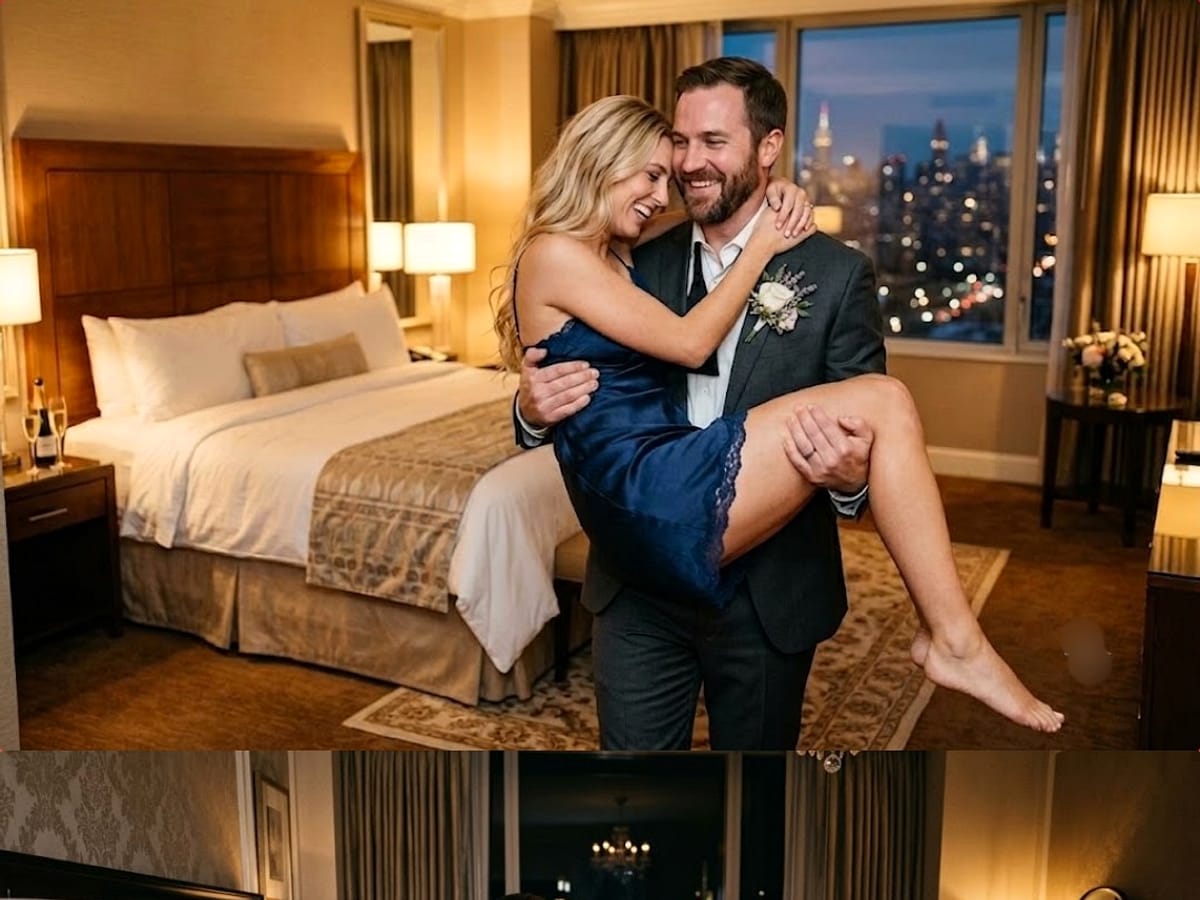
Part 1: The Night Nobody Talks About at Toasts
My husband spent our wedding night with the woman who’d held my bouquet at the altar.
Forty-three people were standing in my parents’ backyard the evening Caleb finally said it out loud.
Every one of them expected me to scream, or slap him, or fold to the ground the way women do in movies about ruined marriages.
I smiled instead.
Not because it didn’t hurt. Because his confession was the very last piece of proof I’d spent months waiting on.
I’m Hannah Whitaker, raised in Savannah, Georgia, in a house with blue shutters and two live oaks out front, under a mother who genuinely believed sweet tea could fix anything short of a felony.
My family ran Magnolia House Events, a business built on weddings, retirement luncheons, and Southern bridal showers where nobody admitted out loud how much the peonies cost.
Caleb Reed showed up in my life three years before our wedding, leather portfolio in hand, the kind of charm older women called “well-raised” without knowing why.
Commercial insurance was his field. He wore navy suits that fit too well and remembered names after one introduction, which my father mistook for character.
My best friend liked him too. Madison Price had known me since ninth grade, back through braces and bad haircuts, through my mother’s cancer treatments, through my broken first engagement.
When Caleb proposed, Madison’s scream beat mine by a full second. She helped pick the venue, tasted six different cakes with me, and called herself my emotional-support maid of honor.
I believed her completely. Betrayal always lands hardest when it wears a face you trust.
We married at a restored plantation venue outside the city, moss dripping from the oaks, 126 guests sweating politely through the late-May humidity.
Caleb’s eyes were wet when I came down the aisle. I thought that meant something tender. I had no idea he was looking at me the way a man looks at a deal about to close.
Madison’s toast made half the room cry. She said I was the sister she’d chosen, that she’d prayed for someone who would guard my heart the way Caleb would.
She lifted her glass and looked straight at him when she said it. He smiled back in a way that snagged in my memory without meaning anything to me yet.
Looking back, there were signs. There always are. They just don’t read as warnings when they’re coming from people you love.
Caleb and Madison texted constantly in the weeks before the wedding, officially about logistics. He knew her coffee order the way you know a spouse’s, from memory, without thinking.
I clocked it. Then I let it go.
That’s the actual mechanism of betrayal. Not stupidity.
Trust teaching you to talk yourself past the first small crack.
The reception ended and Caleb carried me over the threshold of our River Street hotel suite because my aunt insisted, phones out, guests still laughing in the lobby below.
At 12:48 a.m., his phone lit up. He frowned at it.
“Vendor thing,” he said. “Something about the lighting company’s final payment.”
I was still in my dress, pins digging into my scalp. “Tonight?” “Five minutes,” he promised, already headed for the bathroom.
Forty minutes later he came back pale, saying the venue coordinator had driven over and needed him downstairs. I was too tired to push back.
He kissed my forehead before he left again. “Be right back, Mrs.
Reed.” The name still felt borrowed and lovely then.
He returned at 3:17 a.m. smelling faintly of bourbon, though it hadn’t rained and there was rain on him anyway. He slid into bed like he was trying not to wake anyone.
I lay still and pretended sleep, because some part of my stomach already understood what my heart wasn’t ready to translate yet.
Madison skipped the family brunch the next morning. Her text arrived at 9:06 a.m.: a migraine, an apology, a promise to thank everyone later.
Caleb read it over my shoulder. “Poor Maddie,” he said.
I should have caught the tone. But on the first morning of a marriage, nobody wants to play detective.
Three weeks in, my father called me down to his office behind the event company, where our attorney Elaine Porter sat waiting with a folder and my brother Nathan stood near the window, arms crossed.
Magnolia House Events had wired $38,600 to something called Blue Harbor Strategy. No website.
No verifiable license. The receiving account traced straight back to Madison.
I laughed at first, because my brain refused the shape of it. “Madison wouldn’t,” I said. Nobody in that room agreed with me.
Elaine folded her hands. “Hannah, there’s more.” There is always more.
The transfer had gone through at 1:32 a.m. on my wedding night, from my company login, using a verification code sent to my phone while I lay half-asleep in my dress.
Caleb had my password. He’d asked to borrow my phone that night too, claiming his battery had died and he needed to call the front desk.
Elaine slid over hotel security logs. Caleb left our suite at 1:01 a.m.
Madison entered through a side door at 1:14. Neither showed up on any lobby camera again until 3:05.
I did not cry in that office. The shock was too clean, too white, to leave room for tears yet.
Elaine leaned forward. “Do not confront him. Not yet.”
Part 2: The Woman Who Learned to Smile on Command
For the next two months I shared a house with a man I was now watching like a stranger, and I never once let it show on my face.
Caleb made coffee every morning. He kissed my cheek before work, complained about traffic on Abercorn, sent me heart emojis from conference rooms.
He played devoted newlywed so convincingly that some mornings I wondered if I was the one losing my grip on reality.
Madison grew harder to reach. Slower replies, skipped lunches, a sudden need to help her mother in Atlanta. When we did see each other, her hugs lasted a beat too long, like guilt had arms of its own.
Elaine brought in a forensic accountant named Victor Bell, a man who wore square glasses and never used two words when a spreadsheet would do the talking for him.
Victor found more. $4,800 labeled brand consulting.
$7,250 for vendor coordination. $12,000 tagged emergency staffing.
All of it routed through Blue Harbor or accounts tied to Madison.
“Infidelity is painful,” Elaine told me, “but legally, the financial misconduct is our strongest thread. If we can tie the affair to the same window as the transfer, it shows opportunity and coordination.”
“So I stay married to him until he says the truth out loud?” I asked. “You stay safe, calm, and strategic,” she said, “until we have enough to protect you.”
Safe. Calm.
Strategic. I repeated those three words to myself like scripture for weeks.
Georgia only needs one party’s consent to legally record a conversation, Elaine reminded me. I could record Caleb myself. She warned me not to bait him, not to post a word online.
“You’re not trying to win an argument on the internet,” she said. “You’re trying to protect your actual life.”
So I went quiet. Not soft.
Not forgiving. Quiet.
Caleb read my silence as peace, which turned out to be his first real mistake. He relaxed.
Left his phone face-up. Started talking about a bigger house in Ardsley Park, maybe a baby the year after.
He suggested merging more of our finances, now that we were “officially building something.” I smiled at that. Smiling had become my costume.
The hardest part wasn’t Caleb. It was my mother, who had survived cancer twice and called Caleb “son” after the rehearsal dinner and meant every syllable of it.
Telling her before we had proof would have broken something in her I wasn’t ready to break, so I carried the secret through Sunday dinners and grocery runs and a birthday bracelet Madison sent me engraved Sisters by choice.
By August, Elaine had built enough for a civil claim against Madison, and possibly Caleb depending on what he admitted under pressure.
My father wanted to fire everyone connected to the wedding and drive to Caleb’s office with something worse than words. Elaine told him one more joke about violence and he’d be barred from every meeting.
He cried instead, right there at the conference table. “I was supposed to protect you,” he said. “You taught me how to protect myself,” I told him, and meant it.
The plan itself was almost gentle. We’d invite Caleb and Madison to my parents’ place for Labor Day, along with family and a few people from the wedding party.
Elaine wouldn’t attend as a guest, just stay close in case things went sideways legally. Victor had a packet of financial records ready. The goal wasn’t a public ambush for its own sake.
“Is this cruel?” I asked Elaine once.
She looked at me a long moment. “Cruel is stealing on someone’s wedding night.
Asking for the truth is not cruelty.”
Madison nearly backed out. A work trip to Charleston, then car trouble, then a comment about how distant I’d been lately, like I owed her an apology.
I only wrote back that I needed my best friend there. She came.
Of course she came. Guilt is terrified of absence, because absence looks too much like a confession.
Caleb arrived with bourbon for my father and grocery-store flowers for my mother, wearing the watch I’d given him as a wedding gift, looking every bit the man you’d trust with your daughter and your keys.
Madison came twenty minutes later in a green sundress, carrying a peach cobbler from a bakery she used to call overrated. Her perfume turned my stomach when she hugged me.
“You okay?” she whispered.
“I’m great,” I said, and pulled back smiling. She believed it completely.
That belief was her mistake.
Part 3: What Forty-Three People Heard
Dinner went out under the string lights my father had strung between the oaks, pulled pork and grilled corn and three kinds of pie, because my mother trusted restraint with feelings but never with dessert.
From the porch it looked like an ordinary Southern gathering. Inside my chest, everything had already frozen over.
Elaine’s instructions were to wait until after the meal. People reason better fed, and witnesses remember more clearly once the mood has settled.
I ate half a plate of food I couldn’t taste and listened to Caleb charm my uncle with a story about a difficult client. Madison sat across from me, her glass shaking slightly each time she lifted it.
At 7:42, my brother stood and cut the music. Caleb assumed a toast was coming and arranged his face for it. Nathan just looked at me, and I stood up.
“Thank you all for being here.” The yard went quiet.
My mother’s expression shifted first. She’d know the steel under my voice anywhere.
“I asked you here because some things need saying in front of people who love this family. Not for drama. Because a lie has been living too comfortably under our roof.”
Caleb’s smile dropped. Madison stopped moving entirely.
I lifted the folder off the patio table. “On our wedding night, thirty-eight thousand six hundred dollars left the company for a firm called Blue Harbor Strategy. That firm ties back to Madison.”
The sound that moved through the yard wasn’t quite a gasp. It was more like the air leaving the whole party at once.
Madison half rose. “Hannah, what is this?” “Sit,” Nathan said, quiet enough, but nobody mistook it for gentle.
“Hannah, not here,” Caleb tried. “It became here,” I said, “the night the money disappeared.”
“Stolen is a strong word.” “It’s the accurate one. That’s why we brought records.”
My father set the invoices down for everyone to see. My aunt put a hand over her mouth. A groomsman leaned in, reading the top page twice.
“I don’t understand,” Madison said. That was the evening’s first lie.
I turned to Caleb. “You left our suite at 1:01.
Madison entered the hotel at 1:14. The transfer cleared at 1:32, off my laptop, verified by a code sent to my phone.”
He stood up. “I’m not doing this.” “You already did,” I said.
He scanned the yard for the softest face, the easiest exit. He landed on my mother.
“Mrs. Whitaker, I love your daughter.
I don’t understand why she’s doing this.”
My mother didn’t move for a long second, and I genuinely feared she might believe him. Then she said two words. “Answer her.”
Madison started crying, quiet first, harder once nobody rushed to comfort her. I’d seen those tears since high school.
They used to move me instantly. That night they just made me tired.
“Did the money reach an account you controlled?” I asked her, exactly the way Elaine had coached me to ask, flat and unadorned.
“It’s complicated,” Madison said. “No,” I said.
“It isn’t.”
Madison looked at Caleb. That single glance told the whole yard everything words hadn’t yet.
“Why were you at that hotel with her?” I asked him. “I wasn’t,” he said.
I pulled out my phone and played a recording from a conversation we’d had days earlier, his voice laughing off my question, calling it ridiculous that I’d even ask about Madison and the wedding night.
“That was your chance to tell the truth in private,” I said. “You recorded me?”
“I recorded a conversation I was part of. Legally.”
Something shifted in his face. This wasn’t an emotional outburst he could talk his way around.
This was structure. Documented, sequenced, already finished.
Madison broke first. “Caleb, I can’t do this anymore.”
He rounded on her fast enough that people flinched. “Be quiet.”
His second mistake of the night.
A charming man survives almost anything in public except the moment the mask slips and everyone hears how he actually talks to people.
“He told me it was temporary,” Madison sobbed. “That Hannah wouldn’t even notice until after the honeymoon, that he’d put the money back before anyone checked.”
My mother closed her eyes. Caleb pointed at Madison.
“She’s lying.” “No,” Madison said, standing fully now.
“I’m done lying for you.”
Voices piled on top of each other across the yard. I stayed silent, because sometimes silence is the only thing that leaves room for truth to finish arriving.
Madison wiped her face. “He said marrying Hannah gave him access to the family business. That once the accounts merged, nobody would question payments that looked like vendor costs.”
Caleb stepped toward her and Nathan slid between them without a word. Caleb froze.
Madison looked at me, and for one second I saw the ninth grader again, trapped inside the woman who’d helped ruin us. “I’m sorry,” she said. “I’m so sorry.”
I asked the only question that still mattered. “Were you with him in that hotel that night?”
She covered her face. “Yes.”
Caleb laughed once, sharp and mean. “That proves nothing.”
“Then say it,” I told him. “Say you didn’t spend our wedding night with my best friend.”
He looked around at every face watching him, his mother’s hand pressed to her chest, his father staring at the table as if he could disappear into the grain of it.
His pride did what his guilt never could. “Fine,” he said.
“Yes. I was with Madison that night.”
The yard went completely silent. He looked at me like I’d forced this out of him, because men like Caleb hate whoever makes them hear their own voice.
“Happy now?” he said, ugly with it.
There it was. The full sentence. I smiled, not because any of it stopped hurting, but because after months of staying calm on command, he’d just handed the truth to a whole yard of witnesses.
“Thank you,” I said. He blinked. “You just confirmed the night, the relationship, and exactly how you accessed my laptop and my phone during that transfer.”
His face changed completely. For the first time all evening, Caleb looked afraid.
Part 4: Everything He Thought Charm Could Fix
Elaine walked into the backyard five minutes later, having waited in her car two houses down the whole time, gray suit, slim folder, exactly as planned.
Whatever color was left in Caleb’s face drained out completely when he saw her. “I’m Elaine Porter,” she said evenly. “Counsel for Magnolia House Events and the Whitaker family.”
“You planned this,” Caleb said to me. “Yes,” I said. He looked almost offended, as though ambush were only permitted when he was the one running it.
Elaine advised both of them not to say another word without a lawyer present, and mentioned that formal letters would follow regarding the unauthorized transfers.
Caleb left without anyone stopping him. Nobody had to.
The consequences were already walking beside him. His mother trailed him to the driveway, asking what he’d done.
His father lingered a moment longer, looking at me with a grief I hadn’t expected. “I’m sorry,” he managed, voice cracking on the word. I only nodded.
Madison stayed in the yard shaking until my aunt brought her water, a kindness that irritated me before I remembered mercy isn’t the same thing as forgetting.
“Can I talk to you alone?” Madison asked. “No,” Elaine answered before I had to.
Within forty-eight hours my father pulled Caleb off every insurance account tied to the business, the informal advising that had really just been access dressed as helpfulness.
Elaine sent preservation letters freezing communications and demanding Blue Harbor’s records. Madison hired an attorney before the week was out.
Caleb did not, still convinced his charm could out-negotiate consequences. He showed up at our door that Wednesday, rain in his hair, white roses in one hand, the same flowers from our wedding.
I’d already changed the alarm code and kept Nathan in the house with me. I opened the door only as far as the chain allowed.
“I made mistakes,” he said. “Mistakes don’t require fake invoices,” I told him.
“I was scared,” he tried. “Of what?”
“Of not being enough for you.”
Nearly laughed at that. This was a man who’d stolen from my family and slept with my best friend on our wedding night, still angling to be the wounded one in his own story.
“You were enough,” I said. “You just weren’t honest.”
He saw Nathan behind me and his face hardened. “So your whole family’s against me?”
“No. Your choices are.”
“I can fix this,” he said. “You can cooperate with the attorneys.”
“I meant us.” “There is no us.”
I said it out loud for the first time, and it didn’t feel dramatic. It felt clean.
“You’re really ending our marriage over one night?” he asked.
“One night,” I repeated. “The night you used my phone to help move stolen money. The night you left me alone in a hotel room to be with my best friend.”
He had nothing left to say to that. “You’re not sorry it happened,” I told him. “You’re sorry it became evidence.”
Nathan stepped up. “Time to go.”
Caleb left the roses on the porch. I dropped them in the trash before they had a chance to wilt.
The divorce filing followed. Elaine reminded me Georgia law didn’t work like a movie, no judge handing down poetic justice because a wedding night had been ruined, only documents and deadlines and bank records.
Caleb’s employer learned about the fraud complaint the company had filed. Trust isn’t decorative in the insurance business. By late September he was on administrative leave.
He called six times in one day. I never answered.
He texted that I was destroying him. I replied once: I’m documenting what you did.
Then I blocked him except through counsel.
Madison’s collapse looked different. No posts from me were needed. In a city like ours, silence spreads faster than any feed once enough people have seen the truth firsthand.
Her mother called mine in tears. My mother listened, said she was sorry for everyone’s pain, and never invited Madison back into our lives again.
A quiet boundary. A final one.
Madison eventually agreed to cooperate, handing over emails, texts, and voice memos. Some were cruel enough that Elaine warned me before I read them. I read them anyway.
One read: Once I’m fully in, Hannah won’t question expenses. She trusts too easily. That line hurt worse than the affair itself, because he was right, and trust was never my shame to carry.
Another read: Wedding night is perfect timing. She’ll be exhausted and distracted. I closed the folder and walked outside, stood under the oak where Caleb had once promised to honor me.
My father found me there. He didn’t ask if I was fine.
We both already knew the answer. “You used to hide behind this tree when you were mad as a kid,” he said.
“I remember.” “Your mother always brought you lemonade until you came out.”
I smiled despite everything. “I wish lemonade still worked,” he said.
“So do I.”
He put an arm around me, carefully, like I might crack. I didn’t. That became my own quiet victory.
Part 5: What Was Left When the Applause Stopped
By Thanksgiving, Caleb had lost his job. The company never released details, and I never asked for them. People rarely betray you in only one direction.
He moved out of our rented townhouse and into his parents’ guest room in Pooler. His truck was repossessed that December.
The watch I’d given him surfaced later in an online resale ad, badly lit on someone’s kitchen counter. I didn’t buy it back.
Some things belong to strangers now.
The civil case crawled the way civil cases do. Madison’s attorney negotiated repayment.
Caleb denied everything until Madison’s own records made denial pointless. No single gavel moment.
Just meetings and amended filings and fluorescent lights, until the money slowly came back and his version of events collapsed under ordinary proof.
My marriage ended in under a year. The decree came by mail on an unremarkable Tuesday, and I opened it at the kitchen table with coffee going cold and my dog, June, asleep at my feet.
No music, no rain, nothing cinematic. Just the dishwasher humming and my own name looking back at me.
Hannah Whitaker. Not Reed.
The relief arrived so quietly I nearly missed it. My mother asked if I wanted a party.
“No,” I said. “Dinner, then?”
“Maybe.” “Cake?”
“Obviously cake.”
We ate chocolate cake from a bakery on Habersham Street off paper plates in my parents’ kitchen, nobody trusting us with champagne that particular night.
Nathan toasted with sweet tea. “To Hannah, who smiles before the storm.” I rolled my eyes at him and cried later in the bathroom, not over Caleb, but because surviving something takes everything you have, and your body waits until it’s finally safe to admit the cost.
Madison’s letter came in January, plain envelope, no return address, though I knew her handwriting instantly. It sat on my counter two full days before I opened it.
Six pages. She apologized for the money, the lies, the toast, years of a friendship she’d poisoned. She said Caleb made her feel chosen at a time she’d felt invisible, and admitted that wasn’t an excuse.
The last line said she knew she’d lost the right to call herself my best friend and understood forgiveness might never come, only that betraying me was the worst thing she’d ever done.
I folded it back into the envelope and put it in a drawer. I didn’t forgive her that day.
But I stopped carrying her around in my chest. That much was enough.
People assumed I’d hate weddings after all this. I didn’t, which surprised even me. Magnolia House Events kept booking ceremonies under oak canopies and inside old ballrooms.
Watching brides walk aisles and fathers pretend not to cry hurt at first, like pressing on a bruise. Slowly it turned into something else: proof that Caleb hadn’t ruined love itself, only revealed his own inability to keep it honest.
The following spring I planned a wedding for a couple in their sixties, both widowed, both laughing like teenagers at their first look. She wore pale blue instead of white and carried gardenias for her grandmother.
“You made this beautiful,” she told me afterward, squeezing my hands while her new husband danced badly with a granddaughter. Something in my chest finally loosened. “That means a lot,” I told her.
I drove home with the windows down that night, Savannah thick with salt air and rain on warm pavement, and for the first time in nearly a year I didn’t replay the wedding night once. I thought about tomorrow instead. That felt like healing.
Caleb tried once more in June, an email from an old address I’d forgotten to block. Subject line: I’m sorry. He wrote about therapy, a smaller agency outside Macon, finally understanding the size of the harm.
He asked if we could get coffee sometime. I read it twice and deleted it. Not every apology deserves an audience.
A week later I stood in my parents’ backyard under the same string lights from that Labor Day, no folder this time, no husband turning pale.
It was my mother’s sixty-second birthday, yellow flowers on every table, Nathan at the grill, my mother dancing barefoot to Motown with a paper plate in one hand.
My dog stole a dinner roll off my cousin’s toddler and everyone laughed. The whole evening was ordinary, and that ordinariness felt sacred.
I looked toward the oak where Caleb had finally confessed. For months I’d thought of that spot as where my humiliation went public. Later I thought of it as where justice began.
Standing there in the warm dark, I understood it differently. It was the place I stopped protecting people from the truth, mine included.
That’s what surviving betrayal actually teaches you, if you make it through carefully. Not cruelty.
Not suspicion of every small kindness. Not punishing whoever comes next for what the last person did.
It teaches you that peace built on silence was never peace at all. Just fear wearing a prettier dress.
Caleb expected me to shatter in front of a crowd. He thought enough arrogance, enough public pressure, would make my pain louder than his guilt.
He underestimated the woman he married. He underestimated my family. Mostly he underestimated what happens when a woman stops begging to be loved and starts quietly gathering facts instead.
My husband slept with my best friend on our wedding night. That will always be true. It just isn’t the most important thing true about me anymore.
I didn’t scream for an audience. I didn’t chase him through the wreckage trying to keep it warm.
I smiled, because his confession wasn’t my ending. It was the end of his lie.
And when the rest of his life finally came apart, mine, for the first time in a long while, belonged entirely to me again.
Names and identifying details in this account have been changed. This is a dramatized story shared for entertainment and personal reflection, and any resemblance to real people is coincidental.
