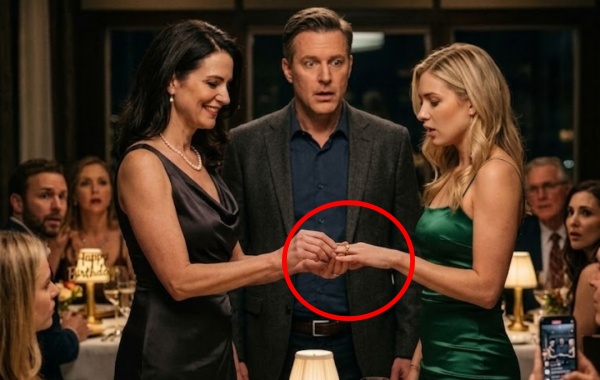
My Husband Walked Into My Birthday Dinner With His Mistress, So I Took Off My Wedding Ring, Handed It to Her, and Said, “He’s Yours.” But the Moment He Put It on Her Finger, the Entire Room Realized This Wasn’t the Ending He Expected.
For fifteen years, I wore that ring as proof of a promise I thought still meant something. Then Caleb arrived at my birthday dinner in Savannah with another woman on his arm, expecting me to cry, beg, or disappear quietly. Instead, I gave her the ring and let him make his choice in front of twenty-three witnesses. What happened next turned his grand performance into the most humiliating mistake of his life.
Part 1: The Birthday Dinner I Almost Canceled
My name is Evelyn Carter, and the night my marriage ended began with a cake I did not even want.
It was my forty-second birthday, and my best friend, Marianne, had reserved the private back room at Brennan’s, a polished Southern restaurant in Savannah, Georgia, where the waiters wore white jackets and every table had fresh magnolias in small glass vases. The room was warm, golden, and full of people who had known me through different versions of my life — college friends, neighbors, two women from the nonprofit board I served on, and my younger brother, who drove in from Atlanta with his wife and their twins. It should have felt like love.
Instead, I spent the first twenty minutes watching the door.
My husband, Caleb Carter, was late.
That had become normal over the last year. Caleb was forty-five, a commercial real estate broker with a gift for walking into rooms like he already owned them. He had built his career selling charm by the square foot, and for a long time, I believed that charm was simply part of the man I married.
By our fifteenth wedding anniversary, I had learned charm could also be camouflage.
For months, Caleb had been distant in ways that were small enough to deny but sharp enough to feel. He took calls outside. He changed his phone passcode. He started working late on Fridays, dressing better for “client drinks” than he did for dinner with me. When I asked questions, he smiled like I was being adorable and unreasonable.
“Evie,” he would say, using the nickname that once softened me, “you know how this business is.”
I did know how business worked. I ran the financial side of a boutique interior design firm, and before that, I spent eleven years in banking. I understood calendars, expense reports, invoices, LLCs, closing deadlines, and the little lies people tell when they think no one will check a number twice. What I did not understand was why my husband suddenly smelled like jasmine perfume when he came home from “commercial walkthroughs.”
Her name was Sloane Mercer.
I knew that before my birthday dinner.
I also knew she was twenty-nine, worked in luxury staging, lived in a new apartment building near the Savannah River, and had once commented a white heart under a photo Caleb posted from a “networking event.” I knew because the first time I saw her name on a credit card receipt, I told myself it was nothing. The second time, I wrote it down. By the sixth time, I had stopped lying to myself.
Still, I went to my birthday dinner wearing my wedding ring.
It was a platinum band with a cushion-cut diamond Caleb had chosen when we were younger and poorer and still seemed capable of being honest with each other. I had loved that ring once. I loved how he had proposed with shaking hands on Tybee Island, how he said, “I can’t promise you a perfect life, but I can promise you I’ll never make you feel alone.”
That promise aged badly.
At 7:38 p.m., Marianne leaned close and whispered, “Do you want me to call him?”
“No,” I said. “He knows where he’s supposed to be.”
She looked at me for one second too long.
Marianne knew some of it. Not all. I had told her Caleb might be cheating, but not that I had already met with a divorce attorney. Not that I had opened a separate checking account. Not that I had copies of bank statements, hotel receipts, and screenshots saved in a folder called Carter Records. Not that I had spent the last three weeks quietly preparing for a birthday dinner I suspected might become something else entirely.
At 7:46 p.m., Caleb walked in.
And he was not alone.
The room changed before anyone spoke.
Caleb stepped through the doorway in a navy suit, no tie, looking expensive and careless. Beside him was Sloane Mercer, wearing a fitted champagne-colored dress, glossy hair over one shoulder, and my husband’s hand resting at the small of her back as if she belonged there. For half a second, everyone seemed to forget how breathing worked.
My brother stood up first.
“Caleb,” he said, voice flat.
Caleb smiled like he had expected discomfort and decided to treat it as a weather condition.
“Sorry we’re late,” he said. “Traffic downtown was a nightmare.”
We.
Not I.
We.
Sloane looked around the room with a nervous little smile, though not nervous enough to leave. She was beautiful in a polished, curated way — the kind of woman who knew exactly how lighting affected her angles. She held a small gift bag in one hand, white with gold tissue paper, as if bringing a present made her presence less grotesque.
I did not move.
The waiter stood frozen near the sideboard with a bottle of Pinot Noir in his hands. Marianne’s mouth was slightly open. My sister-in-law put one hand over her twins’ ears, even though no one had said anything inappropriate yet. The candles on the cake flickered in the corner like they wanted to leave too.
Caleb walked toward me.
“Evie,” he said, lowering his voice. “Can we talk privately?”
I looked at Sloane.
Then back at him.
“No,” I said. “You brought her publicly. We can talk publicly.”
His smile tightened.
“Don’t do this.”
That was when I realized he had planned the humiliation but not my response.
He had expected tears. A scene. Maybe me running to the restroom so he could follow and make me look unstable. He had not expected stillness. Men like Caleb are comfortable with women’s pain when it confirms their power. They get nervous when pain becomes quiet.
Sloane shifted beside him.
“I didn’t want to come like this,” she said softly.
I looked at her.
“Then you should have stayed home.”
Her face flushed.
Caleb’s expression hardened. “That’s enough.”
I almost laughed.
Enough.
He had walked into my birthday dinner with his mistress and decided I was the one approaching the line.
Something inside me became very clear.
I looked down at my wedding ring. The diamond caught the candlelight, throwing a small bright spark across the white tablecloth. For fifteen years, I had worn that ring as a symbol of a promise. That night, it looked more like evidence.
So I twisted it off my finger.
The room went completely silent.
I held the ring out to Sloane.
“If you want him so badly,” I said, “he’s yours.”
No one moved.
Not Caleb.
Not Sloane.
Not even the waiter.
Sloane stared at the ring like it might burn her.
Then Caleb, in the worst decision of his life, took it from my palm.
Part 2: The Moment He Put the Ring on Her Finger
I think Caleb believed he could turn my gesture into proof that I had surrendered.
That was always his gift — taking someone else’s pain and reshaping it into his own advantage. He picked up the ring from my open palm, looked around the room, and gave a small embarrassed laugh, as if I were the dramatic wife and he were the patient man trapped in an awkward social moment. Several guests stared at him in open disbelief.
“Evie,” he said, “you’re upset.”
“No,” I said. “I’m done.”
He glanced at Sloane.
She looked uncertain now, which gave me the first hint that she had not understood exactly what kind of man she had attached herself to. Affairs are built on edited versions. She had probably seen the charming Caleb, the misunderstood Caleb, the lonely Caleb. She had not seen the Caleb who weaponized calmness.
He took Sloane’s hand.
My brother said, “Don’t.”
Caleb ignored him.
Maybe he was angry. Maybe he wanted to prove he was not ashamed. Maybe he thought the room would interpret boldness as love. Whatever the reason, he slid my wedding ring onto Sloane’s finger right there in front of my birthday cake.
And that was when everything went wrong.
Not violently.
Not loudly at first.
The worst things in life often begin with a small sound.
Sloane gasped.
At first, I thought she was reacting emotionally. Then she grabbed her hand with the other one and looked down at the ring. Her face drained of color. The skin around her finger was already reddening, and within seconds, swelling began pushing against the platinum band.
“I can’t get it off,” she whispered.
Caleb frowned. “What?”
“It’s stuck.”
She tugged once, then again, panic rising in her voice. The ring had stopped at the lower part of her finger, too tight to move forward or back. The diamond sat crooked against her knuckle like a cruel little spotlight.
The room came alive all at once.
Marianne grabbed a glass of ice water. My sister-in-law said not to pull too hard. The waiter set down the wine and hurried out to get the manager. Sloane’s breathing became shallow, and Caleb, who handled negotiations worth millions of dollars, suddenly looked useless in the face of a swollen finger.
“Relax,” he told her.
“I am trying,” she snapped.
That was the first honest thing she had said all night.
The restaurant manager arrived with soap, lotion, and a thin piece of dental floss from someone’s purse. A retired nurse from our table stepped forward and calmly explained that if circulation was being affected, they needed to stop pulling and seek medical help. Sloane looked as if she might faint.
My ring, apparently, did not want her either.
I wish I could say I felt only concern.
I did feel concern. I am not a monster. Nobody deserves a medical emergency over a symbol. But beneath that concern was something else — an awful, undeniable sense that the universe had chosen the most theatrical possible way to expose the absurdity of the moment.
Caleb turned toward me.
“Do something,” he said.
I stared at him.
“About what?”
“The ring.”
“You put it on her.”
“It’s your ring.”
“It was,” I said.
His face darkened. “This isn’t funny.”
“No,” I said. “It really isn’t.”
An ambulance was not needed, but the manager called a nearby urgent care clinic that was still open. One of the staff members knew a jeweler two blocks away who sometimes handled stuck rings with a special cutter. Sloane stood in the private dining room, crying quietly now, with ice around her hand and my wedding ring trapped on her finger like a legal exhibit.
The birthday guests had divided into groups.
Some hovered near Sloane, trying to help. Others watched Caleb as if seeing him clearly for the first time. My brother stood beside me, his jaw tight, one hand on the back of my chair like he was anchoring himself.
“You okay?” he asked.
“No,” I said. “But I’m not surprised.”
Caleb heard that.
His eyes shifted.
That was when he realized something.
I was too calm.
And calm women are dangerous to men who depend on confusion.
He stepped closer, lowering his voice. “Evie, we need to talk before this gets out of hand.”
I looked at Sloane’s swollen finger.
“I think it already has.”
He leaned in. “You don’t want to embarrass yourself.”
I smiled, though there was no warmth in it.
“Caleb, you walked into my birthday dinner with your mistress, then placed my wedding ring on her finger in front of twenty-three witnesses. If embarrassment is happening, I’m not the headline.”
His jaw flexed.
Before he could answer, my phone buzzed.
It was an email notification from my attorney, Lydia Grant.
The subject line read: Filing Confirmation – Carter v. Carter
Timing is not always poetic.
But that night, it was.
I opened the email, scanned the first lines, and felt the final lock click into place inside me.
The divorce petition had been filed with the court at 7:52 p.m.
Six minutes after Caleb walked in.
Three minutes before he put my ring on Sloane’s finger.
I had not planned that exact sequence, but I had planned enough.
Caleb saw the email on my screen.
His face changed.
“What is that?”
I turned the phone toward him so he could read the subject line.
For the second time that night, the room went silent.
The ring was still stuck.
Sloane was still crying.
And my husband finally understood that I had not handed over my ring because I was defeated.
I had handed it over because I had already left.
Part 3: What Caleb Didn’t Know I Knew
Caleb tried to follow me into the hallway.
My brother blocked him.
“Move,” Caleb said.
My brother, who is normally the calmest person in any room, looked at him with pure disgust. “You’ve done enough.”
I did not wait to see whether they would argue. I stepped into the corridor outside the private dining room, where the noise of the main restaurant washed over me — forks against plates, low laughter, jazz from hidden speakers, the ordinary rhythm of people having pleasant dinners. It was strange how close normal life can stand to disaster without noticing.
Marianne followed me.
“Tell me what you need,” she said.
“I need five minutes.”
“You have ten.”
She stood guard by the hallway entrance like a woman ready to fight a war in heels.
I leaned against the wall and breathed slowly.
My left hand felt naked without the ring, but not empty. That surprised me. I had expected grief to rush in, but what came first was relief. The kind of relief you feel when a sound you have been ignoring finally stops.
I had known about Sloane for three months.
Not because Caleb confessed.
Because he got careless.
First came the restaurant charge at The Grey, $214.38 on a Tuesday when he claimed he was stuck at a zoning meeting. Then the hotel bar receipt at The Thompson Savannah, two martinis, valet parking, and a room service dessert charged after midnight. Then a jewelry store purchase for $1,650 from a boutique near Broughton Street.
He told me he was cutting back on expenses that same week.
I let him talk.
That was the thing he never understood about my silence. He thought silence meant I believed him. In reality, silence meant I was listening closely enough to remember exact numbers.
I checked only accounts with my name on them. I did not hack his phone. I did not stalk anyone. I simply reviewed credit card statements, bank transfers, shared calendar entries, and social media posts that were available to anyone who knew where to look.
Sloane liked to post hints.
A hand resting near a cocktail glass.
A man’s jacket over the back of a chair.
A hotel room view she captioned when peace finally feels like a person.
I screenshotted everything.
Then I found the business connection.
Sloane’s staging company had received payments from one of Caleb’s real estate clients. That alone was not necessarily improper. Savannah is a small business community, and designers, brokers, stagers, and developers often overlap. But the timing was interesting. Her invoices increased after Caleb began representing a developer whose properties she staged, and several expenses seemed to move through Caleb’s client entertainment budget.
That was when I stopped thinking like a wounded wife and started thinking like the banking professional I used to be.
I created a spreadsheet.
Date.
Vendor.
Amount.
Stated business purpose.
Actual location.
Possible connection to Sloane.
The total marital funds I could reasonably connect to the affair reached $22,840.17.
That number did not include humiliation.
No spreadsheet can calculate that.
Two weeks before my birthday, I met Lydia Grant in her office near Forsyth Park. She had silver hair, sharp eyes, and the reassuring calm of a woman who had watched hundreds of husbands discover that wives can read documents. She explained that Georgia is an equitable division state, not a community property state, and that infidelity does not automatically mean one spouse “wins everything.”
“But money spent on an affair can matter,” she said. “Waste of marital assets, dissipation, credibility, timelines — all relevant if documented properly.”
“I have documentation,” I said.
She looked at my folder.
Then she looked at me.
“Yes,” she said. “You do.”
I told Lydia I did not want a spectacle.
She raised one eyebrow.
“Then don’t create one.”
“I won’t.”
“Good. Let him create his own.”
That was the best legal advice I had ever heard.
And Caleb did.
He created it by bringing Sloane to my birthday dinner.
He created it by letting everyone see her.
He created it by putting my ring on her finger like he was starring in a romance instead of standing in a room full of witnesses.
When I returned to the private dining room, Sloane was being escorted out by the restaurant manager and a staff member. Her hand was wrapped in a towel with ice, and Caleb hovered beside her, looking less like a lover and more like a man watching his investment catch fire. She avoided my eyes.
The ring was still on her finger.
That part mattered more than I wanted it to.
Not because I wanted it back.
Because it had become part of the night’s evidence.
The urgent care clinic later sent her to an emergency room, not because her finger was in danger of being lost, but because the swelling needed proper attention and the ring had to be cut safely. I know this because Caleb texted me at 10:19 p.m.
Caleb: They had to cut it off. Are you happy now?
I looked at the message and felt nothing.
Then another text came.
Caleb: That ring was worth almost $18,000.
There it was.
Not remorse.
Not apology.
A valuation.
I replied once.
Me: Please direct all future communication to my attorney.
Then I blocked him.
Part 4: The Ring, the Receipts, and the Reputation
By morning, Savannah knew.
That sounds dramatic, but anyone who has lived in a Southern city understands how fast private events travel when enough people witnessed them over dessert. Nobody posted a video from my birthday dinner, thank God. My friends had enough decency not to turn my humiliation into content. But people talked.
They always do.
The first call came from Caleb’s mother at 8:07 a.m.
I did not answer.
Then his sister.
Then a board member from the museum fundraiser.
Then Sloane.
I stared at her name on my phone for a long time before letting it ring out.
She left a voicemail. I listened once, sitting at my kitchen island with black coffee gone cold beside me. Her voice sounded smaller than it had at the restaurant.
“Evelyn, it’s Sloane. I know you probably hate me. I just wanted to say I never meant for last night to happen like that. Caleb told me you two were separated in every way except legally. He said your marriage had been over for years. I know that doesn’t excuse anything, but I didn’t know he was going to bring me to your birthday. He said you had invited me so everything could be mature.”
I actually paused the voicemail there.
Invited her.
To my birthday.
That was Caleb’s genius and sickness in one sentence. He had made each woman believe the other had agreed to the humiliation.
Sloane continued, voice shaking.
“And the ring… I didn’t ask him to do that. I should have left. I know that now. I’m sorry.”
The voicemail ended.
I forwarded it to Lydia.
Not because I wanted to punish Sloane.
Because Caleb had lied to both of us, and lies become useful when preserved in their original form.
Lydia called me ten minutes later.
“Do not delete that voicemail,” she said.
“I won’t.”
“Do not respond emotionally.”
“I didn’t respond at all.”
“Excellent.”
There is a strange comfort in being praised for restraint when your life is on fire.
The next few weeks were legal, tedious, and brutal in the quiet way paperwork can be brutal. Caleb hired an attorney who described him as “a respected local businessman seeking an amicable resolution.” Lydia responded by sending a discovery request that asked for financial records, business expense documentation, credit card statements, communications relating to Sloane Mercer, and any client reimbursements connected to entertainment or travel expenses during the previous eighteen months.
Suddenly, Caleb wanted to talk.
He emailed.
Then texted from a new number.
Then sent flowers to my office.
The card said: Can we please handle this with grace?
I threw the card away.
The flowers stayed at reception because one of my coworkers said, “These are guilt hydrangeas,” and that was the first time I laughed in a week.
Caleb’s biggest fear was not losing me.
It was losing control of the story.
He wanted the divorce to be about two people growing apart. He wanted phrases like “private matter” and “mutual respect.” He wanted people to forget the birthday dinner, the mistress, the ring, the emergency room, and the fact that my divorce petition had been filed before he finished performing his cruelty.
Unfortunately for Caleb, documents have better memory than people.
The financial records showed multiple charges connected to dates Sloane later confirmed in her voicemail and written statement. Some were clearly personal. Some were disguised as business expenses. Some involved client accounts, which created a separate problem that had nothing to do with me and everything to do with Caleb’s professional judgment.
I did not report him to his clients.
I did not have to.
One of them found out on his own.
A developer named Martin Keene called my office in late November. He was older, direct, and not easily charmed. He asked whether I knew why his company’s entertainment budget had been used at a hotel bar on a night Caleb was apparently not meeting with anyone from the development team.
I told him politely that I could not discuss matters related to pending divorce proceedings.
Then I gave Lydia his name.
Within a month, Caleb lost that client.
Then another paused a project.
Then his brokerage asked him to take a temporary leave while they reviewed expense practices.
He blamed me, of course.
Men like Caleb rarely blame the match when they are the ones carrying gasoline.
His attorney sent a letter accusing me of attempting to damage his reputation. Lydia sent back a calm response noting that all information referenced in the divorce case had been obtained from lawful access to marital financial records, voluntary statements, or materials produced through proper legal channels. She also noted that Caleb’s public conduct at my birthday dinner had occurred in front of multiple third-party witnesses.
Translation: your client ruined his own reputation in a private dining room with witnesses and a stuck ring.
The ring itself became oddly symbolic in negotiations.
It had been cut at the ER, then returned to Caleb because he had insisted on paying for the repair estimate. He claimed it was marital property. Lydia argued that if he considered it marital property, his decision to place it on Sloane’s finger in public was relevant. If he considered it my separate gift, then he had no right to control it after I removed it.
For three weeks, attorneys argued over a broken wedding ring.
That is divorce in America.
It takes the sacred and turns it into an asset category.
Eventually, I asked Lydia to let it go.
“Are you sure?” she asked.
“Yes.”
It was not generosity.
It was clarity.
I did not want the ring. I did not want the diamond reset. I did not want to wear it around my neck like a survivor in a movie. The ring had served its final purpose the moment Caleb put it on the wrong woman’s finger and turned his betrayal into something no one in that room could misunderstand.
Let him keep the broken symbol.
I kept the truth.
Part 5: What He Got, What She Learned, and What I Kept
The divorce finalized nine months after my birthday.
It was not dramatic in court. Real legal endings rarely are. There was no judge scolding Caleb in a booming voice, no audience gasping, no perfect sentence that repaired the insult. There were signatures, financial disclosures, settlement terms, and the tired relief of two attorneys who had finally dragged a messy private life into organized paperwork.
I received a fair division of assets.
Not everything.
Fair.
The affair-related spending was addressed in the settlement. Certain business valuations were adjusted. The house was sold because neither of us wanted it without winning, and I had no interest in turning a mortgage into a battlefield. I moved into a smaller townhouse near Ardsley Park, with old oak trees on the street and enough windows to make mornings feel possible again.
Caleb’s career did not collapse completely.
That would make the story cleaner, but life is rarely clean. He eventually moved to a smaller brokerage outside Savannah, where people knew enough to be polite and distant. He still wore good suits. He still smiled in photos. But something in his public ease had cracked, and anyone who had been in that birthday room knew where the fracture began.
Sloane disappeared from Savannah’s social events for a while.
I heard through mutual contacts that she left the staging company and moved to Charleston. Before she left, she sent me a letter. Not an email. A real letter on thick cream paper, which felt either thoughtful or absurd, depending on how charitable I was feeling that day.
I let it sit on my counter for two weeks.
Then I opened it.
She wrote that Caleb had told her I was cold, that our marriage was only a business arrangement, that I knew about her and “accepted the situation” because divorce was already coming. She admitted she had wanted to believe him because believing him made her feel chosen instead of guilty. She said the moment he slid my ring onto her finger, she felt something inside her panic even before the swelling started.
That line stayed with me.
She wrote: It felt like I was being handed the life I thought I wanted, and my body rejected it before my mind caught up.
I did not forgive her immediately.
I am still not sure forgiveness is the right word.
But I believed that sentence.
I also believed that she had learned something expensive. Not as expensive as what I paid, but enough to leave a mark. Sometimes people do not understand they are holding a stolen thing until it cuts them.
Caleb tried to come back once.
Not fully.
Men like him test doors before knocking.
It was six weeks after the divorce finalized. He emailed me from a personal account, saying he had been “doing a lot of reflecting” and hoped one day we could remember the good years without bitterness. He mentioned Tybee Island. The proposal. The early apartment with the broken air conditioner. The version of us he wanted to resurrect now that consequences had made him nostalgic.
I read the email twice.
Then I replied with one sentence.
I remember the good years clearly, which is why I know exactly when you stopped deserving them.
I never heard from him again.
The first birthday after the divorce, Marianne insisted on taking me out.
“Absolutely not Brennan’s,” she said.
We went to a noisy Italian place near the river, where nobody knew my name and the waiter brought tiramisu with one candle stuck crookedly in the top. I wore a black dress, no ring, and gold earrings I bought myself. When everyone sang, I did not wish for revenge.
That surprised me.
I wished for peace.
Not the kind of peace that comes from everyone approving of your choices. That kind is fragile and usually fake. I wished for the kind that lives inside your ribs because you are no longer negotiating with a lie.
After dinner, Marianne and I walked along the riverfront. Savannah was humid, alive, and glowing with restaurant lights and tourist laughter. She linked her arm through mine and said, “Do you ever miss him?”
I thought about it.
“Yes,” I said. “But not enough to want him back.”
That was the truth.
I missed the man I believed I married. I missed Sunday mornings when we made pancakes. I missed road trips where Caleb sang badly to old country songs. I missed the version of my life where my birthday did not become local gossip.
But missing something is not the same as being called back to it.
Sometimes it is just grief passing through.
I have learned that public humiliation can become private liberation if you stop trying to rescue the person who caused it. That night, when Caleb walked in with Sloane, I could have screamed. I could have begged. I could have played the shattered wife in front of everyone and given him the satisfaction of my collapse.
Instead, I gave her the ring.
People still ask why.
The simple answer is that I was done wearing a promise he had already broken.
The deeper answer is that I wanted him to hold the full weight of his choice in public. Not as a rumor. Not as a secret. Not as a late-night hotel charge hidden in a statement. I wanted him to see what he had chosen when no one could help him edit the scene.
He thought he was walking into my birthday dinner with power.
He thought bringing her would force me to accept reality on his terms.
He thought my ring would become a symbol of his new beginning.
Instead, the ring trapped itself on her finger, his lies started unraveling in front of witnesses, and the divorce papers were already moving through the court before the candles on my cake burned down.
I do not believe the ring cursed them.
I believe the truth did.
And truth, once it finally arrives, has a way of tightening around the people who thought they could wear someone else’s life without consequence.
Caleb lost the wife who protected his image.
Sloane lost the fantasy he sold her.
And I lost a marriage that had been quietly empty long before that night.
But I kept something better.
My name.
My peace.
My proof.
And the knowledge that when a man tries to humiliate you in front of everyone, sometimes the most powerful thing you can do is hand him exactly what he thinks he wants — and let him discover, in front of the whole room, that it was never really his to take.
