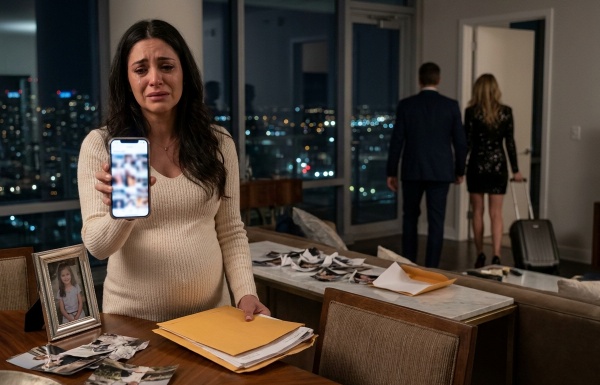
My Husband Left Me for His Mistress After Discovering I Was Three Months Pregnant — But the Things I Kept Secret, the Evidence Circulating Online, and the Daughter He Never Met Left Him in a state of panic for the rest of his life.
Part 1: The Night He Chose Her
My name is Hannah Whitmore, and I was thirty-two years old when my husband looked at the ultrasound photo of our child, set it on the kitchen counter like it was a receipt he did not want, and told me he was leaving.
We lived in a three-bedroom house in Plano, Texas, twenty miles north of Dallas, in a neighborhood full of trimmed lawns, porch flags, two-car garages, and families who waved at each other from SUVs before driving to soccer practice or church or Target. From the outside, our life looked stable. My husband, Caleb Whitmore, was thirty-six, a regional director for a home security company, the kind of man who wore fitted dress shirts, shook hands too firmly, and could sell fear back to people as protection.
I was an instructional designer for a healthcare software company, working remotely from the small office we had painted sage green the summer after we bought the house. I made good money, paid half the mortgage, managed the bills, remembered his mother’s birthday, scheduled the dentist appointments, kept track of the homeowners insurance, and somehow still believed that effort could hold a marriage together if love ever got tired. That was my first mistake. Effort is not a substitute for honesty.
Caleb and I had been married for six years when I found out I was pregnant.
It was not an accident.
We had been trying for eleven months, quietly at first, then anxiously, then with ovulation strips hidden in the bathroom drawer and calendar alerts on my phone that made intimacy feel less romantic and more like a scheduled meeting. Caleb had wanted a child, or at least he had said he did. He talked about little league games and teaching a son to change a tire, which should have told me something about the narrowness of his imagination. I wanted a baby in whatever form that baby arrived.
When the test showed two pink lines, I sat on the bathroom floor and cried so hard I laughed.
I waited until dinner to tell him because I wanted it to feel like a memory worth keeping. I made chicken enchiladas, his favorite, bought sparkling cider, and set a small white gift bag beside his plate with the pregnancy test wrapped in tissue paper and a onesie that said Made in Texas. It was corny. I knew it was corny. I did not care.
Caleb opened the bag, stared at the test, then at the onesie.
For one second, his face went completely blank.
Then he smiled.
Not the smile I had imagined.
Not joy.
Performance.
“Hannah,” he said, and stood to hug me. “Wow. This is huge.”
Huge.
Not wonderful.
Not finally.
Huge.
I told myself he was shocked. I told myself men reacted differently. I told myself not to ruin the moment by needing him to feel it exactly the way I did. That was another mistake women are trained to make — translating disappointment into something gentler so we do not have to admit someone hurt us on purpose.
For the next few weeks, Caleb became polite in the way strangers are polite. He asked how I felt, but did not wait for detailed answers. He came to the first doctor’s appointment, held my hand in the exam room, and stared at the ultrasound monitor as if it were playing a movie in a language he did not speak. When the doctor pointed to the tiny flicker of a heartbeat, I cried. Caleb squeezed my hand once, then checked his phone.
I was three months pregnant when I found the first real proof.
Her name was Marissa Lane.
She worked in Caleb’s Dallas office as a territory sales manager, thirty, recently divorced, bright smile, glossy hair, and a social media feed full of inspirational quotes about “choosing yourself” and “never settling for half-love.” I learned all that later. The first time I saw her name, it was on a hotel receipt in Caleb’s jacket pocket from the Omni Frisco, dated on a night he claimed he had been in Austin for a vendor training.
There were two cocktails.
One room.
No conference charge.
When I asked him about it, he did not deny it.
That was the strange part.
He did not scramble or apologize or invent a story. He sat at our kitchen table, leaned back in his chair, and looked almost relieved, like I had finally opened a door he had been waiting beside.
“I’m in love with someone else,” he said.
The sentence was so clean it felt rehearsed.
I put one hand over my stomach.
“You’re telling me this now?”
He looked at my hand, then away.
“I didn’t plan it this way.”
I almost laughed.
People always say that after planning every step except the consequences.
I asked if it was Marissa. He nodded. I asked how long. He said about seven months. Seven months meant he had been trying to have a baby with me while sleeping with another woman, letting me track cycles and take vitamins and cry over negative tests while he built a second life ten exits away.
That was the moment something in me changed.
Not broke.
Changed.
Breaking suggests something stops functioning.
I became very functional.
Caleb said he needed to “be honest about where his heart was.” He said he cared about me, but staying would be unfair. He said the pregnancy complicated things, but he would “do the right thing financially.” He said all of this while sitting under the pendant light I had picked out, in the house I had helped pay for, beside the ultrasound photo of the child he had helped create.
Then he said the sentence I would remember longer than any other.
“I can’t build a future out of obligation.”
I looked at him and understood that he thought he sounded brave.
He did not.
He sounded like a man abandoning a fire and complimenting himself for not enjoying the smoke.
He moved out three days later.
Marissa came with him to pick up some of his clothes.
She waited in the passenger seat of her white Lexus SUV while Caleb loaded garment bags into the back. I watched from the upstairs window with my hand on my stomach, feeling our daughter flutter for the first time, though I did not yet know she was a daughter. Marissa did not look guilty. She looked impatient.
That was the first secret I kept.
I did not chase him.
I did not beg.
I did not tell him that the baby moved the day he left.
Some moments belong only to the people who stay.
Part 2: The Evidence He Forgot Existed
For the first week after Caleb left, I did what abandoned pregnant women do in private.
I threw up from morning sickness and grief. I slept badly. I folded and refolded tiny baby clothes I had bought too early because hope makes people impractical. I stood in the nursery doorway at midnight and wondered how a room could feel full of someone who had not arrived yet and empty of someone who had chosen to leave.
Then I called an attorney.
Her name was Rebecca Solis, a family law attorney in Dallas who came recommended by a coworker who had once described her as “not mean, just devastatingly prepared.” Her office was on McKinney Avenue, with floor-to-ceiling windows, gray chairs, and a receptionist who spoke softly in a way that made crying feel less embarrassing. I arrived with a folder, a bottle of water, ginger candies for nausea, and the kind of face people have when they are trying very hard not to become a scene.
Rebecca listened without interrupting.
When I finished, she asked, “Do you want to be married to him?”
“No.”
The answer surprised both of us with how quickly it came.
She nodded. “Good. That helps.”
Texas is a community property state, she explained, which meant the assets and debts acquired during the marriage would generally be divided in a manner the court considered just and right. Infidelity could matter in certain ways, especially if marital funds had been spent on the affair. Child support would be calculated under Texas guidelines once the baby was born, and custody, or conservatorship as Texas calls it, would focus on the child’s best interest.
“He cannot divorce himself out of fatherhood,” Rebecca said.
I looked down at my stomach.
“He thinks he can.”
“Many men do,” she said. “Then paperwork educates them.”
That was the first time I smiled in her office.
Over the next month, I became a historian of my own marriage.
I reviewed joint bank accounts, credit card statements, hotel charges, restaurant receipts, Venmo transfers, airline miles, and calendar entries. I did not hack anything. I did not access accounts that were not mine. I simply looked at the financial life Caleb had assumed I was too devastated, too pregnant, or too polite to examine.
Marissa was everywhere.
Dinner at Monarch in downtown Dallas, $286.42, on a night Caleb told me he was eating barbecue with clients. A weekend at a lakefront Airbnb near Possum Kingdom, $1,100, categorized as “team retreat.” A bracelet from NorthPark Center, $740, charged two days after he told me we should “be realistic” about nursery expenses. Hotel stays in Frisco, Austin, Houston, and one in New Orleans during what he had called a security conference.
The total was $18,973.61.
I remember that number exactly.
I wrote it on a yellow legal pad and stared at it until the digits stopped looking like money and started looking like months of deception. That was money from accounts that had paid our mortgage, fertility appointments, insurance premiums, baby vitamins, and the crib I had purchased alone. He had not just given Marissa his time. He had given her pieces of the life I was still funding.
Then came the second secret.
Caleb had been careless at work.
His company sold home security systems, but internally, their sales team operated like many regional offices — shared drives, expense approvals, performance dashboards, recorded Zoom trainings, and managers who believed charm could replace compliance. Caleb had used his company card for some of the affair-related travel, then coded several charges as client development. Normally, I would not have known. But Caleb had forwarded his expense report summaries to our shared home email twice when we were refinancing our mortgage and needed income documentation.
Those summaries were still there.
So were attachments.
So were inconsistencies.
I did not send them to his employer immediately. Rebecca advised caution. Evidence mattered, but timing mattered more, especially because I was pregnant and needed to protect my financial stability before triggering a workplace disaster that could affect support calculations.
“Do not burn down the income source before we have orders in place,” she said.
That sentence became my anchor.
Protection before revenge.
Documentation before emotion.
Timing before satisfaction.
Meanwhile, Caleb continued performing concern.
He texted every few days asking how I felt. He offered to come by “if I needed anything,” which sounded generous until I realized he wanted access without responsibility. He asked whether I had told my parents. He asked whether I was “calm enough” to discuss logistics.
Calm enough.
That phrase told me he had already begun narrating me as unstable.
I saved every message.
Then one afternoon, Marissa posted a photo online.
She must have thought she was being subtle.
It was an Instagram story from a rooftop restaurant in Dallas, showing two wine glasses, a plate of oysters, and Caleb’s hand resting on the table. He was not tagged, but his watch was visible — the same Tag Heuer I bought him for our fifth anniversary. The caption read: Finally choosing happiness.
I took a screenshot.
By evening, someone else had taken one too.
By the next morning, it was circulating in a private Facebook group for local wives and girlfriends of sales professionals in Dallas, the kind of group where women warned each other about fake profiles, bad contractors, shady dates, and men who claimed to be separated when they were not. I did not post it. I did not comment. I only saw it because a friend from college sent it to me with a message that said, Hannah, is this Caleb?
There are humiliations you create.
There are humiliations you inherit.
And then there are humiliations that walk online by themselves because the people causing them cannot resist being admired.
Caleb called me that night.
His voice was tight.
“Did you post something about me?”
“No.”
“Don’t lie to me.”
I was sitting on the nursery floor, assembling a small bookshelf by myself because the delivery had come early and I needed to feel capable.
“I didn’t post anything.”
“Then why are people texting me?”
“Maybe ask the woman who posted the wine glasses.”
Silence.
Then he said, “You’re enjoying this.”
I looked at the crib box, the scattered screws, the ultrasound photo taped to the wall.
“No, Caleb,” I said. “I’m surviving it.”
He hung up.
That was when I understood something important.
He was not afraid of hurting me.
He was afraid of being seen.
Part 3: The Daughter He Never Met
At twenty weeks, I found out the baby was a girl.
I named her Lily Grace Whitmore before I told anyone else.
Lily because my grandmother had grown lilies behind her house in San Antonio and used to say they were proof that delicate things could still be stubborn. Grace because I needed some. Whitmore because, legally and emotionally, I had not yet decided what name should follow her through life. Names are not small things.
Caleb did not come to the anatomy scan.
He said he had an unavoidable work meeting.
A week later, Marissa posted a photo from a resort pool in Scottsdale.
I did not send it to him.
I did not ask.
By then, my pregnancy had become less about him and more about the small person rearranging my body from the inside. Lily kicked during conference calls. She rolled whenever I ate cinnamon toast. She went still when I played certain songs, as if listening. She was mine in a way that felt less like possession and more like duty.
My parents drove up from San Antonio twice a month.
My mother washed baby clothes and pretended not to cry into the tiny socks. My father repaired the nursery closet door, installed a car seat, and once found me sitting on the kitchen floor at 11:00 p.m. because I had dropped a jar of pickles and could not bend fast enough to clean it before the smell made me nauseous. He cleaned the floor without saying anything, then sat beside me until I stopped apologizing.
My friends threw me a baby shower at a restaurant in Richardson with yellow balloons and lemon cake.
I almost canceled it.
I was embarrassed to be visibly pregnant and visibly abandoned, which says nothing good about the way women are taught to carry other people’s shame. But my best friend, Tessa, told me, “You are not going to hide because he forgot how to be decent.” So I went. I wore a blue dress, opened gifts, laughed more than I expected, and cried only once when someone gave me a tiny denim jacket.
Caleb sent a $200 Amazon gift card.
No note.
Rebecca filed for divorce before Lily was born and requested temporary orders preserving marital assets, addressing household expenses, and documenting Caleb’s financial responsibilities after birth. Caleb hired an attorney who sent formal letters about “reasonable access” and “co-parenting intentions.” The language was clean and professional. The reality was that Caleb had attended zero appointments after week twelve, had not asked for the hospital tour information, and had not contributed to the baby items beyond the gift card.
Still, the law did not punish him for emotional absence.
Rebecca reminded me of that often.
“The court will care about the child’s best interest,” she said. “Not whether he disappointed you in the exact way he did.”
“I know.”
“You can know something and still hate it.”
She was right.
In late November, when I was thirty-four weeks pregnant, Caleb asked if Marissa could be present when he met the baby “eventually.”
I read the text twice.
Then a third time.
My hands went cold.
I replied: No.
He wrote back: She’s part of my life now. You need to accept reality.
I forwarded the message to Rebecca.
Her response came five minutes later: Do not engage. We will address boundaries through counsel.
That night, I went into the nursery, sat in the rocking chair, and spoke out loud to Lily for the first time.
“You are not a bargaining chip,” I said.
She kicked once.
Hard.
Three weeks before my due date, Caleb’s employer opened an internal compliance review.
I did not initiate it.
At least, not directly.
Remember the Facebook group? Someone in that group knew someone in Caleb’s company’s HR department. Someone recognized Marissa from a vendor event. Someone else had screenshots of the rooftop story, the Scottsdale resort post, and a public photo Marissa had forgotten to archive from New Orleans. Those images began moving quietly, not viral in the national sense, but fast enough within Dallas professional circles to become impossible to contain.
Then one of Caleb’s former team members sent an anonymous complaint to corporate compliance alleging misuse of company travel funds and conflicts involving a vendor relationship.
I know this because Caleb told me.
He called at 8:40 p.m. on a Thursday, breathless and furious.
“What did you do?”
I was folding burp cloths.
“I’m going to need you to be more specific.”
“Don’t play games. Compliance called me today.”
I sat down slowly.
“What did they say?”
“They’re reviewing expense reports. They have screenshots. They have dates. They asked about Marissa.”
My heart beat hard, but my voice stayed calm.
“That sounds like a work matter.”
“You think this is funny?”
“No.”
“You’re trying to ruin my life.”
“No, Caleb. I’m trying to prepare for our daughter’s.”
He went silent at the word daughter.
I had not told him the sex.
Not directly.
He had not earned that moment.
Finally, he said, quieter, “It’s a girl?”
“Yes.”
Another silence.
“What’s her name?”
I looked at the embroidered blanket my mother had placed across the crib.
“Lily.”
“Lily,” he repeated.
For a second, he sounded human.
Then he ruined it.
“Marissa always liked that name.”
I closed my eyes.
There are moments when a door shuts so completely you stop hearing the other side.
“Goodnight, Caleb.”
I hung up.
That was the last conversation we had before Lily was born.
Part 4: The Panic That Arrived Too Late
Lily Grace was born on December 19 at 4:26 a.m. during a cold rain that turned the hospital windows silver.
She weighed six pounds, nine ounces, had dark hair, long fingers, and the furious expression of someone who had been interrupted. My mother cried. My father stood by the window and wiped his eyes when he thought no one was looking. Tessa cut the cord because she was the person who had shown up consistently enough to deserve the honor.
Caleb was not there.
He knew I was in labor because Rebecca’s office notified his attorney once I was admitted, following the temporary communication plan. He texted me at 2:13 a.m.: Please let me know when she’s here. I saw the message after delivery and did not answer immediately because I was holding my daughter against my chest and discovering that love can arrive as both thunder and silence.
Rebecca notified his attorney at 8:00 a.m. that Lily had been born healthy.
Caleb asked to visit that afternoon.
I said no.
Not forever.
Just not that day.
I had been cut, stitched, exhausted, leaking, shaking, and trying to feed a newborn who had no patience for either of us learning. I did not owe my most vulnerable hours to the man who had asked if his mistress could be present for “eventual” introductions. Hospital staff documented my visitor preferences. Everything was legal. Everything was calm. Everything was controlled.
Caleb did not handle controlled well.
By noon, he had called my phone eleven times.
By 1:30, he had emailed Rebecca accusing me of “parental alienation,” though no custody order yet required hospital visitation and Rebecca responded with a reminder that postpartum recovery, infant health, and legal process would guide access. By 3:00, Marissa had posted a quote about “women who use children as weapons.” She deleted it after forty minutes, but screenshots last longer than moods.
The internet noticed.
Not the whole internet.
Just enough of it.
The Dallas group reposted the quote beside the earlier rooftop photo and a comment thread exploded with people piecing together timelines, job titles, vendor relationships, and the pregnancy. I did not participate. I was in a hospital bed learning how to swaddle. But by evening, Caleb’s name was being discussed in places he could not charm his way through.
His panic changed shape after that.
It was no longer anger.
It was fear.
His company suspended him pending review two days after Lily was born. His expense account was frozen. Marissa’s vendor contract was paused while corporate reviewed possible conflicts. Caleb’s attorney suddenly became much more interested in settlement language that protected his employment records from unnecessary exposure in the divorce file.
Rebecca smiled when she read the email.
Not because she was cruel.
Because she was prepared.
“We will not threaten anything,” she said. “We will simply request what we are entitled to request.”
That became the rhythm of the next several months.
Caleb wanted discretion.
I wanted child support, medical coverage, reimbursement for marital funds spent on the affair, and a parenting plan that recognized reality instead of fantasy.
He wanted to be seen as a devoted father.
I wanted him to learn our daughter’s pediatrician’s name.
He wanted quick access.
I wanted consistency.
The first time Caleb met Lily, she was seven weeks old.
It happened at a supervised visitation center in Plano because temporary orders required a gradual schedule after his absence, the conflict, and his lack of infant-care involvement. He arrived in a pressed shirt, hair carefully styled, looking like he was attending a deposition. He held a diaper bag with tags still on it.
I handed Lily to the visitation supervisor, not directly to him.
That detail hurt him.
I could see it.
But pain is not always punishment. Sometimes it is simply the shape of a consequence.
Through the observation window, I watched Caleb hold his daughter for the first time. His face changed when he looked at her. I will give him that. He looked stunned, softened, almost afraid. Lily stared back at him with the solemn judgment newborns carry naturally, then began to cry.
He panicked.
Not dramatically.
Just enough.
He bounced her awkwardly, looked toward the supervisor, shifted her like a man holding something breakable and unfamiliar. The supervisor showed him how to support her head, how to check her diaper, how to offer the bottle I had pumped and labeled. Caleb listened. For once, he listened.
After the visit, he approached me in the hallway.
Rebecca had said I did not have to talk to him.
But I did.
“She’s beautiful,” he said.
“Yes.”
“She looks like you.”
“She looks like herself.”
He nodded, eyes red.
“I made a mistake.”
I looked at him.
“No,” I said quietly. “You made a life. Then you tried to walk out of one and into another without paying the bill.”
His face tightened.
“I’m trying to fix it.”
“You can’t fix what you did to me,” I said. “You can only decide what kind of father you’re going to be from here.”
He looked toward the room where Lily was being placed back into her car seat.
“And if you never forgive me?”
“Forgiveness is not required for a parenting plan.”
Rebecca would have been proud of that sentence.
Part 5: The Life He Could Not Control
The divorce finalized fourteen months after Caleb left.
By then, Lily had four teeth, a laugh that sounded like hiccups, and a habit of falling asleep with one hand gripping my shirt as if she suspected I might wander off like everyone else. I had returned to work, slowly at first, then fully, with childcare help from my parents and a daycare teacher named Miss Carla who loved Lily with the ferocity of someone who had raised three children and no longer feared anyone’s opinion.
The settlement was not cinematic.
Real legal outcomes rarely are.
I did not “take everything.” He did not end up homeless. No judge slammed a gavel and called him a disgrace. What happened was more ordinary and, in some ways, more satisfying. The money was traced. The affair spending was credited in the property division. Child support was ordered under Texas guidelines. Medical insurance obligations were defined. A step-up parenting schedule was put in place, requiring Caleb to complete infant care education and maintain consistent visitation before moving toward unsupervised longer periods.
Consistency became the test.
Not charm.
Not apologies.
Not dramatic speeches.
Consistency.
That is where Caleb struggled.
His life with Marissa did not survive the compliance review. Affairs built in secrecy often do poorly under fluorescent lights and HR interviews. She resigned from her vendor role three months after Lily was born. Caleb kept his job, but barely — demoted, bonus eliminated, reputation dented in the professional circles where he once moved with easy confidence.
The evidence did not disappear.
That was what scared him most.
Screenshots remained in group chats. Former coworkers remembered. Clients heard versions. Search results did not show anything criminal, because nothing criminal had been proven, but reputational damage does not require a conviction. It only requires people to believe the receipts more than the explanation.
Caleb called it unfair.
I called it public memory.
He became careful in a way I had never seen before. Careful about what he posted. Careful about who tagged him. Careful about expense reports. Careful about women at work. Careful about how he spoke to me in writing because Rebecca had taught him, thoroughly and expensively, that messages could become exhibits.
That was the panic he could never fully escape.
Not terror.
Not danger.
Just the constant awareness that evidence existed.
That the story he wanted to tell about himself was no longer the only version available.
That somewhere, in phones he could not access and inboxes he could not clean, there were screenshots of the life he had tried to build while abandoning a pregnant wife.
He did eventually become a better father than he had been a husband.
I want to be honest about that.
Not perfect.
Not heroic.
Better.
He learned Lily’s medication allergies. He came to pediatric appointments when scheduled. He sent child support on time because withholding it would have been both illegal and documented. He learned that she hated peas, loved blueberries, and needed her stuffed rabbit to sleep. He missed milestones he could never recover, but he stopped missing the ones still in front of him.
By the time Lily was three, she knew him as Dad, not as the man who left before she was born.
That was difficult for me sometimes.
Children do not owe loyalty to adult pain.
I never told Lily the ugly parts. Not when she was small. Not as a weapon. Not to make myself the better parent. She knew she lived with me and visited her father. She knew families could look different. She knew she was loved. That was enough.
But Caleb knew.
Every school event, every birthday party, every Father’s Day craft made with daycare handprints came with the same shadow: he had not been there at the beginning. He had chosen absence first. No amount of later attendance erased that knowledge. It did not have to be spoken to be present.
When Lily was five, she asked why there were no pictures of Dad holding her at the hospital.
We were sitting on the living room floor looking through a baby album. She had syrup on her pajama sleeve and a pink bow sliding out of her hair. The question came out casually, the way children ask things that open old rooms without warning.
I took a breath.
“Because when you were born, Dad and I were not living together,” I said.
“Was he busy?”
I looked at her sweet, serious face.
“He was not ready to be the dad you deserved yet.”
She considered that.
“But he learned?”
My throat tightened.
“Yes,” I said. “He learned.”
That was the kindest true answer I could give.
Later that night, after she fell asleep, I sat on the porch of the small house I had bought in Richardson after selling the Plano house. It was not as big. The kitchen cabinets were older. The backyard fence leaned slightly after storms. But it was mine. Every bill, every repair, every quiet evening belonged to a life I had rebuilt without asking Caleb to validate it.
I thought about the woman I had been the night he left.
Three months pregnant.
One hand over her stomach.
Watching a white Lexus idle outside while her husband carried clothes toward another woman.
I wish I could go back and tell her she was not being abandoned into emptiness.
She was being cleared for arrival.
Lily’s arrival.
Her own.
People like to say karma came for Caleb, but I do not think that is exactly right. Karma sounds mystical, like lightning from a moral sky. What came for Caleb was simpler. Paperwork. Screenshots. Receipts. Timelines. A daughter with his eyes and my stubbornness. A legal system that did not care about his preferred narrative. A professional world small enough for evidence to travel.
And me.
Not revengeful.
Not broken.
Not silent in the way he expected.
Prepared.
That was the real secret I kept.
Not just the documents.
Not just the evidence.
Not even the daughter he did not meet until she was seven weeks old.
The secret was that from the moment he set that ultrasound photo on the counter and told me he could not build a future out of obligation, I stopped trying to make him choose me. I chose the child inside me. I chose facts over pleading. I chose a lawyer over another argument. I chose to let him walk far enough that he could not pretend he had been pushed.
For the rest of his life, Caleb will know there is a version of the story he cannot erase.
He left his pregnant wife for his mistress.
The evidence found daylight.
His daughter was born into a room full of people who stayed.
And by the time he realized what he had lost, the door was not locked.
It was simply no longer his home.
