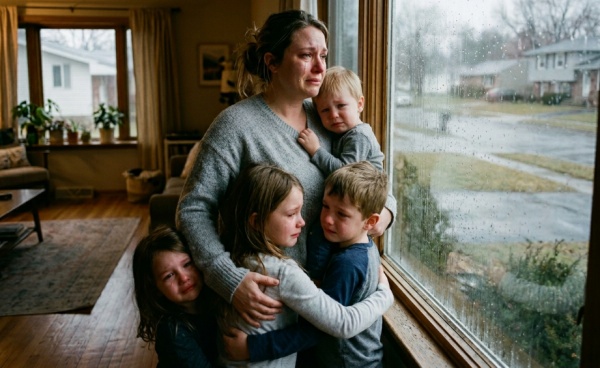
My Husband Walked Out on His Wife and 4 Kids for an Old Flame. My husband didn’t just leave me; he left four children who still waited by the window for him to come home. He told everyone he was finally choosing happiness, while I was the one paying bills, wiping tears, and learning how to stand again. I rebuilt my life one exhausting day at a time, without applause and without revenge. Five years later…
Part 1: The Night He Chose Her
Mark left on a Tuesday night, which somehow made it worse.
If he had left during a thunderstorm, or after some explosive argument, maybe my mind could have wrapped the memory in drama and understood it better. But it was an ordinary Tuesday in suburban Ohio, the kind of evening where the dishwasher hummed, the dryer buzzed, and four kids argued over who had taken the last pack of fruit snacks.
Our house sat at the end of a quiet cul-de-sac outside Columbus, with a basketball hoop over the garage and bikes scattered across the driveway. The lawn needed mowing, the porch light flickered when it rained, and the kitchen calendar was so crowded with school events, dentist appointments, and soccer practices that there was barely room to write the month at the top.
That was our life. Messy, loud, expensive, exhausting, and, I had believed, ours.
I was thirty-eight then. Mark was forty-one. We had been married for sixteen years and had four children: Lily, fifteen; Caleb, twelve; Sophie, eight; and little Ben, who had just turned five and still called spaghetti “basketti.”
That night, I was standing at the stove stirring a pot of chili while Sophie practiced spelling words at the kitchen table. Caleb was in the living room yelling at a video game, Lily was upstairs doing homework with her bedroom door closed, and Ben sat on the floor building a crooked tower out of plastic blocks.
Mark came home at 6:43 p.m.
I remember the exact time because I looked at the microwave clock and felt relieved. He had been coming home later and later for months, always with some explanation about clients, traffic, extra shifts, or “needing a minute to breathe” before walking into a house full of kids.
He walked into the kitchen wearing his navy work jacket, carrying no laptop bag, no lunch container, no stack of mail from the front seat of his truck. His hands were empty, and something about that made my stomach tighten.
“Dinner’s almost ready,” I said.
He did not answer.
Sophie looked up from her spelling list. “Dad, can you quiz me?”
“Not right now,” he said.
His voice was flat, almost polite. Not angry. Not tired. Polite, like he was talking to a stranger in line at the pharmacy.
I turned off the burner.
“What’s wrong?” I asked.
Mark looked at me, and in that moment, before he said a word, I knew. I did not know the details, not yet, but I knew something had already happened somewhere else before he came home. A decision had been made without me.
“I’m leaving,” he said.
The spoon slipped from my hand and hit the tile floor.
Sophie froze. Ben’s block tower collapsed, but he did not cry. From the living room, Caleb shouted something at his game, unaware that his childhood had just shifted behind him.
“What do you mean you’re leaving?” I asked.
Mark glanced toward Sophie, then back at me. “We should talk privately.”
I almost laughed. Privately. In a house with four kids, privacy was something we scheduled like a dentist appointment.
“Sophie,” I said softly, “go upstairs and tell Lily to help Ben get ready for dinner.”
Sophie’s eyes filled with confusion. “Am I in trouble?”
“No, sweetheart.”
She stood slowly, looking from me to her father. Ben got up and followed her, dragging his blanket behind him. I waited until their footsteps disappeared upstairs.
Then I turned to Mark.
“Say it.”
He rubbed both hands over his face. “I can’t do this anymore.”
“This?” I repeated.
“This life.”
The words landed quietly, but they broke something.
I looked around the kitchen—the school papers pinned to the fridge, the half-empty gallon of milk on the counter, the chili cooling on the stove, the small handprints on the sliding glass door. This life was not glamorous. It did not come with soft lighting or romantic music. It came with grocery bills, wet towels, parent-teacher conferences, and kids who needed new shoes every time we blinked.
But it was the life we had built.
“What about the children?” I asked.
His jaw tightened. “I’m still their father.”
“Are you?”
He flinched as if I had slapped him.
That was when he said her name.
“Rebecca and I reconnected.”
Rebecca.
For a second, I did not understand why the name felt familiar. Then it came back to me in fragments. High school girlfriend. Old flame. The girl he had taken to senior prom. The woman who had sent him a Facebook friend request the previous fall.
I remembered asking, “Is that Rebecca from your old pictures?”
He had smiled at his phone and said, “Yeah. Haven’t talked to her in years.”
Apparently, years had ended quickly.
“How long?” I asked.
He looked away.
That was answer enough.
I gripped the edge of the counter. “How long, Mark?”
“Six months,” he said.
The kitchen seemed to tilt.
Six months meant he had lied through Thanksgiving. Six months meant he had kissed me on Christmas morning while texting another woman later that day. Six months meant he had watched me plan Ben’s birthday party, pay bills, pack lunches, sit beside him at church, and fold his laundry while he was building another life in secret.
“Is she married?” I asked.
“She’s separated.”
Of course she was.
It sounded cleaner that way. Softer. Less like two adults had stepped over the wreckage of two families and called it destiny.
Mark kept talking. He said things people say when they want betrayal to sound philosophical. He said we had grown apart. He said he loved me but was not “in love” with me. He said Rebecca understood parts of him I never had. He said life was short, and he did not want to spend the rest of his pretending.
I remember staring at his mouth while he spoke. The same mouth that had said wedding vows in a small Methodist church. The same mouth that had whispered, “We’ll figure it out,” when I cried over a positive pregnancy test at twenty-three. The same mouth that had kissed our babies’ foreheads.
Now it was explaining why leaving us was brave.
“Where are you going?” I asked.
He looked relieved, as if logistics were easier than grief.
“I packed some things earlier. I’m staying at Rebecca’s for now.”
Earlier.
That meant he had packed while I was at work, while the kids were at school, while our home sat open and trusting around him. He had folded clothes into a suitcase, chosen what to take, and left the rest of his life in drawers.
The cruelty was not loud. It was organized.
Caleb appeared in the doorway then, game controller still in his hand.
“What’s going on?” he asked.
Mark straightened. “Buddy, I need to talk to you and your sisters.”
“No,” I said.
Mark turned to me. “They deserve to hear it from me.”
“They deserve better than hearing it five minutes before dinner.”
His face hardened. “Don’t make me the villain.”
That sentence stayed with me for years.
Don’t make me the villain.
As if I had written the scene. As if I had placed him in the doorway with another woman’s name in his mouth. As if the villain was not the person leaving four children and asking their mother to manage the emotional debris.
I lowered my voice. “You did that yourself.”
He left twenty minutes later.
The children watched from the living room window as his truck backed out of the driveway. Lily stood with her arms crossed, face pale and furious. Caleb cried without making a sound. Sophie kept asking where Dad was going. Ben pressed his little hand to the glass and whispered, “Bye, Daddy,” because he still thought people who left came back before bedtime.
That night, nobody ate the chili.
I put the pot in the fridge because food waste still mattered even when your marriage had just ended. I bathed Ben, answered Sophie’s questions badly, sat outside Lily’s locked bedroom door, and found Caleb asleep on the couch with Mark’s old baseball cap clutched against his chest.
At 1:17 a.m., after the house finally went quiet, I sat on the kitchen floor and let myself fall apart.
Not gracefully. Not quietly. Not in the way women in movies cry with one perfect tear sliding down one cheek.
I cried like a person whose life had been split open.
Then, at 6:00 a.m., Ben padded into the kitchen and asked for pancakes.
So I got up.
Because mothers do not get the luxury of staying broken when someone still needs breakfast.
Part 2: The Life He Thought I Couldn’t Handle
Mark believed I would collapse.
I know that because people told me later. Not cruelly, but with the awkward honesty that comes after gossip has lost its usefulness.
“He said he was worried about you,” one neighbor admitted months afterward.
“He told people you never handled stress well,” said my sister, Dana, who had wanted to drive to Rebecca’s house and say things that would have made Thanksgiving permanently uncomfortable.
“He made it sound like the kids were better off with him part-time because you were too emotional,” my mother said, furious in the careful way of a seventy-year-old woman who still believed in manners but had run out of patience.
That was Mark’s story.
He was not abandoning us. He was choosing love after years of quiet misery. He was not betraying his family. He was finally being honest. He was not leaving me to drown in bills, homework, broken appliances, and four devastated children. He was trusting me to be strong.
How generous of him.
The first year after he left was not inspiring. I need to be honest about that because people love stories where a woman gets betrayed and immediately becomes unstoppable. They love the montage version: new haircut, new job, new confidence, sunlight streaming through clean windows.
My first year looked nothing like that.
It looked like crying in the pantry so the kids would not see. It looked like overdraft fees and late-night Google searches about single-parent budgets. It looked like working full-time as a receptionist at a pediatric clinic, then driving across town to pick up kids from three different places because Mark had “something come up.”
Something usually meant Rebecca.
Rebecca lived thirty-five minutes away in a townhouse near Dublin with a white SUV, a golden retriever, and two teenage daughters of her own. On Facebook, she posted pictures of pumpkin patches, wine glasses, lakeside sunsets, and inspirational quotes about choosing happiness. She never posted my children, but I knew they went there every other weekend because Sophie came home smelling like someone else’s laundry detergent.
At first, Mark acted like a man starring in a romantic drama.
He bought new clothes. He grew a beard Rebecca apparently liked. He started listening to country songs about second chances and posted a photo of himself holding her hand at a restaurant in Nashville.
The caption said: Sometimes life brings you back to where your heart was always meant to be.
Lily saw it before I did.
She came downstairs holding her phone, her face hard. “Can I block Dad?”
I looked at the photo. Mark was smiling in a way I had not seen in years. Rebecca’s red nails rested on the table beside his hand, her engagement ring from her first marriage still faintly visible in the tan line on her finger.
I handed the phone back.
“You can mute him,” I said. “Blocking him might cause more drama.”
“I want drama.”
“I know.”
“He left us and now he’s posting like he won a vacation.”
I had no answer good enough for that.
So I said the only true thing I could. “I’m sorry.”
Lily hated that answer. All teenagers hate apologies that do not fix anything.
Money became the first battlefield.
Mark sent child support, but never without reminding me how much it was costing him. He paid what he was required to pay, though he argued over extras like braces, soccer fees, school trips, winter coats, and Ben’s speech therapy copays.
“Do they really need all these activities?” he asked once over the phone.
I was standing in the grocery store comparing prices on cereal, trying to decide whether the family-size box was worth the extra $2.40.
“Yes,” I said. “They need normal.”
“They need realistic expectations.”
I stared at the cart full of store-brand pasta, apples, milk, peanut butter, and one box of cupcakes for Sophie’s class party.
“Mark,” I said, “you do not get to make their life smaller so yours feels affordable.”
He hung up.
That became a pattern.
He wanted fatherhood to fit neatly around his new love story. Every other weekend. Wednesday dinners when convenient. Christmas morning split into time slots. Phone calls that lasted seven minutes unless one of the kids cried, in which case he suddenly had to go.
Meanwhile, I became the parent who remembered everything.
I remembered permission slips, inhalers, shoe sizes, teacher names, favorite snacks, library books, dental appointments, spirit days, medication refills, and which child needed silence and which child needed a hug. I remembered that Caleb acted angry when he was scared. I remembered that Sophie got stomachaches before visits with her dad. I remembered that Ben still waited at the window on Friday nights, even after Mark had texted that he was running late.
I also remembered the mortgage.
That was the mountain.
Our house payment was $1,487 a month, not including insurance and property taxes. On paper, with child support and my income, I could almost manage it. In real life, “almost” meant one car repair could ruin the month.
And then the furnace died in January.
It was twelve degrees outside when I woke up and saw my breath in the hallway. Ben was asleep under two blankets, his cheeks cold. I called three repair companies before one agreed to come that afternoon.
The technician was kind. That made it worse.
He was a man named Earl with gray hair and a Cleveland Browns jacket. He spent forty minutes in the basement, then came upstairs wiping his hands on a rag.
“I can patch it for now,” he said, “but this system’s on borrowed time.”
“How much for the patch?”
“Two hundred eighty.”
I had $312 in checking.
“How long will the patch last?” I asked.
He looked at the four kids sitting at the kitchen table in coats.
“I’ll do what I can,” he said.
I paid him with a debit card and cried in the bathroom afterward.
That night, I called Mark.
“The furnace repair was $280,” I said. “I need you to split it.”
He sighed. “Anna, I can’t just pay every time something breaks at the house.”
Anna.
My name in his mouth sounded like a burden now.
“It’s where your children live,” I said.
“I already send support.”
“The furnace keeps them warm.”
He was quiet.
Then Rebecca’s voice murmured something in the background. Something soft. Something domestic.
I felt a heat rise in my chest that had nothing to do with the broken furnace.
“Never mind,” I said.
I hung up before he could answer.
The next morning, I walked into the pediatric clinic where I worked and asked my supervisor for extra hours. Mrs. Patel, who ran the front desk like a military operation and had known something was wrong for months, looked at me over her glasses.
“How many can you handle?”
“As many as you can give me.”
She studied my face. “Don’t be proud, Anna. Proud doesn’t feed children.”
“I’m not proud,” I said. “I’m scared.”
Her expression softened.
Two weeks later, she called me into her office and handed me a flyer for a medical billing certification program at Columbus State Community College.
“You’re smart,” she said. “You know insurance codes better than half the people upstairs. Get certified. Make more money.”
“I have four kids.”
“Yes,” she said. “That is why you should make more money.”
It was not a grand inspirational speech. It was better. It was practical.
So I enrolled.
I studied after the kids went to bed. I listened to recorded lectures while folding laundry. I made flashcards while waiting at soccer practice. Caleb quizzed me on billing codes while eating cereal. Lily rolled her eyes and then corrected my notes because she could not help herself.
For eight months, I lived in exhaustion.
But exhaustion with a purpose is different from exhaustion without one.
When I passed the certification exam, I sat in my parked minivan outside the testing center and screamed so loudly a man walking his dog jumped.
Then I called the kids.
Lily answered on speaker. “Did you pass?”
“I passed.”
Four voices exploded through the phone.
For the first time since Mark left, I felt something inside me stand up.
Not healed. Not happy.
But standing.
Part 3: Piece by Piece
The second year was when things began to change.
Not all at once. Real rebuilding is boring from the outside. It is made of spreadsheets, routines, small decisions, and the refusal to quit on days when nobody applauds.
I got promoted at the clinic that spring. The raise was not huge, but it was enough to breathe. Enough to pay bills on time. Enough to buy name-brand cereal sometimes just because Sophie loved the one with tiny marshmallows.
I also started baking again.
Before marriage became survival, before motherhood became logistics, before betrayal turned every room in my house into evidence, I had loved baking. My grandmother had taught me in Kentucky summers, standing barefoot in her kitchen while cicadas screamed outside and peach cobbler bubbled in the oven. She never measured vanilla. She said good things deserved generosity.
After Mark left, I stopped baking because sweetness felt insulting.
Then one Saturday, Ben asked if we could make cinnamon rolls.
I almost said no. The kitchen was already messy, the laundry was waiting, and I had a stack of billing assignments to finish. But his face was hopeful in a way I had not seen enough of lately.
So I said yes.
We made a disaster.
Flour coated the counter, the floor, Ben’s hair, and somehow the dog, even though we did not own a dog. Sophie spilled brown sugar. Caleb ate cream cheese frosting with a spoon. Lily pretended to be annoyed and then took six pictures for Instagram.
The cinnamon rolls came out uneven and slightly underbaked in the middle.
They were perfect.
I brought leftovers to the clinic on Monday, mostly because I could not trust myself alone with a pan of frosting-covered carbohydrates. By noon, three nurses had asked if I took orders. By Friday, I had sold four dozen rolls and a lemon pound cake.
I called it a side hustle because calling it a dream felt too dangerous.
For the next year, I baked at night.
Cookies for school fundraisers. Banana bread for neighbors. Cupcakes for birthday parties. Pies for Thanksgiving. I learned cottage food laws in Ohio, got proper labeling, researched what I could legally sell from home, and kept careful records because I had learned the hard way that paperwork protects women from being underestimated.
The kids helped.
Lily designed a simple logo on her laptop: Anna’s Table in blue letters with a rolling pin underneath. Caleb made delivery lists and took his job as “operations manager” far too seriously. Sophie tied ribbons around boxes. Ben became chief taste tester and rated everything with either “amazing” or “needs more chocolate.”
Mark noticed when the kids started talking about it.
During a Sunday pickup, he stood on the porch and looked past me into the kitchen, where cooling racks covered every surface.
“What’s all this?” he asked.
“Orders.”
“For what?”
“Baked goods.”
He blinked. “You’re selling cookies?”
I smiled. “Among other things.”
He laughed once, not kindly. “Well, good luck turning cookies into a career.”
The old Anna might have shrunk.
The new Anna was too tired to shrink.
“Thanks,” I said. “I’ll put you down as supportive.”
Lily snorted behind me.
Mark heard it. His face tightened, but he said nothing.
His life with Rebecca, from what I could see, was becoming less cinematic.
The Nashville posts slowed. The sunset captions disappeared. The photos became fewer and more carefully angled. The kids came home from his weekends quieter than before, not always upset, but watchful.
One Sunday night, Caleb came into the kitchen while I was packing lunch boxes.
“Dad and Rebecca fought,” he said.
I kept spreading peanut butter. “Did you feel unsafe?”
“No.”
“Did anyone yell at you?”
“No.”
“Okay.”
He sat at the table. “She said we’re expensive.”
My hand stopped.
“What exactly did she say?”
He stared at the floor. “She said Dad acts like he has two families but only one paycheck.”
I put the knife down carefully.
“I’m sorry you heard that.”
“Are we expensive?”
I turned to my son, this twelve-year-old boy who was growing too fast and carrying adult words in his backpack.
“You are children,” I said. “You have needs. Food, shoes, school, doctors, birthdays, field trips, haircuts. That is not being expensive. That is being alive.”
He nodded, but I could see the sentence had entered him.
That night, after he went to bed, I wrote Mark an email. Not a dramatic one. Not an angry one, though anger sat beside me like a second person.
I wrote: Please make sure adult financial conversations happen away from the children. They should not be made to feel guilty for having basic needs.
He replied the next morning.
You don’t know the pressure I’m under.
I stared at the screen for a long time.
Then I wrote back: I know the children should not carry it.
That was all.
By the third year, Anna’s Table had become more than a side hustle.
A local coffee shop started buying my muffins twice a week. A church ordered pies for a fundraiser. A woman who ran events at a downtown nonprofit asked if I could handle dessert trays for eighty people.
I said yes before I knew if I could.
Then I figured it out.
That became another rule of my new life: say yes to the door, then learn how to walk through it.
The kids and I became a team in a way I never would have chosen but came to treasure. Friday nights were pizza and order prep. Saturday mornings smelled like butter and sugar. Sunday afternoons were homework, laundry, and labeling boxes.
We were not magically happy. The kids still missed their father. I still cried sometimes. Bills still frightened me. The minivan still made a sound that no mechanic could identify without charging me $95 to listen.
But the house felt different.
Less like a place someone had left.
More like a place where the rest of us stayed.
Lily graduated high school with honors and a scholarship to Ohio State. When she walked across the football field in her red cap and gown, I cried so hard Sophie handed me three napkins from the concession stand.
Mark came with Rebecca.
They sat several rows behind us. Rebecca wore white jeans and sunglasses, and Mark looked older than I remembered. After the ceremony, he tried to hug Lily, but she gave him a polite side hug and turned back to her friends.
I saw pain cross his face.
For one second, I felt sorry for him.
Then I remembered that children do not become distant overnight. They walk backward slowly, one disappointment at a time.
That summer, I signed a lease on a tiny storefront in Worthington.
It had been a sandwich shop before, with faded yellow walls, cracked tile, and a bathroom door that stuck when it rained. The rent scared me. The renovation costs scared me more. My mother said I was brave. Dana said I was insane. Mrs. Patel said both could be true.
I named it Anna’s Table Bakery & Café.
Opening day was October 3rd.
I expected maybe twenty people. Friends, family, a few clinic coworkers. Instead, there was a line down the sidewalk by 8:00 a.m.
Lily ran the register between college classes. Caleb refilled napkins and acted like a young CEO. Sophie arranged cookies in the display case with the focus of a museum curator. Ben stood on a stool behind the counter and told customers the cinnamon rolls were “famous,” which was not true yet but sounded convincing.
At 10:15, Mrs. Patel walked in holding flowers.
“You did it,” she said.
I looked around at the warm lights, blue walls, wooden tables, chalkboard menu, and glass case filled with things I had made with my own hands.
“I think we did,” I said.
That night, after closing, the kids and I sat on the floor behind the counter eating leftover scones.
Caleb leaned back against the cabinet. “Mom?”
“Yeah?”
“Are we rich now?”
I laughed so hard I nearly choked.
“No, honey.”
“But we’re okay?”
I looked at their faces, tired and powdered with sugar.
“Yes,” I said. “We’re okay.”
And for once, I believed it.
Part 4: Five Years Later
Five years after Mark left, I woke up at 4:30 a.m. to make croissants.
That sentence alone would have shocked the woman crying on the kitchen floor after he walked out. Back then, I thought survival meant getting through one more day. I did not know survival could become a business plan, a payroll account, a commercial oven, and a line of regular customers who complained lovingly if we ran out of blueberry muffins.
Anna’s Table had grown slowly and stubbornly.
We were not a national brand. There were no magazine covers or television interviews. But in our corner of Worthington, people knew us. Teachers stopped in before school. Retirees gathered at the corner table. Parents bought birthday cupcakes. College students came for Wi-Fi, coffee, and the kind of cookies that made them call home.
I had twelve employees, including two full-time bakers, three baristas, and a high school student named Mia who decorated sugar cookies better than most adults I knew.
Lily was twenty now, studying social work at Ohio State and still helping with our social media. Caleb was seventeen, tall and thoughtful, working weekends at the café when he was not applying to colleges. Sophie was thirteen, dramatic in a way only middle school girls can be, and Ben was ten, still funny, still soft-hearted, still convinced he had invented quality control.
Mark’s life had changed too.
Rebecca left him in the fourth year.
I did not hear it from him. I heard it from Sophie, who came home from a weekend visit and said, “Dad’s apartment is smaller now.”
I asked if she wanted to talk about it.
She shrugged. “Rebecca said she needed peace.”
There was no triumph in me when I heard it. Maybe there would have been once. Maybe in the first year, I would have privately celebrated with wine and a petty playlist.
But by then, I had built too much of my own life to stand around cheering someone else’s collapse.
Mark moved into a one-bedroom apartment near Westerville. He sold the truck. His job changed twice. The confident man who once spoke about destiny and second chances began texting the kids more often, sometimes too often, trying to squeeze years of absence into heart emojis and dinner invitations.
The children handled him in their own ways.
Lily kept boundaries so firm they could have held up a bridge. Caleb met him for breakfast every few weeks but never talked about anything too deep. Sophie softened toward him and then hardened again whenever he disappointed her. Ben loved him with the uncomplicated ache of a child who still wanted a father to become who he had promised to be.
As for me, I stayed polite.
Not warm. Not bitter. Polite.
Polite is underrated. Polite keeps the door from slamming while also refusing to roll out a welcome mat.
I had not seen Mark in person for nearly seven months when the encounter happened.
It was a cold Thursday in November, the week before Thanksgiving. The sky was low and gray, and the morning rush at the café had been brutal. One espresso machine went down, a delivery arrived late, and a customer got upset because we were out of pumpkin cream cheese muffins, as if I had personally attacked the holiday spirit.
By noon, I needed air.
Our assistant manager, Tasha, ordered me to leave for one hour.
“You are hovering,” she said.
“I own the place.”
“And I am protecting it from your face.”
“My face?”
“Your face says you might reorganize the entire stockroom because you’re stressed.”
She was not wrong.
So I grabbed my coat and walked two blocks to a newer café that had opened near the bookstore. I had avoided it at first because small business owners can be weirdly territorial, but their coffee was good and their quiche was better than I wanted to admit.
A bell chimed as I stepped inside.
The café was warm, with dark green walls, brass lights, and a long wooden counter. A few people typed on laptops near the windows. Someone had hung paper leaves over the pastry case, each one labeled with something customers were thankful for.
I got in line behind a man in a gray coat arguing quietly with his phone.
I was checking emails when I heard the voice.
“Hi there. What can I get started for you?”
My body knew before my mind did.
I looked up.
Mark stood behind the counter wearing a black apron over a white shirt. His hair had more gray than before. His face was thinner. There were lines around his eyes I did not remember, and his wedding ring was gone.
For one second, neither of us spoke.
The world narrowed to the space between us: the counter, the register, the display case of muffins, the five years we had spent becoming strangers.
His eyes widened.
“Anna.”
He said my name softly, but not the way he used to. Not with ownership. Not with impatience. With shock.
I looked at the menu board above him because my brain needed somewhere else to go.
Tasha had sent me out for lunch.
Life, apparently, had sent me here for something else.
Mark swallowed. “I didn’t know you came here.”
“I don’t usually.”
The woman behind me shifted, unaware that she was standing in line behind a small earthquake.
Mark glanced toward the kitchen, then back at me. “I work here part-time.”
I nodded.
That explained the apron, though not the feeling in my chest. It was not satisfaction exactly. It was not pity either. It was the strange discomfort of seeing someone who once towered over your life standing in ordinary fluorescent light, asking what size coffee you wanted.
He cleared his throat. “What can I get you?”
There it was.
Five years earlier, he had walked out believing he was stepping into the greatest love story of his life. He had imagined me on the other side of the door, broken and waiting. He had thought he was leaving the counter of responsibility and walking into a table set for romance.
Now he stood behind an actual counter, wearing an apron, asking me what I wanted to order.
I almost laughed.
Not because it was funny.
Because life has a way of writing scenes too obvious for fiction.
“I’ll have a medium latte,” I said. “Oat milk, please.”
He tapped the screen. “Anything else?”
I looked at the pastry case. There were scones, croissants, lemon bars, and cinnamon rolls that looked dry enough to need medical attention.
“No,” I said. “Just the latte.”
His mouth twitched, like he remembered I had once made cinnamon rolls in our old kitchen with flour in my hair and Ben on a stool beside me.
“That’ll be $5.42.”
I handed him my card.
Our fingers did not touch.
He looked down at the name on the receipt. “Anna’s Table is doing well.”
It was not a question.
“Yes,” I said. “It is.”
“I’ve heard good things.”
“Thank you.”
He seemed to be waiting for more. Maybe for warmth. Maybe for cruelty. Maybe for me to say something dramatic enough to make the moment match the size of what he had done.
But I had learned that peace does not always announce itself.
Sometimes peace is simply ordering coffee from the man who broke your heart and realizing your hand is steady.
The barista beside him made my drink. Mark stayed at the register, though no one else was in line now. The woman behind me had moved to another cashier.
“How are the kids?” he asked.
I looked at him carefully. “You should ask them.”
His face tightened with pain. “I do.”
“Then you know.”
He nodded slowly.
The barista set my latte on the counter. “Medium oat milk latte.”
I picked it up.
Mark said, “Anna, wait.”
I should have walked away. Part of me wanted to. The part of me that still remembered the Tuesday night, the cold furnace, the unanswered calls, the children asking questions I could not fix.
But another part of me was curious.
Not about him.
About whether the sound of his regret could still reach the place inside me he had once ruined.
So I waited.
Part 5: What I Wanted to Order
Mark looked smaller than I remembered.
That is not an insult. It is the truth. For years, in my memory, he had remained huge—not physically, but emotionally. He was the man whose choices had rearranged our lives, whose absence shaped birthdays, holidays, bills, car rides, and quiet moments when the kids pretended not to care.
But standing behind that counter, he was just a man.
A tired man in an apron, with coffee grounds on his sleeve and regret sitting plainly on his face.
“I’m sorry,” he said.
Two words.
Five years late.
I looked at him over the plastic lid of my latte.
“For what?” I asked.
He blinked.
It was not a cruel question. It was a necessary one. People say “I’m sorry” when they want forgiveness, but sometimes they have not actually named the harm. They want the apology to be a key without admitting which door they locked.
Mark looked down.
“For leaving the way I did,” he said. “For Rebecca. For making you handle everything. For the kids. For acting like I was the victim when I was the one who walked away.”
I felt something shift in me.
Not forgiveness. Not exactly.
Recognition.
He had finally said the shape of the thing out loud.
“The kids needed you,” I said.
“I know.”
“I needed support.”
“I know.”
“You made me ask for help you should have offered.”
His eyes filled, but the tears did not fall.
“I know.”
I took a slow breath.
There were so many things I could have said. I could have told him about the night the furnace broke, about Caleb asking if he was expensive, about Lily blocking half her pain behind sarcasm, about Sophie’s stomachaches, about Ben waiting at the window. I could have made him stand there and listen to the full inventory of damage.
But I had lived that inventory.
I no longer needed to perform it for the person who caused it.
“Why now?” I asked.
He gave a sad little laugh. “Because I finally understand what I lost.”
I looked around the café. A college student stirred sugar into coffee. An older couple shared a slice of carrot cake. The paper leaves above the pastry case moved slightly each time the door opened.
“What you lost,” I said, “was not just me.”
“I know.”
“It was bedtime stories. School concerts. Sick days. Inside jokes. Grocery runs. The boring parts.”
His mouth trembled.
“That’s the part I miss most,” he said.
Of course it was.
People romanticize escape because they think ordinary life is the cage. They do not realize ordinary life is where love proves itself. Anyone can hold hands in a Nashville restaurant. Not everyone can stay kind during a stomach flu outbreak, a mortgage payment, and a child’s science fair project due tomorrow.
“Rebecca left,” he said.
“I heard.”
“I thought she was the love of my life.”
I said nothing.
He looked at me then, really looked. “She was a mirror. She reflected the version of me I wanted to believe in. You knew the real one.”
That sentence might have meant something years ago. It might have pulled tears from me, softened me, made me reach across the counter and comfort him because I had once been trained by love to manage his emotions.
But I was not that woman anymore.
“The real you had responsibilities,” I said.
He nodded. “And I ran from them.”
“Yes.”
He accepted the word like he deserved it.
For a moment, I almost felt sorry for both of us. Sorry for the young couple in wedding photos who had no idea how hard life would become. Sorry for the woman I had been, who mistook endurance for devotion. Sorry for the man in front of me, who had chased a fantasy and returned to find reality had continued without him.
But sorrow is not an invitation.
“I’m glad you understand more now,” I said.
He looked up quickly, hope flashing across his face.
I knew that look.
Hope can be beautiful. It can also be dangerous when someone places it in your hands without asking whether you want to carry it.
“Anna,” he said, “do you think we could ever—”
“No.”
I said it gently.
That seemed to hurt him more than if I had said it with anger.
He nodded once, eyes dropping to the counter. “I deserved that.”
“This isn’t about deserving,” I said. “It’s about truth.”
He looked back at me.
“The truth is, I built a life after you left. Not because I wanted to prove something to you. Because our children needed a home, and I needed a future. That life is mine now.”
“I know.”
“No,” I said softly. “You’re learning. That’s different.”
He gave the smallest smile, broken and honest. “Fair.”
Behind him, someone called his name from the kitchen. He glanced back, then at me again.
“I’m proud of you,” he said.
For some reason, that almost made me angry.
Not because it was unkind. Because there had been a time when I would have begged for those words. A time when his approval would have felt like sunlight after winter.
Now it felt like a postcard from a country I no longer lived in.
“Thank you,” I said. “But I didn’t do it for you.”
“I know.”
This time, I believed that he might.
I lifted my latte. “Take care of yourself, Mark.”
“You too, Anna.”
I turned and walked toward the door.
Each step felt strange. Not heavy. Not triumphant. Just real.
Outside, the November air bit my cheeks. Cars moved along the street. A woman pushed a stroller past the bookstore. Somewhere nearby, someone was burning leaves, and the smell carried faintly through the cold.
I stood on the sidewalk and took a sip of coffee.
It was good.
Not as good as ours, but good.
When I got back to Anna’s Table, Tasha looked up from the register.
“You were gone forty-eight minutes,” she said. “I was about to send a search party.”
“I ran into Mark.”
Her eyes widened. “Your Mark?”
“He was never my Mark,” I said.
Tasha put down the receipt tape she was holding. “Are you okay?”
I thought about it.
I thought about the counter, the apron, the apology, the old ache that had stirred but not swallowed me. I thought about the woman I had been five years ago, sitting on the kitchen floor, unable to imagine a life beyond survival.
Then I looked around my café.
Caleb was at a corner table working on a college essay. Sophie was helping Mia box Thanksgiving cookies. Ben was at the display case telling a customer that the pecan pie bars were “life-changing,” which was legally questionable but emotionally accurate. Lily had texted me a photo from campus of a flyer for a social work internship, captioned: Your oldest child continues to be impressive.
The ovens hummed.
The tables were full.
The life I had built was warm around me.
“Yes,” I said. “I’m okay.”
Tasha studied my face and smiled. “Good. Because we need more cranberry orange scones.”
I laughed.
Then I washed my hands, tied on my apron, and went back to work.
That evening, after closing, the kids and I gathered around one of the tables to finalize the Thanksgiving menu. It had become a tradition since opening the café. We hosted a community meal every year for anyone who needed somewhere to go, no questions asked.
The first year, we served twenty-three people.
That year, we expected over a hundred.
“We need more mashed potatoes,” Caleb said, reviewing the spreadsheet.
“We always need more mashed potatoes,” Lily replied over FaceTime from campus.
Sophie raised her hand dramatically. “Motion to add another dessert.”
“Denied,” Caleb said.
“You’re not the boss of dessert.”
“I’m operations manager.”
“You made that title up when you were twelve.”
“And yet it remains accurate.”
Ben leaned across the table. “Can we make cinnamon rolls too?”
I looked at him, this ten-year-old boy who had once stood at the window saying goodbye to a father who did not understand what leaving really cost.
“Of course,” I said.
He grinned. “Famous ones?”
“Famous ones.”
Later, when the kids were occupied, I stepped into the kitchen alone. The stainless-steel counters gleamed under the lights. The big mixer stood in the corner. Trays were stacked high, ready for morning.
I thought about Mark again.
Not with longing.
Not with hatred.
With distance.
He had walked out believing he was entering a once-in-a-lifetime love story. Maybe, in a way, he had. Just not the one he imagined.
Because his leaving forced me into the longest, hardest love story of my life.
The one where I learned to love my children through their anger and confusion. The one where I learned to love myself without someone else’s permission. The one where I turned flour, fear, exhaustion, and stubborn hope into something that could feed people.
Five years earlier, Mark thought I would fall apart quietly.
He was half right.
I did fall apart.
But not quietly.
My children heard me laugh again. My friends watched me rebuild. My community tasted what I made from the ruins.
And when I met him again, standing on the other side of a counter asking what I wanted to order, I finally knew the answer.
I wanted peace.
I wanted my children whole.
I wanted the life I had earned.
And I already had it.
