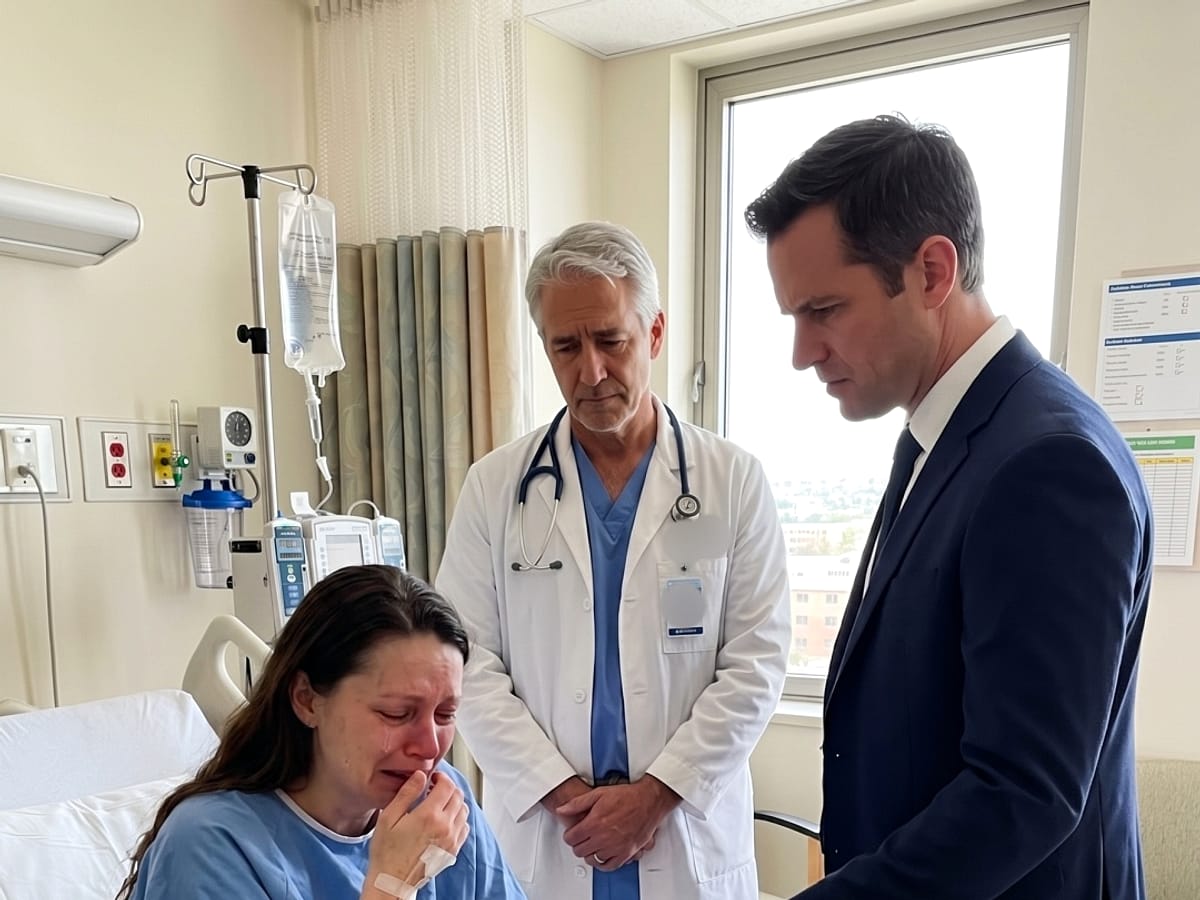
Part 1: The Folder in My Hands
I had been gripping the folder so tightly on the elevator ride up that the cardboard edge left a thin red line across my palm. I did not notice until later. At the time, I was focused on keeping my breathing even, on not crying in front of the doorman, on not letting my legs do the thing they had been threatening to do since I walked out of Memorial Sloan Kettering forty minutes earlier — which was simply stop working.
The folder held my biopsy results. It held phrases I had only ever encountered in hushed waiting rooms and late-night television dramas.
Suspicious mass. Further testing required.
Possible malignancy. The words were printed in a clean, clinical font that made them feel almost polite, as if the hospital believed that good typography might soften the blow.
It did not.
Our penthouse was on the forty-first floor of a building on the Upper East Side that Preston had purchased for $28 million three years into his company’s explosive growth. He liked to stand at the floor-to-ceiling windows in the evenings and look out over the city with a particular expression I had come to recognize — not contentment, exactly, but something closer to inventory. As if he were counting what he owned and finding the total satisfactory.
Preston Hale was forty-two years old, the founder of a security technology company that sold surveillance infrastructure to corporations, governments, and private estates. His face had appeared on the cover of three business magazines. He had been called a visionary so many times that I suspected he had begun to believe it was simply a factual description, like tall or left-handed.
When I walked through the front door that morning, he was standing near the fireplace in a charcoal suit, his phone in one hand and his expression already arranged into something impatient. His assistant, Maren, had apparently texted him that I had left the hospital and canceled a lunch meeting with our foundation’s donor committee. That was how Preston received news about my life — through the people he paid to monitor it.
“What did they say?” he asked, before I had even set down my bag.
I held out the folder. He did not take it.
“They found something,” I said. “It may be cancer.”
I watched his face. I had spent nine years learning to read Preston Hale’s face — the microexpressions he thought he controlled perfectly, the slight tightening around his eyes when something threatened his plans, the way his jaw shifted when he was calculating rather than feeling. I watched all of it happen in the space of a breath.
He asked two questions. What kind, and how certain.
I answered as honestly as I could, which was not very honestly, because I did not yet know enough to be honest. There would be more imaging.
Possibly surgery. A specialist consultation the following week.
Then he looked toward the windows. The city spread out behind him in cold silver light, taxis moving along Park Avenue like sparks struck from flint.
“Claire,” he said, “this is an incredibly inopportune time.”
I heard the word. I turned it over.
Inopportune. Not frightening. Not devastating.
Not even sad. Inopportune — as if my body had failed to check his calendar before producing a suspicious mass.
“The acquisition discussions are at a critical stage,” he continued, his voice taking on the measured cadence he used in board meetings. “The foundation gala is in three weeks.
If this becomes public, it raises questions about stability. About long-term planning.
About the family.”
The family. We had no children.
Preston had deferred that conversation every year of our marriage, always with a new milestone standing between us and the life I thought we were building together. First the company needed to stabilize.
Then the IPO needed to close. Then the European expansion needed to launch.
There was always another milestone. I had eventually stopped asking.
“I’m not thinking about the gala,” I said. “I’m thinking about whether I’m going to need surgery.
Whether I’m going to be sick. Whether I’m going to be all right.”
He flinched. Not with compassion. With the particular discomfort of a man who dislikes words he cannot reframe.
“I think,” he said carefully, “that we should separate.”
I stared at him. The folder was still in my hand. The red line on my palm was beginning to sting.
“Are you asking me for a divorce?” I said.
He exhaled, long and controlled, the way he did when he wanted credit for patience he was not actually exercising. “Yes,” he said. “I think that’s what I’m saying.”
I looked at my husband — the man who had once slept on the floor of my apartment because he could not afford a hotel room during his first investor roadshow. The man who had used my father’s conference room for free for eight months. The man who had stood beside me in Maine, in front of one hundred and eighty people, and promised that sickness and health were not optional clauses.
“Seven minutes,” I said quietly.
He frowned. “What?”
“It took you seven minutes.”
His jaw tightened. “Don’t make this theatrical.”
That was his word for other people’s pain. Theatrical.
If I cried, it was theatrical. If I asked for tenderness when he was busy, theatrical.
If I pointed out that something he had done was unkind, I was being theatrical and he was being honest, and wasn’t honesty a virtue.
I set the folder on the coffee table. I sat down on the sofa. And somewhere forty-one floors below us, Manhattan continued being Manhattan, completely indifferent to the fact that my marriage had just ended in seven minutes, in a room with a $28 million view, while I was still holding a possible cancer diagnosis and my husband was already thinking about the press cycle.
Part 2: Learning to Be Invisible
For the three weeks that followed, I learned something about Preston that I had perhaps always known but never been forced to see so clearly: he was extraordinarily good at managing the appearance of a situation while feeling nothing about the reality of it.
He moved into the guest suite at our Connecticut estate, telling the household staff that he needed quiet for a demanding work period. He continued attending public events with me, standing close enough to suggest a united front for photographers, stepping away the moment the cameras turned elsewhere. He sent flowers to the penthouse once — a large, expensive arrangement that his assistant had clearly ordered, because the card read Thinking of you in Maren’s handwriting.
I threw the flowers away. I kept the card, because I thought someday I might need to remember exactly how little I had been worth at the end.
My attorney was a woman named Nora Chen, whom I had known for six years through a nonprofit board we both served on. She was small, precise, and possessed of a stillness that made opposing counsel visibly nervous.
When I called her the morning after Preston’s announcement, she listened without interrupting, asked four questions, and then said, “Come in tomorrow. Bring everything you can find from the early years of the company.”
I did not fully understand why she wanted those documents yet. But I had learned, in the years of being married to a man who controlled everything, to trust people who asked good questions.
The medical situation moved in parallel, in the way that life insists on continuing even when you would prefer it to pause. Dr.
Patel referred me to a surgical oncologist named Dr. Reyes, who was younger than I expected and spoke with the particular directness of someone who had decided long ago that false comfort was a form of disrespect.
The mass was real. The further testing confirmed what the biopsy had suggested.
Surgery was scheduled for six weeks out, followed by a treatment protocol that Dr. Reyes outlined with calm efficiency while I sat in her office taking notes in a small leather notebook, because writing things down was the only way I knew to keep fear from becoming paralysis.
I told my mother the night after that appointment. She drove in from New Jersey the following morning and sat with me at the kitchen table in the penthouse — Preston’s penthouse, though I was still living in it — and held my hands and did not say anything for a long time, which was exactly right.
My mother was a retired nurse. She understood illness in a way that was neither sentimental nor clinical but simply present.
She also understood, without my having to explain it in detail, what it meant that Preston had not come with me to any of these appointments. She did not say anything about that either.
She just stayed.
My father, when I told him, went very quiet in a different way. My father was a real estate attorney, methodical and careful, a man who processed emotion through action.
He said, “I’m going to make some calls.” I asked him not to do anything yet.
He said, “I’m not going to do anything. I’m going to make some calls.”
I recognized the distinction and let him.
Preston and I did not discuss the divorce during those three weeks. We discussed it through attorneys, through Maren’s carefully worded emails, through the formal language of people who had decided that their marriage was a transaction to be unwound rather than a life to be mourned. His attorney was a man named Gerald Fitch, who had the energy of someone who had spent forty years being paid to be unpleasant and had come to enjoy it.
Nora handled Gerald Fitch the way a surgeon handles a difficult incision — with precision, without drama, and with the clear understanding that she had done this before and he had not rattled her yet.
I went to my pre-surgical appointments. I answered Nora’s questions.
I slept badly and ate carefully and called my mother every morning. I did not cry in front of Preston again.
I had decided, somewhere in the days after he asked for the divorce, that I was not going to give him the satisfaction of watching me fall apart in a room he owned.
I would fall apart privately. And then I would put myself back together, also privately. And then I would walk into whatever came next with my spine straight and my paperwork in order.
What I did not know yet was that the paperwork was going to matter more than either of us had anticipated.
Part 3: The House He Thought Was His
Preston demanded the Connecticut estate on a Thursday morning, and he did it the way he did most things he was slightly ashamed of — through an intermediary, with letterhead.
Daniel Mercer was Preston’s head of legal affairs, a quiet man in his early fifties who wore the same style of navy suit every day and communicated exclusively in complete sentences. He sent Nora a formal proposal stating that Preston was prepared to be generous in the overall settlement but considered the Connecticut property non-negotiable.
The estate had been the site of several significant company events. It held sentimental value.
Preston was prepared to offer a cash settlement in lieu of the property, the figure for which was listed at the bottom of the document in a font slightly smaller than the rest, as if hoping it might be overlooked.
Nora forwarded the proposal to me with a single line of her own: Read the attachment I’ve included before you respond to any of this.
The attachment was a copy of a document I had not thought about in nearly a decade. It was the original deed of trust for the Connecticut property — the one that had been signed when Preston used the estate as collateral during a brutal funding round in the company’s third year.
The property had belonged to my grandmother’s trust. My father had arranged the paperwork.
The collateral had been released once the funding closed, but the underlying ownership structure, which Nora had spent the past two weeks quietly excavating, was considerably more complicated than Preston’s attorneys appeared to have realized.
The short version was this: the Connecticut estate had been purchased using a combination of funds, and a portion of those funds — a meaningful portion — traced back to a loan from my family’s trust that had never been formally converted to equity and had never been repaid. It had simply been absorbed into the company’s early financial history, the way a lot of things get absorbed when a company is growing fast and the people involved trust each other and do not yet understand that trust is not a legal instrument.
My father had the original loan documents. He had kept them in a fireproof box in his home office for nine years, not because he expected to need them, but because he was a real estate attorney and keeping documents was simply what he did.
When Nora presented this information to Gerald Fitch, the response took four days. Four days of silence, which in legal negotiations is not silence at all but the sound of people recalculating.
I had my surgery during those four days. My mother and my college roommate Amanda sat in the waiting room for six hours.
Dr. Reyes came out afterward and said the procedure had gone well, that the margins looked clean, and that she was cautiously optimistic.
I cried in the recovery room, not from pain but from relief so sudden it felt like a physical thing, like a hand releasing a grip I had not known was there.
Preston sent a text message. It said: Glad to hear the surgery went well. Hope recovery is smooth.
Amanda read it over my shoulder and said, with the particular economy of a woman who had known me for twenty-five years, “He is something else.”
I was home within three days, recovering in the penthouse, when Nora called to tell me that Gerald Fitch had requested an in-person meeting. She said it in the tone of someone who already knew how the meeting was going to go and was allowing herself a small, private satisfaction about it.
“What changed?” I asked.
“Your father found the original wire transfer records,” she said. “And Daniel Mercer apparently did not know they existed.”
I thought about Preston, standing at those windows, looking out over the city he believed he had built alone. I thought about the story he told at dinner parties — the scrappy founder, the borrowed warehouse, the sheer force of vision that had turned nothing into something extraordinary. I thought about how clean that story was, and how much it left out.
“What happens now?” I asked.
“Now,” Nora said, “we have a conversation about what this marriage was actually worth.”
Part 4: The Truth That Had Been Waiting
The truth did not arrive all at once. It arrived the way water finds its way through old stone — slowly, persistently, through cracks that had always been there but that no one had thought to examine.
It arrived in boxes my father brought from his home office: original loan documents, wire transfer records, handwritten notes from meetings that had taken place in his conference room when Preston’s company was still small enough to fit around a single table. It arrived in emails forwarded from my father’s old account, messages from Preston’s early investors that referenced my family’s involvement in terms that were considerably warmer and more specific than Preston’s public narrative had ever acknowledged.
It arrived in the form of a woman named Amanda Whitfield — no relation to my family name — who had been Preston’s first operations director and had left the company four years ago under circumstances that had always struck me as abrupt. Amanda Whitfield reached out to Nora after reading a brief item in a business publication about Preston’s divorce proceedings.
She had her own documents. She had her own story.
And she had, it turned out, been waiting for a reason to tell it.
What Amanda described was a pattern. Not a single incident, not a moment of weakness, but a sustained and deliberate practice of rewriting history in real time — of accepting help, absorbing resources, and then reconstructing the narrative so that the help had never existed and the resources had always been his.
She had watched him do it with investors. She had watched him do it with early employees whose equity had been quietly restructured.
She had watched him do it with the story of his own company’s founding, which by the time it appeared in print bore almost no resemblance to what she had witnessed from inside the room.
I sat in Nora’s office on a gray Tuesday afternoon, reading Amanda Whitfield’s written statement, and felt something I had not expected to feel: not anger, exactly, but clarity. The particular clarity that comes when a thing you have half-known for years is finally stated plainly in front of you, and you realize that the reason you only half-knew it was that you had been working very hard not to know it fully.
I had loved Preston. I wanted to be honest about that, even now.
I had loved the man I met in that Brooklyn warehouse, the one who was brilliant and exhausted and genuinely uncertain whether his idea would survive. I had loved his ambition before it curdled into something that required the erasure of everyone who had helped create it.
I had loved what I thought we were building together, which was not just a company or a fortune but a life — a real one, with children and dinners and a Connecticut garden that someone actually had time to tend.
That man had existed. I had not invented him. But somewhere in the years of growth and acquisition and Forbes covers, he had been replaced by something harder and more careful, something that had learned to perform warmth without feeling it and to calculate the value of every relationship in terms of what it could still produce.
I had become, at some point, a liability on his balance sheet. The diagnosis had simply made that visible.
Nora presented the full picture to Gerald Fitch in a meeting I did not attend but that Nora described to me afterward with the quiet satisfaction of someone reporting a clean surgical outcome. The loan documents.
The wire transfers. Amanda Whitfield’s statement.
A forensic accounting summary prepared by a firm Nora had retained, which traced the flow of my family’s early financial support through the company’s founding years with the kind of specificity that made denial structurally impossible.
Gerald Fitch, according to Nora, had been very still for a long time after she finished presenting.
Then he had asked for a recess.
The recess lasted three days. On the fourth day, Daniel Mercer — not Gerald Fitch, but Daniel Mercer himself — called Nora directly and asked whether there was a number that would resolve the matter without further proceedings.
Nora told him she would need to consult her client.
She called me immediately after and said, “They want to settle. Quickly and quietly. Which means they’re more worried about what we have than they’ve let on.”
I thought about the folder I had carried home from Memorial Sloan Kettering. I thought about standing in that living room, holding possible cancer in my hands, while my husband looked at his watch and chose the word inopportune. I thought about the seven minutes.
“Tell them,” I said, “that I’m listening.”
Part 5: What February Gave Back
The divorce was finalized on a cold morning in February, in a conference room on the thirty-second floor of a building in Midtown that smelled of coffee and carpet cleaner and the particular tension of people who are trying very hard to appear composed.
I wore a wool coat the color of dark moss and a soft cream scarf my mother had given me the week after my surgery. My hair had grown back fully by then — it had never actually fallen out, because my treatment had not required the kind of chemotherapy that causes that particular loss, but I had been prepared for it, and the fact that I had kept my hair felt like a small, private gift from a year that had not been generous with gifts.
Nora sat beside me. She was wearing a charcoal blazer and reading glasses she did not usually wear in public, and she had a yellow legal pad in front of her that was covered in her small, precise handwriting.
She had been my attorney for eight months by then, and in that time I had come to understand that her stillness was not the stillness of someone who was waiting. It was the stillness of someone who had already done the work and was simply allowing events to catch up to her preparation.
Preston was across the table with Gerald Fitch and Daniel Mercer. He looked well.
He always looked well — it was one of his gifts, the ability to appear unaffected by things that were, in fact, affecting him considerably. His suit was dark blue.
His expression was neutral. He did not look at me when I sat down.
The settlement terms were read aloud by a mediator named Mr. Okafor, who had the measured cadence of someone who had presided over a great many endings and had learned to treat them all with equal gravity. I listened to each item and felt, with each one, not triumph exactly but something more like the restoration of a balance that had been off for a long time.
The Connecticut estate came to me. Not as a concession, but as a recognition — documented and legally formalized — of my family’s foundational contribution to the company that had purchased it.
The financial settlement was substantial. There was a structured payment tied to the company’s ongoing valuation, which Nora had negotiated with the particular tenacity of someone who understood that Preston’s company would continue to grow and that I had earned the right to benefit from growth I had helped make possible.
There was also, at my specific request, a clause requiring a formal acknowledgment — not public, but legally binding and filed with the court — that the early development of Hale Security Systems had involved material financial and operational support from the Whitmore family trust. Preston’s attorney had pushed back on this harder than on any of the financial terms. That told me everything I needed to know about which part of the settlement Preston found most painful.
He signed it anyway.
When it was done, Mr. Okafor gathered his papers and the room began the quiet choreography of people preparing to leave.
Gerald Fitch spoke quietly to Daniel Mercer. Nora made a note on her legal pad.
I put on my coat.
Preston stood, and for a moment — just a moment — he looked at me directly. I had wondered, in the months since that morning in the penthouse, what I would feel if he looked at me like that again. I had imagined anger, or grief, or the particular hollow ache of something that used to matter and no longer did.
What I felt was simpler than any of that. I felt clear.
I nodded at him, the way you nod at someone you once knew well and no longer need to explain yourself to. He nodded back. Then he looked away, and I walked out of the room with Nora beside me, and the elevator doors closed, and that was the last time I was in the same room as my husband.
My former husband.
The word still felt strange in February. By April it felt accurate. By June it felt like simply a fact about my life, the way being from New Jersey or having brown eyes is a fact — present, unremarkable, requiring no particular emotion.
I had the surgery follow-up in March. Dr.
Reyes reviewed my imaging with the same directness she brought to everything and told me the results were what she had hoped for. She used the word clear in a medical context, and I had to work to keep my face from doing something embarrassing, because that word had taken on a great deal of weight in my life by then and hearing it applied to my health felt like being handed something I had not been sure I would get to keep.
I spent the spring in Connecticut. The estate was mine now, and I had decided to actually live in it rather than maintain it as a backdrop for events I did not enjoy.
I hired a gardener named Rosa who had opinions about the rose beds and was not shy about sharing them. I had the guest suite repainted.
I had a small desk moved into the room with the best morning light, and I began working again — not for Preston’s foundation, which I had quietly resigned from in October, but for a nonprofit I had helped found years earlier, before the marriage had absorbed most of my professional identity.
My mother came for a week in May and we sat in the garden in the late afternoons, drinking tea and not talking about Preston, which was its own kind of luxury. Amanda — my Amanda, my college roommate — came for a long weekend and we stayed up too late talking about things that had nothing to do with divorce or illness or the particular education of learning that someone you loved was not who you believed them to be.
Nora called in June to tell me that Preston’s company had announced a new acquisition, and that the structured payment clause in our settlement meant I would receive a significant additional disbursement. She said it the way she said most things — matter-of-factly, without drama.
I thanked her. She said, “That’s what the paperwork was for.”
I thought about that for a long time afterward. The paperwork.
My father’s fireproof box. The wire transfer records that had sat in his home office for nine years, patient and specific, waiting for the moment when someone needed them to tell the truth.
Preston had built his story on the premise that he had risen alone. That the vision had been his and the sacrifice had been his and the sleepless nights in the Brooklyn warehouse had been his and the company that emerged from all of it was therefore entirely, unambiguously his. He had told that story so many times and in so many rooms that I think he had come to believe it completely, the way people sometimes do when a useful fiction is repeated often enough.
But the documents did not care about the story. The documents only recorded what had actually happened.
I had happened. My family had happened. The conference room and the collateral and the introductions and the meals and the years of standing beside a man and believing in something he was building — all of it had happened, and all of it was written down somewhere, and none of it could be made to disappear just because it was inconvenient to acknowledge.
That was what I kept, in the end. Not the estate, though I was glad to have it.
Not the settlement, though it was fair and I had earned it. What I kept was the knowledge that the truth had been there all along, patient and documented, waiting for someone to ask the right questions.
I kept the understanding that seven minutes had told me everything I needed to know, and that I had been right to listen.
I kept myself.
On a warm evening in late July, I walked out to the Connecticut garden just before sunset. Rosa had done something remarkable with the roses — they were blooming in a way they apparently had not in years, great heavy clusters of pink and cream and deep red that filled the air with a smell so specific and so generous that it stopped me in the middle of the path. I stood there for a moment, just breathing.
The city was two hours away. Preston was in it somewhere, doing whatever came next for him, building whatever story he would tell about this chapter when enough time had passed to make it useful.
I was here, in a garden that smelled like summer, with clean margins and a legal pad full of work I cared about and a phone full of people who had shown up when I needed them to.
I thought about the folder I had carried home from the hospital. I thought about the elevator, and the red line on my palm, and the forty-first floor, and the seven minutes.
Then I thought about the roses.
I stayed in the garden until the light was gone.
Names and identifying details in this story have been changed. This is a dramatized account shared for entertainment and reflection, and any resemblance to real people is coincidental.
