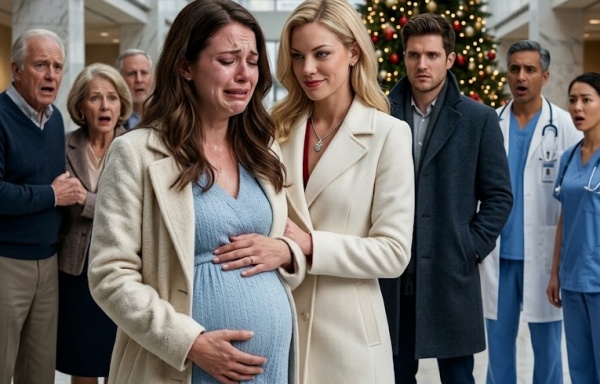
My Husband’s Mistress Grabbed Me While I Was Eight Months Pregnant. He Told His Mistress I Had No Family Left To Defend Me. ut He Forgot The Family He Forced Me To Leave Behind
Emma thought the most painful moment of her marriage would be discovering her husband’s affair outside her own doctor’s office. But when his mistress put her hands on her while she was eight months pregnant, humiliation turned into fear — and fear turned into action. Her husband believed she had been isolated long enough to have no one left to call. He was wrong, and the convoy that arrived at her driveway proved it.
Part 1: The First Time She Put Her Hands On Me
The first time my husband’s mistress put her hands on me, I was eight months pregnant.
It happened on a Friday afternoon in Dallas, Texas, under a sky so bright and blue it almost felt insulting. I had just walked out of my OB-GYN’s office with a folder of ultrasound photos tucked under one arm and a bottle of water in my purse. My daughter had kicked through the whole appointment, strong and stubborn, like she already knew she would need both qualities in the world she was coming into.
My husband, Preston Hale, was supposed to pick me up. He had promised that morning while buttoning his white dress shirt in our bathroom mirror. “I’ll be there, Emma,” he said. “I’m not missing this one.”
But Preston missed things all the time.
He missed appointments, dinners, birthdays, and the quiet moments when a husband is supposed to notice his wife is trying not to fall apart. He missed them with excuses so polished they almost sounded respectful. Client meetings, investor calls, traffic on the Dallas North Tollway, last-minute emergencies that somehow always required cologne and a freshly ironed suit.
That day, he didn’t show up.
I waited outside the medical building for twenty-two minutes, standing near the valet stand while women with husbands, mothers, and sisters came and went around me. I texted him twice. I called once. The call went straight to voicemail.
Then a white Mercedes pulled up to the curb.
At first, I didn’t pay attention. Dallas is full of white Mercedes, black Range Rovers, and people who drive like the road was personally gifted to them. But then the passenger window lowered, and I saw her.
Vanessa Cole.
I knew her name before I knew her face. Preston had mentioned her as a “marketing consultant” helping his firm rebrand one of their luxury apartment developments in Uptown. He had said her name too casually, which was the first sign.
Women always know when a man is trying to sound bored.
Vanessa had glossy chestnut hair, oversized sunglasses, and the kind of red lipstick that looked expensive even from fifteen feet away. She was younger than me, maybe twenty-nine, with perfect nails wrapped around an iced coffee. She looked me up and down slowly, pausing at my belly.
“So you’re Emma,” she said.
I felt my body go still. “And you are?”
She smiled like the question amused her. “Someone Preston should’ve told you about a long time ago.”
The driver’s side door opened, and Preston stepped out.
For a second, everything around me became quiet. The valet speaking into his radio, the traffic on the street, the hum of the automatic doors behind me. All of it blurred into one distant sound.
Preston looked at me, then at Vanessa, then back at me. His face changed three times in one second. Surprise, irritation, and then that smooth controlled expression he wore whenever he was deciding which lie would cost him the least.
“Emma,” he said. “This isn’t what it looks like.”
I almost laughed.
There should be a law against that sentence. No guilty man should be allowed to say it after stepping out of another woman’s Mercedes outside his pregnant wife’s doctor’s office. It should be treated like evidence all by itself.
Vanessa got out of the car next, heels clicking against the pavement. She was taller than I expected, or maybe she only felt taller because she carried herself like she had already won something. She came around the front of the car and stood beside Preston, close enough that her shoulder brushed his arm.
“You told me she knew,” Vanessa said to him.
Preston’s jaw tightened. “Not here.”
I looked at him. “You brought her here?”
“I didn’t bring her,” he said quickly.
Vanessa scoffed. “Don’t start lying now.”
The valet glanced over. A woman pushing a stroller slowed down. I felt the weight of strangers noticing my humiliation, and my cheeks burned hotter than the Texas sun.
I wanted to disappear.
Instead, I put one hand under my belly and said, “Preston, take me home.”
Vanessa laughed softly. “Of course. The poor wife routine.”
I turned to her. “Do not speak to me.”
Her sunglasses came off. Her eyes were sharp, green, and furious in a way that made no sense. She looked at me as if I had stolen something from her, not the other way around.
“You don’t get to order me around,” she said. “You’ve been using this pregnancy to trap him for months.”
The words hit me harder than I expected. Not because they were true, but because I knew Preston had planted them. Men like Preston didn’t just cheat; they built little stories around their betrayal so they could sleep at night.
I looked at him. “Is that what you told her?”
He looked away.
That was answer enough.
I stepped backward, trying to create distance. “I’m calling a rideshare.”
Vanessa moved before I could reach into my purse. She grabbed my wrist, not hard enough to leave a bruise immediately, but hard enough to shock me. Her nails pressed into my skin.
“You don’t get to walk away like you’re innocent,” she hissed.
For one frozen second, nobody moved.
Then something primal rose in me. I wasn’t thinking about pride or marriage or appearances anymore. I was thinking about the baby inside me and the stranger holding my wrist outside a medical building.
“Let go of me,” I said.
My voice was calm. Too calm.
Preston stepped forward, but not to protect me. He put one hand out like he was calming a difficult client. “Vanessa, stop.”
“Tell her,” Vanessa snapped. “Tell her you’re leaving.”
I stared at my husband. The man who had promised to love me in front of two hundred people at a country club in Highland Park. The man whose child I was carrying. The man who looked more embarrassed than ashamed.
“Tell me what?” I asked.
Preston swallowed. “Emma, we need to talk at home.”
Vanessa’s grip tightened. “No. Tell her now.”
That was when I pulled my hand free.
It wasn’t dramatic. I didn’t scream. I didn’t slap anyone. I simply yanked my wrist back, stepped away, and placed both hands over my belly.
“If either of you comes near me again,” I said, “I’m calling the police.”
Vanessa looked stunned, as if consequences were something that happened only to other women.
Preston’s face hardened. “Don’t make a scene.”
That sentence changed everything inside me.
Not the affair. Not Vanessa. Not even the fact that he had missed another appointment. It was the way he said it, as if the real problem was my reaction, not the fact that his mistress had just grabbed his pregnant wife in public.
I looked at him and finally saw the truth.
Preston did not think I was weak because I cried easily. He thought I was weak because I had spent years keeping his life comfortable at the expense of my own. I had mistaken peacekeeping for love, and he had mistaken my silence for permission.
I walked back into the medical building and asked the receptionist to call security.
By the time an officer from building security came outside, Vanessa and Preston were gone.
But the valet had seen everything. So had the woman with the stroller. So had the camera mounted above the entrance.
I didn’t know it then, but that small moment of choosing documentation over drama would become the first thread that unraveled Preston’s entire life.
And it would start with a phone call I never thought I would make.
Part 2: The Family He Made Me Leave Behind
I took an Uber home that day because my husband drove away with his mistress.
That sentence sounds impossible until it happens to you. Then it becomes a fact you repeat in your head because your heart keeps trying to reject it. My husband drove away with his mistress while I stood eight months pregnant outside my doctor’s office.
The driver was an older man named Raul who pretended not to notice that I was crying. He turned the air conditioning higher, kept the radio low, and asked once if I needed him to stop anywhere. His kindness almost broke me more than the betrayal did.
When we pulled into my neighborhood in Preston Hollow, the houses looked the way they always did. Manicured lawns, iron gates, long driveways, security cameras tucked beneath Spanish tile roofs. Every home seemed peaceful from the street.
Ours was a white brick house with black shutters and a fountain Preston insisted on installing because he said it gave the entrance “presence.” I used to think the house was beautiful. That afternoon, it looked like a stage set after the actors had forgotten their lines.
Inside, everything was quiet.
Too quiet.
The nursery was down the hall from our bedroom. I walked there first, still holding the ultrasound photos. The walls were painted a soft cream, and a mobile with tiny gold stars hung over the crib.
Our daughter’s name was going to be Caroline.
I sat in the rocking chair and pressed the ultrasound photo against my chest. For the first time in my pregnancy, I apologized to her out loud.
“I’m sorry,” I whispered. “I thought I picked better for you.”
The baby shifted inside me, a slow roll under my ribs. I took it as forgiveness because I needed something gentle to believe in.
Preston came home three hours later.
I heard his car before I saw him. The deep engine of his black Porsche pulled into the garage, then shut off. I stayed in the living room with my phone recording audio on the coffee table, screen facing down.
That was not something the old Emma would have done.
The old Emma would have been waiting near the door, shaking, asking why, begging for honesty from a man who had proven honesty was not his preferred language. But the woman who came home from the doctor’s office was different. She was scared, yes, but fear had sharpened into strategy.
Preston walked in holding his jacket over one arm. He looked tired and annoyed, like a man returning from a business meeting that had gone badly. Not like a husband whose mistress had assaulted his pregnant wife.
“We need to talk,” he said.
I sat still. “Yes.”
He loosened his tie. “Vanessa shouldn’t have done that.”
“No, she shouldn’t have.”
“But you escalated it.”
I stared at him. “She grabbed me.”
“And you called security.”
“She grabbed your pregnant wife outside a medical building.”
He flinched slightly at the word wife.
That told me more than any confession could have.
Preston rubbed his forehead. “Emma, I know this looks terrible.”
“It is terrible.”
“It’s complicated.”
“It is not complicated.”
He dropped his jacket onto the chair. “You always do this. You make everything black and white.”
I almost smiled because I recognized the pattern. First he minimized. Then he blamed. Then he made me defend my tone instead of addressing his actions.
But I was done performing in conversations designed for me to lose.
“How long?” I asked.
He looked toward the window. “A few months.”
“How long, Preston?”
Silence.
“How long?”
He exhaled. “Almost a year.”
A year.
I was thirty-three weeks pregnant. We had been trying for this baby when he was already with her. I thought about the fertility vitamins, the ovulation strips, the night we cried together after the positive test.
Almost a year.
I stood up slowly because sitting made me feel too vulnerable. “You need to leave.”
His eyebrows rose. “Excuse me?”
“You need to leave this house tonight.”
He laughed once, not because it was funny, but because he was genuinely surprised. “Emma, be reasonable.”
“I am being reasonable.”
“This is my house too.”
“Then call your attorney.”
That got his attention.
For the first time, Preston looked uncertain. Not afraid. Not yet. Just aware that I had stepped outside the role he had written for me.
“You don’t have anyone here,” he said quietly.
There it was.
The sentence behind every choice he had made.
You don’t have anyone here.
He said it gently, almost sadly, as if he were reminding me of a weather forecast. But beneath it was something cruel. He believed it.
And the worst part was, he had worked hard to make it true.
When I married Preston, my family had warned me he was controlling. Not in obvious ways. Not with shouting or slammed doors. Preston controlled with charm, money, and exhaustion.
He convinced me my father was too critical. My brothers were too protective. My mother was too dramatic. My childhood friends were jealous. Slowly, politely, over five years, he turned my world smaller and smaller until almost everyone who loved me became someone I needed to “take a break from.”
My father, Charles Whitmore, was a wealthy man in Houston. He owned a chain of high-end construction supply companies across Texas and Louisiana. He was also stubborn, intimidating, and deeply imperfect, but he loved me with the kind of loyalty that did not need an audience.
My older brother, Grant, was a former Army officer who now ran security logistics for private corporations. My younger brother, Miles, was a trial attorney in Austin with a calm voice and a terrifying ability to remember details. The third man was not related by blood, but he might as well have been: Robert Ellis, my father’s best friend and our family attorney for twenty-five years.
Preston hated all three of them.
He said they made me dependent. He said they treated me like a child. He said a wife should put her husband before her father’s money and her brothers’ opinions.
So I stopped calling as much.
Then I stopped visiting.
Then, when Preston and my father had a brutal argument at Thanksgiving two years earlier, I let Preston convince me that “space” was healthier for everyone. I told myself I was protecting my marriage. In truth, I was helping Preston isolate me.
That night, when Preston said I had no one here, I felt something cold and clear move through me.
He wasn’t just cheating.
He thought he had chosen the perfect victim.
I looked at him and said, “Leave.”
His face hardened. “You’re emotional.”
“I’m documenting.”
His eyes flicked to my phone.
The room changed.
He stared at the device on the coffee table, then back at me. “Are you recording me?”
“Texas is a one-party consent state,” I said. “And I am part of this conversation.”
I had looked that up in the Uber.
Preston’s jaw tightened. “You’ve been busy.”
“Yes.”
He picked up his jacket. “Fine. I’ll go to a hotel. But don’t think this little performance changes reality.”
“What reality is that?”
He stepped closer, lowering his voice. “The reality where you need me.”
I stood my ground.
“No,” I said. “The reality is that you got careless.”
He left with a slammed door and the smell of expensive cologne lingering in the hallway.
The moment I heard his car leave, my knees almost gave out. I sat on the floor beside the couch, one hand on my belly, the other over my mouth. Then I opened my contacts and scrolled to a number I had not called in nearly a year.
Dad.
My thumb hovered over the screen.
I expected pride to stop me. Shame. Fear that he would say he warned me. Fear that my brothers would be angry, not at Preston, but at me for staying away so long.
Instead, when my father answered, his voice softened immediately.
“Emmie?”
I broke.
Not loudly. Not dramatically. Just one terrible breath that carried two years of loneliness out of my body.
“Dad,” I said, “I need help.”
There was no hesitation.
“Where are you?”
“Home.”
“Are you safe?”
“Yes.”
“Is the baby okay?”
“I think so.”
“Stay inside. Lock the doors. I’m coming.”
I wiped my face. “You’re in Houston.”
“Not for long.”
Then he said something I had not realized I needed to hear.
“You are not alone, Emma. Not anymore.”
Part 3: The Luxury Convoy
The next morning, Preston sent flowers.
White roses in a crystal vase. The card said, “Let’s calm down and talk. Love, P.” It was so perfectly Preston that I almost admired the audacity.
A man will destroy your life and then send flowers as if the problem is atmosphere.
I left them on the porch.
At 9:15 a.m., Vanessa sent me a message on Instagram.
“You need to stop making this ugly. Preston has been unhappy for years. You can’t use a baby to keep a man who doesn’t love you.”
I stared at the words while sitting at my kitchen island with a bowl of oatmeal going cold in front of me. My wrist still hurt where she had grabbed me. The baby kicked beneath my ribs, as if irritated on my behalf.
I took a screenshot and did not reply.
At 9:22, Vanessa sent another message.
“He told me your family cut you off. Maybe ask yourself why.”
That one made me laugh softly.
Not because it was funny, but because Preston had been feeding her the same story he fed me. Isolated women are easier to control when everyone believes they are difficult.
At 10:04, Preston called.
I let it go to voicemail.
At 10:06, he texted.
“Vanessa feels terrible. She wants to apologize.”
I looked down at my wrist.
Then I typed, “All communication about the assault will go through the appropriate channels. Do not bring her to my home.”
He replied almost immediately.
“Assault? Emma, don’t be dramatic.”
There it was again.
Don’t make a scene. Don’t be dramatic. Don’t name the thing accurately because naming it gives you power.
I forwarded the messages to Miles, my attorney brother, who had called me at 6:30 that morning from Austin. He had not yelled. He had not asked why I waited so long to call. He simply said, “Send me everything, and do not delete a single message.”
Grant had called next.
My older brother’s voice was controlled in the way military men sound when they are angrier than they want you to know. “Do you need physical security at the house?”
“I don’t think so,” I said.
“That wasn’t my question.”
I paused. “Maybe.”
“Then you’ll have it.”
By noon, a private security vehicle was parked discreetly down the street. Grant had arranged it through a licensed company, not because we were trying to intimidate anyone, but because a pregnant woman who had already been grabbed in public had the right to feel safe in her own home.
At 2:30 p.m., I had another OB appointment because my doctor wanted to check me after the stress. My blood pressure was higher than usual, but the baby’s heartbeat was strong. Hearing that steady rhythm made tears slide down my temples before I could stop them.
“You need rest,” Dr. Klein said gently.
“I’m trying.”
She looked at me in that way doctors do when they know trying is not always enough. “Do you feel safe at home?”
That question hit differently when asked by a professional.
I thought of Preston’s face when he realized I was recording. Vanessa’s hand around my wrist. The way both of them acted offended that I had boundaries.
“Yes,” I said slowly. “But I’m taking precautions.”
“Good,” she said. “Keep doing that.”
When I returned home, Preston’s Porsche was in the driveway.
My stomach tightened.
He was standing near the front steps with Vanessa beside him.
She was wearing jeans, a cream sweater, and sunglasses even though the sky had clouded over. Preston had one hand in his pocket and the other wrapped around his phone. They looked like they had come for a negotiation they expected to win.
The security vehicle pulled closer but stayed back.
I remained in my car and called Grant.
“Don’t get out,” he said.
“They’re at my door.”
“Stay in the locked car.”
Preston walked toward me, palms open, the universal gesture of a man pretending to be harmless. Vanessa followed a few steps behind him.
I lowered my window only an inch.
“Emma,” Preston said. “This is ridiculous.”
“Leave.”
“We need to talk like adults.”
“I told you not to bring her here.”
Vanessa stepped forward. “I came to apologize.”
“You can apologize through the police report,” I said.
Her face changed. “Police report?”
Preston’s eyes flashed. “Emma.”
I looked at him through the narrow gap in the window. “You have thirty seconds to leave my property.”
He laughed under his breath. “Your property?”
That was when Vanessa made her second mistake.
She came around the side of the car and reached for the door handle.
It was locked.
Still, the sound of her pulling it made my whole body go cold.
“Open the door,” she said. “You’re not going to ruin my life because you’re embarrassed.”
I hit the horn.
The sharp blast cut through the street.
The private security guard stepped out of his vehicle and began walking toward us. Preston turned, furious, but before he could speak, a sound rose from the end of the block.
Engines.
Not one.
Several.
I looked past Preston and saw the convoy turn onto our street.
Three black Cadillac Escalades and one silver Mercedes-Maybach rolled slowly toward the house, polished and silent except for the low growl of engines. They moved with the kind of calm authority money can buy but fear cannot fake.
Preston froze.
Vanessa stepped back from my car.
The vehicles stopped at the curb in front of my house. Doors opened one after another.
First came my father.
Charles Whitmore was seventy-two, tall, silver-haired, and dressed in a charcoal suit despite the Texas heat. He moved slowly because of an old knee injury, but there was nothing weak about him. When he looked at Preston, the entire street seemed to hold its breath.
Then Grant stepped out of the second Escalade.
He wore a navy suit, no tie, and the expression of a man who had already assessed every exit, camera angle, and threat within fifty yards. He did not rush. He did not shout. He simply walked toward my car like a wall had learned to move.
Miles emerged from the third vehicle, carrying a leather briefcase. He looked less physically imposing than Grant, but anyone who mistook that for softness would learn quickly. Miles had once dismantled a Fortune 500 executive on cross-examination so thoroughly that the man apologized before the judge asked a question.
Finally, Robert Ellis stepped out of the Maybach.
Robert was in his late sixties, Black, elegant, and calm in a way that made other people nervous. He had been my father’s attorney, advisor, and closest friend since before I was born. When Robert entered a room, powerful men checked their posture.
Together, the three men walked up the driveway.
My father stopped beside my car and looked through the window at me. His face softened.
“Emmie,” he said. “Are you hurt?”
I unlocked the door.
Grant opened it before Preston could move.
The moment I stepped out, my father pulled me into his arms as gently as if I were still a child with scraped knees. I smelled his familiar cedar aftershave and suddenly I was crying into his suit jacket in my own driveway.
“I’m sorry,” I whispered.
His hand rested on the back of my head. “No. He should be.”
Preston cleared his throat. “Charles, this is a private matter.”
My father released me slowly and turned.
The softness disappeared from his face.
“A private matter ended when your girlfriend put her hands on my pregnant daughter,” he said.
Vanessa’s mouth opened. “I didn’t—”
Miles raised one hand. “Before you continue, understand that multiple statements, medical records, text messages, and security footage may become relevant. Choose your words carefully.”
Vanessa went pale.
Preston looked at Miles. “You’re threatening us?”
“No,” Miles said. “I’m advising you not to threaten yourself.”
Grant stepped between Vanessa and me, not aggressively, but decisively. “You need to step away from her vehicle.”
Vanessa did.
My father looked at Preston. “You told my daughter she had no one.”
Preston’s face tightened.
“I didn’t say that.”
I looked at him. “Yes, you did.”
Robert Ellis adjusted his cuffs. “Mr. Hale, this conversation is over. You and Ms. Cole are leaving the property. Future contact regarding marital, financial, or safety matters will be handled through counsel.”
Preston laughed once, but it came out thin. “You can’t just show up with a convoy and give orders.”
Robert’s gaze did not move. “We can show up when Emma asks for help. The difference seems to bother you.”
For a moment, I thought Preston might explode. His pride was cornered, and cornered pride is unpredictable. But then he looked around.
At the security guard.
At the neighbors peering from windows.
At my father, my brothers, and Robert.
At me standing behind them, one hand on my belly, no longer alone.
He took Vanessa by the arm. “Let’s go.”
She pulled away from him. “Don’t touch me.”
Even in the middle of everything, I noticed that.
Preston had brought her to intimidate me. Now she was beginning to understand she had been used as a weapon in a war she did not fully understand.
They got into his Porsche and backed out of the driveway.
Nobody chased them. Nobody shouted. Nobody threatened violence.
That was the most powerful part.
They had expected chaos.
What they got was consequence.
Part 4: What Power Really Looks Like
My father did not storm through my house making speeches.
He walked inside, looked around quietly, and asked if I had eaten. That was how I knew he was angrier than I had ever seen him. My father’s rage did not get loud; it became practical.
Within an hour, Robert was seated at my dining table reviewing documents. Miles was scanning messages into a secure folder. Grant was walking the property with the security team, checking cameras, doors, and blind spots.
I sat on the couch with a blanket over my legs, feeling like I had been rescued from a room I had not realized was locked.
My father brought me soup from the kitchen.
“You need protein,” he said.
“You don’t know anything about pregnancy nutrition.”
“I know soup.”
I laughed, and then I cried again because the laugh felt unfamiliar.
Later that evening, Vanessa sent me a message.
“I didn’t know he was lying about your family. I didn’t know he told you you had nobody. I’m sorry I touched you.”
I stared at it for a long time.
An apology does not undo harm. It does not erase the fear of a locked car door handle being pulled by someone who thinks your pain is an obstacle. But it can reveal something useful.
Vanessa had believed Preston’s version of me because that version made her choices easier. I was unstable. I was manipulative. I was trapping him. If I was the villain, then she could be the love story.
Preston had given us both roles.
The difference was, I was done playing mine.
I sent the message to Miles and did not respond.
The next two weeks were a blur of legal appointments, medical checkups, and emotional aftershocks. Preston’s attorney contacted Robert with a tone that tried to sound dignified. Robert replied in language so polite it felt sharper than anger.
Temporary boundaries were put in place. Preston was not to come to the house without prior written agreement. Communication went through attorneys, except for limited matters related to the baby once she was born.
The footage from the medical building clearly showed Vanessa grabbing my wrist. The valet provided a written statement. My doctor documented the stress and my wrist soreness without exaggerating anything.
That mattered.
In real life, truth is not enough if you cannot prove it. Documentation becomes the bridge between what happened and what people are willing to acknowledge.
Preston tried to apologize three days later.
Not to me directly. Through email. The subject line said: “I’m sorry things got out of hand.”
Things.
That word did a lot of work.
He wrote that Vanessa was emotional, that I misunderstood his intentions, that he never meant to make me feel unsafe. He said he loved our daughter and wanted to “move forward peacefully.”
Miles read it and looked at me. “Do you want to reply?”
“No.”
“Good.”
My father stayed in Dallas for ten days.
At first, I thought his presence would feel overwhelming. Instead, it felt like a doorstop placed against a door I had been holding shut with my own body. He sat with me at breakfast, took calls from my kitchen, and pretended not to watch me every time I winced or rubbed my belly.
One night, I found him in the nursery.
He was standing beside the crib, holding one of Caroline’s tiny white socks in his large hand. His eyes were wet, though he turned away when he heard me.
“I missed too much,” he said.
I leaned against the doorway. “So did I.”
He shook his head. “No, Emma. You were surviving.”
That word stayed with me.
Surviving.
I had spent years calling it compromise. Patience. Loyalty. Marriage. But survival was the more honest name.
Preston’s control had not looked like control at first. It looked like suggestions, concern, financial planning, schedule management, social boundaries, and “protecting our peace.” He did not need to lock a door if he could convince me everyone outside it was dangerous.
That is the kind of cage people admire from the outside.
By the end of February, I filed for divorce.
I did not do it because my father told me to. I did not do it because my brothers were angry. I did it because when I imagined raising Caroline in that house with Preston, I felt my body tighten like it was bracing for impact.
A child can grow in a beautiful house and still learn fear.
I refused to give her that inheritance.
Preston did not take it well.
He sent messages about family, forgiveness, and how divorce would “damage” our daughter. He said I was letting my father control me. He said I was punishing him for one mistake.
One mistake.
I wondered how many choices a man could stack together before he stopped calling it a mistake and admitted it was a life he built.
Vanessa disappeared for a while.
Then one afternoon, she sent Robert a statement through her own attorney. In it, she admitted Preston had told her I was emotionally unstable, estranged from my family, and using pregnancy to delay an inevitable separation. She also admitted he had encouraged her to confront me because he believed I would “back down” if pressured publicly.
Reading those words made me feel both sick and free.
He had not merely failed to protect me.
He had arranged the moment that put me at risk.
My father read the statement once, then removed his glasses and set them on the table.
Grant walked out of the room.
Miles stared at the wall with the expression he got when mentally preparing to ruin someone in court.
Robert simply said, “This will be addressed.”
And it was.
Not with revenge. Not with violence. Not with some dramatic scene outside an office building. It was addressed the way real power handles dangerous men: through filings, evidence, financial disclosures, sworn statements, and calm professionals who do not get distracted by charm.
Preston had always understood money.
He had always understood status.
But he had underestimated something stronger.
A woman who had finally stopped protecting his reputation.
Part 5: The Daughter Who Changed The Ending
Caroline Grace Whitmore-Hale was born on March 18 at 4:37 a.m. during a thunderstorm.
Rain hit the hospital windows in sheets, and lightning flashed over Dallas like the sky was taking pictures. My father waited in the hall. Grant paced so much the nurses started teasing him. Miles brought coffee for everyone and then forgot to drink his own.
Preston was not in the delivery room.
That was my decision.
He was notified after she was born, through the appropriate channels and then with a brief message from me. “Caroline is here. She is healthy. Further arrangements will go through counsel.”
He replied six minutes later.
“Please let me see my daughter.”
My daughter.
I stared at the words while Caroline slept against my chest, her tiny mouth open, her dark hair still damp from birth. She was so small and so real that every argument outside that room seemed suddenly distant and absurd.
I did not hate Preston in that moment.
Hate would have taken energy I needed for her.
But I understood something with perfect clarity: fatherhood was not a title he could use to erase what he had done to Caroline’s mother. If he wanted to be in her life, he would have to do it through structure, accountability, and consistency.
Not charm.
Not pressure.
Not control.
The first time Preston met Caroline, Robert was present, along with a professional supervisor recommended by the court. That sounds cold to people who have never had to rebuild safety from the ground up. To me, it felt merciful.
Preston cried when he saw her.
I watched from across the room as he held our daughter with careful hands. For a moment, I saw the man I once hoped he would become. That hurt more than seeing the man he actually was.
He looked at me over Caroline’s blanket. “She’s perfect.”
“Yes,” I said.
“I’m sorry, Emma.”
I nodded once.
I did not say it was okay.
Because it wasn’t.
The months that followed were not cinematic. Divorce never is. It is forms, invoices, custody calendars, sleepless nights, pumping schedules, pediatrician appointments, and learning how to be calm when someone who hurt you tries to sound reasonable in an email.
I moved into a house my father owned near University Park, temporarily at first. It had oak trees in the front yard and a small guesthouse where a night nurse stayed for the first two weeks because my father insisted and I was too tired to argue. The house felt unfamiliar, but safe.
Safe became my favorite word.
Preston accused me of hiding behind my family. He said the convoy had humiliated him. He said my father wanted to destroy him.
But humiliation is not the same as accountability.
My father did not destroy Preston. Grant did not destroy Preston. Miles and Robert did not destroy Preston.
Preston’s choices did that.
Slowly, the case moved forward. Financial issues surfaced that I had not known about. Credit cards. Business expenses. Gifts. Trips. A necklace Vanessa later returned through her attorney because she wanted “no further involvement.”
I never saw the necklace.
I didn’t want to.
Vanessa’s apology eventually came in writing, more complete than the first one. She admitted she had let jealousy and Preston’s lies guide her behavior. She said there was no excuse for touching me, especially while I was pregnant.
I accepted the apology privately, in my own heart, not because she deserved peace from me, but because I deserved peace from her.
Forgiveness, I learned, does not always mean reunion. Sometimes it means removing someone from the courtroom inside your mind.
By Caroline’s first month, I had created a routine.
Morning feeding by the window. Coffee in the blue mug my mother had given me years before. A walk around the block with the stroller if the Texas heat allowed it. Afternoon naps that never lasted as long as baby books promised.
My father visited almost every evening.
He would stand in the doorway of the nursery and pretend he was only checking on me, but really he wanted to see Caroline. He became ridiculous around her. This powerful man who had negotiated million-dollar contracts and intimidated Preston with one sentence was completely defeated by a baby in a yellow onesie.
Grant was worse.
He bought Caroline a tiny Dallas Cowboys jersey and said she needed to understand loyalty early. Miles argued that teaching a child loyalty through the Cowboys was legally questionable. For the first time in years, my life had laughter that did not feel borrowed.
One evening in May, I sat on the back patio while Caroline slept in a bassinet beside me. The air smelled like cut grass and rain on warm pavement. Fireflies blinked near the hedges.
My father sat across from me with a glass of iced tea.
“I should have come sooner,” he said.
I looked at him. “I should have called sooner.”
He shook his head. “We can spend the rest of our lives arguing over who should have done what sooner.”
“That sounds like us.”
He smiled faintly. “Or we can be here now.”
I looked at Caroline.
“Here now,” I said.
Preston eventually adjusted to a structured co-parenting schedule. Not perfectly. Not gracefully. But he adjusted because the court required clarity, and clarity was something he could not charm his way around.
He saw Caroline. He paid support. He attended a parenting class that Robert suggested through counsel. Whether he did it for appearances or growth, I stopped trying to measure.
My job was not to repair Preston.
My job was to raise Caroline in truth.
A year later, on Caroline’s first birthday, we held a small party in my father’s backyard in Houston. There were pink balloons, barbecue from a place my brothers loved, and a smash cake Caroline treated like a legal opponent. She wore a white dress with tiny embroidered flowers and laughed every time Grant sneezed.
Preston came for one hour.
He was polite. Quiet. Careful. Vanessa was long gone from the story, though the damage she helped expose remained part of its history.
At one point, Preston found me near the dessert table.
“She looks like you,” he said.
I watched Caroline clap frosting-covered hands while my father cheered like she had won a national championship.
“She looks like herself,” I said.
Preston nodded. “You’re different now.”
I looked at him then.
For once, there was no anger in me. No fear either. Just the steady distance of a woman who had crossed a bridge and burned only the parts that led back to danger.
“No,” I said. “I’m who I was before you convinced me to become smaller.”
He lowered his eyes.
I walked away before he could answer.
Later that night, after the guests left and Caroline fell asleep on my chest, I thought about the day outside the doctor’s office. Vanessa’s hand on my wrist. Preston telling me not to make a scene. The moment he said I had no one here.
He had been wrong about many things.
But he was most wrong about that.
I did have people.
I had a father who drove across Texas before sunrise. I had brothers who knew the difference between protection and control. I had Robert, who taught me that power did not need to shout when evidence could speak.
Most of all, I had myself.
That was the person Preston had underestimated most.
People still ask about the convoy.
They want to hear about the Escalades, the Maybach, the three powerful men stepping out like a scene from a movie. They want the dramatic part, the image of Preston’s face when he realized I was not the abandoned woman he thought he had created.
And yes, that moment mattered.
But the real rescue did not happen in the driveway.
It happened when I picked up the phone and called for help. It happened when I stopped protecting a man who had not protected me. It happened when I chose safety over appearances, truth over embarrassment, and my daughter’s future over my husband’s reputation.
The first time his mistress put her hands on me, I was eight months pregnant.
My husband thought that meant I was fragile.
He thought I would cry, forgive, hide, and stay quiet because I had no one left.
But thirty minutes after he learned my family was coming, three powerful men stepped out of a luxury convoy in front of our house.
And for the first time in years, Preston Hale saw me clearly.
Not as the wife he could isolate.
Not as the pregnant woman he could silence.
But as a mother surrounded by truth, family, and the kind of strength no one can steal once it finally comes home.
