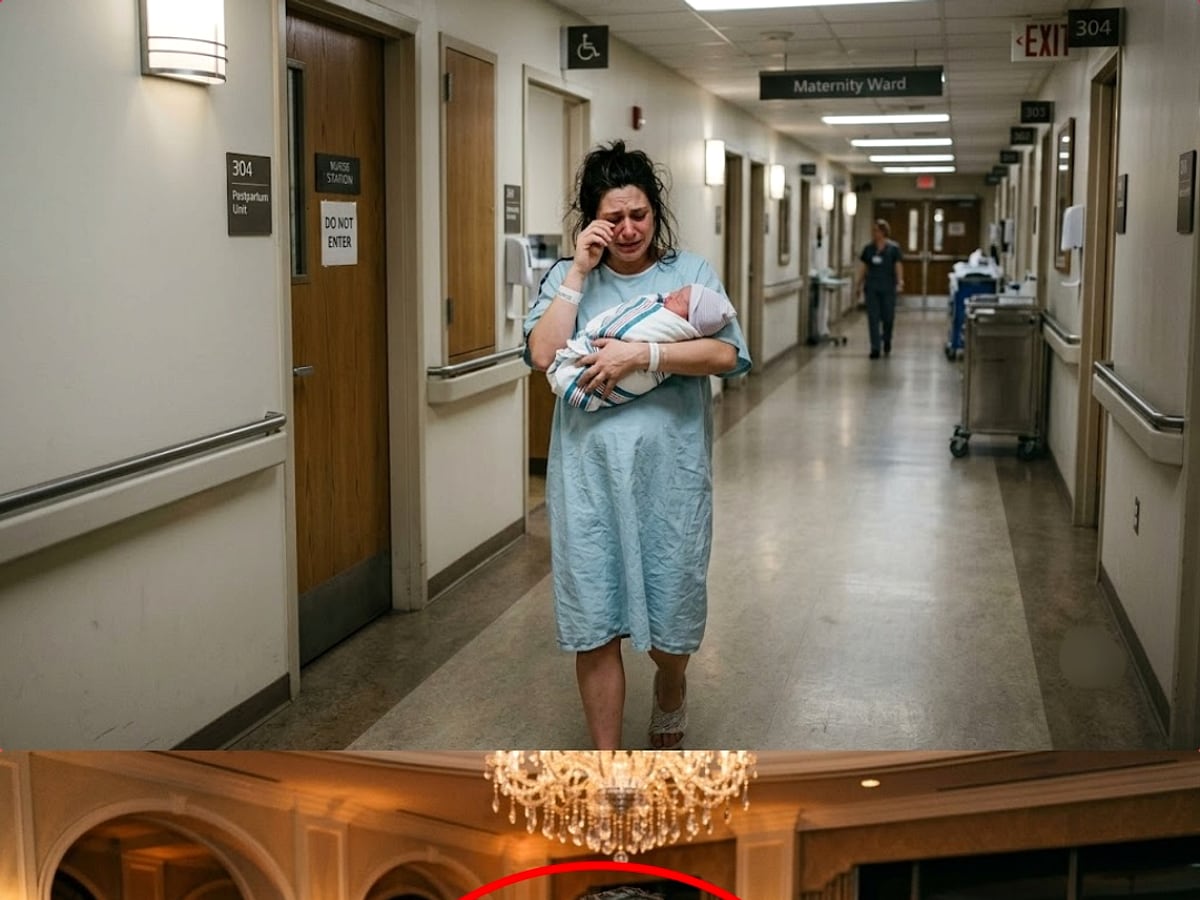
Part 1: The Empty Chair at 3:58 A.M.
The delivery room at NewYork-Presbyterian smelled like antiseptic and recycled air, and every light in it was the kind of white that makes shadows disappear entirely. There are no soft edges in a room like that.
No mercy in the fluorescence. Just the hard, honest fact of what is happening to your body, and the hard, honest fact of who is — and is not — beside you.
At 3:58 a.m., a nurse named Dora placed my daughter on my chest.
Seven pounds, one ounce. Dark hair already curling at the temples.
A mouth so perfectly formed it looked like something a sculptor had spent weeks getting right. Her fingers — all ten of them — were curled inward, tight little fists pressed against her own cheeks, as if she had arrived in this world already braced for it.
I had been in labor for nineteen hours. My throat was raw.
My lower back felt like someone had taken a crowbar to it and then apologized. My hair was plastered to the side of my face in a way I would have been embarrassed about on any other day, but this was not any other day.
This was the day my daughter breathed air for the first time, and I was too overwhelmed to care about anything except the warm, impossible weight of her against my skin.
“Do you have a name?” Dora asked.
I turned my head toward the chair beside the bed.
Dante’s chair.
It was a standard hospital chair — padded, beige, the kind designed for long waits rather than comfort. He had sat in it for the first few hours after we arrived, his knee bouncing, his phone face-down on his thigh, his hand occasionally reaching for mine. He had brought a bag with snacks I never touched and a playlist he had made called “For Stella” — because we had already agreed on her name, had agreed on it months ago over dinner at the kitchen table while I was still small enough to sit comfortably in a chair.
That chair was empty now.
His jacket was draped over the back of it. A gray wool blazer, the one I had given him for his birthday two years ago, still hanging there like a placeholder. Like a promise he had made and then quietly walked away from.
He had left at 10:17 p.m. “One urgent call,” he said.
“Twenty minutes, tops. Don’t let anything happen without me.”
He had kissed my forehead and squeezed my hand and walked out the door with his phone already pressed to his ear.
By midnight, I had called him six times.
By 2 a.m., thirteen.
By 3:58 a.m., I had stopped counting and started surviving.
“Stella,” I whispered to Dora. “Her name is Stella.”
Dora smiled the way nurses smile when they have seen everything and still choose kindness. “That’s a beautiful name.”
Stella Moretti. My daughter. My whole world, compressed into seven pounds and one ounce of fury and perfection.
I pressed my lips to her forehead and breathed her in — that warm, milky, inexplicable scent that belongs only to newborns and exists nowhere else in the world. My tears fell into her dark hair.
I let them. I told myself Dante had been in an accident.
I told myself his phone was dead, his car was in a ditch somewhere on the FDR, and any minute a hospital social worker would come through the door to tell me he was in the ER two floors down and asking for me.
I told myself whatever I needed to tell myself to get through that first hour.
That is what desperate love does to a woman. It makes her an expert at building shelters out of excuses.
My mother arrived at 6:40 a.m. She had driven in from Long Island before sunrise, her winter coat thrown over her pajamas, her face stripped of makeup and full of the kind of fear that only a mother recognizes in another mother.
She walked into the room, saw Stella, and started crying before she even reached the bed. She held the baby first.
Then she held me. She did not ask where Dante was, not right away.
She just kept saying, “You did it, Elena. You brought her here.”
I cried then — not the quiet, photogenic kind of crying, but the kind that comes from somewhere deep and animal, the kind that has nothing to do with beauty and everything to do with truth.
At 7:12 a.m., Dante finally texted.
I’m so sorry. Phone died.
Tell me everything. On my way.
I stared at those three sentences for a long time. Phone died.
Two words so small they were almost an insult. I was still staring at them when Mara walked in carrying two coffees and wearing the expression of someone who had seen something on the internet and wished, very sincerely, that the internet did not exist.
“Elena,” she said. Her voice was careful.
Measured. The voice of a woman choosing her next words like she was stepping across ice.
My stomach dropped before she even finished saying my name.
She held out her phone, and the photograph on the screen cracked something open in me that has never fully closed since.
Part 2: The Man the City Loved
To understand what that photograph meant, you have to understand who Dante Moretti was — or rather, who the city believed him to be.
Dante was forty-two years old when Stella was born. He was the CEO of Moretti Hospitality Group, a company he had built from a single boutique hotel in the Meatpacking District into a portfolio of eleven luxury properties across New York, Miami, and Chicago.
He was the kind of man who got profiled in business magazines not because his publicist called in favors, but because editors genuinely found him interesting. Self-made.
Charismatic. The son of a Bronx contractor who had taught himself finance from library books and worked his way into rooms where people like him were not supposed to exist.
He gave good quotes. He had good hair. He wore suits the way men in old films wore suits — like the clothes were grateful to be on him.
I met Dante at a fundraiser for a literacy nonprofit where I was volunteering as an event coordinator. He had come as a donor.
He spent the first twenty minutes talking to the executive director, and then he spent the next two hours talking to me. He asked questions that were actually questions, not just pauses between his own sentences.
He remembered details. He followed up.
Three days later, he sent flowers to my apartment — not roses, because he had listened closely enough to know I found roses predictable — but a wild arrangement of ranunculus and eucalyptus that smelled like a garden after rain.
I was thirty-four. I had been careful with men for a long time.
I had a rule about moving slowly, about watching how a person behaved when things went wrong, about paying attention to the small moments rather than the grand gestures. Dante seemed to pass every test.
He was patient. He was present.
When I told him I wanted to wait before we moved in together, he said, “I’ll wait as long as you need.” When I told him my father had left when I was nine and that I had complicated feelings about men who made promises, he looked at me steadily and said, “Then I’ll spend however long it takes showing you that I mean what I say.”
We married eighteen months after we met. The wedding was small — forty people at a restaurant in the West Village, string lights and good wine and my mother dancing with Dante’s business partner near the bar. It was the happiest night of my life up to that point.
When I got pregnant, Dante cried. Actually cried — not the polite, one-tear kind, but the full, overwhelmed kind that men sometimes produce when they are caught off guard by joy.
He put his hand flat on my stomach and said, “Hi, little star. I’m your dad.
I’ve been waiting for you.”
He came to every prenatal appointment. He read three books about labor and delivery.
He built the crib himself, badly, and then hired someone to fix it, and then felt guilty about hiring someone and tried to fix it again. He was, by every visible measure, a man preparing to be a father.
Which is why the photograph hit the way it did.
The headline on Mara’s phone read: Dante Moretti Turns Heads at Van Der Meer Foundation Gala With Mystery Woman in Silver.
Below it, a photograph. My husband stood beneath the chandeliers of the Plaza Hotel ballroom, his head tilted toward a woman in a silver dress, his hand resting at the small of her back.
He was laughing. Not smiling politely.
Laughing — the full, open, unguarded kind of laugh I had not seen on his face in months. His wedding ring caught the light in the photograph like a small, terrible joke.
The timestamp on the article read 2:43 a.m.
At 2:43 a.m., I had been shaking through contractions in a room two miles away, calling a number that rang and rang and rang.
I did not scream. I did not throw the phone. I looked down at Stella, who was sleeping against my chest with the absolute confidence of someone who has never been betrayed, and I felt something inside me go very, very still.
“Who is she?” I asked.
Mara hesitated. “The caption calls her Celeste Vale.
She’s a real estate developer. Has properties in Miami and the Hamptons.
She and Dante have apparently been photographed at the same events a few times over the past year.”
A year.
My mother made a sound that was not quite a word.
I handed Stella carefully to Dora, who had come back to check vitals and understood immediately that the room had changed. Then I picked up my own phone and called Dante. He answered on the second ring, his voice warm and slightly breathless, the voice of a man performing urgency.
“Elena, I’m in a cab right now, I’m almost there, I’m so sorry about last night, my phone completely died and I couldn’t find a charger anywhere, I should have —”
“The Van Der Meer Gala,” I said.
Silence.
Not the silence of a man confused. The silence of a man caught.
“I’ll explain everything when I get there,” he said finally.
“Don’t come,” I said. And I hung up.
I did not know yet that Celeste Vale was not the only secret Dante had been keeping. I did not know yet that the photograph was not the wound — it was just the first place the wound became visible.
Part 3: What Noon Looked Like
By noon, I had asked Dante to leave the hospital.
He had arrived at 8:36 a.m. despite what I had said on the phone, which told me everything I needed to know about how seriously he took my words when they inconvenienced him. He came in carrying a bouquet of white peonies — my favorite — and wearing the expression of a man who had rehearsed his apology in the cab and believed sincerely that the right combination of words and flowers could reset any situation.
My mother stood up the moment he walked in. She did not say anything. She simply stood, which was its own kind of statement.
Mara picked up her coffee and moved to the window.
Dante looked at Stella first. I will give him that.
Whatever else he was, whatever he had done, he looked at his daughter with something real on his face — something unscripted and raw that I recognized as genuine. He reached out and touched her cheek with one finger, and his jaw tightened the way it does when he is trying not to cry.
Then he looked at me.
“Elena —”
“I’ve seen the photograph,” I said. “I know where you were.”
He set the peonies on the windowsill. He pulled the chair close to the bed — his chair, the one he had abandoned — and sat down and leaned forward with his elbows on his knees, the posture of a man preparing to negotiate.
“It was a work event,” he said. “The Van Der Meer Foundation is a major donor to two of our properties.
I had to be there. I should have told you, but I knew you’d be upset, and I thought I could get in and out in an hour —”
“Your hand was on her back.”
“She’s a business contact.”
“At 2:43 in the morning.”
“Galas run late, Elena. You know how these things —”
“I called you thirteen times,” I said. My voice was quiet.
I had made a decision sometime in the early hours of the morning, somewhere between Stella’s first cry and Dante’s first text, that I would not raise my voice. I would not give him the performance of my pain.
I would be precise. “I called you thirteen times while I was in active labor.
You did not answer once. Our daughter was born at 3:58 a.m.
and you were not here. That is what happened.
I need you to leave now.”
He tried. He said he had a right to be with his daughter. He said we needed to talk, that I was making decisions in an emotional state, that if I would just let him explain — and I let him say all of it, every word, and then I pressed the call button for the nurse and asked, very politely, if there was a patient advocate available.
There was.
Dante left.
He texted four times that afternoon. The first two were apologies.
The third was a longer message about how he understood I was hurt but that we needed to approach this as a team. The fourth arrived at 5:12 p.m.
and said only: I need you to know that Celeste is not what you think she is. There’s more to this.
Please let me explain before you do anything you can’t undo.
I read that last message three times.
Before you do anything you can’t undo.
It was the kind of sentence that sounds like a warning but is actually a threat wearing a warning’s clothes. It was the kind of sentence that tells you the person who sent it is more afraid of consequences than they are sorry for causes.
I called my attorney that evening from the hospital room, with Stella asleep in the bassinet beside me and my mother dozing in the chair by the window. I spoke quietly.
I was methodical. I had three questions, and I asked all three of them, and I wrote down the answers in the notes app on my phone.
What I did not know yet — what I would not learn until the following morning — was that Dante’s fourth text had not been about protecting his marriage. It had been about protecting something else entirely. Something that, once it came to light, would make the photograph at the Plaza look like the smallest of his problems.
Part 4: The Life Built on Secrets
Dante’s first move was to control the story.
By the morning after Stella’s birth, a representative from Moretti Hospitality Group had issued a statement confirming that Mr. Moretti had attended the Van Der Meer Foundation Gala in a professional capacity and that his presence there was consistent with the company’s longstanding philanthropic partnerships.
The statement made no mention of his wife being in labor. It made no mention of the thirteen unanswered calls.
It was a clean, corporate paragraph designed to make a scandal sound like a scheduling conflict.
Several of Dante’s colleagues reached out to me directly — by text, by email, through mutual friends — to vouch for him. One of his senior vice presidents called my cell phone and explained, gently, that Dante was under enormous pressure and that the gala had been a critical relationship-building event and that surely I could understand the demands of running a company of that size.
I listened to the entire speech. Then I thanked him for calling and hung up.
What none of them knew — what I was only beginning to piece together — was that Celeste Vale was not simply a business contact or even a romantic indiscretion. She was a partner.
Not in the personal sense, though that too was becoming clearer. In the financial sense.
My attorney had referred me to a forensic accountant named Helen, a small, precise woman who wore reading glasses on a chain and spoke about money the way a surgeon speaks about anatomy — with total calm and zero sentimentality. Helen had been doing this work for twenty-two years. She had seen, she told me, almost everything.
She had not quite seen this.
What Helen found, over the course of the next several weeks, was a pattern of transfers that had been running for fourteen months. Money moving from a Moretti Hospitality subsidiary account into a shell company registered in Delaware, and from there into a development fund co-managed by Celeste Vale’s firm, Vale Properties Miami.
The amounts were not small. $185,000 here.
$240,000 there. A transfer of $32,000 that appeared to be for “consulting services” with no corresponding invoice in any file Helen could locate.
The total, when Helen laid it out on a spreadsheet and slid it across the table to me in her Midtown office, was just over $1.4 million.
I sat with that number for a long moment.
“Is this embezzlement?” I asked.
“That’s a determination for investigators and prosecutors,” Helen said carefully. “What I can tell you is that these transfers do not appear in any board-approved budget, they are not reflected in the company’s audited financials, and the shell company receiving the funds has no employees, no physical address, and no documented business activity beyond receiving and forwarding these deposits.”
She paused.
“What I can also tell you is that Moretti Hospitality Group has three institutional investors and a board of directors who would be very interested in this information.”
I thought about Dante’s text. Before you do anything you can’t undo.
He had known. He had known that if I started looking, I would find this.
The gala, Celeste, the photograph — those were the visible surface of something much deeper and much darker. He had not been afraid of losing his marriage.
He had been afraid of losing his company, his freedom, and the carefully constructed version of himself that the city had been admiring for a decade.
I called Helen’s office the next morning and told her to prepare a full report.
Then I called the board’s independent counsel directly.
I did not do this out of anger. I want to be clear about that.
Anger is a fire that burns the person holding it as often as it burns the target. I did it because $1.4 million had been taken from a company that employed over three hundred people, and because the man who had taken it had stood in a hospital room with peonies and tried to make me feel like the unreasonable one.
I did it because Stella was going to grow up watching how her mother handled the moment when the truth became undeniable, and I wanted her to see that the answer was not silence.
Dante found out I had contacted the board on a Tuesday afternoon. He called me eleven times in forty minutes. I answered the eleventh call.
“You don’t understand what you’ve done,” he said.
“I understand exactly what I’ve done,” I said.
He was quiet for a moment. When he spoke again, his voice had changed — the warmth was gone, the performance was gone, and what was left was something smaller and colder than I had ever heard from him before.
“I built everything we have,” he said.
“You built it on other people’s money,” I said. “And you left me alone in a delivery room to do it.”
I hung up.
Stella was in her bouncer on the kitchen floor, watching the mobile above her with the focused, serious expression she had already developed for things she found interesting. I picked her up and held her against my shoulder and stood at the window looking out at the city that had loved Dante Moretti for so long, and I felt, for the first time since 3:58 a.m., something that was not grief or fury or exhaustion.
I felt clear.
Part 5: The First Honest Morning
Three months after Stella was born, Dante Moretti resigned as CEO of Moretti Hospitality Group.
The official statement cited “personal matters” and “a commitment to preserving stakeholder confidence during an independent financial review.” It was a careful, lawyered sentence that said nothing and implied everything.
The business press covered it for two days. A few columnists who had profiled Dante over the years wrote pieces about the unexpected fall of a self-made success story.
One of them called it “a cautionary tale about the cost of overreach.” I thought that was a generous framing, but I did not write in to correct it.
The independent financial review — which was, in practice, a full forensic audit triggered by the information Helen had compiled and the board’s subsequent referral to the SEC — was ongoing. I was told by my attorney not to discuss the specifics publicly, and I have honored that.
What I can say is that the $185,000 transfer, the $240,000 transfer, and the $32,000 “consulting” payment were not the only items that required explanation. Helen had described the full picture as “a pattern of self-dealing that will take considerable time to fully document.”
I trusted her assessment.
Celeste Vale’s firm, Vale Properties Miami, had quietly dissolved its Delaware subsidiary by the time the audit became public knowledge. Celeste herself gave one brief statement through her publicist saying she had been unaware of any irregularities and was cooperating fully with investigators.
Whether that was true was not my concern. My concern was Stella.
Divorce proceedings began six weeks after Stella’s birth. Dante contested nothing in the end — not the asset division, not the custody arrangement, not the support structure.
My attorney told me this was unusual. I told her it was not unusual at all; it was the behavior of a man who understood that a contested divorce would require financial disclosures he could not afford to make under oath.
My mother moved in with me for the first four months. She slept in the guest room and woke up for the 3 a.m.
feedings without being asked, appearing in the doorway of the nursery in her robe with a warm bottle already prepared, as if she had been listening for the sound of Stella stirring. I do not have words adequate for what that meant.
I am not sure words exist for it.
Mara came over every Sunday. She brought food and she sat on the kitchen floor and let Stella grab her fingers and she did not offer advice unless I asked for it, which is the rarest and most valuable quality a friend can have in a crisis.
I went back to work part-time when Stella was ten weeks old, doing event coordination remotely from the apartment. It felt good to have something to organize, something with a checklist and a timeline and outcomes I could control. I had forgotten, in the years of being Dante’s wife, how much I had always liked being competent at things.
There were hard days. I will not pretend otherwise.
There were mornings when Stella was crying and the coffee maker was broken and the radiator was making a sound like a small animal trapped in the wall, and I sat on the kitchen floor and thought about the version of my life I had believed I was living — the one with the husband who built the crib badly and made playlists called “For Stella” — and I grieved it. You can grieve a lie.
The grief is real even when the thing you’re grieving was never real to begin with.
But there were also mornings like the one I am thinking of now, when Stella was about four months old. It was early — not 3:58 a.m.
early, but early enough that the city outside the window was still gray and quiet, the kind of quiet that belongs only to the hour before the world remembers it has somewhere to be. I had brought Stella into bed with me after her feeding, and she had fallen back asleep on my chest, her small fist pressed against my collarbone, her breathing slow and even and perfect.
I lay there in the gray light and I thought: this is the most honest morning of my life.
No performance. No version of myself curated for someone else’s comfort.
No waiting for a text that would explain everything. Just my daughter’s weight on my chest and the city going quiet outside and the knowledge — clean and solid as anything I have ever known — that I had done the right thing at every step, even when the right thing was the hardest thing, even when the right thing meant sitting in a hospital room at 3:58 a.m.
and naming a baby alone.
Stella Moretti.
She has her father’s dark hair and her grandmother’s stubborn chin and eyes that are entirely her own — a shade of brown so warm they look almost amber in the afternoon light. She is, at this writing, seven months old. She has recently discovered that she can make a sound somewhere between a shriek and a laugh that causes every adult in the room to stop what they are doing and look at her, which she finds enormously satisfying.
She does not know yet what happened the night she was born. She does not know about the empty chair or the thirteen unanswered calls or the photograph under the chandeliers or the $185,000 or the $240,000 or the $32,000 that bought nothing anyone could find. She does not know that her father chose a ballroom over a delivery room, or that the choice cost him more than he ever imagined it would.
She will know someday. Children always find out the shape of the story eventually, even when the adults around them try to smooth the edges.
When that day comes, I want her to know this: her mother was alone in that room, and her mother was terrified, and her mother cried into her dark hair at 3:58 a.m. — but her mother did not fall apart.
Her mother held on. Her mother made the calls that needed to be made and signed the documents that needed to be signed and stood in the kitchen with her on a gray morning and felt, for the first time in a long time, like herself.
That is the story I am leaving her.
Not the betrayal. The survival.
Names and identifying details in this story have been changed. This is a dramatized account shared for entertainment and reflection, and any resemblance to real people is coincidental.
