Part 1: The Bag by the Door
Natalie Brooks pulled into her own driveway with the headlights off.
She did that on purpose. Her flight out of Seattle had been canceled twice, then rerouted onto a red-eye that dropped her into Nashville at half past two in the morning instead of the following Monday like she’d planned. She wanted to surprise David, not wake him.
The rideshare from the airport ran her $118 before tip, and she spent the whole drive picturing his face when he found her at the kitchen table with coffee already made.
Twelve years married. Twelve years of remembering birthdays he forgot, paying the property taxes before the county sent a second notice, telling herself his long silences were about work and not about her.
The house on Maple Ridge Lane should have been dark at that hour. It never was, not really, not with David in it.
But when Natalie climbed out with her roller bag, she saw it before she’d even reached the porch steps. A soft yellow glow leaking out of the upstairs hallway window.
David hated a lit hallway at night. He always said it made the house feel like a motel that had left its vacancy sign on.
She stood there a second with her key already between her fingers, feeling the wet Tennessee heat sit on her shoulders like something with actual weight to it.
Somewhere down the block a dog barked once and went quiet, the way a dog does when it senses something is about to be found out and doesn’t want to be the one to say it first.
The door opened without a sound. Natalie had oiled that hinge herself two summers ago.
Past the smell of leftover candle wax and the wine she and David sometimes shared on the porch was a second smell that didn’t belong to either of them. Sweet.
Floral. The kind sold at a department store counter by a woman in a black dress.
Natalie didn’t wear perfume anymore. David had told her years ago that it gave him headaches.
She set her bag beside the entry table, next to the framed photo from their wedding where he had his hand at her waist and she was thirty-four and certain love was a fixed thing, not a business that could run at a loss for years without anyone filing the paperwork.
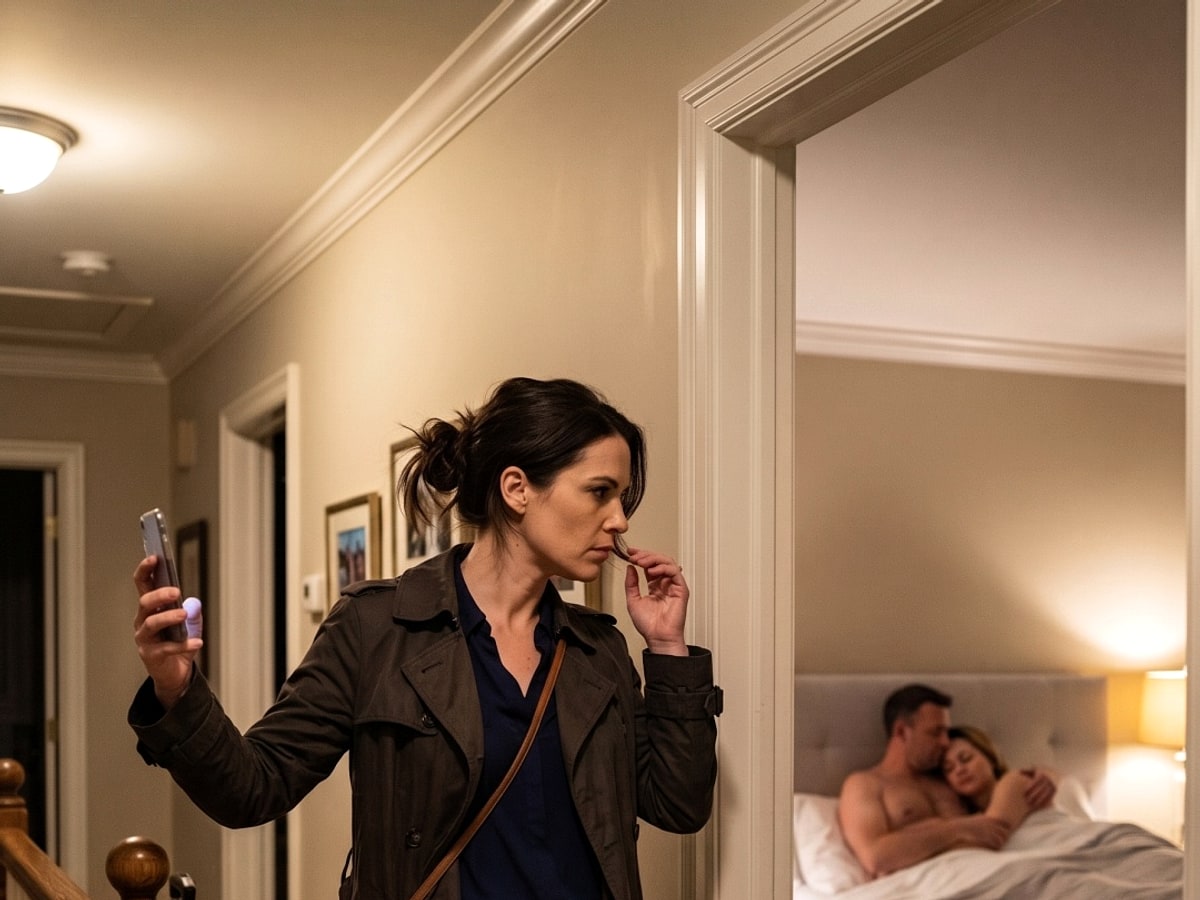
Halfway up the stairs, she heard it. Not words. Just the low, unbothered sound of two people asleep and comfortable in a room that wasn’t supposed to have two people in it.
Her hand found the railing before her brain caught up with what her ears already knew.
What she felt first wasn’t rage. It was something closer to embarrassment, like she’d walked in on a joke everyone already knew the punchline to except her.
The bedroom door sat open two inches, throwing a blade of lamp light across the hallway carpet.
Natalie stood outside it long enough to hear her own pulse. Then she pushed it open.
David lay on his back with one arm thrown over his forehead, the exact way he always slept after too much wine.
Beside him, asleep with her hand loose against the sheet, was a young woman Natalie recognized on sight even though they’d only met twice. Madison Keller.
Twenty-six. The marketing coordinator David once called “hungry, and that’s good in this business.”
Natalie didn’t scream. She didn’t flip the overhead light or rip the comforter off the bed or throw anything against a wall.
She looked at the bedding she’d washed the morning she left for her conference. She looked at the two wineglasses on the nightstand and the candle she usually lit when she wanted the room to feel like somewhere safe.
Madison’s shoes lay on their sides near Natalie’s own laundry basket. David’s shirt was balled up by the dresser like he’d been in a hurry.
For one useless second her mind tried to hand her an excuse. Maybe Madison had needed a place to sleep. Maybe there’d been some emergency nobody had called to tell her about.
Then Madison shifted in her sleep and rested her palm flat against David’s chest, and the excuse dissolved before it finished forming.
Something in Natalie didn’t shatter. It came undone the way a rope frays after years of the same weight pulling on it, one strand at a time, until there’s nothing left holding.
She backed out of the doorway. Her hands, when she lifted her phone, were steadier than she expected them to be.
She wasn’t aiming at the two of them, not exactly. She was documenting the room.
The wine. The clothes on the floor.
The time stamp glowing in the corner of the screen.
Three photos. Then twelve seconds of video from the hallway, enough to show what needed showing without a single word said out loud.
She eased the door shut the same way she’d opened it.
Downstairs, everything looked ordinary in a way that felt almost cruel. The bowl of lemons she’d arranged before her trip was still on the island. David’s keys sat in the ceramic dish she’d bought years ago, on a weekend in Charleston.
Natalie gripped the edge of the kitchen sink and waited for the crying to start. It didn’t.
What came instead was a single, cold, clear thought. Not tonight.
She drank half a glass of water, set it down without a sound, and pulled the spare key to the guesthouse out of the junk drawer.
The guesthouse had been her idea, back when David wanted a bigger media room instead. She’d paid the contractor $42,000 out of her own savings to finish it, in case her mother ever needed somewhere to stay.
At 3:27 a.m., Natalie locked herself inside it and finally let her body shake, quietly, sitting on the edge of the pullout sofa.
By 3:41 a.m., she had backed the photos and the video up to a private cloud folder and emailed copies to the account she used for taxes.
Whatever David believed about the morning waiting for him, it wasn’t going to be a fight. It was going to be paperwork.
Part 2: The Woman Who Never Said No
Natalie hadn’t grown up with money. She’d grown up outside Knoxville in a two-bedroom apartment where her mother clipped coupons at the kitchen table and her father worked nights at a distribution warehouse until his knees quit on him.
Money, in that house, wasn’t freedom. It was weather. It could turn on you without warning, and you learned to watch the sky.
By thirty she was consulting for medical practices across Tennessee and Kentucky, reading balance sheets the way other people read faces, spotting the small lie hiding inside a big number before most people finished their coffee.
David, when she met him, ran a corporate events company with more ambition in it than profit. He wore good suits, leased a BMW he couldn’t quite afford, and talked about scaling the business like the universe owed him a bigger life for wanting one.
He made ordinary Tuesdays feel like the opening scene of a movie. Last-minute reservations.
Slow dancing in an empty parking lot. A note tucked under her windshield wiper that made a stranger at the gas pump smile.
When he proposed eight months in, he cried hard enough that people at the next table clapped.
Her mother had warned her, gently, the way mothers do when they already know the warning won’t change anything. A man can love you and still love what you provide.
Natalie, twenty-nine and glowing with the particular confidence of being chosen, thought that sounded like something bitter people said.
In the early years, helping David felt like partnership. She paid off one of his credit cards because the interest rate was robbery. She covered their down payment because he swore he’d catch up once a big contract landed.
Then it was the office lease. The payroll gap.
The taxes he’d forgotten to set aside. A line of credit she co-signed because his accountant promised it would stabilize everything.
Every time, David called her his rock, his miracle, the reason any of it worked. Gratitude, over the years, quietly rearranged itself into expectation.
Ask him for a receipt and he’d accuse her of treating him like a child. Question a charge and he’d say she made him feel small in his own house, the house her name was actually on.
By year eight, Natalie owned the deed, carried most of the mortgage, and managed both retirement accounts. Golf outings, steakhouse dinners, hotel rooms near conferences he attended without her, all filed under business development, all believed because doubting them meant doubting the marriage itself.
Madison Keller came into the picture two years before that July night. David hired her straight out of a public relations job in Atlanta, calling her fresh, fearless, exactly what the company needed.
At the office Christmas party, Madison wore silver and laughed at everything David said like he’d invented humor. Natalie noticed. She also noticed how young Madison seemed, not innocent so much as unfinished, hungry to be admired by people who hadn’t earned it yet.
“She’s just hungry,” David said in the car afterward, smiling at the road. “That’s good in this business.”
Hungry. As if ambition were something he handed out from his own plate.
Six months later, David started guarding his phone like it owed him money. Face down at dinner.
Into the shower with him. Laughing at messages he wouldn’t explain.
When Natalie asked who kept texting so late, he kissed her forehead and told her to relax, that she wasn’t his parole officer.
Then came the new cologne, the gym membership, opinions about music he’d never cared about before. He dropped twelve pounds and started wearing jeans meant for a man ten years younger.
Natalie saw all of it and did the thing so many wives do when the truth gets close. She negotiated with herself.
Midlife crisis. Needs attention.
If I’m softer, warmer, quieter, this fixes itself.
Three months before she found them, David asked her to cover a short-term cash flow problem at the company. He said it was vendor deposits for three corporate retreats.
The number was $75,000.
Natalie wired it from her own investment account, but for the first time in a decade, something in her pushed back. She asked him to sign a note.
He acted wounded for two days, then signed it with a heavy, theatrical sigh. “Most wives want their husbands to succeed,” he told her, sliding the paper across the table.
“Most husbands,” she answered, “don’t need rescuing this often.”
He didn’t speak to her the rest of that night. That loan, all $75,000 of it, sat between them for weeks like furniture nobody would move.
Now, sitting in the guesthouse with dawn starting to gray the windows, Natalie pulled up the folder where she kept every document that mattered. Mortgage statements.
Bank transfers. Tax returns.
The signed note, still sitting untouched in a downloads folder since the day he signed it.
At 5:12 a.m., she searched Nashville divorce attorneys who handled high-asset, business-entangled cases.
One name stood out fast. Sharp face in the headshot, gray hair, client reviews that used words like strategic and terrifyingly prepared. Evelyn Ward.
Natalie wrote a short email and sent it before she could talk herself into softening it. My husband.
My employee. My bedroom.
I have documentation.
By the time the sun cleared the trees, Evelyn had already written back, and Natalie had a name for what came next, which was no longer a marriage. It was a case.
She showered in the guesthouse, changed into jeans and the white blouse she kept there for emergencies, and pulled her hair back.
She looked tired in the mirror. She did not look broken.
At 7:04 a.m., the back door of the main house opened.
David stepped onto the patio in yesterday’s shirt, unbuttoned at the collar. Madison followed a step behind in a wrinkled black dress, heels in one hand, phone in the other, laughing quietly at something until she looked up and saw Natalie standing on the guesthouse steps with a coffee mug in both hands.
The laughing stopped.
Natalie didn’t move. She watched them the way you’d watch two people who’d shown up late to a meeting they were supposed to be running.
“Good morning,” she said.
Part 3: Thirty Minutes to Pack
David recovered first. He always did, because he’d spent his whole adult life believing the right words could bridge over any hole he’d dug.
He started toward her, then stopped when he actually looked at her face. It wasn’t tears.
It wasn’t shouting. It was something flatter, and much harder to argue with.
“Natalie,” he said, softening his voice into the tone he used right before asking for money. “This isn’t what it looks like.”
Madison stared down at the patio stones, her mascara smudged under one eye, looking younger and sadder than Natalie wanted to let herself notice.
“It looks,” Natalie said evenly, “like my husband brought his employee into my house while I was out of town.”
David flinched at the word employee like it had teeth.
“That’s not fair,” he said. “You don’t understand the context.”
Natalie took a sip of the instant coffee from the guesthouse cabinet. It was terrible. Holding the mug gave her hands something to do besides shake.
“Then you should both leave before either of you tries explaining it,” she said.
Madison’s voice came out small. “I’m so sorry.”
Natalie looked at her, not cruelly, just directly. “You need to go home. And you should think hard about whether a man who let you walk out of his marriage at seven in the morning is going to protect you once you’re inconvenient to him.”
Madison’s face crumpled. David spun toward her.
“Don’t listen to her,” he snapped. “Get in the car.”
That tone told Natalie more than the bedroom had. The same impatience. The same flash of contempt he reserved for anyone who stopped being useful to him.
Madison hurried off toward the driveway. David stayed, dragging a hand through his hair.
“You’re being cold,” he said.
“Yes,” Natalie agreed.
“I made a mistake.”
“No. You made arrangements. Mistakes don’t usually come with wine, candles, and my side of the bed.”
His jaw tightened. “So that’s it? Twelve years and I’m suddenly the villain?”
“You’re my husband, who brought another woman into my home,” Natalie said. “And my business partner, who owes me money.”
“That money was for the company.”
“That money,” she said, “was documented as a loan.”
Something shifted behind his eyes. Not shame.
Concern. Real concern, for the first time all morning.
There it was, Natalie thought. The marriage might be up for negotiation. The money wasn’t.
“Let’s not make this ugly,” David said, lowering his voice.
“You made it ugly,” she said. “I’m making it organized.”
He stepped closer. “You don’t want lawyers in this. They’ll bleed us both dry.”
“I already called one,” Natalie said. “Six-fifteen this morning.”
The color left his face fast enough that it was almost satisfying to watch.
“You what?”
“I spoke with an attorney,” she repeated. “You have thirty minutes to pack whatever you need.
Clothes, laptop, your medication. You’re not sleeping here tonight.”
“It’s my house too.”
“Your name isn’t on the deed, David. If you want to argue that, call your own attorney. Mine will be expecting the call.”
He laughed once, sharp and humorless. “You think you can just throw me out?”
“I think you can leave calmly, or I can ask my attorney how to handle an unwanted person on my property,” Natalie said. “I’m not threatening you. I’m telling you I’m not doing this on the patio.”
For a second she thought he might actually shout. His hands opened and closed at his sides, his face going red.
Then the calculation took over, the way it always did, and he walked back into the house.
She waited outside, exactly like Evelyn had told her to. No hallway argument.
No broken lamp. No story he could bend into something else later.
Twenty-six minutes later he came out with a duffel bag and his laptop case, dressed now in khakis and a polo, like changing clothes could make him a reasonable man again.
He paused at the door. “I still love you,” he said.
Natalie searched herself for the grief those words should have caused. It was there, but it was old grief.
Tired grief. The kind that had been quietly paying bills for years before Madison Keller ever walked into that bedroom.
“You love being rescued,” she told him. “You confused that with loving me.”
He left without answering.
By 8:30 a.m., Natalie was back in the main house, stripping the bed down to the mattress and stuffing everything into trash bags, not because she was ready to sleep in that room again but because she refused to leave it the way they had.
Then she sat at the kitchen island and started Evelyn’s list. Bank statements.
Tax returns. Photos of anything valuable.
A record of every shared account and subscription.
David texted at 10:12. Can we please talk like adults?
She answered with one line. Please communicate through counsel regarding legal and financial matters.
He called twice more before eleven. She let both ring out. Around 10:24 he sent three paragraphs about loneliness, about her travel schedule, about how Madison meant nothing.
She didn’t respond to any of it.
An hour later a text came in from a number she didn’t recognize. I know you hate me.
He told me you two were basically separated already, just staying married for the money. I’m so sorry.
Natalie read it twice, screenshotted it, and typed back only, Do not contact me again. Then she blocked the number.
Around noon, David’s office manager, Carla, called, which never happened unless something was on fire.
“Natalie,” Carla said carefully, “I’m sorry to bother you. David isn’t picking up, and the vendor deposit for the Memphis conference just bounced.”
Natalie closed her eyes. “How much?”
“Twenty-eight thousand. It was due yesterday.”
“Carla, I’m not authorized to run David’s company anymore. You’ll need to reach him.”
There was a pause. “I understand,” Carla said quietly. “I just figured, since you usually handled all of it.”
“I know,” Natalie said. “But not anymore.”
She hung up and sat in the quiet kitchen, and something settled into place with an almost physical weight.
David’s affair wasn’t the disaster. It was the match that finally lit a house that had been filling up with gas for years.
For a decade she’d been the foundation nobody could see. His confidence ran on her credit.
His reputation ran on her labor. His charm ran on her silence.
Now the foundation was moving out from under him, and everything he’d built on top of it was about to feel it.
Part 4: The Receipts
The first formal letter went out three days later, sent by Evelyn to an attorney named Pritchard whose website listed business disputes and DUI defense as his specialties, in that order.
Natalie didn’t find that funny so much as fitting. She forwarded everything Evelyn asked for and did nothing else.
David, on the other hand, could not sit still. He sent flowers with a card that read, I made the worst mistake of my life. Please don’t let lawyers decide who we are.
Natalie left them on the porch until the Tennessee heat finished them off.
Then came the calls to their friends. He told people he was broken, ashamed, desperate to save his marriage. He left out that Madison worked for him, that it happened in Natalie’s bed, and that he’d borrowed $75,000 from his wife while apparently funding a whole second life on the side.
She learned all of it from Hannah, who showed up one evening with barbecue from Martin’s and an expression that could have stripped paint off a wall.
“He’s calling everyone before you can,” Hannah said, dropping the bags on the counter. “Told Mark and Denise you’ve been emotionally unavailable for years.”
Natalie pulled out the coleslaw. “That sounds about right for him.”
“Why are you so calm about this?”
“I’m not calm,” Natalie said. “I’m well-advised.”
Hannah stared at her, then laughed despite herself. “Honestly?
Terrifying. I kind of love it.”
Natalie smiled for the first time in days. She didn’t post anything online, no cryptic quotes about betrayal, no dramatic caption about knowing her worth. She let David talk, and the people who actually knew her could hear the difference between his performance and her silence.
A week after the discovery, the two sides met at Evelyn’s office for the first settlement conversation. Natalie wore navy and small gold earrings and the calm of a woman who’d shown up with receipts.
David arrived ten minutes late, thinner than she remembered from a week earlier.
“My client is hopeful this can be resolved with dignity,” Pritchard opened, “and maybe even an eye toward repair.”
Evelyn folded her hands. “My client is not interested in repair. She’s seeking divorce, repayment of documented loans, and protection of her separate property.”
David looked at Natalie like she’d struck him. “You won’t even try?”
“I tried for twelve years,” she said. “You just never noticed, because trying looked like me staying.”
Evelyn walked through the financial timeline without raising her voice once. The house Natalie bought before the marriage.
The refinance paid from her own account. The signed note for the business loan.
Withdrawals that lined up, almost too neatly, with dates David claimed to be out of town at conferences.
“Are you accusing me of stealing,” David asked.
“I’m asking for documentation,” Evelyn said. “Which is the same thing, if you don’t have it.”
The records finally came in incomplete, missing whole months, full of vague charges labeled client entertainment. One hotel stay in Chattanooga stood out because David had told Natalie he was in Louisville that week.
She went through the report alone at her dining table while rain tapped the windows, and every line felt like a small, separate death. Not because any of it was still shocking, but because the betrayal had turned into arithmetic.
$312.48 for dinner. $189.00 for a boutique hotel.
$640.00 at a jewelry store in Green Hills. $1,200 pulled out in cash two days before Madison’s birthday.
Hannah wanted blood. “One post,” she said.
“No names. Everyone will still know.”
“No,” Natalie told her.
“Why not?”
“Because I don’t want revenge to become a second job.”
That answer stuck with her longer than she expected it to.
Two weeks after the discovery, David showed up unannounced. Natalie watched him through the doorbell camera, standing on the porch in a wrinkled shirt, his usual charm gone thin.
“I just want five minutes,” his voice crackled through the speaker.
“Email Evelyn,” she said.
“Natalie, please. I’m living out of an extended-stay off I-65.
Madison won’t return my calls. The Memphis client walked.
I can’t make payroll Friday.”
Something old in her wanted to fix it, the way it always had. Then she remembered Madison’s shoes tipped over by her own laundry basket.
“I’m sorry you’re going through that,” she said through the camera. “Call your accountant.”
“You know those accounts better than anyone does.”
“Yes,” she said. “That was the problem.”
“Do you want me to lose everything,” he asked, staring straight into the lens.
“I want you to feel the results of decisions you made without me,” she answered.
He stood there a moment longer, then said, “You used to be kinder.”
“I used to be more available to people who hurt me,” Natalie said. “That isn’t the same thing.”
He left after seven minutes. Inside, Natalie leaned against the hallway wall and cried for the first time since that first morning, not because she wanted him back, but because letting someone fall after years of catching him goes against every muscle you’ve trained.
She didn’t open the door.
That night she ordered a new mattress. It cost $2,400, which felt absurd and completely necessary at the same time.
When the delivery crew hauled the old one out wrapped in plastic, Natalie watched it go down the driveway and felt something in her chest loosen.
She painted the wall behind the new bed a deep blue called Evening Harbor, swapped the wine-stained rug for a plain cream one, and moved David’s leather chair out to the garage for good.
For the first time in twelve years, the room looked like it belonged to exactly one person.
Her.
Part 5: The Deck at 3:15 A.M.
Three months after that July night, the divorce still wasn’t final, but the shape of Natalie’s life afterward had started to come into focus.
David’s company shrank from twelve employees to five inside two quarters. Madison resigned before HR ever finished its internal review, and Natalie never asked for details she didn’t need.
David tried, briefly, to become the man she used to love again. He mailed a handwritten letter full of memories: the restaurant where he proposed, a cabin trip to Gatlinburg, a stray dog they’d almost adopted one winter.
He wrote that he’d felt invisible, and that Madison made him feel seen.
Natalie read it once in Evelyn’s office and set it on the table.
“He still thinks his loneliness outweighs my reality,” she said.
“That observation,” Evelyn told her, “will serve you well.”
The settlement itself dragged on. David fought the loan repayment until Evelyn produced the signed note, the wire transfers, and his own emails calling the money temporary financing. He argued for equity in the house until the paperwork made clear how little claim he actually had to it.
He called her vindictive. Then cold. Then, when neither landed, he told her she’d never really loved him.
That one still stung, even though she wished it wouldn’t. She had loved him thoroughly enough to mistake sacrifice for proof, loving him through overdrafts and excuses and years of quietly starving her own needs.
But love, she’d learned, wasn’t a receipt someone could hand you after they’d already spent your trust. It didn’t erase what he’d chosen in secret.
The final decree came through on a January morning, the day a rare half inch of snow shut down half of Nashville and sent everyone to the grocery store at once.
Natalie stood in the kitchen in wool socks, watching flakes gather on the deck railing.
It wasn’t a fairy-tale ending, because those rarely happen in real life. David would repay the loan over time. Natalie kept the house, her retirement accounts, and the consulting firm she’d built without any help from him.
There were still legal bills. Still nights when the betrayal came back like a smell she couldn’t scrub out of the walls.
But there was also room to breathe in a way there hadn’t been in years.
In February, she took herself to Charleston for a long weekend, the same city where she’d once bought a ceramic dish for someone else’s car keys. She stayed near King Street, ate shrimp and grits at a place with green shutters, and walked the Battery in a navy coat while the wind pulled at her hair.
At sunset she sat on a bench facing the water and realized she’d gone four whole hours without thinking about any of it.
That realization made her cry, but it didn’t feel like breaking. It felt more like thawing.
In March, she had six women over for dinner. Hannah brought wine.
Carla showed up with a lemon cake and hugged her a beat longer than usual. Natalie made roast chicken at the dining table David had once called too expensive for people who weren’t entertaining clients.
They laughed loud enough that a neighbor texted to ask if they were celebrating something.
Yes, Natalie wrote back. A return to good judgment.
Everyone lost it when she read the text out loud.
Later, loading the dishwasher after the last guest left, Natalie noticed the house didn’t feel empty. It felt spacious. There’s a difference, and it took her a long time to learn it.
Word of what happened traveled the way these things do, in fragments. Some people heard David had an affair.
Some heard Natalie took him for everything, which wasn’t true but seemed to comfort the people who preferred simple endings. Some heard Madison had gone back to Atlanta to start over.
Natalie didn’t correct most of it. She had no interest in narrating David’s fall. She was busy writing her own next chapter.
In April, an envelope came with David’s first repayment. She opened it standing at the mailbox. The check read $3,500.
She remembered the first time she’d wired money to save his company, and how proud he’d been to introduce her as his partner that same week. She deposited it and filed the stub in a folder marked Closed Matters.
Then she opened a new document on her laptop and named it Things I Want Now.
The page sat blank for a while. Wanting things felt almost irresponsible after a decade of managing other people’s emergencies.
Eventually she typed four lines. A porch swing.
A trip to Maine. Sunday mornings without dread.
A life she didn’t have to finance for someone else.
In May, she adopted a scruffy three-year-old rescue with one white paw and a deep suspicion of delivery drivers, and named her Juniper.
Juniper slept at the foot of the bed, barked at squirrels through the window, and followed Natalie from room to room like she was guarding her from something that had already left.
On the one-year mark of the night she came home early, Natalie woke at 2:58 a.m. for no reason she could name.
For a second her body remembered before her mind did. The hallway light. The sound behind a door that shouldn’t have had a sound coming from it.
Juniper lifted her head and thumped her tail once against the blanket, and Natalie reached down to scratch behind the dog’s ear until her heartbeat settled back into something ordinary.
The room was dark except for moonlight sliding across the floor. The blue wall looked almost silver in it.
She went downstairs, made tea, and let the quiet settle around her. No hidden phone.
No unfamiliar perfume. No laughter being swallowed behind a closed door.
At 3:15 a.m., she stepped out onto the back deck. Summer had come back to Tennessee, warm and loud with insects, and the guesthouse windows caught the moon like they were holding onto it.
She thought about the woman she’d been exactly one year earlier, standing in a hallway with her whole life quietly cracking open while nobody upstairs even woke up.
If she could reach back through that night, she’d tell that woman one thing. Staying quiet wasn’t the same as giving up.
Sometimes walking away without a scene is the most grown thing a person can do in a house full of somebody else’s mess.
David had expected tears. Bargaining. A version of Natalie who’d absorb the cost the way she always had.
Instead she’d walked out of that bedroom, closed the door softly behind her, and by sunrise had already started building a life he wasn’t in.
The house was quiet that morning too. This time, though, the quiet belonged to her.
Names and identifying details in this story have been changed. It is a dramatized account inspired by real patterns of betrayal and recovery, shared for entertainment and educational purposes only. Any resemblance to real people is coincidental.
