The sunday dinner betrayal I am about to describe did not start with shouting. It started with a fork stopping midair and a question so simple it should have had a simple answer.
It did not.
Part 1: The Prescription They Couldn’t Look Me in the Eye About
It was 2:14 p.m. on a Sunday in late October, the kind of afternoon in Glastonbury, Connecticut, where the maple trees outside look like they are on fire and the air smells like woodsmoke and someone’s leaf blower three streets over. My father, Alden, had made his standing rib roast, the one he only made when he wanted the table to feel like a family. The good plates were out. The ones with the gold rim that my mother had picked out before she got sick.
I noticed that detail every single time I sat at that table.
I had driven forty minutes from my apartment in Hartford to be there. I had taken my last blood pressure pill that morning, the one remaining from the previous bottle, because my refill was supposed to be ready Friday. My doctor at Hartford HealthCare had been clear: do not skip more than two days. The pharmacist had been clearer. She had sent a follow-up message through the patient portal flagged urgent in red.
I had handed Calla my debit card Thursday evening.
She had my car. She passed the CVS on Route 2 on the way to literally everywhere she went.
Now it was Sunday.
And nobody at this table could look at me.
I set my fork down and asked again, slower this time.
“Did you pick up my prescription? The doctor said it’s urgent.”
My father said, “We spent that money on her tires. It was an emergency.”
The leaf blower outside kept going. The gravy boat kept steaming. The gold-rimmed plates sat there like nothing had happened.
I stared at him.
Then I looked at Calla.
Then I looked at Maris, who was already opening her mouth to explain why tires counted as a medical emergency and a phone bill did not, apparently, but tires did, and I held up one hand.
“Then I guess you didn’t read the warning the pharmacist sent.”
Maris blinked.
“Warning?”
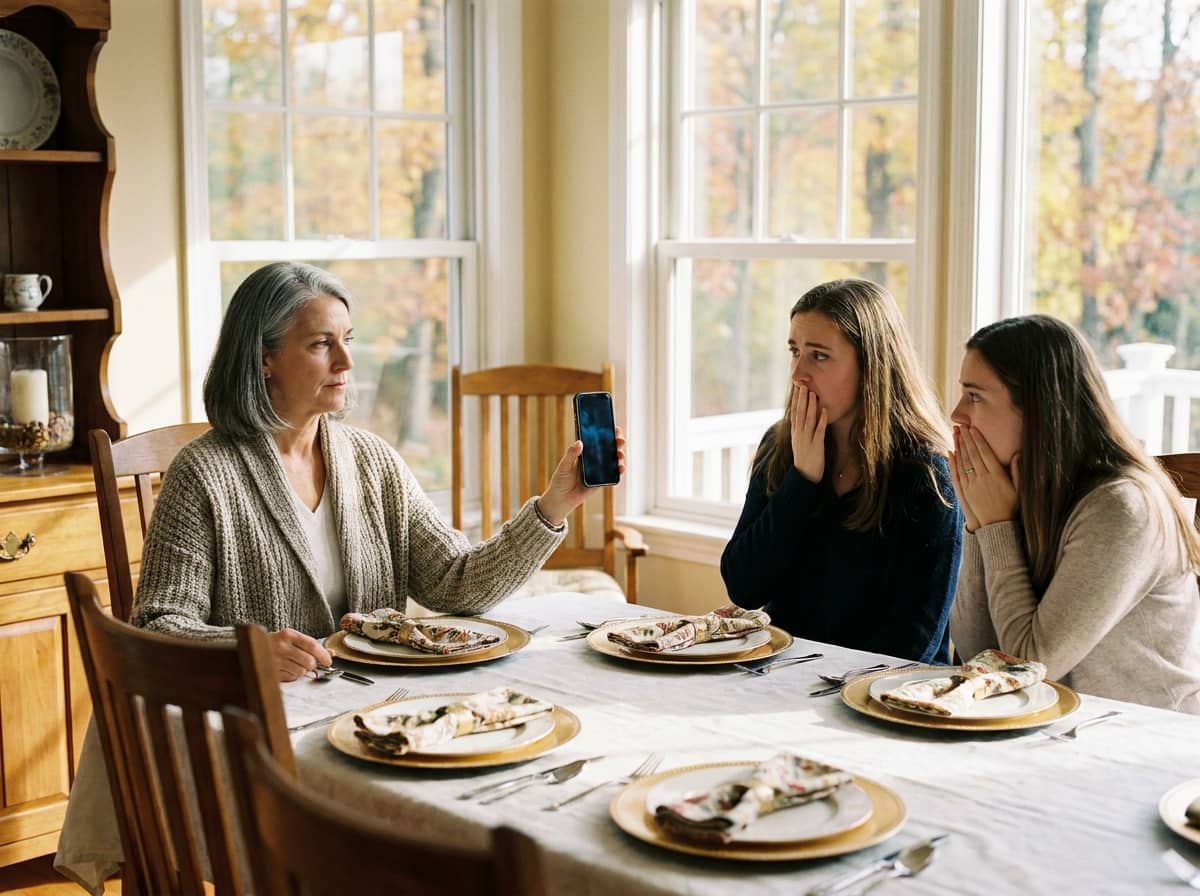
And that was when I reached into my cardigan pocket and pulled out my phone.
The color left my father’s face before I even unlocked the screen.
Part 2: What the Pharmacist’s Message Actually Said
I want to be clear about something before I go further.
I am not a dramatic person. I am a 54-year-old occupational therapist from Hartford. I drive a seven-year-old Subaru Outback. I meal prep on Sundays, or I used to, before Sundays became this. I do not make scenes. I do not raise my voice at dinner tables.
But I had been quietly doing something for eleven months that nobody at that table knew about.
I had been keeping records.
It started small. A screenshot here. A forwarded email there. A note in the Notes app on my phone with dates and dollar amounts. My colleague Renata, who has worked in patient advocacy for twenty years and has the energy of a woman who has seen everything twice, told me once: “If something feels wrong and you can’t prove it yet, start a paper trail. Facts don’t have feelings, but they do have power.”
I had taken that seriously.
The pharmacist’s message was real. I pulled it up and read it aloud at the table.
It said that my metoprolol refill had been flagged as time-sensitive by my cardiologist’s office. It said that a patient representative had called the number on file, which was Calla’s number because she had offered to “manage my pharmacy account” eight months ago and I had been foolish enough to say yes. It said the representative had spoken to someone at that number who confirmed the prescription would be picked up Friday.
That someone was Calla.
She had confirmed it.
Then she spent my $47 on her phone bill and my $112 on two new tires for her Kia and told nobody.
Maris said, “That’s just a phone message. That doesn’t mean anything.”
I looked at her steadily.
“I know,” I said. “That’s why I also have the bank statement.”
I watched Calla’s lavender nails go still on the tablecloth.
The bank statement showed two transactions on Friday afternoon. One at Verizon for $47.13. One at Discount Tire on New Britain Avenue for $112.50. Both on my debit card. Both while she had my car and was supposed to be at the CVS on Route 2.
There was no CVS transaction.
Not Friday. Not Saturday. Not at all.
My father said, “Now, let’s not make this bigger than it is.”
I said, “I agree. Let’s not.”
But what I did not say yet was that the prescription money was not the biggest thing on that table.
Not even close.
Part 3: The Sunday Dinner Betrayal That Had Been Going On for Years
Here is what I had figured out over eleven months of quiet record-keeping.
The $159 was not an isolated incident. It was the most recent entry in a pattern that went back to at least January of the previous year, possibly longer. I had documented fourteen separate transactions where money I had given to my father for shared household expenses, or to Calla for errands she had volunteered to run, had not gone where it was supposed to go.
Fourteen.
The smallest was $23 for a Costco run that never happened. The largest was $800.
That one deserves its own paragraph.
Eight hundred dollars.
My father had called me in March and said the furnace at the house needed an emergency repair. He was on a fixed retirement income. He was embarrassed to ask but he needed help. I had transferred $800 from my savings account within the hour because that is what you do when your father calls and says he is cold and embarrassed.
The furnace repair receipt I later found, after I started paying attention, was dated November of the year before. The furnace had already been fixed. With money from the home warranty.
The $800 had gone to a joint checking account that Maris and Calla shared.
I found this out because my father, who is 71 and not always careful with his browser tabs, had left his online banking open on the laptop he lets me use when I visit. I had not gone looking. I had gone to check my own email. But I saw it. And I did what Renata had taught me to do.
I took a screenshot.
Then I took another one.
Then I sat in the guest bathroom for six minutes and breathed through my nose until my hands stopped shaking. Then I went back to the living room and watched football with my father and said nothing, because I was not ready yet.
I spent the next eight months getting ready.
I called my attorney, a woman named Diane Cho at a small firm in West Hartford who specializes in elder financial matters and does not waste words. I told her what I had. She told me what I needed. I got the rest.
By the time I sat down at that Sunday dinner table, I had a folder on my laptop at home with 47 pages of documentation.
I had not come to that dinner to make a scene.
I had come because Diane told me I needed one more thing: a clear, witnessed moment where they confirmed the pattern in front of me, on a day I could document.
My father had just handed it to me.
“The furnace money,” I said quietly. “Do you want to talk about that too?”
The leaf blower outside finally stopped.
The silence that followed was the loudest thing I had ever heard at that table.
Part 4: What Happens When You Let the System Do the Work
I want to stop here and say something about anger.
I was angry. I am not going to pretend I was some serene, untouchable woman who floated above her feelings. I had driven home from that dinner with both hands tight on the steering wheel and called Renata from the parking lot of a Dunkin’ on I-84 and talked for 45 minutes while she said “mm-hmm” and “I know” and “you did the right thing” until I could breathe normally again.
But I had made a decision eleven months earlier that I was not going to be the one who lost control. Because the moment I lost control, I became the story. I became the hysterical daughter, the difficult one, the one who always made things hard. I had been that character in this family’s version of events my entire adult life.
I was done being their character.
Three weeks after that Sunday dinner, Diane filed a civil complaint for financial exploitation of a family member and fraudulent misrepresentation. Connecticut has specific elder financial abuse statutes, and while I was the one who had been directly defrauded, several of the transactions involved accounts tied to my father’s assets, which opened additional avenues.
The complaint named Maris and Calla.
Not my father.
That was my choice. Diane had asked me twice if I was sure. I was sure. My father was 71 and had been managed by Maris for so long I was not certain he fully understood what had been done in his name. That was a conversation for later, and a different kind of help. What I wanted was for the two people who had run this scheme to face consequences through a process that did not depend on my father believing me.
It did not depend on anyone believing me.
It depended on 47 pages of documentation.
The Hartford Courant does not typically cover civil financial disputes between family members. But Glastonbury is a small suburb, and Maris had spent years building a reputation as a community volunteer, a church committee member, a woman who organized the canned food drive at their parish every November. When the complaint became public record, word traveled the way it always does in small Connecticut towns: quietly, thoroughly, and faster than anyone expected.
Maris called me four days after the filing.
I let it go to voicemail.
She called from the church committee the following week to say she was “stepping back from her role to focus on family matters.” I found this out from my father’s neighbor, a retired postal worker named Gerald who had known my mother and still brought my father tomatoes from his garden every August.
Gerald said she did not look well.
I said I was sorry to hear that.
I meant it, actually. Not for her sake. For what it said about a person, that the thing finally undoing her was not guilt but exposure.
Calla’s situation was more straightforward. She had used my debit card without authorization on at least six documented occasions. The district attorney’s office, after reviewing what Diane forwarded, opened a separate inquiry. Calla hired an attorney. The attorney advised her to make restitution.
She paid back $1,847.
Every dollar.
It arrived as a cashier’s check in a plain envelope with no note inside.
I deposited it and did not feel the satisfaction I had expected. I felt tired. And then, after a few days, I felt something quieter and better than satisfaction.
I felt like myself again.
Part 5: What Was Left at the Table After Everything Cleared
It has been fourteen months since that Sunday dinner.
My father and I talk on the phone every Thursday evening. It took a long time to get there. There were months where he did not call and I did not push. There was a conversation in February, a hard one, where he sat in his kitchen and I sat in mine and he said he had not known the full extent of it and I said I believed him and I also said that not knowing was its own kind of choice and he was quiet for a long time and then he said, “You’re right.”
Two words.
They were enough.
Maris moved out of the Glastonbury house in the spring. I do not know where she went and I have not asked. My father is seeing a therapist through his primary care office, a man named Dr. Osei who apparently plays jazz piano on weekends, which my father mentions every single Thursday as if it is the most remarkable thing about a person. I think it helps him to have something uncomplicated to admire.
My blood pressure is managed. I pick up my own prescriptions now. I go to the CVS on Farmington Avenue on the first Tuesday of every month, and I hand the pharmacist my insurance card, and I pay my $12 copay, and I drive home.
It is the most ordinary errand in the world.
I love it.
Renata asked me once what I would tell someone who was sitting where I had been sitting, watching money disappear and not being able to prove it yet.
I thought about it for a minute.
“Start the folder,” I said. “Don’t confront until you have the folder. And don’t let anyone make you feel like needing proof makes you paranoid. Proof is just love with its eyes open.”
She wrote that down.
I think about the gold-rimmed plates sometimes. The ones my mother picked out. They are still in my father’s cabinet. He told me last month that he uses them now on regular Sundays, not just for company.
I think my mother would have liked that.
She always believed that the good things should not wait for a special occasion. That the people who love you should not have to earn the good plates. That ordinary Sundays, the ones with the leaf blowers and the gravy boats and the imperfect families trying to sit together, those are the ones worth setting the table for.
She was right.
She usually was.
The sunday dinner betrayal that started with a missing prescription taught me something I did not expect to learn: that the quietest people in a room are sometimes the ones who have already decided. They have already made the folder. They have already called the attorney. They are sitting at the table with the gold-rimmed plates, eating the roast chicken, waiting for the moment when the truth does not need their voice anymore.
It speaks for itself.
That is the only kind of justice worth waiting for.
For anyone who has ever been told they were “too sensitive” for noticing something was wrong: you were not too sensitive. You were paying attention. Keep paying attention. Write it down. Date it. Save it.
The facts will catch up.
They always do.
If you want to read more stories about navigating family, loyalty, and the quiet strength it takes to protect yourself, the American Bar Association’s resource on elder financial abuse at americanbar.org is a good place to start understanding your options. You are not alone, and you are not imagining it.
Names and identifying details have been changed. This is a dramatized story and personal reflection shared for entertainment and educational purposes only. Any resemblance to real people is coincidental.
Read Sunday Dinner Betrayal and other true-to-life family dramas. For perspective on situations like this, see family dynamics.
