I Came Home From Military Training to Find My Neighbor Built a Balcony OVER My Backyard—His Lawyer Thought I’d Back Down for $2,500. So I Made Sure He Tear It Down…
I found out my neighbor built a balcony over my backyard while I was gone for a week. And the craziest part wasn’t the balcony itself. It was how casually they acted about it—like building part of their house over someone else’s property was just normal neighborly behavior.
I remember standing there in my backyard that afternoon, staring up at it, thinking the same thing over and over: You have got to be kidding me.
To understand why this got under my skin the way it did, you need to know something about that backyard. I bought my house in 2018—a small two-story place just outside Columbus, Ohio. Nothing fancy. Beige vinyl siding, an older roof that probably needed replacing within five years, and squeaky deck boards that complained every time you stepped on them. The kind of house people drive past without noticing.
But the backyard? That was the whole reason I bought the place.
The lot runs deep—way deeper than most properties in the neighborhood. There’s this massive old maple tree right near the center, probably older than half the houses on the street. When the leaves come in during summer, it throws this huge blanket of shade across the entire yard. The first time I walked the property with my realtor, she said something like, “Most people see the house first.”
I remember looking past the house and saying, “Yeah, but look at this yard.”
Three sides fenced. No direct windows looking down into it. Quiet. Private. The kind of space where you could sit outside with a beer on a Friday night and actually hear crickets instead of traffic from Route 161.
I’d just gotten back from a long overseas rotation with the Ohio National Guard at the time, and all I really wanted was somewhere peaceful—somewhere that felt like mine. For a few years, that’s exactly what it was.
Then the house behind mine sold.
PART 2: MEET THE CARTERS
The old place back there used to belong to a retired couple—the Hendersons. Nice people. Quiet. They had a small ranch-style house and a vegetable garden that looked like something out of Better Homes & Gardens. When they moved to Florida to be closer to their grandkids, the property sat empty for a couple of months.
Then one morning in early spring, a big black Ford F-250 rolled up with a construction trailer hitched behind it. Not long after that, I met the new owners: Travis and Lindsay Carter.
They seemed friendly enough at first. Late thirties, maybe. Travis had that energetic real estate developer vibe—always talking fast like he was pitching something, always wearing a polo shirt with some company logo on it. Lindsay was quieter but very polished, always dressed like she had somewhere important to be, even if she was just checking the mail.
Travis introduced himself over the fence one Saturday afternoon while I was trimming some low branches off the maple tree. He leaned over the chain-link and said, “Hey man, just wanted to give you a heads-up. We’re probably going to tear this place down.”
I looked over at the Henderson house. “You mean remodel it?”
“Nope,” he said, grinning like he’d just told a great joke. “Full rebuild. We’re doing our forever home.”
He said it like those two words meant something sacred. Forever home.
I shrugged and told him good luck with it. Truth is, I didn’t love the idea of eight months of construction noise behind my yard, but it wasn’t my property. And around here, people rebuild houses all the time. Neighborhoods change. Things get updated. I figured it would be noisy for a while, then life would go back to normal.
That was my first mistake.
PART 3: CONSTRUCTION HELL
Two months later, the old Henderson house was gone. Completely gone—just a dirt lot and a temporary chain-link fence around it. Then the framing started.
Every morning around 7:00 AM sharp, you’d hear nail guns popping like someone setting off firecrackers. Trucks idling. Workers shouting measurements back and forth in Spanish and English. Dumpsters parked half in the street. Contractors using my mailbox post to lean ladders against. Little stuff like that.
Nothing illegal, exactly. Just the kind of things that slowly wear on you.
Still, I kept my mouth shut because construction doesn’t last forever. Eventually, the structure started to take shape—and that’s when I noticed something that bothered me a little.
The back of the new house had these enormous windows. Floor-to-ceiling glass panels facing directly toward my backyard.
I remember standing on my deck one evening with my neighbor Dave from across the street, watching the framing go up. Dave squinted at it and said, “That’s a lot of window pointed right at your place.”
I laughed it off. “Yeah, well, guess they like trees.”
But the truth was, I already had a feeling where this was headed. Privacy in the suburbs is this weird, fragile thing. Technically, everyone has their own property. But if someone builds the wrong window in the wrong place, suddenly your backyard doesn’t feel like yours anymore.
Still, windows are windows. You can close blinds. I wasn’t going to start a war over architecture.
By late summer, the house was almost finished. White siding, black trim—that modern farmhouse style you see all over HGTV now. Clean lines. Very deliberate. The backyard side of the house had this second-story living area with sliding glass doors that looked out over the property.
At the time, that’s all it was. Just doors. No balcony. No deck. Nothing sticking out.
Then in October, I had to leave town for a week. Guard training out at Fort Leonard Wood in Missouri. Nothing dramatic—just routine annual training. I locked up the house, asked Dave to keep an eye on things, watered the plants one last time, and figured when I came back, the construction would probably be done.
And in a way, it was.
Just not in the way I expected.
PART 4: THE SHADOW
When I pulled into my driveway that Sunday afternoon, rolled my suitcase through the side gate, and stepped into my backyard, the first thing I noticed wasn’t the house.
It was the shadow.
A long, rectangular shadow cutting across my lawn where the sunlight used to fall in the late afternoon. I looked up—and there it was.
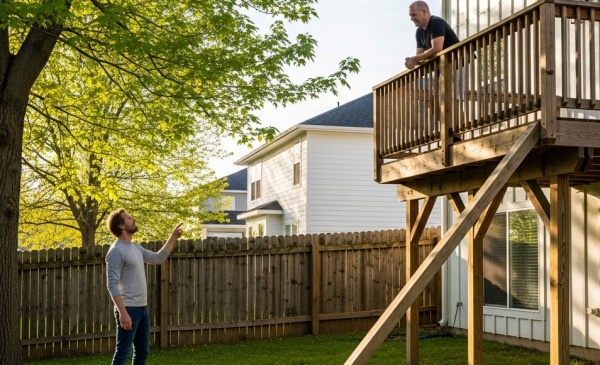
A brand-new second-story balcony hanging off the back of the Carter house.
And it wasn’t just close to the property line.
It was over it.
The structure extended at least three or four feet past their fence line, directly over my yard. The wooden deck boards hung in the air above my grass like some kind of architectural middle finger. There were railings. Potted plants. Even a couple of Adirondack chairs already set up.
I stood there for a solid minute, just staring.
Then I walked directly to the property line and looked up again, trying to make sense of what I was seeing. The balcony was cantilevered—supported by beams that extended from their house, but the actual deck surface jutted out into the airspace above my property.
I pulled out my phone and took about a dozen photos from different angles. Then I walked back inside, opened my laptop, and pulled up the property survey I’d gotten when I bought the house.
The line was clear. The fence was maybe six inches inside my property line, which was fine—fences don’t have to sit exactly on the line. But the balcony? That thing was a solid three to four feet over the line, hanging in the air above land I owned.
I sat there at my kitchen table, staring at the survey, feeling this slow burn of anger building in my chest.
They’d done this while I was gone. On purpose. They knew I wouldn’t be around to notice or object while it was being built. And now it was done, and they were probably hoping I’d just… let it go.
PART 5: THE CASUAL CONFRONTATION
The next morning, I walked over to the Carters’ house and knocked on the front door. Travis answered, coffee mug in hand, looking relaxed and friendly.
“Hey, man! You’re back! How was Missouri?”
“Fine,” I said. “Listen, I need to talk to you about the balcony.”
His smile didn’t falter. “Oh yeah! Looks great, right? Lindsay’s been wanting a deck off the living room since we started planning this place.”
“It’s over my property,” I said flatly.
He blinked. “What?”
“The balcony. It extends over my yard. Past the property line. By about three or four feet.”
Travis laughed—actually laughed—and waved his hand like I’d just told him his shoelace was untied. “Dude, it’s like a few feet. It’s not even touching the ground. You’ve still got your whole yard.”
I stared at him. “That’s not how property lines work.”
“Look,” he said, leaning against the doorframe, “we had it permitted. The city signed off on everything. If there was a problem, they would’ve said something.”
“Did the permit application show the balcony extending over the property line?”
He hesitated. “I don’t know, man. The contractor handled all that.”
“Right,” I said. “Well, I’m going to look into it. Because from where I’m standing, you built part of your house on my land without asking.”
Travis’s friendly demeanor started to crack. “It’s not on your land. It’s in the air. There’s a difference.”
“Not legally, there isn’t.”
He sighed, like I was being unreasonable. “Okay, look. Let’s not make this a thing. We’re neighbors. We’re going to be living next to each other for a long time. Let’s just… be cool about this.”
“I would’ve been cool if you’d asked first,” I said. “But you didn’t. You did it while I was out of town.”
“That wasn’t—” He stopped himself. “That was just timing. The contractor had availability.”
“Right.” I turned to leave. “I’ll be in touch.”
PART 6: LEGAL GROUNDWORK
That afternoon, I called the Columbus Building and Zoning Department. I explained the situation to a woman named Carol who sounded like she’d heard this exact story a hundred times before.
“Do you have a copy of your property survey?” she asked.
“Yes.”
“And you’re certain the structure extends over the line?”
“Positive.”
“Okay. First step is to file a formal complaint. We’ll send an inspector out to verify. If it’s over the line and wasn’t disclosed in the permit application, that’s a violation. They’ll have to either remove it or apply for a variance—which requires your consent as the affected property owner.”
“And if I don’t consent?”
“Then they remove it.”
I felt a grim satisfaction hearing that. “How do I file the complaint?”
She walked me through the process. I filled out the online form, attached photos and a copy of my survey, and submitted it that same day.
Three days later, a city inspector showed up. His name was Gene—older guy, clipboard, tape measure, the works. He spent about twenty minutes measuring, taking notes, and comparing everything to the Carters’ permit documents.
When he was done, he came over to where I was standing on my deck.
“It’s over,” he said simply. “By forty-two inches at the farthest point.”
“And the permit?”
“Permit shows the balcony ending at the property line. What they built doesn’t match what was approved.”
“So what happens now?”
Gene clicked his pen. “I’ll issue a notice of violation. They’ll have thirty days to either remove the non-compliant portion or apply for a variance. If they apply for a variance, you’ll be notified and you can object.”
“And if I object?”
“Then it probably gets denied, and they’ll have to remove it.”
“Good.”
Gene gave me a long look. “For what it’s worth, I see this kind of thing more than you’d think. People assume airspace doesn’t count. But it does.”
“Yeah,” I said. “I’m learning that.”
PART 7: THE ESCALATION
Two weeks later, I got a letter in the mail. Not from the city—from a law firm.
Daniels & Associates, Attorneys at Law.
I opened it standing in my kitchen, and the first line made my blood pressure spike:
“We represent Travis and Lindsay Carter regarding the property dispute at [address]. Our clients believe this matter can be resolved amicably without further legal action.”
The letter went on to claim that the balcony posed no harm to my property, that it didn’t interfere with my use of the land, and that forcing them to remove it would cause “undue financial hardship” since it had already been constructed in good faith.
Good faith. Right.
The letter ended with an offer: they’d pay me $2,500 to sign an easement agreement allowing the balcony to remain.
Twenty-five hundred dollars. For permanent rights to build over my land.
I called my own lawyer the next day—a guy named Phil Brennan who I’d used when I bought the house. Phil read the letter, chuckled, and said, “They’re trying to bully you into giving up your rights for cheap.”
“What do I do?”
“You respond through me. We make it clear you’re not interested in an easement at any price, and that you expect full compliance with the city’s order.”
“Will that work?”
“It’ll make them realize you’re serious. And if they want to fight this, they’ll have to do it the hard way.”
Phil drafted a response. Polite but firm. No easement. No negotiation. Remove the balcony or see you in court.
The Carters didn’t respond.
PART 8: THE HEARING
The variance hearing was scheduled for mid-December at the Columbus Zoning Board of Appeals. It was held in a bland conference room at City Hall, fluorescent lights buzzing overhead, folding chairs arranged in rows.
Travis and Lindsay showed up with their lawyer—a guy in an expensive suit who looked like he billed $400 an hour. I showed up with Phil, my survey, my photos, and a printed timeline of everything that had happened.
The hearing lasted about forty-five minutes. The Carters’ lawyer argued that the balcony was a “minor encroachment” that didn’t affect my use of the property, and that removing it would cost his clients over $30,000.
Phil countered by pointing out that the Carters had built the structure without my knowledge or consent, that they’d misrepresented the design on their permit application, and that property rights don’t disappear just because violating them is expensive.
The zoning board asked me directly: “Would you consider granting an easement in exchange for compensation?”
I looked at Travis. He was staring at the table.
“No,” I said. “They built it without asking. They can take it down.”
The board deliberated for maybe ten minutes. Then they denied the variance.
The balcony had to come down.
PART 9: THE TAKEDOWN
It took the Carters another month to hire a contractor and schedule the removal. I watched from my deck as a crew showed up with saws, harnesses, and a small crane. It took them two days to dismantle the whole thing.
When it was done, the back of their house looked unfinished—just the sliding glass doors leading to nowhere, a gap where the balcony used to be.
Travis never spoke to me again. Lindsay once glared at me from her driveway, but that was it.
Dave came over that evening with a six-pack. We sat on my deck, under the maple tree, and he raised his beer.
“To property lines,” he said.
“To property lines,” I echoed.
And for the first time in months, my backyard felt like mine again.
EPILOGUE: WHAT I LEARNED
People ask me sometimes if I feel bad about making them tear it down. The answer is no. Not even a little.
Because here’s the thing: they didn’t make a mistake. They made a choice. They chose to build over my land while I was gone, hoping I wouldn’t notice or wouldn’t care. They chose to act like my property rights didn’t matter.
And when I stood up for myself, they tried to intimidate me with lawyers and sob stories about money.
But property rights exist for a reason. And sometimes, enforcing them isn’t about being petty. It’s about refusing to let someone take what’s yours just because they think they can get away with it.
So yeah. He built his balcony over my backyard.
And I made damn sure he tore it down.
