Part 1: The Scene That Started Everything
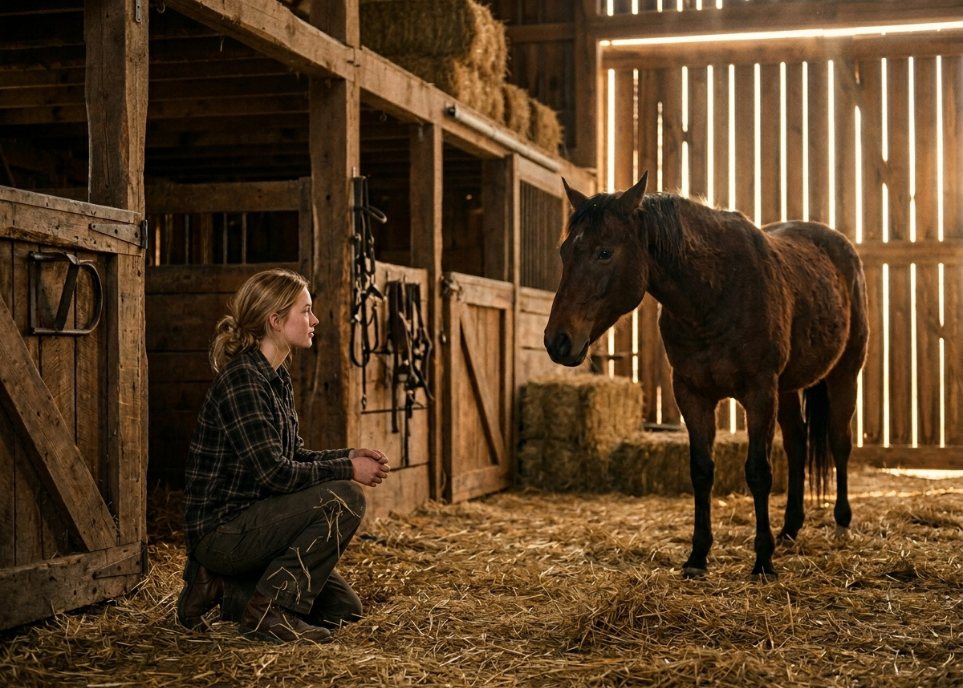
She didn’t cry. She just walked into the barn, knelt down beside the horse no one else could get near, and waited. That was Episode 1 of Heartland, and I have not stopped thinking about it since that Tuesday night in November when I found the show entirely by accident while scrolling through a streaming library at eleven o’clock, looking for something that would make me feel something without requiring me to think too hard about my own life. I did not find what I was looking for. I found something considerably more complicated and considerably better, and I was still watching at four in the morning when the sky outside my window started to go gray at the edges and I realized I had completely lost track of time.
I want to be precise about what Heartland is and what it is not, because I think the gap between those two things is part of why it has not crossed into the mainstream conversation the way it deserves to. On paper, it sounds modest: a Canadian family drama about a horse ranch in Alberta, running since 2007, now in its seventeenth season, beloved by a dedicated and slightly evangelical fanbase that has been recommending it to everyone they know for nearly two decades. That description is accurate and also nearly useless, because it does not capture what the show actually does or why a grown adult will find themselves weeping quietly at a scene involving a teenage girl and a traumatized horse at three-forty-five on a Wednesday morning. The paper description is the minimum. The actual experience of watching it is something else entirely.
What Heartland does, episode by episode and season by season, is the patient, accumulative work of building a world that feels real enough to live in and relationships that feel real enough to grieve. It is not a show about plot, although things happen. It is not a show about spectacle, although the landscape of Alberta — the mountains, the sky, the particular quality of light in that part of the world at certain times of year — is as visually stunning as anything I have seen in prestige television. It is a show about the interior lives of people who love each other imperfectly and show up for each other anyway, and it does that work with a consistency and a craftsmanship that I find myself thinking about long after individual episodes have ended.
Part 2: The World of Heartland Ranch
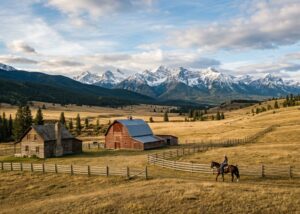
The show is set on a horse ranch called Heartland, outside a fictional Alberta town called Hudson, and the land itself is not background — it is a presence. The mountains in the distance are permanent in a way that the characters are not, and the show uses that contrast quietly and continuously: human relationships against the scale of wilderness, small domestic griefs against an enormous sky, the particular stubbornness of people who have chosen to stay in a hard place because the hard place is theirs. The ranch has been in the Fleming-Bartlett family for generations, and the weight of that history is visible in everything — in the way Jack Bartlett moves through the property, in the way Amy talks about her mother, in the way the buildings and the fences and the land itself carry the marks of people who came before and the expectation of people who will come after.
The Fleming-Bartlett family at the center of the show is a specific and recognizable kind of family — one held together by history and obligation and genuine love in proportions that are not always easy to separate. Jack Bartlett, the grandfather, is a former rodeo champion in his seventies who raised his granddaughters after their mother died and their father left, and who communicates affection almost exclusively through action rather than language. His wife Marion died before the series begins, but her presence is felt throughout — in the ranch she built, in the daughters she raised, in the specific shape of the grief that Jack carries without ever talking about it directly. The daughter he raised, Amy’s mother Marion, whose death before the pilot is the wound at the center of the whole show, is someone we only ever know through the way other people remember her, and somehow that is enough.
Amy Fleming is the show’s emotional core: a teenager in the first season who has inherited her mother’s ability to communicate with horses, particularly horses that have been broken by fear or abuse or trauma. Her method — which the show calls horse whispering, though Amy herself rarely uses that term — is not magic in the way that sounds. It is patience, and attention, and the willingness to sit with something that doesn’t trust you yet and wait for it to decide on its own terms that you are safe. The show takes this work seriously. It does not glamorize it or rush it. It shows the failures alongside the successes, the horses that don’t heal and the ones that surprise her, and in doing so it builds a portrait of what it actually looks like to be someone whose gift is also their discipline.
Part 3: Amy and Ty — The Love Story That Takes Its Time
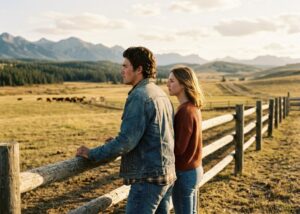
I want to talk about Ty Borden for a while, because I think the relationship between Amy and Ty is one of the finest slow-burn romances in the history of the format, and I do not say that lightly. Ty arrives in Season 1 as a young man with a complicated past, assigned to work at Heartland as a condition of his parole, and the show takes enormous care with him — it does not ask you to trust him immediately, and it does not ask Amy to trust him immediately either. The trust is built the same way Amy builds trust with the horses: slowly, through demonstrated reliability, through showing up when it would be easier not to, through the accumulation of small moments that eventually add up to something undeniable.
What the show understands about romantic love — and what a lot of television gets wrong — is that the anticipation is not just a prelude to the relationship. The anticipation is itself a form of intimacy, and the show honors it by not rushing past it toward resolution. Amy and Ty orbit each other for seasons in a way that is entirely believable because the writers understand that two people who are both carrying significant histories do not simply fall into each other’s arms when the feeling becomes obvious. They hesitate. They misread each other. They protect themselves in ways that look like indifference and are not indifference at all. And when they do finally move toward each other, the audience has earned the moment in a way that makes it land with a weight that a faster relationship never could have generated.
There is a scene — I will not tell you which season, because part of the experience of Heartland is arriving at these scenes without preparation — where Ty does something so quietly, so specifically right for Amy, that I had to pause the episode and sit with it for a moment before I could continue. It is not a grand gesture. It does not involve music swelling or a dramatic speech. It is a small thing, done without acknowledgment, and Amy sees it and understands something about him that she has been trying to understand for a long time. That is the show’s method, and it is devastatingly effective when executed correctly, and Heartland executes it correctly more often than almost anything else I have watched.
Part 4: Jack Bartlett and the Grammar of Unexpressed Love
I need to spend some time on Jack Bartlett, because he is the character I think about most often after I close my laptop and go to sleep. Jack is played by Shaun Johnston with a physical precision and an emotional restraint that together create one of the most complete portraits of a particular kind of man that I have encountered in any medium. He is a man of a certain generation, from a certain landscape, formed by a certain set of experiences, and he has learned over many decades to communicate what matters to him through everything except direct statement. He shows up. He fixes things. He is there in the morning and there in the evening. He does not say I love you the way other characters on other shows say I love you. He says it by staying.
What the show does with Jack across seventeen seasons is something that requires real patience and real craft: it shows him, very slowly, learning to do slightly better. Not perfectly. Not completely. He does not become a different person. But he learns, over years and episodes and genuine mistakes, to say a little more of what he actually means, to let himself be seen in ways that cost him something, to understand that the people who love him need to hear it occasionally, not just feel it through his constant presence. The scenes where he almost says something and then doesn’t, and the person he almost said it to knows anyway — those scenes are the heart of the show for me, the place where Heartland does something that I think is genuinely difficult and genuinely rare.
I watched my father watch Jack Bartlett in one episode I showed him, and I watched my father go very quiet and stay quiet for a while after it ended. He didn’t say anything about it. I didn’t ask. That is its own kind of communication, and Heartland would understand exactly what it meant.
Part 5: What the Horses Are Actually About
The horses in Heartland are not metaphors in the way that sounds — the show does not clumsily announce what it is doing. But it is doing something, and it is worth naming: every horse Amy works with is carrying something. Fear from abuse. Trauma from an accident. Distrust from a history of being mishandled. And Amy’s method of reaching them — her patience, her refusal to force, her willingness to be present without demanding anything in return until the animal decides on its own to come toward her — is also the method the show applies to its human relationships, and to the audience, and to grief itself.
The show understands that healing is not linear and is not guaranteed. Some horses don’t make it. Some wounds don’t close. The show is honest about this in a way that makes the successes feel real rather than inevitable, and that honesty extends to the human stories as well. Characters make mistakes that have lasting consequences. Relationships that seem solid reveal cracks. Grief that seems resolved surfaces again when a particular song plays or a particular season arrives on the ranch. Heartland is not a show that promises resolution. It is a show that promises company — that you will not be alone in the feeling, even if the feeling doesn’t have a clean ending.
This is the quality that I think explains the show’s longevity and the particular intensity of its fanbase. People who watch Heartland do not watch it for the plot twists. They watch it because the show has built a world that feels safe in the specific way that honest things feel safe — not comfortable exactly, but trustworthy. You know the show will not betray you with cheap sentiment or unearned resolution. You know that when something matters, it will be treated with the weight it deserves. That kind of trust, in a viewer, is very hard to earn and very hard to lose once it’s established.
Part 6: The Landscape as Character
Alberta is doing significant work in Heartland, and I want to acknowledge it directly rather than leave it as implied context. The show is filmed on location in and around High River, Alberta, and the landscape — the foothills of the Rockies, the wide sky, the particular gold of the grass in autumn, the deep blue of winter mornings — is not incidental. It shapes the emotional register of every scene it appears in. Human dramas feel different when they happen against that scale. A conversation between two people in a barn becomes something else when outside the barn windows you can see mountains that have been there for millions of years and will be there for millions more. The scale puts the human moment in perspective without diminishing it. If anything, it makes it more precious: this brief, fragile, particular thing happening between these two people, right now, in this specific place and time that will not return.
The show understands something about place that a lot of television ignores: where you are shapes who you are. Jack Bartlett is not separable from the land he works. Amy’s relationship to the horses is not separable from the landscape they live in. The ranch is not just a setting — it is the reason the characters are the people they are, and the reason they stay is the reason everything else in the show is possible. When characters leave Heartland — and some do, for seasons at a time — they carry the ranch with them in ways the show makes visible, and when they return, the return has a weight that only makes sense if you understand that Heartland is not just a place but a gravitational center, the thing everything orbits and everything eventually comes back to.
Part 7: Why You Have Not Heard Enough About This Show
Heartland has been running since 2007. It has over two hundred and fifty episodes. It has a fanbase that has been recommending it, passionately and continuously, for nearly two decades. And yet it exists in a strange blind spot in the mainstream conversation about television, less discussed than shows with a fraction of its longevity and a fraction of its emotional intelligence. I have thought about why this is, and I think the answer is partly structural — it is a Canadian production, airing on CBC, without the marketing infrastructure of a major American network or streaming platform — and partly tonal. Heartland is quiet. It does not announce its quality. It does not give you an obvious hook in the first episode, a cliffhanger that demands you continue, a twist that forces the algorithm to work on its behalf. It gives you a girl in a barn and a horse that doesn’t trust her yet, and it asks you to be patient, and patience is not something the current media environment rewards or encourages.
This is also, I think, precisely why the people who do find it become so committed to it. The patience it asks of you in the first few episodes is the same patience it is teaching you to have — for people who are not yet ready to be reached, for relationships that need more time than you expected, for grief that doesn’t resolve on a schedule. The show practices what it preaches, and the viewers who stay long enough to understand that become, almost without exception, the kind of people who tell everyone they know to watch it. I am now one of those people. I have no apologies about this.
Part 8: Three Episodes Is All I Am Asking
Watch the first three episodes. That is all I am asking. Not because the show is slow to start — it isn’t, exactly — but because three episodes is the minimum unit of time the show needs to show you what it is doing and why it is worth your continued attention. By the end of Episode 3, you will have a sense of Amy and Ty’s dynamic, of Jack’s specific grammar of love, of the ranch as a world with its own internal logic and its own weight. You will have seen Amy work with at least one horse in a way that made you understand something about her that the show did not explain in dialogue. You will have had at least one moment where you paused and thought, this is not what I expected.
If three episodes in you are not at least curious about what happens next, Heartland is genuinely not the show for you, and that is fine — not everything is for everyone, and the show’s particular frequency is not a universal one. But if three episodes in you find yourself wanting to know what Amy and Ty are going to figure out, and what Jack is going to eventually say out loud, and whether the next horse is going to make it — then you should know that there are seventeen seasons waiting for you, and that the people who have watched all of them will tell you, without exception, that it was worth every hour.
I started at eleven on a Tuesday night. It was four in the morning when I finally closed my laptop. The sky was going gray. I had not solved anything about my own life, which was what I had vaguely hoped television might help me do when I started scrolling. But I had spent five hours in a world that felt honest and careful and real, and I had watched a girl in a barn kneel beside a horse that didn’t trust her and wait — simply wait, with full attention and no agenda — until the horse decided she was safe. That is the scene I keep returning to. Not because it resolved anything. Because it showed me something about what patience actually looks like when someone who has it is doing the work.
This article is an independent editorial review written by a fan and content creator. It reflects the author’s personal opinions and viewing experience only. Heartland is a trademark and production of Seven24 Films and Dynamo Films, produced in association with CBC. All rights to the Heartland television series, its characters, storylines, and associated intellectual property belong to their respective owners. This article is not affiliated with, sponsored by, or endorsed by CBC, Seven24 Films, Dynamo Films, or any entity connected to the official Heartland production.
All image generation prompts included in this content are original creative descriptions intended for use with AI image generation tools. They do not reproduce, replicate, or claim to represent actual footage, stills, or promotional materials from the Heartland television series. Any visual similarity to characters or scenes from the show is entirely coincidental and is a result of descriptive language used in a general creative context. The author makes no claim of ownership over any intellectual property associated with the Heartland series.
This content contains no spoilers beyond what is reasonably considered general knowledge about the series. Streaming availability information is provided for reference only and may vary by region and platform — please verify current availability on your local streaming service
